In contrast to potatoes and maize, which have been cultivated for centuries in Europe, European experience with the cultivation of the Andean crops, maca, Lepidium meyenii Walp., and yacon, Smal-lanthus sonchifolius (Poepp. & Endl.) H. Robins., is very brief. The popularity of maca and yacon is increasing due to reports of their antidiabetic, nu-tritive, immunostimulative and fertility-enhancing features. Maca and yacon cultivation in the Czech Republic was first attempted in the 1990s (F���� et al. 1995). Basic information on morphological and enzymatic variability is limited (Q����� & C������� 1997). Our study addresses this topic, as part of a comprehensive research project on maca and yacon (U�������� et al. 2000; V�������� et al. 2001).
MATERIAL AND METHODS
Plant material. The set of material studied in-cluded 15 maca, Lepidium meyenii Walp., accessions
from Peru and 25 yacon, Smallanthus sonchifolius (Poepp. & Endl.) H. Robins., accessions imported from New Zealand (the primary centre of origin having been Ecuador) (Table 1). These collections are maintained as genetic resources for new crop development in the Potato Research Institute Havlíčkův Brod, Ltd., Czech Republic.
Plants were cultivated and evaluated under field conditions in the Haná region at Olomouc-Holice (altitude 210 m, mean day temperature 16.3°C, pre-cipitation during cultivation period 271.4 mm) from May to October 2001. Maca was cultivated with a black, unwoven textile mulch, with 10 plants per accession and a spacing of 45 × 45 cm (this cultivation method was not optimal). Some maca accessions were also cultivated in a greenhouse (daytime temperature 18–30°C, nighttime 12–16°C) (this type of cultivation was more suitable). Yacon was planted in furrows with 5 plants per acces-sion, at a spacing of 70 × 70 cm. Conventional ag-ronomic technologies were used for cultivation.
Morphological Variability and Isozyme Polymorphisms
in Maca and Yacon
A��� LEBEDA1, I���� DOLEŽALOVÁ1, M���� DZIECHCIARKOVÁ1, K���� DOLEŽAL1 and J�� FRČEK2
1Deparment of Botany, Faculty of Science, Palacký University, Olomouc-Holice, Czech Republic;
2Potato Research Institute, Havlíčkův Brod, Czech Republic
Abstract: A set of 15 accessions of maca, Lepidium meyenii Walp., and 25 accessions of yacon, Smallanthus sonchifo-lius (Poepp. & Endl.) H. Robins., cultivated under Czech field conditions was studied to determine relationships between morphological variability and isozyme polymorphisms. Morphological characterisation of maca included evaluation of length, weight, shape, skin and flesh colour of hypocotyls. In yacon, we evaluated shape, colour, skin texture and flesh colour of tubers, as well as the number of roots. Preliminary results showed that maca forms low-weight hypocotyls (up to only 17.4 g) under Czech field conditions. For yacon, tuber production ranged between 1.4 kg and 3.8 kg. Of the 17 analysed enzymatic systems, only esterase (EST) showed some degree of polymorphism in both crops. It was possible to divide accessions of L. meyenii into two groups and S. sonchifolius into six groups on the basis of isozyme polymorphisms. However, EST polymorphisms do not correspond very well to the morphological characteristics of the underground organs of the crops studied.
Keywords: Andean crops; Lepidium meyenii; Smallanthus sonchifolius; functional food; morphological characters; tuber; hypocotyl; protein markers; enzyme
Plants were treated against insects with Karate and Talstar (maca) and Decis (yacon).
Morphological assessment. The aboveground parts of the plants were observed (inevery fortnight) during the vegetative period (L����� et al. 2002). The weight and general shape of maca hypocotyls were assessed following the methods of E�������� (1999) at harvest. The shape of the hypocotyl base and apex was evaluated following to descriptors for Brassica and Raphanus (IBPGR 1990). For hypocotyls, we characterised weight, colour, maculae (spots), length, shape in frontal view and flesh colour. For the underground portion of yacon, tubers and caudices were weighted. Tuber shape was characterised fol-lowing morphological descriptors for yacon (F���� 2001– person. commun.); subsequently, we evalu-ated tuber skin characters, flesh colour and shape in transverse section.
Isozyme analysis. Young true leaves from each plant were harvested and bulked for each acces-sion. Samples were homogenised by grinding one volume of leaf material (1 g) in three volumes of extraction buffer (0.1M Tris-HCl, pH 8.0; 78mM 2-mercaptoethanol; 26mM sodium metabisulfite; 11mM sodium salt ascorbic acid, 4% PVP-40 (poly-vinylpyrrolidone)) (V������� 1983) with a little sea sand and sucrose. Crude extract was centrifuged at 14 000 rpm for 10 min (–4°C). Supernatant was divided into aliquots (60 µl per tube) and stored at –80°C. Samples were thawed and loaded on polyacrylamide gel (8.16% separation gel 13.5 × 10 cm, 4% concentration gel). Electrophoresis was run at 35 mA, 390 V for 2 h, on Adjustable Height Dual Gel Electrophoresis Units (Sigma) with an ESP 601 power supply (Amersham Pharmacia Biotech). Polyacrylamide gel electrophoresis was performed for 17 enzyme staining systems: alcohol dehydrogenase (ADH), acid phosphatase (ACP), diaphorase (DIA), esterase (EST), glutamate-oxaloa-cetate transaminase (GOT), phosphoglucomutase (PGM), glutamate dehydrogenase (GDH),
glucose-6-phosphate isomerase (GPI), glucose-glucose-6-phosphate dehydrogenase (GPD), isocitrate dehydrogenase (IDH), leucine aminopeptidase (LAP), malate de-hydrogenase (MDH), malic enzyme (ME), NADH dehydrogenase (NADH DH), superoxide dismutase (SOD), shikimate dehydrogenase (SHDH) and 6-phosphogluconate dehydrogenase (PGD), following the methods of V������� (1983).
RESULTS AND DISCUSSION
Morphological assessment
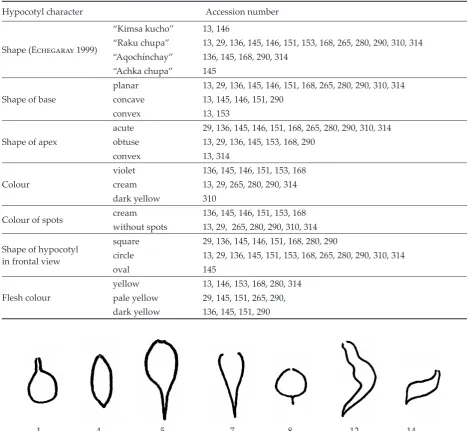
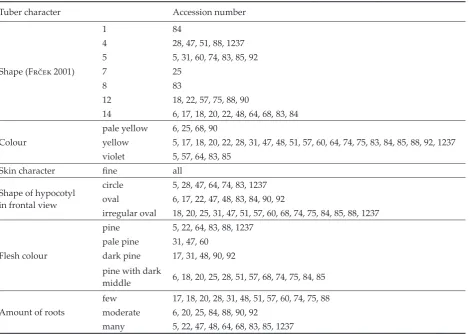
Results of the morphological assessment of the underground parts of maca are summarised in Table 2. The results for yacon are presented in Ta-ble 3. Mean weight of maca hypocotyls and green material in 2001 is shown in Figure 3; the mean weight of yacon tubers and caudices is presented in Figure 4.
The most common shape of maca hypocotyls (see Figure 1), called “Raku chupa”, was recorded for accessions 13, 29, 136, 145, 146, 151, 153, 168, 265, 280, 290, 310 and 314. Shape “Aqochínchay“ was observed for accessions 136, 145, 168, 290 and 314, while shape “Kimsa kucho” was observed for accessions 13 and 146, and shape “Achka chupa” for accession 145. Most plants displayed a flat hy-pocotyl base, except for accessions 13, 145, 146, 151 and 290, which had a concave base, and accessions 13 and 153, which had a convex base. An acute apex was most common, having been observed in 11 accessions (29, 136, 145, 146, 151, 168, 265, 280, 290, 310 and 314). Accessions 13, 29, 136, 145, 153, 168, 290 had an obtuse apex, while a convex apex shape was noted for accessions 13 and 314. Violet and cream-coloured hypocotyls were represented equally, with the exception of genotype 310, which had dark yellow hypocotyls. Cream-coloured spots were confined to violet coloured hypocotyls. No spots were recorded in cream or dark yellow
hy-Table 1. Survey of maca and yacon accessions used in the study of morphological and enzymatic variability
Accession number
Maca
Lepidium meyenii Walp. 13, 29, 136, 144, 145, 146, 151, 153, 168, 265, 280, 290, 310, 314, Unalm amarylla
Yacon
[image:2.595.63.534.105.193.2]pocotyls. The shape of hypocotyl in frontal view was assessed as a circle (accessions 13, 29, 136, 145, 151, 153, 168, 265, 280, 290, 310 and 314), square (29, 136, 145, 146, 151, 168, 280 and 290) or oval
(accession 145). Yellow, pale yellow and dark yel-low hypocotyl-flesh colors were present more or less equally (Table 2).
The greatest hypocotyl weight was recorded for accessions 145 (17.02 g) and 168 (17.4 g); the greatest plant mass was measured in accessions 13 (15.5 g) and 145 (15.1 g). The lowest hypocotyl weight was found in accessions 29 and 265 (9.8 or 5.7 g, respectively). Accessions 146 and 314 (both 1.3 g) (Figure 3) had the lowest plant mass.
Seven basic shapes of tubers were recorded in yacon accessions (Figure 2). The most common were shapes 14 (accessions 6, 17, 18, 20, 22, 48, 64, 68, 83 and 84), 12 (18, 22, 57, 75, 88 and 90), 5 (5, 31, 60, Raku chupa Aqochínchay Achka chupa Kimsa kucho
Figure 1. Basic hypocotyl shapes recorded in maca (E�������� 1999)
1 4 5 7
[image:3.595.62.531.297.728.2]Figure 2. Basic tuber shapes recorded in yacon (F���� 2001, person. commun.) Table 2. Hypocotyl variation in maca accessions
Hypocotyl character Accession number
Shape (E�������� 1999)
“Kimsa kucho” 13, 146
“Raku chupa” 13, 29, 136, 145, 146, 151, 153, 168, 265, 280, 290, 310, 314 “Aqochínchay” 136, 145, 168, 290, 314
“Achka chupa” 145
Shape of base
planar 13, 29, 136, 145, 146, 151, 168, 265, 280, 290, 310, 314 concave 13, 145, 146, 151, 290
convex 13, 153
Shape of apex
acute 29, 136, 145, 146, 151, 168, 265, 280, 290, 310, 314 obtuse 13, 29, 136, 145, 153, 168, 290
convex 13, 314
Colour
violet 136, 145, 146, 151, 153, 168 cream 13, 29, 265, 280, 290, 314 dark yellow 310
Colour of spots cream 136, 145, 146, 151, 153, 168 without spots 13, 29, 265, 280, 290, 310, 314
Shape of hypocotyl in frontal view
square 29, 136, 145, 146, 151, 168, 280, 290
circle 13, 29, 136, 145, 151, 153, 168, 265, 280, 290, 310, 314
oval 145
Flesh colour
yellow 13, 146, 153, 168, 280, 314 pale yellow 29, 145, 151, 265, 290, dark yellow 136, 145, 151, 290
1 4 5 7 8 12 14
74, 83, 85 and 92) and 4 (28, 47, 51, 88 and 1237). Shape 1 was observed in accession 84, shape 7 in accession 25 and shape 8 in accession 83 (Table 3). The tubers were yellow (accessions 5, 17, 18, 20, 22, 28, 31, 47, 48, 51, 57, 60, 64, 74, 75, 83, 84, 85, 88, 92 and 1237), violet (5, 57, 64, 83 and 85) and pale yellow (6, 25, 68 and 90) in colour. A fine skin texture was characteristic for all accessions studied. The shape in transverse section was evaluated as
an irregular oval (accessions 18, 20, 25, 31, 47, 51, 57, 60, 68, 74, 75, 84, 85, 88 and 1237), oval (6, 17, 22, 47, 48, 83, 84, 90 and 92) or circle (5, 28, 47, 64, 74, 83 and 1237). The colour of flesh was assessed as a pine colour with dark middle (accessions 6, 18, 20, 25, 28, 51, 57, 68, 74, 75, 84 and 85), pine colour (5, 22, 64, 83, 88 and 1237), dark pine colour (17, 31, 48, 90 and 92) and pale pine colour (31, 47 and 60). Accessions 17, 18, 20, 28, 31, 48, 51, 57, �
� � �� �� ��
�� �� ��� ��� ��� ��� ��� ��� ��� ��� ��� ��� ���
���������
�������
���
[image:4.595.58.528.85.242.2]��������� �������������� Figure 3. Mean weight of hypocotyl and green material recorded in maca accessions
Table 3. Tuber variation in yacon accessions
Tuber character Accession number
Shape (F���� 2001)
1 84
4 28, 47, 51, 88, 1237 5 5, 31, 60, 74, 83, 85, 92
7 25
8 83
12 18, 22, 57, 75, 88, 90
14 6, 17, 18, 20, 22, 48, 64, 68, 83, 84
Colour
pale yellow 6, 25, 68, 90
yellow 5, 17, 18, 20, 22, 28, 31, 47, 48, 51, 57, 60, 64, 74, 75, 83, 84, 85, 88, 92, 1237 violet 5, 57, 64, 83, 85
Skin character fine all
Shape of hypocotyl in frontal view
circle 5, 28, 47, 64, 74, 83, 1237 oval 6, 17, 22, 47, 48, 83, 84, 90, 92
irregular oval 18, 20, 25, 31, 47, 51, 57, 60, 68, 74, 75, 84, 85, 88, 1237
Flesh colour
pine 5, 22, 64, 83, 88, 1237 pale pine 31, 47, 60
dark pine 17, 31, 48, 90, 92 pine with dark
middle 6, 18, 20, 25, 28, 51, 57, 68, 74, 75, 84, 85
Amount of roots
few 17, 18, 20, 28, 31, 48, 51, 57, 60, 74, 75, 88 moderate 6, 20, 25, 84, 88, 90, 92
[image:4.595.65.535.424.758.2]60, 74, 75 and 88 were produced a small number ofroots, while accessions 5, 22, 47, 48, 64, 68, 83, 85 and 1237 possessed many. A moderate number of roots were observed in accessions 6, 20, 25, 84, 88, 90 and 92 (Table 3).
With respect to yacon tuber production, the most productive were accessions 25, 51, 75 and 85 (3.8 kg), while the lowest yield was recorded for accession 1237 (1.4 kg). The greatest caudex weight (1.2 or 1.3 kg, respectively) was from accessions 64 and 83, while accessions 22 and 47 were lightest (0.55 or 0.6 kg, respectively) (Figure 4).
It is evident from these data that substantial morphological variability among accessions of both crops exists. Because these are preliminary results collected from the first year of the experi-ment, it is not yet possible to make final conclusions concerning the homogeneity, stability or influence of environmental factors on these traits.
Isozyme variability
Fifteen L. meyenii accessions were tested with 17 enzyme staining systems (ADH, DIA, EST, PGM, GOT, GDH, GPI, GPD, IDH, ACP, LAP, MDH, ME, NADH DH, SOD, SHDH, PGD). Systems ADH, MDH, PGM, GPI, PGD were excluded. From the remaining 12 systems, only esterase (EST) showed polymorphism (Figure 5), and that only to a very low degree. Among all staining systems, we observed 64 bands (isoforms) in the set of ac-cessions.
[image:5.595.61.533.87.297.2]In spite of a relatively large variability in mor-phological characters of hypocotyls and yield parameters (Table 2, Figure 3) in L. meyenii geno-types, there is no clear relationship between them and isozyme polymorphisms. It was possible to divide maca accessions into two groups on the basis of EST polymorphisms (Figure 5), with one pattern found in all accessions except 145. This accession does not exhibit certain morphological differences (see Table 2). These results differ from those of L����� et al. (2002), who divided the same set of maca genotypes into three groups (A, B, C)
Figure 4. Mean weight of tubers and caudices recorded in yacon ���
��� ��� ��� ��� ��� ��� ��� ���
� � �� �� �� �� �� �� �� �� �� �� �� �� �� �� �� �� �� �� �� �� �� �� ����
���������
�
����
������
����������� ��������
EST
Rf
A (13, 29, 136, 144, 145, 146, 151, 153, 168, 265, 280, 290, 310, 314, Unalm)
B (145)
[image:5.595.70.276.502.683.2]based on EST banding patterns. Accessions 145, 146, 151, 280 and 310 formed group B, while only Unalm amarilla comprised group C. These dif-ferences likely resulted from the use of different experimental protocols and plants, a phenomenon widely recognised (S����� & S����� 1989; M��-������ 1994).
[image:6.595.63.249.83.250.2] [image:6.595.65.521.305.508.2]Twenty-five accessions of S. sonchifolius were screened with 16 enzyme staining systems (ADH, DIA, EST, PGM, GOT, GDH, GPI, IDH, ACP, LAP, MDH, ME, NADH DH, SOD, SHDH, PGD). Only acid phosphatase (ACP) and esterase (EST) showed a relatively high degree of polymorphism (Figure 6). The remaining 14 systems were
mono-morphic. Among all staining systems, we observed 55 bands (isoforms).
The set of S. sonchifolius genotypes can be divided into several groups (Table 3, Figure 2) based on tu-ber characteristics (F���� 2001 – person. commun). However, this variation does not correspond unam-biguously to EST polymorphisms, which showed six distinct groups (Figure 6b). The largest group – A – represents about 70% of all accessions studied. The majority of tuber morphotypes (five altogether) detected is included in this group (Table 3). The remaining isoforms are represented by 1–3 acces-sions (Figure 6b). The very slight differences in zymograms of individual groups can give only
Figure 6a. Zymograms of acid phosphatase (ACP) isozyme spectra in yacon (Smallanthus sonchifolius)
accessions
A (17, 18, 28, 31, 47, 48, 51, 57, 60, 64, 68, 74, 75, 83, 85, 88, 92) C (1237) E (6)
B (5, 84) D (25, 20, 90) F (22)
Figure 6b. Zymograms of esterase (EST) isozyme spectra in yacon (Smallanthus sonchifolius) accessions
A (17, 18, 22, 28, 31, 47, 48, 51, 57, 60, 64, 68, 74, 75, 83, 84, 85, 88, 92, 1237) B (5, 6, 20, 25, 90)
ACP
Rf
EST
Agriculture, Nitra, Slovak Republic.
IBPGR (1990): Descriptors for Brassica and Raphanus. International Board for Plant Genetic Resources, Rome, Italy.
L����� A., D��������� I., D������ K. (2002): Varia-tion in morphological and biochemical characters in genotypes of maca and yacon. In: Int. Hortic. Congr., August 10–18, 2002, Toronto (Canada), Ab-stract S06-P-94, p. 199.
L����� A., D��������� I., V�������� K., D���������-���� M., GD���������-������� M., OD���������-������ H., UD���������-����D���������-���� J. (2003): Biological and chemical variability of maca and yacon. Chem. Listy (submi�ed for press). M�������� G.P. (1994): Handbook of Detection of
Enzymes on Electrophoretic Gels. CRC Press, Lon-don, Tokyo.
Q����� C.F., C������� R.A. (1997): Maca (Lepidium
meyenii Walp.). In: H������ M., H����� J. (eds):
Andean Roots and Tubers: Ahipa, Arracacha, Maca, Yacon. Promoting the conservation and use of un-derutilized and neglected crops. CIP, Lima, Peru, IPGRI Rome, Italy, 174–197.
S����� D.E., S����� P.S. (1989): Isozymes in Plant Biol-ogy. Dioscorides Press, Portland, Oregon.
U�������� J., F���� J., L����� A. (2000): Potential ex-ploitation of traditional Andean crops, Smallanthus sonchifolius and Lepidium meyenii, in prevention of chronic diseases. Grant Agency of the CR, Prague, Project No. 303/01/0171.
V�������� K., F���� J., U�������� J. (2001): Yacon (Smallanthus sonchifolius) and maca (Lepidium meyenii), traditional Andean crops as new functional foods on the European market. Chem. Listy, 95: 594–601. V������� C.E. (1983): Enzyme activity staining. In:
T������� D.S., O���� T.J. (eds): Isozymes in Plant Genetics and Breeding, Part A. Elsevier, Amsterdam-Oxford-New York, 469–516.
Received for publication December 20, 2002 Accepted a�er corrections March 31, 2003 relatively weak predictions about variability. The
same is true for ACP polymorphisms (Figure 6a). Our results are similar with data recorded in previ-ous analyses (L����� et al. 2002), which described four groups based on EST polymorphism.
The results obtained from the isozyme analysis in both species show that variability detected on this level is low, but nevertheless present. In order to determine the genetic basis of these accessions should be a variation in morphological characters and enzyme banding patterns investigated in more detail. This can be only done through individual plant sampling and the creation of segregating populations through controlled crosses of parents displaying known banding-pattern phenotypes. The question remains of how morphological varia-tion may correspond to variability of nutrivaria-tionally important components. This question is addressed as an item of current research (D������ et al. 2001; V�������� et al. 2001; L����� et al. 2003).
Acknowledgements: The authors are obliged to Mrs. D. V���������, Ms. I. T������������ and Mr. V. V������� for their excellent technical assistance.
References
D������ K., F���� J., C��� L., Š������ V., U�������� J. (2001): Extracts from Smallanthus sonchifolius leaves – characterization and biological activity. In: II. Simpo-sio Latinoamericano de Raices y Tubérculos. Noviem-bre 28–30, 2001, Lima, Peru. Poster FS-P-21.
E�������� M.P. (1999): Caracterización agronómica y selección de diferentes morfotipos de maca (Lepidium
sp.) faze vegetativa, en su habitat natural. In: Curso Taller Internacional sobre Maca Cultivo, aprovechami-ento y conservación. Universidad Nacional Agraria La Molina (UNALM), Lima, Peru.
F���� J., M���� J., P����� J., Š�������� J. (1995): Plant genetic resources. Annual report 1995. University of
Abstrakt
L����� A., D��������� I., D������������� M., D������ K., F���� J. (2003): Morfologická variabilita a polymor-fismus isoenzymů maky a jakonu. Czech J. Genet. Plant Breed., 39: 1–8.
slupky, barva dužiny a množství kořenů. Předběžné výsledky ukázaly, že maka v našich podmínkách vytváří hypokotyly o velmi malé hmotnosti (nejvýnosnější genotyp 168 pouze 17,4 g). Z hlediska produkce kořenových hlíz byly u jakonu nejvýnosnější genotypy 25, 51, 75 a 85 (3,8 kg), naopak nejnižší výnos měl genotyp 1237 (1,4 kg). Z celkem 17 analyzovaných enzymatických systémů pouze esterasy (EST) vykázaly určitý stupeň polymorfismu u obou plodin. Na základě tohoto parametru bylo možné rozdělit genotypy L. meyenii do dvou skupin a S. son-chifolius do šesti skupin. Skutečností je, že polymorfismus EST jednoznačně nekoresponduje s morfologickými znaky podzemních orgánů obou studovaných druhů rostlin.
Klíčová slova: andské plodiny; Lepidium meyenii; Smallanthus sonchifolius; funkční potraviny; morfologické znaky; dužina; hypokotyl; proteinové markery; enzymy
Corresponding author:
Prof. Ing. A��� L�����, DrSc., Univerzita Palackého, Přírodovědecká fakulta, katedra botaniky, Šlechtitelů 11, 783 71 Olomouc–Holice, Česká republika