Potentially toxic elements are widely distributed throughout the environment. The adaptation of plants to toxic concentrations of these elements depends upon various mechanisms operating at both intra and intercellular levels. The molecu-lar mechanism proposed for explanation of the plant metal tolerance through the detoxification resulted in cell wall binding, compartmentalization of elements in vacuoles and adaptive mechanisms of a metabolic and enzymatic nature (Sanita di Toppi and Gabbrielli 1999, Schützendübel and Polle 2002).
Metabolisms of glutathione, organic acids, per-oxidases, stress proteins, proline and related amino acids, as well as mechanisms of compartmental-ization, lignification, and root development are affected by the presence of the toxic elements and many other stress agents, such as salinity, heat, drought (Ramachandra Reddy et al. 2004, Demiral and Türkan 2005). Accumulation of free proline in plants has been often reported as a response
to a wide range of environmental stresses (Curtis et al. 2004, Verslues and Bray 2004, Klotke et al. 2004) including presence of heavy metals (Shaw and Rout 2002). The proteinogenic amino acid proline functions as an osmolyte, radical scavenger, electron sink, stabilizer of macromolecules, and a cell wall component (Matysik et al. 2002).
In higher plants, proline is synthesized in cytosol either from L-glutamic acid or from L-ornithine. On the other hand, proline is metabolized in the mitochondria to L-glutamic acid via proline de-hydrogenase (Di Martino and Pizzuto 2006).
Exposure to toxic metals induces the synthesis of phytochelatins in plants. Phytochelatins are synthesized from glutathione by the influence of the enzymes γ-glutamylcysteine synthetase (this enzyme catalyzes the formation of a peptide bond between the γ-carboxyl group of glutamate and the α-amino group of cysteine) and glutathione synthetase. After induction of this synthesis plants prefer phytochelatin production pathway (the use
The effect of potentially toxic elements and sewage sludge
on the activity of regulatory enzyme glutamate kinase
D. Pavlíková
1, M. Pavlík
2, L. Staszková
1, P. Tlustoš
1, J. Száková
1, J. Balík
11
Faculty of Agrobiology, Food and Natural Resources, Czech University of Life Sciences
Prague, Czech Republic
2
Institute of Experimental Botany, Academy of Sciences of the Czech Republic, Prague,
Czech Republic
ABSTRACT
The glutamate kinase activity was investigated as a plant stress response to Cd, Zn, As or sewage sludge application to soil in the pot and field experiments with spinach (Spinacia oleracea L.). Allosteric regulation of glutamate kina-se activity by free proline creates a possibility for an increakina-se in glutamic acid content due to the synthesis of gluta-thione and phytochelatines in plant cells. For this reason the high rates of As, Cd and Zn applied into soil strongly decreased the glutamate kinase activity. Allosteric regulation of the glutamate kinase activity did not inhibit the synthesis of proline and hydroxyproline under stress condition caused by organic pollutants after application of se-wage sludge. Formed proline was bound to stress proteins and therefore glutamate kinase activity was not inhibited.
Keywords: proline regulation; toxic elements; plant stress metabolism; chronic stress
of glutamate for bond between glutamate and cys-teine) to proline synthesis. Glutamyl kinase and glutamylphosphate reductase have been proposed to convert glutamate to ∆1
-pyrroline-5-carboxyl-ate. There are few convincing reports introducing these two enzymes in plants (Štefl and Vašáková 1982, GarcíaRíos et al. 1997, Girija et al. 2002). Hu et al. (1992) isolated a bifunctional enzyme, ∆1-pyrroline-5-carboxylate synthetase, with both
glutamate kinase and glutamylphosphate reductase activities, that catalyzed the first two steps in the proline biosynthesis. The glutamate kinase enzyme
catalyzed the first step of proline biosynthesis, i.e. the conversion of glutamic acid to γ-glutamyl phos-phate. The glutamate kinase activity responds to abiotic stress in this way (Táborský and Vašáková 1994).
This study was focused on the investigation and explanation of changes in the plant metabolism under a chronic stress caused by contaminants. The glutamate kinase activity [E.C.2.7.2.11] was investigated as a plant response to stress caused by Cd, Zn, As or sewage sludge application into soil.
MATERIAL AND METHODS
Spinach (Spinacia oleracea L. cv. Matador) was cultivated on Chernozem soil (pHKCl = 7.2, Cox = 1.83%, CEC = 258 mval/kg, soil density 1.65 kg/dm3) in a precise field experiment and
a model pot experiment. Spinach was used as the test plant in this study due to its high toxic element accumulation capacity and short growth period.
Field experiment
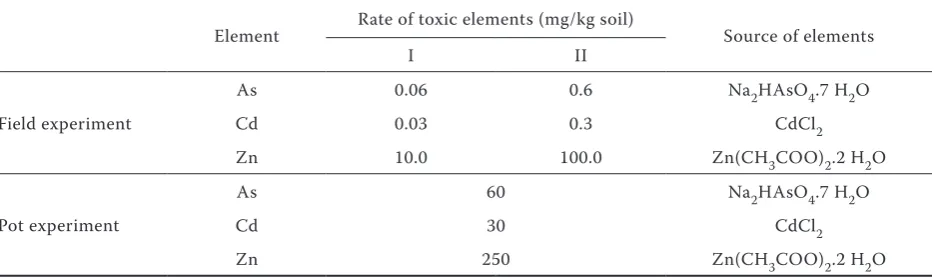
Soil was treated with two rates of toxic elements (Cd, Zn, As) or with sewage sludge in a precise field experiment. Fresh homogeneous sewage sludge (26.4 g/kg soil) with a mean 34% of dry matter was used as the source of toxic elements in this experiment (Table 1). The first rate of toxic elements was set according to their content in sew-age sludge; the second rate was ten times higher (Tables 2 and 3). All treatments were tested in four replications (2 m2 each). Spinach was planted up
to full leaves development.
[image:2.595.63.290.104.177.2]Average month temperatures and rainfall dur-ing the spinach growdur-ing period are described in Table 4.
Table 1. The total content of toxic elements in tested soil and sewage sludge (the average of two experiment years)
As Cd Zn
(mg/kg)
[image:2.595.63.291.226.389.2]Chernozem 18.0 ± 1.0 0.416 ± 0.073 87.1 ± 4.4 Sewage sludge 7.1 ± 0.7 3.76 ± 0.21 1105 ± 16
Table 2. Experimental design
Treatment Fertilization Application of risk elements
Field experi- ment
1 NPK 0
2 NPK toxic elements I
3 NPK toxic elements II
4 NPK sewage sludge
Pot experi- ment
1 NPK 0
2 NPK As
3 NPK Cd
4 NPK Zn
Table 3. The rates of toxic elements
Element Rate of toxic elements (mg/kg soil) Source of elements
I II
Field experiment
As 0.06 0.6 Na2HAsO4.7 H2O
Cd 0.03 0.3 CdCl2
Zn 10.0 100.0 Zn(CH3COO)2.2 H2O
Pot experiment
As 60 Na2HAsO4.7 H2O
Cd 30 CdCl2
[image:2.595.65.533.625.764.2]Pot experiment
For the verification of the effect of toxic elements on glutamate kinase activity a pot experiment was set up using high rates of individual toxic elements. Five kg of soil was thoroughly mixed with 0.5 g N, 0.16 g P, and 0.4 g K, applied in ammonium nitrate and potassium hydrogen phosphate in the control treatment and with the same amount of nutrients plus a toxic element (As or Cd or Zn) in the ob-served treatments (Tables 2 and 3). Soil mixture was filled into plastic pots and sown with spinach seeds. Soil moisture was regularly controlled and kept at 60% of MWHC. All treatments were pre-pared with four replications. Spinach was planted up to full leaves development.
Duration of field and pot experiments was 44 and 46 days in two experiment years.
Analyses of toxic elements
Dry above-ground spinach biomass was used for determination of the total As, Cd and Zn contents. The plant material (1 g of dried and powdered bio-mass) was decomposed in a dry ashing procedure performed in a mixture of oxidizing gases (O2 + O3 + NOx) using the Apion Dry Mode Mineralizer (Tessek, CZ). The ash was dissolved in 1.5% HNO3 (Miholová et al. 1993). Each sample was decom-posed and analysed three times.
Varian SpectrAA-400 (Australia) atomic ab-sorption spectrometer with a GTA-96 graphite tube atomizer was used to determine cadmium. A pyrolytically-coated tube with a L’vov platform was used for all of the measurements.
Flame atomization (air-acetylene flame) was ap-plied (Varian SpectrAA-300 atomic absorption spectrometer, Australia) for zinc determinations.
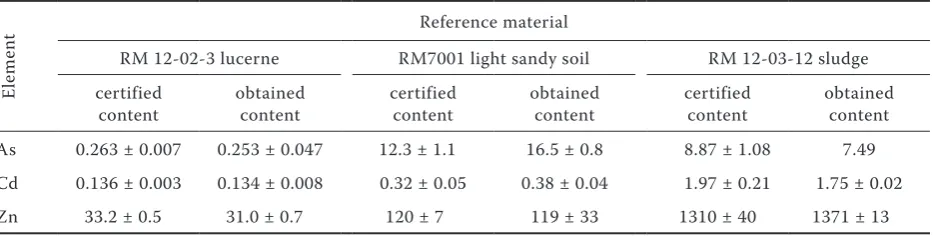
Arsenic was determined by a continual hydride generation technique using the Varian SpectrAA-300 (Australia) atomic absorption spectrometer equipped with a VGA-76 hydride generator. The quality of the plant analyses was verified using the RM 12-02-03 Lucerne reference material (Table 5).
Analysis of the glutamate kinase activity
Glutamate kinase was isolated from acetone- dried spinach fresh above-ground biomass. The hydroxamate method was used for analysis and the determination of its activity was described by Vašáková and Štefl (1982). Each sample (1 g of acetone-dried powder) was analysed two times. The results of glutamate kinase analyses from both years were averaged.
RESULTS AND DISCUSSION
[image:3.595.64.290.92.180.2]Application of toxic elements or sewage sludge into the soil influenced the content of toxic ele-ments in the spinach biomass (Spinacia oleracea L.) (Table 6). The lowest difference between the control treatment and treatments with toxic elements I and sewage sludge application was determined for Cd content. Application of toxic elements I rate and sewage sludge did not increase Cd content in spinach. Only theaddition of toxic elements II rate increased the Cd content in spinach by 28.6% compared with the control. High sorption capac-ity of Chernozem in the field experiment limited
Table 4. Average month temperatures and rainfall dur-ing the spinach growdur-ing period
Month Temperature (°C) Rainfall (mm)
2005 2006 2005 2006
April 10.1 8.9 13.8 58.3
May 14.0 13.5 82.6 97.0
June 16.5 17.7 65.2 58.9
Table 5. Quality control of plant, soil and sewage sludge analyses
El
em
en
t Reference material
RM 12-02-3 lucerne RM7001 light sandy soil RM 12-03-12 sludge certified
content obtained content certified content obtained content certified content obtained content As 0.263 ± 0.007 0.253 ± 0.047 12.3 ± 1.1 16.5 ± 0.8 8.87 ± 1.08 7.49 Cd 0.136 ± 0.003 0.134 ± 0.008 0.32 ± 0.05 0.38 ± 0.04 1.97 ± 0.21 1.75 ± 0.02
[image:3.595.66.533.646.764.2]the cadmium availability for plants. The limited Cd and Zn accumulation in plant biomass after application of sewage sludge to the soil was also confirmed by Balík et al. (2000) and Tlustoš et al. (2001). Arsenic and zinc contents significantly increased in the spinach biomass compared to the control. As content increased by 100% in the plants grown on the soil with toxic elements I and with the sewage sludge treatments, and by 124% in the toxic elements II treatment. The highest increase of zinc content was also determined in spinach grown on toxic elements II treatment (by 214%), increase of Zn content in other treatments was 74% on toxic elements I and 11% on sewage sludge treatment in contrast to control treatment. A non-significant increase of Zn content in plant biomass grown in sewage sludge treatment was caused by limited Zn availability in the sewage sludge for plants. The yield of the above-ground biomass was not affected by addition of toxic ele-ments and sewage sludge (data are not shown).
Application of high rates of toxic elements led to the increase of all toxic elements contents in
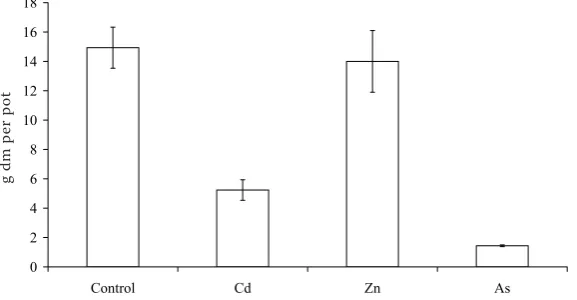
plant biomass (Table 6) in the pot experiment in contrast to the field trial. Arsenic and cadmium rates significantly decreased the yield of the above-ground spinach biomass (Figure 1). Arsenic rate was toxic for plants; therefore the biomass yield of this treatment formed only 10% of the yield of control. The decrease of spinach yield caused by Cd application was 65% compared with the control treatment. Application of zinc did not significantly affect the biomass yield. Tlustoš et al. (2006) also stated that a high content of toxic elements in soil inhibited plant growth due to the phytotoxicity of elements to plants.
Proline is an important amino acid for plant adaptation to stress condition. It is intensively incorporated into proteins, and later accumulated as free proline. The decisive role in the intensity of proline biosynthesis under stress conditions is obviously in the regulation of the first enzyme of proline biosynthesis from L-glutamate – proline-inhibitable enzyme glutamate kinase [E.C.2.7.2.11]
[image:4.595.64.537.84.229.2]via a feedback mechanism, which is governed by the content of proline (Štefl and Vašáková 1982,
Table 6. Total content of As, Cd and Zn in dry above ground spinach biomass (mg/kg)
Treatment As Cd Zn
Field experiment
0 0.075 ± 0.009 0.63 ± 0.06 68.4 ± 8.8
toxic elements I 0.150 ± 0.031 0.65 ± 0.04 119.0 ± 5.6 toxic elements II 0.168 ± 0.009 0.81 ± 0.10 215.0 ± 9.1 sewage sludge 0.148 ± 0.017 0.69 ± 0.06 75.7 ± 1.9
Pot experiment
0 0.073 ± 0.065 0.44 ± 0.03 63.8 ± 2.2
As 3.387 ± 0.286 – –
Cd – 39.80 ± 2.60 –
Zn – – 285.7 ± 6.7
Figure 1. Yield of aboveground biomass of spinach growing in pot experiment (g dm per pot)
0 2 4 6 8 10 12 14 16 18
Control Cd Zn As
g
dm
p
er
p
[image:4.595.152.441.589.739.2]1984). Free proline decreases the activity of glu-tamate kinase. Glutamic acid not transformed to proline can be used for synthesis of gluthatione. Phytochelatins are synthesized from glutathione and increase the tolerance of plants against toxic elements. This result was also confirmed by our experiments.
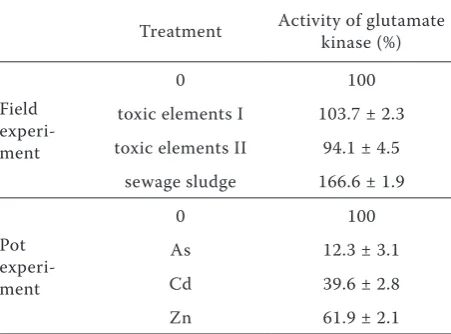
Both rates of toxic elements in field experiment did not significantly influence glutamate kinase activity (Table 7). Our results showed a significant increase of the glutamate kinase activity only in the spinach biomass growing on sewage sludge treat-ment. Pollutants of organic origin contained in the sewage sludge could be the source of the metabolic stress for plants. Results of the analysis of used sewage sludge determined in the Laboratory of Waste-Water Treatment in Prague showed a high content of organic pollutants (447 µg/kg mono-aromatic hydrocarbons, mainly xylene; 270 µg/kg polychlorinated biphenyls; 15 770 µg/kg polyaro-matic hydrocarbons, mainly fluoranthene, phen-anthrene and naphthalene). Baran and Oleszezuk (2003) found also polychlorinated terphenyls, naphthalene, phenols, chlorophenols, phthalates, polychlorinated biphenyls and polyaromatic hy-drocarbons in sewage sludge and effects of these substances on plants. These substances can in-duce plant metabolic stress mechanisms. Proteins containing proline have a significant role in these mechanisms; for this reason the effect of allosteric inhibition of glutamate kinase activity was low and the activity of glutamate kinase increased. Formed proline is bound to proteins and therefore glutamate kinase activity is not inhibited.
For the verification of thetoxic element effect on glutamate kinase activity a pot experiment using high rates of individual toxic elements was set up. Results of the glutamate kinase activity showed a strong effect of all three elements (Table 7), mainly of As. Arsenic decreased the glutamate kinase activ-ity by 87.7%. Effect of zinc as an essential element in the glutamate kinase activity was significantly lower compared to both Cd and As.
Allosteric regulation of glutamate kinase activ-ity by free proline makes it possible to increase glutamic acid content using in synthesis of gluta-thione and phytochelatines in plant cell. Increased content of free proline inhibited biosynthesis of further proline. Increased inhibition of proline biosynthesis resulted in the preference of meta-bolic way of phytochelatin synthesis, glutamate kinase activity therefore decreased in As, Cd and Zn treatments of the pot experiment. According to our previous results of sequential extraction of
spinach biomass (Pavlíková et al. 2004, 2005) the mass portion of phytochelatins fractions increased in spinach cultivated on soil contaminated with toxic elements as well as with sewage sludge. The role of proline accumulation in plants stressed by toxic elements has not been fully elucidated. Sharma et al. (1998) and Shaw and Rout (2002) reported accumulation of free proline in plants in response to toxic element stress. According to Shaw and Rout (2002) the accumulation of proline has not provided a protective mechanism against toxic elements but probably a physiological reaction inducing plant ontogenetic cycle. Schat etal. (1997) suggested that accumulation of proline was a result of water stress induced by toxic elements, however it has not acted as a protective mechanism.
REFERENCES
Balík J., Tlustoš P., Pavlíková D., Száková J., Kaewra-hun S., Hanč A. (2000): Cadmium and zinc uptake by oat from soils amended by sewage sludge incubated with lime and bentonite. Rostl. Výr., 46: 273–280. Baran S., Oleszezuk P. (2003): The concentration of
polycyclic aromatic hydrocarbons in sewage sludge in relation to the amount and origin of purified sewage. Pol. J. Environ. Stud., 12: 523–529.
Curtis J., Shearer G., Kohl D.H. (2004): Bacteroid pro-line catabolism affects N-2 fixation rate of drought-stressed soybeans. Plant Physiol., 136: 3313–3318. Demiral T., Türkan I. (2005): Comparative lipid
per-oxidation, antioxidant defence systems and proline content in roots of two rice cultivars differing in salt tolerance. Environ. Exp. Bot., 53: 247–257.
[image:5.595.305.531.79.246.2]Di Martino C., Pizzuto R. (2006): Mitochondrial transport in proline catabolism in plants: the exis-tence of two separate translocators in mitochondria Table 7. Relative changes of glutamate kinase activity
Treatment Activity of glutamate kinase (%)
Field experi- ment
0 100
toxic elements I 103.7 ± 2.3 toxic elements II 94.1 ± 4.5
sewage sludge 166.6 ± 1.9
Pot experi- ment
0 100
As 12.3 ± 3.1
Cd 39.6 ± 2.8
isolated from durum wheat seedling. Planta, 223: 1123–1133.
GarcíaRíos M., Fujita T., LaRosa P.C., Locy R.D., Clit-hero J.M., Bressan R.A., Csonka L.N. (1997): Cloning of a polycistronic cDNA from tomato encoding γ-glutamyl kinase and γ-glutamyl phosphate reduct-ase. Proc. Nat. Acad. Sci. U.S.A., 94: 8249–8254. Girija C., Smith B.N., Swamy P.M. (2002): Interactive
effects of sodium chloride and calcium chloride on the accumulation of proline and glycinebetaine in peanut (Arachis hypogaea L.). Environ. Exp. Bot., 47: 1–10. Hu C.A.A., Delauney A.J., Verma D.P.S. (1992): A
bi-functional enzyme (delta-1-pyrroline-5-carboxylate synthetase) catalyzes the 1st 2 steps in proline
bio-synthesis in plants. Proc. Nat. Acad. Sci. U.S.A., 89: 9354–9358.
Klotke J., Kopka J., Gatzke N., Heyer A.G. (2004): Im-pact of soluble sugar concentrations on the acquisi-tion of freezing tolerance in accessions of Arabidopsis thaliana with contrasting cold adaptation – evidence for a role of raffinose in cold acclimation. Plant Cell Environ., 27: 1395–1404.
Matysik J., Alia Bhalu B., Mohanty P. (2002): Molecular mechanisms of quenching of reactive oxygen species by proline under stress in plants. Curr. Sci., 82: 525–532. Miholová D., Mader P., Száková J., Slámová A., Svatoš Z.
(1993): Czechoslovak biological certified reference materials and their use in the analytical quality as-surance system in a trace element laboratory. Fresen. J. Anal. Chem., 345: 256–260.
Pavlíková D., Pavlík M., Vašíčková S., Száková J., Tlustoš P., Vokáč K., Balík J. (2004): Separation of organic compounds binding trace elements in seeds of Leuzea carthamoides (Willd.) DC. Appl. Organo-metal. Chem., 18: 619–625.
Pavlíková D., Pavlík M., Vašíčková S., Száková J., Vokáč K., Balík J., Tlustoš P. (2005): Development of sequential extraction procedure of substances bind-ing trace elements in plant biomass. Anal. Bioanal. Chem., 381: 863–872.
Ramachandra Reddy A., Chaitanya K.V., Jutur P.P., Sumi-thra K. (2004): Differential antioxidative responses to water stress among five mulberry (Morus alba L.) cultivars. Environ. Exp. Bot., 52: 33–42.
Sanita di Toppi L., Gabbrielli R. (1999): Response to cadmium in higher plants. Environ. Exp. Bot., 41: 105–130.
Schat H., Sharma S.S., Vooijs R. (1997): Heavy metal-induced accumulation of free proline in a metal-tol-erant and a nontolmetal-tol-erant ecotype of Silene vulgaris. Physiol. Plant., 101: 477–482.
Schützendübel A., Polle A. (2002): Plant responses to abiotic stresses: heavy metal-induced oxidative stress and protection by mycorrhization. J. Exp. Bot., 53: 1351–1365.
Sharma S.S., Schat H., Vooijs R. (1998): In vitro allevia-tion of heavy metal-induced enzyme inhibiallevia-tion by proline. Phytochemistry, 49: 1531–1535.
Shaw B.P., Rout N.P. (2002): Hg and Cd induced changes in proline content and activities of proline biosyn-thesizing enzymes in Phazeolus aureus and Triticum aestivum. Biol. Plant., 45: 267–271.
Štefl M., Vašáková L. (1982): Allosteric regulation of proline-inhibitable glutamate kinase from winter-wheat leaves by L-proline, adenosine-diphosphate and low-temperatures. Collect. Czech. Chem. Com-mun., 47: 360–369.
Štefl M., Vašáková L. (1984): Regulation of proline-in-hibitable glutamate kinase (EC 2.7.2.11, ATP – gam-ma-L-glutamate phospotransferase) of winter-wheat leaves by mono-valent cations and L-proline. Collect. Czech. Chem. Commun., 49: 2698–2708.
Táborský J., Vašáková L. (1994): The effect of selected pesticides on the activity of glutamate kinase enzyme in winter wheat leaves. Rostl. Výr., 40: 343–348. Tlustoš P., Balík J., Dvořák P., Száková J., Pavlíková D.
(2001): Zinc and lead uptake by three crops planted on different soils treated by sewage sludge. Rostl. Výr., 47: 129–134.
Tlustoš P., Száková J., Hrubý J., Hartman I., Najmano-vá J., Nedělník J., PavlíkoNajmano-vá D., Batysta M. (2006): Removal of As, Cd, Pb, and Zn from contaminated soil by high biomass producting plants. Plant Soil Environ., 52: 413–423.
Vašáková L., Štefl M. (1982): Glutamate kinases from winter wheat leaves and some properties of proline-inhibitable glutamate kinase. Collect. Czech. Chem. Commun., 47: 349–359.
Verslues P.E., Bray E.A. (2004): LWR1 and LWR2 are required for osmoregulation and osmotic adjustment in Arabidopsis. Plant Physiol., 136: 2831–2842.
Received on February 6, 2007
Corresponding author:
Doc. Ing. Daniela Pavlíková, CSc., Česká zemědělská univerzita v Praze, Fakulta agrobiologie, potravinových a přírodních zdrojů, 165 21 Praha 6-Suchdol, Česká republika