Soil contamination by toxic elements is one of the major environmental problems because of the large inputs of toxic elements over the past centuries. The large adverse effects of heavy met-als emissions from smelters on surrounding eco-systems and the microorganisms were observed from 1960–1970. Until now a considerable body of information has been accumulated on the ef-fects of heavy metals on soil microorganisms and microbially-mediated processes from laboratory studies and field experiments (Giller et al. 1998). The significant negative effects on microbial bio-mass and its metabolic activities are described in many studies (i.e. Brookes 1995, Leita et al. 1995, Nannipieri et al. 1997), however, there is an enor-mous disparity between studies, as to which metal concentrations are toxic (Bååth 1989). For instance, Mühlbachová and Šimon (2003) showed that the activity of the microbial pool could differ among the studied contaminated areas and that in
long-term contaminated soils it could not be necessarily lower in the presence of toxic elements.
Together with the understanding of the effects of toxic elements on natural ecosystems, the soil remediation practices have been developed in the past years. Among the techniques available for soil remediation the metal immobilization plays a significant role. Liming is a common practice for reducing the mobility of heavy metals (Kuntze et al. 1984) because it does not only support the plant nutrition by calcium, but it improves the soil properties and is often used to decrease the heavy metals mobility.
High acidity inhibits the growth of soil bacteria in favour of more resistant fungi. In contrast, lim-ing which increases the soil pH usually improves the bacteria growth. The recovery of soil bacteria after heavy metals amendment was faster when soil pH, which had decreased due to the metal addition, was restored by liming (Rajapaksha et
Effects of liming on the microbial biomass and its activities
in soils long-term contaminated by toxic elements
G. Mühlbachová
1, P. Tlustoš
21
Research Institute of Crop Production, Prague-Ruzyne, Czech Republic
2Czech University of Agriculture in Prague, Czech Republic
ABSTRACT
The effects of liming by CaO and CaCO3 on soil microbial characteristics were studied during laboratory
incuba-tion of long-term contaminated arable and grassland soils from the vicinity of lead smelter near Příbram (Czech Republic). The CaO treatment showed significant negative effects on soil microbial biomass C and its respiratory activity in both studied soils, despite the fact that microbial biomass C in the grassland soil increased sharply
du-ring the first day of incubation. The metabolic quotient (qCO2) in soils amended by CaO showed greater values than
the control from the second day of incubation, indicating a possible stress of soil microbial pool. The vulnerability
of organic matter to CaO could be indicated by the availability of K2SO4-extractable carbon that increased sharply,
particularly at the beginning of the experiment. The amendment of soils by CaCO3 moderately increased the soil
microbial biomass. The respiratory activity and qCO2 increased sharply during the first day of incubation, however
it is not possible to ascribe them only to microbial activities, but also to CaCO3 decomposition in hydrogen
carbo-nates, water and CO2. The pH values increased more sharply under CaO treatment in comparison to CaCO3
treat-ment. The improvement of soil pH by CaCO3 could be therefore more convenient for soil microbial communities.
Keywords: liming; soil microbial biomass; respiratory activity; metabolic quotient qCO2; heavy metals
al. 2004). The increase of soil pH by liming is thus usually favourable for the microbial growth and it was found that microbial biomass increased already after two years after liming in compari-son to unlimed control (Bezdicek et al. 2003). Moreover, liming significantly increased total soil protein and these results were related to similar but less pronounced changes in microbial bio-mass in Cd contaminated and limed control soils (Singleton et al. 2003). In addition, the growth of microbial biomass and the growth of bacteria as the response to increased pH in limed soils were commonly found (i.e. Geissen et al. 1998, Chagnon et al. 2001, Lorenz et al. 2001, Reichardt et al. 2001, Oyanagi et al. 2004). Waschkies and Huttl (1999) however reported that the concentration of microbial biomass increased almost linearly with the pH range between 3.9 and 5.3 and no signifi-cant change in microbial biomass was detected with a further increase of pH above 5.3. On the
other hand, in a study using Ca(OH)2 the numbers
of colony-forming units (CFU) and the biomass of fungi decreased (Weyman-Kaczmarkowa and Pedziwilk 2000) indicating that the microbial bio-mass growth and activities could be inhibited by such types of liming. Furthermore, Groffmann (1999) did not observe any effect on biomass C after liming with Ca-Mg acetate or Ca carbonate, probably because the carbon addition stimulated microbial growth and activity, but there was no increase in microbial biomass due to the predation of the new biomass by soil fauna.
The aim of this research was to evaluate whether different forms of liming can affect the soil mi-crobial biomass C and its activities in soils con-taminated with toxic elements.
MATERIAL AND METHODS
The area about 60 km SW from Prague (Czech Republic) with long-term contaminated soils from the vicinity of the Příbram smelter was used in the experiment. The arable (P1) and grassland (P2) soil chosen for the experiment were typic
Cambisols according to the FAO classification (Mühlbachová and Šimon 2003, Šichorová et al. 2004, Mühlbachová et al. 2005). The Příbram smelter has been in operation since 1786. Metal mining was ceased in 1972, but a secondary lead smelter has still been running. Since 1982 a 98% efficient dust separator and a 160 m stack have been in use (Kalac et al. 1991, Riuwerts and Farago 1996).
Soils were sampled in the autumn 2003 (layer 0–200 mm) making 6 samplings in the circle of 2 m from each sampling site; soil characteristics are shown in Table 1.
Seven days prior to the experiment, three repli-cations of each treatment (1 kg of soil on an oven dry basis) in plastic jars were placed into 3 litre plastic containers, tightly covered with fitting lids, and they were conditioned at 28°C. The soils were preincubated at the 40% water holding capacity (WHC) with the jar of 25 ml 1M NaOH to take
up the CO2-evolved and the distilled water at the
bottom of the container. At the beginning of the experiment each soil replication was mixed with
3 g CaO/kg soil or 5.36 g CaCO3/kg soil in order
to obtain the same Ca concentrations for both amendments. The treated and control soils were adjusted to the 50% of its WHC. Thereafter, the amended soils were incubated under the above described conditions. The containers were aer-ated daily to ensure a sufficient oxygen supply. The soils were regularly adjusted to 50% WHC
during the 1st year of incubation, a jar with 25 ml
1M NaOH in the containers was replaced weekly and the distilled water in one month intervals. The soils without lime amendment served as a control and they were conditioned as the treated ones for 28 days in the first part of the experiment; the last measure was performed after 365 days in order to compare the fresh lime application and the long-term effects.
The respiratory activity was determined by sepa-rate incubation of 100 g of soil weighed in three replicates for each treatment and incubated in 1 litre tightly closed plastic containers containing
[image:2.595.60.531.692.762.2]5 ml 1N NaOH to determine the CO2-evolved. The
Table 1. Basic characteristics of soils from the Příbram area (pH, Corg, CEC, available Ca, K, Mg, P and toxic
elements concentrations)
Soil (HpH
2O)
Soil
texture C(%)org (mmol/kg)CEC
Ca K Mg P As Cd Cu Pb Zn
mg/kg
microbial biomass content, respiratory activity, pH and available toxic elements fractions were determined at days 0, 1, 2, 7, 14, 28 and 365 of the incubation.
The measurements of the soil microbial
bio-mass C (Bc) were performed using the
fumigation-extraction method (F.E.) according to Vance et al.
(1987) procedure.The microbial biomass C was
calculated from the relationship: Bc = 2.64 Ec, where
Ec is the difference between organic C extracted
from the fumigated and non-fumigated treatments, both expressed as µg C/g oven dry soil.
K2SO4-extractable carbon was determined by
shaking of 20 g soil samples (an oven dry basis) for 30 minutes on an overhead shaker with 80 ml
of 0.5M K2SO4 solution. The extraction was
per-formed according to the determination of non-fumigated C described by Vance et al. (1987). Filtered extracts were determined on carbon con-tent, similarly as microbial biomass measurements,
by digestion with mixture of H2SO4 and H3PO4 and
with K2Cr2O7 and titration of excess dichromate
with (NH4)2Fe(SO4)2.6 H2O.
The CO2 C evolved was determined as an amount
of organic C released as CO2 after absorption in
NaOH and precipitation with BaCl2 and was
ana-lysed by titration with standard HCl on the auto-matic titrator Titrino 716. The metabolic quotient
(qCO2) was calculated according to Anderson and
Domsch (1990) equation:
qCO2 = µg CO2-C/µg CBc/h
Values of soil pH were determined by combined glass electrode on the pH meter in the solution soil/water (1/2.5 w/v) after 1 h shaking on the overhead shaker.
RESULTS AND DISCUSSION
The CaO and CaCO3 treatments had different
effects on the microbial biomass C dynamics and the divers effects were observed also between ar-able and grassland soil (Figure 1). At the beginning of the experiment the CaO amendment decreased sharply the microbial biomass C in the arable soil (P1) from 171.4 µg C/g soil to 91.6 µg C/g soil and its subsequent increase did not reach the control
and CaCO3 values even one year after the CaO
treatment (Table 2). The microbial biomass C in the grassland soil (P2) increased after CaO amend-ment from 333.4 µg C/g soil to 596.2 µg C/g soil. However, since the second day of incubation it remained, similarly to the CaO treated soil P1,
lower than control and CaCO3 treatment. The
microbial biomass C decreased during the year of incubation in all studied treatments, but at the end of experiment, the largest microbial biomass C
was found in CaO amended grassland soil. The
addition of CaCO3 in a one-year interval did not
have any significant effects on microbial biomass development and was not significantly different from the control in both studied soils (Table 2).
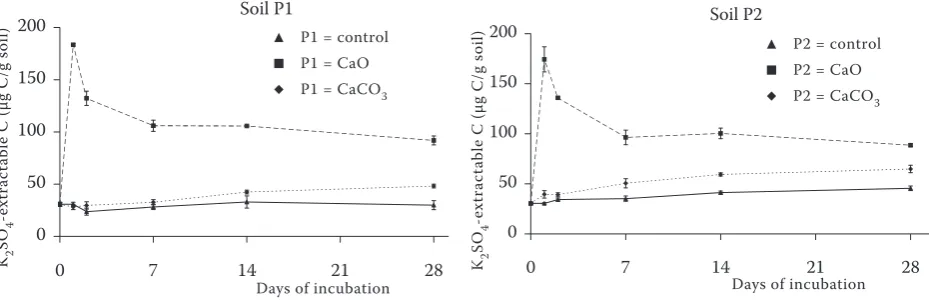
The obtained results showed that the microbial biomass C was negatively affected by the CaO ap-plication already from the first day of the experi-ment in the arable soil (P1) and from the second day in the soil P2 (Figure 1). It is possible to sup-pose that the microbial biomass C in the grassland soil P2 increased under CaO treatment during the first day of incubation due to a greater amount of easily available carbon, which was possible to observe in both examined soils (Figure 2). The net decrease of the microbial biomass C as the response to CaO treatment during the
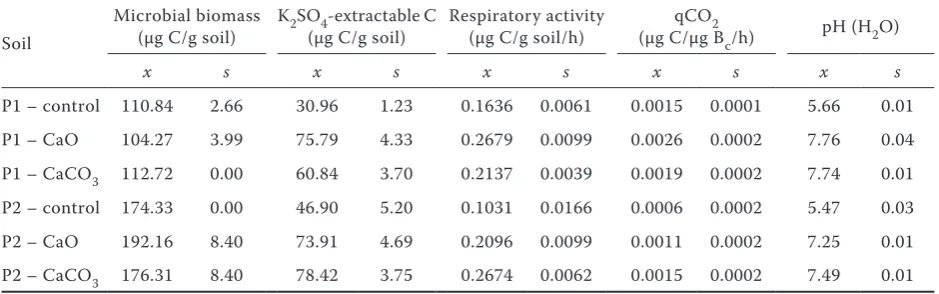
incuba-Table 2. The microbial biomass, K2SO4-extractable C, respiratory activity, qCO2, pH after 365 days of the
in-cubation
Soil
Microbial biomass
(µg C/g soil) K2SO(µg C/g soil)4-extractable C Respiratory activity (µg C/g soil/h) (µg C/µg BqCO2c/h) pH (H2O)
x s x s x s x s x s
P1 – control 110.84 2.66 30.96 1.23 0.1636 0.0061 0.0015 0.0001 5.66 0.01 P1 – CaO 104.27 3.99 75.79 4.33 0.2679 0.0099 0.0026 0.0002 7.76 0.04 P1 – CaCO3 112.72 0.00 60.84 3.70 0.2137 0.0039 0.0019 0.0002 7.74 0.01 P2 – control 174.33 0.00 46.90 5.20 0.1031 0.0166 0.0006 0.0002 5.47 0.03 P2 – CaO 192.16 8.40 73.91 4.69 0.2096 0.0099 0.0011 0.0002 7.25 0.01 P2 – CaCO3 176.31 8.40 78.42 3.75 0.2674 0.0062 0.0015 0.0002 7.49 0.01
[image:3.595.63.533.596.743.2]tion suggests that the biomass C was disturbed and the soil organic matter rapidly mineralized due to the strong exothermic chemical reaction of soil water with CaO. On the other hand, the results obtained after one year of incubation did not confirm significantly lower microbial biomasses in comparison to control and the larger biomass C was found in the grassland soil (Table 2). In fact, Stenberg et al. (2000) found that liming with CaO increased microbial activities under long-term field experimental conditions.
The CaCO3 application increased the microbial
biomass C in both P1 and P2 from the 2nd and the
7th day of the incubation, respectively, indicating
the positive effects of this type of liming on the microbial biomass C, although the increase repre-sented only about 20 µg C/g soil. The application of limestone is largely used on uncontaminated soils to improve the soil properties and has usually positive effects on the microbial growth (Geissen
et al. 1998, Chagnon et al. 2001, Lorenz et al. 2001, Reichardt et al. 2001, Oyanagi et al. 2004).
After CaO amendment a significant increase of
easily available C, expressed here as K2SO4-ex-
tractable carbon, was observed during the first day
of incubation; up to 183.46 µg C/g for P1 soil and
174.34 µg C/g for P2 soil (Figure 2). Thereafter
the K2SO4-extractable carbon decreased
un-der CaO treatment throughout the incubation.
K2SO4-extractable carbon in CaCO3 amended
soils increased regularly during the incubation from 30.77 µg C/g to 48.18 µg C/g at day 28 for the soil P1 and from 30.44 µg C/g to 68.82 µg C/g for
the P2 soil at day 28. After one year the K2SO4-ex-
tractable C increased up to 60.68 µg C/g P1 soil and 70.95 µg C/g P2 soil.
The sharp increase of K2SO4-extractable
car-bon in CaO treated soils is probably linked to the exothermic reaction of CaO in the moist soil and subsequent disruption of the soil organic
com-Figure 1. The microbial biomass dynamics in arable (P1) and grassland (P2) soil treated with CaO and CaCO3
[image:4.595.63.532.61.213.2]during laboratory incubation
Figure 2. The K2SO4-extractable carbon dynamics in arable (P1) and grassland (P2) soil treated with CaO and
CaCO3 during laboratory incubation
Soil P1
0 50 100 150 200
0 7 14 21 28
Soil P2
0 50 100 150 200
0 7 14 21 28
K2
SO
4
-e
xt
ra
ct
ab
le
C
(µ
g
C
/g
s
oi
l)
Days of incubation
K2
SO
4
-e
xt
ra
ct
ab
le
C
(µ
g
C
/g
s
oi
l)
Days of incubation
▲ P1 = control
■ P1 = CaO
◆ P1 = CaCO3
▲ P2 = control
■ P2 = CaO
◆ P2 = CaCO3 Soil P1
0 50 100 150 200 250
0 7 14 21 28
Soil P2
0 100 200 300 400 500 600 700
0 7 14 21 28
M
ic
ro
bi
al
b
io
m
as
s
(µ
g
C
/g
s
oi
l)
Days of incubation
M
ic
ro
bi
al
b
io
m
as
s
(µ
g
C
/g
s
oi
l)
Days of incubation
▲ P1 = control
■ P1 = CaO
◆ P1 = CaCO3
▲ P2 = control
■ P2 = CaO
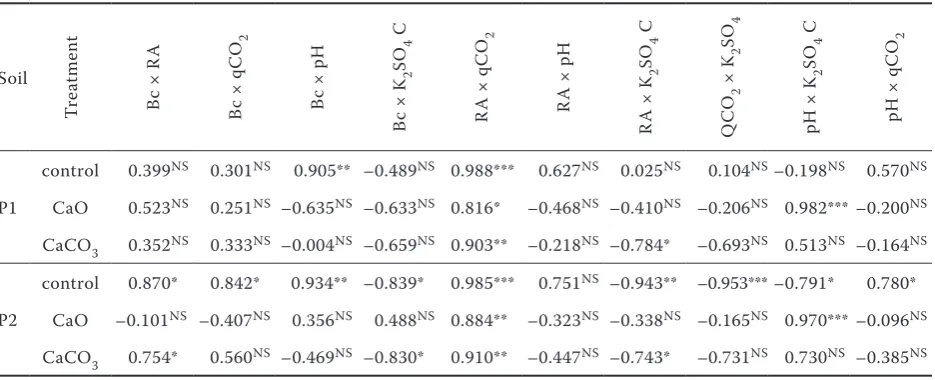
[image:4.595.66.531.572.723.2]plexes. The direct effects of CaO treatment on carbon extractability also confirm highly significant
relationships between pH and K2SO4-extractable
carbon (Table 3). The liming usually improves soil microbial properties. Particularly the bacterial activity could be recovered after metal addition up to values similar to those of the control soil when soil pH, which had decreased due to metal addition, was restored to control values by lim-ing (Rajapaksha et al. 2004). On the other hand, the form of used Ca amendment seems to be particularly important for carbon mineralization and microbial activities. Nevertheless, it is dif-ficult to compare the incubation experiment and the liming with CaO in field trials with different tillage when CaO usually stabilized or improved soil microbial activities (Stenberg et al. 2000). The results after one year of incubation confirmed
the decrease of K2SO4-extractable carbon in CaO
treatments; relatively small differences were how-ever obtained for microbial biomass. From the long-term view the microbial properties seemed not to be greatly affected by CaO, although the short-term incubation showed clearly negative
effects of CaO on microbial biomass and K2SO4
-extractable C availability. In addition, CaCO3
application could mobilise soil organic matter as suggested Chander and Joergensen (2002). The
increased contents of K2SO4 extractable C and
increased microbial biomass C could confirm this opinion.
The CaO amendment decreased the respiratory activity in soils P1 and P2 during the first two days of the experiment (Figure 3). Thereafter the soil
respiratory activity increased over the control and
it remained larger till the 28th day of experiment
when no significant differences were observed.
The respiratory activity in CaCO3 treatment
increased significantly in both studied soils dur-ing the first day of incubation in comparison to control and CaO treatments. Thereafter, a pro-gressive decrease in the soil respiratory activity was observed in both P1 and P2.
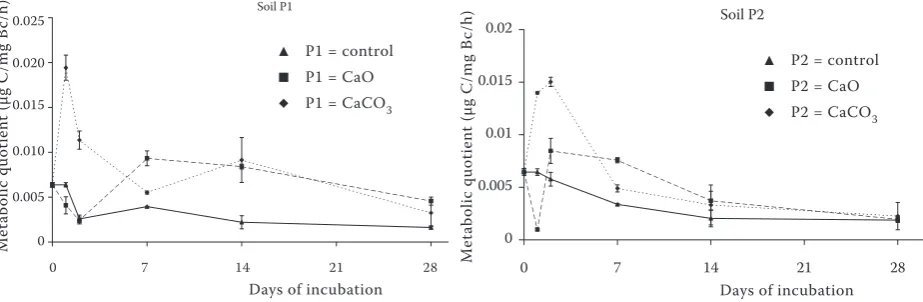
The metabolic quotient (qCO2) (Figure 4) was
found to be a sensitive indicator of soil microbial processes (Anderson and Domsch 1990). The
highest qCO2 was found in both CaCO3 amended
soils during the first day of incubation. In contrast,
decreased qCO2 in CaO treated variants during
the first day (soil P2) and the second day (soil P1) of the incubation could be caused by the exother-mic reaction of CaO in soils and by significantly decreased microbial biomass C, however the
sub-sequent increase of qCO2 was recorded.
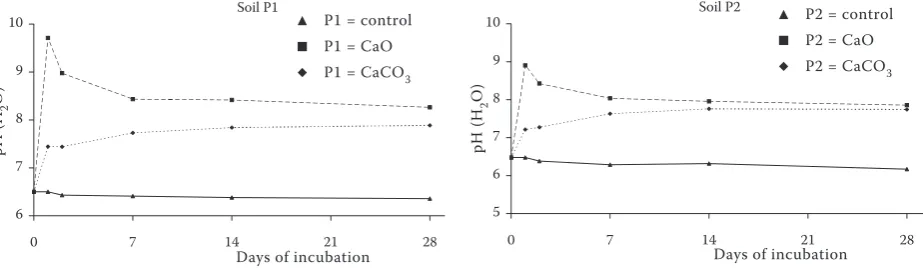
Values of pH in both control soils decreased slowly during the incubation (Figure 5) but the different course of pH development was observed
for CaO and CaCO3 amendment. The pH in CaO
treatment increased sharply up to 9.71 in the soil P1 and 8.9 in the soil P2. Afterwards the pH decreased slightly throughout the incubation, however it
remained still higher than the CaCO3 treatment
till 28th day of the incubation and than the control.
The CaCO3 treatment increased pH continually
up to the 14th day for the soil P1 and 28th day for
the P2 soil. In comparison to the beginning of the incubation, the values of pH after one year
were lower in all treatments. The CaCO3
treat-Table 3. Correlation coefficients among selected soil characteristics
Soil
Tr
ea
tm
en
t
Bc
×
R
A
Bc
×
q
C
O2
Bc
×
p
H
Bc
×
K2
SO
4
C
R
A
×
q
C
O2
R
A
×
p
H
R
A
×
K2
SO
4
C
Q
C
O2
×
K2
SO
4
pH
×
K2
SO
4
C
pH
×
q
C
O2
P1
control 0.399NS 0.301NS 0.905** –0.489NS 0.988*** 0.627NS 0.025NS 0.104NS–0.198NS 0.570NS
CaO 0.523NS 0.251NS –0.635NS –0.633NS 0.816* –0.468NS –0.410NS –0.206NS 0.982*** –0.200NS
CaCO3 0.352NS 0.333NS –0.004NS –0.659NS 0.903** –0.218NS –0.784* –0.693NS 0.513NS –0.164NS
P2
control 0.870* 0.842* 0.934** –0.839* 0.985*** 0.751NS –0.943** –0.953*** –0.791* 0.780*
CaO –0.101NS –0.407NS 0.356NS 0.488NS 0.884** –0.323NS –0.338NS –0.165NS 0.970***–0.096NS
CaCO3 0.754* 0.560NS –0.469NS –0.830* 0.910** –0.447NS –0.743* –0.731NS 0.730NS –0.385NS
Bc = microbial biomass C, RA = respiratory activity, K2SO4 C = K2SO4-extractable C, qCO2 = metabolic quotient,
[image:5.595.65.533.77.267.2]ment showed higher pH in comparison to the CaO amendment and the lowest pH was observed in both control soils.
The relationships between microbial biomass C,
K2SO4-extractable carbon and either respiratory
activity or qCO2 were significant only in control
soils; in the case of K2SO4-extractable carbon
they were significant also in the soil P2. In CaO
or CaCO3 amended soils no relationships were
found (Table 3) suggesting that the changes in microbial activities after liming were so large that it is not possible to explain them by a simple cor-relation between these parameters. It is possible
that the CaO and CaCO3 amendments
disequili-brated the soil microenvironment. Great changes in microbial biomass C and in respiratory activity
in CaO/CaCO3 treatments, mainly at the
begin-ning of the incubation, could explain the lack of relationships between these soil characteristics. On the other hand, the respiratory activity and
especially the qCO2 usually reflect very well the
microbial activity. An increase of the soil
respira-tory activity and qCO2 under heavy metal stress
was described by Brookes (1995) and Giller et al. (1998). It was generally explained as a result of a larger microbial activity and mineralization of soil organic matter (Brookes 1995) or stimulation of the microbial activity (Groffman 1999). On the other hand, Wardle and Ghani (1995) showed that this index could respond unpredictably and some disturbances such as fertilization or liming can
either decrease or increase qCO2. There is another
possible explanation; the significant part of CO2
-evolved in CaCO3 amended treatments did not
derive only from the microbial respiratory activity or from the autolysed dead microbial cells and there-fore it was probably not a result of a greater energy demand of microbial biomass C in contaminated environment (Brookes 1995, Giller et al. 1998) but
[image:6.595.67.531.63.215.2]of CO2 evolution from applied CaCO3.
Figure 3. The respiratory activity in arable (P1) and grassland (P2) soil treated with CaO and CaCO3 during
laboratory incubation
Figure 4. The metabolic quotient (qCO2) in arable (P1) and grassland (P2) soil treated with CaO and CaCO3
during laboratory incubation
Soil P1
0 1 2 3 4
0 7 14 21 28
Soil P2
0 1 2 3 4 5
0 7 14 21 28
Re
sp
ir
at
or
y
ac
tiv
ity
(µ
g
C
/g
s
oi
l)
Days of incubation
Re
sp
ir
at
or
y
ac
tiv
ity
(µ
g
C
/g
s
oi
l)
Days of incubation
▲ P1 = control
■ P1 = CaO
◆ P1 = CaCO3
▲ P2 = control
■ P2 = CaO
◆ P2 = CaCO3
Soil P2
0 0.005 0.01 0.015 0.02
0 7 14 21 28
M
et
ab
ol
ic
q
uo
tie
nt
(µ
g
C
/m
g
Bc
/h
)
Days of incubation
M
et
ab
ol
ic
q
uo
tie
nt
(µ
g
C
/m
g
Bc
/h
)
Days of incubation
▲ P1 = control
■ P1 = CaO
◆ P1 = CaCO3
▲ P2 = control
■ P2 = CaO
◆ P2 = CaCO3 Soil P1
0 0.005 0.01 0.015 0.02 0.025
0 7 14 21 28
0.025
0.020
0.015
0.010
0.005
0
[image:6.595.66.528.574.725.2]No significant relationships were found between microbial biomass or respiratory activity and pH
values in soils treated with CaO or CaCO3,
suggest-ing that the changes in microbial activities were too large to be explained by a simple correlation between these parameters. On the other hand, the significant relationships were found between
K2SO4-extractable carbon and CaO treatment in
both arable and grassland soil confirming disturb-ing effects of the direct application of CaO on the soil organic matter (Table 3).
The form of liming was critical for the soil mi-crobial activities. The CaO amendment decreased the soil microbial biomass; during the first days of
incubation the respiratory activity and qCO2 were
also decreased. At last, the exothermic reaction of CaO caused rapid mineralization of the organic
matter in soils. The CaCO3 amendment had not so
negative effects on the microbial biomass and its activities and from the microbial point of view it was more suitable liming agent for soils. However,
possible dissociation of CaCO3 molecule increased
the respiratory activity and thus possible flux of
CO2 in the atmosphere.
REFERENCES
Anderson T.H., Domsch K.H. (1990): Application of
eco-physiological quotients (qCO2 and qD) on
micro-bial biomass from soils of different croping histories.
Soil Biol. Biochem., 22: 251–255.
Bååth E. (1989): Effects of heavy metals in soil on mi-crobial processes and populations: a review. Water
Air Soil Poll., 47: 335–379.
Bezdicek D.F., Beaver T., Granatstein D. (2003): Subsoil
ridge tillage and lime effects on soil microbial activ-ity, soil pH, erosion, and wheat and pea yield in the
Pacific Northwest, USA. Soil Till. Res., 74: 55–63.
Brookes P.C. (1995): The use of microbiological param-eters in monitoring soil pollution by heavy metals.
Biol. Fert. Soils, 19: 269–279.
Chagnon M., Pare D., Hebert C., Camire C. (2001): Effects of experimental liming on collembolan com-munities and soil microbial biomass in a southern
Quebec sugar maple (Acersaccharum Marsh.) stand.
Appl. Soil Ecol., 17: 81–90.
Chander K.C., Joergensen R.G. (2002): Decomposition
of 14C labeled glucose in a Pb-contaminated soil
remediated with synthetic zeolite and other
amend-ments. Soil Biol. Biochem., 34: 643–649.
Geissen V., Rudinger C., Schoning A., Brummer G.W. (1998): Microbial biomass and earthworm populations in relation to soil chemical parameters in an
oak-beech forest soil. Verh. Gesell. Okol., 28: 249–258.
Giller K.E., Witter E., McGrath S.P. (1998): Toxicity of heavy metals to microorganisms and microbial processes in agricultural soils: a review. Soil Biol.
Biochem., 30: 1389–1414.
Groffman P.M. (1999): Carbon additions increase
ni-trogen availability in northern hardwood forest soils.
Biol. Fert. Soils, 29: 430–433.
Kalac P., Burda J., Staskova I. (1991): Concentrations of lead, cadmium, mercury and copper in mushrooms in the vicinity of lead smelter. Sci. Tot. Environ.,
105: 109–119.
Kuntze H., Herms U., Pluquet E. (1984): Schwermetalle in Böden-Bewertung und Gegenmaßnahmen. Geol.
Jb., A: 75.
Leita L., De Nobili M., Muhlbachova G., Mondini C., Marchiol L., Zerbi G. (1995): Bioavailability and ef-fects of heavy metals on soil microbial biomass sur-vival during laboratory incubation. Biol. Fert. Soils,
19: 103–108.
Lorenz K., Feger K.H., Kandeler E. (2001): The response of soil microbial biomass and activity of a Norway spruce forest to liming and drought. J. Plant Nutr.
[image:7.595.68.530.61.195.2]Soil Sci., 164: 9–19.
Figure 5. Values of pH (H2O) in arable (P1) and grassland (P2) soil treated with CaO and CaCO3 during
labora-tory incubation
Soil P1
6 7 8 9 10
0 7 14 21 28
Soil P2
5 6 7 8 9 10
0 7 14 21 28
pH
(H
2
O
)
Days of incubation
pH
(H
2
O
)
Days of incubation
▲ P1 = control
■ P1 = CaO
◆ P1 = CaCO3
▲ P2 = control
■ P2 = CaO
Mühlbachová G., Šimon T. (2003): Effects of zeolite amendment on microbial biomass and respiratory activity in heavy metal contaminated soils. Plant Soil
Environ., 49: 536–541.
Mühlbachová G., Šimon T., Pechová M. (2005): The availability of Cd, Pb and Zn and their relationships with soil pH and microbial biomass in soils
amend-ed by natural clinoptilolite. Plant Soil Environ., 51:
26–33.
Nannipieri P., Badalucco L., Landi L., Pietramellara G. (1997): Measurement in assessing the risk of chem-icals to the soil ecosystem. In: Zelikoff J.T. (ed.): Ecotoxicology: responses, biomarkers and risk as-sessment. SOS Publ., Fair Haven, NJ 07704 USA: 507–534.
Oyanagi N., Aoki M., Toda H., Haibara K. (2004): Ef-fects of liming on chemical properties and microbial
flora of forest soil. J. Jpn. For. Soc., 83:
Rajapaksha R.M.C.P., Tobor-Kapon M.A., Baath E. (2004): Metal toxicity affects fungal and bacterial activities in soil differently. Appl. Environ. Microbiol.,
70: 2966–2973.
Reichardt W., Meepetch S., Angeles O., Ruaysoongnern S. (2001): Microbiological interventions in acid sandy rice soils. In: Proc. Int. Wksh.: Increased lowland rice production in the Mekong region. Vientiane Laos: 201–207.
Riuwerts J., Farago M. (1996): Heavy metal pollution in the vicinity of a secondary lead smelter in the Czech
Republic. Appl. Geochem., 11: 17–23.
Singleton I., Merrington G., Colvan S., Delahunty J.S.
(2003): The potential of soil protein-based methods
to indicate metal contamination. Appl. Soil Ecol.,
23: 25–32.
Stenberg M., Stenberg B., Rydberg T. (2000): Effects of reduced tillage and liming on microbial activity and soil properties in a weakly-structured soil. Appl. Soil
Ecol., 14: 135–145.
Šichorová K., Tlustoš P., Száková J., Kořínek K., Balík J. (2004): Horizontal and vertical variability of heavy metals in the soil of a polluted area. Plant Soil
Envi-ron., 50: 525–534.
Vance E.D., Brookes P.C., Jenkinson D.S. (1987): An ex-traction method for measuring microbial biomass C.
Soil Biol. Biochem., 19: 703–707.
Wardle D.A., Ghani A. (1995): A critique of the
micro-bial metabolic quotient (qCO2) as a bioindicator of
disturbance and ecosystem development. Soil Biol.
Biochem., 27: 1601–1610.
Waschkies C., Huttl R.F. (1999): Microbial degradation of geogenic organic C and N in mine spoils. Plant
Soil, 213: 221–230.
Weyman-Kaczmarkowa W., Pedziwilk Z. (2000): The development of fungi as affected by pH and type of soil, in relation to the occurrence of bacteria and soil
fungistatic activity. Microbiol. Res., 155: 107–112.
Received on November 1, 2005
Corresponding author:
Ing. Gabriela Mühlbachová, Ph.D., Výzkumný ústav rostlinné výroby, Drnovská 507, 161 06 Praha-Ruzyně, Česká republika