Empirical observations considering the effects of titanium (Ti) compounds on plants have been reported since the beginning of the 20th century (see Kužel et al. 2003b for review). Most of the works published during that period have brought interesting results about beneficial effects of Ti, but much less is known about its phytotoxic effects at higher doses. Therefore, this poorly explored area of plant physiology remains the challenge for a more thoroughgoing research.
Nearly all experiments studying phytotoxicity of Ti were carried out in hydroponic solutions. Early references were published by Pais et al. (1969a, b), investigating the effects of various trace elements on the development of sweet pepper (Capsicum annuum L.) and tomatoes (Lycopersicon lycoper-sicum L.) in hydroponic cultures; they discovered
that although Ti stimulates the plants at concentra-tions lower than 1 mg/kg, it is phytotoxic at higher doses. Hara et al. (1976) studied the influence of titanium on cabbage plants (Brassica capitata L.) in hydroponic culture and they observed a decrease of the plants’ yield already at 0.4 mg/kg Ti. Wallace et al. (1977) found a significant yield decrease of bush beans (Phaseolus vulgaris L.) at 10–4 mol/dm3 Ti (~ 4.8 mg/kg Ti) applied as TiCl3 into nutri-ent solution. A similar toxicity limit for Ti(IV) ascorbate was documented by Maroti et al. (1984) in tobacco (Nicotiana tabacum L.) callus culture: 5 mg/kg of Ti inhibited the growth, 10 mg/kg led to necrosis. Some phytotoxic impact on oats (Avena sativa L.) was observed for the same compound at 18 mg/kgof Ti in nutrient solution (Hrubýet al. 2002).
The effect of simultaneous magnesium application
on the biological effects of titanium
S. Kužel
1, P. Cígler
2, M. Hrubý
3, J. Vydra
1, D. Pavlíková
4, P. Tlustoš
41
Faculty of Agriculture, University of South Bohemia in České Budějovice,
Czech Republic
2
Institute of Chemical Technology, Prague, Czech Republic
3
Institute of Macromolecular Chemistry, Academy of Sciences of the Czech Republic,
Prague, Czech Republic
4
Czech University of Agriculture in Prague, Czech Republic
ABSTRACT
Most of the works published since the beginning of the 20th century have brought interesting results about
benefi-cial effects of titanium (Ti) on plants, but much less is known about its phytotoxic effects at higher doses. Here we demonstrate the influence of Mg treatment on the phytotoxic effects of Ti. Mg, Ti + Mg and two different concen-trations of Ti leaf sprays were applied on oats (Avena sativa L. cv. Zlaťák) grown on three different soil types (Flu-visol, Luvisol and Chernozem). Physiological parameters of oats as well as some essential elements contents were analyzed. The foliar applications of Ti caused significant toxic manifestations on oats at ≥ 10 mg/kg concentrations. Mg partially ammeliorates these toxic effects if applied together with Ti. The effect was strong on Fluvisol, but we-aker on Chernozem and Luvisol. Ti effects are more significant the further the soil is from the nutritional optimum of the plants. This is most evident in the case of Fluvisol, which is deficient in Mg, Fe, Mn, and Zn. It seems that Ti possesses a generally equalizing effect on the elements content in the plant.
Keywords: titanium; magnesium; iron; plants; Avena sativa L.; nutrition; hormesis; toxicity
The hydroponic methods stated above enable an exact definition of experimental conditions; how-ever, the obtained data are hardly comparable with experiments where Ti is applied in form of foliar spray, as widely used in agriculture. Generally, the effect of Ti is considerably weaker if it is applied on leaves than if added into the nutrient solution (Kužel et al. 2003a). Surprisingly, experiments that examine toxic levels of Ti in form of foliar sprays are practically missing. The only available data are from the studies performed by Huang et al. (1993) and Kužel et al. (2003a) and are stated in Table 1. Phytotoxic effects of Ti leaf sprays were compared to their beneficial effects at lower concentrations.
In our recent work (Kužel et al. 2003a) we ob-served an increased beneficial stimulation by Ti in plants oversupplied by Mg. We demonstrate here that this phenomenon might be generally useful
not only at the beneficial levels of Ti, but generally for an amelioration of its phytotoxicity.
MATERIAL AND METHODS
Plants culture
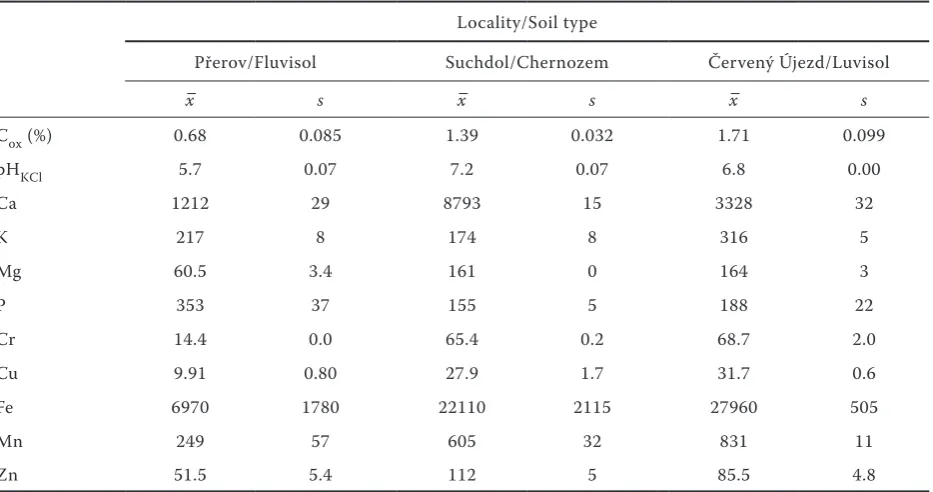
Oat plants (Avena sativa L. cv. Zlaťák) were grown in pots (20 plants per pot) filled with 5 kg of three different soil types (Luvisol, Chernozem and Fluvisol; see Table 2 for soil chemical com-position before fertilization). Four replications of each experimental treatment were made. All treatments were fertilized by NPK in following doses: 0.2 g N (NH4NO3), 0.03 g P and 0.08 g K per kg of soil using KH2PO4 as fertilizer.
The following leaf sprays (30 ml per pot) were used: (i) deionized H2O; (ii) Mg sulphate
solu-Table 1. Beneficial and phytotoxic concentrations of Ti sprays for different plants
Kužel et al. (2003a) Huang et al. (1993)
Ti chemical form citrate ascorbate or citrate
Beneficial concentration 10 mg/kg 2–50 mg/kg
Phytotoxic concentration 50 mg/kg > 100 mg/kg
[image:2.595.63.532.79.168.2]Plant oats wheat
Table 2. Chemical analysis of soils; all localities are situated in the Czech Republic
Locality/Soil type
Přerov/Fluvisol Suchdol/Chernozem Červený Újezd/Luvisol
–x s –x s –x s
Cox (%) 0.68 0.085 1.39 0.032 1.71 0.099
pHKCl 5.7 0.07 7.2 0.07 6.8 0.00
Ca 1212 29 8793 15 3328 32
K 217 8 174 8 316 5
Mg 60.5 3.4 161 0 164 3
P 353 37 155 5 188 22
Cr 14.4 0.0 65.4 0.2 68.7 2.0
Cu 9.91 0.80 27.9 1.7 31.7 0.6
Fe 6970 1780 22110 2115 27960 505
Mn 249 57 605 32 831 11
Zn 51.5 5.4 112 5 85.5 4.8
Element contents are stated in mg/kg except for Cox (stated in mass %); –x – average value of analyzed parameter,
[image:2.595.66.533.485.731.2]tion (2000 mg/kg Mg); (iii) Ti-citrate solution (10 mg/kg Ti) [Recently it was shown by Collins et al. (2005) that the reaction of TiCl4 with at least three equivalents of citric acid (in pH range 3–8) produces 3:1 citrate/titanium complexes with suc-cessive deprotonation of carboxylates as the pH increases. In this range and under these conditions, hydroxo- or oxo-metal species are believed not to be present in solution; thus 3:1 citrate/titanium complex could be expected as the active form in this experiment.]; (iv) Ti-citrate solution (50 mg/kg Ti); (v) Mg sulphate + Ti-citrate mixed solution (2000 mg/kg Mg, 10 mg/kg Ti). The sprays were adjusted to the pH = 5. Citric acid control was not included because the typical citrate content in plant tissues is about several orders of magnitude higher than the citrate content in spray solution. Thus, we supposed that such low concentrations of citrate could not significantly influence the metabolism of the plants (Tlustoš et al. 2005).
Oat was sown on April 25, the first foliar treat-ment was applied on June 7, and the second on June 21. Oat was harvested in milky ripe stage two weeks after the second foliar application.
Soil and plant analysis
Samples of three different soil types were taken from Přerov (Fluvisol), Suchdol (Chernozem) and Červený Újezd (Luvisol), all in the Czech Republic. The amounts of available nutrients (P, K, Mg, Ca) were determined in air-dried soil samples using Mehlich III extraction solution (Mehlich 1984) and AAS spectrometer (Varian SpectrAA 300) in the case of K, Mg, and Ca, and spectrophotometry (Specol 210) in the case of P. The pH-value was de-termined in 0.2 mol/dm3 KCl suspension (1:2.5 w/v) by glass ISE (Zbíral 2001). Cox was determined spectrophotometrically by oxidation of the organic matter by K2Cr2O7 in acidic environment (Sims and Haby 1971). The total element contents in soils (Cr, Cu, Fe, Mn, Zn) were determined in digests obtained by a two-step decomposition by dry ash-ing in a mixture of oxidizash-ing gases and the ash was decomposed in a mixture of HNO3 + HF, evaporated and dissolved in diluted aqua regia as described by Száková et al. 2000 (see Table 2 for data).
Following parameters of the plants were deter-mined in plants washed with distilled water: – Aboveground fresh weight (AFW), in grams
per pot.
– Aboveground dry weight (ADW); dried in oven (10 hours at 105°C), in grams per pot.
– The content of chlorophylls (CH) in flag leaf, by spectrophotometry (Carl Zeiss, Spekol 220 spectrophotometer) after extraction (according to Porra et al. 1989) of homogenized raw mate-rial with ethanol (with the addition of CaCO3), in mg/g of raw leaf biomass.
– The Ti (TiC), Mg (MgC), Fe (FeC), Zn (ZnC) and Mn (MnC) contents in top dry mass, in mg/kg.
The contents of the elements in the plant mate-rial after washing at aqua regia were determined in digest using dry ashing procedure (Mader et al. 1998). Flame and flameless atomic absorption spectrometry (Varian SpectrAA 300) were used for the determination of these elements in digests. The quality of analyses was controlled by refer-ence materials.
Statistical analysis of data
Data were filtered via Q-test at level α = 0.05, maximum 1 value per variant was excluded if distant. One-way ANOVA was used to test differ-ences among the variants and it was computed in Microcal ORIGIN program, version 5.0.
RESULTS
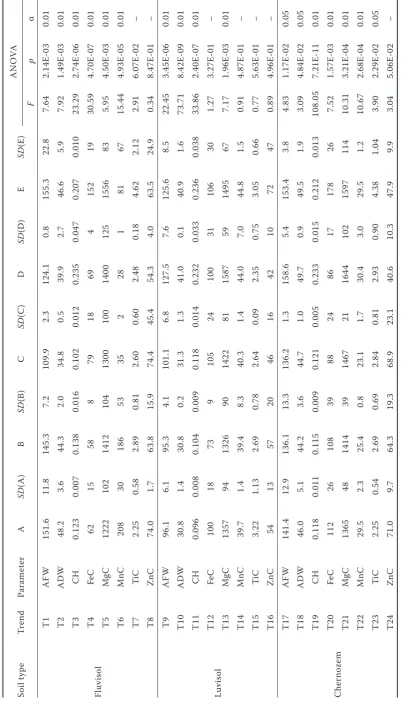
The results are summarized in Table 3; trends are marked T (Trend number). The strength of the influence (how much the factor influences the parameter) is stated in text as the ratio of maximal and minimal value in the trend. Unless stated otherwise, the effects of Ti alone and Mg alone are stated against blank (deionized water treatment) and the effect of Ti in combination with Mg is stated against the Mg leaf spray alone to distinguish the effects of Ti from the effects of Mg in the combined treatments. Only data necessary for the demonstration of the trends are given.
(2.20-times, T4); Mg alone slightly increases FeC (1.12-times, T4). Ti alone (1.16-times, T5) as well as in combination with Mg (1.11-times, T5) increases MgC; MgC is increased by the foliar absorption by Mg alone as well (1.15-times, T5). MnC is strongly (5.88-times, T6) decreased by Ti alone at the higher Ti concentration, but is significantly increased if in combination with Mg even at the medium Ti concentration (2.89-times); Mg alone extremely decreases MnC (7.44-times, T6). Mg increases the resorption of Ti from leaves (1.60-times, T7). ZnC is not significantly influenced by Ti alone, but it is increased by Ti in combination with Mg (1.17-times, T8); Mg alone decreases ZnC (1.36-times, T8). The results are summarized in Figure 1a.
Luvisol. Ti alone does not significantly influ-ence AFW (T9) and ADW (T10), but Mg alone has a significant positive effect on both these parameters [1.33-times increase of AFW (T9) and 1.33-times increase of ADW (T10)]. CH is increased by Ti alone (1.23-times, T11), but the effect of Mg is much stronger (2.41-times increase, T11); the combination Mg + Ti is not significantly different from Mg alone in CH (T11). The effect
of Ti on FeC (T12) and MgC (T13) is not distin-guished even in combination with Mg, but Mg alone increases MgC (1.17-times, T13). MnC (T14) is not significantly influenced by any treatment used. Mg increases the resorption of Ti from leaves if sprayed in combination with Ti (1.30-times, T15), but Mg alone decreases the uptake of Ti from soil. ZnC is not influenced by Ti alone, but is significantly increased by the combination Ti + Mg against Mg alone (1.73-times, T16); Mg alone decreases ZnC (1.28-times, T16). The results are summarized in Figure 1b.
[image:5.595.71.533.66.319.2]Chernozem. Ti does not have a significant ef-fect on AFW (T17) and ADW (T18), but both these parameters are increased by Mg alone [AFW – 1.12-times (T17) and ADW – 1.08-times (T18)]. CH is not significantly influenced by Ti alone, but is decreased by the combination of Ti + Mg against Mg alone (1.10-times, T19); Mg alone significantly increases CH (1.98-times, T19). FeC is decreased by Ti alone (1.28-times, T20), but Ti + Mg strongly increases FeC (2.08-times, T20) against Mg alone; Mg alone decreases FeC (1.31-times, T20). MgC is increased by Ti application (1.08-times, T21),
Figure 1. The effects of the treatments on investigated parameters divided according to soils: (a) Fluvisol; (b) Luvisol; (c) Chernozem; the values are stated in percents of the maximal value in the particular trend
Ti and Mg concentrations: A– no Ti, no Mg; B– medium Ti concentration (10 mg/kg), no Mg; C– high Ti concen-tration (50 mg/kg), no Mg; D – no Ti, Mg concenconcen-tration 2000 mg/kg; E– medium Ti concenconcen-tration (10 mg/kg), Mg concentration 2000 mg/kg
0 20 40 60 80 100
AFW (T1) ADW (T2) CH (T3) FeC (T4) MgC (T5) MnC (T6) TiC (T7) ZnC (T8)
%
o
f m
ax
im
um
0 20 40 60 80 100
AFW (T9) ADW (T10) CH (T11) FeC (T12) MgC (T13) MnC (T14) TiC (T15) ZnC (T16)
%
o
f m
ax
im
um
0 20 40 60 80 100
AFW (T17) ADW (T18) CH (T19) FeC (T20) MgC (T21) MnC (T22) TiC (T23) ZnC (T24)
Physiological parameter (Trend number)
%
o
f m
ax
im
um
A B C D E
(a)
(b)
but the effect of the application of Mg alone is much stronger (1.21-times, T21). MnC is con-siderably lowered by Ti alone (1.28-times, T22), but the effect practically disappears in the case of simultaneous application of Mg (T22); Mg alone does not show a significant effect on MnC (T22). Mg alone considerably stimulates the uptake of Ti from soil (1.62-times, T23). ZnC is not almost influenced by Ti alone (T24); Mg alone lowered ZnC (1.75-times, T24). The results are summa-rized in Figure 1c.
DISCUSSION
The results from our experiment are strongly dependent on soil properties, but we can general-ize some trends. Both the concentrations of Ti in leaf sprays used in this experiment were already phytotoxic. The typical beneficial manifestations of Ti were not observable except for some effects on Fluvisol, see below. The effects connected with the detoxification of Ti (changes in element and chlorophyll contents) were the only significant. The toxicity limit of Ti could be quite sharp, as demonstrated by Maroti et al. (1984); they observed strong beneficial effects of Ti on tobacco callus at the concentration 2 mg/kg Ti in nutrient medium, but the inhibition of growth followed by necro-sis was observed at concentrations higher than 5 mg/kg. We used another way of application of Ti compounds on plants in this experiment – a leaf spray. As the concentration 10 mg/kg Ti showed already some manifestations of Ti toxicity, it is the lowest phytotoxic concentration of Ti leaf spray described up today (compare with Table 1).
If we consider that Ti(IV) is present in plants in the form of phosphate complexes (Gryzhankova and Boichenko 1975, Gryzhankova et al. 1975), we could explain this primary toxicity on molecular basis as a destabilization of biologically active phos-phate esters/normally stabilized by Mg(II) ions in the cell/by Ti(IV). The importance of high affinity of Ti(IV) to phosphate groups for its biological activity was referred to by Guo et al. (2001). We can thus expect protective effects of higher Mg concentrations against phytotoxicity of Ti on the basis of competitive antagonism. This effect was really observed – we found that the additional Mg ameliorated the toxic effects of Ti.
Similarly to Kuželet al. (2003a), the effect of Ti (in both concentrations used), as compared to the control with no application, is radically dif-ferent from the effect of (Ti + Mg), especially in
the essential elements contents in plant (as FeC); redistribution of mineral nutrients during seed-filling stage within shoot was not considered in this study because whole shoots were analyzed. Another effect is a significant increase of CH by a single Mg application (more than twice on aver-age), while MgC is increased considerably less. This would suggest that although most of the Mg present in leaf is metabolically inactive (in phytate depo etc.), the additional Mg from the leaf spray is biologically much more available. This effect can-not be explained by non-uniform senescence of the variants because there were not observed any signs of senescence in any variant in time of harvest.
However, the trends greatly differ in the strength of the particular effect if we look at the effect of soil the plants grow in. It was observed that the effects of treatments are relatively strong on Fluvisol, but weak on Chernozem and Luvisol. It thus generally confirms that Ti effects are most evident under conditions of limited and insufficient supply of the essential elements (see data in Table 2 for Fluvisol that is deficient in Mg, Fe, Mn and Zn). Ti is ben-eficial in this case to the elements contents and some physiological parameters. The fact that Ti is more beneficial on a poor soil is already known (Lopez-Moreno et al. 1996); these authors assume that the crucial effect is the lack of phosphorus, but we have observed a rather reversed effect. The effect is the most evident in our experiment on Fluvisol, which is rich in phosphate (353 mg P per kg, see Table 2) that decreases the bioavail-ability of the cationic nutrients complexed by it for the plant. The soil pH value also seems to play some role, due to its influence on the mobility of the ionic nutrients in soil (Ti is the most efficient on more acidic Fluvisol).
is dose-responsive and depends on the strength of the plant defense reaction versus Ti toxic effect on the particular parameter (see Hrubý et al. 2002 and Kužel et al. 2003a for details). This effect is usually called hormesis and is known for a range of elements, mainly heavy metals (e.g. As, Cd, Pb, Hg, Se and Zn) (Calabrese and Baldwin 2003).
The above stated complex defensive reaction results in equalizing effect of Ti on the elements contents in the plant. This means that if the blank level of the element in the plant is rather low, it is increased by Ti and vice versa to a certain, probably optimal, concentration. This could be advantageous for the amelioration of the toxic ef-fects of heavy metals by Ti. Protective efef-fects of Ti on plants intoxicated by heavy metals (cadmium) were described in (Lesko et al. 2002) and we ob-served here similar results for manganese that is phytotoxic in higher concentrations; Ti application caused a significant decrease in MnC.
Besides, statistically significant correlations were observed between TiC and the other parameters followed in this study: AFW (0.37), ADW (0.33), FeC (0.64), MgC (0.45); the number in parentheses is the particular correlation coefficient between the stated parameter and TiC for all the variants and replicates. The correlation was statistically significant at level α = 0.01 in all the cases stated above. The correlation of TiC with the other inves-tigated parameters is not statistically significant at level α = 0.05.
REFERENCES
Calabrese E.J., Baldwin L.A. (2003): Inorganics and hormesis. Crit. Rew. Toxicol., 33: 215–304.
Collins J.M., Uppal R., Incarvito Ch.D., Valentine A.M. (2005): Titanium (IV) citrate speciation and struc-ture under environmentally and biologically relevant conditions. Inorg. Chem., 44: 3431–3440.
Gryzhankova L.N., Boichenko E.A. (1975): Study of titanium compounds in plants. Fiziol. Rast., 22: 1177–1182.
Gryzhankova L.N., Udelnova T.M., Boichenko E.A. (1975): Iron, manganese and titanium compounds in marine plants. Izv. Akad. Nauk SSSR, Ser. Biol.,
1: 76–82.
Guo M.L., Guo Z.J., Sadler P.J. (2001): Titanium(IV) targets phosphoesters on nucleotides: implications for the mechanism of action of the anticancer drug titano-cene dichloride. Biol. Inorg. Chem., 6: 698–707. Hara T., Sonoda Y., Iwai I. (1976): Growth response of
cabbage plants to transition elements under water
culture conditions. I. Titanium, vanadium, chro-mium, manganese, and iron. Soil Sci. Plant Nutr.,
22: 307–315.
Hrubý M., Cígler P., Kužel S. (2002): Titanium in plant nutrition. The contribution to understanding the mechanism of titanium action in plants. J. Plant Nutr.,
25: 577–598.
Huang M.L., Tang X.D., Lu L. (1993): The use of tita-nium chelate in agriculture. In: Froes F.H., Caplan I.L. (eds.): Titanium ’92: Sci. Technol. In: Proc. Symp. 3. Miner. Met. Mater. Soc., Warrendale: 2779–2786.
Kužel S., Hrubý M., Cígler P., Tlustoš P., Phu N.V. (2003a): The mechanism of physiological effects of titanium leaf sprays on oat (Avena sativa L.) plants grown on soil. Biol. Trace Elem. Res., 91: 179–189.
Kužel S., Hrubý M., Cígler P., Tlustoš P., Száková J. (2003b): Titanium and plants – the centenary story. In: Simon L., Szilágyi M. (eds.): Trace Elements in the Food Chain. György Bessenyei Publ., Nyíregy-háza: 150–156.
Lesko K., Stefanovits-Banyai E., Pais I., Simon-Sarka-di L. (2002): Effect of cadmium and titanium-ascor-bate stress on biological active compounds in wheat seedlings. J. Plant Nutr., 25: 2571–2581.
Lopez-Moreno J.L., Giménez J.L., Moreno A., Fuentes J.L., Alcaraz C.F. (1996): Plant biomass and fruit yield induction by Ti(IV) in P-stressed pepper crops. Fert. Res., 43: 131–136.
Mader P., Száková J., Miholová D. (1998): Classical dry ashing of biological and agricultural materials. Part II. Losses of analytes due to their retention in an absolute residue. Analusis, 26: 121–129.
Maroti M., Pais I., Bognar J. (1984): The role of titanium in plant life. V. The effect of titanium on the growth of tobacco callus. Acta Agron. Acad. Sci. Hung., 33: 315–322.
Mehlich A. (1984): Mehlich No. 3 soil test extractant: A modification of Mehlich No. 2. Commun. Soil Sci. Plant. Anal., 15: 1409–1416.
Pais I., Somos A., Duda L., Trjanyi F., Nagymihaly F. (1969a): Microelement tests on tomato and sweet pepper. Kert. Egy. Közlem., 33: 63–81.
Pais I., SomosA., Duda L., Trjanyi F., Nagymihaly F. (1969b): Trace-element experiments with tomato and paprika. Kertészet, 62: 25–40.
Sims J.R., Haby V.A. (1971): Simplified colorimetric determination of soil organic matter. Soil Sci., 112: 137–141.
Száková J., Tlustoš P., Balík J., Pavlíková D., Balíková M. (2000): Efficiency of extractants to release As, Cd, and Zn from main soil compartments. Analusis, 28: 808–812.
Tlustoš P., Cígler P., Hrubý M., Kužel S., Száková J., Pavlíková D., Balík J. (2005): The role of titanium in biomass production and its influence on essential
elements contents in field growing crops. Plant Soil Environ., 51: 19–25.
Wallace A., Alexander G.V., Chaudhry F.M. (1977): Phytotoxity of cobalt, vanadium, titanium, silver, and chromium. Commun. Soil Sci. Plant Anal., 8: 751–756.
Zbíral J. (2001): Comparison of methods for soil pH determination. Rostl. Výr., 47: 463–466.
Received on July 3, 2006
Corresponding author:
Prof. Ing. Stanislav Kužel, CSc.,Zemědělská fakulta, Jihočeská univerzita v Českých Budějovicích,Studentská 13, 370 05 České Budějovice, Česká republika