The modern agriculture and food processing, gener-ally all kinds of entrepreneurship in agribusiness, are becoming more complicated and more demanding. The reason is not only in closer connection with other branches of the national and international economy but also in the additional social, ecological, health and environmental issues.
Management of such a complicated complex of activities calls for the high professional level of top managers. Reliable information about the conditions and running of the reproduction process including its development estimation are necessary. The decision making process should be supported by automatic expert systems which is able to propose the best solution as well as the optimal decision based on collection and evaluation of information.
Small and medium enterprises (SME’s) in agri-business usually do not have sufficient sources to invest into introduction, maintenance and deve-lopment of such systems. There is not only a lack
of the financial, material and time sources. The decisive elements are knowledge and experience of the manager. Insufficient sources are limiting fac-tors for the necessary analysis, which could be used as the decision base. A research made by external service provider exceeds the budget constraint of most companies. The reasonable solution is to use the potential of simple methods. These methods are able to provide approximate, benchmarking but valuable results. The goal of scientific institutes is to propose and describe such methods together with the publicity among the professional community.
This article represents one of the possible accesses to the price creation in SME’s. The method is based on the Simple Additive Weighting method (SAW), which has been described in literature, for example Ching-Lai, Kwangsun (1981); Fiala et al. (1997); Tyc, Holoubek (2004). The article deals with the possible exploitation of SAW for assessment and correction of the price of concrete product.
Multiple-criteria approach for strategy adaptation
in SME’s
Vícekriteriální přístup pro adaptaci podnikové strategie v malých
a středních firmách
L. DÖMEOVÁ, M. HOUŠKA, M. BERÁNKOVÁ
Czech University of Agriculture, Prague, Czech Republic
Abstract: The formulation and adaptation of a firm strategy in small and medium enterprises depends on the management qualification and available project and modeling tools. With regard to the conditions in small Czech companies engaged in agribusiness, we encourage using uncomplicated quantitative models, the results of which can be also valuable. In the con-tribution, we show the possible utilization of simple additive weighting method for price assessment.
Key words: decision making, decision support, small and medium enterprises, simple additive weighting method, utilizati-on functiutilizati-on, competitiutilizati-on
Abstrakt: Vytváření a adaptace podnikové strategie v malých a středních firmách závisí na kvalifikaci řídících pracovníků a disponibilních projektových a modelových nástrojích. Vzhledem k podmínkám v malých českých firmách doporučujeme použití nekomplikovaných kvantitativních nástrojů, jejichž výsledky mohou být přínosné. V článku se zabýváme použitím metody váženého součtu pro rozhodování o ceně.
Klíčová slova: rozhodování, podpora rozhodování, malé a střední firmy, metoda váženého součtu, funkce užitku, konku-rence
MULTIPLE ATTRIBUTE DECISION MODEL (MADM) AND THE SIMPLE ADDITIVE WEIGHTING METHOD (SAW)
The MADM model is expressed in a decision ma-trix
(1)
The decision matrix A is a (m × n) matrix with
m alternatives in lines and n criteria in columns whose element aij = (i = 1, …, m; j = 1, …, n) indicates evaluation of alternative Ai with respect to attribute (criterion) j. Hence the column vector Aj = (a1j, a2j, …, amj)T shows the contrast of each alternative with respect to criterion j. Suppose the first k criteria are cost criteria and the rest (n – k) criteria are benefit criteria. The benefit criterion means if aij > ai’j, then, with respect to criterion j the alternative Ai is pre-ferred to alternative Ai’. The cost criterion means that if aij < ai’j, then, with respect to criterion j, the alternative Ai is preferred to alternative Ai’.
The relative attribute importance is expressed by weight vector v = (v1, v2, …, vn). Usually the weight is normalized so that
(2)
The SAW method algorithm starts with determi-nation of the ideal alternative H = (H1,H2, …, Hn), which consist of the best attribute values by each attribute, and the negative ideal alternative D = (D1,
D2, …, Dn), which consists of the worst attribute values by each attribute.
Then the decision matrix is standardized by the formula
(3)
For all the values of the standardized decision matrix
R = (rij) is valid rij∈〈0; 1〉.
Finally, the decision maker chooses the alternative with maximum value of scalar product ui
(4)
The modified SAW method enables the user to change one of the variant’s values in order to
im-prove the aggregate evaluation of the variant so that the variant will reach the stated value of the utility function. This property we used in the following case study. In the first step, we found out how the change of one parameter had influenced the total value of utility function. Let the value (parameter) of i-th variant by j-the criterion be changed by ∆aijand at the same time it is valid:
Dj ≤ aij + ∆aij ≤ Hj (5)
Than only one value in the whole standardized matrix is changed during the standardization pro-cedure (3), value rij by:
(6)
The utility ui obtained using (4) is changed:
(7)
The change in single element of the decision matrix under the stated condition would result in different evaluation of the single variant the parameter of which has been changed.
Suppose now that the inequality (5) is not valid. That is why there is a change in the ideal or negative ideal variant. Let:
aij + Δaij ≥ Hj, (8)
then:
Hj’ = a
ij + Δaij (9)
The evaluation of all variants with the exception of Aj is changed into:
(10)
The evaluation of Ai is changed into:
. (11)
In the following case study, we show how to use the above described feature of the frequently used SAW method for improving the market position. We will call the algorithm above “inverse SAW algorithm”. The method enables the decision maker to choose the strategy of behavior.
11 12 1 1, 1 1
21 22 2 2, 1 2
1 2 , 1
k k n
k k n
m m mk m k mn
a a a a a
a a a a a
A
a a a a a
� � � � � � � � � � � � � � � � � � � � � � � � 1 1 �
�
� n j j v j j j ijij Ha DD
r � ��
�
�
� n j ij j
i r v
u 1 j j ij ij j j ij j j j ij j j j ij ij
ij a H a D D Ha DD H aD r H aD
r � � � � � � � � � � � � � � � ' j j ij ij j j ij j j j ij j j j ij ij
ij a H a D D Ha DD H aD r H aD
r � � ��
� � � � � � � � � � � ' j j j ij n
j ij j
i r v H aD v
u �
�
� ���1 ' i k v D H D a u n
j j j j
j kj k � � � �
�
� , 1 ' ' i k v D H D a a u nj j j j
CASE STUDY: PRODUCT PRICE ASSESSMENT
The case study shows how the inverse SAW al-gorithm can be used for product price assessment. The user is in the position of the manager of a meat processing plant and his goal is to carry a product (certain kind of salami) through the competitive agribusiness environment.
The consumer (wholesaler, chain of supermarkets) is choosing the products by its marketability to final customers. The decision can be based on the published results of consumer tests, on own experience, own research on preferences, etc. It was proved that the final consumer calls for good quality, enjoyable taste and reasonable price and that is why the wholesale customer uses the same criteria. It is clear that also the producer has to use the same criteria.
Suppose that the aim of the producer is to get into the wholesale. The strategy of the vender is to sell products of the acceptable quality for outstand-ing (low) prices. It means that the criterion price is
preferred both to the taste and to the quality. The taste and the quality are equally important. The ap-propriate weight vector can be then constructed as
v = (0.2; 0.2; 0.6).
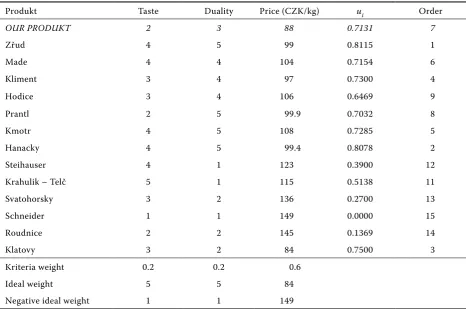
The salami producer should make a preliminary evaluation whether his product is competitive to other producers. The data are in Table 1.
It is also important for decision-making that the only parameter, which can be changed immediately without changing technology or material, is the price. The change of taste or quality needs changes in the production technology and such changes are not flexible enough. If the technology change is planned, probably more methods and more complicated analysis should be used.
[image:3.595.64.531.389.698.2]In our example, the product has got to the first half of the evaluated products. The wholesaler’s offer is not that wide so the products does not have a real chance to get into the group of the products being sold. In the case the product has been already placed among the wholesale offer, the position among first five products would be satisfactory. But this is not
Table 1. Data for preliminary evaluation*
Produkt Taste Duality Price (CZK/kg) ui Order
OUR PRODUKT 2 3 88 0.7131 7
Zřud 4 5 99 0.8115 1
Made 4 4 104 0.7154 6
Kliment 3 4 97 0.7300 4
Hodice 3 4 106 0.6469 9
Prantl 2 5 99.9 0.7032 8
Kmotr 4 5 108 0.7285 5
Hanacky 4 5 99.4 0.8078 2
Steihauser 4 1 123 0.3900 12
Krahulik – Telč 5 1 115 0.5138 11
Svatohorsky 3 2 136 0.2700 13
Schneider 1 1 149 0.0000 15
Roudnice 2 2 145 0.1369 14
Klatovy 3 2 84 0.7500 3
Kriteria weight 0.2 0.2 0.6
Ideal weight 5 5 84
Negative ideal weight 1 1 149
Evaluation scale: 5 = very good, 4= good, 3 = average, 2 = satisfying, 1 = unsatisfying. The evaluation of TASTE consists of evaluation of look, consistency and taste. The evaluation of QUALITY consists of water activity, content of soybean proteins, pure muscular proteins and fat.
our situation. Let us imagine that we are trying to displace one of the currently offered products and replace it by our salami and that is why we need to place our product among the first three ones. Only in such case the wholesaler will take in mind the op-tion to start purchasing our product and to displace another one.
First we proved the chances of a less aggressive strategy. We go down with the price of our product by 3% to 85.35 CZK/kg. The value of the criterion price for our product is not higher than the actual ideal value, H3 = 84, so that we use formulas (6)–(7) for recalculation. We get:
u1’ = 0.7374
what will cause, according to the Table 1, shift to the third rank.
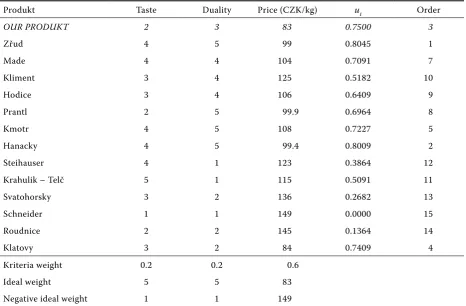
The second example examines a more aggressive strategy. We lower the price by 5.6% to 83 CZK/kg. The value of the ideal variant H3will change toH3’. For new evaluation and ranking, it is necessary to re-calculate the whole table using the formulas (8)–(11). The results see in Table 2.
It follows from the Table 2 that the plan to place the product among the first three would be fulfiled when the price decreases to 83 CZK/kg. The utility
function for further price reduction would not be improved but this indicator would go down for ev-ery other product. This conclusion follows directly from the features of the evaluation process, which were deducted above and formalized in formulas (6)–(11).
CONCLUSIONS
The article proposes the fast way of evaluation of the competitive position in the market. The case study is methodological so that it shows how to use the proposed method.
[image:4.595.66.533.84.390.2]The case study is just a model case. In the real situ-ation, there will be probably more decision criteria. There may be also the possibility to change other parameters of the product – not only the price. The final result of the chosen strategy is usually influ-enced by negotiations with the wholesale vendor, which can dependend on relations to other suppliers. Lowering the price is not unlimited because it must be over production costs to secure the acceptable profit for the producer. The inverse SAW method we propose as a tool for preliminary analysis, which can bring valuable information about the situation in the market. Even this simple method is able to eliminate Table 2. Recalculation of the model with modified decision matrix
Produkt Taste Duality Price (CZK/kg) ui Order
OUR PRODUKT 2 3 83 0.7500 3
Zřud 4 5 99 0.8045 1
Made 4 4 104 0.7091 7
Kliment 3 4 125 0.5182 10
Hodice 3 4 106 0.6409 9
Prantl 2 5 99.9 0.6964 8
Kmotr 4 5 108 0.7227 5
Hanacky 4 5 99.4 0.8009 2
Steihauser 4 1 123 0.3864 12
Krahulik – Telč 5 1 115 0.5091 11
Svatohorsky 3 2 136 0.2682 13
Schneider 1 1 149 0.0000 15
Roudnice 2 2 145 0.1364 14
Klatovy 3 2 84 0.7409 4
Kriteria weight 0.2 0.2 0.6
Ideal weight 5 5 83
Ching-Lai H., Kwangsun Y. (1981): Multiple attribute decision making. Springer Verlang, Berlin-Heide-lberg-New York.
Tyc O., Holoubek J. (2004): Poznámky k problemati-ce víproblemati-cekriteriálního hodnoproblemati-cení konečného počtu variant. Proceedings of conference Kvantitativné metódy v ekonómii. SPU, Nitra.
http://ekonomika.idnes.cz
Arrived on 1st February 2006
strategies, which have no chance for success so that remarkable costs could be spared.
REFERENCE
Fiala P., Jablonský J., Maňas M. (1997): Vícekriteriální rozhodování. VŠE, Praha.
Contact address:
Ludmila Dömeová, Milan Houška, Martina Beránková, Czech Agriculture University Prague, Kamýcká 129, 165 21 Prague 6-Suchdol, Czech Republic