ISSN Online: 2329-3292 ISSN Print: 2329-3284
A Framework of Output Specifications and
Evaluation Method for Hospital PPP Projects
Yun Pei
College of Civil Engineering and Architecture, Zhejiang University, Hangzhou, China
Abstract
Introduction: Public-private partnership (PPP) has been adopted widely in infrastructure construction projects, and its application in medical and health service industry is increasing day by day. However, the performance of a PPP project could be affected by a number of factors and their interactions, due to its complexity in multiple stakeholders and stages. Previous researches on hospital PPP projects mainly focus on the factors which lead to success/failure, or the results of implementing PPP on hospital projects, or risk management, rather than its evaluation mechanism. So, to comprehensively promote and guarantee the effective implementation of the hospital PPP project, a scientif-ic quantitative evaluation method according to certain evaluation procedures and the performance evaluation system for hospital PPP projects are pro-posed from the perspective of the government.
Keywords
Public-Private Partnership (PPP), Analytic Hierarchy Process (AHP), Output Specification
1. Introduction
Public-private partnership (PPP) is cooperation between the public and private sector that combines the abilities of partners involved to achieve better out-comes, and is seen as a revolution in construction industry, being welcomed by agencies and governments. What’s more, PPP projects lay more emphasize on hospital assets, with all focus on leveraging capacities and integrating resources of both public and private sectors, just to introduce funding and expertise into healthcare sector.
To achieve the common goals, both the public and private sectors need to sign an agreement and form a project company to help construct the project. In PPP How to cite this paper: Pei, Y. (2019) A
Framework of Output Specifications and Evaluation Method for Hospital PPP Projects. Open Journal of Business and Management, 7, 167-179.
https://doi.org/10.4236/ojbm.2019.71012
Received: December 10, 2018 Accepted: January 6, 2019 Published: January 9, 2019
Copyright © 2019 by author(s) and Scientific Research Publishing Inc. This work is licensed under the Creative Commons Attribution International License (CC BY 4.0).
http://creativecommons.org/licenses/by/4.0/
Open Access
hospital projects, the public sector is in charge of the operation of core health services, clinical services for instance. Meanwhile, private sector is concentrating on no-core services, such as safety secure and cleaning. However, there are still problems that occur in such projects, caused by complexity of multiple stake-holders and long periods of construction. So, research mainly focused on the risk management of hospital PPP projects, and quantities of studies put effort into how to save costs. However, in some projects, the government’s specific effi-ciency gains from part of the successful bidder’s proposal evaluation, and it may be possible to include performance indicators related to the availability of these efficiency gains when the project is operational. According to literature review and investigations, there are few examples of PPPs in the hospital sector in de-veloping countries, and how to comprehensively evaluate the performance of a hospital PPP project from the standpoint of the public sector has not been pro-posed yet. In order to deal with such problem, the project company shall regu-larly monitor and analyze the construction and operation of the project accord-ing to the concession agreement, conduct performance evaluation with the rele-vant departments, and establish a mechanism for adjusting the price or financial subsidies according to the performance evaluation results and in accordance with the concession agreement. The quality and efficiency of the public services will then be guaranteed. Project companies should also consider public opinions as an important part of monitoring the implementation of the hospital PPP project and performance evaluation.
Based on the above research status, this paper sets output specifications and constructs the framework of evaluation indicators for evaluation, using analytic hierarchy process (AHP) method to assess the implementation of hospital PPP projects. Finally, the framework and its evaluation method are applied in a spe-cific hospital PPP project as a case study. Therefore, the result of study can be provided to the public sector to regulate and guarantee the successful imple-mentation of hospital PPP projects, and to improve the level of management of medical and health.
2. Research Methodology
2.1. Questionnaire Survey
The study adopted a questionnaire survey approach using a self-administered questionnaire, released by mail. The mail survey approach was considered as feasi-ble due to samples that are geographically dispersed. Respondents were enticed to responds with rewards. The survey was supported by personal face-to-face interview. The interviewers were guided by a set of similar questionnaire used in the mail survey. A total of 142 questionnaires were e-mailed and 69 question-naires were collected in this survey, of which 58 were valid questionquestion-naires. Among the effective responses, there are 13 experts, scholars in universities or academic institutions, 17 government officials, 28 design institutes, contractors and other business people. Most of the respondents have a rich PPP project
(average 12 years, maximum duration of 38 years) experience. Additional 31 responses were obtained from the personal face-to-face interview. This tech-nique will also help to reduce the rate of misinterpretation of questionnaires and to prevent respondent’s error.
The sample size of this questionnaire is relatively small, probably due to the following two reasons: Firstly, the application of PPP mode in China started late, there are not much experienced experts or scholars in this field as expected. Se-condly, the questionnaire contains 22 primary indicators and 56 secondary in-dicators, which makes filling the questionnaire time-consuming, thus retard many respondents. However, the respondents of this questionnaire are targeted to the relevant personnel in the PPP fields within a certain scope, and the re-sponse rate is 40.8%. According to the Moser and Kalton research, when the questionnaire survey rate is less than 30% - 40%, the result of questionnaire sur-vey is biased [1]. So the survey result is credible and effective in terms of re-sponse rate. For the reliability and validity of the questionnaire survey results, the paper uses Alpha reliability coefficient for reliability test and KMO value for validity test. According to SPSS analysis, Cronbach’s Alpha was 0.897 and the KMO value was 0.876, indicating that the consistency of the questionnaire was good and the questionnaire was valid. The identified indicators were stable and reliable.
In the questionnaire, the output specifications and indicators through litera-ture review were listed, and questions were written to inquire suggestions on the reduction/increase of indicators by respondents. While interviewing, pairwise comparison of indicators was asked and recorded as data to estimate weights of each indicator. After the evaluation system was created, an interviewee was asked to provide a score of each indicator to get the whole evaluation score for the output of the hospital PPP project which is actually put into operation.
2.2. Determination of Weight Vector
ω
by AHP
The analytic hierarchy process (AHP) was officially proposed by the American operations researcher T. L. Saaty in the mid-1970s [2]. It is a systematic and hie-rarchical analysis method combining qualitative and quantitative methods. Due to its practicality and effectiveness in dealing with complex decision-making problems, it has quickly gained worldwide attention. Its applications span the areas of economic planning and management, energy policy and distribution, behavioral science, military command, transportation, agriculture, education, talent, health, and the environment.
The basic idea of AHP is basically the same as the process of thinking and judging a complex decision-making problem. This method provides a basis for quantitative evaluation of indicators, selection of optimal solutions, and has been widely used. Figure 1 shows the hierarchical structure of AHP model.
The objectives of the decision, the factors considered (decision criteria) and the decision objects are divided into the highest layer, called Objective (Level 1).
Figure 1. Hierarchy structure of performance evaluation indicators.
The middle layer concludes factors to consider, guidelines for decision making, namely Criteria (Level 2). The lowest layer contains the alternatives when mak-ing decisions, called Attributes (Level 3). Hence, the hierarchical structure dia-gram is drawn [3].
The weight of each indicator is determined by means of pairwise comparisons of the activities to indicate the power with which one activity dominates another.
The pairwise comparison is established using a nine-point scale that converts the human preferences between available alternatives as equal importance, weak importance, strong importance, very strong importance and absolute impor-tance, and each scale is empowered 1, 3, 5, 7, 9 relatively. As for Intermediate values between adjacent scale values, we use 2, 4, 6, 8 as transition scores. The comparison is based on experts’ judgment. Suppose n experts take part in the survey. Each expert’s opinion is obtained and analyzed individually to determine the weight vector ωi belonging to Indicator Group i (i = 1 − l). The following
procedures provide a method to obtain the weight of indicators at Level 3 in
Figure 1. As is shown in Figure 1, Indicator Group 1 is composed of x number
of indicators, and is defined by
{
α α1, , ,1 …α1}
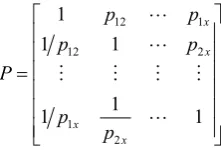
Then, the pairwise judgment matrix for the weight of indicators based on the kth expert’s thoughts (k = 1 − n) is an x-by-x nonzero reciprocal matrix P, as presented below (Pij means the pairwise value after comparing αi with αj):
12 1 12 2 1 2 1 1 1 1 1 1 x x x x p p p p P p p =
As an example, the eigenvector of indicator 𝛼𝛼1is calculated by
(
1 2)
1k 1k, 1k , , 1kn
ω′ = ω ω′ ′ …ω′
1 1 i n n k ij j p ω = ′ =
∏
Then the eigenvector is normalized by 1 1 1 1 i i j k k n k j ω ω ω = ′ = ′
∑
Based on the scores given by Expert k, the weight vector ω1k of the
indica-tors of Indicator Group 1 is: ω1k =
(
ω1 1k ω1 2k … ω1k n)
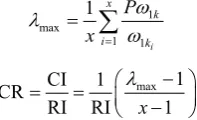
.At last, a way to prevent artificial error and a consistence check need to be conducted until the precise result is obtained. The maximum eigenvalue λmax is a measure of consistency of judgement.
1 max 1 1 1 i x k i k P x ω λ ω = =
∑
max 1 CI 1 CRRI RI x 1
λ −
= =
−
CR represents the consistency ratio; CI represents the consistency index; Ri represents average consistency index, as is shown in Table 1. When CR < 0.1, the matrix has satisfactory consistency; otherwise, it needs to be adjusted.
After all the results are calculated and the weight vector ω1k
(
k= −1 m)
areworked out, the weight vector 𝜔𝜔1for Indicator Group 1 is determined by:
1 1 1 2 1
1 1 1
1 1
1
1 n n n n
k k k x
k k k
k i
n n n n
ω ω ω
ω ω = = =
= = = …
∑
∑
∑
∑
The weight vectors ω ω2− 2l for indicators at Level 3 of Indicator Group 2-l
can be obtained by means of the above method. And the weight ωm for the
in-dicator groups at Level 2 can also be calculated with the method.
3. The Framework of Output Specifications for Hospital PPP
Projects
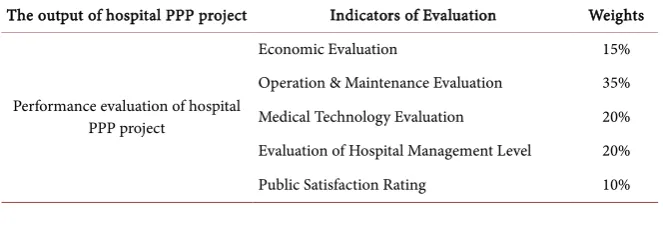
According to the literature review and a questionnaire survey conducted pre-viously, the output specifications and indicators can be synthesized and summa-rized into five categories, namely economic evaluation, operation & maintenance evaluation, medical technology evaluation, evaluation of hospital management level, public satisfaction evaluation [4] [5] [6]. These five categories will be dis-cussed separately in the following paragraphs, and the weights are calculated us-ing the data collected from questionnaire survey and method mentioned above.
3.1. Economic Evaluation
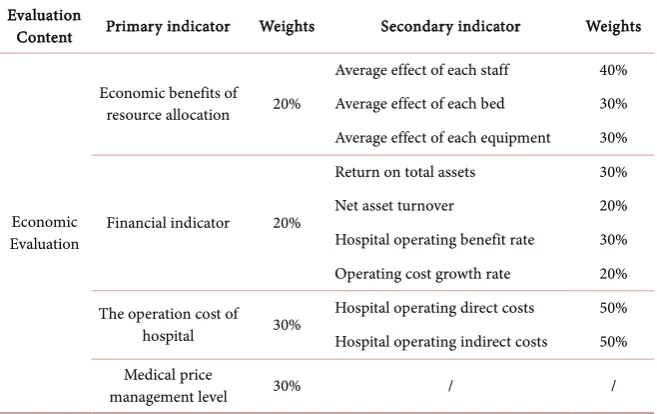
As is shown in Table 2, this section mainly evaluates the economic situation of hospital from perspectives of economic benefits of resource allocation, financial indicator, the operation cost of hospital, and medical price management level.
[image:5.595.324.423.123.183.2]The economic benefits of resource allocation shall be assessed by the use of resources in terms of personnel, beds and equipment. It mainly investigates whether hospitals can organize production factors such as personnel, beds and equipment according to medical needs during operation, maximize economic benefits, and avoid waste of resources caused by idleness.
Table 1. Average random consistency index.
x 1 2 3 4 5 6 7 8 9
RI 0.00 0.00 0.58 0.90 1.12 1.24 1.32 1.41 1.45
Table 2. Economic evaluation. Evaluation
Content Primary indicator Weights Secondary indicator Weights
Economic Evaluation
Economic benefits of resource allocation 20%
Average effect of each staff 40% Average effect of each bed 30% Average effect of each equipment 30%
Financial indicator 20%
Return on total assets 30%
Net asset turnover 20%
Hospital operating benefit rate 30% Operating cost growth rate 20%
The operation cost of hospital 30%
Hospital operating direct costs 50% Hospital operating indirect costs 50% Medical price
management level 30% / /
Financial indicators are based on the internal perspective of the hospital to consider the financial situation of the hospital, the main indicators are: total re-turn on assets, net assets re-turnover rate, hospital operating efficiency rate, oper-ating cost growth rate.
The operation cost of hospital means to assess the economic status of hospital management and decision-making from the aspects of direct cost and indirect cost, classifying, recording, collecting, and analyzing reports on various expenses in the medical service process, analyzing relevant costs information.
The level of medical price management, that is, from the perspective of the degree of openness and transparency of the price, the procurement process, and the true and accurate price information, whether the hospital’s drug price and the medical treatment price are controlled within a reasonable level, and truly serve the people’s livelihood.
3.2. Operation & Maintenance Evaluation
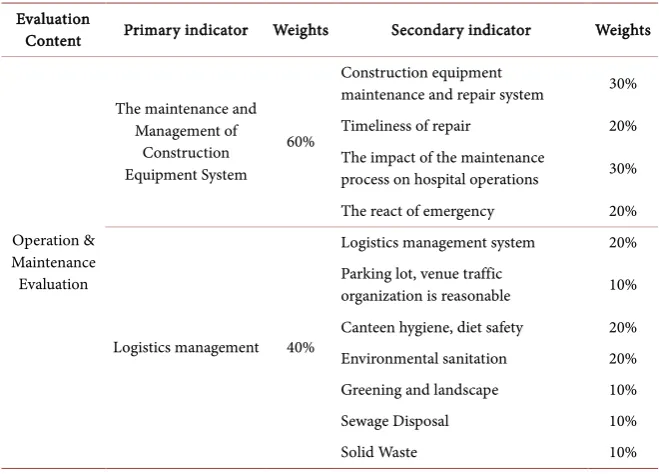
As is shown in Table 3, this section evaluates hospital operation and mainten-ance of hospital PPP projects from the perspective of third-party regulatory agencies [4]. When the social capital party participates in the construction and design of the hospital PPP project, it is mainly responsible for providing the re-pair and maintenance of the building during the operation period.
The evaluation of hospital operation and maintenance is divided into main-tenance and management of construction equipment system and evaluation of logistics management work.
The maintenance and management of construction equipment system takes up 60% of “Operation & Maintenance Evaluation”, which makes it extremely important when a hospital PPP project is evaluated from this perspective. The hospital’s operation status is inspected from the perspective of hospital construc-tion equipment hardware. The index is divided into construcconstruc-tion equipment
Table 3. Operation & maintenance evaluation. Evaluation
Content Primary indicator Weights Secondary indicator Weights
Operation & Maintenance Evaluation
The maintenance and Management of
Construction Equipment System
60%
Construction equipment
maintenance and repair system 30% Timeliness of repair 20% The impact of the maintenance
process on hospital operations 30% The react of emergency 20%
Logistics management 40%
Logistics management system 20% Parking lot, venue traffic
organization is reasonable 10% Canteen hygiene, diet safety 20% Environmental sanitation 20% Greening and landscape 10%
Sewage Disposal 10%
Solid Waste 10%
maintenance and repair system, maintenance technology advancement, main-tenance timeliness, mainmain-tenance process impact on hospital operation, emer-gency Handling job evaluations.
The evaluation of logistics management is to investigate the operation of the hospital from the soft environment of daily affairs indirectly related to hospitals and medical treatment. The indicators are divided into logistics management system, parking lot, reasonable traffic organization, canteen hygiene, food safety, environmental sanitation, green landscape, Seven tertiary indicators for sewage discharge and solid waste disposal.
When evaluating the infrastructure of a hospital, special considerations should be given to the layout, function setting, medical procedures, safety re-quirements, sanitation rere-quirements, environmental protection and supporting facilities of the hospital building; the climate and resources of the local area should be combined according to the principle of adapting to local conditions. So, the environmental, economic and cultural characteristics were evaluated in this paper.
Operational management evaluation is carried out during the operational man-agement phase. The evaluation of the operation and manman-agement stage shall be carried out after the completion of the design scale and normal operation for more than one year (including one year), after the construction and equipment audit.
3.3. Medical Technology Evaluation
As is shown in Table 4, this section evaluates medical technology for hospital PPP projects from the perspective of third-party regulators.
The evaluation of medical technology is divided into service level of outpa-tient and inpaoutpa-tient, surgical and anesthesia skill, and quality of nursing.
Table 4. Medical technology evaluation. Evaluation
Content indicator Primary Weights Secondary indicator Weights
Medical Technology
Evaluation
Service level of outpatient and
inpatient 40%
Qualified rate of prescription 25% Admitting and discharge diagnosis accuracy 25% The success rate of critically ill patients rescue 25% The average length of stay 25%
Surgical and anesthesia skill 30%
The incidence of complications of the patients 50%
The mortality of anesthesia 50% Quality of
nursing 30% / /
Service level of outpatient and inpatient is divided into four aspects, including the qualified rate of prescription, admitting and discharge diagnosis accuracy, the success rate of critically ill patients rescue, and the average length of stay.
Surgical and anesthesia skill is divided into the incidence of complications of the patients and the mortality of anesthesia, that is, accidents caused by impro-per oimpro-peration of anesthesia during surgery.
Quality of nursing is evaluated from the perspectives of medical care ratio, guard bed ratio, nurse-to-patient ratio, implementation of job responsibilities, and number of patient care accidents. Different from the above grading, quality of nursing is assessed comprehensively, so secondary indicator doesn’t show up
in Table 4.
3.4. Evaluation of Hospital Management Level
As is shown in Table 5, this section evaluates hospital management for hospital PPP projects from the perspective of third-party regulators.
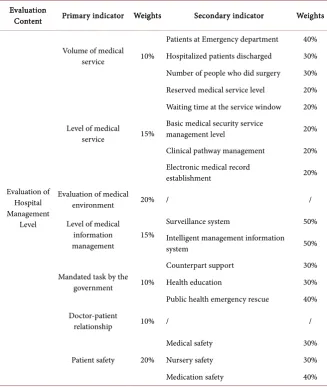
The evaluation of hospital management is divided into volume of medical ser-vice, level of medical serser-vice, evaluation of medical environment, level of medi-cal information management, mandated task by the government, doctor-patient relationship and patient safety.
Volume of medical service is divided into three aspects: patients at emergency department, hospitalized patients discharged, and number of people who did surgery.
Level of medical service is divided into the reserved medical service level, waiting time at the service window, basic medical security service management level, clinical pathway management and electronic medical record establishment. Level of medical information management is assessed from the following perspectives, namely surveillance system and intelligent management informa-tion system.
Mandated task by the government is evaluated from counterpart support, health education and public health emergency rescue.
Table 5. Evaluation of hospital management level.
Evaluation
Content Primary indicator Weights Secondary indicator Weights
Evaluation of Hospital Management
Level
Volume of medical service 10%
Patients at Emergency department 40% Hospitalized patients discharged 30% Number of people who did surgery 30%
Level of medical service 15%
Reserved medical service level 20% Waiting time at the service window 20% Basic medical security service
management level 20%
Clinical pathway management 20% Electronic medical record
establishment 20%
Evaluation of medical
environment 20% / /
Level of medical information
management 15%
Surveillance system 50%
Intelligent management information
system 50%
Mandated task by the government 10%
Counterpart support 30%
Health education 30%
Public health emergency rescue 40% Doctor-patient
relationship 10% / /
Patient safety 20%
Medical safety 30%
Nursery safety 30%
Medication safety 40%
Patient safety is evaluated from three aspects, medical safety, nursery safety and medication safety respectively.
Evaluation of medical environment and doctor-patient relationship are eva-luated according to the average score of different aspects.
3.5. Public Satisfaction Rating
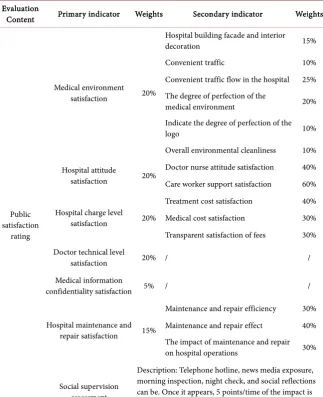
In this section, the hospital PPP project is evaluated from the perspective of Pub-lic satisfaction rating, indicators and weights to assess were described in Table 6. This evaluation standard is based on the satisfaction assessment of the public PPP medical project, and is entrusted by a third-party regulatory agency by the supervisory function in the implementation of the PPP project.
Public satisfaction can measure the extent to which medical development of medical PPP programs provides social infrastructure and transportation services to meet user expectations. The evaluation results of public satisfaction can pro-vide important decision support for the improvement of medical management level of PPP project operators and improvement of medical service level.
Table 6. Public satisfaction rating. Evaluation
Content Primary indicator Weights Secondary indicator Weights
Public satisfaction
rating
Medical environment satisfaction 20%
Hospital building facade and interior
decoration 15%
Convenient traffic 10%
Convenient traffic flow in the hospital 25% The degree of perfection of the
medical environment 20%
Indicate the degree of perfection of the
logo 10%
Overall environmental cleanliness 10%
Hospital attitude
satisfaction 20%
Doctor nurse attitude satisfaction 40% Care worker support satisfaction 60%
Hospital charge level satisfaction 20%
Treatment cost satisfaction 40% Medical cost satisfaction 30% Transparent satisfaction of fees 30% Doctor technical level
satisfaction 20% / /
Medical information
confidentiality satisfaction 5% / /
Hospital maintenance and repair satisfaction 15%
Maintenance and repair efficiency 30% Maintenance and repair effect 40% The impact of maintenance and repair on hospital operations 30%
Social supervision assessment
Description: Telephone hotline, news media exposure, morning inspection, night check, and social reflections can be. Once it appears, 5 points/time of the impact is verified, and 10 points/time is deducted for major problems and adverse consequences.
Public participation is a necessary procedure for the evaluation of PPP projects. Public participation means that the legal interests of the public, groups, and units, in which the project is located are fully guaranteed in order to make the argumentation of the PPP construction project more scientific and reasonable.
The purpose of public participation is to consider and compensate the inter-ests and opinions of the groups directly or indirectly affected by the project through effective consultation with the public. Accepting social supervision and encouraging the public to participate in the supervision of the project is to effec-tively improve the implementation level and efficiency of the project. It is also an effective way to reduce the problems that may arise from the project construc-tion and improve the social and environmental benefits of the construcconstruc-tion project.
The government shall set up special funds for investigations for the public
satisfaction rate survey, and the PPP project operators can actively cooperate and conduct public satisfaction surveys in accordance with the requirements of the Ministry of Health and the Ministry of Environmental Protection and survey specifications.
The evaluation method uses a third-party regulatory agency to issue a public opinion questionnaire or a household visit to the affected groups of the PPP project, conduct statistical analysis on the opinions of the respondents, and per-form verification scores based on the questionnaire survey.
The third-party regulatory agencies of the PPP project are required to collect public opinions and, after verification, provide feedback to the government and PPP project operators.
The PPP project operation unit announces the performance evaluation status of PPP medical projects to the public every year; and can actively cooperate with the establishment of local PPP project supervision, complaints, and reporting hotlines, and there are special people to answer; the complaint handling rate is 100%.
Based on the above research and results, the final performance evaluation of hospital PPP project can be summarized in Table 7.
3.6. Application
Using the data of a certain PPP hospital provided by an interviewee charged of operation, it is estimated that the total score for the hospital PPP project which has been put into operation for 2 years in the UK equals 86.78 (100 is full mark).
Background information provided by the interviewee was as follows:
[image:11.595.209.541.620.734.2]The project was constructed to improve the network of urban clinics and pro-vide publicly funded health care services with hospitals. The PPP hospital project includes the construction of a new 489-bed national referral hospital, a portal clinic near the hospital, and refurbishment and re-equipment clinics. The second purpose of PPP is to engage the private sector in new ways to ensure that these facilities operate effectively and to provide more effective, higher quality care and a wider range of services. The English PPP hospital project is managed by government employees whose operations are governed by laws, regulations and traditions that govern public sector procurement, human resource management, finance and administration. Partnership mechanisms, including a comprehensive
Table 7. Performance evaluation of hospital PPP project.
The output of hospital PPP project Indicators of Evaluation Weights
Performance evaluation of hospital PPP project
Economic Evaluation 15%
Operation & Maintenance Evaluation 35% Medical Technology Evaluation 20% Evaluation of Hospital Management Level 20% Public Satisfaction Rating 10%
network of contracting construction and operations, and the use of output-based payment mechanisms, aim to increase accountability for service delivery and quality of care by reducing government accountability for day-to-day operations. Through tendering, the alliance of social capital companies signed contract, agreed to build, operate, manage and provide clinical and non-clinical services through the integrated network over 20 years. The project has a total value of about $120 million. Capital expenditures are co-financed through public (42%) and private funds 58%).
Based on the above information, a whole new questionnaire was designed to get an overall rating of the PPP hospital project. Firstly, when the investigating the stakeholders of this PPP project, scores on each dimension listed in the above tables were collected, and then we use SPSS to confirm the validity and consistency of the data and remove the deviated number from database. 48 sets of data were proved valid. Then, after calculating the average number of each category, the weight provided by previous study was used to be multiplied by the average score of each corresponding indicator. Finally, the overall rating of the hospital PPP project was calculated (87.5), which means there’s still much room for improvement.
4. Conclusion
The study elucidates into the output specifications of hospital PPP projects and works out a way to quantify the indicators of performance evaluation system. At last, a case study was conducted to further confirm the validity and feasibility of the evaluation model. However, the weight of each indicator might not suit every hospital PPP project, and the indicators should be updated as project changes. What’s more, more scientific methods should be put forward to further eliminate subjective bias when determining weights of indicators, for example, fuzzy analytic hierarchy process (FAHP) approach [7], grey correlation analysis method and so on.
Conflicts of Interest
The author declares no conflicts of interest regarding the publication of this pa-per.
References
[1] Wijewardena, H. and Zoysa, A.D. (2005) A Factor Analytic Study of the Determi-nants of Success in Manufacturing SMEs. Faculty of Commerce—Papers.
[2] Saaty, T.L. (1967) Modern Nonlinear Equations. Dover Publications.
[3] Saaty, T.L. and Vargas, L.G. (2012) Models, Methods, Concepts & Applications of the Analytic Hierarchy Process. Springer US.
[4] Vian, T., Mcintosh, N., Grabowski, A., et al. (2015) Hospital Public-Private Part-nerships in Low Resource Settings: Perceptions of How the Lesotho PPP Trans-formed Management Systems and Performance. Health Systems & Reform, 1, 155-166. https://doi.org/10.1080/23288604.2015.1029060
[5] Chen, M., Zhu, Q.C. and Dong, D.M. (2011) Game Study on Construction Safety Supervision Based on System Dynamics. China Safety Science Journal, 21, 73-81. [6] Javed, A.A., Lam, P.T.I. and Chan, A.P.C. (2013) A Model Framework of Output
Specifications for Hospital PPP/PFI Projects. Facilities, 31, 610-633.
https://doi.org/10.1108/f-02-2012-0014
[7] Carr, V. and Tah, J.H.M. (2001) A Fuzzy Approach to Construction Project Risk Assessment and Analysis: Construction Project Risk Management System. Ad-vances in Engineering Software, 32, 847-857.
https://doi.org/10.1016/S0965-9978(01)00036-9