THE IMPLEMENTATION OF OPEN AND DISTANCE LEARNING PROGRAMMES IN KENYAN PUBLIC
UNIVERSITIES: MANAGEMENT AND TECHNICAL CHALLENGES
*,1
Dr. David Kiprop
1
Lecturer, Kisii University
2
Faculty of Education and Human Resource Management, Kisii University, Eldoret Campus
P. O. Box 6434
ARTICLE INFO ABSTRACT
An overview of the history of Open and Distance Education integration strategies in institutions of repute the world over reveals at least two distinct characteristic features: being fraught with myriad challenges and an outstanding determination and resol
of the project in order to achieve the set goals of ODL. This paper examines the educational management and technical challenges facing integration and implementation of Open and Distance Learning programmes i
of the seven public universities in Kenya, namely Maseno, Moi, Masinde Muliro, Egerton, Kenyatta, Nairobi and Jomo Kenyatta Universities. Data was collected using questionnaires
schedules from 20 departmental chairs and practitioners. These respondents were purposefully selected along with 378 students randomly selected from the accessible population. The data was analyzed using Chi
indicated that there was inadequacy of trained teaching and technical staff, funds allocation, infrastructure in general, motivation of faculty, student support provision and lack of policy guidelines on ODL crucial issues. The research recommendations included the need for adequate training of human resource personnel, and liaison between the universities and the government and other interested stakeholders to help in infrastructure acquisition.
Copyright © 2016, Dr. David Kiprop et al. This is an open access article distributed under the Creative Commons Att use, distribution, and reproduction in any medium, provided the original work is properly cited.
INTRODUCTION
Adoption of technology-anchored Open and Distance Learning (ODL), which for long was a Cinderella in the spectrum of national educational systems up to the 1970s, is no
peripheral concern (Sewart, Keegan & Holmberg, 1983). Reiterating the need to adopt ODL as an integral and an indispensable part of the mainstream educational system the world over, Daniel (2004), for example, point out the inadequacies of traditional ways of delivering education. He further stresses the need for reinforcement of the same by innovative methods for the realization of the fundamental rights of all people to learning. Hardin and Ziebarth (2000) suggest that “… very soon every teacher and student would need access to the information represented on the web in order to be competitive in the work and in their lives” (p. 27).
*Corresponding author: Dr. David Kiprop,
Lecturer, Kisii University, P. O. Box 6434-30100, Eldoret, Kenya.
ISSN: 0975-833X
Article History:
Received 04th February, 2016
Received in revised form 28th March, 2016 Accepted 01st April, 2016
Published online 10th May,2016
Key words:
Management, Technical Challenges, Integration,
Implementation, Open, Distance, Learning.
Citation: Dr. David Kiprop, Dr. Justina Syonthi Ndaita and Dr. Julia Situma
Kenyan public universities: Management and technical challenges
RESEARCH ARTICLE
THE IMPLEMENTATION OF OPEN AND DISTANCE LEARNING PROGRAMMES IN KENYAN PUBLIC
UNIVERSITIES: MANAGEMENT AND TECHNICAL CHALLENGES
Dr. David Kiprop,
1Dr. Justina Syonthi Ndaita and
2Dr. Julia Situma
Lecturer, Kisii University, P. O. Box 6434-30100, Eldoret, Kenya
Faculty of Education and Human Resource Management, Kisii University, Eldoret Campus
P. O. Box 6434-30100, Eldoret, Kenya
ABSTRACT
An overview of the history of Open and Distance Education integration strategies in institutions of repute the world over reveals at least two distinct characteristic features: being fraught with myriad challenges and an outstanding determination and resolve exhibited by the founders to make a success of the project in order to achieve the set goals of ODL. This paper examines the educational management and technical challenges facing integration and implementation of Open and Distance Learning programmes in public universities in Kenya. The paper is based on a study conducted in six of the seven public universities in Kenya, namely Maseno, Moi, Masinde Muliro, Egerton, Kenyatta, Nairobi and Jomo Kenyatta Universities. Data was collected using questionnaires
schedules from 20 departmental chairs and practitioners. These respondents were purposefully selected along with 378 students randomly selected from the accessible population. The data was analyzed using Chi-square test of goodness of fit and percentage distribution techniques. The findings indicated that there was inadequacy of trained teaching and technical staff, funds allocation, infrastructure in general, motivation of faculty, student support provision and lack of policy guidelines DL crucial issues. The research recommendations included the need for adequate training of human resource personnel, and liaison between the universities and the government and other interested stakeholders to help in infrastructure acquisition.
is an open access article distributed under the Creative Commons Attribution License, which use, distribution, and reproduction in any medium, provided the original work is properly cited.
anchored Open and Distance Learning (ODL), which for long was a Cinderella in the spectrum of national educational systems up to the 1970s, is no longer a peripheral concern (Sewart, Keegan & Holmberg, 1983). Reiterating the need to adopt ODL as an integral and an indispensable part of the mainstream educational system the world over, Daniel (2004), for example, point out the onal ways of delivering education. He further stresses the need for reinforcement of the same by innovative methods for the realization of the fundamental Hardin and Ziebarth (2000) suggest that “… very soon every teacher and student would need access to the information represented on the web in order to be competitive in the work and in their lives” (p. 27).
30100, Eldoret, Kenya.
Further, some experts (e.g. the United States of America’s Pew Higher Education Roundtable) suggest that 30
secondary learning would take place through some form of distance learning. Yet others suggest, including substantial numbers of faculty members, that ODL is a passing fad suitable for only a narrow niche of courses, and that traditional settings will remain the overwhelming methods of education (Clarks, 1993, p. 19-33).
One of the recent developments of ODL is the emergence of virtual universities. The most successful major distance education institution was the British Open University (BOU), which has granted 227,000 degrees (Blumenstyk, 1999) since 1971, and has had an excellent reputation despite Great Britain’s conservative educational tradition. Other examples of success cases include the Indira Gandhi National Open University (IGNOU), with a student population exceeding 4 million (IGNOU, 1999). IGNOU caters not onl
learners but also for those from other countries such as Bahrain, Doha, Dubai, Abu Dhabi, Kuwait and Sultanate of
International Journal of Current Research
Vol. 8, Issue, 05, pp.30886-30893, May, 2016
Dr. David Kiprop, Dr. Justina Syonthi Ndaita and Dr. Julia Situma, 2016. “The implementation of open and distance learning programmes in
and technical challenges”, International Journal of Current Research, 8, (05), 30886
THE IMPLEMENTATION OF OPEN AND DISTANCE LEARNING PROGRAMMES IN KENYAN PUBLIC
UNIVERSITIES: MANAGEMENT AND TECHNICAL CHALLENGES
Dr. Julia Situma
30100, Eldoret, Kenya
Faculty of Education and Human Resource Management, Kisii University, Eldoret Campus,
An overview of the history of Open and Distance Education integration strategies in institutions of repute the world over reveals at least two distinct characteristic features: being fraught with myriad ve exhibited by the founders to make a success of the project in order to achieve the set goals of ODL. This paper examines the educational management and technical challenges facing integration and implementation of Open and Distance n public universities in Kenya. The paper is based on a study conducted in six of the seven public universities in Kenya, namely Maseno, Moi, Masinde Muliro, Egerton, Kenyatta, Nairobi and Jomo Kenyatta Universities. Data was collected using questionnaires and interview schedules from 20 departmental chairs and practitioners. These respondents were purposefully selected along with 378 students randomly selected from the accessible population. The data was d percentage distribution techniques. The findings indicated that there was inadequacy of trained teaching and technical staff, funds allocation, infrastructure in general, motivation of faculty, student support provision and lack of policy guidelines DL crucial issues. The research recommendations included the need for adequate training of human resource personnel, and liaison between the universities and the government and other
ribution License, which permits unrestricted
Further, some experts (e.g. the United States of America’s Pew Higher Education Roundtable) suggest that 30-50% of all post-secondary learning would take place through some form of
earning. Yet others suggest, including substantial numbers of faculty members, that ODL is a passing fad suitable for only a narrow niche of courses, and that traditional settings will remain the overwhelming methods of education
One of the recent developments of ODL is the emergence of virtual universities. The most successful major distance education institution was the British Open University (BOU), which has granted 227,000 degrees (Blumenstyk, 1999) since n excellent reputation despite Great Britain’s conservative educational tradition. Other examples of success cases include the Indira Gandhi National Open University (IGNOU), with a student population exceeding 4 million (IGNOU, 1999). IGNOU caters not only for Indian learners but also for those from other countries such as Bahrain, Doha, Dubai, Abu Dhabi, Kuwait and Sultanate of OF CURRENT RESEARCH
Oman in the Middle East Asia (Bansal & Chaudhary, 1999). Anadolu University in Turkey, with Open Education Faculty, was founded in 1982. The University has more than 600,000 students. The China TV University System has also been one of three large distance education systems in China. Others include the Correspondence University System and the Self-Study Examination System (Daniel, 1996). Today, more than 800,000 students are enrolled to this University. Kenyan universities such as Kenyatta and University of Nairobi with their student populations of 6000 and 4000, respectively, are no match to them in comparison. The delivery mode of instruction to students was via broadcasting system. The striking feature of the integration and implementation of ODL mode of delivery was its seemingly intentionally selective implementation of programmes by concerned providers. Programmes were designed to meet certain needs. For example, according to Jegede (2001), Zimbabwe and Tanzania chose to train mainly teachers and businessmen through ODL mode. In Mauritius and Uganda, particularly during the initial stages of ODL programme development, the selective nature of programmes implemented was apparent. Adopting ODL for its flexibility factor to students, Mauritius implemented programmes suitable to mainly continuing education learners (for instance, housewives, employed women, out of school youths and functionally illiterate persons). Rumajogee (2000), however, reports that multiple-media award and non-award programmes of both long-term and short-term social significance were added. These programmes included Mauritian history, environment, arts, culture and languages. Similarly, Uganda, assisted by African Medical Research Foundation (AMREF), set up a Distance Education Unit, the rational of which was to provide continuing education or in-service training as an integral part of professional development of health workers. In Ghana, the National Functional Literacy programme, took centre stage in ODL programme integration and implementation. However, it was, albeit being broad-based in “curriculum” coverage, community-broad-based. It was run by a local radio station (Radio Ada). The community-based programmes offered included health, sanitation, culture, functional literacy and the environment. However, the situation negated the very spirit of “Open” education in which learners, desirous of a variety of higher education courses in the many fields, did not access them due to the inherent problems. In Botswana, however, there emerged the Nation Qualifications framework which was an interesting attempt to learn from international experience whilst developing a system that met local needs and provided a policy framework applicable to all education and training providers.
The sub-Saharan Africa has generally had one of the most important legacies bequeathed to the African societies by the Christian and Muslim religious bodies in the form of a conventional education system. This system has for ages been the major agent of education for transforming societies as across the political, cultural, social, economic, individual (intellectual) and technical domains. The mode of delivery of learning in this system has been characterized by face-to-face interactions between teachers and learners, structured courses of study, fixed locations for learning, fixed timetables and a system of certification. However, none of the developing
countries has fulfilled the promise of providing education to the entire population through this conventional system. There is, therefore, a need to integrate and implement Open and Distance Learning. ODL provides easy access to students and is flexibility compared to the conventional or traditional modes of delivery.
In East Africa, Kenya boasts of more universities than its neighbours, Uganda and Tanzania on the adoption of Open and Distance Learning. However, Kenya is yet to make impressive gains on this score. Tanzania has implemented some programmes in this field. Statistics reveal that from 1994 the adoption of ODL programmes has steadily been on the increase. Commencing with ten (10) disciplines, basically Arts-based programmes, four degree programmes were offered. By end of 1996 three more degree programmes had been introduced. Dodds (1996) documents the enrolment statistics in the aforesaid programmes.
ODL in Kenyan Universities
A number of the universities in Kenya have implemented ODL programmes. Moi University is yet to fully establish or embrace Open and Distance Learning. To date, no tangible results have been achieved in respect to integration of Open and Distance Learning except in some certificate courses. Egerton University established the College of Distance and Open Learning in 2003. The programmes targeted a limited number of students, primarily those wishing to upgrade their certificates and diplomas to degree levels. Upgrading courses for the Department of Defence (DOD) personnel at Lanet-Nakuru are also offered. In addition, the CDOL offers school-based Bachelor of Education Programmes. The University also offers Open and Distance Learning programmes along with face-to-face teaching during the holidays and evenings, respectively. The ODL programmes are, therefore, localized and limited to the geographical area surrounding the University despite its collaboration with UNISA. As such, the programmes may not have a big impact nationally. University of Nairobi was a pioneer of Open and Distance Learning through the College of Education and External Studies (CEES), one of its six colleges. Open and Distance Learning mode offers the following, among other, programmes: In-service Teacher Training Programmes for untrained teachers in primary schools; Adult Literacy Teacher Training Programmes and External Degree and Postgraduate Diploma. ODL is offered in one faculty out of six faculties in the 24 Faculties, Institutes and Schools. Kenyatta University offers three programmes under ODL, namely: Open Learning, Virtual Learning and e-Learning currently. Open Learning uses multimedia approach, which include print-based materials, recorded audio-tapes, teleconferencing, computer mediated learning and tutorials conducted at the eight regional centres in the county.
In Masinde Muliro University, the School of Open Learning and Continuing Education (SOLACE) offers the following programmes: Certificate in Global Education and Linkages; Diploma in Business Studies and Bridging Certificate in English among others. In Maseno University, ODL is offered in the School of Open Distance and E-Learning Programmes. It is one of ten academic and professional programmes offered in institutes, faculties and schools.
[image:3.595.62.530.70.160.2]The overall distribution of the ODL programmes adoption across universities in Kenya is ashown in Table 2 below.
Table 2. ODL programmes Adoption across Select Kenyan Universities
University No. of ODL
Programmes
Total Programmes ODL as %
of Total
Egerton 6 121 5
Mainde Muliro 7 50 14
Moi University 1 98 1
Nairobi 4 200 2
Source: Commission for Higher Education (2006)
[image:3.595.38.287.349.412.2]A number of studies (ADEA, 2002; Kinyanjui, 1998; Agunga, 1997; Carty, 1999) have documented a variety of challenges facing the integration of ODL programmes in the sub-Saharan African countries exists. However, these studies do not specify challenges facing integration of ODL in higher education programmes (e.g. Pharmacy, Engineering and Medicine) in specific countries such as Kenya. The inadequacy of conventional modes and the challenges faced in attempts to integrate and implement ODL programmes have contributed to the educational crisis witnessed in Kenya today. For example, many KCSE graduates continue to miss out on university education. Admission to Kenyan public universities is based on the capacity of accommodation. This has over the years denied large numbers of candidates attaining the minimum university entry requirements chances to have university education. Indeed, the number of students being left out during admission has been growing over the years as shown in the table below.
Table 3. Public University Admission in Kenya, 2001-2006
Year No. Sitting Score C+ &> Admitted Left Out
KCSE 2006 63,104 10,000 53,000
KCSE 2005 260,443 68,040 10,218 57,822
KCSE 2004 222,51 58,239 10,632 47,607
KCSE 2003 207,730 49,870 10,263 39,607
KCSE 2002 198,076 42,721 10,923 31,798
KCSE 2001 194,788 42,158 10,966 31,192
Sewart, Keegan and Holmberg (1983) observe that ODL approaches were of peripheral concern to the national educational systems. Similarly, Daniel (2004) argues that these approaches are an indispensable part of the mainstream educational systems the world over, especially in the developed countries. According to Daniel (2004), ODL has an edge over traditional modes of delivering education. Surprisingly, however, many institutions in the sub-Saharan Africa (SSA), Kenya included, are yet to effectively integrate and implement ODL programmes.
Statement of the Problem
The traditional modes of delivering education in the sub-Saharan Africa pose managerial challenges to efforts at integration and implementation of ODL programmes in public universities. The first of these challenges are those related to the usage of educational communication technologies, especially computers. Becker (as cited in Pelgrum & Plomp, 1993) states that the introduction of computers in education was a large-scale complex innovation before which many obstacles had to be overcome to realize success. Akker, Vanden, Keursten and Plomp (1992) also point out that there is still a long way to go to ensure computer use is effectively integrated and implemented. The authors identify the following as factors that must be considered for successful integration of computer technology in existing systems of education: National context; school organization; external support and innovation.
According to Akker, Vanden, Keursten and Plomp (1992), school managements suffer from a number of shortcomings. The school authorities in the echelons of administration (national context), for instance, fail to make proclamation of new aims for school education system and to encourage initiatives and activities in the field; encourage and support human and material resource provision, and motivate and train staff. In the absence of this management input, new innovations fail to take off. Therefore, this paper seeks to establish if the ODL directors/department heads charged with the responsibility of effecting the technology-anchored ODL programmes integration and implementation get the necessary support from the universities’ top management. Agunga (1997) observes that some of the challenges that ODL integration and implementation in SSA educational institutions faces include the vagaries of nature, societal problems (ethnic strives and political instability) and low food production. According to ADEA (2002), the following, among other, limitations hinder effective ODL programme integration and implementation: A low level of political support for ODL by political authorities
Table 1. Kenyatta University ODL Programme Enrolment, 2002-2007
Year Centres Total
Nairobi Nakuru Kisumu Kakamega Nyeri Embu Garissa Mombasa
2002 673 145 160 68 169 103 17 163 1498
2003 528 148 158 129 272 145 34 165 1609
2004 129 42 37 33 49 39 39 72 440
2005 149 89 36 52 43 158 22 122 671
2006 306 110 101 71 51 92 24 87 852
2007 171 45 48 34 35 60 29 105 527
[image:3.595.35.289.674.744.2]in Africa; the public service failure to recognize ODL in its assessment of employee qualifications; lack of professionally trained personnel; lack of follow-up and support programmes; limited budgets and domestic infrastructure. Standa (2005, p. 13) similarly identifies the mindset of service providers (the teachers/lecturers) and their educational background as some of the factors that determine the acceptance, adoption and ownership of ODL programmes. Other factors listed by Standa (ibid.) include infrastructure, diversity of stakeholders and availability of resources. Some of these issues have also been addressed by ADEA (2002), Kinyanjui (1988) and Talab and Newhouse (1993).
The challenges highlighted by Akunga (1997) and the limitations pointed out by ADEA (2002) and also some of the factors identified by Standa (2005) are too general as they reflect an overview of SSA experience disregarding individual countries’ initiatives over time. They also fail to take into consideration emerging trends in ODL. These new trends in ODL programme integration and implementation involve, among others, networking and collaboration between local and foreign universities. These issues have transformed the reality of ODL programme integration and implementation on the ground as well as introduced new challenges. Finally, researchers contend that there is a dearth of empirical data as to what challenges Kenyan public universities face in the process of integrating and implementing ODL programmes in their education systems. Failure to clearly identify and address these challenges has negatively affected higher education programmes in most developing countries, Kenya included. According to Wanjohi (2006), more than 80% of KCSE candidates who qualified for higher education did not join university. Indeed, access to university education is becoming increasingly impossible to a growing majority of candidates in Kenya. Therefore, the integration and implementation of Open and Distance Learning programmes is expected to provide more students with an opportunity to access university courses from wherever they are.
Unequal access to higher education across the gender divide and unbalanced regional distribution are also the problematic features of Kenya’s higher education (Wanjohi, 2006). These problems stem from the cultural, political and historical milieus of Kenya. Some districts and provinces produce more candidates who qualify for admission into public universities because they are endowed with better facilities than others. This contributes to regional imbalance in university admissions. Furthermore, the male/female admission ratio is often skewed in favour of male students. For example, of the 10,197 students admitted to public universities in the 2005/2006 academic year, 78% of students were male students and the remaining 22% being female.
Agalo (2002) traces the problem of the growing number of secondary school graduates missing higher education in Kenya to the early 1970s. This was the time when the University of Nairobi took the initiative to open a constituent college, the current Kenyatta University, to cater for the increasing demand for higher educational. Nevertheless, the demand for more university places continued to rise. As such, Moi University was established in 1984 to provide more access to university
education. Since then, four more public and sixteen private universities have been given charters to offer higher education in Kenya. Still these institutions have failed to meet the growing need for higher education in Kenya because they are limited by accommodation capacity. Therefore, the integration and implementation of the Open and Distance Learning is expected to enhance the capacity of universities to reach out to a larger number of students in diverse environments and conditions (Daniel, 2004).
Individual universities have, however, displayed low-key approach to adopting ODL. The pace at which the initiatives to fully integrate ODL in public universities in Kenya have been too slow. This means that there are challenges that hamper these initiatives. The study therefore sought to investigate these challenges in order to propose solutions and enhance effective implementation of ODL programmes in Kenya’s public universities.
Literature Review
gives credence to Fafunwa’s (as cited in Bishop, 1986) apt caution to innovators that: “you cannot use yesterday’s tool for today’s job and expect to be in business tomorrow” (p. 6). With respect to education, institutions cannot afford to keep using traditional methodology of teaching and learning and expect to meet the expectations of today’s educational needs. A wide range of challenges have been documented with respect to integration and implementation of ODL programmes. A brief examination of some of them shed light on pertinent issues involved. A general overview of the sub-Saharan African ODL projects reveals that the challenges faced in its integration and implementation in higher education are numerous. Too often, for instance, distance education (ODL) strategies have been introduced hastily or arbitrarily in a top-down approach. Kinyanjui (1998) criticizes this approach as a serious challenge to effective integration and implementation of the ODL programme. Agunga (1997) gives an historical perspective of the challenges facing effective integration and implementation of ODL in higher education programmes in the sub-Saharan Africa. The author contends that challenges stem from vagaries of nature, societal problems (ethnic strives and political unrest) and low food production among others. These factors militate against development within the region. The attention of leaders is focused more on the problems than the equally important social amenities (water, electricity and telecommunication networks) and when these are available they are underutilized for educational purposes. Lack of electricity and telecommunication networks is indeed a setback to the delivery of teaching and learning through the ODL mode since it is basically technology-mediated.
Kinyanjui (1998) and Carty (1999) both agree that, at the organizational level, ODL and its associated technologies have often been introduced without a clear understanding of organizational cultures and political, economic, physical, social, technological and trade contexts. Kinyanjui (1998) identifies two perspectives that are pertinent to this issue: the argument that the operational effectiveness of ODL programme integration and implementation is below expectation in the sub-Saharan Africa due to lack of policy coordination with other efforts and an inadequacy of ODL supportive funding policies. Arguing that ODL had been below expectation partly due to lack of policy coordination with other efforts, the author identifies other efforts as provision of adequate resources, development of support infrastructure and the education and training of ODL users. Regarding the argument on ODL supportive funding policy, Kinyanjui (1998) gives the example of the 2001 South African proposal to fund ODL provision at 50% of the subsidy granted to conventional face-to-face institutions as perhaps indicative of the trend in the rest of the sub-Saharan Africa. ADEA (2002, p. 41) underscores some limitations to effective integration and implementation of ODL programmes. These limitations could be categorized and explained as follows: first is support; there is a low level of political support for ODL programmes by political authorities in Africa. This has been a challenge to integration of ODL into higher education programmes because politicians exert their influence on the allocation of resources. Without their support, projects may not be funded as required. Second is recognition by government; the public service has
largely failed to recognize ODL programmes in its assessment of employee qualifications. This limitation is significant in that it affects students’ and other stakeholders’ attitudes towards ODL. Third is personnel; lack of professionally trained personnel raises key questions on the quality of ODL courses, instructional and material development. This may compromise the desired standards for ODL. Last limitation is administrational shortcomings; for instance, lack of follow-up and support programmes; limited budgets and poor domestic infrastructure. The Kenyan experience with regard to ODL programmes integration and implementation was generally reflected in a paper entitled Transforming Education for a New Africa; Realizing the Potential of Open and Distance Learning
presented by the Ministry of Education, Science and Technology (MoEST) before the All-Africa Ministers’ Conference on Open and Distance Learning held in South Africa in 2004. This Conference not only lent credence to the view that ODL is a panacea for the 21st century educational challenges but also that its adoption should be a priority concern.
The overall import of the Conference resolutions sought to raise the status of ODL as mode of education delivery. The second resolution on strategies to be applied in effective integration and implementation of ODL programmes indicated that clear commitment by governments, Kenyan included, was lacking, policy framework formulation was still in the pipeline and prioritization of capacity building in the development and management of ODL programmes at all levels was yet to be effected. Mbwesa (2005, p. 3) believes that if properly implemented ODL raises the possibility of expansion of the provision of and access to higher education. Standa (2005, p. 13), the immediate former Vice Chancellor of Kenyatta University, identifies attitudinal challenges, other adverse factors, to the mainstreaming of ODL in general and electronic learning in particular among. He maintains that the mindset of service providers, infrastructure, diversity of stakeholders and availability of resources, among other factors, determine the success of implementation of ODL as a mode of educational delivery. Havelock and Huberman (as cited in Bishop, 1986. p. 5) states that it is important to understand that innovations are not adopted by people on the basis of intrinsic value of the innovation, but rather on the basis of the adopters’ perception of the changes they personally would be required to make. The designers, administrators and advisors of projects do not generally have to make very many changes themselves. Their tasks largely remain the same. It is the other members of an organization who have to modify their behaviours. Unfortunately, employees very often modify their behaviours rapidly in fairly significant ways and with little previous or even gradual preparation. Typically the kinds of rapid and massive changes advocated are those that planners or administrators or advisors would never plan, administer or advice for themselves.
MATERIALS AND METHODS
University) excluded because it was involved during the piloting of the research instruments. Jomo Kenyatta, Kenyatta and Nairobi universities in Nairobi, Egerton and Moi Universities in the Rift Valley, Masinde Muliro University in Western and Maseno University in Nyanza. The locations of the universities represented both urban and rural settings: with those in Western Kenya region mostly considered as located in rural setting. Purposive sampling was used to select University of Nairobi, Egerton and Masinde Muliro universities as study locations in matters pertaining to student issues involved in the study. The target population of the study was the 28 ODL senior staff, the Department heads or Directors and practitioners and the estimated over 11,000 students of Kenyan public universities. These Universities included Jomo Kenyatta, Kenyatta, Maseno, Masinde Muliro, Moi, Egerton and Nairobi universities. The key target sample population consisted of 24 department chairs and practitioners. However, only 20 respondents participated in the research study. All 6 directors / department chairs, from the 6 participating public universities took part in the interview exercise. The second research sample population of student respondents representing 3 purposively sampled universities was undergraduates of final fourth-year cohorts. They were considered the most knowledgeable and experienced participants on issues pertaining to ODL integration and implementation challenges by virtue of their having had relatively longest periods of exposure to them. A further Stratified Random sampling technique was used to select a representative sample from the target population of 1260 respondents. In the course of data collection, the researcher used the following instruments and procedures: Library (Literature) search; Document analysis; Checklist; Interviews, and Questionnaires. The data collected was analyzed using the Statistical Package for Social Scientists (SPSS) method. Data was also analyzed using descriptive statistics, for example, frequencies, tables, percentages, charts, graphs and means.
RESULTS AND DISCUSSION
The study sought to identify management related challenges to effective implementation of ODL programmes in Kenyan public universities. To achieve this objective, the respondents were asked to give their views on given statements on management. A further analysis of the collected data was done using Chi-square statistical technique.
Optional Proclamation of ODL Programmes by University Administration
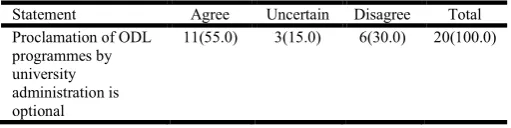
[image:6.595.35.291.699.763.2]Department chairs and practitioners were asked to give their opinions on whether or not proclamation of ODL programmes by university administration was optional. The results were as presented in Table 3 below.
Table 3. Optional Proclamation of ODL Programmes
Statement Agree Uncertain Disagree Total
Proclamation of ODL programmes by university administration is optional
11(55.0) 3(15.0) 6(30.0) 20(100.0)
The results in the table above show that 11(55%) of the departmental chairs agreed, 6(30%) disagreed while 3(15%) were uncertain that the proclamation of ODL programmes by university administration was optional. These results indicate a statistically significant difference in the opinion of departmental chairs and practitioners on whether or not the proclamation of ODL programmes by university administration was optional. Specifically, significantly more (55%) departmental chairs and practitioners agreed that the proclamation of ODL programmes was optional than those who disagreed (30%). This was contrary to the view that optional proclamation of ODL programmes can deprive the system of desired support from the general administration and hence pose challenges. Akker, Vanden, Keursten and Plomp (1992) posit that, in the national context, obstacles may arise from failure by senior authorities in the highest echelons of administration to make proclamations of new aims for the educational system and encourage initiatives and activities in the field (ODL programme implementation stage) despite adequate investment in human and material resources.
Further analysis of the results from an interview with a number of departmental chairs and practitioners from the institutions with a long history of ODL implementation experience revealed that the proclamation of O&DE programmes was not optional. However, the above findings were not surprising. This is because growing attention has been given to ODL by both the Kenya government and the public universities. In response to the recommendation of the 2004 All-Africa Ministers Conference on ODL in South Africa, the Kenya government drafted a policy document, Sessional Paper I of 2005, which addresses policy concerns of ODL. Public universities on the other hand have had various reasons to focus on ODL. Mbwesa (2005) sees diverse potentials in ODL. According to Mbwesa, ODL media have an edge over the conventional methodology. This view is also supported by Standa (2005). An interview with departmental chairs showed that some senior executives within university administrations had taken the initiative to spearhead the implementation of ODL programmes in their institutions. In view of the above observations, therefore, institutional proclamation of ODL programmes was optional and may not have necessarily been a serious challenge to implementation of ODL programmes. The results of Chi-square analysis of findings on proclamation of ODL programmes being optional indicated a statistically significant difference in the opinion of the departmental chairs and practitioners on whether or not proclamation of OL&DE programmes was optional. Indeed, there were significantly more of the respondents who agreed that the proclamation of ODL programmes by university administrations was optional than those who disagreed. As such, the departmental chairs and practitioners were of the opinion that proclamation of ODL programmes was optional.
Availability of Teams of Experts in ODL Instructional Course Development
Table 4. Availability of Teams of Experts in ODL Instructional Course Development
Statement Agree
F(%)
Uncertain F(%)
Disagree F(%)
Total F(%) Staffing institutions
with teams of ODL experts in instructional course development
9(45.0) 3(15.0) 8(40.0) 20(100.0)
The above results show a significant difference in the opinions of departmental chairs and practitioners on institutions being staffed with ODL instructional course development experts. In particular, there were more, 9(45%), of the respondents who agreed than those, 8(40%), who disagreed. The same statement elicited contrary opinions from the students: 164(43%) of the students disagreed with the view that ODL trained lecturers were available whereas 140(37%) agreed. The Chi-square analysis of the research findings on this issue showed a statistically significant difference in the opinion of the department chairs and practitioners on whether or not institutions were staffed with teams of experts in ODL instructional course development. More, 9(45%), of the respondents agreed that institutions were staffed with teams of experts in ODL course development than and only 8(40%) disagreed. Thus, in the opinion of the department chairs and practitioners, institutions were staffed with teams of experts in ODL course development. Students were asked to give their opinions on whether or not there were enough trained lecturers. On this item, 164(43.4%) of the students disagreed that trained lecturers were available, 74(19.6%) were uncertain about the issue and 140(37.0%) agreed.
The discrepancy between the views of department chairs and practitioners and those of the students could be explained by findings from a further probe of the views of departmental chairs and practitioners. The probe revealed that the institutions sometimes lacked trained teaching staff and adequately trained technical staff, and that different levels of staffing needs existed in the various universities. These results it revealed that Kenyan public universities still have to grapple with the inadequacy of trained teaching and technical staff as a challenge to effective implementation of ODL programmes. Sherry (1996) observes that training teachers and facilitators to effectively use ODL technology, among other measures, is necessary for an excellent ODL programme implementation.
Quality of ODL Teacher Training as Reflected in Teacher Performance of Duties
Departmental chairs and practitioners were asked to give their opinions on whether or not the quality of ODL teacher training was reflected in the teachers’ performance of duties. The research results showed that 11(55%) of the departmental chairs and practitioners agreed that the quality of teacher training was reflected in teacher performance of duties, 2(10%) disagreed. Moreover, 7(35%) expressed uncertainty over the matter. In view of these results, the quality of teacher training being reflected in performance of duties posed no challenge to the implementation of the ODL programmes. The Chi-square analysis of the data revealed a statistically insignificant
difference in the opinions of the respondents on whether or not the quality of teacher training was reflected in teacher performance of duty at study centres. Indeed, more respondents agreed that the quality of teacher training was reflected in teacher performance of duties at study centres than those who disagreed. Thus, it could be said that in the opinion of department chairs and practitioners quality of ODL teacher training was reflected in teacher performance of duty at study centres.
Motivation of Lecturers was as Factor in ODL Programme Adoption
Departmental chairs and practitioners were asked to give their opinions on whether or not motivation of lecturers was a factor in ODL programme adoption. The results indicated that 19(95%) of the departmental chairs and practitioners agreed that motivation of lecturers is a factor in ODL programme adoption, 1(5%) respondent expressed uncertainty over the matter and none of them expressed disagreement. The Chi-square analysis showed that there was a statistically significant difference in the opinion of respondents on whether or not motivating lecturers had any effect on ODL programme adoption. Indeed, the results indicated a near unanimity in their view that motivating lecturers affected ODL programme adoption. It could be said then that in the opinion of the respondents, adoption of ODL programmes depended on motivating lecturers.
Conclusion and Recommendations
The study results indicated that public universities in Kenya face major challenges in integrating and implementing ODL programmes. The key management challenges they face include inadequate trained teaching and technical staff, insufficient funding, inadequate student support provision and insensitivity to issues of gender parity in admission of students. Some of the technical challenges they face include lack of both ODL institutional platform guarantee to deliver programmes and institutional infrastructure to do the same. Based on the study results and conclusion, the following recommended that the University management should address the issue of availability of financial resources. This is important in that the insufficiency of funds allocated to ODL programmes provision has proved detrimental to quality assurance of both human and material resource. Moreover, employment of staff at all levels must be based on merit. The management should also formulate and implements ODL policy to cater for crucial issues, such as, gender parity, the needs of physically handicapped students, adequate funds allocation to meet the demands of dual mode education systems and lecturers’ property rights. The Non-Governmental Organizations and other higher educational stakeholders should also provide assistance in the provision of training of ODL personnel and provision of technical as well as material resources.
REFERENCES
reference to Germany, United Kingdom and Kenya (PhD Thesis). Moi University, Kenya.
Agunga, R. 1997. The Politics of Distance Education in the Development of Africa. African Educational Research symposium on Politics and Education, Athens, Ohio. Akker, J., Keursten, P., & Plomp, T. 1992. The integration of
computer use in education. International Journal of
Educational Research, 17(1), 65-76.
Association for the Development of Education in Africa (ADEA) 2002. Distance Education and Open Learning in Sub-Saharan Africa: A Literature Survey on Policy and Practice. A Report of the Working Group on Distance Education and Open Learning, February.
Bansal, K. and Chaudhary, S. S. 1999. Interactive Radio for Supporting Distance Education: An Evaluation Study.
Indian Journal of Open Learning, 8(1), 61-71.
Bishop, G. 1986. Innovation in Education. London: MacMillan Publishers.
Blumenstyk, G. 1999. Distance learning at the Open University: The British Institutions’ Success as inspired imitators in the United States. The Chronicle of Higher Education, July 23, pp. A35FF.
Carty, W. 1999. New Markets for Meeting Old Needs: US Distance Education and Developing Countries. London: EDUCASE.
Clarks, T. 1993. Attitudes of higher education faculty toward distance education: A national survey. The American Journal of Distance Education, 7(2), 19-33.
Daniel, J. 2004. The Sustainable Development of Open and Distance Learning for Sustainable Development. Paper presented at the Commonwealth of Learning Institute Strategies for Sustainable Open and Distance Learning, 9 June 2004, Dunsmuir Lodge, Sydney, BC, Canada.
Daniel, J. S. 1996. The mega-universities and the knowledge media. London: Kogan Page.
Dodds, A. J. 1996. The use of distance learning in non-formal education. Vancouver and Cambridge, CoL and IEC. Government of Kenya 2005. Sessional Paper No. 1. Nairobi:
Government Printers.
Hardin, J. and Ziebarth, J. 2000. Digital technology and its impact on education (National Centre for Supercomputing Applications, University of Illinois at Urbana-campaign). The future of networking technologies for learning. U.S Department of Education’s Office of Educational Technology, found at: http://www.ed.gov./technology/ futures/hardin.html
Holloway, R. E. and Ohler, J. 1991. Distance Education in the Next Decade. In G. J. Anglin, (Ed.). Instructional Technology Past, Present and Future (pp. 259-266). Englewood, CO: Libraries Unlimited, Inc.
IGNOU 1999. School of Computer and Information Sciences - Information Brochure. New Delhi: IGNOU.
Jegede, O. 2001. Primary Teacher Education: The use of distance education methodologies for primary teacher education in Nigeria. Vancouver: Commonwealth of Learning.
Kelly, G. J., Brown C. and Crawford, T. 2000. Experiments, Contingencies and Curriculum: Providing Opportunities for Learning through Improvisation in Science Teaching. Science Education, 84, 624-657.
Kinyanjui, P. 1998. Distance and open learning in Africa: What Works or Does Not Work. Proc. EDI/World Bank Workshop on Teacher Education through Distance Learning, Addis Ababa, Ethiopia.
Mbwesa J. 2005, December 8. Potentials of Open and Distance Learning. The Standard, p. 3. Nairobi: The Standard Group.
Ministry of Education, Science and Technology (MoEST) 2004. Transforming Education for a New Africa; Realizing the Potential of Open and Distance Learning. MoEST. Pelgrum, W. and Plomp, T. (Eds) 1993. Theoretical
Framework, Design and Sampling in The IEA Study of Computers in Education: Implementation of an innovation in 21 Education Systems. Oxford: Pergamon Press. Rumajogee, A. 2000. Evolution of open distance learning in
Mauritius. Conf. SADC Technical Committee on Open and Distance Learning, 1-3 October 2001. Maputo. Mozambique.
Sewart, D., Keegan, D. and Holmberg, B. (Eds) 1983. Distance Education: International Perspectives. London: St. Martin’s Press.
Sherry, L. 1996. Issues in Distance Learning. International Journal of Educational Telecommunications, 1(4), 337-365. Standa, E. 2005, August 23. Change of attitude needed in
e-learning. The Standard, p. 13. Nairobi: The Standard Group.
Talab, R. S., & Newhouse, B. 1993. Self efficacy, performance variables, and distance learning facilitator technology adoption: Support for the teacher needs hierarchy, In Proceedings of Selected Research and Development Presentations. Associations for Educational Communications and Technology: Research and Theory Division.
US Congress, Office of Technology Assessment 1988. Power on! New tools for teaching and learning. OTA-SET-379. 79. Washington, DC: U.S. Government Printing Office. Wanjohi, N. 2006. ICT in education and training: trends, risks
and opportunities. Keynote Address During the Meeting of the Specialized Committee on ICT Education in East Africa, Nov 27 2006, Jomo Kenyatta University of Agriculture and Technology, Nairobi Kenya.