DEVELOPMENT OF AN INSTRUMENT TO EVALUATE NURSING STUDENT’S PERCEPTIONS ON THE
USE OF THE CONCEPT MAP IN PROBLEM
*
Lee
Department of Nursing, Tzu Chi College of Technology, Taiwan
ARTICLE INFO ABSTRACT
Background
However, there is no instrument problem based learning (PBL).
Aim: The aim of this study was to develop an instrument to evaluate the perception of CM used in PBL for nursing students.
Methods
213 nursing students in a PBL course was gathered.
Results
learning efficiency; 2) integration of knowledge in a holistic view; 3) presentation of individuality; 4) enhancement of learning motivation; 5)
variance of 59.386 %. overall and subscale
instrument to evaluate the perception of CM used in PBL for nursing students.
Copyright © 2015Lee-Chun Tang and Huei-Chuan Sung
permits unrestricted use, distribution, and reproduction in any medium, provided the original work is prope
INTRODUCTION
Concept Map (CM) is defined as diagrams that describe the individual’s understanding of correlations between concepts in a specific area of knowledge (Torre, Daley,
Siddartha, Petkova, and Ziebert, 2007). CM is widely applied in the sciences, and is regarded as a very meaningful learning strategy (Novak and Canas, 2006a). Numerous research studies support the use of CM to achieve substantial learnin promotes the metacognition process, which refers to a level of thinking that involves active control over the process of thinking that is used in learning situations. Studies indicate that CM in nursing education assists in the visualization of nursi processes and helps to link nursing theory and clinical practice in a logical and holistic approach. CM is not only an effective learning tool, but can also be used to evaluate the learning process in PBL (Hsu and Hsieh, 2005; Novak
2006b). CM is reported to help students link new and existing knowledge, and identify knowledge gaps. A qualitative study identified CM as: integration of physiological mechanisms, challenging students’ knowledge of the material, and identification of knowledge gaps.
*Corresponding author: Lee-Chun Tang,
Department of Nursing, Tzu Chi College of Technology, Taiwan
ISSN: 0975-833X
Article History: Received 30th March, 2015 Received in revised form 17th April, 2015 Accepted 05th May, 2015 Published online 27th June, 2015
Key words:
Concept map, Problem-based learning, Nursing,
Education.
Citation: Lee-Chun Tang and Huei-Chuan Sung of the Concept Map in Problem-based Learning”,
RESEARCH ARTICLE
DEVELOPMENT OF AN INSTRUMENT TO EVALUATE NURSING STUDENT’S PERCEPTIONS ON THE
USE OF THE CONCEPT MAP IN PROBLEM-BASED LEARNING
Lee-Chun Tang and Huei-Chuan Sung
Department of Nursing, Tzu Chi College of Technology, Taiwan
ABSTRACT
Background: The concept map (CM) has been documented as a learning tool in nursing
However, there is no instrument available to assess how nursing students perceive its assistance in problem based learning (PBL).
The aim of this study was to develop an instrument to evaluate the perception of CM used in PBL for nursing students.
Methods: A cross-sectional survey was conducted which used a self 213 nursing students in a PBL course was gathered.
Results: The CM-PBL scale was developed, and contains 33 items with f
learning efficiency; 2) integration of knowledge in a holistic view; 3) presentation of individuality; 4) enhancement of learning motivation; 5) promotion of learning satisfaction. CM
variance of 59.386 %. Cronbach’s alpha coefficients and intra-class
overall and subscales were above 0.8. The CM-PBL scale presents to be a instrument to evaluate the perception of CM used in PBL for nursing students.
Chuan Sung. This is an open access article distributed under the Creative Commons Att use, distribution, and reproduction in any medium, provided the original work is properly cited.
Concept Map (CM) is defined as diagrams that describe the individual’s understanding of correlations between concepts in Stark-Schweitzer,
CM is widely applied in the sciences, and is regarded as a very meaningful learning Canas, 2006a). Numerous research studies support the use of CM to achieve substantial learning. It promotes the metacognition process, which refers to a level of thinking that involves active control over the process of thinking that is used in learning situations. Studies indicate that CM in nursing education assists in the visualization of nursing processes and helps to link nursing theory and clinical practice in a logical and holistic approach. CM is not only an effective learning tool, but can also be used to evaluate the learning Novak and Canas, link new and existing knowledge, and identify knowledge gaps. A qualitative study identified CM as: integration of physiological mechanisms, challenging students’ knowledge of the material, and
Department of Nursing, Tzu Chi College of Technology, Taiwan.
A quantitative evaluation of CM used on final exam scores revealed significant increase (50.10) in the group of students used CM compared with students in non
accepted by students and faculty, feasible to incorporate into PBL, and increased in learning satisfaction
Richards, Pernar, Sullivan, and
et al. (2007). Analyzed in a qualitative study, and indicated
that students reported the impacts of CM used in PBL groups including: 1) think critically about a case; 2) formulate hypotheses about a case; 3) identify areas I did not fully understand; and 4) identify areas I under
also reported that using CMs in PBL were feasible, and may foster learning and clinical performance
documented in several studies to be an learning tool to enhance PBL satisfaction. However, there is no instrument available assess how nursing students perceive its assistance in problem based learning (PBL). The aim of this study was to develop an instrument to evaluate the perception of CM used in PBL for nursing students.
Literature Review
PBL
Diverse teaching and learning strategies are essential in nursing education to help organize and integrate information and knowledge, and to enhance critical thinking in PBL. International Journal of Current Research
Vol. 7, Issue, 06, pp.17023-17029, June, 2015
INTERNATIONAL
Chuan Sung, 2015. “Development of an Instrument to Evaluate Nursing Student’s Perceptions on the Use
”, International Journal of Current Research, 7, (6), 17023-17029
DEVELOPMENT OF AN INSTRUMENT TO EVALUATE NURSING STUDENT’S PERCEPTIONS ON THE
BASED LEARNING
Department of Nursing, Tzu Chi College of Technology, Taiwan
The concept map (CM) has been documented as a learning tool in nursing education. to assess how nursing students perceive its assistance in
The aim of this study was to develop an instrument to evaluate the perception of CM used in
onducted which used a self-report questionnaire. Data from
PBL scale was developed, and contains 33 items with five subscales: 1) increase of learning efficiency; 2) integration of knowledge in a holistic view; 3) presentation of individuality; 4) promotion of learning satisfaction. CM-PBL has an explained class correlation coefficients for the PBL scale presents to be a reliable and valid instrument to evaluate the perception of CM used in PBL for nursing students.
is an open access article distributed under the Creative Commons Attribution License, which
A quantitative evaluation of CM used on final exam scores revealed significant increase (50.10) in the group of students students in non-CM. CMs are well accepted by students and faculty, feasible to incorporate into PBL, and increased in learning satisfaction (Veronese,
and Schwartzstein, 2013). Torre
in a qualitative study, and indicated the impacts of CM used in PBL groups including: 1) think critically about a case; 2) formulate hypotheses about a case; 3) identify areas I did not fully understand; and 4) identify areas I understood well. Students using CMs in PBL were feasible, and may foster learning and clinical performance CM has been documented in several studies to be an learning tool to enhance PBL satisfaction. However, there is no instrument available to assess how nursing students perceive its assistance in problem based learning (PBL). The aim of this study was to develop an instrument to evaluate the perception of CM used in PBL for
learning strategies are essential in nursing education to help organize and integrate information and knowledge, and to enhance critical thinking in PBL.
INTERNATIONAL JOURNAL OF CURRENT RESEARCH
PBL encourages an open learning environment to improve intrinsic learning motivation, thus strengthen self-directed learning. Literature indicates that PBL helps students develop the following abilities: critical thinking, self-directed learning, communication and cross-subject cooperation, teamwork spirit, and continued lifelong learning (Van Berkel and Schmidt, 2000; Palfreyman, 2001; Hmelo-Silver, 2004; Chung and Chow, 2004; Siu, Laschinger, and Vingilis, 2005). Problem-based learning (PBL) is a diverse, formal, or informal learning approach, which respects students’ interests, cultural backgrounds, and past experiences (Smith and Spurling, 1999). PBL emphasizes that students share ideas from different perspective views and fields, and allows students to regard their knowledge as unique during an interactive learning process (Benson, 2004).
PBL encourages students to define problems, generate learning issues, make connections with prior knowledge, as well as seek and understand the relevant information prior to analysis (Woods, 2000). Students collect information through multiple resources, then analyze and integrate the information in a logical manner. PBL activates students existing knowledge, constructs new knowledge through collection, analysis, comprehension, and integration of empirical data (Morrison, 2004). Through group problem discussion allows for further application of new knowledge in case scenario problem, and solutions can be generated and organized (Woods, 2000; Morrison, 2004; Schmidt et al., 2011). In PBL, teachers use diverse learning strategies such as CM to improve learning motivation and strengthen active learning (Sanders and Welk, 2005; Claudia, 2005). Baugh (1998) indicated that the development of CM was due to the utilization of diverse learning strategies under the changing nursing curricula.
CM
CM is a visual learning technique, and was first developed by Novak in 1972 in the course of Novak’s research program at Cornell University. CM is also referenced in the literature as Mind Map (Novak and Canas, 2006a). Currently CM is the preferred descriptor. It connects secondary concepts that are relevant to primary concepts using solid lines, dotted lines, or arrows to form a hierarchical network map for knowledge integration (Novak and Canas, 2006a). CM is a cognitive learning process, in which new and existing knowledge is organized and integrated. CM is individual creative thinking and active learning to process data, instead of receiving data passively (Novak and Canas, 2006a). CM is introduced and promoted as part of directed learning (PBL is one of self-directed learning) and a visual construct to assist students to better link and integrate the new and existing knowledge (Cicognani, 2000). CM can represent knowledge structure by illustrating the relationships between relevant concepts within a given subject domain (Kassab and Hussain, 2010). Students use CM to construct a nursing plan, which is a learning process for both the nursing student and teacher (All and Havens, 1997; Kinchin, 2005; Hill, 2006). CM facilitates students to present thinking pattern in a visual way. Teachers can better evaluate students’ comprehension of course materials. As such, CM is not only a learning guide and assessment tool, but also has utility in research and clinical decision-making (All and
Havens, 1997; Irvine, 1995; Hsu, 2004; Hill, 2006). Studies support that CM facilitates to enhance learning performance.
Tsai, Lin, and Yuan (2001) examined the effectiveness of computer-based CM and indicated that students showed greater learning motivation. Nursing students using CM as a learning strategy, compared their first and final maps, and found significant improvement in scores (Hsu, and Hsieh, 2005). Additionally, students with high learning anxiety had positive feedback and preferred to use computer-based CM.
CM used in PBL
Using CM in PBL group discussion, students can effectively integrate and utilize new and existing knowledge to achieve meaningful learning (Novak, 2002). PBL students can construct concept maps incorporating their unique ideas and thinking processes to reflect their personal values, roles and mindsets. The CM construction process empowers and promotes self-directed learning (Hill, 2006). PBL discussion integrates the past clinical experiences, case profiles, and empirical studies in order to generate a CM. Key to the construction of the CM is the inclusion of the patient’s personal values and beliefs when developing nursing plans (Schuster, 2000; Hill, 2006). The construction of a CM may be used to evaluate students’ competency to integrate the pathogenesis, diagnostic tests, treatment selection, nursing diagnosis, and nursing practices (Lin, Pan, and Chiang, 2005).
CM is used in PBL to promote students’ brainstorming, organization, and critical thinking techniques (Spencer, Anderson, and Ellis, 2013). The visualization of CM allows for the integration of knowledge at multiple levels of awareness while also being a tool for effective information management. CM is integrated into the delivery of PBL approaches in health professions education. Through the use of CM students are able to integrate basic and clinical science information, move from linear thinking patterns to more integrated holistic patterns, and demonstrate critical thinking abilities within their disciplines (Daley, and Torre, 2010). Computer-based CM programs are available for PBL. However, development of a reliable CM- PBL scale is essential for evaluation of use of CM in PBL for nursing students.
Aim
The aim of this study was to develop an instrument to evaluate the perceptions of using CM in PBL for nursing students.
METHODS
Items that were deemed too similar were deleted or refined. These 52 items were examined for validity by PBL group 2 which consisted of 2 experts. Appropriateness was examined a five-point Likert scale (1=irrelevant and should be deleted; 2= slight relevance but needs large revision; 3= relevant but needs small revision; 4=relevant but needs rewording; 5= relevant no revision required) was developed and utilized. Only items with a score equal to and over 4 were retained. All 52 items were retained.
Each item in the questionnaire used a five-point (1-5) Likert scale format. High scores indicated strong agreement; lower scores indicated strong disagreement. Scaling assumptions of the CM-PBL were tested using means, standard deviations, and item-total correlations. Cronbach’s alpha coefficients and intra-class correlation coefficients (ICC) and tested for reliability. Pilot testing for internal consistency was conducted on 15 nursing students and showed Cronbach’s alpha 0.979. These 15 students were asked to comment on the level of understanding, appropriateness of items, and the item wording. Modifications were based on the suggestions from the students and expert panel.
Ethical considerations
The study was approved by the College Research Institutional Review Board IRB (Registration number 952A598). The procedures and purpose of the study were fully explained to the participants before the informed consent was singed and data was collected. The privacy and confidentiality of the participants was protected at all time and the right to withdraw at any time during the study was retained.
RESULTS
Subjects
The study used a cross-sectional design. Common rules for adequate sample size for application of Factor Analysis are N
200; the ratio of N to the number of variables in the model
(p) N/ p 10; the ratio of N to the model parameter (q) N/ q
5 (Hair, Anderson, Tatham, and Black, 1998; Thompson, 2000). Data was collected from 213 first Year RN –BSN program nursing students. Subjects ranged in age from 20-21 years and 99.8 % were female. The 213 nursing students were familiar with PBL and had been introduced to and used CM as a learning tool. The students used CM in the PBL discussions throughout the entire semester. This included discussions based on two clinical cases was total eight scenarios over an eight week period. Nursing students completed and returned the questionnaires at the end of the semester (at the 18th week), with a 100 % response rate, assessing their PBL based course
Item Analysis
Item analysis was conducted to select items that were highly correlated in order to reduce the item-total. The item-total correlation had to be > 0.30 for homogeneity.
Items were deleted which showed low internal correlation. The data was analyzed by factor analysis using the following criteria: (1) Bartlett’s test of sphericity for testing the hypothesis that the correlation matrix is an identity matrix; (2) Kaiser-Meyer-Olkin (KMO) for measuring sample size adequacy; (3) a scree plot for determining the number of factors ; (4) the Eigenvalue >1.0 for indicating the number of variance in the items of the factor that can be explained; (5) a cutting point ≧ 0.4 for factor loading for retaining items; and (6) the conceptual consideration to place the items with the factor (Strickland, 2003).
Exploratory factor analysis (EFA)
[image:3.595.309.554.570.669.2]The initial instrument was tested using exploratory factor analysis (EFA), which identified the factor structure based on data. Items were deleted based on the rules of communalities under 0.5 and factor loading below 0.5. EFA for construct validity was computed to validate the construct of the CM-PBL. The content validity of the 52 items instrument was reviewed by the PBL expert panel for wording, and pilot tested using15 nursing students with Cronbach’s alpha =0.979. The expert panel had received training and had been involved in the tutorial process for at least two semesters. Data analysis for the item-total correlation must be > 0.30 for homogeneity. The 52 items-total correlations were ranged from 0.362-0.862. Based on the rules, items with communalities and factor loading below 0.5 were deleted. Nineteen items were deleted and 33 items retained. The KMO measure of sampling adequacy was 0.936, suggesting that the patterns of correlation were relatively compact. The Bartlett’s Test of Sphericity was significant at the level of p<0.0001 (Chi square=4942.376), indicating the sample was large enough to conduct factor analysis (Table1).
Table 1.KMO and Bartlett's Test
KMO and Bartlett's Test
Kaiser-Meyer-Olkin Measure of Sampling Adequacy. .936
Bartlett's Test of Sphericity Approx. Chi-Square 4942.376
Df 528
Sig. .000
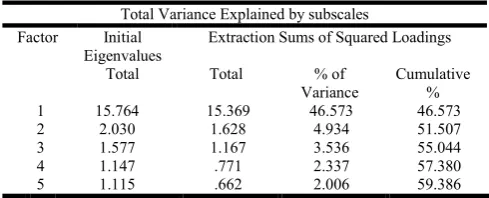
Table 2. The results of the principal axis factor for CM in PBL (n=213)
Total Variance Explained by subscales
Factor Initial
Eigenvalues
Extraction Sums of Squared Loadings
Total Total % of
Variance
Cumulative %
1 15.764 15.369 46.573 46.573
2 2.030 1.628 4.934 51.507
3 1.577 1.167 3.536 55.044
4 1.147 .771 2.337 57.380
5 1.115 .662 2.006 59.386
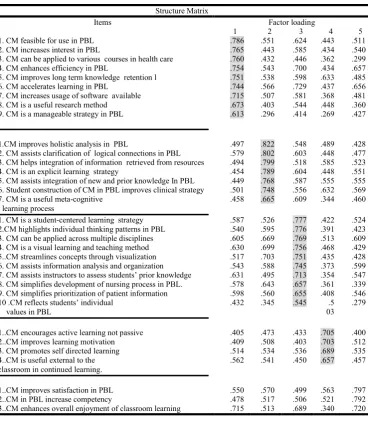
The data was analyzed with the statistical computer program SPSS 18 and The Principal Axis Factoring analysis post rotated variance with Eigenvalue over 1. The indicated 5 factors explain the 59.386% of total variance. Factor 1 through factor 5 was calculated at 46.5 %, 4.9 %, 3.5 %, 2.3 % and 2.0 % respectively (Table 2, Figure 1). The factor loading of the 33 items was > 0.54.
Table 3. Factor loading for the items in CM-PBL
Structure Matrix
Items Factor loading
1 2 3 4 5
1. CM feasible for use in PBL .786 .551 .624 .443 .511
2. CM increases interest in PBL .765 .443 .585 .434 .540
3. CM can be applied to various courses in health care .760 .432 .446 .362 .299
4. CM enhances efficiency in PBL .754 .543 .700 .434 .657
5. CM improves long term knowledge retention l .751 .538 .598 .633 .485
6. CM accelerates learning in PBL .744 .566 .729 .437 .656
7. CM increases usage of software available .715 .507 .581 .368 .481
8. CM is a useful research method .673 .403 .544 .448 .360
9. CM is a manageable strategy in PBL .613 .296 .414 .269 .427
1.CM improves holistic analysis in PBL .497 .822 .548 .489 .428
2. CM assists clarification of logical connections in PBL .579 .802 .603 .448 .477
3. CM helps integration of information retrieved from resources .494 .799 .518 .585 .523
4. CM is an explicit learning strategy .454 .789 .604 .448 .551
5. CM assists integration of new and prior knowledge In PBL .449 .768 .587 .555 .555
6. Student construction of CM in PBL improves clinical strategy .501 .748 .556 .632 .569
7. CM is a useful meta-cognitive learning process
.458 .665 .609 .344 .460
1. CM is a student-centered learning strategy .587 .526 .777 .422 .524
2.CM highlights individual thinking patterns in PBL .540 .595 .776 .391 .423
3. CM can be applied across multiple disciplines .605 .669 .769 .513 .609
4. CM is a visual learning and teaching method .630 .699 .756 .468 .429
5..CM streamlines concepts through visualization .517 .703 .751 .435 .428
6. CM assists information analysis and organization .543 .588 .745 .373 .599
7. CM assists instructors to assess students’ prior knowledge .631 .495 .713 .354 .547
8. CM simplifies development of nursing process in PBL. .578 .643 .657 .361 .339
9. CM simplifies prioritization of patient information .598 .560 .655 .408 .546
10 .CM reflects students’ individual values in PBL
.432 .345 .545 .5
03 .279
1..CM encourages active learning not passive .405 .473 .433 .705 .400
2..CM improves learning motivation .409 .508 .403 .703 .512
3. CM promotes self directed learning .514 .534 .536 .689 .535
4..CM is useful external to the classroom in continued learning.
.562 .541 .450 .657 .457
1..CM improves satisfaction in PBL .550 .570 .499 .563 .797
2..CM in PBL increase competency .478 .517 .506 .521 .792
[image:4.595.115.483.168.765.2]3..CM enhances overall enjoyment of classroom learning .715 .513 .689 .340 .720
Using the pattern of factor loading, items were examined to define the factor names. The factor names based on the loading were 1) Increase of learning efficiency, Eigenvalue 15.764, 9 item load; 2) Integration of knowledge in a holistic view, Eigenvalue 2.030, 7 item load; 3) Presentation of individuality, Eigenvalue 1.577, 10 item load; 4) Enhancement of leanring motivation, Eigenvalue 1.147, 4 item load; 5) promotion of learning satisfaction, Eigenvalue 1.115, 3 item load (Table 3). The internal consistency of the subscales was calculated by Cronbach’s alpha as 0.91, 0.91, 0.91, 0.80, and 0.82 respectively. Consistency > 0.80 for all factors indicated acceptable reliability.
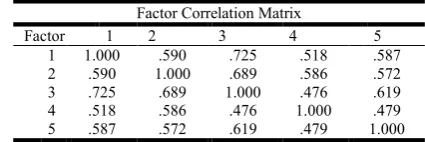
Table 4. Correlation Matrix Showing Correlation Coefficients between Factors
Factor Correlation Matrix
Factor 1 2 3 4 5
1 1.000 .590 .725 .518 .587
2 .590 1.000 .689 .586 .572
3 .725 .689 1.000 .476 .619
4 .518 .586 .476 1.000 .479
5 .587 .572 .619 .479 1.000
DISCUSSION
CM is a visual technique to improve creativity and information linkages using colors and images to emphasize the relationships between ideas and concepts. CM facilitates critical thinking in the nursingstudents,andreveals individual differences in learning, perceptions, and understanding (All, and Huycke, 2007; Vacek, 2009a; Vacek, 2009b). The wide use of CM in nursing education has been well documented. CM is both a learning and teaching tool which allows for clustering information, and is also useful as an evaluation tool for students’ thought processes (Ausubel, 1968). Hill (2006) and test indicated that students construct CM which reflects their mindsets, while simultaneously empowering self-directed learning and increases competency. The process of constructing CM assists students identifying main concepts, relationships between concepts, making logical cross links, and integrating theory into practical application (Hsu, 2004; MacNeil, 2007). CM has been used by PBL tutors to promote students' brainstorming, organization, and development of care plans (All, and Huycke, 2007; Spencer, Anderson, and Ellis,
2013). Students have to interpret the information they learned from textbooks and lectures into knowledge that has meaningful value and recognized utility. Students exposed to CMs developed better understanding of concepts and be more able to effectively apply information to solve case problems (Hendricson et al., 2006). It remains essential to have a reliable instrument to evaluate and confirm the benefits of a learning tool used to assist teaching. This validated CM-PBL scale was developed for nursing students. The five factors were identified as: 1) increase of learning efficiency; 2) integration of knowledge in a holistic view; 3) presentation of individuality; 4) enhancement of learning motivation; 5) promotion of learning satisfaction. The satisfaction factor is an anomaly within the factors due to the low item load of 3 which defies the factor criteria demand of a load of 4. It was concluded that the subjective perceptions outweighed the criteria requirements while the Eigenvalue of 1.115 supported its’ inclusion. The low number of items in factor 4 and 5
subscale criteria, resulted in a Cronbach’s alpha of 0.80 and 0.82 respectively. The five factors were extracted with total explained variance of 59.386 % and then correlated with correlation coefficients between 0.518-0.725. With the exceptions of factor 3 (individuality) and 4 (motivation), and factor 4 (motivation) and 5(satisfaction) which presented with 0.476 and 0.479 respectively while remaining significant. The process of constructing CM in PBL can be a stressful experience which will impact a students’ learning satisfaction. Constructing CM is a contradictive process with both positive and negative feedback. Kostovich et al. (2007) supports the current findings which also indicate students learn how to integrate, comprehend, and think critically. However, the process of CM has the potential for confusion and is not particularly easy. This supports that students’ satisfaction is essential and valid to include in the CM-PBL scale. Due to the nature of the study several limitations exist. Unfortunately due to the low number of PBL tutors available one tutor participated in both PBL group 1. and group 2. to examine the appropriateness of items. This has the potential to have affected the scale. Of the student population studied 98 % were female which may also affect the results. Due to time constraints and availability another limiting factor is the focus on one PBL course over one time period; as opposed to multiple courses tested multiple times or multiple courses tested one time.
Conclusion
Based on the current literature, this is the first study to develop a scale for measuring CM used in PBL for nursing students. The CM- PBL scale shows excellent potential for accurate evaluation of CM use in PBL amongst nursing students. Further validation is required to authenticate the validity of the instrument and allow for further refinement.
Relevance to clinical practice
PBL has been widely documented as an effective teaching and learning strategy in nursing education to cultivate students’ core competence in communication, critical thinking, teamwork, holistic care planning, as well as clinical care practice. CM is a useful and effective tool for students in multiple learning strategies (Kostovich et al., 2007). A valid tool evaluating students’ application of CM in PBL is essential to support and improved the use of CM in the PBL classroom and clinical practice.
Acknowledgements
Study design, data collection, manuscript preparation: L.-C. T; H.-C. S.
Conflict of interest
There is no conflict of interest
REFERENCES
All AC,Havens RL. Cognitive/concept mapping: a teaching strategy for nursing. J Adv Nurs.. 1997 Jun; 25(6):1210-1219.
All AC, Huycke LI. Serial concept maps: tools for concept analysis. J Nurs Educ., 2007 May; 46(5): 217-224.
Ausubel DP. Educational Psychology: A Cognitive View. New York: Holt, Rinehart and Winston; 1968.
Benson EP. Online learning: A means to enhance professional development. Crit Care Nurse, 2004 Feb; 24(1): 60-63. Baugh NG. Clinical concept mapping as preparation for
student nurses’ clinical experiences. J Nurs Educ., 1998 Sep; 37(6): 253-256.
Cicognani A. Concept mapping as a collaborative tool for enhanced online learning. Educational Technology and Society. 2000 Jul; 3(3): 150-158.
Chung JCC, Chow SMK. Promoting student learning through a student-centred problem-based learning subject curriculum. Innovations in Education and Teaching International. 2004 May; 41(2): 157-168.doi: 10.1080/1470329042000208684
Claudia P. Learning-whose responsibility is it? Nurse Educ. 2005 Jul-Aug; 30(4): 159-165.doi: 10.1097/00006223-200507000-00008
Daley BJ, Torre, DM. Concept maps in medical education: an analytical literature review. Med Educ. 2010 May; 44: 440-448.doi:10.1111/j.1365-2923.2010.03628.x.
Hmelo-Silver CE. Problem-based learning: what and how do students learn? Educational Psychology Review. 2004 Sep; 16(3), 235-266.doi:10.1023/B:EDPR.0000034022.164 70.f3
Hill CM. Integrating clinical experiences into the concept mapping process. Nurse Educ. 2006 Jan-Feb; 31(1): 36-39.doi: 10.1097/00006223-200601000-00010
Hendricson WD, Andrieu SC, Chadwick DG, Chmar JE, Cole JR, George MC, Kalkwarf KL. Educational strategies associated with development of problem-solving, critical thinking, and self-directed learning. J Dent Educ., 2006 Sep; 70(9): 925-936.
Hair JF, Anderson RF, Tatham RL, Black WC. Multivariate data analysis 5th ed. New Jersey. Prentice Hall Inc.; 1998 Hsu LL, Hsieh SI. Concept map as an assessment tool in a
nursing course. J Prof Nurs., 2005 May-Jun; 21(3): 141-9. Irvine LMC. Can concept mapping be used to promote
meaningful learning in nurse education? J Adv Nurs. 1995 Jun; 21: 1175-1179.
Hsu LL. Issues and innovations in nursing education developing concept maps from problem-based learning scenario discussions. J Adv Nurs., 2004 Dec; 48(5): 510. doi: 10.1111/j.1365-2648.2004.03233.x
Kinchin I. Using concept maps to optimize the composition of collaborative student groups: a pilot study. J Adv Nurs, 2005 Jul; 51(2): 182-7. doi: 10.1111/ j.1365-2648.2005.03478.x
Kassab SE, Hussain S. Concept mapping assessment in a problem-based medical curriculum. Med Teach, 2010; 32(11): 926. doi:10.3109/0142159X.2010.497824
Kostovich CT, Poradzisz M, Wood K, O'Brien KL. Learning style preference and student aptitude for concept maps. J
Nurs Educ., 2007 May; 46(5): 225-231.
Lin MC, Pan NN, Chiang CL. The use of concept maps in the first-year junior college course, "introduction to nursing".
Journal of Evidence-based Nursing, 2005 Jun; 1(2):
101-111.
Macneil MS. Concept mapping as a means of course evaluation. J Nurs Educ., 2007 May; 46(5): 232-234. Morrison J. Where now for problem based learning? The
Lancet. 2004 Jan; 363(9403): 174. doi: 10.1016/S0140-6736(03)15298-1
Novak JD. Learning meaningful learning: the essential factor for conceptual change in limited or inappropriate propositional hierarchies leading to empowerment of students. Sci. Ed. 2002 Jun; 86(4): 548 – 571. doi: 10.1002/sce.10032
Novak JD, Canas AJ. The theory underlying concept maps and how to construct them. Technical Report IHMC CmapTools; 2006-01.
Novak JD, Canas AJ. Advancing teaching and learning in medical education through the use of concept maps. Concept Maps: Theory, Methodology, Technology. Proceeding of Second International Conference on Concept Mapping, San Jose, Costa Rica; 2006b.
Palfreyman D.. The Oxford tutorial: ‘thanks, you taught me how to think’. Oxford Centre for Higher Education Policy Studies: Oxford; 2001.
Strickland OL. Using factor analysis for validity assessment: Practical considerations. J Nurs Meas., 2003 Winter; 11(3): 203-205.doi: http://dx.doi.org/10.1891/jnum. 11.3.203. 61274
Schuster PM. Concept mapping: reducing clinical care plan paperwork and increasing learning. Nurse Educ. 2000 Mar-Apr; 25 (2): 76-81.doi:10.1097/00006223-200003000-00009
Spencer JR, Anderson KM, Ellis KK. Radiant thinking and the use of the mind map in nurse practitioner education. J Nurs Educ., 2013 May; 52(5), 291-293. doi:10.3928/01484834-20130328-03
Schmidt HG, Rotgans JI, Yew EH. The process of problem-based learning: What works and why. Med Educ. 2011 Aug; 45(8): 792–806. doi:10.1111/j. 1365-2923.2011. 04035.x.
Siu HM, Laschinger HKS, Vingilis E. The effect of problem-based learning on nursing students perceptions of empowerment. J Nurs Educ., 2005 Oct; 44(10): 459-469. Smith J, Spurling A. Lifelong learning: riding the tiger. New
York: Cassell; 1999
Sanders D, Welk DS. Strategies to scaffold student learning: applying Vygotsky's zone of proximal development. Nurse Educ. 2005 Sep-Oct ; 30(5): 203-207.doi: 10.1097/ 00006223-200509000-00007
Thompson B. Ten commandments of structural equation modeling. In L.G. Grimm and P. R. Yarnold (eds.), Reading and understanding more multivariate statistics. Washington, DC: APA; 2000. 261-283p
Torre DM, Daley B, Stark-Schweitzer T, Siddartha S, Petkova J, Ziebert, M. A qualitative evaluation of medical student learning with CMs. Med Teach. 2007 Nov; 29: 949–955. Tsai CC, Lin SSJ, Yuan SM. Students' use of web-based CM
testing and strategies for learning. Journal of Computer
Assisted Learning, 2001; 17(1): 72-84.doi:
10.1046/j.1365-2729.2001.00160.x
Vacek JE. Using a conceptual approach with a concept map of psychosis as an exemplar to promote critical thinking. J
Nurs Educ., 2009b Jan; 48(1): 49-53.doi:
10.3928/01484834-20090101-12
Veronese C, Richards JB, Pernar L, Sullivan AM, Schwartzstein RM. A randomized pilot study of the use of concept maps to enhance problem-based learning among first-year medical students. Med Teach. 2013 Sep; 35(9): e1478-e1484. doi:10.3109/0142159X.2013.785628.
Van BHJM, Schmidt HG. Motivation to commit oneself as a determinant of achievement in problem-based learning. Higher Education, 2000 Sep; 40: 231-242.doi: 10.1023/A:1004022116365
Woods DR. Problem-based learning: how to gain the most from PBL. Hamilton: McMaster University; 2000.