Original Article
TNF-α and IL10 polymorphisms interaction increases
the risk of ankylosing spondylitis in Chinese
Han population
Nai-Guo Wang, Da-Chuan Wang, Bing-Yi Tan, Feng Wang, Ze-Nong Yuan
Department of Spinal Surgery, Shandong Provincial Hospital Affliated to Shandong University, Jinan 250021,
Shandong, China
Received August 28, 2015; Accepted September 29, 2015; Epub November 1, 2015; Published November 15, 2015
Abstract: Aims: The target of this article was to reveal the role of tumor necrosis factors α (TNF-α) and Interleukin-10 (IL10) gene polymorphisms in ankylosing spondylitis (AS) development and explore the interaction between these
two gene polymorphisms. Methods: The genotyping of gene polymorphims was conducted using ABI Taqman
as-say method in 84 AS patients and 92 healthy people. Hardy-Weinberg equilibrium (HWE) was checked in the con
-trol group and the genotypes and alleles difference were compared with χ2 test. Odds ratio (OR) with 95% confi -dence interval (CI) was calculated to identify the strength of association between gene polymorphism and disease. Meanwhile, multifactor dimensionality reduction (MDR) method was used to analysis the interaction between gene polymorphisms. Results: The genotypes CG+CC of the minor allele in IL10 rs1878672 in cases was obviously higher frequency than the controls (P=0.03) and the minor allele C was also associated with the increased risk of AS, compared with G allele (OR=2.05, 95% CI=1.08-3.89). Rs3024490 in IL10 also showed a significant correlation to the onset risk of AS (GG vs. TT: OR=3.03, 95% CI=1.04-8.87; G vs. T: OR=1.70, 95% CI=1.08-2.68). What’s more, there was the interaction between TNF-α rs3093662 and IL10 rs3021094, rs3024490 polymorphisms in AS.
Conclusions: IL10 rs1878672 and rs3024490 polymorphisms obviously increase the susceptibility to AS, but not
TNF-α rs3093662. Both IL10 and TNF-α polymorphisms may affect the onset of AS.
Keywords:IL10, TNF-α, polymorphism, ankylosing spondylitis, interaction
Introduction
Ankylosing spondylitis (AS) is a chronic inflam -matory disorder which mainly invades axial
skeleton and characterized by sacroilioarthritis and involving in eye, lung, kidney and cardio -vascular system in a variable extent [1, 2]. This
disease strikes the adults in 20-60 years old
mostly with the high incidence, which gives rise
to heavy socio-economic burden for patients’
family [3]. Human leucocyte antigen (HLA)-B27
is the first certain molecule proved to be strong -ly associated with AS [4, 5]. Unfortunate-ly,
HLA-2B only accounts for the part risk of AS, what’s
more, a number of previous researchers have found that some other genes, including ANTXR2, KIF21B, ERAP1, TNF-α and IL10
sig-nificantly are correlated with AS susceptibility
[6-10].
Tumor necrosis factors α (TNF-α), belonging to TNF family, is a kind of cytokine caused cell
death. It is encoded by TNF-α gene located on chromosome 6p21.3, including 4 exons and 3
introns [11]. Interleukin-10 (IL10) is an anti-inflammatory cytokine and encoded by IL10 gene in chromosome 1q31-32, containing 5 exons [12]. Many single nucleotide
polymor-phisms (SNPs) have been identified in TNF-α and IL10 gene, in the meanwhile, various stud-ies have found that some SNPs can affect the transcription level of TNF-α and IL10 [13, 14].
They may be associated with infectious, auto-immune diseases and cancers and interfere into the generation, development of diseases. The research showed that the expression level
patients could improve the symptoms [15].
Meanwhile, the levels of IL10 were significantly
higher in AS patients than the healthy people and the haplotype of IL10 increased the sus-ceptibility to AS in Chinese population [16]. Hence, the two genes served as candidate sus-ceptibility genes for AS.
However, most of the early researches focused on the role of single gene polymorphisms in AS. The aim of the study was to investigate the association of TNF-α rs3093662 and IL10 rs1878672, rs3021094, rs3024490 SNPs and their interactions with AS susceptibility and hoped to gain more clues for explaining the eti-ology of AS.
Materials and methods
Subjects
This study was conducted with a case-control design. 84 AS patients with positive HLA-B27 diagnosed by the pathology department in
Provincial Hospital affiliated to Shandong
University (Jinan, Shandong Province) were selected as the case group from 4, 2012 to 11, 2013. The cases age range was 15-42 and included 32 females and 52 males. Besides, the patients were excluded if they were simulta-neously subject to tumors, cardiovascular
sys-tem disease and the other inflammatory dis -eases or once had the relative disease history. In the control group, 92 healthy persons were enrolled, who experienced the physical exami-nation in the same hospital with the cases at the same time and their age and gender were frequency-matched with the cases. All subjects were Han population and meanwhile they had no relationship by blood. The study was approved by the Research Ethics Committee of above hospital and written consents were obtained from all participants in our study.
Genotyping
Blood samples were collected from each sub-ject and stored at -80°C refrigerator for next
instructions [10]. All samples were measured in 3 replicates.
Statistical analysis
SPSS 18.0 software was used in statistical analysis. The genotypes distributions of TNF-α and IL10 SNPs were verified it they conformed
to Hardy-Weinberg equilibrium (HWE) among the controls. The differences were judged
based on t-test by age and χ2 test by the other
indexes. The data were represented with n (%) or _X±s and odds ratio (OR) with corresponding
95% confidence interval (95% CI) was used to
reveal the association intensity of gene poly-morphism with disease susceptibility. P<0.05
was considered as the statistically significant
meaning. At last, the interaction among gene
polymorphisms was analyzed by the method of
multifactor dimensionality reduction (MDR) in AS.
Results
Demographic and clinical data of the cases and controls
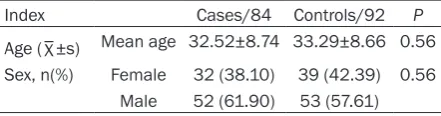
In this article, 176 subjects were enrolled including 84 AS patients and 92 healthy peo-ple. The males accounted for 61.90% and 57.61% in two groups respectively and there
was no significant difference between the two
groups (P=0.56). The average age of partici-pants in cases was 32.52±8.74 and the control group was a little higher (33.29±8.66), but the
difference was not significant (P=0.56) (Table 1).
Effects of SNPs in TNF-α and IL10 genes on
AS susceptibility
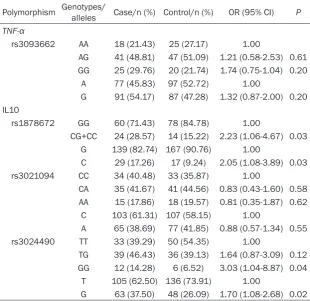
HWE was tested before the study, the results indicated that the genotypes distributions of TNF-α and IL10 SNPs in the control group con-formed to HWE and the population possessed a representativeness (P>0.05).
Any genotypes and alleles of TNF-α rs3093662
[image:2.629.99.320.105.163.2]polymorphism had no significant difference in
Table 1. Characteristics of subjects in the case and control groups
Index Cases/84 Controls/92 P
Age (_X±s) Mean age 32.52±8.74 33.29±8.66 0.56 Sex, n(%) Female 32 (38.10) 39 (42.39) 0.56
Male 52 (61.90) 53 (57.61)
step. And then blood DNA extraction was con-ducted by the method of the conventional chloroform isoamyl alcohol extraction. The genotyping of rs3093662 in TNF-α and rs3024490, rs1878672 and rs3021094 in IL10 was conducted utilizing an ABI Taqman
assay on a 7900 system (Applied Biosystems,
these two groups (P>0.05) and it was not an
[image:3.629.96.407.106.407.2]independent risk factor for AS. As was shown in
Table 2, we also gained the similar result in IL10 rs3021094 polymorphism (P=0.58, 0.62, 0.55, respectively). Differently, the mutant gen-otypes CG+GG of IL10 rs1878672 polymor-phism had a higher frequency in cases than that of the controls (28.57% & 15.22%) and it
significantly increased the susceptibility to AS
TNF served as a multifunctional pro-inflamma
-tory cytokine, which not only is it associated
with various physiological processes but also involves in several pathological processes,
such as apoptosis, proliferation, inflammation
and immunoreguation [17-19]. The up-regulat-ed expression of TNF-α is associatup-regulat-ed with
vari-ous illnesses involved inflammatory, autoim -mune system disorders and tumors. The previ-Table 2. Relationship of the genotypes and alleles distribution TNF-α and
IL10 polymorphisms with AS susceptibility
Polymorphism Genotypes/ alleles Case/n (%) Control/n (%) OR (95% CI) P
TNF-α
rs3093662 AA 18 (21.43) 25 (27.17) 1.00
AG 41 (48.81) 47 (51.09) 1.21 (0.58-2.53) 0.61 GG 25 (29.76) 20 (21.74) 1.74 (0.75-1.04) 0.20
A 77 (45.83) 97 (52.72) 1.00
G 91 (54.17) 87 (47.28) 1.32 (0.87-2.00) 0.20 IL10
rs1878672 GG 60 (71.43) 78 (84.78) 1.00
CG+CC 24 (28.57) 14 (15.22) 2.23 (1.06-4.67) 0.03 G 139 (82.74) 167 (90.76) 1.00
C 29 (17.26) 17 (9.24) 2.05 (1.08-3.89) 0.03 rs3021094 CC 34 (40.48) 33 (35.87) 1.00
CA 35 (41.67) 41 (44.56) 0.83 (0.43-1.60) 0.58 AA 15 (17.86) 18 (19.57) 0.81 (0.35-1.87) 0.62
C 103 (61.31) 107 (58.15) 1.00
A 65 (38.69) 77 (41.85) 0.88 (0.57-1.34) 0.55 rs3024490 TT 33 (39.29) 50 (54.35) 1.00
TG 39 (46.43) 36 (39.13) 1.64 (0.87-3.09) 0.12 GG 12 (14.28) 6 (6.52) 3.03 (1.04-8.87) 0.04
T 105 (62.50) 136 (73.91) 1.00
G 63 (37.50) 48 (26.09) 1.70 (1.08-2.68) 0.02
(OR=2.23, 95% CI=1.06-4.67, P=0.03). So was the mutant allele C, com- pared with allele G (OR =2.05, 95% CI=1.08-3.89, P=0.03). In the analysis, we also found that GG genotype and G allele of rs302-4490
might increase the risk
for AS (GG vs. TT: OR =3.03, 95% CI=1.04-8.87; G vs. T: OR=1.70, 95% CI=1.08-2.68).
The interaction analysis
of TNF-α and IL10 SNPs
based on AS
The interaction analysis results of TNF-α and IL10 SNPs were dis-played in Table 3. In the best model of two sites, three sites and four sites, only 3 sites (rs- 3093662, rs3021094, rs3024490) had a
sta-tistically significant
me-aning (P=0.01) and was the best model in overall interaction analysis. Its testing accuracy was 56.80% and meanwh- ile, the cross-validation consistency was very good (10/10) in this model. Therefore, there existed the interaction between TNF-α and IL10 SNPs and they played the role in the develop-ment of AS syner- gistically.
[image:3.629.95.404.454.599.2]Discussion Table 3. The best models of TNF-α and IL10 gene polymorphisms
interac-tion
Model Gene Locus Cross-validation consistency accuracy (%)Testing OR (95% CI) P
2 IL10 rs1878672 8/10 53.40 2.62 (1.34-5.13) 0.62
rs3024490
3 TNF-α rs3093662 10/10 56.80 4.51 (2.28-8.95) 0.01
IL10 rs3021094 rs3024490
4 TNF-α rs3093662 10/10 54.71 6.62 (3.26-13.45) 0.17
ous studies showed that the patients with
active AS showed the increased levels of TNF-α
in sacroiliac joint, which suggested an impor-tant role of TNF-α in AS occurrence [20]. There is no doubt that some functional genetic vari-ants of TNF-α can affect its expression in
tran-scription and translation level [21], so the influ -ence of polymorphsims in TNF-α on the
diseas-es drown scientists’ attention widely. Among
them, -308G/A polymorphism in TNF-α promot-er region has been reported to involve in vari-ous diseases, including AS in multiple popula-tions. Manolova et al. found that this SNP played a role in AS occurrence and determining the age of onset, disease severity and the out-come of treatment in AS patients based on the Bulgarian population [22]. Ji et al. show that -308G/A polymorphism in TNF-α may be a
weak indicator to identify the active state of AS
in Chinese population [23]. In this article, TNF-α rs3093662 was explored the association with
AS, but the relationship wasn’t found in our
population.
IL10, as an important anti-inflammatory factor can inhibits the synthesis of pro-inflammatory cytokines IL-4, IL-5 and decrease the level of
immunoglobulin E (IgE) and the number of eosinophil granulocyte (EOS) in blood. IL10 can suppress not only the generation of Th1, Th2
cytokines but the cloning and proliferation of
T-cells induced by antigen, and the expression of IL10 in patients with allergic disease is lower than healthy controls, which considers that IL10 may regulate the function of others
cyto-kines and play the immunomodulatory role in
the pathologic process of allergic disease, according to the study of Kawamoto et al. [24]. IL10 exists a mass of SNPs [25], such as -1082G/A, -819C/T, -592C/A, -627C/A poly-morphisms, which may affect the transcription activity of IL10 and its expression in plasma.
What’s more, IL10 polymorphism has been found to contribute to the susceptibility to AS in a Chinese population [8]. At the same time, IL10 rs1878672, rs3024490 polymorphisms
were also identified the significant correlation to AS risk and might affect the AS occurrence
through regulating the expression of IL10 in plasma.
In the meanwhile, because IL10 serves as an effective inhibitor of TNF, the relative research-es has showed that the differencresearch-es in the
regu-lation of IL10 and TNF-α play critical roles in the abnormal inflammatory responses [26]. We all know that in early, researches almost involved
in the association between polymorphisms of single gene and AS susceptibility. Increasingly, some scientists attempted to study the associ-ation of multiple gene polymorphisms interac-tion and AS susceptibility. Zhang et al. studied the association of HLA-B27 and ERAP1 with AS susceptibility and concluded that the interac-tion of HLA-B27 and ERAP1 was likely to increase the risk for AS [27]. Similarly, the rela -tionship of HLA-B27 subtypes and TNF-α poly-morphism with AS in Iranian population were investigated and the results showed that there was no interaction between the -238A/G poly-morphism of TNF-α and HLA-B27 subtypes to AS susceptibility [28]. In our study, the interac-tion of IL10 and TNF-α polymorphisms was
analyzed based on AS and the conclusion was
that TNF-α rs3093662 and IL10 rs3021094, rs3024490 SNPs existed the interaction and affected the generation and progression of AS synergistically. Therefore, it suggests that the
genetic variants influence the expression level of gene and regulate the ratio of TNF-α and
IL10 in plasma to involve in relative diseases. In conclusion, AS is a complicated and
multifac-torial disease characterized by familial inheri -tance, so genetic variant of relative gene is an important direction to explain the etiology and pathology of AS. Rs3093662 in TNF-α and rs1878672, 3024490 in IL10 are revealed to
significantly increase the risk of AS, meanwhile,
there was the interaction between TNF-α rs3093662 and IL10 rs3021094, rs3024490 SNPs in AS.
Disclosure of conflict of interest
None.
Address correspondence to: Dr. Nai-Guo Wang, Department of Spinal Surgery, Shandong Provincial
Hospital Affliated to Shandong University, Jinan
250021, Shandong, China. E-mail: guonie625@163. com
References
[1] Jenkinson TR, Mallorie PA, Whitelock HC, Kennedy LG, Garrett SL and Calin A. Defining spinal mobility in ankylosing spondylitis (AS).
[2] Brown MA, Kennedy LG, MacGregor AJ, Darke
C, Duncan E, Shatford JL, Taylor A, Calin A and
Wordsworth P. Susceptibility to ankylosing
spondylitis in twins: the role of genes, HLA, and the environment. Arthritis Rheum 1997; 40: 1823-1828.
[3] Bakland G, Gran JT, Becker-Merok A, Nordvag BY and Nossent JC. Work disability in patients with ankylosing spondylitis in Norway. J
Rheumatol 2011; 38: 479-484.
[4] de Bruyere M and Nagent de Deuxchaisnes C.
Segregation of HL-A27 and ankylosing spondy
-litis in an informative kindred. Tissue Antigens
1976; 7: 15-22.
[5] Hanova P, Pavelka K, Holcatova I and Pikhart
H. Incidence and prevalence of psoriatic
arthri-tis, ankylosing spondyliarthri-tis, and reactive arthri
-tis in the first descriptive population-based study in the Czech Republic. Scand J
Rhe-umatol 2010; 39: 310-317.
[6] Karaderi T, Keidel SM, Pointon JJ, Appleton LH, Brown MA, Evans DM and Wordsworth BP.
Ankylosing spondylitis is associated with the
anthrax toxin receptor 2 gene (ANTXR2). Ann Rheum Dis 2014; 73: 2054-2058.
[7] Yang X, Li M, Wang L, Hu Z, Zhang Y and Yang Q. Association of KIF21B genetic
polymor-phisms with ankylosing spondylitis in a
Chinese Han population of Shandong Province. Clin Rheumatol 2015; 34: 1729-36.
[8] Davidson SI, Wu X, Liu Y, Wei M, Danoy PA, Thomas G, Cai Q, Sun L, Duncan E, Wang N, Yu Q, Xu A, Fu Y, Brown MA and Xu H. Association
of ERAP1, but not IL23R, with ankylosing spon -dylitis in a Han Chinese population. Arthritis Rheum 2009; 60: 3263-3268.
[9] Dong X, Zheng Y, Shi TY and Liu HY. Effects of tumor necrosis factor-alpha on sexual activity
of male patients with ankylosing spondylitis.
Clin Rheumatol 2015; 34: 915-920.
[10] Lv C, Wang Y, Wang J, Zhang H, Xu H and Zhang
D. Association of Interleukin-10 gene polymor
-phisms with ankylosing spondylitis. Clin Invest
Med 2011; 34: E370.
[11] Aguillon JC, Cruzat A, Cuenca J and Cuchacovich
M. [Tumor necrosis factor alpha genetic
poly-morphism as a risk factor in disease]. Rev Med
Chil 2002; 130: 1043-1050.
[12] Edwards-Smith CJ, Jonsson JR, Purdie DM, Bansal A, Shorthouse C and Powell EE.
Interleukin-10 promoter polymorphism pre -dicts initial response of chronic hepatitis C to interferon alfa. Hepatology 1999; 30: 526-530.
[13] Peng Y and Li LJ. TNF-alpha-308G/A polymor-phism associated with TNF-alpha protein ex-pression in patients with diabetic nephropathy. Int J Clin Exp Pathol 2015; 8: 3127-3131.
[14] Miteva LD, Stanilov NS, Deliysky TS and Stanilova SA. Significance of -1082A/G poly -morphism of IL10 gene for progression of colorectal cancer and IL-10 expression. Tumour Biol 2014; 35: 12655-12664.
[15] van der Heijde D, Han C, DeVlam K, Burmester G, van den Bosch F, Williamson P, Bala M, Han
J and Braun J. Infliximab improves productivity and reduces workday loss in patients with an
-kylosing spondylitis: results from a random
-ized, placebo-controlled trial. Arthritis Rheum
2006; 55: 569-574.
[16] Zauner D, Quehenberger F, Hermann J, Dejaco
C, Stradner MH, Stojakovic T, Angerer H, Rinner
B and Graninger WB. Whole body
hyperther-mia treatment increases interleukin 10 and toll-like receptor 4 expression in patients with ankylosing spondylitis: a pilot study. Int J
Hyperthermia 2014; 30: 393-401.
[17] Israni AK, Li N, Cizman BB, Snyder J, Abrams J, Joffe M, Rebbeck T and Feldman HI. Associ-ation of donor inflammAssoci-ation- and
apoptosis-related genotypes and delayed allograft
func-tion after kidney transplantafunc-tion. Am J Kidney
Dis 2008; 52: 331-339.
[18] Zhao M, Yang Y, Bi X, Yu X, Jia H, Fang H and Zang W. Acetylcholine Attenuated TNF-alpha-Induced Apoptosis in H9c2 Cells: Role of Calpain and the p38-MAPK Pathway. Cell Physiol Biochem 2015; 36: 1877-1889. [19] Braun J, Deodhar A, Dijkmans B, Geusens P,
Sieper J, Williamson P, Xu W, Visvanathan S,
Baker D, Goldstein N and van der Heijde D. Efficacy and safety of infliximab in patients with ankylosing spondylitis over a two-year pe -riod. Arthritis Rheum 2008; 59: 1270-1278. [20] Francois RJ, Neure L, Sieper J and Braun J.
Immunohistological examination of open
sac-roiliac biopsies of patients with ankylosing
spondylitis: detection of tumour necrosis fac-tor alpha in two patients with early disease and transforming growth factor beta in three more advanced cases. Ann Rheum Dis 2006; 65: 713-720.
[21] Hohler T, Schaper T, Schneider PM, Meyer zum Buschenfelde KH and Marker-Hermann E.
Association of different tumor necrosis factor
alpha promoter allele frequencies with anky -losing spondylitis in HLA-B27 positive individu-als. Arthritis Rheum 1998; 41: 1489-1492. [22] Manolova I, Ivanova M, Stoilov R, Rashkov R
and Stanilova S. Association of single nucleo-tide polymorphism at position -308 of the
tu-mor necrosis factor-alpha gene with ankylos -ing spondylitis and rheumatoid arthritis. Biotechnol Biotechnol Equip 2014; 28: 1108-1114.
single-nucleotide polymorphisms of tumor
ne-crosis factor gene and different stages of anky -losing spondylitis. Cell Biochem Biophys 2013; 67: 915-922.
[24] Kawamoto M, Matsui E, Kaneko H, Fukao T,
Teramoto T, Kasahara K and Kondo N. IL-10 plays an important role as an immune-modula-tor in the pathogenesis of atopic diseases. Mol Med Rep 2008; 1: 837-842.
[25] Kim KW, Lee KE, Hong JY, Kim MN, Heo WI, Sohn MH and Kim KE. Involvement of IL-10 gene promoter polymorphisms in the suscepti-bility for childhood asthma. Lung 2011; 189: 417-423.
[26] Westendorp RG, Langermans JA, Huizinga TW,
Elouali AH, Verweij CL, Boomsma DI and Van-
denbroucke JP. Genetic influence on cytokine
production and fatal meningococcal disease. Lancet 1997; 349: 170-173.
[27] Zhang Z, Dai D, Yu K, Yuan F, Jin J, Ding L, Hao Y, Liang F, Liu N, Zhao X, Long J, Xi Y and Sun YY. Association of HLA-B27 and ERAP1 with
an-kylosing spondylitis susceptibility in Beijing
Han Chinese. Tissue Antigens 2014; 83: 324-329.
[28] Nicknam MH, Mahmoudi M, Amirzargar AA, Jamshidi AR, Rezaei N and Nikbin B. HLA-B27
subtypes and tumor necrosis factor alpha pro-moter region polymorphism in Iranian patients
with ankylosing spondylitis. Eur Cytokine Netw