www.impactjournals.com/oncotarget/ Oncotarget, Vol. 7, No. 27
CHES-1-like, the ortholog of a non-obstructive
azoospermia-associated gene, blocks germline stem cell differentiation by
upregulating Dpp expression in Drosophila testis
Jun Yu1,3, Yujuan Liu1,3, Xiang Lan2, Hao Wu1,3, Yang Wen1, Zuomin Zhou1,3, Zhibin
Hu1, Jiahao Sha1,3, Xuejiang Guo1,3,4, Chao Tong2
1State Key Laboratory of Reproductive Medicine, Nanjing Medical University, Nanjing 211166, China
2Life Sciences Institute and Innovation Center for Cell Signaling Network, Zhejiang University, Hangzhou 310058, China 3Department of Histology and Embryology, Nanjing Medical University, Nanjing 211166, China
4Animal Core Facility, Nanjing Medical University, Nanjing 211166, China
Correspondence to: Chao Tong, email: [email protected]
Xuejiang Guo, email: [email protected]
Keywords: non-obstructive azoospermia, Drosophila, testis tumor, BMP signaling, germline stem cells Received: February 22, 2016 Accepted: May 16, 2016 Published: June 2, 2016
ABSTRACT
Azoospermia is a high risk factor for testicular germ cell tumors, whose underlying molecular mechanisms remain unknown. In a genome-wide association study to identify novel loci associated with human non-obstructive azoospermia (NOA), we uncovered a single nucleotide polymorphism (rs1887102, P=2.60 ×10⁻⁷)
in a human gene FOXN3. FOXN3 is an evolutionarily conserved gene. We used Drosophila melanogaster as a model system to test whether CHES-1-like, the Drosophila FOXN3 ortholog, is required for male fertility. CHES-1-like knockout flies
are viable and fertile, and show no defects in spermatogenesis. However, ectopic
expression of CHES-1-like in germ cells significantly reduced male fertility. With
CHES-1-like overexpression, spermatogonia fail to differentiate after four rounds of mitotic division, but continue to divide to form tumor like structures. In these testes, expression levels of differentiation factor, Bam, were reduced, but the expression region of Bam was expanded. Further reduced Bam expression in CHES-1-like expressing testes exhibited enhanced tumor-like structure formation. The expression of daughters against dpp (dad), a downstream gene of dpp signaling, was upregulated by CHES-1-like expression in testes. We found that CHES-1-like could directly bind to the dpp promoter. We propose a model that CHES-1-like overexpression in germ cells activates dpp expression, inhibits spermatocyte differentiation, and finally leads
to germ cell tumors.
INTRODUCTION
Testicular germ cell tumors (TGCTs) are the most common cancer among young men in industrialized countries [1]. TGCTs are thought to be derived from germ cell lineage cells that are blocked in differentiation and maturation [1]. The causative genetic aberrations were
rarely identified. Genome-wide association study (GWAS)
studies revealed polymorphic loci linked to the KIT/
KITLG [2, 3], RAS [4], and steroid signaling pathways
[5, 6]. However, the molecular mechanisms underlining TGCTs remain poorly understood.
Drosophila and human testes share many features of spermatogenesis [7, 8]. Many mutants of homologous human and Drosophila genes exhibit similar testicular
phenotypes. The adult fly testis is a blind tube that opens
into the seminal vesicle and ejaculatory duct [8]. The apical tip of the tube is a cluster of somatic cells called
hub cells. Eight to ten germ line stem cells (GSCs) are
tightly associated with the hub cells, and each is enveloped
by two cyst-stem cells (CySCs). Each GSC divides
asymmetrically to maintain one cell associated with the
undergo four rounds mitosis before further differentiation, and then enter meiosis and mature into spermatids [9].
The self-renewal and differentiation of early germ cells in flies are tightly controlled [9]. Similar to humans, flies also develop testis tumors when germ cells fail to differentiate and over-proliferate [10]. Janus kinase-signal transducer and activator of transcription (JAK-STAT) and
bone morphogenetic protein (BMP) signaling are critical
for GSC maintenance [8, 9]. Malfunction of these two pathways could lead to testis tumors in flies. Hub cells
secrete Unpaired (Upd) to bind receptor Dormless on
GSCs and CySCs, which activates JAK-STAT signaling and maintains germline and somatic stem cell self-renewal [11, 12]. The ectopic expression of Upd in GSCs
results in testis tumors with a massive accumulation of
undifferentiated GSC-like cells [11, 12].
Two BMP-like molecules, Dpp and Gbb, expressed in hub and cyst cells are required for GSC maintenance [13–15]. Dpp and Gbb are received by GSCs, where they repress the expression of the differentiation factor, Bag-of-marbles (Bam) [13–15]. Bam and its regulator, Benign
gonial cell neoplasm (Bgcn), are required for restricting proliferation of mitotically amplifying spermatogonia [16, 17]. Mutations in bam or bgcn lead to testis tumors with extensive proliferation of undifferentiated germ cells [18,
19]. Since BMP signaling could repress bam expression, ectopic expression of dpp in germ cells leads to reduced
bam expression and the formation of tumor-like structures in testis [13, 15]. Despite its important functions in fly
spermatogenesis, BMP signaling is also required in testis development and spermatogenesis in mammalian systems
[20]. Aberrant BMP signaling was reported in human
samples with TGCTs [21]. Therefore, investigation of
germ cell differentiation in flies might provide insight into
potential mechanisms for human TGCTs.
Our previous work has successfully used Drosophila
testis as a model system to evaluate the possible loci
associated with a severe symptom of male infertility: non-obstructive azoospermia (NOA) [22, 23]. We found two
loci near DMRT2 and DMRT3, two genes encoding a DM domain containing a transcription factor, were associated
with NOA [22]. Interestingly, DMRT1, the paralog of
DMRT2/3, was found to be associated with human TGCTs
[24, 25]. Studies showed that the risk of TGCTs was
increased in azoospermia or subfertile patients [1, 26–28]. Therefore, genes associated with azoospermia might also modulate the risk of TGCTs.
In the same GWAS study [23, 29], we uncovered that a single nucleotide polymorphism (SNP) in the
human FOXN3 gene is associated with NOA. FOXN3 is evolutionary conserved. As indicated in Ensembl database, fly gene CHES-1-like is the ortholog of both human FOXN3 and FOXN2, which is a one to multiple orthologous relationship. To evaluate the functional
relevance of the GWAS study, we assessed the function
of CHES-1-like in fly spermatogenesis. CHES-1-like
mutant male flies were viable and fertile. We found that CHES-1-like is not required for GSC maintenance or other spermatogenesis processes in fly testes. However, ectopic
expression of CHES-1-like in germ cells significantly reduced male fertility. When CHES-1-like was overexpressed, spermatogonia failed to differentiate after four rounds of mitotic division, but continued to divide
to form tumor-like structures. We found that CHES-1-like
could activate dpp expression and block spermatocyte
differentiation. Our results suggest that NOA-associated SNPs could be a potential modulator of testis tumor
development.
RESULTS
Loss of CHES-1-like does not cause spermatogenesis defects
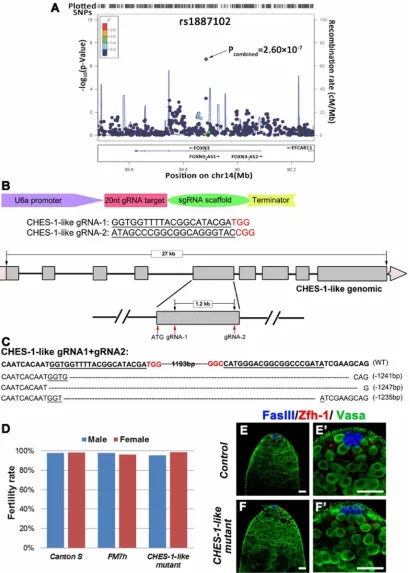
In our previous NOA GWAS screen [23, 29], one SNP (rs1887102, P=2.60 ×10⁻⁷) in the human gene, FOXN3, was found to be associated with NOA (Figure 1A). FOXN3 is an evolutionarily conserved gene. In
Drosophila, CHES-1-like is the ortholog of FOXN3. To evaluate whether this loci is functionally relevant to spermatogenesis, we tested the function of CHES-1-like in fly testes.
We knockdown CHES-1-like expression in germ
cells of fly testes (Nos>CHES-1-like RNAi) and did not
observe obvious defects (Supplementary Figure 1). We
generated CHES-1-like deletion mutants using Cas9-mediated mutagenesis. We recovered multiple lines with different indels confirmed by PCR and sequencing (Figure 1B, 1C). Both the hemizygous mutant male flies and homozygous mutant female flies were viable and fertile (Figure 1D). We further examined the testes of CHES-1-like mutants by immunostaining with antibodies
recognizing hub cells, germ cells, and cyst cells (Figure 1E, 1F). The patterns of all cell types were identical to
the wild type controls, indicating that loss of CHES-1-like does not affect spermatogenesis in flies.
Ectopic expression of CHES-1-like in germ cells induces testis tumor formation
Since CHES-1-like loss of function did not result in spermatogenesis defects, we decided to examine whether
ectopic expression of CHES-1-like could lead to testis malfunction. We generated UAS-CHES-1-like transgenic
flies, and crossed these flies with different Gal4 lines expressing specifically in germ cells (Nos-Gal4 and Bam-Gal4; Figure 2A), cyst cells (Tj-Gal4; Supplementary Figure 2), and hub cells (Upd-Gal4; Supplementary Figure 3) in fly testes.
Figure 1: Loss of CHES-1-like does not cause spermatogenesis defects in Drosophila. A. The SNP rs1887102 at 14q32.11 was identified as a NOA associated SNP. Additive models of logistic regression analyses were used to estimate the P-value of association analyses in 981 NOA cases and 1,657 controls. The marker SNP is shown in purple and the r2 value of the rest of the SNPs are indicated by different colors. The genes within the region of interest are annotated, with arrows indicating transcription direction. B. The design of knock out (KO) strategy for CHES-1-like gene using CRISPR/Cas9 technology. The scheme shows that the design of the injected construct, sequence of gRNAs, and the location of the gRNAs. C. Indels identified in Three CHES-1-like alleles. D. The fertility of controls and
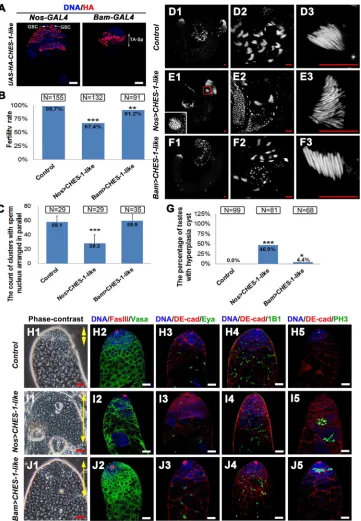
Figure 2: Ectopic expression of CHES-1-like in germ cells causes male fertility defect and tumor like structure formation.
A. The patterns of Nos-Gal4 and Bam-Gal4 driving HA tagged CHES-1-like protein expression. B. The fertility rate of male flies with indicated genotypes. CHES-1-like overexpression in germ cells reduced male fertility. Chi-square test was used. ***: P<0.001; **: P<0.01. C.
The quantification of the clustered elongated spermatids at the proximal ends of the testes with indicated genotypes. Nos>CHES-1-like testes
have reduced numbers of elongated spermatids. Student’s t test was used, ***: P<0.001. D-F. Whole mount testes with indicated genotypes were stained with Hochest 33342. (D2-F2 and D3-F3) are enlarged views of (D1-F1) to show the proximal end of the testes and clustered spermatids. The boxed region of (E1) shows a cyst with over-proliferated germ cells. G. The quantification of testes containing cysts with over-proliferated germ cells (hyperplasia cysts). Chi-square test was used. ***: P<0.001; *: P<0.05. H1-J1. The phase contrast images of testes with
indicated geneotypes show an increasing of the small cells that resembled GSCs and spermatognia in the apical region of both Nos>CHES-1-like and Bam>CHES-1-like testes (areas indicated by yellow double head arrows). The hyperplasia cysts were indicated by red arrows. (H2-J5) Immunostaining of testes with indicated geneotypes. DNA, germ cells, hub cells, cyst cells, mature cyst cells, fusomes, and dividing cells were labeled with Hochest 33342, Vasa, FasIII, DE-Cadherin, Eya, 1B1, and pH3, respectively. Nos>CHES-1-like testes has overproliferated
clusters of elongated spermatids were greatly reduced in Nos>CHES-1-like testes compared to normal testes
(Figure 2C-2F). An increase in the small cells resembling GSCs and spermatogonia in the apical region of both Nos>CHES-1-like and Bam>CHES-1-like testes was
observed by phase contrast microscopy (Figure 2H1, 2I1, 2J1). Cysts with an overproliferation of small cells were
also observed in the distal region of the Nos>CHES-1-like testis tips (Figure 2G, 2H1, 2I1, 2J1).
We further examined Nos>CHES-1-like and
Bam>CHES-1-like testes with various cellular markers
(Figure 2H-2J). DNA and Vasa staining confirmed that the region of GSCs and spermatogonial cells were expanded (Figure 2H2, 2I2, 2J2). In the Nos>CHES-1-like testes,
cysts packed with small cells form tumor-like structures in which Vasa staining is lost (Figure 2I2). We used the
1B1 antibody to label fusome, a membrane structure that connects sibling germ cells. Most fusomes observed in the apical tip of Nos>CHES-1-like and Bam>CHES-1-like testes were small and branched (Figure 2H4, 2I4, 2J4),
suggesting that the majority of cells were interconnected and resembled proliferating spermatogonia. This indicates that the spermatogonial cells failed to cease mitotic division after four rounds, and continually divided to form
tumor-like structures. Indeed, using the cell proliferation marker phospho-Histone H3 (pH3) antibody to label
dividing germ cells, pH3 could be observed only at the tip
of wild type testes (Figure 2H5). However, ectopic pH3
labeling was observed in some cysts distal from the tip of the testes with ectopic CHES-1-like expression in germ
cells (Figure 2I5, 2J5). We also used FasIII to label hub cells, and Eya and DE-cadherin to label cyst cells. There
was no dramatic change in the number and morphology of
either cell type (Figure 2H-2J and Supplemental Figure 1). We further investigated Tj-Gal4-driven CHES-1-like expression in cyst cells and Upd-Gal4-driven CHES-1-like
expressionin hub cells, and examined the resulting testes with various markers. There was no obvious difference between wild type testes and the testes with CHES-1-like expression in cyst (Supplementary Figure 2) and hub cells (Supplementary Figure 3).
CHES-1-like inhibits spermatocyte differentiation through suppressing Bam expression
The expression of Bam is required for spermatogonial cells to exit the mitotic cell cycle and begin differentiation [19]. It is likely due to the disruption of Bam signaling that spermatogonia were unable to cease
mitosis in CHES-1-like germ cell ectopically expressing
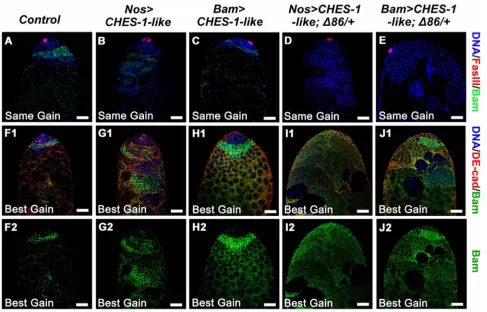
testes. To test this, we analyzed Bam expression patterns in these testes. In wild type animals, Bam is expressed
primarily in the transient amplifying (TA) spermatogonia, a strip of cells near the apical tip of the testes (Figure 3A). The expression level of Bam was greatly reduced in
both Nos>CHES-1-like (Figure 3B) and Bam>CHES-1-like testes (Figure 3C). However, the expression region of Bam was expanded (Figure 3F1-3J1, 3F2-3J2). We also used Bam-GFP reporter to analyze bam expression patterns. In Nos>CHES-1-like testes, GFP expression
levels were reduced and the expression regions were
expanded (Supplementary Figure 4). The reduction of GFP
staining is obvious but less dramatic than the reduction of Bam staining in Nos>CHES-1-like testis (Figure 3B, Supplementary Figure 4), which is likely due to that not
only the transcriptional levels but also the protein levels of
Bam is affected by CHES-1-like expression.
It has been reported that around half of male germ cells lacking one copy of bam will complete one or more
extra TA divisions before differentiation [30]. Removing
one copy of bam further reduced the fertility of male flies with CHES-1-like overexpressing in germ cells (Figure 4A). DNA staining in the testis tail revealed that clusters of
elongated spermatids were further reduced in these testes
compared to the testes with CHES-1-like overexpressing alone (Figure 4B and 4C1-4E3). Bam expression in these testes was reduced to an undetectable level (Figure 3D, 3E). There was an increase in aberrant tumor-like cysts packed with over-proliferated small cells (Figure 4F-4I). These results suggest that CHES-1-like likely suppresses spermatocyte differentiation by down-regulating Bam
expression.
CHES-1-like activates TGF-β signaling by
upregulating dpp expression
In testis, Bam expression is repressed by BMP
signaling. Therefore, CHES-1-like-mediated down regulation of Bam expression might reflect the activation
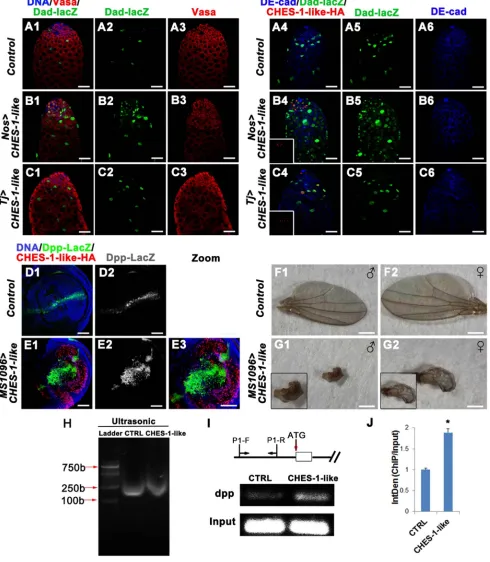
of BMP signaling. Indeed, the BMP signaling downstream gene daughters against dpp (dad) was expressed at low
levels in GSCs and spermatogonial cells in wild type testes (Figure 5A1-5A6). Expression levels of Dad-lacZ dramatically increased in the germ cells expressing CHES-1-like (Figure 5B1-5B6). However, ectopic expression of CHES-1-like in early cyst cells with Tj-Gal4 did not increase Dad-lacZ expression in cyst cells (Figure 5C1-5C6). The upregulation of Dad expression and downregulation of Bam expression indicates that CHES-1-like may ectopically activate BMP signaling.
BMP downstream gene expression is mediated by
phosphor-Mad (p-Mad) and its cofactor, Medea. Since CHES-1-like is a FOX domain-containing protein, a potential transcriptional factor, we first tested whether
it could interact with Mad to regulate Dad and Bam expression. However, we did not detect any interaction
between CHES-1-like and Mad (Supplementary Figure 5). Because ectopic expression of CHES-1-like in germ
cells mimicked the phenotype of Dpp overexpression in
germ cells [13, 15], we tested whether CHES-1-like could
MS1096-Gal4-driven CHES-1-like expression in the wing imaginal
disc porches and examined Dpp-lacZ expression patterns (Figure 5D-5G). In the wild type wing discs, Dpp-lacZ appeared as a thin strip at the anterior/posterior (A/P) boundary (Figure 5D1, 5D2). When CHES-1-like was overexpressed, the expression region of Dpp-lacZ was greatly expanded (Figure 5E1-5E3). As a result, the adult
wings of the MS1096>CHES-1-like flies were deformed (Figure 5F1-5G2). However, another gene ptc does not change its expression patterns in the wing porches when
CHES-1-like is overexpressed (Supplementary Figure 6), indicating that the changes of Dpp-LacZ expression
patterns is not due to the morphological changes of the wing discs.
To test whether CHES-1-like directly binds to
the dpp promoter to activate Dpp expression, we used a chromatin immunoprecipitation (ChIP) assay to detect the
interaction between CHES-1-like and the dpp promoter.
We expressed HA-tagged CHES-1-like in Drosophila S2 cells, and immunoprecipitated the protein-DNA complex after cross-linking. Indeed, CHES-1-like was able to
interact with the dpp promoter region (Figure 5H-5J).
DISCUSSION
In this study, we used Drosophila testis as a
model system to test the functional relevance of a
NOA-associated human gene, FOXN3. Although loss of CHES-1-like, the fly ortholog of FOXN3, did not result in
spermatogenesis defects, the ectopic expression of CHES-1-like in germ cells blocked spermatocyte differentiation and induced tumor-like structure formation. Our study has revealed CHES-1-like as a novel BMP signaling regulator
to promote expression of the BMP ligand Dpp.
In flies, CHES-1-like, together with another fork head transcription factor Jumu, governs cardiac progenitor cell division and specification by regulating Polo kinase activity, as well as the expression of fibroblast growth factor and Wnt signaling pathway receptors [31, 32]. Inactivation of FOXN3 in Xenopus and mice led to
craniofacial defects and was sometimes lethal [33, 34].
[image:6.612.65.552.335.647.2]It has been well established that BMP signaling is required for the differentiation and proliferation of osteoblasts of the mammalian skull [35]. Interestingly, the expression levels of the BMP pathway ligands BMP2,
Figure 3: Ectopic expression of CHES-1-like in germ cells led to reduced level of Bam expression. A-E. Bam expression
levels are greatly reduced in the testes with CHES-1-like ectopic expression in germ cells. The same gain were used to indicate the level of Bam expression, DNA (Blue), hub cells (Red), and Bam (Green) were labeled with Hochest 33324, FasIII, and Bam antibodies. Remove
one copy of bam (Δ86/+) further decreased Bam expression. F1-J2. Using longer exposure time (best gain) to show the signals of Bam
Figure 4: Removing one copy of bam enhanced CHES-1-like overexpression phenotypes. A. Male fertility rates are further reduced in the Nos>CHES-1-like; Δ86/+ and Bam>CHES-1-like; Δ86/+ animals. Chi-square test was used. ***: P<0.001. B. The
quantification of the clustered elongated spermatids at the proximal ends of the testes with indicated genotypes. Removing one copy of
bam further reduced the numbers of elongated spermatids in CHES-1-like overexpression testes. Student’s t test was used, ***: P<0.001.
C-E. Whole mount testes with indicated genotypes were stained with Hochest 33342. (C2-E2 and C3-E3) are enlarged views of (C1-E1) to show the proximal end of the testes and clustered spermatids. The boxed regions of (D1 and E1) show cysts with over-proliferated germ
cells. F. The quantification of testes containing cysts with over-proliferated germ cells (hyperplasia cysts). Chi-square test was used. ***: P<0.001. G-I. The phase-contrast views and the immunostaining views of the apical tips of testes with indicated genotypes. Loss of one
Figure 5: CHES-1-like prevents spermatogonial differentiation through promoting Dpp expression to ectopically activate BMP signaling in germ cells. A1-C6. Over-expressing CHES-1-like in germ cells (Nos>CHES-1-like) but not cyst cells (Tj>CHES-1-like) activates BMP down-stream gene dad reporter dad-lacZ expression in germ cells. DNA, germ cells, cyst cells, dad-lacZ, and HA tagged CHES-1-like were labeled with Hochest 33342, Vasa, DE-Cadherin, LacZ, and HA anitibodies. D1-E3. CHES-1-like
overexpression in wing imaginal discs ectopically induces dpp expression in wing porch. Dpp expression was monitored by reporter dpp-lacZ. F1-G2. Images of adult wings of animals with indicated genotypes. H-J. ChIP assay indicates that CHES-1-like could bind to dpp
BMP4, and BMP7 were greatly reduced in the FOXN3 knockout animals [34]. In our study, we found that CHES-1-like binds to the dpp promoter and activated Dpp
expression, suggesting that CHES-1-like might directly regulate BMP ligand expression. Dpp is critical for fly development [36, 37]. However, loss of CHES-1-like
did not result in any obvious developmental defect. It is possible that there is redundant molecules or pathways could compensate the effects caused by the loss of
CHES-1-like. Jumu is a good candidate since it is playing redundant roles during fly heart development. However, ectopic expressing Jumu in germ cells (Nos>UAS-Jumu) does not have any defects (Supplementary Figure 1), indicating Jumu might not play similar roles as
CHES-1-like in testes.
The function of FOXN3 has never been linked to testis
tumors or male sterility. The data from human protein atlas (http://www.proteinatlas.org/) revealed that the protein levels
of FOXN3 were upregulated in most cancer tissues. A recent study in a cancer cell line indicated that CHES1/FOXN3
decreases cell proliferation by repressing PIM2 and protein
biosynthesis, suggesting that FOXN3 is a potential tumor
suppressor [38]. However, we found that overexpression
of CHES-1-like in fly testis could prevent early germ cell differentiation and lead to tumor-like structure formation.
This paradox might arise because of the complex and
context-dependent physiological functions of BMP signaling [39]. Therefore, whether FOXN3 promotes or inhibits tumor
formation might be determined by the tissue context.
In this study, we found that the ortholog of a
NOA-associated gene could modulate testis tumor formation. It is striking since infertility is a high risk factor of testis
tumors. The misregulation of FOXN3 could contribute to both spermatogenesis defects and tumor genesis. Further investigation is necessary to dissect the role of FOXN3 in
TGCTs.
MATERIALS AND METHODS
Fly strains
All flies were cultured on standard corn meal food
at 25 °C. Information for alleles and transgenes used in
this study can be found either in FlyBase or as noted: Nos-Gal4 (BDSC, #4937), Tj-Gal4 (DGRC, #104055), Upd-Gal4 (BDSC, #26796), MS1096-Gal4 (THFC, #TB00038), CHES-1-like RNAi (THFC, #THU2388), Dpp-lacZ, Dad-lacZ, BMPGFP/+, and Bam-Gal4;Δ86/+
are gifts from DH Chen.
Generation of CHES-1-like transgenic fly
CHES-1-like CDS (BDGP, clone RE02128) was
subcloned into the pUAS-attB-HA vector. Primers used
for PCR are: forward: 5- AAAAGCGGCCGCAATG TCCACAGATAATCCCACACAG-3 and reverse: 5-
GTTCTAGATTACCGCATCCAGGCGGACT-3. Jumu CDS (BDGP, clone LD24749) was subcloned into the pUAS-attB vector. Primers used for PCR are: forward:
5-ATAAGAATGCGGCCGCGATGTTCGAACTAGAG GATTATTCGA-3 and reverse: 5-CCGCTCGAGCTAGA TGACGCGGTTGACCAGC-3. The transgenic flies were
generated using standard procedures.
CRISPR/Cas9-mediated genome editing
CHES-1-like mutant was generated by an optimized
CRISPR / Cas9-mediated genome editing method as described before [40]. Two sgRNAs targeting CHES-1-like exon regions were designed to generate an about
1.2kb DNA fragment deletion. Genomic DNA PCR and sequencing were used to confirm the deletions.
Light and phase-contrast microscopy
Fly testes were dissected in 1x phosphate-buffered saline (PBS) and washed several times. Testes were observed on slides by a phase-contrast microscope after gently squashing them with a cover slip. For an overall
view of wing morphology, adult wings were observed directly under light microscope.
Immunofluorescence and antibodies
Fly testes were dissected in 1x PBS and fixed for 30 min in 4% paraformaldehyde. After washing three times in 1x PBS with 0.1% Triton X–100 (PBST) and blocking for 1hr in 5% bovine serum albumin (BSA), the samples were incubated with primary antibodies overnight at 4°C. After washing three times for 10 min in 0.1% PBST, the
samples were incubated for 1 hr with secondary antibodies at room temperature followed by three times washing in
0.1% PBST. Testes were then stained with Hoechst 33342 (1.0 mg/ml, Invitrogen) for 5 min before mounting. The antibodies used were as follows: mouse anti-Eya (DSHB, 1:20); mouse anti-FasIII (DSHB, 1:50); rat anti-DE-cadherin (DSHB, 1:20); mouse anti-1B1 (DSHB, 1:75); rabbit anti-Bam C (a gift from DH Chen, 1:2000) [41]; rabbit anti-Vasa (1:1000, Santa Cruz); rabbit anti-PH3 (CST, 1:400); mouse anti-lacZ (Promega, 1:1000); rabbit anti-HA-tag (CST, 1:1000), rat anti-Zfh1 (C Tong lab, 1:2000), mouse anti-Ptc (DSHB, 1:100), chicken anti-GFP (Abcam, 1:1000). Secondary antibodies conjugated to A488, Cy3, A594, or A647 (Molecular Probes and Jackson Immunologicals) were diluted at 1:1000.
Chromatin immunoprecipitation (ChIP) assay Formaldehyde cross-linking and chromatin immunoprecipitation (ChIP) assays of S2 cells were performed using a protocol as described before [42]. S2 cells transfected with HA-CHES-1-like were subjected
DNA fragments of appropriate size among100-1000 bp.
Twenty percent of total supernatant was used as a total
input control. Following removal of bound proteins, immunoprecipitated DNA was subjected to PCR.
The primer pair used for the CHES-1-like CHIP assays are: 5-CACACACGCTCAGAGACACA-3 and 5-CAAGCGGGACGACTATAGGG-3.
Immunoprecipitation (IP)
pUAS-Myc-Mad and pUAS-Flag-Medea were made by inserting PCR products of CDS of Mad and Medea into pUAS-Myc and pUAS-Flag constructs. Following primers were used: Mad-Myc F:5-AATTGCGGCCGCATGGAC ACCGACGATGTG-3, Mad-Myc R: 5-ACGTCTAGA TTAGGATACCGAACTAATTGC-3, Medea-Flag F:5- AATCTCGAGATGGGCGGCGGCTCGGG-3, Medea-Flag R: 5-ATTTCTAGATTAGGCGGCGGCACGCGG-3. S2 cells transfected with Myc-Mad and HA-CHES-1-like or Flag-Medea were subjected to IP assays. IP were performed as described [43].
ACKNOWLEDGMENTS
The authors wish to thank all study participants, research staff, and students who assisted with this work.
We are grateful to the THFC, BDSC, DGRC, and DHSB for providing fly strains and antibodies, as well as Dahua Chen (Institute of Zoology, CAS) for sharing reagents and
stocks.
FINANCIAL SUPPORT
This work is supported by grants from the National
Basic Research Program of China (2014CB943100, 2012CB966600, 2013CB911400), National Natural Science Foundation of China (31271432), and Specialized Research Fund for the Doctoral Program of Higher Education (20130101110116).
CONFLICTS OF INTEREST
The authors declare no conflicts of interest.
REFERENCES
1. Meyts ER, McGlynn KA, Okamoto K, Jewett MA, Bokemeyer C. Testicular germ cell tumours. Lancet. 2015.
2. Kanetsky PA, Mitra N, Vardhanabhuti S, Li M, Vaughn DJ, Letrero R, Ciosek SL, Doody DR, Smith LM, Weaver J, Albano A, Chen C, Starr JR, Rader DJ, Godwin AK, Reilly
MP, et al. Common variation in KITLG and at 5q31.3
predisposes to testicular germ cell cancer. Nat Genet. 2009; 41:811-815.
3. Rapley EA, Turnbull C, Al Olama AA, Dermitzakis ET, Linger R, Huddart RA, Renwick A, Hughes D, Hines S,
Seal S, Morrison J, Nsengimana J, Deloukas P, Rahman N, Bishop DT, Easton DF, et al. A genome-wide association study of testicular germ cell tumor. Nat Genet. 2009; 41:807-810.
4. Goddard NC, McIntyre A, Summersgill B, Gilbert D, Kitazawa S, Shipley J. KIT and RAS signalling
pathways in testicular germ cell tumours: new data and a
review of the literature. Int J Androl. 2007; 30:337-348; discussion 349.
5. Ferlin A, Ganz F, Pengo M, Selice R, Frigo AC, Foresta C. Association of testicular germ cell tumor with
polymorphisms in estrogen receptor and steroid metabolism
genes. Endocr Relat Cancer. 2010; 17:17-25.
6. Kristiansen W, Andreassen KE, Karlsson R, Aschim EL, Bremnes RM, Dahl O, Fossa SD, Klepp O, Langberg CW, Solberg A, Tretli S, Adami HO, Wiklund F, Grotmol T,
Haugen TB. Gene variations in sex hormone pathways and
the risk of testicular germ cell tumour: a case-parent triad study in a Norwegian-Swedish population. Hum Reprod. 2012; 27:1525-1535.
7. Davies EL, Fuller MT. Regulation of self-renewal and
differentiation in adult stem cell lineages: lessons from the
Drosophila male germ line. Cold Spring Harb Symp Quant Biol. 2008; 73:137-145.
8. Fuller MT, Spradling AC. Male and female Drosophila germline stem cells: two versions of immortality. Science. 2007; 316:402-404.
9. Spradling A, Fuller MT, Braun RE, Yoshida S. Germline stem cells. Cold Spring Harb Perspect Biol. 2011; 3:a002642.
10. Hime GR, Loveland KL, Abud HE. Drosophila spermatogenesis: insights into testicular cancer. Int J Androl. 2007; 30:265-274; discussion 274.
11. Kiger AA, Jones DL, Schulz C, Rogers MB, Fuller MT. Stem cell self-renewal specified by JAK-STAT activation in response to a support cell cue. Science. 2001; 294:2542-2545.
12. Tulina N, Matunis E. Control of stem cell self-renewal in Drosophila spermatogenesis by JAK-STAT signaling. Science. 2001; 294:2546-2549.
13. Bunt SM, Hime GR. Ectopic activation of Dpp signalling
in the male Drosophila germline inhibits germ cell
differentiation. Genesis. 2004; 39:84-93.
14. Kawase E, Wong MD, Ding BC, Xie T. Gbb/Bmp signaling
is essential for maintaining germline stem cells and for repressing bam transcription in the Drosophila testis.
Development. 2004; 131:1365-1375.
15. Shivdasani AA, Ingham PW. Regulation of stem cell maintenance and transit amplifying cell proliferation by
tgf-beta signaling in Drosophila spermatogenesis. Curr Biol.
2003; 13:2065-2072.
16. Gonczy P, Matunis E, DiNardo S. bag-of-marbles and
benign gonial cell neoplasm act in the germline to restrict proliferation during Drosophila spermatogenesis.
17. Lavoie CA, Ohlstein B, McKearin DM. Localization and
function of Bam protein require the benign gonial cell
neoplasm gene product. Dev Biol. 1999; 212:405-413.
18. Gateff E. Gonial cell neoplasm of genetic origin affecting both sexes of drosophila melanogaster. Prog Clin Biol Res.
1982; 85:621-632.
19. McKearin DM, Spradling AC. bag-of-marbles: a
Drosophila gene required to initiate both male and female
gametogenesis. Genes Dev. 1990; 4:2242-2251.
20. Young JC, Wakitani S, Loveland KL. TGF-beta superfamily
signaling in testis formation and early male germline
development. Semin Cell Dev Biol. 2015; 45:94-103.
21. Fustino N, Rakheja D, Ateek CS, Neumann JC, Amatruda JF. Bone morphogenetic protein signalling activity
distinguishes histological subsets of paediatric germ cell
tumours. Int J Androl. 2011; 34:e218-233.
22. Yu J, Wu H, Wen Y, Liu Y, Zhou T, Ni B, Lin Y, Dong J, Zhou Z, Hu Z, Guo X, Sha J, Tong C. Identification of seven genes essential for male fertility through a genome-wide association study of non-obstructive azoospermia and RNA interference-mediated large-scale functional screening in Drosophila. Hum Mol Genet. 2015; 24:1493-1503.
23. Hu Z, Li Z, Yu J, Tong C, Lin Y, Guo X, Lu F, Dong J, Xia Y, Wen Y, Wu H, Li H, Zhu Y, Ping P, Chen X, Dai J, et al. Association analysis identifies new risk loci for
non-obstructive azoospermia in Chinese men. Nat Commun.
2014; 5:3857.
24. Turnbull C, Rapley EA, Seal S, Pernet D, Renwick A, Hughes D, Ricketts M, Linger R, Nsengimana J, Deloukas P, Huddart RA, Bishop DT, Easton DF, Stratton MR, Rahman N. Variants near DMRT1, TERT and ATF7IP
are associated with testicular germ cell cancer. Nat Genet.
2010; 42:604-607.
25. Kanetsky PA, Mitra N, Vardhanabhuti S, Vaughn DJ, Li M, Ciosek SL, Letrero R, D'Andrea K, Vaddi M, Doody DR, Weaver J, Chen C, Starr JR, Hakonarson H, Rader DJ, Godwin AK, et al. A second independent locus within
DMRT1 is associated with testicular germ cell tumor
susceptibility. Hum Mol Genet. 2011; 20:3109-3117.
26. Eisenberg ML, Betts P, Herder D, Lamb DJ, Lipshultz LI. Increased risk of cancer among azoospermic men. Fertil Steril. 2013; 100:681-685.
27. Mancini M, Carmignani L, Gazzano G, Sagone P, Gadda F, Bosari S, Rocco F, Colpi GM. High prevalence of testicular
cancer in azoospermic men without spermatogenesis. Hum
Reprod. 2007; 22:1042-1046.
28. Walsh TJ, Croughan MS, Schembri M, Chan JM, Turek PJ.
Increased risk of testicular germ cell cancer among infertile
men. Arch Intern Med. 2009; 169:351-356.
29. Hu Z, Xia Y, Guo X, Dai J, Li H, Hu H, Jiang Y, Lu F, Wu Y, Yang X, Yao B, Lu C, Xiong C, Li Z, Gui Y, Liu J, et al. A genome-wide association study in Chinese men identifies three risk loci for non-obstructive azoospermia. Nat Genet. 2012; 44:183-186.
30. Insco ML, Leon A, Tam CH, McKearin DM, Fuller MT. Accumulation of a differentiation regulator specifies transit
amplifying division number in an adult stem cell lineage.
Proc Natl Acad Sci U S A. 2009; 106:22311-22316.
31. Ahmad SM, Bhattacharyya P, Jeffries N, Gisselbrecht SS, Michelson AM. Two Forkhead transcription factors regulate cardiac progenitor specification by controlling the expression of receptors of the fibroblast growth factor and Wnt signaling pathways. Development. 2015.
32. Ahmad SM, Tansey TR, Busser BW, Nolte MT, Jeffries N, Gisselbrecht SS, Rusan NM, Michelson AM. Two forkhead
transcription factors regulate the division of cardiac
progenitor cells by a Polo-dependent pathway. Dev Cell. 2012; 23:97-111.
33. Schuff M, Rossner A, Wacker SA, Donow C, Gessert S, Knochel W. FoxN3 is required for craniofacial and eye development of Xenopus laevis. Dev Dyn. 2007; 236:226-239.
34. Samaan G, Yugo D, Rajagopalan S, Wall J, Donnell R, Goldowitz D, Gopalakrishnan R, Venkatachalam S. Foxn3 is essential for craniofacial development in mice
and a putative candidate involved in human congenital
craniofacial defects. Biochem Biophys Res Commun. 2010; 400:60-65.
35. Nie X, Luukko K, Kettunen P. BMP signalling in craniofacial development. Int J Dev Biol. 2006; 50:511-521.
36. Hamaratoglu F, Affolter M, Pyrowolakis G. Dpp/BMP signaling in flies: from molecules to biology. Semin Cell Dev Biol. 2014; 32:128-136.
37. Restrepo S, Zartman JJ, Basler K. Coordination of
patterning and growth by the morphogen DPP. Curr Biol.
2014; 24:R245-255.
38. Huot G, Vernier M, Bourdeau V, Doucet L, Saint-Germain E, Gaumont-Leclerc MF, Moro A, Ferbeyre G. CHES1/ FOXN3 regulates cell proliferation by repressing PIM2 and protein biosynthesis. Mol Biol Cell. 2014; 25:554-565.
39. Massague J. TGFbeta signalling in context. Nat Rev Mol Cell Biol. 2012; 13:616-630.
40. Ren X, Sun J, Housden BE, Hu Y, Roesel C, Lin S, Liu LP, Yang Z, Mao D, Sun L, Wu Q, Ji JY, Xi J, Mohr SE, Xu J, Perrimon N, et al. Optimized gene editing technology for Drosophila melanogaster using germ line-specific Cas9. Proc Natl Acad Sci U S A. 2013; 110:19012-19017. 41. Chen D, McKearin D. Gene circuitry controlling a stem cell
niche. Curr Biol. 2005; 15:179-184.
42. Shang Y, Hu X, DiRenzo J, Lazar MA, Brown M. Cofactor dynamics and sufficiency in estrogen receptor-regulated transcription. Cell. 2000; 103:843-852.