Police
Health centre Town
hall
Fire station
Hospital School
Park
Comprehensive
Area Assessment
Framework document
Police
Health centre Town
hall
Fire station
Hospital School
Park
© Audit Commission, Care Quality Commission,
Contents
Introduction
3
Part one
6
Executive summary
6
Framework overview
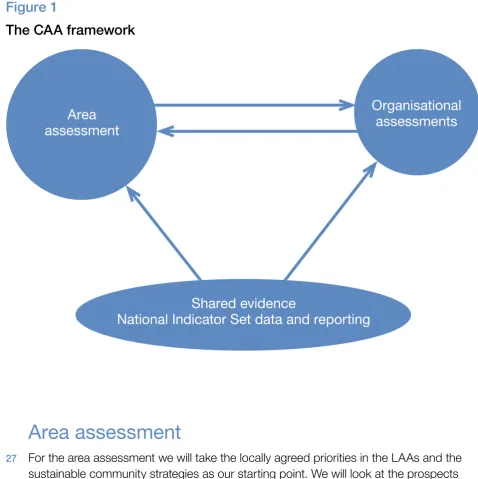
9
Area assessment
10
Organisational assessments
11
How we will carry out CAA and inspection
12
Reporting CAA
12
Part two
13
The Comprehensive Area Assessment framework:
What we will deliver
13
Area assessment
13
Underpinning themes
14
The three key area assessment questions
16
Green and red flags
20
Area assessment over time
22
Organisational assessments
23
Organisational assessment of councils
24
Managing performance
26
How CAA will take account of different types of local government 28
Scoring the organisational assessment
30
Organisational assessments of health services
31
Organisational assessments of police
32
Organisational assessments of fire and rescue services
33
How we will carry out CAA
34
Types of evidence
34
The National Indicator Set
34
Evidence from inspection and regulation
35
Local performance information and self-assessment
35
Views of people who use services, residents, businesses,
community groups and other third sector organisations
37
Other agencies
37
Use of evidence
38
Our approach to quality assurance
39
Involvement of peers and experts by experience
45
How the inspectorates will be organised
46
Improvement and inspection planning
47
Improvement planning
47
Inspection
48
Rolling programmes of inspection
50
Targeted and triggered inspection
51
Reporting CAA
53
What we will report on
53
Reporting the area assessment
53
Reporting the organisational assessment for councils
59
Reporting the National Indicator Set
60
Timing of reporting
62
An evolving assessment
64
Reviewing and evaluating CAA
65
Contents
Introduction
1 Comprehensive Area Assessment (CAA) is the new framework for the independent
assessment of local public services in England. This document sets out how CAA will be delivered from April 2009.
2 The inspectoratesI responsible for this document have been jointly commissioned to work together to develop and implement a methodology to deliver CAA and make the other necessary changes in assessment and inspection arrangements to implement the ambitions and commitments of the Local Government White Paper: Strong and Prosperous Communities.II
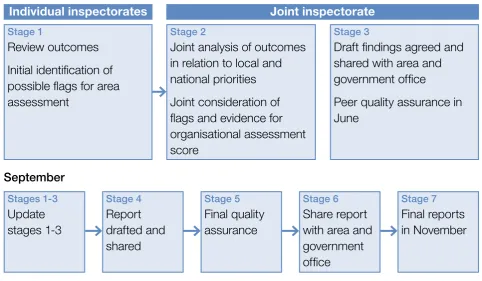
3 This White Paper set out proposals for a new performance framework for local services.
The Local Government and Public Involvement in Health Act 2007 put the legal framework for many of these proposals in place, including CAA. As inspectorates we have worked together, and with local service commissioners and providers, to develop CAA. Since November 2007 we have consulted extensively on the principles and overall approach and have tested it through action learning and trialling.III We have also consulted citizens and people who use local services about what they want from CAA.
4 Around £200 billion of public money is spent on providing local public services each
year in England. CAA is an important part of assessing and reporting on how well this money is spent, and making sure that local public bodies are accountable to the public for their service quality and impact. As well as providing information for local people, CAA will give government an overall picture of how well councils and their partners are doing in delivering key national and local priorities.IV It will also provide constructive challenge and feedback to local service bodies to support their improvement efforts.
Comprehensive Area Assessment | Introduction | 3 |
I The inspectorates (Audit Commission, Commission for Social Care Inspection, Healthcare Commission, HMI Constabulary, HMI Prisons, HMI Probation and Ofsted) have developed CAA together. In April 2009, the Care Quality Commission will take over from the Commission for Social Care Inspection, Healthcare Commission and Mental Health Act Commission. In this framework document, ‘we’ refers to these inspectorates.
II Joint Ministerial Commissioning Letter, 3 April 2007.
III Further information and links to websites discussed in this framework can be found on the Audit Commission website.
5 CAA represents a fundamental change in our approach to inspection, reflecting the
changes in local public services in recent years and in the environment in which they work. Since 2002, the performance of local public bodies has improved and they are increasingly working together to deliver further improvements. Independent assessments have been a catalyst for, as well as providing objective evidence of, this improvement. Local services have developed stronger performance management, more effective sharing of good practice and practical support for services in difficulty.
6 These improvements are very significant but it is also clear that examples of serious
service failure have not been eliminated and there can be no room for complacency. There remains an important role for independent assessment especially to provide assurance on the quality and safety of key services such as health, adult social care and children’s services. Important too are our judgements about how well local services are providing value for money at a time of great pressure on public spending.
7 CAA provides an independent assessment of how well people are being served by
their local public services. It focuses on how well these services, working together, are achieving improvement and progressing towards long-term goals. At its heart is a new area assessment in which the inspectorates will provide their joint view on the short, medium and long-term prospects for better results for local people. This will be linked to assessments of the performance and value for money provided by the individual public bodies serving the area carried out by the relevant inspectorates. This document deals in detail with the area assessment and the organisational assessment of local councils. The assessments of NHS organisations, police authorities and forces, fire and rescue authorities, probation boards and prisons are described in the related frameworks of the relevant inspectorates.
8 The area assessment will draw on the detailed work of the inspectorates in their
core areas of activity, the views of local people, people who use local services and other stakeholders, the new National Indicator Set and the information being used to manage public services locally. It will address local priorities and will always include a specific focus on people, including children and young people, who may experience disadvantage in accessing public services and whose personal circumstances make them most vulnerable.
Comprehensive Area Assessment | Introduction | 5 |
9 The framework for CAA set out in this document defines the principles we will apply
and explains how we will gather evidence to inform the area assessments, and the organisational assessment for each council. It also explains the relationship between the two types of assessment and how they will be reported. The framework clarifies how we will use these assessments to identify where inspection or other support for improvement is necessary, and how CAA will evolve over time.
10 The CAA approach allows the inspectorates to take account of rapid changes in
the external environment in assessing the prospects for better outcomes locally. For example, the area assessments for 2009 will reflect the action being taken locally to mitigate the effects of the current economic downturn, and will take into account any impact on local priorities.
11 By refocusing our inspection effort as set out in this framework and the associated
frameworks for individual services, we aim to deliver the required level of assurance on inherently high risk services, further reduce the assessment burden on high performing public bodies, act as a catalyst for better partnership working at the local level and support local accountability by providing clear information to local people.
12 This document is in two parts:
• Part one: An executive summary.
Part one
Executive summary
13 People deserve clear and impartial information about how well they are being served by
their local public services, how that compares with elsewhere, and what the prospects are for the improvement of quality of life in their area. This information will help people to hold elected representatives and those providing local public services to account for their performance and use of public money. It will help people make informed choices and influence local decisions.
14 From April 2009 CAA will provide:
• a catalyst for improvement: better local outcomes, more effective partnership working, more responsive services and better value for money;
• independent assurance for citizens, service users and taxpayers;
• an independent evidence base for central government on progress with national priorities and improving local services; and
• a means of focusing, rationalising and coordinating inspection.
15 Individual assessment regimes will continue to provide assurance on the performance of
services meeting the needs of people whose circumstances make them vulnerable (for example, inspection of care services and safeguarding arrangements for children and adults) and other services dealing with inherently high risks (such as probation services). In addition, and for the first time, we will bring together our work to provide an overview of how successfully local organisations are working individually and together to improve their area. Local services increasingly work through formal arrangements, such as children’s trusts, care trusts, crime and disorder reduction partnerships and others, with local strategic partnerships coordinating overall. CAA will allow us to reflect how well these, and less formal joint working, are improving outcomes for local people.
16 An illustrative example of how we will report our findings can be found at
http://www.audit-commission.gov.uk/caademo/. We will also publish the detailed guidance we give our staff responsible for carrying out CAA.
Comprehensive Area Assessment | Executive summary | 7 |
17 What matters locally varies from place to place. Led by locally-elected councillors,
councils and their local partners have developed sustainable community strategies to set out the local challenges and agreed priorities for their areas and how they plan to achieve sustainable development.I In addition, they have agreed with central government new local area agreements (LAAs) setting out improvement targets up to March 2011 for those issues that are most important locally and important to government.II Longer-term goals are set out in sustainable community strategies and local development frameworks. In CAA we will consider progress towards achieving local priorities, in relation to these different timescales.
18 Government has also introduced a set of national indicators to reflect its priority
outcomes delivered by councils alone or with partners and to provide a consistent way of measuring progress. This National Indicator Set replaces a number of different information sets and simplifies and reduces the amount of performance data collected by government. CAA will report performance against the National Indicator Set, including the statutory education and attainment targets.
19 Examples of the issues being tackled by local partnerships include supporting the
local economy; responding to the needs of the rapidly increasing proportion of older people; reducing the number of young people not in education, employment or training; addressing shortages of affordable housing; improving environmental sustainability; reducing crime; preventing violent extremism; and tackling the causes of poor health. These issues are neither the preserve of any one public body nor issues for the state alone. They highlight the importance of effective local political leadership and governance, including purposeful engagement with local people whether as taxpayers, residents, service users, employers or volunteers.
I Sustainable Community Strategies Guidance
| 8 | Comprehensive Area Assessment | Executive summary
20 In this context, the current focus of inspectorates in assessing individual services and
organisations is no longer sufficient. The power of CAA to support improving outcomes in an area will come from the added value of joining up the assessment of local services. CAA will focus on outcomes and how well local public bodies work with each other, the private and third sectors, other organisations working locally, including town and parish councils, and their local communities.I It will be forward looking and assess the prospects for future improvement. Individual inspection regimes will continue to provide assurance on the performance of services meeting the needs of people whose circumstances make them vulnerable (for example, inspections of care services and safeguarding services for children and adults).
21 Citizens expect local services to work together to make efficient and effective use of
their collective resources to meet the needs and priorities of the community. They expect maximum value for their money and easy access to high quality and responsive services. Financial resources are under great pressure, making the search for
efficiencies and value for money more critical than ever. CAA will provide independent assessment information to strengthen the ability of people to influence how services are provided and improved.
22 CAA will come into effect at a difficult time for the global and national economy and
the effects are already being felt in local areas across England. With its emphasis on sustainable development, CAA has been designed to be flexible and adapt to such changes. We will judge how well councils and their partners understand the local impact of the recession and how well they are responding using the tools and influence available to them to mitigate the impact on their communities and prepare for the upturn. We will highlight examples of effective partnership working on the local economy as a source of learning for others, as well as highlight areas where inadequate action is being taken.
Comprehensive Area Assessment | Framework overview | 9 |
23 CAA is part of a new performance framework that is area based and focused on
outcomes delivered by councils working alone or in partnership. It is designed to be more proportionate than previous frameworks and to be aligned with frameworks in other local service sectors. By bringing together evidence across different local services, CAA will be more effective in driving improvement than separate assessments for each sector can be.
24 CAA will have two main elements which will inform each other:
• an area assessment that looks at how well local public services are delivering better results for local people across the whole area, focusing on agreed priorities such as health, economic prospects and community safety, and how likely they are to improve in the future; and
• organisational assessments for councils, combining the external auditor’s assessment of value for money in the use of resources with a joint inspectorate assessment of council service performance.
25 The organisational assessments for the other main public bodies in each area are
described in the respective frameworks for NHS organisations, police authorities and forces and fire and rescue authorities, and each of these include the external auditor’s assessment of value for money.
26 For both elements we will use the performance reported against the National Indicator
Set as a key source of evidence. We will also ensure that the links between the area assessment and the organisational assessments are managed so they support partnership and individual accountabilities.
| 10 | Comprehensive Area Assessment | Framework overview
Figure 1
The CAA framework
Area
assessment
Organisational
assessments
Shared evidence
National Indicator Set data and reporting
Area assessment
27 For the area assessment we will take the locally agreed priorities in the LAAs and the
Comprehensive Area Assessment | Organisational Assessments | 11 |
28 The area assessment will be reported as a narrative and will not receive a numerical
score or other overall rating. If, in our view, the action being taken in the area to improve an important outcome is unlikely to deliver the improvement sought, we may highlight this as a significant concern using a red flag. Where we have identified exceptional performance or improvement, or promising prospects for improvement through innovation, we may highlight this as a source of learning for others using a green flag.
Organisational assessments
29 For councils, the organisational assessment will combine use of resources and
[image:13.595.94.558.425.746.2]managing performance themes into a combined assessment of organisational effectiveness scored on a scale from 1 (lowest) to 4 (highest).
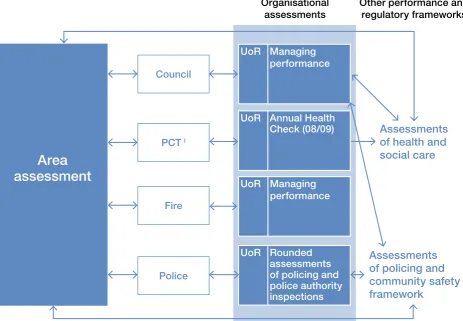
Figure 2
How CAA will align to other performance frameworks
Other local organisations such as housing associations and probation boards and trusts are also subject to inspection and assessment but do not receive use of resources assessments.
I National Indicators within Vital Signs Tier 3 will not be used to assess PCTs.
Area
assessment
Council UoR UoR UoR Managing performance Rounded assessments of policing and police authority inspections Managing performanceAssessments of policing and community safety framework
Assessments of health and social care
Organisational
assessments Other performance and regulatory frameworks
UoR Annual Health Check (08/09) PCT I
Fire
How we will carry out CAA and inspection
30 We will prepare our assessments using evidence from our other inspection work
and draw on the information that is available nationally and that used locally as far as we can to avoid making extra demands on local services. We will apply the COUNT principle (collect once and use numerous times). CAA will not rely on the type of rolling programmes of major inspections, with detailed performance criteria and a focus on the corporate arrangements of local service organisations, used in previous assessment frameworks.
31 High performing organisations and partnerships delivering improvements in outcomes
and value for money will receive less inspection. The more robust, relevant and timely the information being used to manage services locally, the less we as inspectorates will need to request additional information.
32 We will work with government offices in the regions, regional improvement and efficiency
partnerships and others to ensure a coordinated approach to supporting improvement. We will work together as inspectorates to plan and coordinate any inspections that are needed so that they can provide the assurance or improvement support desired without undue administrative impact on the inspected organisations.
Reporting CAA
33 Our aim is that our CAA reports become a valuable resource for local people, elected
councillors, the local strategic partnership and local organisations, national government and others with an interest in the future of the area. Our findings will inform the
discussions between the local strategic partnership and the government office for their region and future versions of the LAA. As inspectorates, we will use the knowledge gained through CAA to better target our future work and we will coordinate our activity to better manage the impact on local organisations and services.
Part two
Comprehensive Area Assessment | Area assessment | 13 |
The Comprehensive Area Assessment framework:
What we will deliver
Area assessment
34 The area assessment takes the area’s LAA and sustainable community strategies as
its starting point, along with statutory education and attainment targets.I We look at local priorities, in the context of wider national themes. In some cases, it may identify important local issues that are not reflected in these agreed priorities. For example, poor performance in an important service area that has not been targeted for improvement may be identified. Similarly, we may identify situations where priorities have not been reviewed to reflect significant changes in circumstances, such as the economic downturn. As such, CAA will be helpful to the LAA review process in considering whether the priorities within it remain the most appropriate as well as providing an assessment on the prospects of achieving current targets and improvement priorities. Similarly, CAA can help local partnerships review and update their sustainable
community strategies.
35 Our broad approach is to assess the future prospects in the area for achieving better
outcomes by looking at the impact that local service organisations are collectively having on improving priority outcomes. Our assessment will therefore focus on the third of the following questions. The first two questions will provide underlying evidence and understanding to support our judgements on the third question.
36 To carry out the area assessment, we will consider three key overarching questions:
• How well do local priorities express community needs and aspirations? • How well are outcomes and improvements needed being delivered?
• What are the prospects for future improvement?
| 14 | Comprehensive Area Assessment | Underpinning themes
37 We will produce area assessment reports for each of the 152 LAA areas, which will raise
issues about particular districts, partnerships, neighbourhoods or wider regions where appropriate. Over time, we will build a fuller picture for each area and will increasingly be able to report on more localised issues. The assessment will, as needed, trace progress with agreed targets and issues in particular districts, urban neighbourhoods or rural communities, and cover multi-area agreements and sub-regional issues, as appropriate to each area.
38 We will focus our reports on the prospects for improvement and its sustainability and
this will be shaped by our assessment of the first two key questions. For example, if local needs are not understood well enough, it is unlikely that the right improvement will occur in future. Similarly, if there is little evidence of improving outcomes over time, prospects for improvement are less likely to be promising.
Underpinning themes
39 Underpinning these three questions are themes that thread though the area
assessment. These are:
• sustainability; • inequality;
• people whose circumstances make them vulnerable; and • value for money.
Sustainability
40 CAA is inherently about sustainability. Sustainable development is as much about
Comprehensive Area Assessment | Tackling inequality, disadvantage and discrimination | 15 |
Tackling inequality, disadvantage and
discrimination
41 Effective local public services target effort where improvement is most needed to
tackle inequalities within and between communities. This may include focusing on the particular needs of people who are disadvantaged or discriminated against through age, disability, race, gender or trans-gender, religion or belief, and sexual orientation. It may also include efforts to reduce child poverty or other inequalities within communities. We will consider how well local partners know and understand the nature and extent of inequality and disadvantage within their communities and how effectively they are working to reduce or eliminate discrimination.
People whose circumstances make them
vulnerable
42 People may be vulnerable because of their dependence on public services, (for
example, because of illness, the need for care or support, or homelessness), because they are at risk of harm (for example, linked to substance abuse), or because they are marginalised or discriminated against in society. Some groups are at very high risk, such as people who need or are leaving care services, people with learning disabilities or people receiving mental health services.
43 As inspectorates, we have specific responsibilities in relation to people whose
| 16 | Comprehensive Area Assessment | Value for money
Value for money
44 Providing value for money has always been important throughout public services
and the increasing pressure on public spending means this will remain a high priority everywhere. The use of resources elements of organisational assessments place a significant focus on value for money and CAA will present an opportunity for us to take a broader view across organisations. The common approach to use of resources across councils, primary care trusts, police and fire services will support this. Where there are significant issues arising from this that relate to the wider use of resources to improve outcomes in an area, we will report on these in the area assessment.
The three key area assessment questions
45 The three key questions for the area assessment will enable us to build up ourunderstanding of local priorities, how well they express community needs and aspirations and current performance and trends so that we can reach conclusions about the prospects for future improvement. Our judgements and reporting will be on these prospects, as described under the third question, and only on the preceding two questions by exception, where there is a direct link to improving outcomes.
How well do local priorities express community
needs and aspirations?
46 Understanding how well local partners understand their communities and listen and
Comprehensive Area Assessment | Value for money | 17 |
47 Understanding the needs and aspirations of communities should always include those
whose circumstances make them vulnerable and those who are hardest to reach or hear. These people may have a greater need for public services than the population as a whole. We expect local services to be effective at giving a voice to people who are vulnerable or at greater risk of disadvantage and inequality, identifying their potential and supporting them to achieve the levels of choice, autonomy and improved outcomes that other citizens enjoy. This will vary according to the local context but it will specifically include groups at very high risk outlined in Paragraph 42 and will include groups which local partners have a requirement to consult and engage with under equality legislation.
48 Councillors lead and represent their communities and councils have a duty to involve
local people and the organisations that represent them in decision making. Councils also need to have regard to the needs of local businesses and to engage them in developing local priorities. Other local services, including the police and NHS organisations, also have duties to engage with local people. Information from the Place Survey and the National Survey of Third Sector Organisations, introduced by government in 2008, will contribute to evidence on meeting the duty to involve. By considering how well local partners engage local people, CAA will assess how well these duties are carried out. It also seeks to encourage communities to take opportunities to influence local decisions and thus help enhance local democracy.
49 In reviewing the evidence, we will be looking at how effective engagement is, by
understanding:
• how well councils and their partners know and engage with their communities, including children, and understand the needs of vulnerable and marginalised groups;
• the extent to which the priority outcomes for the area have been defined with the involvement of communities;
• how well communities have been involved in assessing whether priority outcomes have been delivered; and
| 18 | Comprehensive Area Assessment | Value for money
50 We recognise that agreeing priorities, as well as being based on needs, is also a political
process, and that for councils, decisions are made by locally elected politicians. We also recognise that decisions about priorities involve weighing up the diverse and complex needs and aspirations of many stakeholders, and a balance of short and longer-term needs. Our role is not to challenge legitimate political choice but to support democratic decision making by looking at how well these decisions have taken account of these needs and aspirations.
51 Local partners need to work together to engage local people in setting priorities as well
as in developing, commissioning and delivering local services. Partners must make clear the purpose of any engagement activity and strengthen the capacity of the community to get involved. We may seek additional evidence, where appropriate, of whether good practice is followed in engaging with local people and the organisations that represent them. We may need to better understand the extent to which local partners:
• have sustainable arrangements, mechanisms and tools to engage local people, set priorities and improve the area and people’s lives;
• the extent to which these arrangements are coordinated across partnerships;
• encourage empowerment, giving people a greater sense of influence over local decisions;
• are sensitive to the particular communication or other needs which minority or marginalised groups have;
• focus on outcomes for people who use services;
• manage the risks of engagement activities for individuals, the council and its partners;
• focus on value for money; and
• feed back and make changes as a result of engagement and inform people of these.
52 We may also consider the quality of engagement through visits, for example to
Comprehensive Area Assessment | Community needs and aspirations? | 19 |
53 Different areas use different approaches to understanding and tackling priorities. CAA
will not prescribe one way of working over another, but it will make an independent assessment of the impact of actions taken to meet local needs and improve people’s quality of life.
How well are the outcomes and improvements
needed being delivered?
54 Assessing current and recent performance is a critical first step to looking ahead to
the future. Government, the public and local public service users need assurance on how well local public services are performing. Independent assessment provides this assurance. Councillors and the governing bodies of other local services can use independent assessment to support their role in holding local services to account. Third sector organisations and local business also have an interest in how their local services are performing. By answering this question we will give an overview of how well local partnerships are delivering their priorities.
55 If there is evidence that performance is a concern in one or more important outcome
areas or that it represents significant success or innovation, we will say this in our assessments, whether it is covered by the LAA or not. Some outcomes, such as improving the local economy or transport, are best addressed by neighbouring organisations working together. Where a responsibility exists to assess certain
outcomes, as with children’s services and social care, these assessments will always inform the area assessment. We will also reflect important developments since the LAA was first agreed such as the action being taken to mitigate the local impact of the economic downturn.
56 Robust assessment of performance must be based on an understanding of the range
| 20 | Comprehensive Area Assessment | What are the prospects for future improvement?
What are the prospects for future improvement?
57 This question draws on the conclusions from the previous two questions and reflects themain purpose of the area assessment. Our reporting and judgements will focus mainly on the prospects for future improvement.
58 Effective partnership working is vital to improving outcomes. As well as the local
strategic partnership, this also includes, for example, children’s trusts, crime and disorder reduction partnerships and multi-area agreements. Inspectorates will, through the evidence used for CAA, need to be satisfied that partnership working is effective at managing and improving outcomes but we will not routinely inspect partnership arrangements themselves. We will instead use the joint inspectorate evidence to assess whether we consider that local partnership working is likely to achieve the agreed local priority outcomes and this will inform our overall judgements. We will look at evidence of the capacity and capability of partners to identify where weaknesses in partnership working represent a barrier to improved outcomes, or where innovative or excellent partnership working is delivering results. The few rolling inspection programmes that government approves (see Paragraph 155 to 158) will look at any partnership arrangements relevant to their scope. We will inspect partnership arrangements further only where there are serious concerns that priority outcomes are not being achieved or if other serious governance issues emerge.
Green and red flags
59 The area assessment is not scored. To provide a clear indication of either significant
concerns about future improvement or to highlight exceptional performance or
improvement, we will use red and green flags. Feedback from the public, government and others has welcomed these clear statements of our views on our most significant judgments in each place. They will signal where extra support or inspection may be needed and where organisations may learn from the success of others.
60 Reflecting that CAA will be bespoke to each area and that each area will have its own
Comprehensive Area Assessment | Red and green flags | 21 |
61 Green flags represent exceptional performance or outstanding improvement which is
resulting in proven delivery of better outcomes for local people that are sustainable and which we consider others could learn from. Good or very good practice is not sufficient. Nor is rapid improvement that we are not confident can be sustained. We will also use green flags to highlight innovative practice that has promising prospects of improving outcomes for local people that we consider others can learn from.
62 We will report a red flag where there are significant concerns about outcomes and future
prospects for outcomes, which are not being tackled adequately. A red flag means that inspectorates have jointly judged that something different or additional needs to happen to improve outcomes.
63 We are likely to report a red flag where one or more of the following applies and where
not enough is being done to tackle the concern: • performance is poor, slipping or not improving;
• service or outcome standards are unacceptable; • improvement is not on track to achieve a target;
• locally agreed priorities do not reflect evident and pressing need; • insufficient account is being taken of inequality; and
• insufficient account is being taken of people whose circumstances make them vulnerable or who are at risk of avoidable harm.
64 Because a red flag reflects significant concerns about the prospects for improvement,
not current performance, before awarding one we will consider whether:
• the local partnership is aware of the concern;
• plans to improve the areas of weakness are robust and if there is evidence of improvement; and
| 22 | Comprehensive Area Assessment | Area assessment over time
65 It is important to note that a deteriorating outcome will not necessarily trigger a red flag.
For example, if in our view a local partnership or the accountable partner body is taking effective action to mitigate the impact of the economic downturn (perhaps helping to keep the local increase in worklessness below the level being experienced in similar places elsewhere), a red flag would not be reported.
66 Red and green flags are not the opposite of each other. They each have their own
distinct purpose and criteria. We are developing a formal procedure to allow challenge to the reporting of red flags. However, we do not intend that the non-award of green flags will be subject to challenge. We will publish our formal approach to challenges by 31 March 2009.
67 Judgements about places will touch on sensitive issues such as partnership approaches
to preventing violent extremism and counter terrorism. We will report our findings with great care to avoid increasing existing risks or exacerbating community tension. We will give clear feedback in our reporting to the local partners but we will consider carefully the impact of our public reporting and how it is presented. This will help ensure corrective action is maintained or improved without it being undermined.
Area assessment over time
68 CAA will build a fuller picture of each area over time and we will not cover everything
each year. Red and green flags will be kept under review and will be removed from our reports when they are no longer relevant, normally when we publicly report again. To ensure a proportionate approach is maintained, we will not seek to carry out a complete reassessment of areas of concern (either red flagged or potentially so), but will use the following approach to review change:
Initial red flag assessment Future years:
What is the issue? What is new or has changed? What is the scale of the impact? Has it got better?
How serious is it? Will it get better in the future? Is it getting better?
Comprehensive Area Assessment | Organisational assessments | 23 |
Organisational assessments
69 Local public service organisations are assessed by different inspectorates and in
ways which reflect the context and organisation of each service sector. The form of organisational assessments therefore varies and these are set out in the relevant performance frameworks for each sector. These assessments will both inform and be informed by CAA. The contribution of each organisation to improving outcomes in the area will be directly reflected in its organisational assessment so that efforts are directed at improving outcomes, rather than organisational scores. This will work in two ways: if a flag in the area assessment highlights concerns or exceptional performance or improvement regarding the contributions of a specific partner, this will be reported in more depth in the relevant organisational assessment, and is likely to impact on the organisational assessment scores. Similarly, any concerns or positive indicators arising from the organisational assessment, which impact significantly on outcomes for the wider area or region will be reported in the area assessment and may result in a flag.
70 Assessing the effectiveness of councils is an integral part of CAA, because of its focus
on the outcomes delivered through councils working alone or with partners. This section sets out the organisational assessment for councils, then summarises the arrangements for other sectors, (police, fire, health) with links to more details. The Audit Commission’s use of resources assessment will contribute to the organisational assessments in local government, primary care trusts, police and fire and rescue services. Organisational assessments will provide assurance to the public and to government that local services are delivering priorities and improving key services.
Initial green flag assessment Future years
What is the issue? Is the improvement of performance as noteworthy as the previous year?
What is the scale of the impact? Is there anything new for others to learn from?
| 24 | Comprehensive Area Assessment | Organisational assessments of councils
71 In May 2008, the Audit Commission published details of the use of resources
assessments to be made in 2009 with an update in February 2009 to incorporate the scoring arrangements.I This sets out how the work of appointed auditors under the statutory Code of Audit Practice will be translated into a scored use of resources assessment. The approach taken will be similar across councils, primary care trusts, police and fire and rescue services. It is based on key lines of enquiry assessed across three themes:
• managing finances;
• governing the business; and • managing resources.
72 The arrangements for scoring the use of resources assessment have now been
confirmed following consultation and are summarised for each sector below.
73 A formal procedure will allow challenge to the overall organisational assessment scores
and we will publish details of this by 31 March 2009.
Organisational assessment of councils
74 We will assess the effectiveness of each council through an assessment of how well
each organisation delivers value for money in the use of resources and how well it manages its performance. We will publish a single short report that includes an overall score for each organisation alongside the area assessment. Our published guidance for staff will contain more information about how the key lines of enquiry will be applied.
| 26 | Comprehensive Area Assessment |Managing performance
75 For councils with responsibility for children’s services and social care, we will jointly
agree the managing performance and overall organisational assessment score. The Audit Commission, the Care Quality Commission and Ofsted directly assess council services so these inspectorates will contribute most evidence to these assessments. The Audit Commission will make the overall assessment for district councils, taking account of relevant evidence from other inspectorates, including from HMI Constabulary in relation to community safety.
76 The organisational assessments will:
• support and complement the area assessment’s focus on priority outcomes;
• ensure accountability at an organisational level, including contributions to delivering LAAs and wider sub-regional or regional strategies, including multi-area agreements;
• bring together contributions from inspectors and auditors to provide a rounded assessment of organisational effectiveness;
• inform and focus improvement planning, including inspection programming; and
• help the public hold their local public bodies to account.
Managing performance
77 In assessing the managing performance theme and key lines of enquiry, we will focus on
how effective the organisation is at:
• identifying and delivering priority services, outcomes and improvements;
• improving the services and outcomes for which it is responsible;
• contributing to improving wider community outcomes, including those set out in formal agreements such as LAAs or multi-area agreements;
• tackling inequality and improving outcomes for people whose circumstances make them vulnerable; and
• providing the leadership, capacity and capability it needs to deliver future improvements.
78 Each council organisational assessment will contain an explicit statement on the
Comprehensive Area Assessment | Organisational assessments of councils | 25 |
Organisational assessment for councils
Theme Key lines of enquiry
U se o f r es o ur ce s Managing finances
How effectively does the organisation manage its finances to deliver value for money?
Does the organisation plan its finances effectively to deliver its strategic priorities and secure sound financial health?
Does the organisation have a sound understanding of its costs and performance and achieve efficiencies in its activities?
Is the organisation’s financial reporting timely, reliable and does it meet the needs of internal users, stakeholders and local people?
Governing the business
How well does the organisation govern itself and commission services that provide value for money and deliver better outcomes for local people?
Does the organisation commission and procure quality services and supplies, tailored to local needs, to deliver sustainable outcomes and value for money?
Does the organisation produce relevant and reliable data and information to support decision making and manage performance?
Does the organisation promote and demonstrate the principles and values of good governance?
Does the organisation manage its risks and maintain a sound system of internal control?
Managing resources
How well does the organisation manage its people, natural resources and physical assets, to meet current and future needs and deliver value for money?
Is the organisation making effective use of natural resources? Does the organisation manage its assets effectively to help deliver its strategic priorities and service needs?
Does the organisation plan, organise and develop its workforce effectively to support the achievement of its strategic priorities?
M an ag in g p er fo rm an ce Managing performance
How well does the organisation manage and
improve its services and contribute to wider community outcomes?
How well is the organisation delivering its priority services, outcomes and improvements that are important to local people? Does the organisation have the leadership, capacity and
Comprehensive Area Assessment | Managing performance | 27 |
79 Ofsted and the Care Quality Commission continue to have statutory responsibilities for
assessing performance of children and young people’s services and adult social care. Each organisation will fulfil this responsibility through its contribution to CAA and will also publish more detailed findings separately. The results of these statutory assessments will be reported in the organisational assessment for councils and the outcomes reflected in the area assessments. These contributory assessments will carry significant weight in the collective decision about the managing performance theme score but this will be based on the local context and significance of the findings rather than a formula or rules based approach.
80 Ofsted will provide an annual grade of the performance of children’s services (as
required by the 2006 Education and Inspections Act) within the CAA organisational assessment, drawing from its inspection and regulatory work and the National Indicators covering the five Every Child Matters outcomes.I It will contribute to the organisational assessments. See the prototype web reporting tool, (explained in the ‘Reporting CAA’ section of this document) for an example of how this will look. Ofsted has outlined its arrangements for this in an accompanying document.
81 The Care Quality Commission will assess the performance of the council’s adult social care
services in delivering outcomes. This assessment is based around the seven outcomes from the health White Paper Our Health, Our Care, Our Say.II The framework also assesses the leadership and commissioning and use of resources for adult social care.
82 The Care Quality Commission’s assessment of councils’ delivery of adult social care
outcomes will be reported, and used, as an integral part of the managing performance theme for the organisational assessment. The Care Quality Commission will use the four point scale in paragraph 89 to grade its assessment. An example of how this might look is set out in the prototype web reporting tool. The Care Quality Commission’s ungraded assessment of commissioning will also inform auditors assessments of use of resources.
I The five Every Child Matters outcomes are; be healthy, stay safe, enjoy and achieve, make a positive contribution and achieve economic well-being.
| 28 | Comprehensive Area Assessment | Different types of local government
83 We will not use rules to govern how an Ofsted or Care Quality Commission grade will
impact on the overall managing performance score for councils. But if the graded judgement is in the lowest categories this will have a significant bearing on the overall managing performance score and therefore on the council score.
How CAA will take account of different types of
local government
84 In areas with county and district councils, partnership arrangements are more complex
than in areas with a single council. Most county and district councils each have separate local strategic partnerships and separate sustainable community strategies. For
many services, the area on which the responsibility is based is different under county and district areas than those with only a single council. In these situations, effective partnership working within and across districts and between districts and the county council as well as with partners from other sectors is all the more important. We will take account of these additional complexities and inter-relationships and how effective they are will affect our conclusions about the prospects for improving outcomes and about individual organisations. We will look at how well these complexities are managed and being overcome locally to improve working between district and county councils and to improve accountability, leadership, efficiency and outcomes.
85 In these areas, many of the local services that are managed by the district council
Comprehensive Area Assessment | Different types of local government | 29 |
86 In the same way, outcomes relating to housing markets, sub-national economic
development, reducing transport congestion and climate change, are often sensibly tackled across a geographical area larger than any single council. Where there are potential benefits of councils and other partners working together to address these issues, we will take account of this in the appropriate organisational (and area) assessments. For example, where several areas have entered into a multi-area
agreement, we will report specifically on contributions and overall delivery against the wider priorities and outcomes identified. We recognise the complexity around multi-area agreements and have been working with partnerships to explore how assessment and reporting can support improvement and delivery at this level. It is likely that in the first year of CAA we will undertake a piece of research work immediately after the first results are published to draw together the conclusions around multi-area agreements and sub-regional issues that we are able to draw based on our work throughout 2009. This is likely to be published in the first half of 2010.
87 We appreciate that in London and metropolitan areas the city-wide bodies are important
| 30 | Comprehensive Area Assessment | Scoring the organisational assessment
Scoring the organisational assessment
88 The organisational assessment scores for managing performance and value for money
in the use of resources will be combined into a single score using the table below. Where the managing performance theme score and the use of resources score are the same, the grade will simply be carried forward to become the overall organisational assessment score. A score of 1 in either the managing performance or the use of resources theme will lead to an overall organisational assessment score of 1. Beyond this, where the managing performance theme score and the use of resources score are different, we will use our professional judgement to decide the overall organisational assessment score between the options in the following table. This allows for more professional discretion in weighing up evidence and taking account of the local context in determining which themes should carry more weight. The overall score is shown in blue in the table.
Managing performance Use of
resources
Scores 1 2 3 4
1 1 1 1 1
2 1 2 2 or 3 2 or 3
3 1 2 or 3 3 3 or 4
4 1 2 or 3 3 or 4 4
89 The scores 1 to 4 represent the following descriptors of performance:
Overall [organisation x] performs poorly/adequately/well/excellently
1 An organisation that does not meet minimum requirements Performs poorly 2 An organisation that meets only minimum requirements Performs adequately 3 An organisation that exceeds minimum requirements Performs well
4 An organisation that significantly exceeds minimum
requirements
Comprehensive Area Assessment | Organisational assessments of health services | 31 |
90 The use of resources overall score will be calculated using an average of the scores
for the three themes. There are circumstances when averaging an even number of key lines of enquiry within a theme will result in theme scores of 1.5, 2.5 or 3.5 so the Audit Commission has specified key lines of enquiry which will determine how the scores are rounded. For example, the score for the use of information key line of enquiry will be used for the governing business theme as it reflects the importance of having appropriate and reliable information to support good governance and effective decision making.
Organisational assessments of health services
91 The organisational assessments of NHS organisations to be published by the CareQuality Commission in 2009 will provide assessments on the quality of services
(commissioning, including children’s health), assessment of standards (provider services) and financial management. There will not be an overall use of resources score for
primary care trusts in 2009. The equivalent organisational assessments for NHS trusts in 2009 will be of the quality of financial management, an assessment of national priorities and assessment of standards. The Care Quality Commission’s assessments of the quality of financial management will use the Audit Commission’s judgement in the ‘managing finances’ theme. The assessment of the quality of commissioning and provider services will also use evidence from the remaining two themes for its standards-based assessment wherever possible. This will reduce the risk of trusts being assessed twice for the same issue in the different frameworks.
92 World Class Commissioning (WCC), with its emphasis on healthy life expectancy,
| 32 | Comprehensive Area Assessment | Organisational assessments of police
93 We are committed to using any relevant information from other assessment processes
such as WCC, and to ensuring the public receive a single, coherent story. The Care Quality Commission will work closely with CAA Leads and NHS organisations’ auditors to achieve this.I We recognise it is important that NHS organisations are not assessed twice on the same issues, so clearly communicating how we will rely on each other’s assessments will be important. For the 2008/09 use of resources assessment the Audit Commission will not include the commissioning and procurement key lines of enquiry but will rely on any output from WCC for CAA. In this way we believe that the two frameworks can feed each other. The Care Quality Commission and the Audit Commission are discussing with the Department of Health how further alignment between these assessments can be achieved in 2009/10.
Organisational assessments of police
94 From April 2009, HMI Constabulary’s Rounded Assessment of police force performance
will draw on the performance measures within the current Assessment of Policing and Community Safety data set. Through the CAA area assessment, we will make one assessment of community safety outcomes delivered by crime and disorder reduction partnerships in an area. That same assessment will be an integral component of HMI Constabulary’s Rounded Assessment, providing the assessment of community safety outcomes delivered by the police working in partnership.
Comprehensive Area Assessment | Organisational assessments of fire and rescue services | 33 |
95 From April 2009, for the first time, police authorities will be inspected jointly by HMI
Constabulary and the Audit Commission across the full range of their activities.
Inspections will provide objective assessments of how well individual police authorities are fulfilling their statutory functions. Inspections will probe:
• the effectiveness of the police authority’s performance management, leadership and scrutiny role; and
• how the police authority manages resources and people and how it works in
collaboration with communities and partners to build capacity, ensuring the delivery of priority services, outcomes and improvements that are important to local people. The inspections will determine how the police authority promotes value for money, efficiency and productivity. The overall use of resources score will be determined in the same ways as for councils, set out in Paragraphs 89 and 90. Police authority inspections will dovetail with CAA, including use of resources assessments, and HMI Constabulary’s Rounded Assessment of police force performance.
96 HMIC will continue to deliver programmed inspections in all police forces in England
and Wales including those of protective services – such as counter-terrorism, tackling serious and organised crime and strategic roads policing – and in delivery of priorities identified in response to the Home Office policy statement From the Neighbourhood to the National: Policing Our Communities Together, published in November 2008.
Organisational assessments of fire and rescue
services
97 The Audit Commission will base its assessment on the priorities and objectives set
out in the Fire and Rescue Service National Framework, assessing the extent to which individual fire and rescue services are delivering against the framework, effectively balancing their prevention, protection and response functions. This will include considering how well equality and diversity are fully integrated into all aspects of the service. The Audit Commission will also assess the impact and effectiveness of the service’s contribution to broader partnership outcomes in the LAA.
98 The Audit Commission has responsibility for providing explicit assurance and for
| 34 | Comprehensive Area Assessment | How we will carry out CAA
How we will carry out CAA
99 CAA will focus on outcomes and assess the effectiveness of how well local public
services work, together and individually, to improve outcomes for people.
Types of evidence
100 We will consider a wide range of evidence in forming our judgements, likely to include,
but not limited to, the following:
• LAAs, sustainable community strategies and any other locally agreed targets;
• the National Indicator Set and other nationally available data;
• findings from inspection, regulation and audit, including relevant evidence from other performance frameworks;
• local performance management information used to monitor local priorities including any self evaluations and evidence from scrutiny;
• briefings or evidence from other agencies including the government offices in the regions, strategic health authorities, the Tenant Services Authority, the Homes and Communities Agency and regional development agencies; and
• the views of people who use services including residents, third sector organisations and local businesses in the area.
The National Indicator Set
101 Performance data for 2008/09 will be available from spring 2009 for the new
national indicators and will be an important source of evidence for both the area and organisational assessments. The national indicators will provide information about progress towards LAA and statutory targets and broader improvement and performance, including how far inequalities in outcomes are being reduced.
102 For each indicator, we will compare and report local performance against the national
Comprehensive Area Assessment | Evidence from inspection and regulation | 35 |
103 To protect and support vulnerable people (including children and young people), some indicators have national minimum expectations or performance bands. We will reflect these in our comparative reporting for these indicators (see prototype CAA reporting tool).
104 We will also continue to use other robust national data sets that are available, such as the health profiles published for each council area annually and data from returns provided by each fire and rescue service, where these do not impose unnecessary additional administrative demands.
Evidence from inspection and regulation
105 We may use as evidence for area assessments and organisational assessments relevant findings from any inspection. This includes triggered inspections, rolling programmes such as Ofsted’s three-yearly inspections of safeguarding and looked after children and HMI Probation’s inspection of youth offending, and routine regulatory inspections.
106 Routine inspection and regulation of some services will continue after 1 April 2009. For example, Ofsted will continue to inspect early years’ settings, schools, colleges, adult learning, children’s homes, fostering and adoption services and is to introduce unannounced annual inspections of frontline social care practice. The Care Quality Commission will register health and social care providers, carry out reviews of health and social care commissioning and of providers, and protect the rights of people detained under the Mental Health Act 1983. The Tenant Services Authority will be preparing their regulatory framework for social housing in 2009 and this will be used in subsequent years to produce performance information at a local level.
Local performance information and
self-assessment
| 36 | Comprehensive Area Assessment | Local performance information and self assessment
108 Councils also have an important role in scrutinising local services and contributing
to improving outcomes. Council overview and scrutiny committees not only hold the council executive to account but also consider matters that affect the local area or its citizens and have specific powers in relation to local health services. There is a two-way relationship between scrutiny and CAA. Scrutiny reviews carried out locally will provide valuable evidence that can feed in to CAA and may help inspectorates understand issues without having to carry out additional work. The findings from CAA will also be helpful to overview and scrutiny committees in identifying where they may wish to focus their attention and in providing them with helpful insights when conducting reviews. CAA is therefore of direct interest to elected councillors whatever position they hold, as community leaders on the executive or in holding the executive to account and representing local people.
109 Inspectorates do not require a new separate self-assessment for CAA. However, we
support the approach being taken by the Improvement and Development Agency and the Local Government Association and others that encourages consistent partnership self-evaluation. The more robust the self-assessment, the more reliance we will be able to place on it.
110 In addition to self-assessment carried out for local performance management, there
remains a statutory requirement for an annual review of the Children and Young People’s Plans. Ofsted will, as far as possible, rely on this self-assessment rather than require an additional self-assessment for their statutory assessment of children’s services. There is no equivalent to this for adult social care, so councils will still be asked for a self-assessment to inform this assessment in the first year of CAA and the Care Quality Commission will review this for future years.
111 As well as any self-assessment, inspectorates will draw evidence from key documents
Comprehensive Area Assessment | Other agencies | 37 |
Views of people who use services, residents,
businesses, community groups and other third
sector organisations
112 The views and experiences of local people are key sources of evidence for CAA. We
will draw on the findings of the new biennial Place Survey, the National Survey of Third Sector Organisations and the annual Business Survey. In addition, we will take account of the area’s own evidence about users’ views of local services. We expect this to include information about the views of: children and young people; those who may experience disadvantage in accessing public services; groups and individuals whose views are seldom heard; people whose circumstances make them vulnerable and the third sector.
113 We will also consider evidence provided by local citizens and service user groups,
LINks, Citizen’s Advice Bureaux, the National Tenant Voice, the Equalities and Human Rights Commission, members of parliament, the views of the local business community, and the Local Government Ombudsman and the Standards Board for England where it is available.
Other agencies
114 We will consider evidence and briefings from other agencies, for example using evidence
from the Homes and Communities Agency about progress in improving housing and regeneration. HMI Prisons inspects a wide range of custodial facilities regularly and will provide evidence about the quality of local services provided to those held in these nationally managed institutions.
115 In considering its evidence, HMI Probation will scrutinise performance information
provided by the Youth Justice Board.
116 Government offices in the regions, strategic health authorities and regional improvement
| 38 | Comprehensive Area Assessment | Use of evidence
Use of evidence
117 We will take account of the latest available evidence, as far as possible. Subject to legal
or confidentiality limits, quality assured evidence will be available to the organisations in the area so that it is clear what our assessments have relied on. We will collate and review evidence through a joint assessment system that will enable the inspectorates to share evidence and support the development of shared judgements. As far as is practical we will share this information with the local partners, this will support
transparency around the evidence we use and how we have arrived at our judgements from it.
118 For area assessments and council organisational assessments, we will rely mainly on
Comprehensive Area Assessment | Our approach to quality assurance | 39 |
Our approach to quality assurance
119 The added value from the area assessment will derive from our ability to make more
rounded and robust judgements about local outcomes and improvement through joint analysis and interpretation of information previously held separately by each inspectorate. Our joint analysis will enable us to:
• focus more clearly on the priorities that matter to local people rather than being constrained by organisational structures;
• address cross-cutting issues where responsibilities are shared and better reflect the inter-relationships between outcomes and how well local partners are addressing these together; and
• help identify new insights into the quality of services experienced by people that were previously unobtainable from the information held by any individual inspectorate.
120 Our aim is to integrate quality assurance at the earliest stages of the assessment to
avoid over-reliance on retrospective review as we approach publication. This ‘right first time’ approach will mean that the inspectorates will quality assure the evidence, for which each has prime responsibility according to their own procedures before it is submitted for joint consideration. We aim to make our processes open, transparent, fair and equitable so that there is clarity about the evidence on which our assessments are based. We will also ensure our judgements are well supported by evidence and we will include input from people who use services and those responsible for local public services to strengthen credibility. We aim for high quality judgements that help improve services and outcomes and aid local democracy.
121 We will use an analytical framework to help us make best use of the information
| 40 | Comprehensive Area Assessment | Our approach to quality assurance
122 There are two stages in the analytical framework:
• first stage analysis of information by the individual inspectorates; and
• second stage, cross-sector analysis of inspectorates’ information.
123 The first stage analysis will derive from inspectorates’ own programmes of inspection,
assessment and review. Each inspectorate will focus its analysis on the sector(s) it is responsible for, extended to include national information from other sectors and inspectorates where relevant (for example, linking indicators from the national indicator set).
124 The framework for the second stage analysis links inspectorates’ (and other) information
from different sectors to issues. Each piece of information may be linked to a number of issues so that the framework can be thought of as a web of linked hubs and spokes. The starting point for the framework will be the outcomes in the National Indicator Set, and the national indicators themselves. However, the framework will not be limited to pre-defined issues so that other, major cross-cutting issues may be identified.
125 The interpretation of the analyses leading to judgements about whether a flag, red or
green, should be allocated to an issue is described in Paragraphs 59 to 67.
126 The first stage analysis will be subject to each inspectorate’s own quality assurance
Comprehensive Area Assessment | Our approach to quality assurance | 41 |
127 At both stages, inspectorates will review all relevant evidence, considering implications
for the area and organisational assessment. Using the themes below, inspectors will jointly assess evidence against national and local priorities, such as themes in sustainable community strategies, and report in the area assessment on those that matter most in each area:
• How safe is the area?
• How healthy and well supported are people?
• How well is adult social care meeting people’s needs and choices? I
• How well kept is the area?
• How environmentally sustainable is the area?
• How strong is the local economy?
• How strong and cohesive are local communities?
• How well is h