Military Conflict and Terrorism: General Psychology Informs
International Relations
Lyle E. Bourne Jr., Alice F. Healy, and Francis A. Beer University of Colorado at Boulder
Several experiments, focusing on decisions made by young, voting-age citizens of the United States about how to respond to incidents of international conflict, are summa-rized. Participants recommended measured reactions to an initial attack. Repeated attacks led to escalated reaction, however, eventually matching or exceeding the conflict level of the attack itself. If a peace treaty between contending nations was in place, women were more forgiving of an attack, and men were more aggressive. There was little overall difference in reactions to terrorist versus military attacks. Participants responded with a higher level of conflict to terrorist attacks on military than on cultural– educational targets.
The end of the East–West cold war and the fall of the Berlin Wall were triggers for major peace efforts and serious attempts to settle long-standing political disputes among nations. One of the most visible transitional events, of course, was the reunification of Germany, but there have been numerous other more recent exam-ples of progress (and sometimes regress) in the Middle East, in Northern Ireland, on the Korean peninsula, in India/Pakistan, and elsewhere. These developments provided a context for re-cent trends toward peaceful international rela-tions, and there was an enormous amount of literature produced by political scientists in an effort to understand these trends (e.g., Tanter, 1999; Volkan, 1999). But progress toward peace has recently been derailed by the shock-ing events of September 11, 2001, and the United States and many of its allies are cur-rently engaged in an all-out new kind of war, a war against terrorism.
Over the 15 years before September 11, while peace-oriented international developments were
unfolding, we conducted a series of laboratory experiments, paralleling real international events, to examine how young citizens of the United States understand and react to episodes of international conflict and conflict resolution. The earliest of these studies explored military conflicts among nations, whereas the more re-cent studies contrasted military conflict with terrorist attacks and then focused on terrorism, fortuitously anticipating the events of Septem-ber 11. One purpose of this work has been to determine whether there are any tried and true general psychological principles that might help to understand why international events unfold as they do, why political decision makers act the way they do, and how decisions made by dip-lomats might differ from those made by the general public. But it should be noted that par-ticipants in these studies, thus far, have been limited to college students. Generalizations from these results to real or expert political decision making are unclear, and their justifica-tion remains to be determined.
Priming and Personality in International Disputes
In all of our experiments, we ask young adult college student participants to evaluate mostly fictitious news reports describing aggressive acts against the United States or against an ally of the United States by a nonaligned, opposi-tional country.
Lyle E. Bourne Jr. and Alice F. Healy, Department of Psychology, University of Colorado at Boulder; Francis A. Beer, Department of Political Science, University of Colo-rado at Boulder.
This article is based on a Division 1 (Society for General Psychology) presidential address delivered by Lyle E. Bourne Jr. at the 2001 annual convention of the American Psychological Association in San Francisco.
Correspondence concerning this article should be ad-dressed to Lyle E. Bourne Jr., Department of Psychology, University of Colorado, Boulder, Colorado 80309-0345. E-mail: [email protected]
Priming
Our first study was modeled on the dispute between Great Britain and Argentina over the Falkland (Malvinas) Islands (Beer, Healy, Sin-clair, & Bourne, 1987). The experiment began with a fictional scenario, read by participants, based on the then recently concluded (1982) confrontation. We asked participants to choose an appropriate reaction from a list of alterna-tives, graded in conflict level, for one fictitious country, called Afslandia, to take in response to an action taken by another fictitious country, Bagumba, over some disputed territory. The same request was repeated over several rounds of action and reaction between the two contend-ing countries.
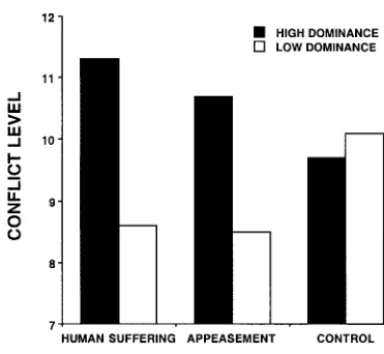
The main focus of this study was on the effects of priming: priming by texts read by some participants before any action decisions. One group of participants read a brief but com-pelling description of events leading up to World War II, focusing on the policy of West-ern statesmen in dealing with Germany’s inva-sion of Czechoslovakia. The clear point of the story was that, when a country engages in war-like aggression against another country, escala-tion of conflict is inevitable and diplomatic ef-forts after peace are futile. Appeasement can only lead to wider, longer disputes. This de-scription was written in a way so as to prime a conflictual, stand-up-for-your-rights attitude in readers. Another group read a description of the material and human costs of international con-flict. The horrors of trench warfare during World War I, the suffering of military personnel on both sides, and the latent effects of this experience on the postwar morale and econo-mies of contending countries were vividly de-scribed. This narrative was intended to prime cooperative, pacifist, nonconflictual responses. The remaining participants were given no prim-ing text before they read the conflict scenario. Our theory was that any text about international interaction might call to the readers’ mind one or more general schemas representing relevant or analogous previous experiences or knowl-edge. On the basis of what we know about priming, then, we expected that the first vignette would prime participants to adopt an aggressive attitude toward the contemporary conflict and that the second vignette would have the oppo-site effect.
Individual Differences in Personality
After we completed this study, reports began to appear supporting a role for individual per-sonality variables in real-life political decision making. Satterfield and Seligman (1994), for example, suggested that it might be possible to predict high-level international decisions from the personal explanatory styles of political de-cision makers. They derived a measure of ex-planatory style for George Bush and Saddam Hussein, based on content analysis of public statements made by these two national leaders at various points in time during the Gulf War. Statements were scored on the dimensions of internality– externality of event control, stabil-ity–instability of event causes over time, and globality–specificity of event effects. From these scores, Satterfield and Seligman computed a composite measure of explanatory or attribu-tional style for each leader. This composite measure was highly and reliably predictive of the level of aggression and degree of risk taking represented in the subsequent decisions and ac-tions of Bush and Hussein. Interestingly, the correlations were higher for Bush, suggesting a greater reliance in his case on personal convic-tion as opposed to raconvic-tional decision. A similar interest in individual differences also led us to measure, among our participants, certain per-sonality traits (using the 16 PF; Institute for Personality and Ability Testing, 1979) that we thought might be related to political decision making regarding international disputes.
Experimental Results
than simply reminding participants about past wars. It seems that any war-related vignette will activate underlying personality predispositions that enhance or inhibit aggressive military decisions. Results of the first experiment indicated that, at least for young American citizens, peace–war decisions are not necessarily undertaken on the basis of rational calculation of benefits and costs, although rational choice is surely a major part of real or elite political decision making. We suggest that decisions, especially those that are made serially and at a tactical level by ordinary citizens, are likely to be affected sig-nificantly by the schemas or images called to mind by the stream of events and by overall predispositions to respond submissively or dominantly. However, even in the real world of policy making, primes and personality might operate, possibly in subtle and informal ways, as signals or cues that flow through the stream of political events. Their effects might very well help to explain why different major players on the political scene—like Bush and Hussein dur-ing the Gulf War or Sharon and Arafat today— react quite differently to the same events, events that might lead to cooperation and peace if reacted to in the same way by both sides.
The Role of Peace Treaties and of Gender
There was some suggestion in this first ex-periment that men and women react differently
to acts of international aggression, as one might expect intuitively. But the numbers of men and women were not balanced across conditions. Thus, we corrected that flaw in subsequent stud-ies, and the results highlight not only the influ-ence of personality variations but also an ex-traordinary and unanticipated gender difference in naive political decision making. In the next study, we were primarily interested in the effect that the existence of a peace treaty might have on an individual’s expression of conflict in re-action to an international attack. One might reasonably expect a peace treaty to minimize conflictual interactions between nations. The main question was, What happens if or when there is a transgression by one of the two parties to the treaty?
Effects of a Peace Treaty
Participants in our next study (Beer, Sinclair, Healy, & Bourne, 1995; see also Bourne, Sin-clair, Healy, & Beer, 1996) were instructed to read through a test booklet, the first part of which contained items from the 16 PF, focusing on two bipolar dimensions, radicalism– conser-vativism and submissiveness– dominance. Next, participants read a background scenario de-scribing an ongoing situation of intransigent regional conflict. In this case, the scenario was a fictionalized account of post–Gulf War activ-ities in the Middle East, as Israel and the Arab countries attempted to work out a peace agree-ment. In our scenario, two neighboring coun-tries are described as being locked in a historical struggle of tension and hostility. Afslandia is supported by the United States, and Bagumba is supported by its fictitious superpower ally, Cal-deron. After reading the background scenario, half of the participants read a simulated news story reporting the signing of a “historic peace agreement between Afslandia and Bagumba at Camp David.” On the next page of the booklet, the following news flash appeared: “Bagumba’s Artillery Opens Fire on Afslandia’s Military Outpost Near the Border.”
[image:3.522.53.245.74.251.2]Participants were asked to respond to the news flash by choosing a reaction “that would be best for the United States [Afslandia’s major ally] to support at this time in response to this news event.” Twelve illustrative reactions, rank ordered in terms of level of conflict, were pre-sented below a scale of numbers, 1–12. For
example, Number 4 was “The United States supports Afslandia’s Foreign Minister in post-poning a state visit to Bagumba, denouncing its recent hostile actions”; Number 7 was “The United States supports Afslandia in mining three of Bagumba’s bridges and important in-dustrial plants”; and Number 10 was “The United States supports Afslandia in using bat-tlefield nuclear weapons against key command sites in Bagumba.” The rank ordering and con-flict levels of the sample of reactions presented to participants were determined in a separate norming study, reported in detail in Beer et al. (1995). It is important to keep in mind that these action items were described as examples repre-senting quantitatively the different levels of possible retaliation. Participants were instructed to select an action number that was appropriate in terms of its level of aggression in response to the news flash. After their first action response, participants proceeded to the next page of the test booklet and were informed that “This news flash has just appeared. Despite Afslandia’s re-sponse, Bagumba’s artillery continues to fire on Afslandia’s military outpost near the border.” Participants were asked once again to respond to the news flash by choosing one of the 12 possible action alternatives that would be best for the United States to support at this time in response to this news event. In all, partici-pants were asked to respond a total of five times to these repeated reports of aggression by Bagumba.
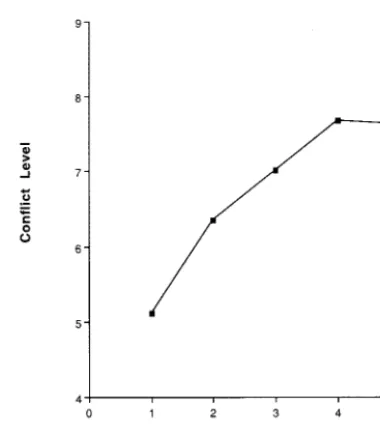
On a 1–12 scale, Bagumba’s action—Ba-gumba’s artillery firing on Afslandia’s military outpost near the border— had a normative value of 8, as determined in the norming study. Figure 2 shows the average levels of conflict chosen by participants in each of five rounds of reaction to Bagumba, both as raw scores and as the best fitting equation. Two points are worth noting. First, the initial reaction of participants was at a level of conflict substantially lower than that of the initial act committed by Bagumba. There is something here that might be called forgiveness or the discounting of aggression. Participants’ initial reaction to an unprovoked attack is rela-tively mild. Second, conflict level increased gradually over rounds, but it never exceeded the level of Bagumba’s action. Participants appear to support the gradual escalation of hostility but only to a point of approximate reciprocity.
Next, we looked at this trend over action rounds in light of four between-groups vari-ables, namely, the existence or nonexistence of a peace treaty, the two personality variables created by partitioning participants at the me-dian level of dominance–submissiveness and radical– conservative traits, and finally gender. The main effect of action round was highly significant but interacted with none of the four between-groups variables. There was no signif-icant overall effect of peace treaty. Of the two personality variables, only dominance–submis-siveness returned clear-cut results. High domi-nance participants were uniformly more con-flictual (M⫽7.26) than low dominance partic-ipants (M ⫽ 6.25), regardless of peace treaty, gender, or round. Conservative participants tended to be more conflictual across all action rounds than did liberal participants, but the dif-ference was small and statistically unreliable.
Effects of Gender
[image:4.522.259.449.70.288.2]What should we expect about gender? Tradi-tionally, aggression is considered to be a mas-culine trait, and thus we might expect men to be more conflictual overall than women. But the literature on gender differences in decision making, such as it is, indicates little difference
between men and women over a variety of experimental situations. Still, there are impor-tant gender differences in many behaviors in-volving moral reasoning and interpersonal rela-tionships (see, e.g., Eagly, 1987). According to Gilligan (e.g., Gilligan, 1982) and Buss (e.g., 1994), two authors with quite different perspec-tives on the matter, under circumstances in which a close relationship exists, women are more likely than men to search for ways to preserve that relationship. Women are generally more cooperative and compassionate in inter-personal interactions than men. Men, in con-trast, seem more preoccupied with justice and with reaction in kind. Thus, even (or perhaps especially) when a relationship exists between two people, men seem more likely than women to act defiantly in the face of any active trans-gression by the other party. Does this translate to cases in which countries rather than individ-uals are the players?
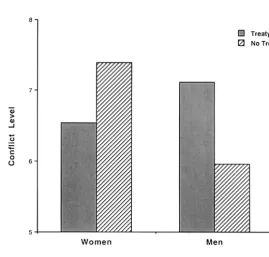
In the data of the present experiment, the two genders showed essentially the same overall level of conflict in their action selections. How-ever, and this is especially noteworthy in the
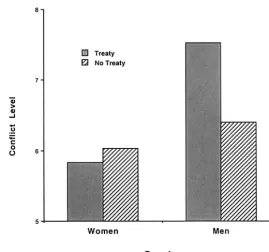
[image:5.522.117.386.376.633.2]light of earlier remarks about the differential importance of relationships to men and women, the presence of a peace treaty affected the two genders in diametrically opposed ways. As shown in Figure 3, there was a large and sig-nificant crossover interaction in action choices between gender and peace treaty. Men made more conflictual action choices in the presence of a peace treaty than in the absence of a peace treaty. Women, in contrast, made weaker con-flictual action choices in the presence of a peace treaty than in its absence. Personality differ-ences in the action choice data were statistically controlled by a linear regression analysis, so this effect is not attributable to a difference in dominance–submissiveness between the gen-ders. Thus, the absence of an overall peace treaty or an overall gender effect in action choices is highly misleading. Peace agreements do have consequences and gender matters, but the effects are revealed only when the two vari-ables are considered together. Especially when a relationship, signified by a peace agreement, exists between the two sides, men seem more
likely than women to act defiantly in the face of any active transgression.
Generality of Interaction Between Peace Treaty and Gender
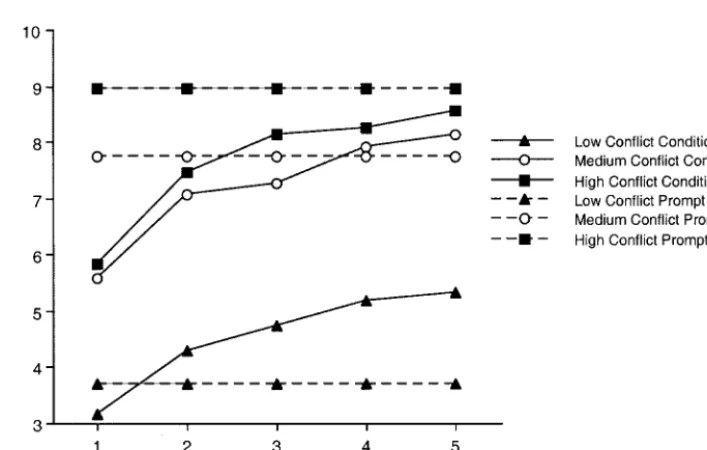
How stable are these results? Given the po-tential importance of a Peace Treaty⫻Gender interaction, we thought that it was necessary to replicate this finding. A replication also gave us the opportunity to extend the scope of the earlier studies, by including other acts of aggression as prompts or primes, in an effort to determine the generality of forgiveness, escalation, and reci-procity effects. In a follow-up study (Sinclair, Healy, Beer, & Bourne, 2002) based on the same Afslandia versus Bagumba scenario, we used three priming events (i.e., attacks of Ba-gumba on Afslandia) differing in conflict level, one higher, one lower, and one at the same level of conflict as in the preceding study. Personality measurements were taken as before, and partic-ipants were asked, after reading their prime, to respond in five action rounds. Our expectations were that participants would discount Bagum-ba’s initial act of aggression but gradually es-calate over five rounds to a level of conflict
approximately equal to the prime, regardless of the level of the prime. Moreover, we expected to find a significant Gender⫻Treaty interaction at each prime level.
The data depicted in Figure 4 are consistent with these expectations in that participants did exhibit some initial forgiveness of the opposi-tion’s attack and escalated their retaliation in the face of continuing acts of hostility. Note that although participants’ final level of conflict ap-proximated the level of the prime for the primes of high and medium conflict levels, the final conflict level was higher than that of the prime when it was at a low level, suggesting a possible boundary condition on reciprocity.
[image:6.522.84.438.406.631.2]Unlike the preceding study, there was an overall gender difference in these data, one that cannot be removed by controlling the signifi-cant difference between men and women in dominance–submissiveness. Overall, women were less conflictual than men, even when dom-inance differences were factored out. Our main interest, however, is in the Gender ⫻ Treaty interaction. As shown in Figure 5, that interac-tion was essentially the same as in the previous study. The interaction was not affected by any of the other variables in this experiment and
appeared at all levels of prime, although it was numerically most pronounced at the midlevel prime.
Some Tentative Implications
In review, recommended responses by young citizens to military attacks by another nation tended to follow a pattern of reciprocity, with two important constraints. First, counterre-sponses tended to be initially forgiving or dis-counted. Second, however, counterreactions es-calated over rounds, eventually approaching and sometimes exceeding the conflict level of the aggressor’s attack. These action–reaction results might have some implications for the control of intransigent conflict. They suggest that the moves of each agent influence the coun-termoves of its opponent. Unilateral aggression, especially when it is repeated, risks expanding conflict; Saddam Hussein and the Arabs and Israelis stand as fairly recent historical exam-ples of this principle. An interesting possibility is that unilateral deescalation, as exemplified in the politics of Mikhail Gorbachev, might have a similar downward ratcheting effect. We have
not yet examined this possibility but hope to do so eventually.
[image:7.522.117.386.73.325.2]In the scenario read by some participants in the preceding experiment, Afslandia and Ba-gumba recently signed an agreement to main-tain the peace in a region that had historically been rife with conflict. Naively, we expected the existence of this treaty to mitigate Afslandia’s tendency to react in kind to Bagumba’s hostil-ity. But there was no consistent overall differ-ence in the conflictual counterresponses of par-ticipants operating under the existence or the nonexistence of a peace treaty. The overall ef-fect or lack thereof, however, does not tell the whole story. Our results suggest that peace trea-ties and identical international events can have substantially different meanings for men and women. For the female decision maker, the existence of a peace treaty between nations means that efforts after conciliation should be pursued, even in the face of a transgression. For the male decision maker, though, it provides the occasion for retaliation and revenge. If men are the decision makers in an unstable situation, it is probably best not to have a peace treaty, espe-cially if it is tentative or preliminary to larger
negotiations. Its violation will just exacerbate the problem. But if women are to make these decisions, preliminary peace treaties are to be sought after because they might minimize the level and probability of follow-up aggression.
Military Versus Terrorist Attacks
The experiments described thus far are lim-ited in obvious ways. A particularly important limitation is their focus on only one type of conflict: conflict involving the military, occur-ring outside of the United States, and involving a fictitious ally and opposing nation. In recent times, many real-life conflictual acts have been executed by terrorist groups rather than by the military of another nation. There existed a sub-stantial political science literature before Sep-tember 11 focusing on terrorism and its specific implications for democracies, foreign policies, and international relations. Although the public view of terrorism might well have changed since September 11, this literature suggested that people generally think of terrorist acts as qualitatively different from and less serious than military engagements and of terrorists as not necessarily representative of their nation of origin (e.g., Crenshaw, 1986). But there are other obvious differences between terrorist and military attacks. For example, political scien-tists claim that terrorism, but not military action, exceeds the bounds of socially accepted lence, provoking a greater sense of moral vio-lation (Crenshaw, 1986). Further, military at-tacks are designed to overwhelm an enemy, whereas terrorist attacks are symbolic in nature and are designed primarily to influence public opinion. There are other important differences between terrorism and “conventional” interna-tional disputes. The point is that citizens, as decision makers, might be expected to respond differently when their country or an ally is at-tacked by a terrorist group as opposed to the military, assuming of course attacks of equal severity. This literature inspired us to conduct a study comparing reactions to military and ter-rorist acts that were equated on other dimen-sions (Healy, Hoffman, Beer, & Bourne, 2002).
Differences in Reactions to Terrorist and Military Attacks
Most of what we know about public reaction to military versus terrorist aggression is based
on case studies or anecdotes. To collect more systematic empirical evidence, in a series of three experiments (Healy et al., 2002), we asked young adults to respond to conflictual events involving a terrorist group from an opposing country. It is critical to note that these experi-ments were completed before the events of Sep-tember 11, 2001, and the results might be dif-ferent today.
In one experiment, for half of the partici-pants, a fictional attacking country, Bagumba, was said to have a peace treaty with a fictional ally of the United States, Afslandia. There was no peace treaty between Bagumba and Afs-landia for the other half of the participants. For half of the participants in each of these groups, Bagumba’s military attacks Afslandia, whereas, for the remaining participants, Afslandia is at-tacked by a state-sponsored terrorist group based in Bagumba. Military and terrorist attacks were described essentially in the same way, so any differences in the participants’ responses to the attacks could not be attributed to differences normally confounded with this comparison.
The Democratic Peace Hypothesis
The results of the preceding experiment led us to focus in subsequent studies on terrorist attacks taking place in different political and geographical contexts. One political context that has been the target of a substantial body of recent literature in international relations is the form of government (or regime) of contending nations (see, e.g., Cederman, 2001, and Hender-son, 2002, for recent discussions of this issue). A democratic peace hypothesis formulated by Russett (1993) implies that nations with a dem-ocratic form of government do not go to war against other democratic countries. A weaker version of this hypothesis is that democratic nations tend not to support attacks of any kind on each other (Maoz, 1997). Both versions are based on the arguments that (a) alternative dip-lomatic mechanisms for settling disputes are available to democracies and (b) shared cultural values mitigate conflict. On the basis of this hypothesis, one might expect that participants, who in our experiment are young citizens of a democracy, will respond less conflictually to an attack on the United States (or an ally) by an-other democratic nation than by a nondemo-cratic nation. But we have proposed an exten-sion of this hypothesis based on the idea that participants are likely to treat two contending democratic countries as though they had an implicit peace treaty. If this is a reasonable assumption, then, on the basis of earlier find-ings, we would predict that female participants
will forgive and respond less forcefully to an attack by a democratic nation relative to one by a nondemocratic nation. Male participants, in contrast, will retaliate more vigorously to an attack by a democratic nation than to an attack by a nondemocratic nation.
The background scenario presented to partic-ipants at the outset of the next experiment de-scribed the country of Calderon, a superpower nation that often opposed the United States. For different participants, Calderon was said to have either a democratic or a nondemocratic govern-ment. According to the democratic peace hy-pothesis of Russett (1993), we would predict that reactions by our participants to any kind of attack by Calderon on the United States might be weaker if Calderon is a democracy than if it is a nondemocracy. But, on the assumption that there is an implicit peace treaty among demo-cratic nations, Calderon’s form of government (democratic or nondemocratic) might have an effect similar to the peace treaty variable, re-sulting in an interaction between gender and form of government.
Even though the United States has not been involved in any military conflict within its bor-ders in modern times, it has suffered a number of serious terrorist attacks. In some cases, the attack has occurred within the United States (e.g., the attacks of September 11 on the World Trade Center in New York City and the Penta-gon in Washington, D.C.). Other terrorist activ-ities involving United States citizens or prop-erty have occurred within allied nations (e.g., the bombing of the United States embassies in East Africa or the more recent bombing of the USS Cole in Yemen). We were concerned in the present study with determining whether there is a difference in reaction to a terrorist attack on domestic versus foreign soil. Participants were asked to respond over successive rounds to a terrorist act perpetrated on U.S. citizens in five different venues—an office building housing the Coca Cola Company, a military barracks, a university campus, a cafe, and a tour bus— located either inside or outside of the United States.
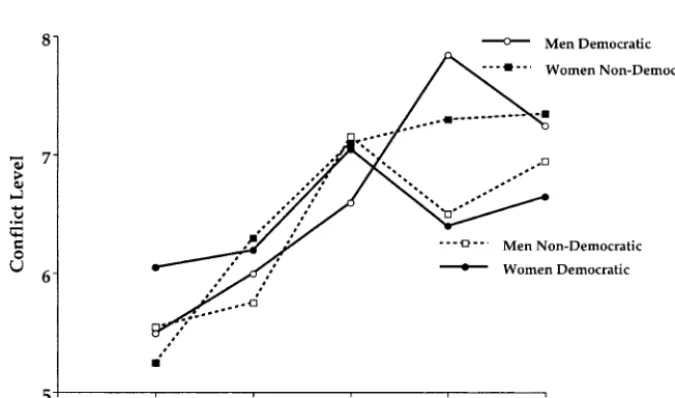
There was no overall difference in level of conflictual response attributable either to loca-tion of attack, inside or outside the United States, or to form of government of the attack-ing country. The latter result is, of course, in-consistent with predictions based on the
[image:9.522.54.245.73.221.2]cratic peace hypothesis (Russett, 1993). Partic-ipants’ responses did increase in conflict over rounds, as in previous experiments, although the venue and nature of the attack varied over rounds in the present experiment. As shown in Figure 7, this escalation effect depended on the combination of the gender of the participant and whether or not the attack was made by a dem-ocratic country. During the last two rounds, men responded with more conflict to an attack by a democratic adversary than to an attack by a nondemocratic adversary, whereas women re-sponded with more conflict to an attack by a nondemocratic adversary than to an attack by a democratic adversary. This outcome is in ac-cord with predictions based on our extension of the democratic peace hypothesis and on an anal-ogy between the relationship among democra-cies and the existence of an implicit peace treaty.
Although the sample of target sites was lim-ited in this experiment, the general pattern of reactions observed suggested that the degree of retaliatory conflict recommended by citizens depended on where the attack took place. Citi-zens seemed to respond differently and more intensely to terrorist attacks occurring at a mil-itary base (such as in the bombing of the United States military barracks in Beirut) than in a nonmilitary setting (as in the tour bus bombing
in Egypt or the school bus bombing in Israel), possibly because an attack on the military is a more warlike act than an attack in a civilian setting. This possibility was explored more thoroughly in the next experiment.
Targets of Terrorist Attacks
In a final study, we varied systematically the site of the terrorist acts, distinguishing between clearly military and clearly cultural– educa-tional sites. The offending country, Calderon, was described as democratic for half of the participants and as nondemocratic for the re-maining participants. The nature of the terrorist act varied over six rounds, in this case all within the United States. For three rounds the target was military (a naval ship, an air force base, or a military barracks) and for the remaining rounds it was cultural– educational (a library, an art museum, or a university campus).
[image:10.522.83.421.430.629.2]Target site had a major impact on partici-pants’ level of retaliation against a terrorist at-tack. Specifically, and possibly counterintu-itively, participants responded with a signifi-cantly higher level of conflict overall to attacks on military targets than to attacks on cultural– educational targets. This outcome was expected given the results of the previous experiment and might be attributed to the fact that attacks by
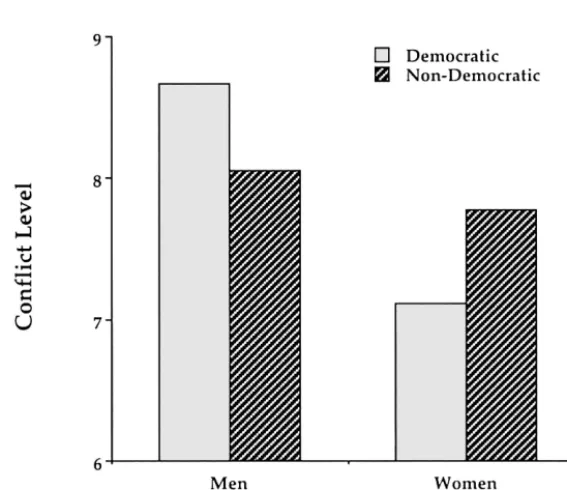
one country on the military establishment of another have historically led to escalation of conflict and eventually to states of war. Attacks on nonmilitary targets, in contrast, are often (or at least sometimes) discounted by the target country. Once again, it is possible that the events of September 11 have changed public opinion in this regard. In general, the results of this study, like the previous study, were incon-sistent with predictions from the democratic peace hypothesis in that there was no main effect of type of government of the terrorist-supporting country for either men or women. However, in the last round of the experiment, women responded with a somewhat higher level of conflict in the face of an attack by a nonde-mocracy than a denonde-mocracy. Men, in contrast, showed the opposite pattern, responding with a somewhat higher level of conflict in the face of an attack by a democracy than in the face of an attack by a nondemocracy during the last round. Thus, the Gender ⫻ Form of Government in-teraction was evident numerically once again, as depicted in Figure 8, but, as in the last experiment, only after participants had experi-enced some number of previous aggressive episodes.
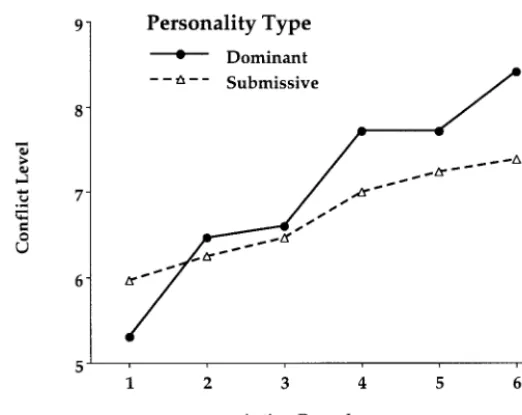
A division of participants in each counterbal-ancing group in this experiment into those rel-atively high and those relrel-atively low on the submissive– dominant scale of the 16 PF yielded a significant interaction between per-sonality group and round. This interaction re-flects the fact that the more dominant partici-pants responded with a higher level of conflict than did the more submissive participants, showing greater escalation of retaliation; how-ever, as with form of government, gender, and certain other variables, the effect was evident only in the later rounds, as shown in Figure 9.
General Conclusions
We undertook these simple experiments as studies of the influence of media reports on public opinion regarding international disputes and terrorism. As such, they might or might not contain a larger message for international poli-cymakers. After an overview of what these studies demonstrate, we briefly consider the question of generality and of possible implica-tions for a deeper understanding of international relations. First, there are systematic action–re-action effects in simulated situations of
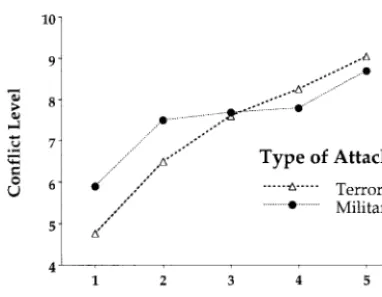
[image:11.522.112.396.387.632.2]tional crisis and tension. College students, young voting-age citizens of this country, rec-ommend measured reactions to reports of ag-gressive attacks by another country, either ter-rorist or conventional military attacks, dis-counted and tempered initially by forgiveness. But they become less tolerant if attacks persist, even when the target of attack changes across rounds. This pattern of forgiveness followed by escalation was enhanced for terrorist acts rela-tive to military acts. Participants responded to terrorist acts less conflictually than to military attacks at the outset but more conflictually in the later rounds. Thus, to justify a strong and com-mensurate response to an opposing country, re-peated acts of either state-sponsored terrorism or military action appear to be necessary. Once respondents have overcome their initial reluc-tance, however, they react even more strongly to terrorism than to a military attack. Note fur-ther that the specific target of a terrorist act has a significant effect on intensity of reaction. Per-haps counterintuitively, participants in our ex-periments responded with more overall conflict to terrorist attacks on military targets than to attacks on cultural– educational targets.
But these overall effects do not tell the com-plete story. There are major individual-differ-ences variables operating in our experiments. Dominant individuals are more aggressive in
their responses to an attack, especially when first primed by reminders of previous wars; submissive individuals are less aggressive with war priming. Moreover, identical international events appear to have substantially different meanings to men and women. With a peace treaty in place between nations, men, faced with reports of transgression, recommend strong re-taliation. Under similar circumstances, women moderate their response relative to a no peace treaty condition.1Further, along the same lines, gender of decision maker interacted with form of government of a terrorist-sponsoring nation. Participants appeared to interpret a shared form of government (democracy) as tantamount to an implicit peace treaty. By virtue of their common democratic form of government, two countries in dispute have ready-made formal diplomatic (i.e., nonconflictual) mechanisms for resolving their differences. But again, women appear to interpret these preexisting contractual relation-ships among nations differently than men. And
1In an informal seminar discussion of this effect, a
[image:12.522.119.380.74.281.2]stu-dent reported on a magazine interview with Virginia Woolf, published in the 1930s, that he had recently come across. Apparently, when asked what she would do to preserve world peace at that time of growing unrest in Europe, Woolf said, “Put women in charge.” This answer, although simple and possibly naive, parallels some of our findings.
for that reason, women ultimately respond with less conflict in the face of an attack by a dem-ocratic country (with an implicit peace treaty) than by a nondemocratic country. Men, on the other hand, retaliate against contractual viola-tion, ultimately responding with greater conflict to an attack by a democratic country than one by a nondemocratic country.
It is important to note that these interactive effects of gender and form of government were evident only in the later rounds of international dispute. There seems to be a general principle that certain variables exert their influence only after participants have had some amount of ex-posure to a conflictual international climate. Some conflictual acts may initially be ignored, excused, or forgiven, minimizing the impact of relatively subtle political variables (e.g., form of government) and individual-differences vari-ables (e.g., gender). However, after repeated assaults, these variables become overriding and significantly influence the level of counterat-tack. The situation is similar for certain person-ality variables. More dominant participants re-sponded with a higher level of conflict than did more submissive participants, but mostly in the later rounds or after being primed by war vignettes.
Thus, reactions to international disputes and attacks of one country on another change over time. Individual decision makers start out in a forgiving mode, such that some critical vari-ables have little effect on their decision behav-ior initially. But as conflict and reaction to con-flict escalate, these variables begin to manifest themselves. Thus, one possible bottom-line les-son from this research for policymakers who wish to take account of public opinion is that initial public reactions are likely to be quite different from subsequent reactions in the face of a continuing conflict. The current Arab–Is-raeli dispute is a poignant example.
One final comment is in order. The interna-tional system in which we live brings with it order and disorder, peaceful agreements and violent disturbances. Peace treaties, even tenta-tive or preliminary ones, as for example in the Middle East or Northern Ireland, are usually seen as evidence of progress into a new age. But, as the world has often experienced, treaty violations can amplify conflict. The desirability of treaty agreements in real-life international relations might depend, as it does in our
artifi-cial laboratory situation, on the gender and per-sonality of individuals in power. Although we are aware of the limits on psychological exper-iments, it might not be unreasonable to try out some of these laboratory-based principles in the real world. Even if there are fewer women than men or fewer submissive than dominant person-alities active in today’s international arena, pol-iticians and diplomats might be well advised to take account of the facts of general psychology and of the psychology of individual differences. General psychology actually might have some-thing to contribute to further peaceful progress in the current fragile post– cold war, terrorism-threatened international environment. In inter-national relations, as elsewhere, general psy-chological variables involving memory, person-ality, and gender probably make a bigger difference than they are typically given credit for.
References
Beer, F. A., Healy, A. F., Sinclair, G. P., & Bourne, L. E., Jr. (1987). War cues and foreign policy acts.
American Political Science Review, 81, 701–715.
Beer, F. A., Sinclair, G. P., Healy, A. F., & Bourne, L. E., Jr. (1995). Peace agreement, intractable con-flict, and escalation trajectory: A psychological laboratory experiment. International Studies Quarterly, 39, 297–312.
Bourne, L. E., Jr., Sinclair, G. P., Healy, A. F., & Beer, F. A. (1996). Peace and gender: Differential reactions to international treaty violations. Peace
and Conflict: Journal of Peace Psychology, 2,
143–149.
Buss, D. M. (1994). The strategies of human mating.
American Scientist, 82, 238 –249.
Cederman, L.-E. (2001). Back to Kant: Reinterpret-ing the democratic peace as a macrohistorical learning process. American Political Science
Re-view, 95, 15–32.
Crenshaw, M. (1986). The psychology of political terrorism. In M. G. Hermann (Ed.), Political
psy-chology (pp. 379 – 409). San Francisco:
Jossey-Bass.
Eagly, A. H. (1987). Sex differences in social
behav-ior: A social-role interpretation. Hillsdale, NJ:
Erlbaum.
Gilligan, C. (1982). In a different voice:
Psycholog-ical theory and women’s development. Cambridge,
MA: Harvard University Press.
Healy, A. F., Hoffman, J. M., Beer, F. A., & Bourne, L. E., Jr. (2002). Terrorists and democrats: Indi-vidual reactions to international attacks. Political
Henderson, E. A. (2002). Democracy and war: The
end of an illusion. Boulder, CO: Lynne Rienner.
Institute for Personality and Ability Testing. (1979).
Administrator’s manual for the 16 PF.
Cham-paign, IL: Author.
Maoz, Z. (1997). The controversy over the demo-cratic peace: Rearguard action or cracks in the wall? International Security, 22, 162–198. Russett, B. M. (1993). Grasping the democratic
peace: Principles for a post-Cold War world.
Princeton, NJ: Princeton University Press. Satterfield, J. M., & Seligman, M. E. P. (1994).
Military aggression and risk predicted by explan-atory style. Psychological Science, 5, 77– 82.
Sinclair, G. P., Healy, A. F., Beer, F. A., & Bourne, L. E., Jr. (2002). The effects of peace treaty,
gen-der, and prime magnitude on the reactions to in-ternational disputes. Manuscript in preparation.
Tanter, R. (1999). Rogue regimes: Terrorism and
proliferation. New York: St. Martin’s Press.
Volkan, V. D. (1999). Bloodlines: From ethnic pride
to ethnic terrorism. Boulder, CO: Westview Press.
Received February 17, 2002 Revision received May 15, 2002