LOUIS COMTET
University of Paris-&d (Orsay), France
ADVANCED
COMBINATORICS
The Art of Finite and In_fiite Ex,namionsREVISED AND ENLARGED EDITION
D. REIDEL PUBLISHING COMPANY
ANALYSE COMBINATOIRE, TOMES I ET II First published in 1970 by Presses Universitaires de France, Paris
Translated from the French by J. W. Nienhays
Library of Congress Catalog Card Number 73-8609 1 Cloth edition: ISBN 90 277 0380 Y Paperback edition: ISBN 90 277 0441 4
Published by D. Reidel Publishing Company, P.O. Box 17, Dordrecht, Holland
Sold and distributed in the U.S.A., Canada, and Mexico by D. Reidel Publishing Company, Inc.
306 Dartmouth Street, Boston, Mass. 02116, U.S.A.
All Rights Reserved
Copyright 0 1974 by D. Reidel Publishing Company, Dordrecht, Holland No part of this book may be reproduced in any form, by print, photoprint, microfilm,
or any other means, without written permission from the publisher Printed in The Netherlands by D. Reidel, Dordrecht
TABLE OF CONTENTS
INTKODUCTION
SYMBOLS AND ABRKEVIATlONS
CHAPTER I. VOCABULARY OF COMBINATORIAL ANALYSlS
1.1. Subsets of a Set; Operations I .2. Product Sets
1.3. Maps
1.4. Arrangements, Permutations
1.5. Combinations (without repetitions) or Blocks t.6. Binomial Identity
1.7. Combinations with Repetitions 1.8. Subsets of [II], Random Walk 1.9. Subsets of Z/rzZ
1.10. Divisions and Partitions of a Set; Multinomial Identity 1.11. Bound Variables
1.12. Formal Series 1.13. Generating Functions
1.14. List of the Principal Generating Functions 1.15. Bracketing Problems
I. 16. Relations 1.17. Graphs
1.18. Digraphs; Functions from a Finite Set into Itself Supplement and Exercises
CHAPTER II. PARTITIONS OF INTEGERS
2.1. Definitions of Partitions of an Integer In] 2.2. Generating Functions ofp(n) and P(n, nz) 2.3. Conditional Partitions
2.4. Ferrers Diagrams
2.5. Special Identities; ‘Formal’ and ‘Combinatorial’ Proofs 2.6. Partitions with Forbidden Summands; Denumerants Supplement and Exercises
1X XI I
1 3 4 5 7 12
15
19 23 25 30 36 43 48
52
VI TABLE OF CONTENI’S ‘I‘ABl.li 01’ C’ONTEN’I‘S VII
CHAPTER III. IDENTITIES AND EXPANSIONS I27
3.1. Expansion of a Product of Sums; Abel Identity I 27 3.2. Product of Formal Series; Lcibniz Formula 130
3.3. Bell Polynomials 133
3.4. Substitution of One Formal Series into Another; E~ormuJa of
Fag di Bruno 137
3.5. Logarithmic and Potential Polynomials I40
3.6. Inversion Formulas and Matrix Calculus 143
3.7. Fractionary iterates of Formal Series 144
3.8. Inversion Formula of Lagrange 14s
3.9. Finite Summation Formulas I.51
Supplement and Exercises 155
CHAPTER IV. SIEVE FORMULAS I76
4.1. Number of Elements of a Union or Inlersection I76
4.2. The ‘probl&me des renconlres’ 1 S)
4.3. The ‘probkme des m&ages 182
4.4. Boolean Algebra Generated by a System of Subsets IS5 4.5. The Method of R&nyi for Linear Inequalities I SC)
4.6. PoincarC Formula lOI
4.7. Bonferroni Inequalities IO3
4.8. Formulas of Ch. Jordan I OS
4.9. Permanents I ofl
Suppiemeni and Exercises I ox
CHAPTER V. STIRLING NUMBERS 204
Supplement and Exeicises 219
C’IIAP I‘ER VI. PI~RhlU’l‘A’I IONS
6. I. The Symmetric Group
6.2. Counting Prol~lems Relaled to Ikconiposition in Cycles; I&- turn lo Stirling Numbers of‘ the First Kind
230 230
6.3. Multil~cr~nutatioiis
6.4. Inversions of a E’crmutntion of In]
6.5. Permutations by Number of Rises; Eulcrian Numbers 6.6. Groups of Pcrniutalions; Cycle Indicak)r Polynomial; 13urn-
side ‘I’lieorem
233 235 236 240
6.7. ‘l‘l1corem of PGlya Supplcnienl aritl Excwises
246
250 254
(:IIAI’l‘ER VII. EXAMPLES OF INI:QlJhLITlES AND ESl‘lMA’I‘I‘:S
7. I. (.‘onvexity and Ilnimotlality ofC.‘ombinatorial Sequences 7.2. Sperncr Systems
7.3. Asymptofic Study of file Number of Regular C;raphs of Order ‘l‘wo on N
268
268
271
7.1. Random Permulatinns ‘7.5. ‘1 heorcm of Rnmsq
‘l.c>. Rinnr! (Bicolour) Ramsey Numbers 7.7. Squa1-es in Rel:ltions
Supplement and Exercises
273 27Y %X3 287 258 291
I-~JNI~AMENTAI. NIJMERICAI. ‘I‘h131,ES
Factorials with Their Prime Factor Decomposition Binomial C’oefkicnls
Parlifions of Itilegers Ikll Polynomials
Iq~rit Iiriiic IWgn0mi:tls
1’31 ti:llly Ordinary Ml p0lync,niinls Mllltinoniinl <‘oefi&nls
Stirling N~~mbcrs ofllie 13lsl ICincl
Slil lirlg NIII~~IXYS ofille S~~c~c)wl !:.ilrcl :ind llxpon~n~i:~l Ntrn~lws
305
20 306
307
30 7 308 309 309
310 310 31 .! 337 5.1. 5.2. 5.3. 5.4. 5.5. 5.6. 5.7. 5.8.
Stirling Numbers of the Second Kind S(n, k) and Partitions of
Sets 701
Generating Functions for ,~(/I, k) ?Oc,
Recurrence Relations between the S(n, 1~) 2.08 The Number m(rt) of Partitions or Equivalence Relations of a
Set with II Elements 2 I C)
Stirling Numbers of the First Kind .T(II, k) and iheir (knrr:>tin,g
Functions 31 2
Recurrence Relations hetwecn !!w:c(!,, l:) .!! 4
The Values of ,y(II, k) 2 I 6
INTRODUCTION
Notwithstanding its title, the reader will not find in this book a systematic account of this huge subject. Certain classical aspects have been passed by, and the true title ought to be “Various questions of elementary combina- torial analysis”. For instance, we only touch upon the subject of graphs and configurations, but there exists a very extensive and good literature on this subject. For this we refer the reader to the bibliography at the end of the voiume.
The true beginnings of combinatorial analysis (also called combina- tory analysis) coincide with the beginnings of probability theory in the 17th century. For about two centuries it vanished as an autonomous sub- ject. But the advance of statistics, with an ever-increasing demand for
configurations as well as the advent and development of computers, have, beyond doubt, contributed to reinstating this subject after such a long period of negligence.
For a long time the aim of combinatorial analysis was to count the different ways of arranging objects under given circumstances. Hence, many of the traditional problems of analysis or geometry which are con- --..--A ^L ^ --.A-:- - ^_^^ A .GrL c-fc- -L --.- 4 -_--I 1, ^_.^ a ---L:..,,,*:,.l t.c;,,IGU ac a bGILLI,II III”luGlIC WlLll 1111,LG ~LIL&LUIGJ, ,ka”G a b”III”IIIQL”IIcu character. Today, combinatorial analysis is also relevant to problems of existence, estimation and structuration, like all other parts of mathema- tics, but exclusively forfinite sets.
My idea is here to take the uninitiated reader along a path strewn with particular problems, and I can very well amagine that this journey may jolt a student who is used to easy generalizations, especially when only
some of the questions I treat can be extended at all, and difficult or un- solved extensions at that, too. Meanwhile, the treatise remains firmly elementary and almost no mathematics of advanced college level will be necessary.
At the end of each chapter I provide statements in the form of exercises
X INTRODUCTION
these 219 questions with their answers, so they can be consulted as a kind of compendium.
The iirst items I should quote and recommend from the bibliography are _’ the three great classical treatises of Netto, MacMahon and Riordan. The bibliographical references, all between brackets, indicate the author’s ( name and the year of publication. Thus, [Abel, 18261 refers, in the 1_,\
bibliography of articles, to the paper by Abel, published in 1826, Books are indicated by a star. So, for instance, [*Riordan, 19681 refers, in the biblio- r gruphy of books, to the book by Riordan, published in 1968. Suffixes a, b,
c, distinguish, for the same author, different articles that appeared in the same year.
Each chapter is virtually independent of. the others, except of the fist; but the use of the index will make it easy to consult each part of the book separately.
I have taken the opportunity in this English edition to correct some printing errors and to improve certain points, taking into account the suggestions which several readers kindly communicated to me and to whom I feel indebted and most grateful.
R(N)
B n,k C E(X) GF N N P(A) WV ‘9-W) %(N) A+B R RV
Z
n n :=
[nl
n!
b>k Wk
bl
lbll
(2
s h k)
SYMBOLS AND ABBREVIATIONS
set of k-arrangements of N partial Bell polynomials set of complex numbers
expectation of random variable X generating function
denotes, throughout the book, a finite set with n elements, IN] = n set of integers > 0
probability of event A set of subsets of N
set of nonemepty subsets of N
set of subsets of N containing k elements = A v B, understanding that A n B = 8
set of real numbers random variable set of all integers >cO difference operator
indicates beginning and end of the proof of a theorem equals by definition
the set (1,2, 3, . . ., n} of the first n positive integers n factorial= the product i.2.3. . . . . n
=x(x-I)...@--k+l) =x(x+1)...@!-k-1)
the greatest integer less than or equal to x the nearest integer to x
binomial coefficient = (n),/k! Stirling number of the first kind s(n, k) Stirling number of the second kind INI number of elements of set N
F bound variable, with dot underneath CA, A complement of subset A
Cmf coefficient of t” in the formal series f
CHAPTER1
VOCABULARY OF COMBINATORIAL ANALYSIS
In this chapter we define the language we will use and we introduce those elementary concepts which will be referred to throughout the book. As much as possible, the chosen notations will not be new; we will use only those that actually occur in publications. We will not be afraid to use two different symbols for the same thing, as one may be preferable to the other, depending on circumstances. Thus, for example, K and CA L-r,- I-.--r- ri_ ---t---r -0 1 1 - n -.-?I In -L--l I-- A,.- :.-r--- UUlll UGIIUK UK LXJllll)ltXlltXIL VI A, A n D iillU Al3 S1illll.l 101 111~ IIILtXbC~- tion of A and B, etc. For the rest, it seems desirable to avoid taking positions and to obtain the flexibility which is necessary to be able to read different authors.
1.1. SUBSETSOFASET;OPERATIONS
In the following we suppose the reader to be familiar with the rudiments of set theory, in the naive sense, as they are taught in any introductory mathematics course. This section just defines the notations.
N, Z, R, C denote the set of the non-negative integers including zero, the e..., rot “I. VL nf . . . 1.1. VD”.” nil intern+-rr K=n )“, the I..” cot YI. nf “L the . ..” .--. regl ...a.YI-Y nllmhm-c -..- am-l the . ..- .,“” c,=t .,. nf the .--.. complex numbers, respectively.
We will sometimes use the following fogicul abbreviations: 3 (= there exists at least one), V (= for all), * (=implies), -E (=if), o (=if and only if).
When a set 52 and one of its elements o is given, we write “oEQ” and we say “w is element of a” or also “0 belongs to 0” or “w in 52”. Let n be the subset of elements o of Sz that have a certain property 9, ll c s2, then we denote this by :
Clal
n:= {co I OEi-2,
P’>,
2 ADVANCED COMBINATORICS VOCABULARY OF COMBINATORIAL ANALYSIS 3
together AI, is known, then we also write: n:= (a, b, c ,..., I>.
If N is a finite set, IN1 denotes the number of its elements. Hence
INI =card N=cardinaZ of N, also denoted by 8.
‘Q(N) is the set of all subsets of N, including the empty set; Tp’(N)
denotes the set of all nonempty subsets, or combinations, or blocks, of N; hence, when A is a subset of N, we will denote this by Ac N or by AE~(N), as we like. For A, B subsets of N, A, Bc N we recall that
AnB:=(xIxA,x&},
AuS:= {x I XEA or xEB},
(the or if net exclusi-qe) j+$-h _-- *I.- --a- --- I bII 016 ~11~ mterseCtivn and the union or^ A and
B. It sometimes will happen somewhere that we write AB instead of
AnB, for reasons of economy. (See, for example, Chapter IV.) For each
family S of subsets of N, S: = (A&t, we denote:
n A, := {x I VIEI, XEA,},
rel IEJ U AI:={x13z~I,x~A,}.
The (set theoretic) difference of two subsets A and B of N is defined by:
WI
A\B:=(xlx~A,x@).The complement of A (c N) is the subset N\A of N, also denoted by A, or CA, or &A. Th e operation which assigns to A the set A is called
i3~3phit3iii. Cieariy :
Clcl
A\B=AnB.p(N) is made into a Boolean algebra by the operations U, n and 0. Such a structure consists of a certain set M (here = !# (N)) with two oper- ations v and A (here v =u, A =n), and a map of Minto itself: a+a’
(here A -+ A= c A) such that for all a, b, c, . . . EM, we have: [ld] (I) (avb) vc=av (bvc),
(II) (u A b) A c= a A (b A c) (associatiuity of v and A ).
(III) avb=bva,
(IV) a A b = b A a (commutativity of v and A ).
(V) There exists a (unique) neutral element denoted by 0, for v: avO=Ova=a.
(VI) There exists a (unique) neutral element denoted by 1, for h:ahl=lAa=a.
(VII) a A (b v c) = (a A b) v (a A c) (distributivity of A with
respect to v ).
(VIII) a v (b A c) = (a v b) A (a v c) (distributivity of v with
respect to A ).
(IX) Each aeM has a complement denoted by a such that
aAd=& avti=l.
The most important interrelations between the operations u, n, c are the following:
DEMORGAN FORMULAS. Let (A,),,* and (BK)6EK be two families of N,
A,cN, B,cN, 1~1, XGK. Then:
I31
Cl fl
Ckl
WI
c’,LJ 4) = ,f-J (CA,)
cc,f-J
4) = ,LJ (CA*)
(U 4) n (.(dEBJ = U
(4 n K)
beI
(I,K)EJXK
U-l A,) u tKf-lK
Bd = f-l (4 ” Bd
IEI (I,I()EIxK
A system 9 of N is a nonempty (unordered) set of blocks of N, without
/- cv~rn~frn~~Al\\\.
i~~&hiCG t---u c y fy \A. /,I, 2 k-sysie,m IS a system con" cidinu _____^ F) _- nf k
blocks.
1.2. PRODUCTSETS
Let be given m finite sets Ni, 1 < i<m, and recall that the product set
n;l= i Ni or Cartesian product of the N, is the set of the m-tuples (y): = =(Y19Yzr..., y,), where y,eN, for all i= 1,2,. . ., m. The product set is
also denoted by N1 x Nz x ... x N,,, or by N,N,N, . . . N,,, if there is no danger for confusion. We call yr the projection of (y) on NI, denoted by P’i (Y),
If Ni = N2= ... = N,,,= N, the product set is also denoted by N‘“; the
diagonalA ofNm is hence the set of the m-tuples such that yi =y2 = .a* =ym.
4 ADVANCED COMBINATORICS
of finite sets satisfies:
q In fact, the number of m-tuples (y 1, y 2, . . . . y,) is equal to the product of the number of possible choices for y, in N,, which is lN1l, by the number of possible choices of y2 in N,, which is lN21, etc., by the number of possible choices of ym in N,,,, which is lN,,,l, because these choices can be done independently from each other. n
Example. What is the number d(n) of factors of n, with prime decompo- sition n =p”‘p”’ 1 2 . . .pp? To choose any factor pt’p’$. . .pp of n is the same as to choose the sequence (6,, 82, . . .
=(O, I,2 ,..., a,), i=l, 2 )..., k. , 6,) of exponents such that 6+:A,:= Then,
=lA1I-lA,l...IAkl=(cr,+l)(a,+l)...(cl,+l). d(nj=jA, xA,x . . . xA,(=
1.3. MAPS
Let g(M, N) or NM be the set of the mappings f of M into N: to each XE M, f associates a ye N, the image of x by f, denoted by y= f (x). We write often f:Mw N instead of fE3 (M, N). As M and N are finite,
m = IMI, n= INI, we can number the elements of M, so let M= {x1, x2,. . . ,
x~}. It is clear that giving f is equivalent to giving a list of m elements
of N, say (YI,Y,, . . . . y,,,), written in a certain order and with repetitions
allowed. Bv givino the lict WP -an= bL-- AI--~
. w-.---o -__- -.UL ..- lllrUll CIIG~~ CII~L y, is the image of xi,
1 <i<m:y,=f (xi). In other words, giving f is equivalent to giving an m-tuple EN”, also called an m-selection. In this way we find the jus- tification for the notation NM for g(M, N). Taking [2a] into account, we also have proved the following.
THEOREM A. The number of maps of M into N is given by
[3a] ls(M, N)l = lN”l = lNll”l. For each subset A c M, we denote:
[3b] f(A):= {f(x) I x~A}.
In this way a map is defined from ‘$J (M) into !$ (N), which is called the
extension off to the set of subsets of M. This is also denoted by f.
VOCABULARY OF COMBINATORIAL ANALYSIS 5
For all YEN, the subset of M: PI f-‘(Y):={xIf(X)=Y},
which may be empty, is called the pre-image or inverse image of y by f. THEOREM B. The number of subsets of M, the empty set included, is given by :
I31 pp (M)I = 2’4.
m Let N be the set with two elements 0 and 1. We identify a subset
ACM with the mapping f from M into N defined by: f (x)= 1 for XEA, and f (x) = 0 otherwise (f is often called the characteristic function). In this way we have established a one-to-one correspondence between the sets !p(M) ._.-- _. ancl NM, ~SICP, by [-?a], ‘Q(M) has t!le same number of elements as NM, which is lNll”l =21”1.
For computing un,=Ip(M)I, we can also remark that there are just
as many subsets of M that do not contain a given point x as there are subsets containing it, namely u,,,...~ in both cases. Hence u,=u,,-r +
+u,,-I =2~,,,-~, which combined with uO= 1 gives ~,,,=2~ indeed. n We recall that feNM is called injective (or is said to be an injection) if the images of two different elements are different: x1 #x2 ?f (x1) # f (x2);
f is called surjective (or is said to be a surjection) if every elemenl of N is image of some element in M: Vye N, !lx o M, f (x) = y ; finally f is called
bijective (or is said to be a bijection) if f is surjective as well as injective; in the last case the inverse or rec@rocal of-f, denoted by f -‘, is defined by y=S -’ (x), if and only if x=f(y), where xeM, YEN.
To count a certain finite set E, in other words, to determine the size, consists in principle of constructing a bijection of E onto another set F’, whose number of elements is known already; then [El = IFI.
EXAMPLE. Let E be the set of all subsets of N with evelz size, and F
the set of the others (with odd size). We can choose XEN and build a bijection f of E into F as follows: f (A)=Au{x} or A\(x) according to x$A or XEA. Thus, IEl= IFI = (+)I‘$ (N)I =2”-i. (See also p. 13.)
1.4. ARRANGEMENTS,PERMUTATIONS
From now we denote for each integer ka 1:
6 ADVANCED COMBINATORICS
DEFINITION A. A k-arrangement a of a set N, 1 < k g n = 1 N 1, is an inject ive
map u from [k] into N (formerly called ‘variation’). We will denote the set
of k-arrangements of N by ‘91k (N).
Giving such an a is hence equivalent to giving first a subset of k elements of N:
B = a(Ckl) = {a(l), a(2), . . . . a(k)},
and secondly a numbering from 1 to k of the elements of B, so finally, a totally ordered subset of k elements of N, which will often be called a k-arrangement of N too (not quite correct, but quite convenient).
We introduce now the following notations:
WI
n..-
t*-
fi i = 1.2.3 . . . n, if n>l; O!:=l. i=lPC1
(nh:=h (n-i+l)=&
=n(n- l)...(n-k+l), if ka 1; (?I)~:= 1
l?dl
<njk:=th (n+i-l)=(n(:kl):)!=n(n+l)...(n+k-I), ;f k>l;(n),:=l.
n ! is called n factorial; (PI)~ is sometimes called falling factorial n (of
order k), and (n>r is sometimes called rising factorial n (of order k), or
also the Pochhammer symbol. So, (n), = (1)” = n !, (n)k = (n + k - l)k,
(nX=<n-k+ I),. etc. These notations are not vet +pA ~XJJ~ The use of , -.. -.I.. .I -11. (nx in the sense indicated, is inspired by formula [Sal (p. 8) that as- sociates the symbols (r~)~ and
0
i with each other in a symmetrical way, both using parentheses. The symbol (IZ)~ that we introduce here for lack of any better is not standard, and if often written (n)k in texts on hyper- geometric series. For the reader familiar with the r function:
I?4 n! = r(n + l), (n)k=I’(n+l)/P(n-k+l),
(TI>~ = r (n + k)/T (n) .
Besides, for complex z (and k integer 2 0), (z)~ and <z)~ still make sense: PI (z)~:= z(z - l)... (z-k + l), (z)e:= 1
Pkl (z),:=z(z+l)...(z+k+), (z),,:=l,
VOCABULARY OF COMBINATORIAL ANALYSIS 7
and hence they can be considered as polynomials of degree k in the in- determinate z.
THEOREM A. The number of k-arrangements of N, 1 G k G n = IN I, equals:
C4N 1’3, (N)I = (11)~ = n (n - 1). . . (n - k + 1).
n There are evidently IZ choices possible for the image a(l) of 1 (~[k]); after the choice of a (1) is made, there are left only (n - 1) possibilities for a (2) because 01 is injective, so c( (2) #cc(l); similarly, there are left for ~(3) only (11-22) possible choices, because c~(3)#a(2) and LX(~)#CC(~), etc.; finally, for a(k) there are just (n- kf 1) possible choices left. The number of a is hence equal to the product of all these numbers of choices. -l-h;0 I ,I,&3 ;c 1.3 ~,,,,1 uyuu C” “\” tn m/w- 1) (ff-2)...(?t-,& !>. n
Note. If k>n, then (n)k=O, and [4h] is still valid.
DEFINITION B. A permutation of a set N is a bijective map ofN onfo itself.
We denote the set ofpermutations of N by 6 (N).
THEOREM B. The number of permutations of N, IN I= n > 1, equals n !
n One can argue as in the proof of Theorem. A above. One may also observe that there is a bijection between G(N) and 2fI, (N). n
1.5. CC)M_R!NAT!ONS (WITHOIJT REPETITIONS) OR BLOCKS
DEFINITION A. A k-combination B, or k-block, of a finite set N is a
nonempty subset of k elements of N: BcN, lGk=IBlGn=INI. Zf one does not know in advance whether k > 1, one says rather k-subset of N (k 20).
We denote the set of k-subsets of N by &(N).
A k-block is also called a combination of k to k of the n elements of N.
Pair and 2-block are synonymous; similarly, triple or triad and 3-block, etc. Next we show three other ways to specify a k-subset of N, INI =IZ.
THEOREM A. There exists a bijection between <q,(N) and the set of func-
tionscp:N-+(O, l},f or which the sum of the values equals k, xpEN~( y) = k.
8 ADVANCED COMHINA’~‘OIIICS
tions of the equation x1 + x2 + .‘. + x, = k, for nhich all xi equal 0 or I.
THEOREM C. Giving a BE Sp, (N) is equivalent to giving a distribution of k indistinguishable balls in n distinct boxes, each box containing at most one ball.
q For Theorem A it is sufficient to define for each BE?&(N) the characteristicfunction q=~~ by q(y)= 1 if DEB and =0 otherwise. For Theorem B we number the elements of N from 1 to II, N = ( y, , y2,. . ., y,,} ;
for each BEAM we define xr=xi(B) by xi= 1 if yiEB and =O other- wise. Finally, for Theorem C each box is associated with a point YEN; to every BE!Q~(N) we associate the following distribution: the box associated with y contains a ball if yeR and no ba!! if y#,~. 3~
THEOREM D. The mrmber of k-subsets of N, 0 <k d n = [N 1, denoted by equals :
n. I =k!(n-k)!=
We will adopt the notation L
0 , used almost in this form by Euler, and fixed by Raabe, with the exclusion of all other notations, as this notation is used in the great majority of the present literature, and its use is even so still increasing. This symbol has all the qualities of a good notation: economical (no new letters introduced), expressive (it is very close in
(lZ)k
appearance to the explicit value -~ -), typical (no risk of being confused
k!
with others), and beautiful. In certain cases, one might prefer (n, b) in- stead of a+b
( a > (see pp. 27 and 28), so that (a, b) = (b, a) is perfectly symmetric in a and b. We recall anyway the ‘French’ notation Ci, and
the ‘English’ notation “C,.
l We prove equality (*); Ihe others are immediate consequences. If k=O, (11)~j0!= 1 [4b, c] (p. 6), and I$(N)I=l because q,(N) con- tains only the empty subset of N. Let us suppose k> 1. With every ar- rangement cre&(N), we associate B=f(a)=(a(I), x(2),..., a(k)}~
E S(N) (P. 7). f is a map from Y&(N) into 5&(N) such that for all
BE’!&(N) we have:
L-W
1-f-l (B)j = k!,since there are k ! possible numberings of B (= the number of k-arrange- ments of 13). Now the set of pre-images f-‘(B), which are rnutualiy disjoint, covers ‘&(N) entirely as B runs through 2&(N). Hence, the number of elements of Z&(N) equals the sum of all If -‘(@I, where
BE&(N), which is CSc, (*)I. Hence; by [4h! (p. 7) for equality (**), arId by [5b] for (***):
hence 1&(N)I=(rz),/k!. II
*rile argument we just have used is sometimes called the ‘shepherd’s principle’: for coupling the: number of sheep in a flock, just count the legs and divide by 4.
I1
DEFINI-~ION 13. 7he irrfcgcrs k
0
are cali& binomial coefficients.We will see the juslificalion of this name on p. 12. DEFINITION C. The double sequence
0
i ‘which is tlejined by C5a] for (II, k)
E N2 (anti cqml to 0 for k > n) fill be defined,from no)t on alsofor (x, Y)EC’
in the f;~llo~l~ing lt’ay :
ytEN
if XEC, y#N
10 ADVANCED COMRJNATORJCS VOCARULARY OF COMRlNATORlAL ANALYSIS 11
THEOREM E. The binomial coeflcients sarisfv the following recurrence r&t- tions :
cse] (;)=(;;;)+(n;l); k,n>l.
[Sg]
(n~:)=(~)+(ktl)-+...+(I:)=~k(:);
k,n>O.
[$I (“k’)=(t>-(k”l)i--+(- ijk(;)=
- i (- Ilk-j
in\
.i=O bl’
lf n is replaced by a real or complex number z (z can also play the roIe qf
an indeterminate variable), then [5e, f, h] still hold, and we have instead of
[5g], for each integer ~20:
WI
(;;;)=(~)+(z;‘)+-..+(z~s)+(~;~;).
l [se, f] can be verified by substituting the values [5a, d] for the binorn- ial coefficients; [Sg’], hence [5g], follows by appIying [se] to each of the terms of the sum CizG f \ k+ i , fo!!owed z+l-i \ by the evide::t r:--‘;‘:-,.- Ul.llf)llllC‘, tion. For [Sh], an analogous method works (a generalization is found at the end of Exercise 30, p. 169).
As an example, we will also give combinatorial proofs of [se, f. g]. For [Se], let US choose a point XGN, \NJ=n, and let .Y and .7 re- spectively be the system of k-blocks of N that contain or not contain respectively the point x. Clearly, 9’nF=0, so:
PiI
I(Pkw=
1-q + v-l.
Now every BBY corresponds to exactly one B’E $3 (N\(x)), namely B\(x), hence:
C31
191 =
I9-h (N\ (#I = (: I i).
Also, 9 = vk(N - ix}); hence: [:5k] ,F\ =(“k’).
Finally, [Si, j, k] imply [se].
For [5f], let us take the inlerpretation of 0 L
as the number of distri- butions of balls in boxes (Theorem C, p. 8). We form all the distributions successively. Then we need in total k i
0
0 i balls. The 11 boxes play a symmetric role, so every box receives (l/n). k i
0
times a ball. Now, every distribution that gives a ball to a given box, corresponds to
- .--:. :-.- 1..
exactlv one distribution I of (k- i) baiis in the ~emii~il~ug \,I- i) boxes. These are in number, so as result we find that (k/n)
For [5gi we humber the elements of N, N: = {x1,x2, . . . . ~~1. We put for i=l, 2,...:
Y,:=(BIBEpk(N); X1,X2,...,Xi-1$8; XiEB).
Evidently, each BE pk(N) belongs to exactly one ,4Oi, iE[n]. SO:
Now, every BEY, corresponds to exactly one:
Hence : c:= ~\{x~}dpk-I(N\jxI,X2 ,...,
%jj-
[5m]A -23 <=- ti7+ r:-,. q iIT.?!..- rscj. 7.7 .k - - _ - . _ - . _ - 1
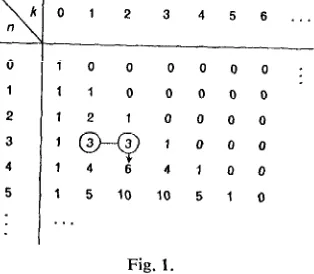
Pnscal triarlgle (or arithmetical trianglej is the name for the infinite table, which is obtained by placing each number
11
0 k at the intersection of the n-th row and the k-th column, k, 1130 (Figure 1). The numerical computation of the first values can be quickly done, by using [se] and
0 0
0 the initial values
!c
=O, except for o = 1. 0
12 ADVANCED COMRINATURICS
0 1 2 3 4 5 6 . . .
IO 0 0000:
11 0 oooo-
12 f 0000
13 3 14 0-Q
1000 6 4100
1 5 10 10 5 1 0
Fig. 1.
shaded area, the heavy dots represent the pairs (:I, ,+’ 1 SUCh ilint ilie col-l-e- sponding
0 IY are related by a linear recurrence relation (that is. wit11
(4 (b) Cc)
Fig. 2.
for example [Sf]). Diagrams 2a, b, c are said to be of the second, first and (n--&I)- s or er, respectively, as their associated recurrence relations. t d A table of binomial coefficients is presented on p. 306.
1.6. BINOMIAL IDENTITY
THEOREM A. (Newton binomial formula, or binomial identity). 4f.v nrrdq are commuting elements (oxy=yx) of a ring, den we have for encJr itt- teger n>O:
[6a] (x + Y)” = i. (3 XkYnmk
VOCARUL,ARY OF COMBINATORIAL ANALYSIS 13
Note. If the ring does not have an identity, we must interpret x’y” and r”y” as y” and x”, respectively. We can also consider [6a] as an identity between polynomials of the indcterminates x and Y.
a Let us examine the coefiicients ck,I of the expansion of: I:6bl (X + J’)” = f’,P, . . . p,, = c Ck,IXkJt,
k. 1 f,:=X+ J’, iE[if].
‘I’he term x”Y’ is obtained by choosing k of ihe II factors Pi, ie[fl], in the sense that one multiplies the terms ‘x’ of these factors by the terms ‘Y’ of the remaining (n-k) factors. So I= IT- Jc. Hence the coefficient ck: =
- c~,,,-~ equals the number of different choices of the k factors Pi anlong
lhe n, hence equals 0
‘$ (‘Th eorem D, p. 8). n
f’or instance, if .x=y= I, then we have & L =2” and thus we find
0
again the result of p. 5: the total number of subsets of N equals 2”. If X=-I, y=l we obtain xk(--l)k i
0
=O, in other words: in N there
are just as many ‘even ’ as ‘odd’ subsets (see also p. 5).
Now we evaluate the rl-th power of the difference operator.
‘THEOREM B. .l,er A he the difference operator, wJ?icJz assigns to ew’y ftmc-
fiorr feAR, &ji~wd on the wan] numbers, and &h values if? a ?‘ifzg A, the
jirrrc& q = Af, tvl~iclt is defhed by g (x) =f (x-t 1)--j (x), XER. For each integer n>2, we rle$ne A”’ = A (A”-‘f ), and we denote A”f (x) instead of (A’lf) (x). Then we have:
[Gc] &y(x)= i (- I)“‘(;)f(x+lr), n=o, 1,2 )....
k=O
m Let E be the trmzsl~zliort operator defmed by Ef (x):=~(x+ I), and 1 the identity operator, If-f. Clearly, A= E-Z. Now E and I commute in the ring of operators acting on AR. Hence, deftning Ek=E(E’-‘)=
= E(E(Ekm2))=.~., we have, by [6a]:
A” = (E - I)” = k& (- 1>n-k (3 Ek
[image:12.826.150.307.60.197.2]14 ADVANCrII) COMll1NA Iolll(:s
In the case of a sequer~ca zlnl, WE N, [ (,c-] implics:
C
64
A”u, = i (- I)“--” ;
k=O 0
I’,,, t k ;
where Au, = 11, + 1 --II,, A’u,n =A (Au,) = II,,+ 2 -- 2rr,,, +, -t- II ,,,. etc. /I/I,,,> o, for all 111, means that II,, is iucreasitzg, A 2r~m20 for all III, IIIE^:IIIS thar u, is cm2 vex.
If A operates on one of the variables of a ftlnclion of ,mwrn/ 1 at-i:lhJes, one can place a dot over the variable concerwd to indicate this. SO 1”~ write :
LeeI
Af(li, u): = J‘(u + 1) 11) -- ,I’(ll, V)) dS(u, q: = .f(u, u -t 1) - .f(,rr, u).Emqdes. (I) Akd” nwans the value of A~.+” in the poirlt .Y-?o, ;III~ then [6c] gives:
C6fl AkOn= i (- 1)' "j
j-0 0
(k - j)" ,
which are, UP to a coeficient k!, the StirIirtg mmher.y CI~‘ the sc~rolltl hirlt/ (cf. p. 204).
In other words:
[6g’] (1 + x)” G 1 -I- xp (mod p).
which weans that the two pol~vioir~inls haw rlw sm7c ~of,tiikw.r ;I/ 7,/t>%
16 AI)\‘ANN(‘lil) l’Oh4IlINA IOllll’S
WI
n We give two proofs of this Iheoreni.
(I) We partition the set of soliilioiis of [7a] ( \\e ( ellote I 11~ nilnil~rr r)f
these solutions by 7’(rl,~)) into two kinds. First, the solulions \r,itl, .Y, -~-0: there are evidently 7’(11- I, 17) of tlwnl. Next, the solrltiolls 1’o1 \cl~ic~ll
x1 >, I; if for these we put -x#, =.Y, .~- I (>O). these sol,,lioilc cot ICS~I)II(~
each to exactly one solution of 3-i -t- .y? .I ... -I-.v,-I’--- I. Ol’\\‘lli~~ll lllc~rc ;?I(’
T(n, ,n - I ). Finally.
I?1
T (n, p) = T(/z - I, p) -i- ‘1‘ (II. 1’ -- I ).To this relation we still must add the lbllowing irttid ~o~~li/i~~r. whir+ follow from [7a] :
Pdl
T(n, 0) = 1 )
‘7‘ ( I. I’) 7 I .Now the double sequence 7’(n, p) is co~~pletely deterrllilwtl. As :I III:IIICI
of fact. the sequence Il’(rr, ~7): r r1ip I
i I’ >
ccitlciilly s:,liQ;lic~s 111~ ,~‘(‘,II rence relation [7c] as well as lhc ‘I~c~r~~cl;~~-y ronciilic~,,’ [ 711 I. I1c1,r.r
T(n, p) = CV(n, p).
(11) We represent the 11 boxes J, j-z, ___, Jo of ~I’heorcni (.’ i,, :, ,.I!\>, si,lf: by side. We number the separations betnren the boxes I)y P, . c?. . . c,, , . going from left to right (Figure 3). Let iiow A’:- (j,,. ~3~. ,... \;,I hc 111~
set of these boxes and let Z: = [II -f p --- I ] -.: ( I, 2, ., II {- p l 1. NOW IV
define the mapffrom Q,(N) into ‘I!,, . , (Z) as follows: witI, cwy distl i.
18 ADVANCED COMBINATORICS
Abelian words. One can also give a more abstract definition of the concept of combination with repetitions, which is important to know. Let X be a nonempty set, the alphabet: we denote the set of finite sequences
f
of elements of X (also called letters) by X*. We denotef=(x,,&,,= = ( xi,, Xii, . . . . x1,), where r is a variable integer > 1. Such a sequence fis also called an r-arrangement with repetition of 3. Hence, when Xc’1 has the meaning given on p. 4, and when we make the convention to let the empty set 0, denoted by 1, also belong to X*, then we have:
x*:= (1) u (,V1 XL”).
The sequence f = (xll, xi2, . . . , XJ will be identified with the monomial
or word xlIxj,. . . x!~. In this formj the integer t is cal!ed the &gr~e of the monomial or the iength of the word f. By definition, the length of 1 is 0. In thecasexisfinite, 3 : ={xl, x2, . . . . x,}, we can denote by a, the number of times that the letter Xi occurs in the word f, ai>O, iE[n]; in that case we often say that f has the specification (al, a2, a3,. . ., a,). For example, for X:=(x,y}, Xc31 consists of the following 8 words: xxx, xxy, xyx, yxx, xyy, yxy, yyx, yyy. These can also be written: x3, x’u, xyx, yx’, xy’, yxy, y’x, y3. The specifications are then (3,O) (2, 1), (2, 1), (2, 1) (1,2), (1,2), (1,2), (0,3), respectively.
The set X* is equipped with an associative composition law, theproduct by juxtaposition, which associates with two words f =Xi,x12 . . . Xi, and B = Xj$j, * - * XI.9 the product word :4 =xG.xr- ..L IL... xkrqsT where xk.yxi, if
t,<r, and xk,=xjt-, if t >r. One also says that fg is the concatenation of
f and g. This composition law is associative, and has the empty word 1 as unit element. In this way X* becomes a monoid (that is to say a set with an associative multiplication, and a unit element), which is called the free monoid generated by X. Furthermore, when we denote the set of words of length n by Xc”], we identify Xcl’ with 3, so XcX*.
We introduce an equivalence relation on 3*, by defining two wordsf and g to be equivalent if and only if they consist of the same letters, up
to order, but with the same number of repetitions. The equivalence class that contains f, is called the abelian class off, or also the abelian word f.
There is a one-to-one correspondence between the abelian classes and the maps II/ from X into N that are everywhere zero except for a finite number of points. In fact, if we index the set E of the VEX where J/(y) > 0,
VOCABULARY OF COMBINATORIAL ANALYSIS 19
in such a way that E={y,, y2,... y{}, then we can bijectively associate
with II/ the abelian class of the word:
y~‘Yl’y~‘Y2’*** yf(Yl):= ~
YlYl... l s
.a.
q? (yl) times $ (yZ) times * (x) times If X is finite, X=N, it is clear that an abelian word is just a combina- tion with repetitions, of N (Definition, p. 15).
The set of abelian words Z* can also be made into a monoid, when we consider it as a part of N*; this last set is equipped with the usual addition of functions I/I. In this way we define the free abelian monoid generated by X.
1.8. SSTBS14TS OF [n 1 , RANDOM WALK
Let N be a finite totally prdered set (Definition D, p. 59), with n ele- ments, which we identify with [n] : = { 1, 2,. . . , n). We are going to give several interpretations to the specification of a subset p c [n], of cardinal
p (= [PI). We introduce moreover: q:= If’\ = ICPI = it - p.
(1) To give a PC [n] is equivalent to giving an integer-valued se- quence x(t), defined by:
.
PaI i
+ 1 if teP
x(t)--(t-l)= -1 if @; te[n], x(0):=0.
\ r
One can represent x(t) by a broken line, which is straight between the points with coordinates (t, x(t)). Th us, Figure 4 represents the x (t )
associated with the block:
Pbl P = (3, 5, 6, 7, 8, 10, 11, 12} c [12].
20 ADVANCED COMBINATORICS VOCABULARY OF COMBINATORIAL ANALYSIS 21
Evidently, p+q=n and x(n)=(x(n)-x(/z- l))+...+(x(2)-x(l))+ +x(l)=P-q; hence:
[8c] ~=3(n+x(n)), q=3(n-x(n)).
This way of determining PC [n] suggests a process, if we imagine that t represents successive instants 1, 2,. . ., n.
(2) Giving PC [n] is also equivalent to giving the results of a game of heads or tails, played with n throws of a coin, if we agree that
x(t)-x(t- l)= 1 e the t-th throw is tails (t E [n]) .
The numbers p, q of [8c] are then the numbers of tails and heads ob- tained in the course of the game, respectively. Because of this interpreta- tion, the sequence x(t) is often called rundom walk: ,it translates the (stochastic) movements by jumps of + 1 of a moving point on the x-axis, whose motion occurs only at the times t= 1,2,. . . n (a kind of Brownian movement on a line).
Giving Pc[n] is also equivalent to giving the successive results of drawing balls from a vase, which contains p black and q white balls, and agreeing that x(t)-x(t- I)= 1 -z+ the t-th ball drawn is black (I~[IZ]).
(3) One often prefers in combinatorial analysis to represent PC [zz] by a polygonal line V which joins the origin (0,O) with the point B with coordinates (p, q) such that the horizontal sides, having lengths one and ,l”, ,.,.11..,1 L,“:-,,rrl..4^..” --.... -n--- 1 +,. &L^ ,,.:..4, ,.c.. ..,,I ,I... -,,... &:,.,.I axi” tiau&Al l,“, ‘I”,“U‘ O‘CpT, b”IILap”uu C” C11k p”LLlKl “1 y, a1.u LliG “c;, Llbcl, sides correspond to the points of the complement of p. Thus, Figure 5 represents the subset p defined by [Sb]. Such a polygonal line may be called ‘minimal path’ joining 0 to B (of length n =p + q). (In fact, there does not exist a shorter path of length less than n, which joins 0 to B,
Fig. 5.
consisting of unit length straight sections bounded by points with integer coordinates.)
(4) Finally, giving PC [n] is also equivalent to giving a wordf with two letters a and b, of length n, where the letter a occurs p times, and the letter
b occurs q times, p= IPI (see p. 18). Thus, the word representing P of [8b] is bbabaaaabaaa.
Now we treat two examples of enumerations in [IZ].
THEOREM A. ([Gergonne, 18121, [Muir, 19011). Letf,(n, p)be the rzzzmber of p-blocks Pc[n] with the following property: between two arbitrary points of P are at least l(> 0) points of [rz] which do not belong to P. Tlzen:
[Sd] J (n, P) = (’ - ‘“,- ” ‘> -
II Let P be {ii,&,..., i,}, l<ir <i,<...<i,<n and yk:=ik-ik-l-l,
yl:=i,-1, yp+r.- * -n - ip. Giving P is equivalent to giving a solution with integers yi of:
C
84
Yl+Y,+~**+Y,+YjJ+,=~-Pyk>l if 2<k<p, y1 and Y,+~ 20.
We put z,:=y,-1 if 2=$k<p, and zl:=yl, ~,+~:=y,+,. Then Zi > 0, for every io[p + l] and [8e] is equivalent to:
INI ~~+z~+~~~+z~+z~+~=n-P-((p-1)1, which has in--(p- 1)1\ .
L P I solutions, by Theorems B and 21, of pp. 15. n Observe that I= - 1 recovers [7b] p. 16...!
(For other problems concerning the blocks of [n], the reader is referred to [*David, Barton, 19621, pp. 85-101, [Abramson, 1964,1965], [Abram- son, Moser, 1960, 19691, [Church, Gould, 19671, [Kaplansky, 1943, 19451, [(Rene) Lagrange, 19631, [Mood, 19401.)
THEOREM B (of AndrP). Let p and q be integers, such that 1 <p <q, p + q = n. Tlze number of minimal paths joining 0 with the point M(p, q) (in the sense of (3) on p. 20) that do not have any point in common with the line x= y, except tlze point 0 is 4S n
0 ’ q+p P’
22 ADVANCED COMBINATORICS
which candidates B and.9 receivep andq votes respectively (so 9 is elected), then the probability that candidate 22 has constantly rhe majority during the countins of the votes is equal to (q -p)((q +p).
This is the famous ballot problem, formulated by [Bertrand, 18875; we give the elegant solution of [Andre, 18873. Desire Andre, born Lyon,
1840, died Paris, 1917, devoted most of his scientific activity to combina- torial analysis. A list and a summary of his principal works are found in PAndre, 19101. See also Exercises 11 and 13 pp. 258 and 260.
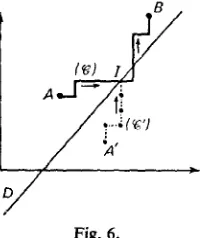
n We first formulate the principle of reJlection, which essentially is due to Andre. Let be given a line D parallel to the line x=y, and two points A, B lying on the same side of D (for instance above, as in Figure 6). The number of minimal paths (the adjective minimal will be omitted in the sequel) joining A with B that intersect or touch D, is equal to the number
8
t
tel
I
.:j:“:
A -:
$.!(G.)
;,
AD / r
Fig. 6.
of paths joining B with the point A’ which lies symmetric to A with respect to D. In fact, when Zstands for the first point that V has in common with D, going from A to B, we can let the path V=(A, Z, B) correspond to the path Q’= (A’, Z, B), which is just the same as % between Z and B,
but with the part A’Z just equal to the image by reflection with respect to
D of the part AZ of V.
Now let C(A, B) be the set of paths joining A (xTA, yA) with B(x,, yD), O<X,,<X~, O<y,<y,. Clearly, the number of paths joining A with B
equals :
VOCABULARY OF COMBINATORIAL ANALYSIS 23
because giving a path is equivalent to choosing a set of (x, -x~) horizontal segments among (x,-f- ye - xA-yA) places (the duration of the walk).
Let us call a suitable path one that satisfies the hypotheses of Theorem B. The number of suitable paths, which is the number of paths joining
W(0, 1) with B(p, q) without intersecting the line x= y, is hence, by the principle of reflection equal to IC( IV, B)I - IC( V, B)I (Figure 7); which means, by [8g], equal to (p+p4-1)_(pp+;l), hence the result, after simplifications.
I
I 1
1
B(P.4)
Ip1/
!..A. . . v fl,O)
Fig. 7.
The probabilistic interpretation supposes that every path EC(O, B) is equally probable, so that the probability we look for is the quotient of the number of suitable paths (which we found already), and the total number of paths joining 0 with B, which is 1C (0, B)J = (“) : we find that
\P/
the probability is (q-p)/(q+p), as announced. Every step represents avote,
the horizontal ones being for B and the vertical ones for d. n For other problems related to the problem of the ballot, see [Carlitz, Riordan,
19641, [*Feller, 1968, I], p, 67-97, [Goodman, Narayana, 19671, [Guil- baud, Rosenstiehl, 19601, [Kreweras, 1965, 1966a], [Narayana, 1965, 19671, [Riordan, 19641, [Sen, 19643, [*Spitzer, 19641, and especially (*Takacs, 1967). The reader should also solve Exercises 20-22 on pp.
81-83.
1.9. SUBSETS OF Z/nZ
[image:17.839.183.285.259.378.2]24 ADVANCED COMBINATORICS
Pal
~=[~]=z/~z={O,i,Z
,..., n-11.
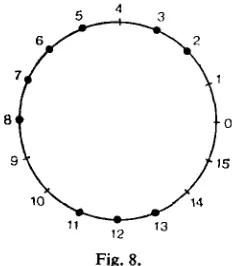
Figure 8 represents the block P={2,3,5,6,7,8, 11, 12, 13)o[lX], with which we can associate the circular word bbaabaaaabbaaabb, where the i-th term equals a or b according to whether IEP or #P, O<i,<n - 1.
[image:18.802.149.269.123.256.2]We show now an example of enumeration in [ii].
Fig. 8.
THEOREM ([Kaplansky, 1943)). Let g,(n,p) be the number of p-blocks PC [ii] with th e o f I1 owing property: between any two points v and w of P
(that means on each of the two open arcs VW of the circle on which we think
[ii] situated) there are at least l( Z 0) points of [ii] that do not belong to P. Then:
n When JY stands for the set of the Pc[ri] that satisfy the condition mentioned in the theorem, [I] : = (0, 1,. . ., I? >, then we let:
d,:={pIp~d,pn[I]=l), i=O,1,2 ,..., l-l. ~*:={PIPEJz$Pn[z]=0}.
&* and the &, evidently partition & into I+ 1 disjoint subsets. Hence: l-l
I%1
91(4 P> = l-011
= W*l + C
I&ii-i=O
Now, choosing PE&~ is equivalent to choosing on the straight interval [i+Z+l,i+Z+2,... ,i+n-I-l]thep-l!-blockP’:=P\(i}withn-221-l
VOCABULARY OF COMBINATORIAL ANALYSIS 25
elements. Hence, by Theorem A (p. 21), we have:
WI
I&J=fr(n-21-l,p-l), O<i<l-1.Similarly, choosing PE&‘* is equivalent to choosing it on the straight interval [r+ 1, I+ 2,. . ., n - l] with II - 1 elements. Hence :
PI
l&*1 = A (n - 1, P).
Finally, [SC, d, e] imply, by [8d] (p. 21) for the equality (*), and with simplifications for (**):
g,(n,p)=lf,(n-21-l,p-l)+f,(n-&p)=
It would be interesting to give a combinatorial significance of gl(n, p)
for 1~0. Also see Exercise 40, p. 173.
1.10. DIVISIONS AND PARTITIONS OF A SET;
MULTINOMIAL IDENTITY
DEFINITION A. Let JZ be a finite (ordered) sequence of subsets, distinct
or not, empty or not, of a set N:
.A:= (A,, A,, . . . . A,), AlCN, iE[m], in 3 1.
We say that .M is a division of N (confusion with partition (Definition C, p. 30) should be avoided), or m-division if we want to specify of how
many subsets it consists, if the union of the Ai, ie[m] is N, and if these A,
are mutually disjoint. We denote:
[lOa] N=A,+A,+***+A, or N=i$IAi, (notation of [*Neveu, 19641, p. 3) as one wishes.
For example, with N={a, b, c,d,e}, AI:=O, A,:={b,d), A3:=0, A,:= = {a, c, e}, the ordered set d:=(A,, AZ, A,, A4) is a 4-division of N. For each division, the nonempty subsets are evidently different and mutu- ally disjoint, and between their cardinalities the following relation exists:
26 ADVANCED COMBINATORICS
Many identities are only the consequence of [lob]: one counts a set in two different ways, which gives a combinatorial proof of the identity which is to be examined.
Examples. (1) Let E be the set of nonempty subsets of A : = { 1, 2,. . .,
m + 11, and let us call E, (c E) the set of subsets of A for which the greatest element isj( > 1). Evidently, E=xim=+: Ej. Now, IEI =2”‘+l- 1 and lEjj =
=2’-’ (the number of subsets of { 1,2, ..,,j- 1)). Then, by using [lob] we obtain* 2m+‘-l=l+2+22+~~~+2m. . More generally, for any in- tegers x, y, ma 1, we could prove by a strictly combinatorial argument the well-known identity:
X m-k-1 - ym+l =(x-y)(x”+xm-1y+xm-2y2+...).
(2) Let Z=X+ Y be a division of the set Z, x: = 1x120, y: =I YI 20. We denote E for the set of all A CZ such that I,41 =n (E= ‘!&(Z)), and Ek
for the set of all BEE such that IBnXl =k. Clearly, E=x;=, Ek. Now,
from lEl=ri’) and lEJ=(i) (nTk)follows the Vandermonde con- volution (see p. 44):
n
(“:Y>=~($(n~k)
k=O
(3) With 2=X+ Y once again, let E be the set of functionsffrom [n] into Z, and iet & consist of
aii
f such that If -i (X)( = k. We haveE=&, Ek, IEl=(x+y)“, IEkl= i xkynTk. Therefore 0
(x + yy = 2 (3 xkY”-k -
k=O
(4) By considering E, the set of functionsffrom {x, y, z} into [n + I] = ={1,2,3 ,..., n + I} such that f(x) <f(z), f(y) < f (z), and the following subsets: (i) E,:={flf(z)=k+l}, (ii) A:={flf(x)=f(y)), (iii) B:=
={fIf(x)~f(y)},(iv)C:={fIf(x)~f(y)},wefindE=~~=l Ek= =A+B+C,i.e., with [lob]: IEl=xkn,~ k2= (n;*)+(n;*)+(n;*)
=&l(n+ 1) (2nf 1). (S ee also p. 155 and Exercise 4, p. i20.). ’ ’
VOCABULARY OF COMBINATORIAL ANALYSIS 27
THEOREM A. Let (al, a,, . .., a,,,) be a sequence of nt integers > 0 such that: a, + a, +*-a+ a, = II) m>l, n>o,
then the number of divisions pi = (A,, A,, . . . , A,,,) of N, 1 N I = n, such that lAil=ni, iE[m],alsocalled(a,,a,,..., a,,,)-divisions, is equal to (note that
O!=l):
[lOc] , :! , and can be denoted by a,.a,.... %I-
or, even better, by:
[*WI (a,, aID*.., a,).
Until recently one said that JZ was a permutation with repetition of aI elements of N, a2 elements of N, etc. Notation [IOc’] which we introduce here and whose virtues we wish to recommend now, is not standard yet, but seems to become more and more in use. Anyway, it has the qualities of a good notation (cf. p. 8) and it is hard to imagine a simpler one. Moreover, it has the advantage over [IOc] of being coherent with the
classical notation of the binomiuI coefhcients. In fact, if we use [lOc] for the case of binomial coefficients, we get the notation (k&k) for (;)’ which is undesirable. On the contrary, it seems good to extend the usual notation for the binomial coefficients in the case of with x a real or complex variable, by the following notation:
[,fJy]
(
k k x k := (k:)rkTZZ
19 21 “‘9 j 1=x(x-1)(x-2)...(x-kk,-k2-*..-kj+l)
-kI!k2! . . . k,! ,
because in this case, for II, +a, + =a. +~,,,=II, we have in our notation:
(
al, a 2,.“,
4 = n n(
> (=
>
= etc.,u2,
n 3, . ..f allI
a,, a39 .*., %28 ADVANCED COMBINATORICS
n As & is ordered, giving .,+% means first giving A,, then AZ, then A,, then Aq, etc. Now the number of possible choices for A, c N, IN I= n,
(A,(=a,, equals
0 i1 , by [Sal (p. 8). Such a choice being made, the number of possible choices for A, c N\A,, 1 N\A, I= n - a,, 1 AZ J = (I~, is
n-a, ( >
a2
, etc. The required number (of the possible 4) hence is equal to : (a:) (n--4)...(n--a~ ---ykl),
which is equal to [lOc] after simplification. n
The notation [IOa] suggests us to write U- V instead of U\V, as in [lb] (p. Z), if Vc U. In other words, for three subsets U, V: W of N:
[lOd] W=U-V-SU=V+W+SW=U\V and VcU.
The folIowing notation also originates from [ lOa] : [lOe] Ai$Az+.‘.fA,cNoAlu...uA,cN and
A, n Aj =o, i,<i<j,<l.
THEOREM B (multinomial identity). Jf x1 x2,. . ., x, are commuting e/e-
ments of a ring (~x~x,=x~x~, 1 <i<j<m), then we have for all integers nao:
[lOf-J ( f XI)” = (Xi + X2 + .*. + X,)” =
\i=i /
= C (a,, a2, . .., a,) xylxy . . . xz”,
the last summation takes place over all m-tuples (a,, a2, . . ., a,,,) of positive
or zero integers ai>0 such that a,+a,+...+a,,,=n. Because of this,
DEFINITION B. The numbers:
(
al, a2, . . . . a,) = (al + a2 +...-t a,)! = n. I a,!a,! . . . a,? a,!a,!...a,!‘ are called multinomial coefficients.For n, m fixed, the number of multinomial coefficients equals the number
VOCABULARY OF COMBINATORIAL ANALYSlS 29
of solutions of a,+...+a,=n, which is
t +:- 73 by Theorems B and D (p. 15). A table of the multinomial coeflicients can be found on p. 309. H We argue as in the proof of Theorem A (p. 12). Let:
[log] (x1 -I- x2 -I-.**-I- X,)n = PIP, ..* P”
= c cll,,02 ,..., a,X(;%-- x29
with P,:=x,+x,+... +x,, the summation taking place over all systems of integers (a,, a2, . . . . a,,,) that occur as exponents of the terms on the right-hand side of [ 1 Og]. Obtaining x”,lxy . . . xf” in the expansion of the product PIP:, . . . is equivalent to giving a division of the set (PI, P,, . . ,, P,} into subsets A,, AZ, . . . . A,,, such that IAil =ai, iElm]. This we do with the understanding that this division corresponds to multiplying the ‘x1’ of the a, factors P,EA~ by the ‘x2’ of the a2 factors PI~A2, etc. (if ai=O, then one just multiplies by 1). Hence, on one hand:
Cl
OhI
a, f a2 -t-e..+ a, = n, aieN, ie[m] ;on the other hand, the number of terms x;lxF . . ., where the ai are fixed such that [ lOh] holds, is equal to (a,, a2, . . . , a,,,), by [ IOc’]. n
Thus, (x,+x~+~~~+x,,,)~=~~~:= x~,+~~~~~~,~,,,x~x~; because the solutions of a,-!-...+-a,,,=2 are of the form: (I) aL=2, al=0 if ifk, in which case [lOc] = 1; (II) al=aj= 1 if i#j, al=0 if I# i, j, in which case
rlOcj=2. In the same manner, (x,~x,~-...)~=~x:+~CX~~~-~
+ 6CXiXjXk, (X~~x~+...)4=Cx,P+4~X~Xj3+6CX~XjZ+12CXiXjX~+
+24 ~xixjx,x,. Moreover, the number of c’s in the expansion of (x1 +x2 + . ..)” is exactly p(n), the number of partitions of n, p. 94. (See also Exercise 28, p. 126, and Exercise 9, p. 158.) Multinomial coefficients enjoy congruence properties, analogous to [6g, g’] p. 14, the proof being very similar:
THEOREM C. For any prime number p and a, + a2 + a3 + *** =p, we have
( a,, u2, a,, . ..) z 0 (mod p), except(p,O,O, . ..)=(O.p,O, . ..)=...=l.
30 ADVANCED COMBINATORICS VOCABULARY OF COMBINATORIAL ANALYSIS 31
DEPIN~ION C. A non-ordered (finite) set B of p blocks of N (=p-system of N, cf. p. 3), 9’~ ‘p’ (N), is called a partition of N, or p-partition if one wants to specryy the number of its blocks, if the union of all blocks of B equals N, and if these blocks are mutually disjoint.
Hence in a partition, as opposed to a division (1) no ‘subset’ is empty; (2)
the ‘subsets’ are not labelled.
Similar to [lOa], we denote for such a partition, in order to express the fact that B, B’&=>BnB’=@:
NeBT/Y VB0, IBI 2 1.
Evidently there is a bijection between the set of equivalence relations of N and the set of partitions of N: we just associate with every equivalence relation d the partition whose blocks are the equivalence classes of b.
TKEOREM D. Let f be a map of M into N, fEN”. The set of the nonempty
pre-images f -l(y), YE-N (p; 5) co.ns?i!utes a partition ctf M, which is called the partition induced by f on M.
This is evident. It follows in particular, for each f E N M that:
tloil WI = & If -’ (v)l .
1.11. BOUND VARIABLES
It is well known that a finite sum of il terms x1, x2, . . . , x,, real numbers, or, more generally, in a ring, is denoted by x1 +x,+.e. -tx, (such a way of writing, of course, does not mean at all that n>3), or eveu better:
[lla] i xke
k==l
We generalize this notation. Let m be an integer > 1, and f a real-valued function (or, more generally, with values in a ring) defined for all points
(=m-tuples) c:=(cl, c2,..., c,,,) of a product set: [lib] E:=E, x E, x-.*x E,.
(Frequently we will have E1 = E, = ... =E,,,=N.) If f is only defined on
61 (cE), it will be extended to the whole of E by 0, in most cases. Let us
consider a finite set I’cE. The expression S, denoted in any of the fol- lowing four ways:
[W (S =Erf (4 = ccsr f(c) = c f(c,, cz, ...9 4 = ;;c:;;:‘.“rl:,:,f (Cl, c2, .*., c,),
equals by definition the finite sum of the values off in each point c of r, which is called the summation set. If I’nE=@, we give S the value 0.
L-1
14
EMPTY SUM CONVENTION: xceB f(c): = 0.Sometimes we qualify S by saying that it is a multiple sum of order m.
ForIn=l,2, 3 ,..., one says usually simple, double or triple sum.
It is clear that the value [ 1 lc] of S is completely determined by r and
f. Thus, S does not depend on c=(cl, cd, . . . . c,), even though it occurs in formula [l lc]. For this reason, the letters c or (cl, c2, . . . . c,) are called
bound variables of the summation (dummy or dead are also used synon- ymously for bound). It is useful to note the analogy with the notation I= Stf (x) dx of the integral, in which x is also a bound (real) variable, while Z only depends on a, b and f.
Usually, the summation set r is defined by a certain number of condi- tions or restrictions, %‘,, V,, . . . . V, on the c,, c2, . . . . c,; these conditions will just be t ---,I-+PA ‘a,ID,QLL" h.r "J O“,,.n6 LI.UL . ..I y-1... " --.-- *-., nn.rinn th-t the nnint P hplnnnc to ?!lp whw+
r,, r,, . . . . TI. We will therefore write any of the following: WI (S=)w,,wE,, v f(~)=C’0,.0~ . . . of (4
2.. , I
= c f (cl = ccc r1nr2n...nl-, f (4. cer,nr*n...nrl
For example, [l 1 f] is equivalent with [l la] :
C1lfl c xk Or &Ck%Xk-
l<k$n
If the expression for the pi is not very simple, it is better to avoid writing it underneath or on the side of the summation sign C, but following it. In that case one uses a phrase like “the summation takes place over all c such that . . .“.
32 ADVANCED COMBINATORICS
in the detailed description of the conditions E4,. It is important to distin- guish these from the bound variables, especially in the case that we wish to use notation [lie]. Therefore we introduce the
Wsl
DOT CONVENTION: every letter with a dot underneath stands for a bound variable.Of course, we do not have to dot every bound variable: in [l If], for example, there is but one possible interpretation. We must try to limit the dots to the cases where there is possible danger of confusion or am- biguity (examples follow). Furthermore, each variable needs only to be pointed once, and not every time it appears in the conditions Vi, V,, . . . . In general, however, we are not at all embarrassed by excesses, as far as this is concerned. The use of dots under the bound variables is imposed upon us by our total and absolute rejection of the notation by repeated c signs (which is still commonly used), for any multiple sum of order m
(Theorem B below).
Before demonstrating the preceding by examples, we still put the cw NONNEGATIVEINTEGER CONVENTION: in thesequelofthisbook
each bound variable will represent an integer 20 unless stated otherwise.
Now we give the following results:
THEOREM A (associativity) . For all partitions 9: = (r, , Tz, . . . , I!,) of r,
r=rl+r2+.e-+r,, we have:
m
yp)=
c ( c f(C)>’
1<!4s ,cEI-,
THEOREM B (analogue of the Fubini theorem for multiple integrals) :
Cl 13 c
(cl, cd E El x Ez f (Cl, 4 = .LxEE, ‘& fh 4 = c2zE2 'clxE, fh 4)
WI
c
f (Cl, c29 c3) =(a, CL c,) E El x Ez x E,
= .,TE, t2TE2 izE, f (cb c2, c3))) = etc.
VOCABULARY OF COMBINATORIAL ANALYSIS 33
(For the number of possible ‘Fubini formulas’ see Exercise 20 on p. 228.)
Examples. (I) To calculate, for nZ0 integer, the double sum: s:= c ClC2.
$1+$2=”
We get, if we reduce it to a simple sum:
S = C cl(n - cl) = n C c1 - C cf OS$,<, O<C,Qfl O<C,<fl
= n--- n(n-t1) n(n+1)(2n+1)=n(n2-I)
2 6 6 ’
(See also Exercise 28 on p. 85 for a generalization.)
(II) To calculate, for a and b complex, a, 6, ab # ! and n an integer > 0, the double sum:
S: = c ahbk.
OSljSk$fl
We can do this as follows, where we use Theorem B for the equality (*):
n+1
s'g c (0" h<T<nbk)= ,<;<." b b--lb"
OSh$fl X.' ..'
b ll+1 =---- c
b - 1 o<e<n
b”+l (a”+1 _ 1) (ab)“+l - 1
= (b - 1) (a - 1) - (b - 1) (ab - 1)’ We could also have started with S=COSkGn(bk co?$!&k a”).
(III) For any$nite set N, INI =n, to calculate the double sum: S:=ATNIA nBI.
c .
(The summation is taken over allpairs of subsets (A, B)e p(N) x p (IV).)
By Theorem B, we get for S:
34 ADVANCED COMBINATORICS
IAnBl = i, where A isfixed, equals IA’
( i > .2”- IA I, which is the number of i-subsets of A times the number of subsets of N-A. Hence, as Cy= ,, i a
=c.z~‘-~ ( hi h w c results from taking the derivative of the polynomial 0 i (1 +x)“=C;(=o (;) x1, and substituting 1 for x), which we use for equal- ity (*), we get for S:
= 2”--’ c IAl = 2n-len2n-1 = n4”-1.
4CN
More symmetrically, we could have said also:
=
(Furthermore, x(A,n--al,1 =n2k(“-1), where 4r, AZ, . . . . AkCN.)
In certain cases, we can immediately lower the order of a summation by applying Theorems A and B:
THKNEM C. !f’f(c,, ~2 ,..., c,,,)=$I (cl, cz ,..., cr,).fz (%+I,..., cm,),
O<h<m, then:
WI
(Cl.
cat
. ..t c
c,)GE,X...XE,,,
f(c19 c29
***,
cm)
=
= (
c
(cl, . . . . c,,) EEI x . . . x Eh
fi h-*, cd) x
XC
(Ch+lr...,~m)EEh+lX...XE,
c
fz(cfl+l~...9
cm)).
Particularly:
CW
c
(CI. . . . . cm) E El X **. X E,,, g&1)
. . . ..g&&
VOCABULARY OF COMBINATORIAL ANALYSIS 35
It will be noticed that this theorem bears some analogy to the theorem on double integrals: if A = [a, b] x [c, d] then jJA f(x) g (y) dxdy =
= <j: f (xl dx) (j: g (Y) dy).
Clearly, everything that has been said in this section about the notation of finite sums, can be repeated, with the necessary changes, for any ex- pression in which addition is replaced by an internal associative and com- mutative composition law in the range off. Thus, we denote:
I-I xk for the product x1 x2.. . x, ; lS$<Pl
u A, for the union A, u A, u...u A, ; 1 <kbll
n IQ, for the intersection Al n A, n-..n A,. lCk<lI
Conventions [l Ig, h] still hold for fl, 0, n, but [l Id] (p. 31) is replaced by [ 1 In, o, p]:
Cllnl
EMPTY PRODUCT CONVENTION : nc E *f(C): = 1.L-1
101
EMPTY UNION CONVENTION : UE E B A (c) : = &, where A (c)c N.CllPl EMPTY INTERSECTION CONVENTION : neao A(c):=N, where
A(c)cN.
E.yample. Compute, for n integer > 1, the double product: P:= rI apbq.
p+q<n . .
We can work this out as follows, using [Sg] on p. 10 for (*): P = JJ ( n aPbq) = JJ ( n apbk-‘)
O<k$n p+f=k O<+<n OSp4k
= ,g<. ..' @
W+ 1)/z. @(A+ W) = o'-jn (&fk: '1
..'
= (ab) &” (“:‘)(+,) (“:2).
More generally, it can be found without difficulty that the I-th order product nai’ap22 ..a a:‘, where pl +p2 + .a* +pl Gn, has the value
36 ADVANCED COMBINATORICS
1.12. FORMAL SERIES (I) General remarks
The concept of formal power series is a generalization of polynomial. We think the best is to sketch here the outlines of the theory, following Bourbaki ([*Bourbalci, Algebre, chap. 4, 5, 19591, p, 52-69; see also [*Dubreil (P. and M.-L.), 19641, p. 124-31, [*Lang, 19651, p. 146, [*Zariski, Samuel, II, 19601, p. 129); we will refer to this author for proofs and more details.
In this section, each small Greek letter represents ajrlite sequence of k integers 20, where k is an integer 2 1, which is given once and for all. Such a sequence is sometimes also called a multi-index. Thus, if we write k:=Ntk1,inwhich[k]:={l,2 ,..., k},thenaokmeansthata=(a,,a, ,..,, ak), where aioN.
We may denote:
[l2a] a! := a,! a,!... cr,!, I4 :=a1 +cl,+..-+cr,,
[12a’] c, : = c LI,,(12, . ..+ L, t’ : = tilt? . . . tz.
We will consider the case of formal series in k variables over a field C (often C=R or C).
DEFINITION A. A formal power series $ in k indeterminates (or variables) t,, t2, . . ., . .., tk over C is a formal expression of the following type:
@W f = f(t) = f (11,
t29 . . ‘9 fk) = C,,e,i a$= p,,II*;Pk,O Qwz . . . s*w!? *. * t? 3
where ap = a,,,, p2 ,.... IIk, the coefficients off, form a multiple series of order k with values in C. Each expression a/ =aP, ,1(2 ,... , Iry t f’ . . . tl” is called a monomial off. As the pl, pz,. . . , pk are bound variables, they can have a dot underneath. We denote C[[ti, t2, . . . . tk]], or even better Ck[[t]], which is called the set of formal series f.
f is a polynomial if all coefficients except a finite number of them equal zero, which is usually formulated by saying “almost all ar are zero”. In
VOCABULARY OF COMBINATORlAL ANALYSIS 3