Grid-enabled electromagnetic
optimisation (GEM) for industrial use
Marc Molinari, Simon J Cox, Andy J Keane Southampton e-Science Centre School of Engineering Sciences University of Southampton, SO17 1BJ
{m.molinari, sjc, ajk}@soton.ac.uk
Abstract. We have developed a tool for parametric electro-magnetic design studies using industrial analysis code for the design search and optimisation of photonic crystals. This soft-ware tool allows engineering users to transparently access Grid compute components for an end-to-end design of a photonic device using computational electromagnetics. In this paper, we give an overview of the industrial application background, pre-sent some aspects of the interface developed, and discuss some of the issues involved in the computational tasks and the stor-age of metadata.
1 Introduction
Industrial engineering applications fre-quently require resources which are often not available to or accessible from small or medium sized enterprises (SME). This can be due to the high acquisition and/or main-tenance cost of large computer systems or that of specialised software applications or due to the sporadic nature of the load placed on such a resource which does not justify its outright acquisition.
Grid technology [1] addresses these needs by enabling large-scale resource sharing over the web and thus offers SMEs the pos-sibility of cost-effectively using software services and compute resources on an as-needed or on-demand basis.
We concentrate on the field of Computa-tional Electromagnetics (CEM) within the area of Engineering Design Search and Op-timisation, in which companies endeavour to find product designs which optimally fulfil certain objectives and respect con-straints placed on them.
Grid-enabled Electromagnetic Optimisation (GEM, [2]) is a DTI-funded project in
laboration with Mesophotonics Ltd [3], a start-up company working on the design, fabrication and characterisation of next-generation planar photonic devices. We will demonstrate the use of Grid resources for parametric studies of photonic crystals de-sign.
collaboration with Mesophotonics Ltd [3], a
This paper is organised as follows. Section 2 gives a brief overview of the application background, in section 3 we detail some of the technology used. Section 4 discusses the user interface and issues we encoun-tered are discussed in section 5 before we present further work in section 6.
2 Application
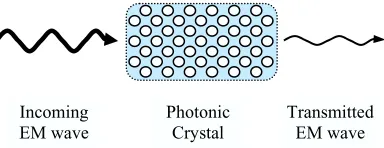
Figure 1 The geometrical design of a photonic crystal determines its light transmission proper-ties.
A typical example of a PC is shown in fig-ure 1. The base material is a silicon sub-strate with periodic changes in the dielectric constant, which can be obtained by, for ex-ample, etching a silicon wafer using a pre-defined geometrical pattern. The geometry used determines the transmission and re-flection properties of the crystal for electro-magnetic waves with wave lengths corre-sponding to that of visible and infrared light. These PCs can be used as components for filters, splitters or other optical devices. Suppose an engineer wants to optimise the electromagnetic transmission properties of such a PC. There exist designs which ex-hibit a reduction of light propagation within a specific frequency range, called a photonic bandgap (PBG) of the crystal. For certain applications, it is desirable to obtain a large bandgap in the frequency spectrum. The size of the bandgap for a number of design geometries can be investigated by sampling the parameters r and d across a range of values. Every design point gives rise to a different frequency spectrumf(r,d) for the transmission of light; and after post-processing this spectrum, we obtain differ-ing band gap values b(r,d) for the corres-ponding geometries.
This approach can be seen as initial design search, from which further local design op-timisation can be carried out at a later stage. The number of designs and the number of parameters varied for each design can be large and thus gives rise to many solutions and large amounts of data. All of these so-lutions – if good or poor – yield valuable information for later design optimisation and need to be preserved in a design data
The analysis of the frequency spectrum for a given geometry is
base. They may also be re-used in the
de-the computationally
rameters, we employ the LP-tau
De-bled desktop computers
he company has ftware and would
(b)
alysis package to
(c)
ise this using an
(d)
nd what re-most expensive part as it involves a full finite difference time domain (FDTD) based analysis with a subsequent Fourier transformation of the obtained time spec-trum.
To sample the large space of possible de-sign pa
sign of Experiment (DoE) method, which can at present be accessed through a web interface and will be available as a grid ser-vice in due course.
The computation currently takes place on a pool of Condor-ena
or – if a Linux executable can be used – on Globus-enabled resources.
2.1 Application Scenarios
(a) A software engineer at t developed analysis so
like to use a Design of Experiment ser-vice to obtain optimal distribution of design points. The computation using his executable should be carried out ef-ficiently on a cluster of machines within or outside the company and the resulting data and metadata shall be stored in a database.
The engineer would like to use a com-mercial solver and an
compare results, which is available on the web exposed via a Grid service. The design point data is already stored in the database.
The engineer selects a specific design and would like to optim
Optimisation Service on the Grid. The computation will take place both lo-cally for the objective function and through a compute service for obtaining updates of the design point.
A new engineer wants advice about how to run a design search a
sources to use. The knowledge-based advice service will help and guide set-ting up the components based on the knowledge extracted from previous senior engineers’ tasks.
Incoming
3 Middleware
For initial parametric studies of the designs, ed Matlab [4] as a problem
ice interconnects, we have
Computational Grids make it possible to of distributed
engineer-tly inte-grate access to Grid resources. The Geodise
eodise high level routines, which
nd hence operating system inde-we have employ
solving environment and used the Grid in-terface functionality developed by the Geo-dise project [5].
As the XML based SOAP is the protocol used for web serv
developed and integrated the XML Toolbox for Matlab [6] to be able to convert the pro-prietary Matlab structures into XML and vice versa.
4 User Interface
access a wide range
ing applications and services. However, the consumption of these services remains dif-ficult due to the lack of high-level tools to support engineers. One way of integrating Grid computing into engineering applica-tions is by providing interface funcapplica-tions
project provides such interfaces for the Matlab problem solving environment for access to compute as well as database re-sources.
We have developed a user interface on top of the G
[image:3.595.98.499.90.393.2]which seamlessly and transparen Figure 2. Graphical user interface/portal for (a) project definition, (b) process flow editing with Grid component insertion, (c) design parameter definition and (d) visualisation capabilities.
provides a straightforward to access and integrate Grid services for parametric CEM studies.
Figure 2 shows examples of this Matlab based (a
run-time. The parameter definition screen lets the user choose the range of design vari-ables and select parameters for a DoE (if not requested from the DoE Grid service).
Figure 3. Matlab script for interaction with da-ta
The local directory tree with all data neces-sary for a submission for the analy
bases on the Grid.
sis is
and execution as well as
script which can be used to create
In an industrial environment, resources can offers the
possibil-is results
come the
then created in the background and the en-gineer can start the computation on the compute screen, where resources can be further specified.
The monitoring pane allows the inspection of the job queue
the results while the job is running re-motely. After jobs have finished, the engi-neer will be able to query job details and results from a Xindice database, where metadata about the runs and designs has been stored. A visual examination of the results will be possible via the visualisation pane.
Figure 3 shows cut-outs from a created Matlab
Archive D
ess to Grid resources
sign';
.param.d] = designpoint(i);
];
le, outfile );
);
y results:
ns with bandgap bigger than 99 odel = pbg_design & …
sult
des
tandard.fileID}, … me/Eng007/pbg_files/' )
les/*')
PBG designs, store the related metadata in a database on the Grid and query this data later to retrieve designs with specific prop-erties.
5 Issues encountered
be very scarce. The Grid
ity of incorporating unavailable resources in the business workflow. Not only the (hori-zontal) computational workflow which we have been looking at in this paper is impor-tant, also the overall inclusion of Grid tech-nology in the vertical business workflow which ranges from an initial design idea via computational electromagnetics to sharing of manufacturing data to the product which then needs to be verified experimentally. The results of the experiment as well as the performance of the product in the final application are all aspects which are important to the industrial partner and can be associated with future Grid technology. Of high importance for commercial entities is the security of code and analys
when being executed or transferred across the internet and such issues are addressed by, for example, WS security [7].
Amongst some of the interoperability issues we have faced, one was to over
proprietary data formats of existing soft-ware packages. During the course of this project, we developed for example the XML Toolbox for Matlab to be able to convert proprietary data type formats into an open standard XML format. This was necessary to enable us to create and use generic parameter description for a
seam-esign Data:
% create proxy for acc gd_createproxy;
metadata common to all designs % define design
m.m del = 'pbg_deo
% do computation for 1000 design points for i=1:1000
% create design point (r,d) [m.param.r, m
infile = ['geometry_', num2str(N), '.cad']; outfile = ['spectrum_', num2str(N), '.dat'
% call routine that creates geometry file create_pbg_geometry_file( infile, m.param );
% archive geometry definition and metadata gd_archive( infile, m );
spectrum for design % Grid-compute frequency
compute_pbg( m.param, infi
% post-process result and obtain bandgap m.result.bandgap = postprocess_pbg(outfile
% archive spectrum results and metadata gd_archive( outfile, m );
end
Quer
% find all desig M = gd_query( 'm
result.bandgap > 99.7' ) M: 4x1 struct array with fields
standard, access, model, param, re
Now, is a vector of structures containing the mM etadata of all PBG ns with bandwidth larger than 99. In this case, four designs ig
tch
ma the query. The associated files can be retrieved and viewed:
Retrieve results:
gd_retrieve( {M.s '/ho
nents and to subsequently be able to store XML (meta-)data in a native XML data-base.
In addition offer almost all currently acces-sible Globus-enabled resources on the UK Grid Linux-based operating systems
b Ser-form para-al
webpages
rk will also include the set-up of
isa-Acknowledgements
by the DTI. The
Kesselman, J Nick and S Tuecke. The physiology of the Grid: An Open Grid chitecture for Distributed Systems Integration, Open Grid Service
Infrastruc-[2]
k
, Southampton e-Science Centre,
y/ws-secure whereas most of the software used in SMEs
is Microsoft Windows based, i.e. there are issues with usage of these resources.
6 Conclusion & Future Work
We have used locally available We vices and a Condor pool to per metric studies for computation magnetics problems in an SME.
We are currently concerned with the inte-gration of web service access and function-ality within a Web portal, i.e.
through which engineers can access/use the services.
Future wo
7 References
a repository of electromagnetic analysis codes and the deployment of a metadata-based design exploration system using cur-rent web standards such as WebDAV. We will further expose solver and optim tion software via GridService specification compliant interfaces (OGSI.NET) and test these for application in a commercial envi-ronment.
This project is funded
thors are grateful for many helpful discus-sions with researchers and engineers from Mesophotonics Ltd and the Geodise team.
[1] I Foster, C Services Ar
ture WG, Global Grid Forum, June 22, 2002 The GEM project, http://www.soton.ac.uk/~gridem [3] Mesophotonics Ltd, http://www.mesophotonics.co.u [4] Matlab 6.5, http://www.themathworks.com
[5] The Geodise project, http://www.geodise.org further details, see Geodise articles in this issue.