BMCProtector: A Blockchain and Smart Contract
Based Application for Music Copyright Protection
Sijia Zhao
School of Computer Science and Statistics Trinity College Dublin
College Green, Dublin, Ireland Email: [email protected]
Donal O’Mahony
School of Computer Science and Statistics Trinity College Dublin
College Green, Dublin, Ireland Email: [email protected]
Abstract—In this paper, we explore the design and construct a prototype implementation of an Ethereum application, BM-CProtector, which is based on Blockchain and Smart Contract technology, to protect music copyright and ensure rights holders income rights. With the blockchain, musicians can easily autho-rize and manage their music copyright on a public ledger. Without intermediaries being involved during the propagation process, rights holders can receive a greater share of royalty payments from the music industry automatically and instantly. We also deal with piracy issues using encryption and watermarking methods. BMCProtector provides a solution to protect music copyright more effectively.
Keywords—Blockchain, Smart Contract, Copyright.
I. INTRODUCTION
The development of technology has had a great effect on the creation and dissemination of digital media and created a new music format: digital music. Digital music improves the efficiency of music dissemination and reduces costs in the industry. With the Internet, everyone in the world can enjoy music from a digital music platform which makes large scale propagation possible. The emergence and development of digi-tal music not only increases consumption, but also creates new problems about how to protect copyright and artists incomes in the Internet era. The first problem is copyright. A few listeners can purchase music and download or copy it from the Internet and spread it to others for free infringing the artists’ copyright. Another problem is correctly calculating artists income. Some musical works in services like Google Music are free or almost free to listen and download while other works need to be purchased. There are also intermediaries, like propagators and agents, which will extract royalties along the route. This means that artists put a lot of effort into writing music, but earn little from their works. The digital music supply chain is shown in Figure 1.
[image:1.612.321.564.220.357.2]Musicians, composers, and researchers have been search-ing for ways to protect copyright for several years. Digital Watermarking is a significant way to protect copyright and track the spreading path to detect forgery or imitation. Hartung and Kutter [2] reviewed requirements and applications for watermarking, and discussed robustness and security aspects in detail. Anderson and Petitcolas [3] presented a unified terminology for steganography and outlined several approaches to hide encrypted copyright marks, and outlined potential attacks on steganography schemes. Ponnisathya [4] proposed an approach which combines the Discrete Wavelet Transform
Fig. 1. Digital Music Supply Chain [1]
and Singular-value decomposition transforms to embed and extract watermarks in video data aiming to prevent different kinds of attacks.
Music copyright itself can be tracked and protected by digital watermarking and steganography to some extent. How-ever, there has been no efficient method to protect artists income rights until blockchain technology and smart contracts appeared. Since digital music sharing platforms have been established, the music industry has been in turmoil. Income transmission has a lack of transparency which causes different parties during the process to charge money step by step, and only a small part of income is eventually received by artists. Blockchain technology provides a method to balance conflicts of interest. The blockchain is a public ledger and everyone has the chance to confirm transactions and read data in the chain. The payment can be transferred by cryptocurrencies, including digital coins, like Bitcoin [5], Bitcoin Cash, Ripple, Litecoin, and other kinds of token, like Ether and ERC20 [6] format tokens, which can be used in smart contracts [7]. With smart contracts, payment and distribution can be operated automatically without control from a central authority. The stakeholders details will also be included into the smart contract which can be viewed by all. Therefore, payments can be easily tracked which avoids unauthorized collection of fees by intermediaries due to opaque information.
blockchain technology and smart contracts can be applied in music copyright protection. Section 4 discusses applications that use blockchain technology to protect music copyrights. Section 5 proposes our music copyright protection scheme. Section 6 describes the implementation of our project. We evaluate the project in Section 7. Finally, section 8 concludes the paper.
II. MUSICCOPYRIGHT
Music copyright is the right for musicians to control what they have created. It includes the right to perform, transmit, reproduce, claim authorship and protect the integrity of works. Copyright allows creators and their business partners to use these controls to make a profit.There are two kinds of copyright you would face when you listen to a song on the Internet or a radio.
A. Musical Composition
The composition consists of music and lyrics. Participants in the musical composition are songwriters, composers, pub-lishers and right administrators.
B. Sound Recording
A sound recording involves musical instruments, singing and spoken voice by humans or animals. The authors of this part are the performers and the record producers. The interests of copyright owners are easily infringed by interme-diaries, illegal propagation. The effect of intermediaries has been described above. For illegal propagation, once consumers download a song, they can use it offline. Some dishonest users may upload the song as if it was their work and it may then be propagated online. Others can download this music without payment. With illegal propagation, copyright owners cannot recover their royalties. All licensing bodies use some kind of central copyright databases. Different countries, even different companies will maintain different databases [8], which makes the assessment of infringement more difficult.
III. WHY THEBLOCKCHAIN ANDSMARTCONTRACTS CAN BE APPLIED INMUSICCOPYRIGHTPROTECTION
Blockchains allow for the maintenance of a distributed database, with unchangeable and transparent data. With blockchain technology, the industry can build a global database for copyright of music and help to directly increase the income of musicians and copyright owners, and improve transparency by displaying transactions in the public chain.
A. A global database for music copyright
There are many online music platforms, such as Google Play Music, iTunes, and YouTube. All the information about the music, including the sound recording, underlying lyrics and the copyright owner data, is stored in the database of each company. The information about music in different databases may have some differences. It is difficult to reconcile these differences. The blockchain is a public distributed ledger. When a node connects to the blockchain network, all the information is updated and synchronized automatically, and every member has the same information. Blockchain technol-ogy finally allows for the creation of a single global database for music copyright come true.
B. Payment without third parties
There are many intermediaries involved in music dissemi-nation that deduct fees, like copyright agents. After the many deductions, only a small amount of money remains for the copyright owners. In addition, many platforms pay royalties by bank transfer. The process is always slow and may take several days to come to the intermediate company and months or years to get to the actual rights owners. As a stable P2P network platform, the blockchain can build a direct bridge between musicians and consumers. It can ensure that musicians receive their royalty payments on time, and avoid unnecessary deductions from intermediaries. With smart contracts, the royalty payment method is wired into the contract. Once the music is downloaded, the revenue is distributed automatically to different parties without the need for intermediaries. That will reduce the deduction of third parties and improve the efficiency of transmission of royalty payments.
IV. THEMUSICAPPLICATIONS BASED ONBLOCKCHAIN
TECHNOLOGY
Several start-up companies are beginning to explore the protection of music copyright with blockchain and smart contract technology.
A. Ujo
Ujo [9] is a music company which aims to build an Ethereum based music supply chain and was founded in 2015. It allows musicians to register their music on the Ethereum blockchain and their fans can use these musical works through streaming and downloads. Ujo music uses schema.org, an online community, to create, maintain and improve structured data schemas. Ujo builds a data set, including the musical work name, title, International Standard Musical Work Code (ISWC) [10], release date and explicit content, and then translates the data to fit with the COALA IP specification [11], a licensing framework for digital assests, to allow others to access licensing information more easily. In Ujo, audio files and images are stored on a distributed file storage system, called the InterPlanetary File System (IPFS) [12]. Fans can separately buy components of a song, such as drums, vocals, bass, strings or synth. Ujo music provides a platform to access music for fans and receive royalties for artists. However, there is not too much consideration on the copyright protection after fans purchase a song.
B. Dot Blockchain Music
Fig. 2. Publishment process in DotBlockchain
[image:3.612.50.293.218.266.2]In phase 2 [14] which began in October 2017, Dot-Blockchain Music clarified more details of their implementa-tion. The details are described in Figure 3. In December,2012, there were more than 65 million songs that DotBlockchain had permission to use.
Fig. 3. Architecture of DotBlockchain
The copyright data includes details of performer, aggre-gator, label, Demand-Side Platform (DSP), Performing Rights Organization (PRO), publisher and composer. DSPs are plat-forms like Apple music and Spotify which provide an interface to manage data exchange. PROs act as copyright collectives or agencies which provide intermediary functions between copyright purchaser and copyright owners. These data are combined together into a .bc file and registered to Hyper-Ledger Sawtooth. HyperHyper-Ledger Sawtooth is an open-source framework for building and running blockchains. There are five partner companies which, together with DotBlockchain, protect music ownership. They are a) SOCAN, a Canadian-based performance rights organization, b) MeidaNet, SOCANs rights administration subsidiary, c) Songtrust, publishing roy-alty administrator, d) CdBaby, an indie music distributor, and e) FUGA, a digital rights service. [15] DotBlockchain uses .bc files to collect and protect the copyright information. However, it can only be decoded by their specific music player which has limitation for the widely use.
C. PeerTracks MUSE
PeerTracks is a U.S. company that produces a streaming platform based on the MUSE Blockchain [16]. The Alpha version of PeerTracks was launched in 2015. It uses Delegated Proof of Stake (DPoS) [17] to achieve distributed consensus on its private blockchain. Any artist can create his own token on PeerTracks and have its ownership recorded on the MUSE Blockchain. A buyer could read the licensing conditions of a song and purchase the rights to use it directly on the blockchain. A token provides an incentive mechanism in the PeerTracks platform. PeerTracks uses the MUSE blockchain to allow every artist on their platform to create their own tokens. Tokens are limited in number and their value is volatile. If the artist is very popular on the platform, his token will be worth more. The artist can directly give their tokens to fans. If fans hold the token, they can get discounts on the musical work or related merchandise, including concert tickets and backstage passes. It is a good way to motivate fans to interact with the platform to support their artists. It is also
an approach for undiscovered artists to gain public attention. However, like Ujo, PeerTracks also put less attention on the copyright protection itself in the current stage.
D. Bittunes
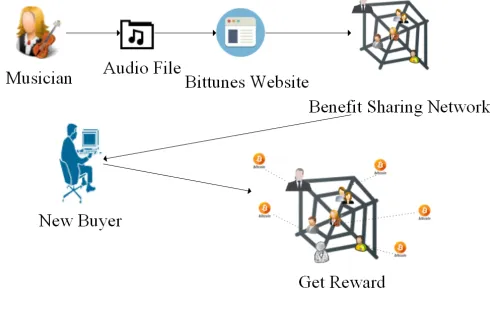
Bittunes [18] operates on the Bitcoin Blockchain forming a distributed music network which is organized by Bittunes Pty. Ltd, an Australian start-up company. It uses bitcoin as the digital currency. It is a platform that provides benefits not only for artists, but also for fans. Musicians can automatically receive their royalties in bitcoin, and fans can share a percent-age of the remainder. For example, in a smart contract, 80 percent of the royalties could be directed to copyright holders, and the remaining 20 percent will be randomly given to five consumers. The more times a song is purchased, the more money will return to participants, including musicians and fans. In order to implement Micro Payments, Bittunes will use sidechain technology [19] which enables bitcoins and other tokens to be transferred between different blockchains. Each song has an ID in the blockchain and this ID will be embedded to the audio file. However, this mechanism can only identify the copyright owner. If the song is distributed illegally by an purchaser after download it, the audio file cannot be tracked. Figure 4 shows the architecture of Bittunes.
Fig. 4. Architecture of Bittunes
E. Other platforms
Besides the applications and technologies we introduced above, there are some other organizations or companies moting blockchain-based music applications or copyright pro-tection schemes. Berkeley College of Music together with the M.I.T Media Lab and other partners, including YouTube, Spotify, and Intel, established the ’Open Music Initiative’ [20] in order to build a blockchain-based architecture to track and manage payment for the music industry. SingularDTV [21] is another music platform, established by a United States company, which based on the Ethereum blockchain. It shares the same idea with PeerTracks, that artists can create their own token and use it to raise funds. Also, it has the same problems as PeerTracks, lack of offline copyright protection after purchased by fans.
[image:3.612.321.566.343.504.2]income stream, but also considers protection and tracks the copyright itself after a song has been purchased. In addition, we have a versioning system to help copyright owners update smart contracts when something went wrong.
V. PROPOSEDMUSICCOPYRIGHTPROTECTIONSCHEME
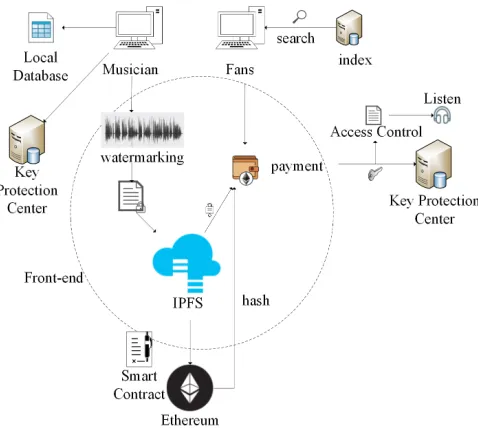
[image:4.612.50.300.272.415.2]The aim of this paper is to design an Ethereum-based application which provides an automated, globally ownerless, distributed platform for musicians to protect copyright of their musical works. It must ensure that musicians can authorize and manage copyright independently. Without third parties, such as banks and music companies involved in the payment process, rights holders can receive almost all their royalties. In addition, unlike platforms we introduced above, our scheme has mechanisms to protect the music copyright after a song is purchased by fans and the spreading path can also be tracked by our platform. Figure 6 shows the implementation architecture.
Fig. 5. BMCProtector Framework
For the Network Layer, users are linked through the blockchain network. Each user accesses the system through a node in the blockchain. A user can use services only when he has synchronized information of the whole chain. This confirms that the same ledger is shared among all users.
For the Storage Layer, due to the limitation of the block size, about 20k bytes for each Ethereum block in March 19th 2018 [22], it is impossible to store the audio files in the blockchain. In addition, each node needs to synchronize the whole data on the blockchain. If we store too many large files on the blockchain, it is a waste of network resources. IPFS is used as an external storage platform. It is a Peer-to-Peer storage platform which uses a content delivery protocol to retrieve and share objects. Each file has its own fingerprint hash when uploaded to the IPFS platform as an identifier. People who have this value can retrieve files from the platform. Smart contracts in the blockchain are used to store the basic information, like the music title, copyright owner, and IPFS hash which confirms this data is unchangeable and traceable.
The Service Layer contains functions that users need to operate. We use a watermark to add the copyright owner information to the audio file and allows tracking the ownership off-line. IPFS use content address to find the file itself. The IPFS address will be contained in the smart contract in our system. If the content address leak, it means everyone can
access the file. In order to withdraw this limitation, we encrypt audio files to protect the security of them. Key management is used to manage the decryption key. Digital signatures avoid the man-in-the-middle attack during the key exchange process. Access control limits the access permission when the expiry date of the audio file is coming. In this layer, there is nothing to stop pirates from uploading other versions of the musical work. However, it can be used to recognize illegal or unauthorized work.
For the View Layer, users can interact with our application. Musicians can upload their musical works using this applica-tion. Fans can search, purchase, download and listen to audio files from our application. Information that musicians input on the application will be added to the smart contract by the web3.js service, a Javascript API which makes the interaction between Web application and Ethereum nodes possible. After the audio file is downloaded by fans, fans can play it locally without interacting with the blockchain.
VI. IMPLEMENTATION
[image:4.612.325.564.335.549.2]In this section, we will describe the main features of the implementation. The details are shown in Figure 7.
Fig. 6. BMCProtector System Implementation
TABLE I. NOTIFICATIONDESCRIPTION
Symbol Meaning
g Large Prime Number
x Random number, a private value chose by the musician
y Random number, a private value chose by the key protection center
CertM Certificate of the musician
CertKP C Certificate of the key protection center
k shared key for both the musician and the key protection center
SigM Signed by the musician using his private key
SigKP C Signed by the key protection center using its private key
Ek Encrypted by shared key, k
A. Tracking Copyright
Digital watermarking is a kind of technology that embeds digital information into digital media to track and reveal the copyright owner and purchaser. In this paper, a vector quan-tization method [23] is used to embed multiple watermarks. The copyright holder who first publishes the musical work can embed an original watermark. The fans watermark will be embedded into the song automatically when the song is purchased by a fan and this will help to track the propagation path. Once illegal propagation of this audio file happens, the copyright owner can discover the original purchaser.
B. Audio File Encryption
When a node connects to the IPFS system, they can access any file if they have the hash address. To prevent illegal download, before uploading the song to IPFS platform, that song should be encrypted to secure it. However, if we write the key to the smart contract, it is possible to be viewed by anyone. Therefore, we introduce a third party, the Key Protection Center, to help agree the key with musicians and decrypt the file without disclosing the key to customers. The key agreement uses the Station-to-Station protocol which based on classic DiffieHellman and can protect against man-in-the-middle attack. This key will be input to the AES algorithm to encrypt the audio file.
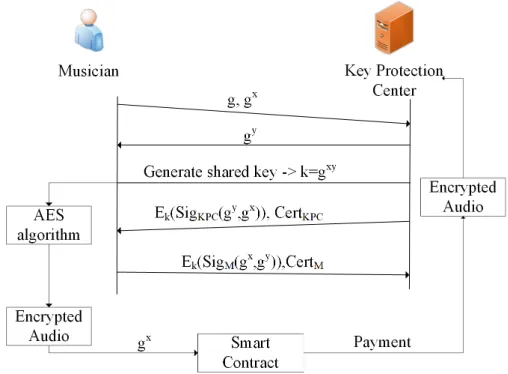
Figure 7 shows the purchase process including the encryp-tion step. Details are described step by step in the following. Table 1 specifying the meaning of each variable.
(1) The musician chooses g and random x, then caculates gx. gx together with g will be sent to the Key Protection Center. (2) Once the Key Protection Center gets gx and g, it will generate gy and send it to the musician. During this process, both the musician and the key protection center can get the share key,k= (gx)y.
(3) The Key Protection Center signs (gy, gx) with its private key, and encrypts the signature with the key,k. The Certificate of the Key Protection Center, CertKP C, and the encrypted signature will be sent to the musician. The public key which used to verify the signature is acquired through CertKP C through PKI [24].
(4) The musician will then sign (gx, gy) by his private key and encrypt it with the same shared key. The Certificate of M and encrypted signature will be sent to the Key Protection Center. The Key Protection Center will verify the signature by the public key of the musician.
[image:5.612.49.302.68.181.2](5) The musician can use the shared key, k, with the AES algorithm to encrypt the audio. gx is then written into the
Fig. 7. Music Upload Encryption Method
music smart contract.
When a fan wants to purchase music, he can get the public value of the musician, gx, and connect to the Key Protection Center to generate the full key. The audio file will then be decrypted by the key.
C. Upload Audio File to IPFS
Our system uses the IPFS platform as our external dis-tributed storage. We use JavaScript code to connect to IPFS, upload a file and return a hash code which is used to retrieve the specific file later. Once we have the hash value from IPFS, this hash will be integrated with other copyright parameters and stored in the smart contract.
D. Music Smart Contract
In this system, we use Solidity, a programming language specifically designed for blockchain platforms, to write smart contracts for musical works. This smart contract defines oper-ations for copyright parameters and functions that are used to distribute payment. When a musician publishes a song, the system will call that smart contract on their behalf, input parameters to the contract and register the contract in the blockchain. The copyright parameters include,
• Title
• Album
• Publishing year
• Artist, Songwriter, Composition owner, Record owner
• The International Standard Recording Code and Inter-national Standard Musical Work Code
• Owners wallet address, Artist wallet address, Song-writer wallet address, Composition owner wallet ad-dress, Sound record owner wallet address
• IPFSHash
• Public value of the musician,gx
• Total price and the royalty to be paid to all parties
E. Royalties Distribution
[image:6.612.332.552.54.231.2]In BMProtector, we use a RoyaltyDistribution Contract to distribute the royalties to different copyright owners. When the music publisher publishes the musical work to our platform, he needs to provide the copyright parameters which we mentioned above. When a fan finishes the purchase process, the Royalty-Distribution Contract will be called which automatically sends royalties to the wallet address of the artist, the songwriter, the composition owner and the sound record owner. Figure 8 shows the process of royalties distribution.
Fig. 8. Process of Royalties distribution
F. Music File Access Control
If copyright owners do not want to give permanent access right to the fans, they can use the access control mechanism to specify the royalty price for a period of time. An access control mechanism is used for the audio file after it is purchased by fans to protect music copyright outside the blockchain. At payment time, a fan chooses how long he wants to use this song and this data will be detected by the music player. After the expiry date, the music will be no longer available.
G. Versioning System
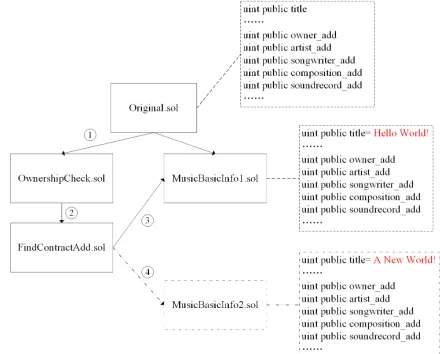
We use a Versioning System to update the data in smart contracts. The main idea of the Versioning System is to forward a function call to a new contract which is an update. Figure 10 shows the process of the Versioning System. The Original contract holds the state of the contract, including copyright parameters. The MusicBasicInfo1 contract is the first contract which defined by the copyright publisher with exact value. OwnershipCheck contract is used to ensure that only the publisher can set a new value for the parameter. After verified, FindContractAdd contract helps to modify the states of the Original contract it inherited.
As the example we show in Figure 10, the FindContrac-tAdd contract first points to the MusicBasicInfo contract. If the publisher needs to modify the MusicBasicInfo1 contract, he can generate a new contract, MusicBasicInfo2. Then he can set the FindContractAdd contract to point to this new contract address.
In BMCProtector, the IPFS service is used to store the music file which aims to reduce the storage pressure on the blockchain. Unlike traditional cloud storage, files can be published safely using hashes. Before being published into the IPFS platform, the musical work needs to be encrypted. We use the Station-to-Station protocol for participants to achieve key agreement and utilize the AES algorithm to encrypt the audio file. Only users who paid for it can get the key to
Fig. 9. Process of the Versioning System
decrypt it. With watermarking, the platform can track music and detect when it is used by unauthorized users. We employ an access control mechanism in BMCProtector, which can define the expiry date of the music at the point of payment. The BMCProtector considers both online and offline copyright protection during implementation. In addition, our platform allows publishers to modify data in the smart contract if some wrong happens.
VII. EVALUATION
The system was implemented on a Ubuntu 16.04 desk-top with an IntelCorei5. We use the Go implementation of Ethereum to deploy a testchain, geth v1.8.2 which uses Proof-of-Work as the consensus protocol. The smart contract is implemented in solidity [25].
Our BMCProtector uses the blockchain and smart contract technology to solve these challenges. All the copyright infor-mation can be tracked in the blockchain and people around the world can share the same copyright ledger in the public blockchain. Stakeholders can agree on the rules in the smart contract, like the percentage of royalties due to each partici-pant. When the smart contract is committed to the blockchain, these rules operate automatically and no one can reduce the royalties to others. Once fans purchase a song on our platform, stakeholders defined in the smart contract immediately receive their royalties after the transaction is confirmed by the public blockchain.
[image:6.612.51.305.180.276.2]When fans listen the music in a player, the expiry date can be detected and fans cannot access the file after the expiry date. These mechanisms can help protect copyright off the blockchain. However, our platform cannot protect spreading of the music in other formats, like an audio file which recorded and uploaded by illegal person.
In our platform, we introduce a Versioning System to upgrade smart contracts which contains the copyright infor-mation. Unlike the traditional blockchain that data cannot be changed when contracts are deployed, music publishers can generate a new contract and let the original contract to point to the new contract. This mechanism helps the copyright owner modify their copyright policy.
During the simple evaluation, we were able to achieve a transaction rate equivalent to 123k per day, and it is possible to reach 44 million transactions per year. For comparison, the number of paid subscribers to Apple Music worldwide in the year 2018 is 40 million [26]. The number of paid Spotify subscribers worldwide is nearly 75 million [27]. Using future scalability solution, like Raiden network [28] or the Plasma [29], applied in the Ethereum network, the number of transactions supported on the blockchain can be increased significantly.
In our BMCProtector, we integrate the existing technolo-gies and adapt them to become more suitable for the music copyright protection based on the blockchain and smart con-tracts.
VIII. CONCLUSIONS ANDFUTUREWORK
Music copyright is the right of artists to reproduce, perform and distribute a musical work. Many countries around the world have published related laws and rules to help protect this kind of right. However, there are still some issues of concern in the digital music industry, including rights and licensing management, levying fees from intermediaries, and piracy problems.
In this paper, we design and implement a Blockchain and Smart Contracts based scheme, BMCProtector, to protect music copyright and rights of copyright owners. We create a bridge between artists and fans in our application. Unlike other applications which only focus on the payment function of the music industry, we not only focus on automatic royalty distribution by the blockchain and smart contracts, but also deal with the piracy issues of musical works themselves.
However, there are still some business and political prob-lems that may block users from taking part. For example, some companies do not want to lose control of the process. Not every artists wants to disclose their income to the public. Intermediaries are afraid that this technique will diminish their income. Therefore, to practice blockchain-based music copy-right protection, we not only need to improve the technology, but also need attend to the business effects.
REFERENCES
[1] P. Galuszka. Music aggregators and intermediation of the digital music market.International Journal of Communication, pages 254–273, 2015. [2] F. Hartung and M. Kutter. Multimedia watermarking techniques.
Proceedings of the IEEE, 87(7):1079–1107, Jul 1999.
[3] R. J. Anderson and F. A. P. Petitcolas. On the limits of steganography.
IEEE Journal on Selected Areas in Communications, 16(4):474–481, May 1998.
[4] S. Ponnisathya, S. Ramakrishnan, S. Dhinakaran, P. S. Ashwanth, and P. Dhamodharan. Chaotic map based video watermarking using dwt and svd. In2017 International Conference on Inventive Communication and Computational Technologies (ICICCT), pages 45–49, March 2017.
[5] Satoshi Nakamoto. Bitcoin: A peer-to-peer electronic cash system. 2008. https://bitcoin.org/bitcoin.pdf.
[6] Vikram Dhillon, David Metcalf, and Max Hooper. Ethereum Tokens: High-Performance Computing, pages 79–109. Apress, Berkeley, CA, 2017.
[7] Vitalik Buterin. A next-generation smart contract and decentralized ap-plication platform. 2013. https://github.com/ethereum/wiki/wiki/White-Paper.
[8] Masataka Goto and Takuichi Nishimura. Rwc music database: Music genre database and musical instrument sound database. InISMIR, pages 229–230, 2003.
[9] Juri Mattila. The blockchain phenomenon the disruptive potential of distributed consensus architectures. ETLA Working Papers 38, The Research Institute of the Finnish Economy, 2016.
[10] Mirna Willer. How does it implement concepts from the frad model and ime icc statement of international cataloguing principles. World Library and Information Congress: 75th IFLA General Conference and Council, 2009.
[11] T.McConaghy C.Choi S.Rouviere J.Benet D.J.Stern P.D.Filippi, G.McMullen. How blockchains can support, complement, or supplement intellectual property. WORKING DRAFT, 2016. https://github.com/COALAIP/specs/blob/master/presentations/ COALA\%20IP\%20Report\%20-\%20May\%202016.pdf.
[12] M. Cochez, D. Hser, and S. Decker. The future of the semantic web: Prototypes on a global distributed filesystem. In 2017 IEEE 37th International Conference on Distributed Computing Systems (ICDCS), pages 1997–2006, June 2017.
[13] K. N. Ambili, M. Sindhu, and M. Sethumadhavan. On federated and proof of validation based consensus algorithms in blockchain. IOP Conference Series: Materials Science and Engineering, 225(1):012198, 2017.
[14] Benji Rogers. A your song name.bc file is these six things, and many more. Dot Blockchain Media, Oct 2017. https://medium.com/dotblockchainmusic/a-your-song-name-bc-file-is-these-six-things-and-many-more-77d557cd686d.
[15] Dan Rys. Dotblockchain music signs up four industry partners, enters phase two of data project. Billboard, Jan 2017. http://www.billboard.com/articles/business/7676970/dotblockchain-music-signs-industry-partners-phase-two-data.
[16] Kefa Rabah. Overview of blockchain as the engine of the 4th industrial revolution. Mara Research Journal of Business Management - ISSN: 2519-1381, 1(1):125–135, 2017.
[17] L. S. Sankar, M. Sindhu, and M. Sethumadhavan. Survey of consensus protocols on blockchain applications. In2017 4th International Confer-ence on Advanced Computing and Communication Systems (ICACCS), pages 1–5, Jan 2017.
[18] Bittunes. An independent digital music market. bittunes.org, [Online; accessed Nov 2017]. http://www.bittunes.org/general-explanation/. [19] Joost de Kruijff and Hans Weigand. Understanding the Blockchain
Using Enterprise Ontology, pages 29–43. Springer International Pub-lishing, Cham, 2017.
[20] John Lahr. Berklee’s open music initiative. Berklee College of Music: Music Business Journal, 2016. http://www.thembj.org/2016/08/berklees-open-music-initiative/. [21] SingularDTV. Singulardtv: Sngls creation specifications.
Sin-gularDTV White Paper, 2016. https://coss.io/documents/white-papers/singulardtv.pdf.
[22] Etherscan.io. Ethereum average blocksize chart. https://etherscan.io/chart/blocksize.
[24] Carlisle Adams and Steve Lloyd. Understanding PKI: Concepts, Standards, and Deployment Considerations. Addison-Wesley Longman Publishing Co., Inc., Boston, MA, USA, 2nd edition, 2002.
[25] Ethereum. Solidity documentation-release 0.4.22. 2018. https://media.readthedocs.org/pdf/solidity/develop/solidity.pdf. [26] Apple. Apple reports first quarter results.
https://www.apple.com/newsroom/2018/02/applereportsfirstquarter-results/.
[27] Statista. Number of paying spotify subscribers worldwide from july 2010 to january 2018 (in millions). 2018. https://www.statista.com/statistics/244995/numberofpayingspotify-subscribers/.
[28] Raiden. Raiden network nightly documentation. 2018. http://raiden-network.readthedocs.io/en/latest/.
![Fig. 1.Digital Music Supply Chain [1]](https://thumb-us.123doks.com/thumbv2/123dok_us/927637.605583/1.612.321.564.220.357/fig-digital-music-supply-chain.webp)