Boronic Acid Homopolymers as Effective
Polycations for Sugar-Responsive Layer-by-Layer
Assemblies
Danielle Bruen‡,1, Paula P. Campos‡,2, Marystela Ferreira3, Dermot Diamond1, Colm Delaney*,1,†
and Larisa Florea*,4
‡These authors contributed equally to this work
1Insight Centre for Data Analytics, National Centre for Sensor Research, School of Chemical
Sciences, Dublin City University, Dublin 9, Ireland
2Post-Graduation Program in Materials Science and Technology (POSMAT), State University of
São Paulo (UNESP), Bauru 17033-360, Brazil
3Federal University of São Carlos (UFSCAR), Sorocaba, SP 18052-780, Brazil
4AMBER Centre and CRANN, School of Chemistry, Trinity College Dublin, College Green,
Dublin 2, Ireland
†Current address: School of Chemistry, University College Dublin, Science Centre - South
Belfield, Dublin 4, Ireland
Abstract
Due to their reversible diol-binding ability, phenylboronic acid (BA) derivatives have gained considerable interest for the development of saccharide sensors and drug delivery systems. In particular, BA-containing polymers have been used for the realisation of sugar-responsive layer-by-layer (LbL) films. Herein, a LbL system based on cationic BA-homopolymers (PBA) is presented, and its subsequent sugar-induced disassembly is described. The BA-linear polymers (PBA) were intercalated with poly(vinylsulfonic acid, sodium salt) to form (PBA/PVS)n film
assemblies. Different orientations of the boronic acid substituent (ortho-, meta- and para-) in the PBA polymer were investigated for their influence on the LbL assembly. The rate of disassembly in the presence of glucose or fructose was analyzed by UV-vis spectroscopy. Additionally, the PVS component was replaced by an anionic fluorophore, pyranine (PYR), which allowed the assembly and disassembly to be monitored by fluorescence.
Introduction
Stimuli-responsive layer-by-layer (LbL) films have been widely investigated, in which the disassembly of the multilayer films can be stimulated by numerous triggers, such as pH,1-4 ionic
strength,5 temperature,6, 7 light,8, 9 mechanical stimulation,10, 11 or in the presence of small
biomolecules.12-16 Typically, these external stimuli weaken the electrostatic interactions between
adjacent layers, leading to disassembly of the LbL film.14, 17-20 In this context, sugar-responsive
phenylboronic acid polymers (PBA) have gained much attention in LbL systems, in particular for the development of insulin releasing structures.20-30 Lewis acidic boronic acids (BAs) have the
typically at values between the pKa of the BA (~9) and the BA ester (~6), sugar introduction can
significantly disrupt interactions in a LbL assembly through competitive binding.19
Watahiki, et al.32 produced multilayer films on glass slides composed of BA dendrimers and
poly(vinyl alcohol) (PVA) that could stimulate disassembly in the presence of glucose. The layers were assembled under neutral or basic conditions by covalent interactions forming cyclic boronate ester bonds between the BA dendrimers and the diol groups in PVA. Disassembly of the layers was dependent on the competitive binding to glucose over the diol groups in PVA, where the layers could be completely disassembled within 30 min in the presence of 100 mM glucose in pH 7.4 buffer at 37 °C.32
Similarly, Suwa, et al.33 fabricated LbL films with a BA dendrimer modified with
poly(amidoamine) and intercalated with PVA to form a sugar-responsive film. The film was found to be unstable in weakly acidic solutions of pH 4-6, similar to that of Watahiki, et al.,32 but
could be assembled in more basic solutions of pH 7-9, through the formation of stable boronate ester bonds. The disassembly of the film was monitored in sugar solutions and could be disassembled by ~20% in the presence of 30 mM glucose, at pH 7.4 or pH 9.0. The same film disassembled by 60% in 10 mM fructose at pH 7.4, and by 90% in 10 mM fructose at pH 9.0.33
Levy, et al.14 formed LbL assemblies by alternating poly(acrylic acid)phenylacrylamido-BA
with the polysaccharide mannan, which were held together by boronate ester bonds between the BA polymer and polysacharride, on the surface of a gold-coated quartz crystal or fluorescently labelled colloidal CaCO3 templates.14 Upon introduction of common monosaccharides, such as
monosaccharides.14 The layers were assembled in aqueous solutions close to the pK
a of the BA at
pH 9-11. Overall, the LbL film was most responsive to fructose, owed to a notably higher binding constant than that of glucose, galactose and mannose.14 Similarly, the LbL-coated
capsules released their content within 15 min in the presence of 10 mM fructose or 100 mM of the other saccharides. Below the critical sugar concentration, the films took hours to disassemble. Since this system was pH sensitive, the film could also be disassembled in solutions of pH 1-8 after less than a minute, in the absence of any saccharides.14
In all these studies the LbL assembly principle relied on the reversible formation of cyclic boronate esters between two alternating polymeric layers, that could be dissasembled through competititve binding with a secondary diol containing compound: typically, a monosaccharide of interest. Herein we instead employ cationic PBA chains (Figure S1), namely poly[N-(ortho-boronobenzyl)-2-(methacryloyloxy)-N,N-dimethylethane-1-ammonium bromide] (PoBA), poly[N-(meta-boronobenzyl)-2-(methacryloyloxy)-N,N-dimethylethane-1-ammonium bromide] (PmBA) and poly[N-(para-boronobenzyl)-2-(methacryloyloxy)-N,N-dimethylethane-1-ammonium bromide] (PpBA), alternated with anionic poly(vinylsulfonic acid, sodium salt) (PVS) for the formation of LbL films. Subsequent disassembly, in the presence of monosacharrides, results from the formation of an anionic cyclic boronate ester form upon sugar binding and the generation of an induced conformational change around boron. This disrupts electrostatic interactions between the alternating layers, thereby inducing disassembly.
Results and Discussion
The linear BA polymers (PoBA, PmBA and PpBA) were synthesized from the monomers oBA, mBA and pBA, which have been previously reported by us for hydrogel fabrication with
composed of cationic BA derivatives, were polymerized by photo-induced radical polymerization, as described in the experimental section. Precipitation of the polymers was completed through the addition of cold diethyl ether and the filtered polymer was collected as a white solid. The polymers were subsequently characterized by 1H NMR, where successful
polymerization was confirmed by the absence of the monomeric vinyl group (~6.1 ppm (1H, s, CH2) and ~5.7 ppm (1H, s, CH2)) in the polymer spectrum.35
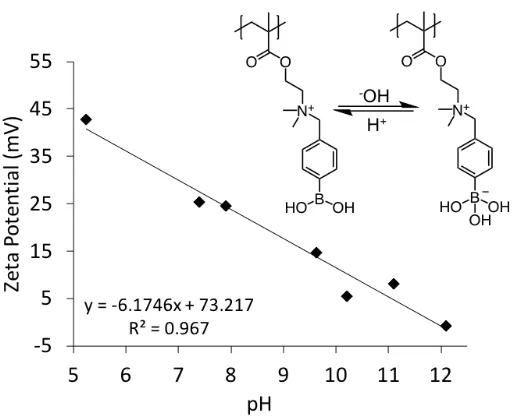
The zeta potential of the PBA polymers was investigated at different pH values to determine the average surface charge, thereby quantifying their ability to function as a polycation. Measurement of surface charge proves considerably important for the formation of LbL films which rely on electrostatic interactions, by ensuring comparable zeta potentials between the polycation and polyanion layers, necessary for optimal assembly.37 The zeta potential for PpBA
Figure 1. Zeta potential of PpBA (1 mg mL-1) between pH 5.2 to 12.1 measured by dynamic light
scattering (DLS). The trend illustrates a linear dependence of surface charge with pH.
The assembly of the LbL films on quartz substrates was monitored by UV-vis spectroscopy (Figure 2, Figure S2-3). The (PEI/PVS)n and (PBA/PVS)n layers were deposited by dip-coating
the substrate in alternating solutions containing the polyelectrolytes. Two bilayers of poly(ethyleneimine) and PVS ((PEI/PVS)2) polyelectrolytes were initially adsorbed on to the
slides to reduce any influence of substrate morphology on the film growth and to enhance the assembly of subsequent bilayers.4 The efficiency of LbL assembly for PoBA, PmBA and PpBA
polymers was tested in a film of 5 bilayers intercalated with PVS. Two absorbance bands were observed, centered at 230 and 265 nm, respectively, corresponding to π-π* transitions.38 The
bilayer deposition was followed at λmax = 230 nm.
From Figure S3, the trend in the slopes for the assembly of each film can be related to assembly efficiency and therefore, to the orientation of the BA group in the PBA polymer. The increase in the absorbance band at λmax = 230 nm versus the number of bilayers for
0.064 was obtained in the case of (PEI/PVS)2(PmBA/PVS)5 and (PEI/PVS)2(PpBA/PVS)5,
respectively (Figure S3), for the same number of bilayers. This increase in slope can be attributed to the orientation of the BA group as it is positioned further away from the N+ moiety.
In the case of the ortho derivative, the BA group is next to the N+ charge, which would allow for
an N+-B- interaction above the pK
a of the molecule. Although further away, in the case of the meta
derivative, N+-B- interaction is still possible through mediation of solvent molecules.39, 40 This
intramolecular interaction competes with the electrostatic interactions between the ammonium (in PBA) and sulfonate (in PVS) groups required for LbL assembly with PVS. Consequently, the assembly of the (PEI/PVS)2(PpBA/PVS)5 film is optimum since the BA group is positioned the
furthest away from the N+ moiety, where this through-space intramolecular N+-B- interaction is
not possible, leading to enhanced deposition of the polyions for film assembly. For this reason, the PpBA was the polymer chosen for further studies.
Figure 2. UV-vis spectra of the quartz substrate after each bilayer deposition, during the fabrication of (PEI/PVS)2(PpBA/PVS)15 LbL film. The inset shows a plot of the absorbance at
λmaxabs = 230 nm with increased number of (PpBA/PVS) bilayers. Error bars represent the standard
deviation error for n = 3 films.
On exposing the LbL films to a solution containing glucose or fructose, a release assay could be performed. At pH 7.4, below the determined pKa of the BA derivatives (pKa ~8.7), the
conformation of the BA in the deposited PBA layers is predominantly trigonal planar and the boron atom is neutral. On introducing the monosaccharide, sugar binding can result in the formation of an anionic cyclic boronate ester, rendering boron negatively charged. Consequently, the electrostatic interactions between the PBA and PVS can become weakened to initiate disassembly in the LbL film. In order to study sugar-induced disassembly of the (PEI/PVS)2(PoBA/PVS)5, (PEI/PVS)2(PmBA/PVS)5 and (PEI/PVS)2(PpBA/PVS)5 films, the quartz
substrates containing 5 bilayers of each film were placed into sugar containing solutions at pH 7.4 at 36 °C with gentle stirring.
0 0.2 0.4 0.6 0.8 1 1.2
200 225 250 275 300 325 350 375 400 425 450
Ab
so
rb
an
ce
Wavelength (nm)
PEI/PVS Quartz Slide
lmaxabs= 230 nm
y = 0.065x + 0.027 R² = 0.997
0.0 0.2 0.4 0.6 0.8 1.0 1.2
0 2 4 6 8 10 12 14
Ab
so
rb
an
ce
[image:8.612.171.454.71.280.2]When the LbL films were placed in a glucose solution of 100 mM, the absorbance at λmax for the
(PEI/PVS)2(PpBA/PVS)5 film decreased by 39% in approximately 1h, while for the
(PEI/PVS)2(PoBA/PVS)5 film a decrease in absorbance by ~13% was recorded after the same
amount of time (Figure S4). In both cases, no significant changes in absorbance were recorded after the first hour in 100 mM glucose. The better disassembly of the PpBA film over the PoBA film can be attributed to the orientation of the BA group in the ortho versus the para position. In the ortho position, glucose binding can be limited by steric hindrance of the methyl groups attached to the adjacent N+ moiety. The close proximity of the N+ moiety also enhances
stabilization in the PBA by forming N+-B- intramolecular interactions, to neutralize the induced
negative charge on boron upon glucose binding. As a result of this enhanced stabilization upon glucose binding, the disassembly process is impeded. In the para isopolymer this is not the case. The BA group is positioned opposite the N+ moiety, where a through-space N+-B- intramolecular
interaction is not permitted. Consequently, upon glucose binding to the PpBA polymer there is no stabilization effect and hence, disassembly of the LbL film can occur. Nevertheless, the disassembly in each case is still limited and less successful compared to previously reported studies.14, 32, 33
Instead, an accelerated disassembly profile was observed when the (PEI/PVS)2(PBA/PVS)5
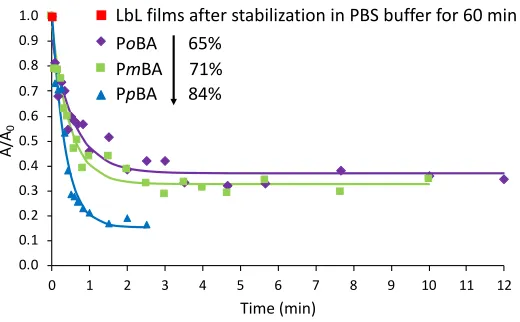
LbL films were immersed in a 10 mM fructose solution. In this case, the PoBA, PmBA and PpBA containing LbL films showed a total decrease in absorbance at λmaxabs = 230 nm by 65%,
PoBA, PmBA and PpBA containing LbL films was estimated by fitting the values of the absorbance at 230 nm using Microsoft Excel Solver and Equation 1 (Figure 4). The rate constant (k) was found to be 1.64 min-1 for the PoBA-containing film, 2.10 min-1 for the PmBA-containing
film and 2.81 min-1 for the PpBA-containing film. This rapid response to fructose over glucose,
can be explained by the higher binding constant of fructose with phenylBA, in comparison to other sugars such as glucose.32, 41, 42 James, et al.43 have reported the binding constant of phenylBAs
as 110 M-1 with glucose and 4370 M-1 with fructose. The furanose ring form of fructose binds with
40 times greater affinity to phenylBAs in contrast to the pyranose form of glucose. Since 99% of glucose exists in the pyranose form and less than 1% of glucose exists in the furanose form,43 this
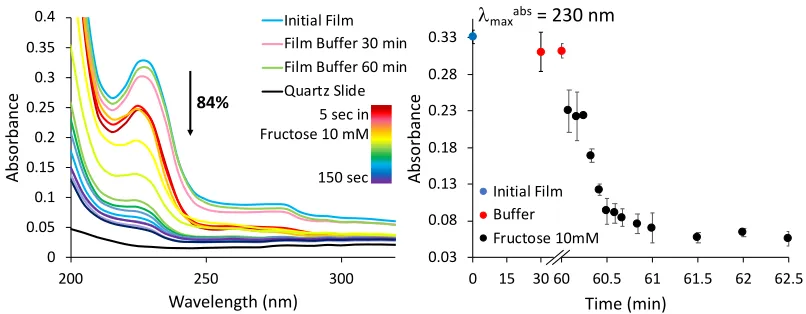
[image:10.612.108.511.459.616.2]low concentration of the furanose form of glucose accounts for the discrepancies between these binding constants. To monitor the disassembly with fructose more closely, the release assay profile was monitored in 5 s intervals (Figure 4). This figure illustrates that the PpBA film was disassembled in the presence of 10 mM fructose by 27% after 5 s, by 71% after 30 s and by 84% after 150 s.
Figure 3. Absorbance spectra for the disassembly of the (PEI/PVS)2(PpBA/PVS)5 film in 10 mM
fructose (left) and the average absorbance at λmaxabs = 230 nm (n = 3) over time, illustrating the
0 0.05 0.1 0.15 0.2 0.25 0.3 0.35 0.4
200 250 300
Ab
so
rb
an
ce
Wavelength (nm) Initial Film Film Buffer 30 min Film Buffer 60 min Quartz Slide
0.03 0.08 0.13 0.18 0.23 0.28 0.33
0 15 30 45 60
Ab
so
rb
an
ce
Time (min)
60 60.5 61 61.5 62 62.5 Time (min)
5 sec in Fructose 10 mM
150 sec
lmaxabs= 230 nm
0 0.05 0.1 0.15 0.2 0.25 0.3
0 20 40 60 80
Ab
so
rb
an
ce (A
. U
.)
Time (min)
disassembly of the LbL film. The points on the curve represent the mean ± the standard deviation.
Figure 4. Normalized absorbance (A/A0) at 230 nm following the disassembly of the PBA films;
PoBA ( ), PmBA ( ) and PpBA ( ) with 10 mM fructose at pH 7.4, where the red square represents the stabilization of the films in buffer for 60 min before the addition of fructose; A0 is
the stable measurement in buffer and A is the measured absorbance after the addition of fructose. The experimental values were fitted using a single exponential model (Equation 1) to determine the disassembly constant (k) for the sugar-induced disassembly.
Previous work has shown that incorporation of drug molecules between adjacent layers can offer a means of producing drug-delivery systems.13, 43-47 In this regard, the fluorescent dye pyranine
(PYR) was employed as a model for anionic drugs, in an attempt to understand more about the interaction between the PBA polymer and small anionic molecules, and also as a means of monitoring the sugar-induced disassembly process by fluorescence spectroscopy. It has been previously demonstrated that small molecules (e.g. dyes) can be used for the fabrication of LbL assemblies in combination with oppositely-charged polyions.46
0.0 0.1 0.2 0.3 0.4 0.5 0.6 0.7 0.8 0.9 1.0
0 1 2 3 4 5 6 7 8 9 10 11 12
A/ A0 Time (min) 0.05 0.25 0.45 0.65 0.85 1.05
0 10 20 30 40 50 60 70
A/ A0 Time (min) oBA mBA pBA 0 0.05 0.1 0.15 0.2 0.25 0.3
0 20 40 60 80
Ab so rb an ce (A . U .) Time (min) Initial Film Buffer Fructose 10mMPoBA 65%
PmBA 71% PpBA 84%
0.05 0.25 0.45 0.65 0.85 1.05
0 10 20 30 40 50 60 70
Ab so rb an ce (A . U .) Time (min) oBA mBA pBA 0.05 0.25 0.45 0.65 0.85 1.05
60 65 70
Ab so rb an ce (A . U .) Time (min) 0 0.05 0.1 0.15 0.2 0.25 0.3
0 20 40 60 80
Ab so rb an ce (A . U .) Time (min) Initial Film Buffer Fructose 10mM64%
77% 82% 0.05 0.25 0.45 0.65 0.85 1.05
0 10 20 30 40 50 60 70
Ab so rb an ce (A . U .) Time (min) oBA mBA pBA 0.05 0.25 0.45 0.65 0.85 1.05
60 65 70
Ab so rb an ce (A . U .) Time (min) 0 0.05 0.1 0.15 0.2 0.25 0.3
0 20 40 60 80
Ab so rb an ce (A . U .) Time (min) Initial Film Buffer Fructose 10mM64%
77% 82% After Stabilisation in Buffer
LbL films after stabilization in PBS buffer for 60 min
0.05 0.25 0.45 0.65 0.85 1.05
0 10 20 30 40 50 60 70
A/ A0 Time (min) oBA mBA pBA 0.05 0.55 1.05
60 63 66 69 72
A/ A0 Time (min) 0 0.05 0.1 0.15 0.2 0.25 0.3
0 20 40 60 80
Ab so rb an ce (A . U .) Time (min) Initial Film Buffer
Fructose 10mM65% 71% 84% 0.05 0.25 0.45 0.65 0.85 1.05
0 10 20 30 40 50 60 70
Ab so rb an ce (A . U .) Time (min) oBA mBA pBA 0.05 0.25 0.45 0.65 0.85 1.05
60 65 70
Ab so rb an ce (A . U .) Time (min) 0 0.05 0.1 0.15 0.2 0.25 0.3
0 20 40 60 80
Ab so rb an ce (A . U .) Time (min) Initial Film Buffer
Fructose 10mM64% 77% 82% 0.05 0.25 0.45 0.65 0.85 1.05
0 10 20 30 40 50 60 70
Ab so rb an ce (A . U .) Time (min) oBA mBA pBA 0.05 0.25 0.45 0.65 0.85 1.05
60 65 70
Ab so rb an ce (A . U .) Time (min) 0 0.05 0.1 0.15 0.2 0.25 0.3
0 20 40 60 80
Ab so rb an ce (A . U .) Time (min) Initial Film Buffer
Fructose 10mM64% 77% 82% Buffer 0.05 0.25 0.45 0.65 0.85 1.05
0 10 20 30 40 50 60 70
A/ A0 Time (min) oBA mBA pBA 0.05 0.55 1.05
60 63 66 69 72
A/ A0 Time (min) 0 0.05 0.1 0.15 0.2 0.25 0.3
0 20 40 60 80
Ab so rb an ce (A . U .) Time (min) Initial Film Buffer
Fructose 10mM65% 71% 84% 0.05 0.25 0.45 0.65 0.85 1.05
0 10 20 30 40 50 60 70
Ab so rb an ce (A . U .) Time (min) oBA mBA pBA 0.05 0.25 0.45 0.65 0.85 1.05
60 65 70
Ab so rb an ce (A . U .) Time (min) 0 0.05 0.1 0.15 0.2 0.25 0.3
0 20 40 60 80
Ab so rb an ce (A . U .) Time (min) Initial Film Buffer
Fructose 10mM64% 77% 82% 0.05 0.25 0.45 0.65 0.85 1.05
0 10 20 30 40 50 60 70
Ab so rb an ce (A . U .) Time (min) oBA mBA pBA 0.05 0.25 0.45 0.65 0.85 1.05
60 65 70
Ab so rb an ce (A . U .) Time (min) 0 0.05 0.1 0.15 0.2 0.25 0.3
0 20 40 60 80
Ab so rb an ce (A . U .) Time (min) Initial Film Buffer
Fructose 10mM64% 77% 82% Buffer 0.05 0.25 0.45 0.65 0.85 1.05
0 10 20 30 40 50 60 70
A/ A0 Time (min) oBA mBA pBA 0.05 0.55 1.05
60 63 66 69 72
A/ A0 Time (min) 0 0.05 0.1 0.15 0.2 0.25 0.3
0 20 40 60 80
Ab so rb an ce (A . U .) Time (min) Initial Film Buffer
Fructose 10mM65% 71% 84% 0.05 0.25 0.45 0.65 0.85 1.05
0 10 20 30 40 50 60 70
Ab so rb an ce (A . U .) Time (min) oBA mBA pBA 0.05 0.25 0.45 0.65 0.85 1.05
60 65 70
Ab so rb an ce (A . U .) Time (min) 0 0.05 0.1 0.15 0.2 0.25 0.3
0 20 40 60 80
Ab so rb an ce (A . U .) Time (min) Initial Film Buffer
Fructose 10mM64% 77% 82% 0.05 0.25 0.45 0.65 0.85 1.05
0 10 20 30 40 50 60 70
Ab so rb an ce (A . U .) Time (min) oBA mBA pBA 0.05 0.25 0.45 0.65 0.85 1.05
60 65 70
Ab so rb an ce (A . U .) Time (min) 0 0.05 0.1 0.15 0.2 0.25 0.3
0 20 40 60 80
Ab so rb an ce (A . U .) Time (min) Initial Film Buffer
Figure 5 shows the assembly of the (PEI/PVS)2(PpBA/PYR)5 film tracked by UV-vis
spectroscopy. The PpBA polymer was used since it showed the optimum results in the previous film assembly and disassembly study. The absorbance bands observed in the LbL film are characteristic for those of the PpBA polymer at 230 and 250 nm and for pyranine at 290, 373, 405 and 465 nm. The inset of Figure 5 confirms the linear deposition of the bilayers onto the quartz slide with a slope of 0.050 at λmaxabs = 405 nm, demonstrating an assembly similar to that of
the (PEI/PVS)2(PpBA/PVS)5 film.
Figure 5. UV-vis spectra of the quartz substrate before (in black) and after each bilayer
deposition, during the fabrication of the (PEI/PVS)2(PpBA/PYR)5 LbL film. The inset shows a
plot of the absorbance at λmaxabs = 405 nm with increased number of (PpBA/PYR) bilayers. Error
bars represent the standard deviation error for n = 3 films.
To determine the performance of the (PEI/PVS)2(PpBA/PYR)5 film in response to saccharides,
the film was placed in a fructose solution and monitored in tandem by UV-vis and fluorescence spectroscopy. The (PEI/PVS)2(PpBA/PYR)5 film was initially stabilized in pH 7.4 buffer for 60
min at 36 ºC under gentle stirring, which resulted in a slight decrease in the absorbance at λmaxabs = 0
0.1 0.2 0.3 0.4 0.5 0.6 0.7
200 300 400 500
Ab
so
rb
an
ce
Wavelength (nm)
Quartz Slide
y = 0.050x - 0.013 R² = 0.998 0
0.05 0.1 0.15 0.2 0.25 0.3
0 1 2 3 4 5
Ab
so
rb
an
ce
[image:12.612.181.427.264.449.2]230 nm, attributed to dissolution of some weakly bound material. Subsequent immersion of the film in a 30 mM fructose solution showed a decrease in absorbance by 63% within approximately 4.5 min (Figure 6, black). In comparison with the (PEI/PVS)2(PpBA/PVS)5 film
which disassembled by 84% in 2.5 min, the disassembly of the fluorescent (PEI/PVS)2(PpBA/PYR)5 film occurred to a smaller extent, indicating that the intermolecular
interactions within the film were stronger than in the PpBA/PVS case. Similarly, the first order disassembly constant (k) for the fructose-induced disassembly of (PEI/PVS)2(PpBA/PYR)5 was
found to be 1.05 min-1 (Figure S7), smaller than that obtained for the (PEI/PVS)
2(PpBA/PVS)5
film under similar experimental conditions. The disassembly of the (PEI/PVS)2(PpBA/PYR)5 film
was examined by simultaneously monitoring the absorbance of the film and the fluorescence of the solution, following the specific pyranine bands (Figure S8-9). The film was placed in a pH 7.4 phosphate buffer solution at 36 °C under gentle stirring to stabilize the film before fructose was introduced. From Figure S8 the absorbance spectra of the (PEI/PVS)2(PpBA/PYR)5 film can
be seen, showing the characteristic absorbance bands for pyranine. These reveal a decrease of absorbance intensity at 375 and 410 nm and an increase in the absorbance band at 460 nm, when the dry film is exposed to the 7.4 buffer solution. These absorbance differences can be attributed to changes in hydrogen bonding interactions between the -OH group of pyranine with the aqueous solvent.48 After stabilization of the LbL film in the pH buffer, introduction of the film
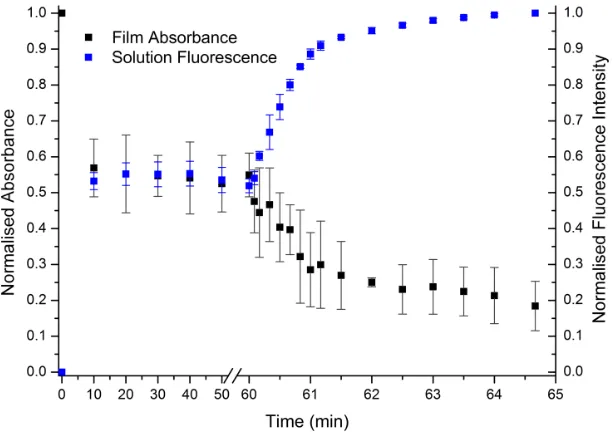
into the fructose solution (30 mM) caused a decrease by 63% (relative to buffer) within 4.5 min in the characteristic absorbance bands of pyranine (Figure 6, black), indicating film disassembly. Simultaneously, the fluorescence of the solution was monitored at 500 nm (λex = 405 nm) to
in the fructose solution. As shown in Figure 6, the curve representing the decreasing in the absorbance of the film (black) and the curve showing fluorescence increase of the solution (blue) are complementary, indicating that the two processes occur simultaneously.
Figure 6. Graph showing the disassembly of the fluorescent (PEI/PVS)2(PpBA/PYR)5 film in
fructose solution (30 mM) at pH 7.4, 36 °C, where the film was first stabilized in PBS buffer for 60 min. The decrease in absorbance of the film was monitored at λmaxex = 405 nm (black points).
The fluorescence of the sugar solution simultaneously increases due to dissolution of pyranine, where the excitation wavelength was 405 nm and the fluorescence in solution was tracked at λmaxem
= 500 nm (blue points). Error bars represent the standard deviation error for n = 3 (corresponding to the disassembly of 3 different LbL films).
Conclusions
In summary, two types of LbL films were assembled, based on (PEI/PVS)2(PBA/PVS)5 and
[image:14.612.157.463.169.387.2]disassembled to a greater extent in the presence of fructose over glucose, where the (PEI/PVS)2(PpBA/PVS)5 showed the optimum response to both sugars by disassembling by 39%
in glucose (100 mM) and by 93% in fructose (10 mM). In this regard, the PpBA polymer was employed to construct a fluorescent film with the anionic fluorophore pyranine to mimic a drug delivery model. Overall, the PpBA films showed optimum responses and would be recommended for implementation into sugar monitoring or drug delivery systems. Future work could involve the fabrication of these LbL films upon microcapsules or microtubes encapsulated with insulin for sustained drug release in a drug delivery system.
Experimental
Hydrogen peroxide (30 wt% in H2O), poly(ethyleneimine) (PEI, branched; 50% w/v in water),
poly(vinylsulfonic acid, sodium salt) solution (PVS; 25 wt.% in H2O),
PpBA in pH 5.4-12.1 were measured at a concentration of 1 mg mL-1. All pH measurements were
carried out using a VWR SympHony SP70P pH meter (VWR, PA, USA). Deionized water (18.2 MΩ cm-1) was purified using a Merck Millipore Milli-Q Water Purification System (Merck
Millipore, Darmstadt, Germany). The phosphate buffer solution at pH 7.4 was prepared from 0.1 M potassium dihydrogen phosphate (KH2PO4; 100 mL) and 0.1 M sodium hydroxide (NaOH; 78
mL) salts and was made up to 200 mL using deionized water.
The BA monomers were synthesized according to a literature procedure.34, 35 Briefly, a one-step
synthesis was used to produce a series of polymerisable BA monomers. 2-(Dimethylamino)ethyl methacrylate underwent a quaternization reaction with a bromomethyl substituted phenylboronic acid to form the BA-ammonium bromide monomeric salts, namely N-(2-boronobenzyl)-2-(methacryloyloxy)-N,N-dimethylethane-1-ammonium bromide (oBA), N-(3-boronobenzyl)-2-(methacryloyloxy)-N,N-dimethylethane-1-ammonium bromide (mBA) and N-(4-boronobenzyl)-2-(methacryloyloxy)-N,N-dimethylethane-1-ammonium bromide (pBA), where the boronic acid is positioned in the ortho-, meta-, or para-position to the ammonium chain, respectively. Upon quaternization of the nitrogen atom, the BA monomers are rendered water-soluble, which is an advantage for subsequent polymerization strategies.
The LbL films were assembled on to quartz slides (40 x 10 x 1 mm). The slide was primed using NH4OH/H2O2/H2O (1:1:5, v:v:v) and HCl/H2O2/H2O (1:1:6, v:v:v) hydrophilization solutions
at 75 °C for 10 min and washed with deionized water. PEI and PVS solutions were prepared at concentrations of 1 mg mL-1 and 4 µL mL-1, respectively. The PYR solution was prepared at 1
mM. The PBAs were dissolved in DI H2O at a concentration of 1 mg mL-1 and the pH was altered
to pH 7.4 using acetic acid and sodium hydroxide and measured using a SympHony pH meter. All LbL films were assembled with 2 initial (PEI/PVS)2 bilayers to minimize any interference
with the quartz or glass substrate,4 in a process as follows: (1) the substrate was immerse in PEI
(1 mg mL-1) for 3 min, (2) in deionized water for 30 s, (3) in PVS (4 µL mL-1) for 3 min and (4) in
deionized water for 30 s. Subsequently, the substrate was immersed into the respective PBA and PVS polymer solutions for 3 min to deposit the linear chains. The polymer solutions during LbL assembly for all films were kept at room temperature. A washing step using deionized water was performed for approximately 30 s to avoid contamination between the polyelectrolyte solutions. This cyclic process was repeated until all desired 5 or 15 bilayers were afforded. A UV-vis spectrum of the slide after air drying was recorded after each bilayer deposition.
To disassemble the LbL films, the slide was simply dipped in the pH 7.4 buffer solution at 36
𝑦 = 𝑎 ∗ 𝑒&'(+ 𝑏 (1)
where y is the absorbance at 230 nm ((PEI/PVS)2(PBA/PVS)5) or 405 nm
((PEI/PVS)2(PpBA/PYR)5), respectively, a is the scaling factor, k is the first order disassembly
rate constant (min-1), b is the baseline offset, and t is time (min).
ASSOCIATED CONTENT
Supporting Information. The Supporting Information is available free of charge. UV-Vis and
fluorescence data for the LbL assembly and disassembly studies (PDF). AUTHOR INFORMATION
Corresponding Author
*To whom correspondence should be addressed: [email protected]; [email protected]
ACKNOWLEDGMENT
The authors, D.B., L.F. and D.D., are grateful for financial support from Science Foundation Ireland (SFI), under the Insight Centre for Data Analytics initiative, grant number SFI/12/RC/2289. C.D. and D.D. acknowledge the Technology Innovation Development Award (TIDA) number 16/TIDA/4183. LF acknowledges the ERC (European Research Council) Starting Grant (project number 802929-ChemLife). P.P.C. and M.F. also gratefully acknowledge support from CAPES (001) and CNPq, Brazil.
ABBREVIATIONS
BA, phenylboronic acid/bornic acid; LbL, layer-by-layer; PBA, BA-homopolymers/BA-linear polymers/phenylbornic acid polymers; PVS, poly(vinylsulfonic acid, sodium salt); o-, ortho; m-, meta; p-, para; PYR, pyranine; PVA, poly(vinyl alcohol); PoBA,
poly[N-(meta-boronobenzyl)-2-(methacryloyloxy)-N,N-dimethylethane-1-ammonium bromide]; PpBA, poly[N-(para-boronobenzyl)-2-(methacryloyloxy)-N,N-dimethylethane-1-ammonium bromide]; NMR, nuclear magnetic resonance; s, singlet; PEI, poly(ethyleneimine); A, absorbance; A0, initial
absorbance; k, disassembly constant.
REFERENCES
1. Sukhishvili, S. A; Granick, S. Layered, Erasable Polymer Multilayers Formed by Hydrogen-Bonded Sequential Self-Assembly, Macromolecules 2002, 35, 301-310.
2. Shiratori, S. S.; Rubner, M. F. pH-Dependent Thickness Behavior of Sequentially Adsorbed Layers of Weak Polyelectrolytes, Macromolecules 2000, 33, 4213-4219.
3. Yoo, D.; Shiratori, S. S.; Rubner, M. F. Controlling Bilayer Composition and Surface Wettability of Sequentially Adsorbed Multilayers of Weak Polyelectrolytes, Macromolecules
1998, 31, 4309-4318.
4. Campos, P. P.; Fernandes Fraceto, L.; Ferreira, M. Layer-by-Layer Films Containing Emodin or Emodin Encapsulated in Liposomes for Transdermal Applications, Colloids Surf., B
2018, 162, 69-75.
5. Schuler, C.; Caruso, F. Decomposable Hollow Biopolymer-Based Capsules, Biomacromolecules 2001, 2, 921-926.
7. Sun, Q. Q.; Deng, Y. L. Encapsulation of Polystyrene Latex with Temperature-Responsive Poly(N-isopropylacrylamide) via a Self-Assembling Approach and the Adsorption Behaviors Therein, Langmuir 2005, 21, 5812-5816.
8. Tao, X.; Li, J. B.; Mohwald, H. Self-Assembly, Optical Behavior, and Permeability of a Novel Capsule Based on an Azo Dye and Polyelectrolytes, Chem.–Eur. J. 2004, 10, 3397-3403.
9. Campos, P. P.; Dunne, A.; Delaney, C.; Moloney, C.; Moulton, S. E.; Benito-Lopez, F.; Ferreira, M.; Diamond, D.; Florea, L. Photoswitchable Layer-by-Layer Coatings Based on Photochromic Polynorbornenes Bearing Spiropyran Side Groups, Langmuir 2018, 34, 4210– 4216.
10. Gao, C.; Donath, E.; Moya, S.; Dudnik, V.; Mohwald, H. Elasticity of Hollow Polyelectrolyte Capsules Prepared by the Layer-by-Layer Technique, Eur. Phys. J., E 2001, 5, 21-27.
11. Gao, C. Y.; Leporatti, S.; Moya, S.; Donath, E.; Mohwald, H. Stability and Mechanical Properties of Polyelectrolyte Capsules Obtained by Stepwise Assembly of Poly(styrenesulfonate sodium salt) and Poly(diallyldimethyl ammonium) Chloride onto Melamine Resin Particles, Langmuir 2001, 17, 3491.
12. Sato, K.; Imoto, Y.; Sugama, J.; Seki, S.; Inoue, H.; Odagiri, T.; Hoshi, T.; Anzai, J. Sugar-Induced Disintegration of Layer-by-Layer Assemblies Composed of Concanavalin A and Glycogen, Langmuir 2005, 21, 797-799.
14. Levy, T.; Déjugnat, C.; Sukhorukov, G. B. Polymer Microcapsules with Carbohydrate-Sensitive Properties, Adv. Funct. Mater. 2008, 18, 1586-1594.
15. Joseph, V. S.; Hong, J.-D. Phenylboronic Acid-Modified Oligoamine Sensitive to Monosaccharides and Carbon Dioxide under Physiological Conditions, Colloids Surf. Physicochem. Eng. Asp. 2018, 553, 312–316.
16. Campos, P. P.; Moraes, M. L.; Volpati, D.; Miranda, P. B.; Oliveira Jr., O. N.; Ferreira, M. Amperometric Detection of Lactose Using β-Galactosidase Immobilized in Layer-by-Layer Films, ACS Appl. Mater. Interfaces 2014, 6, 11657–11664.
17. Choi, D.; Hong, J. Layer-by-Layer Assembly of Multilayer Films for Controlled Drug Release, Arch. Pharm. Res. 2014, 37, 79-87.
18. Guan, Y; Zhang, Y. Dynamically Bonded Layer-by-Layer Films: Dynamic Properties and Applications, J. Appl. Polym. Sci. 2014, 131, 40918-40929.
19. Wang, B.; Yoshida, K.; Sato, K.; Anzai, J. Phenylboronic Acid-Functionalized Layer-by-Layer Assemblies for Biomedical Applications, Polymers 2017, 9, 202-218.
20. De Geest, B. G.; Sanders, N. N.; Sukhorukov, G. B.; Demeestera, J.; De Smedt, S. C. Release Mechanisms for Polyelectrolyte Capsules, Chem. Soc. Rev. 2007, 36, 636-649.
21. Kost, J.; Wolfrum, J.; Langer, R. Magnetically Enhanced Insulin Release in Diabetic Rats, J. Biomed. Mater. Res. 1987, 21, 1367-1373.
23. Saslawski, O.; Weingarten, C.; Benoit, J. P.; Couvreur, P. Magnetically Responsive Microspheres for the Pulsed Delivery of Insulin, Life Sci. 1988, 42, 1521-1528.
24. Zhu, Y.; Zheng, L. Y. Preparation and Characterization of Glucose-Sensitive Hydrogel Submicron Particles Using Inverse Microemulsions, J. Drug Delivery Sci. Technol. 2006, 16, 55-58.
25. Wu, J.-Z.; Williams, G. R.; Li, H. Y.; Wang, D. X.; Li, S. D.; Zhu, L. M. Insulin-Loaded PLGA Microspheres for Glucose-Responsive Release, Drug Deliv. 2017, 24, 1513–1525.
26. Zhang, X.; Guan, Y.; Zhang, Y. Dynamically Bonded Layer-by-Layer Films for Self-Regulated Insulin Release, J. Mater. Chem. 2012, 22, 16299-16305.
27. Qi, W.; Yan, X.; Fei, J.; Wang, A.; Cui, Y.; Li. J. Triggered Release of Insulin from Glucose-Sensitive Enzyme Multilayer Shells, Biomaterials 2009, 30, 2799-2806.
28. Qi, W.; Duan, L.; Li, J. Fabrication of Glucose-Sensitive Protein Microcapsules and Their Applications, Soft Matter 2011, 7, 1571-1576.
29. Chen, X.; Luo, J.; Wu, W.; Tan, H.; Xu, F.; Li, J. The Influence of Arrangement Sequence on the Glucose-Responsive Controlled Release Profiles of Insulin-Incorporated LbL Films, Acta Biomater. 2012, 8, 4380-4388.
31. James, T. D.; Phillips, M. D.; Shinkai, S. Boronic Acids in Saccharide Recognition, RSC Publishing, Ed. J. F. Stoddart, 2006, pp. 3-176.
32. Watahiki, R.; Sato, K.; Suwa, K.; Niina, S.; Egawa, Y.; Seki, T.; Anzai, J. Multilayer Films Composed of Phenylboronic Acid Modified Dendrimers Sensitive to Glucose Under Physiological Conditions, J. Mater. Chem., B 2014, 2, 5809-5817.
33. Suwa, K.; Nagasaka, M.; Niina, S.; Egawa, Y.; Seki, T.; Anzai, J-I. Sugar Response of Layer-by-Layer Films Composed of Poly(vinyl alcohol) and Poly(amidoamine) Dendrimer Bearing 4-Carboxyphenylboronic Acid, Colloid Polym. Sci. 2015, 293, 1043–1048.
34. Delaney, C.; Florea, L.; Bruen, D.; Diamond, D. Boronic Acid Derivatives for Sugar-Sensing Hydrogels, GB Patent, GB1805226.6, 29 March 2018.
35. Bruen, D.; Delaney, C.; Diamond, D.; Florea, L. Fluorescent Probes for Sugar Detection, ACS Appl. Mater. Interfaces 2018, 10, 38431-38437.
36. Bruen, D.; Delaney, C.; Florea, L.; Diamond, D. Glucose Sensing for Diabetes Monitoring: Recent Developments, Sensors 2017, 17, 1866-1887.
37. 36. Decher, G. Fuzzy Nanoassemblies: Towards Layered Polymeric Multicomposites, Science 1997, 277, 1232-1237.
39. Sun, X.; James, T. D. Glucose Sensing in Supramolecular Chemistry, Chem. Rev. 2015, 115, 8001-8037.
40. Hansen, J. S.; Christensen, J. B.; Petersen, J. F.; Hoeg-Jensen, T.; Norrild, J. C. Arylboronic Acids: A Diabetic Eye on Glucose Sensing, Sens. Actuators, B 2012, 161, 45-79.
41. Egawa, Y.; Gotoh, R.; Seki, T.; Anzai, J. Sugar Response of Boronic Acid-Substituted Azobenzene Dye-Modified Polymer, Mater. Sci. Eng. C 2009, 29, 115–118.
42. Camara, J. N.; Suri, J. T.; Cappuccio, F. E.; Wessling, R. A.; Singaram, B. Boronic Acid Substituted Viologen Based Optical Sugar Sensors: Modulated Quenching with Viologen as a Method for Monosaccharide Detection, Tetrahedron Lett. 2002, 43, 1139–1141.
43. Wu, X.; Li, Z.; Chen, X.-X.; Fossey, J. S.; James, T. D.; Yun-Bao Jiang, Y.-B. Selective Sensing of Saccharides Using Simple Boronic Acids and Their Aggregates, Chem. Soc. Rev.
2013, 42, 8032-8048.
44. Zhuk, I.; Jariwala, F.; Attygalle, A. B.; Wu, Y.; Libera, M. R.; Sukhishvili, S. A. Self-Defensive Layer-by-Layer Films with Bacteria-Triggered Antibiotic Release, ACS Nano 2014, 8, 7733-7745.
45. Schmidt, D. J.; Moskowitz, J. S.; Hammond, P. T. Electrically Triggered Release of a Small Molecule Drug from a Polyelectrolyte Multilayer Coating, Chem. Mater. 2010, 22, 6416-6425.
47. Costa, R. R.; Alatorre-Meda, M.; Mano, J. F. Drug Nano-Reservoirs Synthesized Using Layer-by-Layer Technologies, Biotechnol. Adv. 2015, 33, 1310-1326.
48. Heo, W.; Uddin, N.; Park, J. W.; Rhee, Y. M.; Choi, C. H.; Joo, T. Coherent Intermolecular Proton Transfer in the Acid-Base Reaction of Excited State Pyranine, Phys. Chem. Chem. Phys.
A series of linear cationic boronic acid homopolymers are synthesized and assembled into layer-by-layer films. Their response to common saccharides, such as glucose and fructose is probed in solution to induce disassembly in the films. Fluorescent films using the anionic fluorophore pyranine were also assembled to mimic a drug delivery model. Facile polymer synthesis, combined with UV-vis and fluorescence analysis detailing comprehensive solution studies, has allowed for the generation of layer-by-layer films with a tailored saccharide response.
Fructose solution H H O B N+ O OH OH + + + H H O B N+ O O O + + +
LbL film in
Fr uc to se OH S O O O-S O O O-S O O O-PBA polymer Pyranine Fructose c
LbL Film in a Sugar Solution Fructose solution H H O B N+ O OH OH + + + H H O B N+ O O O + + +
LbL film in
Fr uc to se OH S O O O-S O O O-S O O O-PBA polymer Pyranine Fructose