Concurrent Data Structures
Thesis by
William J. Dally
In Partial Fulfillment of the Requirements for the Degree of
Doctor of Philosophy
California Institute of Technology Pasadena, California
1986
Ackno\v ledgments
While a graduate student at Caltech I have been fortunate to have the opportunity to work with three exceptional people: Chuck Seitz, Jim Kajiya, and Randy Bryant.
My
ideas about the architecture of VLSI systems have been guided by my thesis advisor, Chuck Seitz, who also deserves thanks for teaching me to be less an engineer and more a scientist. ~!any of my ideas on object-oriented programming come from my work with Jim Kajiya, and my work with Randy Bryant was a starting point for my research on algorithrn.s.I thank all the members of my reading committee: Randy Bryant, Dick Feynman, Jim Kajiya, Alain Martin, Bob McEliece, Jerry Pine, and Chuck Seitz for their helpful com-ments and constructive criticism.
My fellow students, Bill Athas, Ricky Mosteller, ~1.ike Newton, Fritz Nordby, Don Speck, Craig Steele, Brian Von Herzen; and Dan Whelan have provided constructive criticism, comments, and assistance.
This manuscript was prepared using TEX [73] and the Ll~TEX macro package [78]. I thank Calvin Jackson, our local TEXpert, for his help with typesetting problems. Most of the figures in this thesis were prepared using software developed by Wen-King Su. Bill Athas, Sharon Dally, John Tanner, and Doug Whiting deserve thanks for their careful
proofreading of this document. '
Financial support for this research was provided by the Defense Advanced Research Projects Agency. I am grateful to AT&T Bell Laboratories for the support of an AT&T Ph.D. fellowship.
Concurrent data structures simplify the development of concurrent programs by encap-sulating commonly used mechanisms for synchronization and communication into data structures. This thesis develops a notation for describing concurrent data structures, presents examples of concurrent data structures, and describes an architecture to sup-port concurrent data structures.
Concurrent Smail talk (CST), a derivative of Smalltalk-80 with extensions for concur-rency, is developed to describe concurrent data structures. CST allows the programmer to specify objects that are distributed over the nodes of a concurrent computer. These distributed objects have many constituent objects and thus can process many messages simultaneously. They are the foundation upon which concurrent data structures are built.
The balanced cube is a. concurrent data structure for ordered sets. The set is distributed by a. balanced recursive partition that maps to the subcubes of a binary n-cube using a Gray code. A search algorithm, VW search, based on the distance properties of the Gray code, searches a balanced cube in O(log
N)
time. Because it does not have the root bottleneck that limits all tree-based data structures to0(1)
concurrency, the balanced cube achieves O(~) 10g ;V concurrency.Considering graphs as concurrent data structures, graph algorithms are presented for the shortest path problem, the max-flow problem, and graph partitioning. These algorithms introduce new synchronization techniques to achieve better performance than existing algorithms.
Contents
Acknowledgments . ill
Abstract . lV
List of Figures IX
1 Introduction 1
1.1 Original Results . 2
1.2 Motivation 3
1.3 Background 4
1.4 Concurrent Computers . 5
1.4.1 Sequential Computers 6
1.4.2 Shared-Memory Concurrent Computers
"'
I1.4.3 Message-Passing Concurrent Computers 9
1.5 Summary
..
102 Concurrent Smalltalk 11
2.1
Object-Oriented Programming12
2.2
Distributed Objects . 132.3 Concurrency 16
2.4 Locks 20
I'),..
Summary 22
... 1 • • c •
3 The Balanced Cube 23
3.1
Data Structure 243.1.l
The Ordered Set 243.1.2
The Binary n-Cube25
3.1.3
The Gray Code . . . 263.1.4
The Balanced Cube 283.2
Search .. ~ ~ ~.
. .
~. . .
.. 303.2.1
Di.stance Properties of the Gray Code 303.2.2
VW Search 323.3 Insert
40
3.4 Delete 44
3.5 Balance 52
3.6 Extension to B-Cubes 57
3.7 Experimental Results . 57
3.8 Applications . 62
3.9 Summary
..
654 Graph Algorithms 66
4.1
Nomenclature . . 664.2
Shortest Path Problems 684.2.1
Single Point Shortest Path 684.2.2
Multiple Point Shortest Path 804.2.3
All Points Shortest Path . 834.3.l Constructing a Layered Graph
4.3.2 The CAD Algorithm
4.3.3 The CVF Algorithm
4.3.4 Distributed Vertices
4.3.5 Experimental Results
4.4 Graph Partitioning . . . .
4.4.l Why Concurrency is Hard
4.4.2 Gain . . . .
4.4.3 Coordinating Simulta.n.eous Moves
4.4.4 Balance . . . .
4.4.5 Allowing Negative Moves
4.4.6 Performance
4.4.7 Experimental Results
4.5 Summary . . . .
5 Architecture
5.1 Characteristics of Concurrent Algorithms
5.2 Technology . . . .
5.2.1 Wiring Density
5.2.2 Switching Dynamics
5.2.3 Energetics . . . •
5.3 Concurrent Computer Interconnection Networks
5.3.l Network Topology . . .
5.3.2 Deadlock-Free Routing .
5.3.3 The Torus Routing Chip .
5.4 A Message-Driven Processor . . .
88 89 96 103 105 109 110 111 112 114 115 116 116 118 119 120 122 122 125
1')"" .. 1
128
129
143
150
5.4.2 Method Lookup
5.4.3 Execution
5.5 Object Experts
5.6 Summary
6 Conclusion
A Summary of Concurrent Smalltalk
B Unordered Sets
B.l Dictionaries .
B.2 Union-Find Sets
C On-Chip Wire Delay
Glossary
Bibliography
166
168
172
173
175
180
190
190
193
195
198
List of Figures
1.1 Motivation for Concurrent Data Structures
1.2 Information Flow in a Sequential Computer
1.3 Information Flow in a Shared-Memory Concurrent Computer
1.4 Information Flow in a Message-Passing Concurrent Computer
2.1 Distributed Object Class Tally Ccllection
2.2 A Concurrent Tally Method .
2.3 Description of Class Interval .
2.4 Synchronization cf Methods
3.1 Binary 3-Cube . . . .
3.2 Gray Code Mapping on a Binary 3-Cube.
3.3 Header for Class Balanced Cube
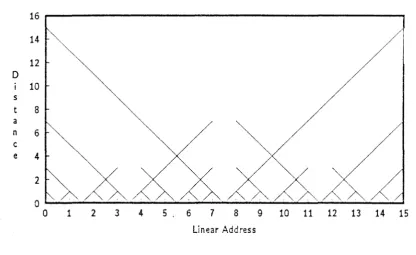
3.4 Calculating Distance by Reflection
3.5 Neighbor Distance in a Gray ;!-Cube
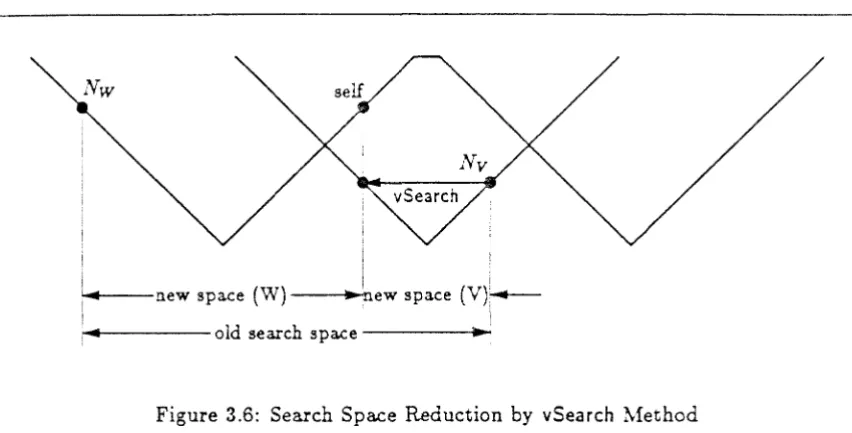
3.6 Search Space Reduction by vSearch Method
3.7 Methods for at: and vSearch . . . .
3.8 Search Space Reduction by wSearch Method .
3.9 Method for wSearch . .
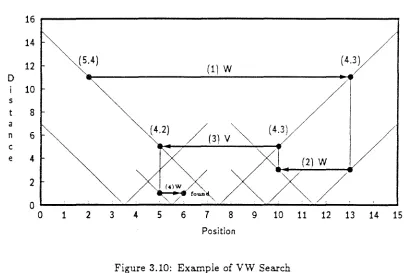
3.10 Example of VW Search
4
6
8
9
14
17
18 19
26
28
29 31 33
34
36
37
37
3.12 Method for localAt:put: .
3.13 Method for split:key:data:flag:
3.14 Insert Example . . .
3.15 Merge Dimension Cases
3.16 Method for mergeReq:flag:dim: .
3.17 ~fethods for mergeUp and mergeDown:data:flag: 3.18 Methods for move: and copy:data:flag:
3.19 Merge Example: A dim = B dim
3.20 Merge Example: A dim
<
B dim3.21 Balancing Tree, n = 4
3.22 Method for size:of:
3.23 Method for free: .
3.24 Balance Example .,
3.25 Throughput vs. Cube Size for Direct Mapped Cube. Solid line is ,Q4:Y_._ log4 N
42
42
44 46 46
47
48
49
50
53
55 55
56
Diamonds represent experimental data. . . . 59
3.26 Barrier Function (n=lO) . . . 60
3.27 Throughput vs. Cube Size for Balanced Cube Solid line is ~;X.
Dia-monds represent experimental data. . 61
3.28 Mail System . . . . 62
4.1 Headers for Graph Classes . . '. . . 67
4.2 Example Single Point Shortest Path Problem 69
4.3 Dijkstra's Algorithm . . . 69
4.4 Example Trace of Dijkstra's Algorithm . 70
4.5 Simplified Version of Chandy and Misra's Concurrent SPSP Algorithm . 71
4.7 Pathological Graph for Chandy and ~1isra's Algorithm . 73
4.8 Synchronized Concurrent SPSP Algorithm .
74
4.9 Petri Net of SPSP Synchronization . . .
4.10 Example Trace of Simple Synchronous SPSP Algorithm 76
4.11 Speedup of Shortest Pa.th Algorithms vs. Problem Size .
77
4.12 Speedup of Shortest Pa.th Algorithms vs. Number of Processors .
4.13 Speedup of Shortest Path Algorithms for Pathological Graph 79
4.14 Speedup for 8 Simultaneous Problems on R2.10 . . 81
4.15 Speedup vs. Number of Problerr..s for R2.10, n=lO 82
4.16 Floyd's Algorithm . . . . 83
4.17 Example of Suboptimal Layered Flow 86
4.18 CAD and CVF Macro Algorithm . . 89
4.19 CAD and CVF Layering Algorithm . 90
4.20 Propagate Methods 92
4.21 Reserve Methods . 93
4.22 Confirm Methods 94
4.23 request Methods for CVF Algorithm 97
4.24 send Messages Method for CVF Algorithm 99
4.25 reject and ackFlow Methods for CVF Algorithm 100
4.26 Petri Net of CVF Synchronization . . . 102
4.27 Pathological Graph for CVF Algorithm 103
4.28 A Bipartite Flow Graph . . . . 104
4.29 Distributed Source and Sink Vertices 104
4.30 Number of Operations vs. Graph Size for Max-Flow Algorithms 105
4.33 Thrashing . . . 111
4.34 Simultaneous Move That Increases Cut 112
4.35 Speedup of Concurrent Graph Partitioning Algorithm vs. Graph Size 117
5.1 Distribution of Message and Method Lengths 121
Packaging Levels . . . . 123
5.3 A Concurrent Computer 128
5.4 A Binary 6-Cube Embedded in the Plane 130
5.5 A Ternary 4-Cube Embedded in the Plane . 131
5.6 An B-ary 2-Cube (Torus) . . . . 131 5.7 Wire Density vs. Position for One Row of a Binary 2~Cube . 134 5.8 Pin Density vs. Dimension for 256, 4K, and lM Nodes . . . . 135 5.9 Latency vs. Dimension for 256, 4K, and lM Nodes, Constant Delay 137
'
5.10 Latency vs. Dimension for 256, 4K, and IM Nodes, Logarithmic Delay . 140 5.11 Latency vs. Dimension for 256, 4K, and lM Nodes, Linear Delay 141 5.12 Deadlock in a 4-Cycle . . . 143
5.13 Breaking Deadlock with Virtual Channels 147
5.14 3-ary 2-Cube . . . 149
5.15 Photograph of the Torus Routing Chip . 151
5.16 A Packaged Torus Routing Chip 152
5.17 A Dimension 4 Node 153
5.18 A Torus System. . . 154
5.19 A Folded Torus System 155
5.20 Packet Format . . . 156
5.22 Channel Protocol Example 157
5.23 TRC Block Diagram . . . . 158
5.24 Input Controller Block Diagram. 159
5.25 Crosspoint of the Crossbar Switch 160
5.26 Output Multiplexer Control . . . 161
5.27 TRC Performance Measurements 162
5.28 Message Format 165
5.29 Message Reception 166
5.30 Method Lookup . . 167
5.31 Instruction Translation Lookaside Buffer 168
5.32 A Context . . . . 169
5.33 Instruction Formats
170
5.34 A Coding Example: Locks . 171
A.1 Class Declaration .,
.
181A.2 Methods . . . 184
B.1 A Concurrent Hash Table
191
B.2 Concurrent Hashing . . . 192
B.3 A Concurrent Union-Find Structure 194
B.4 Concurrent Union-Find . . 194
>
Chapter 1
Introduction
Computing systerns have two major problems: they are too slow, and they are too hard to program.
Very large scale integration (VLSI) [86] technology holds the promise of improving com-puter performance. VLSI has been used to make comcom-puters less expensive by shrinking a rack of equipment several meters on a side down to a single chip a few millimeters on a side. VLSI technology has also been applied to increase the memory capacity of computers. This is possible because memory is incrementally extensible; one simply plugs in more chips to get a larger memory. Unfortunately, it is not clear how to apply VLSI to make computer systems faster. To apply the high density of VLSI to ~proving the speed of computer systems, a technique is required to make processors incrementally extensible so one can increase the processing power of a system by simply plugging in more chips.
Ensemble machines [110] , collections of processing nodes connected by a communications network, offer a solution to the problem of building extensible computers. These concur-rent computers are extended by adding processing nodes and communication channels. While it is easy to extend the hardware of an ensemble machine, it is more difficult to extend its performance in solving a particular problem. The communication and syn-chronization problems involved in coordinating the activity of the many processing nodes make programming an ensemble machine difficult. If the processing nodes are too tightly synchronized, most of the nodes will temain idle; if they are too loosely synchronized, too much redundant work is performed. Because of the difficulty of programming an ensemble machine, most successful applications of these machines have been to problems where the structure of the data is quite regular, resulting in a regular communication pattern.
them. This separation encourages programmers to write modular code. Each module describes a particular type or class of object. Inheritance allows a programmer to de-fine a subclass of an existing class by specifying only the differences between the two classes. The subclass inherits the remaining protocol and behavior from its superclass, the existing class. Late, run-time, binding of meaning to objects makes for more flexible code by allowing the same code to be applied to many different classes of objects. Late binding and inheritance make for very general code. If the problems of programming an ensemble machine could be solved inside a class definition, then applications could share this class definition rather tha.n have to repeatedly solve the same problems, once for ea.ch application.
This thesis addresses the problem of building and programming extensible computer systerns by observing that most computer applications a.re built around data structures, These applications can be ma.de concurrent by using concurrent data structures, data structures capable of performing many operations simultaneously. The details of com-munication and synchronization are encapsulated inside the class definition for a con-current data structure. The use of concon-current data structures relieves the progra..T.mer of many of the burdens associated with developing a concurrent application, In many cases communication and synchronization are handled entirely by the concurrent data structure and no extra effort is required to make the application concurrent. This thesis develops a computer architecture for concurrent data structures.
1.1
Original Results
The following results are the major original contributions of this thesis:
• In Section 2.2, I introduce the concept of a distributed object, a single object that
is distributed a.cross the nodes of a concurrent computer. Distributed objects can perform many operations simultaneously. They are the foundation upon which concurrent data structures are built.
• A new data structure for ordered sets, the balanced cube, is developed in Chapter 3. The balanced cube achieves greater concurrency than conventional tree-based data structures.
• In Section 4.2, a new concurrent algorithm for the shortest path problem is de-scribed.
• Two new concurrent algorithms for the max-flow problem are presented m Sec-tion 4.3.
of dimension and derive the surprising result that, holding wiring bisection width constant, minimum latency is achieved at a very low dimension.
• In Section 5.3.2, I develop the concept of virtual channels. Virtual channels can be used to generate a deadlock-free routing algorithm for any strongly connected interconnection network. This method is used to generate a deadlock-free routing algorithm for k-ary n-cubes.
• The torus routing chip (TRC) has been designed to demonstrate the feasibility of constructing low-latency interconnection networks using wormhole routing and vfrtuai channels. The design and testing of this self-timed VLSI chip are described in Section 5.3.3.
• In Section 5.5, I introduce the concept of
an
objut expert, hardware specialized to accelerate operations on one class of object. Object experts provide performance comparable to that of special-purpose hardware while retaining the flexibility of a general purpose processor.1.2
Motivation
Two forces motivate the development of new computer architectures: need
anci
technol~ ogy. As computer applications change, users need new architectures to support their new programming styles and methods. Applications today deal frequently with non-numeric data such as strings, relations, sets, and symbols. In implementing these applications, programmers are moving towards fine-grain object-oriented languages such as Smalltalk, where non-numeric data ca.n be packaged into objects on which specific operations are defined. This packaging allows a single implementation of a popular object such as an ordered set to be used in many applications. These languages require a processor that can perform late binding of types and that can quickly allocate and de-allocate resourcesoNew architectures are also developed to take advantage of new technology. The emerging VLSI technology has the potential to build chips with 107 transistors with switching times of 10-10 seconds. Wafer-scale systems may contain as many as 109 devices. This technology is limited by its wiring density and communication speed. The delay in
Concurrent Data Structures
Object-Oriented Programming
( _ _
VLSI_)
Figure 1.1: Motivation for Concurrent Data Structures
this technology requires architectures that distribute computation in a loosely coupled manner so that the latency of communication does not become a bottleneck.
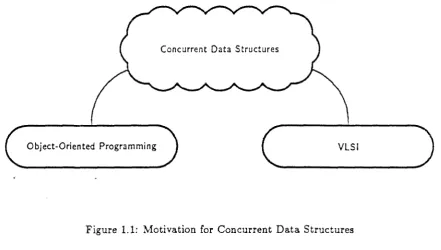
This thesis develops a computer architecture that efficiently supports object-oriented programming using VLSI technology. As shown in Figure 1.1, the central idea of this thesis is concurrent data structures. The development of concurrent data structures is motivated by two underlying concepts: object-oriented programming and VLSI. The paradigm of object-oriented programming allows programs to be constructed from object classes that can be shared among applications. By defining concurrent data structures a.s
distributed objects, these data structures can be shared a.cross many applications. VLSI circuit technology motivates the use of concurrency and the construction of ensemble machines. These highly concurrent machines a.re required to take advantage of this high throughput, high latency technology.
1.3
Background
[image:17.534.49.490.138.388.2]structure distributed across a loosely coupled network of computers. The concurrency achieved in these data structures is limited, and their analysis for the most part ignores communication cost. In contrast, the concurrent data structures developed here-are intended for tightly coupled concurrent computers with thousands of processors. Their concurrency scales with the size of the problem, and they are designed to minimize communications.
Many algorithms have been developed for concurrent computers ~7],
[9], [15], [75] [85],[102:,
;116]. Most concurrent algorithms are for numerical problems. These algorithms tend to be oriented toward a small number of processors and use a MMD[42]
shared-memory model that ignores communication cost and imposes global synchronization.Object-oriented programming began with the development of SI?vfULA
[11], [19].
SIM-ULA incorporated data abstraction with cla.sses, inheritance with subclasses, and late-binding with virtual procedures. SIMULA is even a concurrent language in the sense that it provides co-routining to give the illusion of simultaneous execution for simulation problems. Smalltalk[51], [52],
[7
4], [136]
combines object-oriented programming with aninteractive programming environment. Actor languages
[1], [17]
are concurrent object-oriented languages where objects may send many messages without waiting for a reply. The programming notation used in this thesis combines the syntax of Smalltalk-80 with the semantics of actor languages.The approach taken here is similar in many ways to that of Lang
[i9].
Lang also pro-poses a concurrent extension oi an object-oriented programrning language, SThIULA, and analyzes communication networks for a concurrent computer to support this language. There are several differences between Lang's work and this thesis. First, this work de-velops several programming language features not found in Lang's concurrent SIMULA: distributed objects to allow concurrent access, simultaneous execution of several methods by the same object, and locks for concurrency control. Second, by analyzing interconnec~ tion networks using a wire cost model, I derive the result that low dimensional networks are preferable for constructing concurrent computers, contradicting Lang's result that high dimensional binary n-cube networks are preferable.1.4
Concurrent Computers
This thesis is concerned with the design of concurrent computers to manipulate data structures. We
will
limit our attention to message-passi"ng[112]
MIMD[42]
concurrent computers. By combining a processor and memory in each node of the machine, this classAddress
Old Data ,,_
New Data
...
Processor
-
--
Memory--
~Figure 1.2: Information Flow in a Sequential Computer
Concurrent computers have evolved out of the ideas developed for programming multi-programmed, sequential computers. Since multiple processes on a sequential computer communicate through shared memory, the first concurrent computers were built with shared memory. ~ the number of processors in a computer increased, it became neces-sary to separate the cormnunication channels used for communication from those used to access memory. The result of this separation is the message-passing concurrent com-puter.
Concurrent programming models have evolved along with the machines. The problem of synchronizing concurrent processes was first investigated in the context of multiple processes on a sequential computer. This model was used almost without change on shared-memory machines. On message-passing ma.chines, explicit communication prim-itives have been added to the process model.
1.4.1
Sequential Computers
A sequential computer consists of a processor connected to a memory by a communi-· cation channel. ~ shown in Figure 1~2, to modify a. single data object requires three messages: an address message from processor to memory, a data message back to the processor containing the original object, and a data message back to memory containing the modified object. The single communication channel over which these messages travel is the principal limitation on the speed of the computation, and has been referred to as the Von Neumann bottleneck [4J.
level communication and synchronization mechanisms such as interlocked read-modify-write operations, semaphores, and critical sections are built up from reading and writing shared memory locations. On some machines interlocked read-modify-write operations are provided in hardware.
Communication between processes can be synchronous or asynchronous. In program-ming systems such as CSP [62] and OCCA.\1 [64] that use synchronous communication, the sending and receiving processes must rendezvous. 'Whichever process performs the communication action first must wait for the other process. In systems such as the Cos-mic Cube [123] and actor languages [1],[17] that use asynchronous communication, the sending process may transmit the data and then proceed with its computation without waiting for the receiving process to accept the data.
Since there is only a single processor on a. sequential computer, there is a unique global ordering of communication events. Communication also takes place without delay. A shared memory location written by process A on one memory cycle can be read by process B on the next cycle 1. With global ordering of events and instantaneous com-munication, the strong synchronization implied by synchronous communication can be implemented without signifi.cant cost. The same is not true of concurrent computers where com..rnunication events are not uniquely ordered and the delay of cornmunication is the major cost of computation.
It is possible for concurrent processes on a sequential computer to access an object simultaneously because the access is not really simuitaneous. The processes, in fact, access the object one a.t a. time. On a. concurrent computer the illusion of simultaneous access can no longer be maintained. Most memories have a. single port and can service only a. single access at a. given fone.
1.4.2
Shared-Memory Concurrent Computers
To eliminate the Von Neumann bottleneck, the processor and memory can be replicated and interconnected by a. switch. Sha.red memory concurrent computers such as the NYU Ultra.computer [106],[54],[55], C.M~1P [135], and RP3 [100] consist of a number of processors connected to a number of memories through a switch, as shown in Figure 1.3.
'
Although there a.re many paths through the switch, and many messages can be trans-mitted simultaneously, the switch is still a bottleneck. While the bottleneck has been made wider, it has also been made longer. Every message must travel from one side of the switch to the other, a considerable distance that grows larger as the number of processors increases. Most shared-memory concurrent computers are constructed using indirect networks and cannot take advantage of locality. All messages travel the same
00000000
l I l I I
i
I I
Old DataI
SWITCHI
I
1
•
I
i
l
I
1
Address New Data00000000
Figure 1.3: Information Flow in a Shared-Memory Concurrent Computer
distance regardless of their destination.
Shared-memory computers are programmed using the same process-based model of com-putation described above for multiprogrammed sequential computers. As the name im~ plies, communication takes place through shared memory locations. Unlike sequential computers, however, there is no unique global order of communication events in a shared-memory concurrent computer, and several processors cannot access the same shared-memory location at the same time.
Some designers have avoided the uniformly high communication costs of shared-memory computers by placing cache memories in the processing nodes [53]. Using a cache, mem-ory locations used by only a single processor can be accessed without communication overhead. Shared memory locations, however, still require communication to synchronize the caches2• The cache nests the communication channel used to access local memory
inside the channel used for interprocessor communication. This division of function between memory access and communication is made more explicit in message-passing concurrent computers.
Control
Message
•
Figure 1.4: Information Flow in a. ~fessage-PassiI1g Concurrent Computer
1.4.3
1\ifessage-Passing Concurrent Computers
In contrast to sequential computers and shared-memory concurrent computers which operate by sending messages between processors and memories, a message-passing con~ current computer operates by sending messages between processing nodes that contain both logic and memory.
As shown in Figure 1.4, message-passing concurrent computers such as the Caltech Cos-mic Cube [112] and the Intel iPSC [65] consist of a. number of processing nodes intercon-nected by communication channels. Each processing node contains both a processor and a local memory. The communication channels used for memory access are completely separate from those used for inter-processor communication.
Message-passing computers take a further step toward reducing the Von Neumann bot-tleneck by using a direct network which allows locality to be exploited. A message to an object resident in a neighboring processor travels a variable distance which can be made short by appropriate process placement.
specifies: the object to be modified, the modification to be performed, and the location to which the control state is to move next.
Keeping data stationary also encourages locality. Ea.ch data object is associated with the procedures that operate on it. This association allows us to place the logic that operates on a class of objects in close proximity to the memory that stores instances of the objects. As Seitz points out, "both the cost and performance metrics of VLSI favor architectures in which cornmunication is localized" f 111].
'
.
Message-passing concurrent computers are programmed using an extension of the process model that makes communication actions explicit. Under the Cosrric Kernel [123], for example, a process can send and receive messages as well as spawn other processes. This model makes the separation of corrununication from memory visible to the programmer. It also provides a base upon which an object-oriented model of computation can be built.
1.5
Summary
Chapter 2
Concurrent Smalltalk
The message-passing paradigm of object-oriented la.."lguages such as Smalltalk-80 [51] introduces a discipline into the use of the communication mechanism of message-passing concurrent computers. Object-oriented languages also promote locality by grouping together data objects with the operations that are performed on them.
Programs in this thesis are described using Concurrent Smalltalk (CST), a derivative of Smallta.lk-80 with three extensions. First, messages can be sent concurrently without waiting for a reply. Second, several methods may access an object concurrently. Locks a.re provided for concurrency control. Finally, the language allows the programmer to specify objects that are distributed over the nodes of a concurrent computer. These distributed objects have many constituent objects and thus can process many messages simultaneously. They are the foundation upon which concurrent data structures are built.
The remainder of this chapter describes the novel features of Concurrent Smalltalk. This discussion assumes that the reader is familiar with Smalltalk-80 [51]. A brief overview of CST is presented in Appendix A. In Section 2.1 I discuss the object-oriented model of programming and show how an object-oriented system can be built on top of the conventional process model. Section 2.2 introduces the concept of distributed objects. A distributed object can process many requests simultaneously. Section 2.3 describes how a method can exploit concurrency in processing a single request by sending a message without waiting for a reply. The use 'of locks to control simultaneous access to a CST object is described in Section 2.4. Section 2.5 describes how CST blocks include local variables and locks to permit concurrent execution of a block by the members of a collection. This chapter concludes with a brief discussion of performance metrics in
2.1
Object-Oriented Programming
Object-oriented languages such as Sl)vHJLA [11; and Smalltalk
'.51]
provide data abstrac-tion by defining classes of objects. A class specifies bot!i the data state of an object a~d the procedures or methods that manipulate this data.Object-oriented languages are well suited to programming message-passing concurrent computers for four reasons.
• The message-passing paradigm of languages like Smalltalk introduces a discipline into the use of the corrununication mechanism of message-passing computers.
• These languages encourage locality by associating each data object with the meth-ods that operate on the object.
• The information hiding provided by object-oriented languages makes it very con-venient to move com..'11on1y used methods or classes into hardware while retaining compatibility with software implementations.
• Object names provide a. uniform address space independent of the physical place-ment of objects. This avoids the problems associated with the partitioned address space of the process model: memory ad.dresses in~rnal to the process and process identifiers external to the process. Even when memory is shared, there is still a partition between memory addresses and process identifiers.
In an object-oriented language, computation is performed by sending messages t'o objects. Objects never wait for or explicitly receive messages. Instead, objects are reactive. The arrival of a message at an object triggers an action. The action may involve modifying the state of the object, transmitting messages that continue the control flow, and/or creating new objects.
The behavior of an object can be thought of as a function,
B
[1].
LetS
be the set of all object states and M the set of all messages. An object with initial state,i
ES, receiving a message, m E lvf, transitions to a new state, n E S, transmits a po~ibly empty set of messages m1C Af, and creates a. possibly empty set of new objects o C 0.
B: S x Af ...._.. P(lv!), S, P(O). (2.1)
Actions as described by the behavior function (2.1) are the primitives from which more complex computations are built. In analyzing timing and synchronization each action is considered to take place instantaneously, so it is possible to totally order the actions for a single object.
size is sent to object x, and the method must wait for the reply before continuing.
xSize +-x size.
ySize +-xSize
*
2.Since there is no receive statement, multiple actions are required to implement this method. The first action creates a. context and sends the size message. The contex:; con-tains a.11 method state: a. pointer to the receiver, temporary variables, and an instruction pointer into the method code. A pointer to the context is placed in the reply-to field of the size message to ca.use the size method to reply to the context rather than to the original object. When the size method replies to the context, the second action resumes execution by storing the value of the reply into the variable xSize. The context is used to hold the state of the method between actions.
Objects with behaviors specified by (2.1) can be constructed using the message-passing process model. Ea.ch object is implemented by a process that executes an endless receive-dispatch-execute loop. The process receives the next message, dispatches control to the associated action, and then executes the action. The action may change the state of the object, send new messages, and/or create new objects. In Chapter 5 we will see how, by tailoring the hardware to the object model, we can make the receive-dispatch-execute process very fast.
2.2
Distributed Objects
In many cases we want an object that can process many messages simultaneously. Since the actions on an object a.re ordered, simultaneous processing of messages is not consi_s., tent with the model of computation described above. We can circumvent this limitation by using a distributed object. A distributed object consists of a collection of constituent objects, each of which can receive messages on behalf of the distributed object. Since many constituent objects can receive messages at the same time, the distributed object can process many messages simultaneously.
class superclass
instance variables cla.ss variables locks
cla.ss methods
class methods ...
instance methods
tally: aKey
11
TallyCoi!ection Distributed Collection data
the class name a distributed object local collection oj data none
none
count data matching aKey (self upperNeighbor) localTally: aKey sum: 0 returnFrom: myld
localTally: aKey sum: anlnt returnFrom: anld
J newSum
I
newSum <--sum. data do: [:eachI
(each
=
aKey) ifTrue: [newSum <--newSum +1]]. (myld = anld) ifTrue: [requester reply: newSumJifFalse: [(self upperNeighbor) localTally: aKey sum: newSum returnFrom: anld].
other instance methods ...
objects (COs). Each CO has an instance variable data and understands the messages tally: and localTally:. A distributed object is created by sending a newOn message to its class.
aTailyCollection +-TallyCollection newOn: someNodes.
The argument of the newOn: message, someNodes, is a collection of processing nodes1 .
The newOn: message creates a CO on each member of someNodes. There is no guarantee that the COs will remain on these processing nodes, however, since objects are free to migrate from node to node.
When an object sends a message to a distributed object, the message may be delivered to any constituent of the distributed object. The sender has no control over which CO receives the message. The constituents thern.selves, however, can send messages to specific COs by using the message co:. For example, in the code below, the receiver (self), a constituent of a distributed object, sends a localTaily message to the an ldth constituent of the same distributed object.
(self co: anld) localTally: #foo sum: 0 returnFrom: myld.
The argument of the co: message is a constituent identifier. Constituent identifiers a.re integers assigned to each constituent sequentially beginning with one. The constant myld gives each CO its own index and the constant maxld gives each CO the number of constituents.
The method tally: a Key in Figure 2.1 counts the occurrences of a Key in the distributed collection and returns this number to the sender. The constituent object that receives the tally message sends a localTally message to its neighbor2• The localTally method
counts the number of occurrences of aKey in the receiver node, adds this number to the sum argument of the message and propagates the message to the next CO. When the localTally message has visited every CO and arrives back at the original receiver, the total sum is returned to the original customer by sending a reply: message to requester. Distributed objects often forward mes~ages between COs before replying to the original requesting object. Tally Collection, for example, forwards loca!Tally messages in a cycle to all COs before replying. CST supports this style of programming by providing the reserved word requester. For messages arriving from outside the object, requester is bound to the sender. For internal messages, requester is inherited from the sending method.
1
Processing nodes are objects.
This forwarding behavior illustrates a major difference between CST and Smalltalk-SO: CST methods do not necessarily return a value to the sender. :'vfethods that do not explicitly return a value using
'i'
terminate without sending a reply. The tally: method terminates without sending a reply to the sender. The reply is sent later by the locaffaily method.The tally: method shown in Figure 2.1 exhibits no concurrency. The point of a dis-tributed object is not to provide concurrency in performing a single operation on the object, but rather to allow many operations to be performed concurrently. For example, suppose we had a Tally Collection with 100 COs. This object could receive 100 messages simultaneously, one at each CO. After passing 10,000 localTally messages internally, 100 replies would be sent to the original senders. The 100 requests are processed concurrently.
Some concurrent applications require global communication. For example, the concur-rent garbage collector described by Lang [79] requires that processes running in each processor be globally synchronized. The hardware of some concurrent computers sup-ports this type of global communication. The Caltech Cosmic Cube, for instance, prcr vides several wfre-or global communication lines for this purpose [112].
Some applications require global communication combined with a simple computation. For example, branch and bound search problems require that the minimum bound be broadcast to all processors. Ideally, a communication network would accept a bound from each processor, compute the minimum, and broadcast it. In fact, the computation can be carried out in a distributed manner on the wfre-or lines provided by the Cosmic Cube.
Distributed objects provide a convenient and machine-independent means of describing a broad class of global communication services. The service is formulated as a distributed object that responds to a number of messages. For example, the synchronization ser-vice can be defined as an object of class Sync that responds to the message wait. The distributed object waits for a specified number of wait messages and then replies to all requesters. On machines that provide special hardware, class Sync can make use of this hardware. On other ma.chines, the service can be implemented by passing messages among the constituent objects.
2.3
Concurrency
CST does not exclude the use of concurrency in performing a single method. A more sophisticated tally: method is shown in Figure 2.2. Here I use messages upperChild a.nd lowerChild to embed a tree on the COs3• When a CO receives a tally: message it sends
two localTally messages down the tree simultaneously. When the localTally messages
3The implementation of methods upperChild and lowerChild is straightforward and will not be shown.
instance methods for class Ta!lyCollection
tally: aKey
l I
jself localTaily: aKey level: 0 root: myld.
localTally: aKey level: anlnt root: anld
i
upperTally lowerTaily sum aleveq alevei=
anlnt+
1.sum .-Q.
data do: [:each
I
(each
=
aKey) ifTrue: [sum -sum+1lJ.
(anlnt<
maxlevel) ifTrue: [count data matchi"ng a.Key
upperTal!y -{self upperChild: anld level: alevel) localTally: aKey level: 1 root: anld. lowerTally <-(self lowerChild: anld level: alevel) localTally: aKey level: 1 root: anld. jupperTally
+
lowerTal!y+
sumJ.jsum.
Figure 2.2: A Concurrent Tally Method
reach the leaves of the tree, the replies are propagated back up the tree con2urrently. The new TallyCollection can still process many messages concurrently, but now it uses concurrency in the processing of a single message as well.
The use of a comma, ', ', rather than a period, '.', at the end of a statement indicates that the method need not wait for a reply from the send implied by that statement before continuing to the next statement. When a statement is terminated with a period, '.', the method waits for all pending sends to reply before continuing.
A simpler example of concurrency is shown in Figure 2.3. This figure shows a portion of the definition of Class lnterval4• The definition has two methods; l:u: is a class method
that creates a new interval, and contains: is an instance method that checks if a number is contained in an interval.
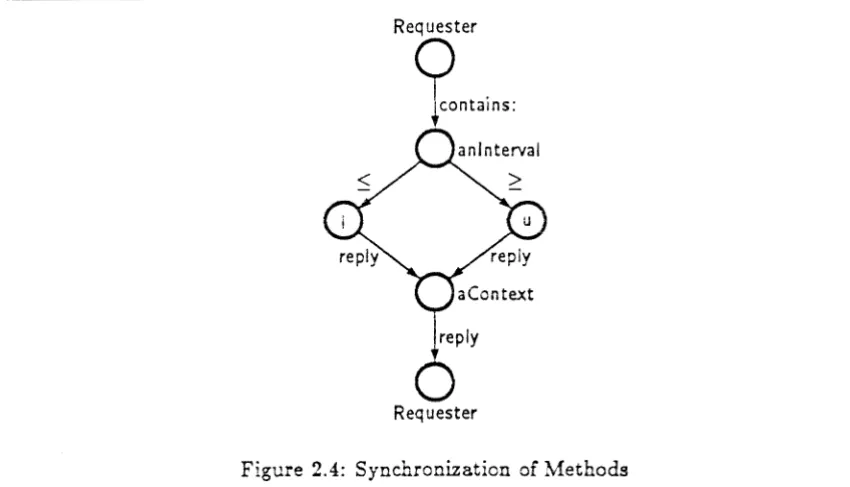
As shown in Figure 2.4, the contains: method is initiated by sending a message, contains: aNum, to object, anlnterval, of class Interval. Objects of class Interval have two
acquain-tances 5 , I and u. To check if it contains aNum, object an Interval sends messages to both
'The term Interval here means a closed interval over the real numben, {a E ~
i
I~ a:::; u}. This differs from the Smallta.lk-80 [51] definition of cla.J1s Interval.6
cla.ss
supercla.ss
instance variables
cla.ss variables
locks
cla.ss methods
Interval Object I
u
rwlock
I: aNum u: anotherNum
I
newlntervalI
newlnterval +-self newLocal. newlnterval I: aNum.
newlntervai u: anotherNum. jnewlnterval
other class methods ...
instance methods
contains: aNum
require rwlock.
I
lin uinI
lin +-I ::; aNum. uin +-u2:
aNum. t(lin and: uin)other instance methods ...
the class name
the name of its superclass lower bound
upper bound none
implements readers and writers
creates a new interval
tests for number in interval
I
reply6
Requester
Figure 2.4: Synchronization of Methods
I and u asking I if I ~ aNum, and asking u if u
>
aNum. After receiving both replies, anlnterval replies with their logical and.Observe that the contains: method requires three actions. The first action
oc~urs when
the contains: message is received by anlnterval. This action sends messages to I and u and creates a context, aContext, to which l and u will reply. The first reply to aConte.xt triggers the second action which simply records its occurrence and the value in the reply. The second reply to aContext triggers the final action which computes the result and replies to the original sender. In this example the context object is used to join two concurrent streams of execution.Only the first action of the contains: method is performed by object anlnterval. The subsequent actions are performed by object aContext. Thus, once the first action is complete an Interval is free to accept additional messages. The ability to process several requests concurrently can result in a ~reat deal of concurrency. This simple approach to concurrency can cause problems, however, if precautions are not taken to exclude incompatible methods from running concurrently.
Figure 2.3 illustrates another novel feature of CST. Instance variables in CST may be either internal variables or external variables. Internal variables are stored in the same processing node as an object and may be accessed without passing messages. External variables may be stored anywhere and require message passing for access. An internal variable is created using the newlocal message, while an external variable may be ac~
[image:32.526.46.471.93.336.2]in Figure 2.3 uses the newLocai method to generate new instances of class intervai.
2.4
Locks
Some problems require that an object be capable of sending messages and rece1vrng their replies while deferring any additional requests. In other cases we may want to process some requests concurrently, while deferring others. To defer some messages while accepting others requires the ability to select a subset of all incoming messages to be received. This capability is also important in database systems, where it is referred to as concurrency control [133].
Consider our example object, an!nterval. To maintain consistency, anlnterval must defer any messages that would modify I or u until after the contains: method is complete. On the other hand, we want to allow an Interval to process any number of contains: messages simultaneously.
SAL, an actor language, handles this problem by creating an insensitive actor which only accepts become messages
[1]
6. The insensitive actor buffers new requests until the originalmethod is complete. Lang's concurrent SIMULA [79] incorporates a select construct to allow objects to select the next message to receive. While exclusion can be implemented using select, Lang's language treats each object as a critical region, allowing only a single method to proceed at a time. Neither insensitive actors nor critical regions allow an object to selectively defer some methods while performing others concurrently.
Adding locks to objects provides a general mechanism for concurrency control. A lock is part of an object's state. Locks impose a partial order on methods that execute on the object. Each method specifies two possibly empty sets of locks: a set of locks the method requires, a..'1.d a set of locks the method excludes. A method is not allowed to begin execution until all previous methods executing on the same object that exclude a required lock or require an excluded lock have completed. The concept of locks is similar to that of triggers [90].
A solution to the readers and writers" problem is easily implemented with this locking mechanism. All readers exclude rwlock, while all writers both require and exclude rwlock. Many reader methods can access the object concurrently since they do not exclude each other. As soon as a writer message is received, it excludes new reader methods from starting while it waits for existing readers to complete. Only one writer at a time can gain access to the object since writers both require and exclude rwlock. This illustrates how mutual exclusion can also be implemented with a single lock.
6
Blocks in CST differ from Smalltalk-SO blocks in two ways.
• A CST block may specify local variables and locks in addition to just arguments. [ :arg1 :arg2
I
(locks) :var1 :var2I
code]• It is possible to break out of a CST block without returning from the context in which the value message was sent to the block. The down-arrow symbol,
'l ',
is used to break out of a block in the same way that'i'
is used to return out of a block.Sending a block to a collection can result in concurrent execution of the block by members of the collection. Giving blocks local variables allows greater concurrency than is possible when all temporary values must be stored in the context of the creating method. Locks are provided to synchronize access to static variables during concurrent execution.
2.6
Performance Metrics
Performance of sequential algorithms is measured in terms of time complexity, the num~ ber of operations performed, and space complexity, the amount of storage req~ired [2]. On a concurrent machine we are also concerned with the number of operations that can be performed concurrently.
The algorithms and data structures developed in this thesis are based on a message-passing model of concurrent computation. Message-message-passing concurrent computers are communication limited. The time required to pass messages dominates the processing time, which we will ignore.
In sharp contrast, most existing concurrent algorithrns have been developed assuming an ideal shared-memory multiprocessor. In the shared-memory model, communication cost is ignored. Processes can access any memory location with unit cost, and an unlimited number of processes can access a single memory location simultaneously. Performance of algorithms a..'lalyzed using the shared-memory model does not accurately reflect their performance on message-passing concurrent computers.
Communication cost has two components:
latency: the delay of delivering a single message in isolation,
For purposes of analysis I will ignore throughput and consider only latency.
The prograrn.s in this thesis are analyzed assuming a binary n-cube interconnection topol-ogy. Programs are chargeci one unit of time for ea.ch communication channel traversed in a binary n-cube.
2.7
Summary
In
this chapter I have introduced Concurrent Smalltalk (CST), a programming notation for message-passing concurrent computers. Its novel features include locks for concur-rency control, and the ability to create distributed objects. CST borrows its syntax, late-binding, and inheritance directly from the Smalltalk programming language [511.Many of the ideas in CST are borrowed from Athas' language, XCPL [3J.
Distributed objects are implemented as a collection of constituent objects (COs). Any CO ca.n receive a message sent to the distributed object. Since many COs can receive messages at the same time, a distributed object ca.n process many messages simultane-ously. The constituents of a distributed object are assigned to processing nodes when the object is created. Thus, distributed objects provide a mechanism for mapping a data structure onto an interconnection topology. Distributed objects are the foundation upon which concurrent data structures, such as the balanced cube described in Chapter 3, are built.
CST permits methods to exploit concurrency by sending several messages before waiting for any replies. CST also allows some methods to terminate without sending any reply. Thus a message can be forwarded across many objects before a reply is finally sent to the original requester.
Chapter 3
The Balanced Cube
Sequential computers spend a large fraction of their time manipulating ordered sets of data.. For these operations to be performed efficiently on a concurrent computer, a new data structure for ordered sets is required. Conventional ordered set data structures such as heaps, balanced trees, and B-trees [2] have a single root node through which all operations must pa.ss. This root bottleneck limits the potential concurrency of tree structures, making them unable to take advantage of the power of concurrent computers. Their maximum throughput is 0(1). This chapter presents a new data structure for implementing ordered sets, the balanced cube [21], which offers significantly improved concurrency.
The balanced cube eliminates the root bottleneck allowing it to achieve a throughput of 0
(i
0;N)
operations per unit time1. Concurrency in the balanced cube is achieved through uniformity. With the exception of the balancing algorithm, all nodes are equals. An operation may originate at any node and need not pass through a root bottleneck as in a tree structure. In keeping with the spirit of a homogeneous machine, the balanced cube is a homogeneous data structure.Why is a concurrent data structure such as the balanced cube needed? Many a.pplica.. tions are organized around an ordered set data structure. By using a balanced cube to implement this data structure, the application can be made concurrent with very little effort. The application is divided into 'partitions that communicate by storing data. in and retrieving data from the balanced cube. Because the balanced cube can process these requests concurrently, accesses to the balanced cube do not serialize the application. In Section 3.8 we will see how a balanced cube can be used in a concurrent computer mail system, in a concurrent artwork analysis program, and in a concurrent directed-search algorithm.
The balanced cube's topology is well matched to binary n-cube multiprocessors. The
balanced cube maps members of an ordered set to subcubes of a binary n-cube. A Gray code mapping is used to preserve the linear adjacency of the ordered set in the Hamming distance adjacency of the cube.
Previous work on concurrent data structures has concentrated on reducing the interfer-ence between concurrent processes accessing a common data base but has not addressed the limited concurrency of existing data structures. Kung and Lehman [76] have devei~ oped concurrent algorithms for manipulating binary search trees. Lehman and Yao
[81]
have extended these concepts and applied them to B-trees. Algorithms for concurrent search and insertion of data in AVL-trees [31~ and 2-3 trees [32] have been developed by Ellis. Ellis has also developed concurrent formulations of linear hashing [33] and extendible hashing [34].These papers introduce a. number of useful concepts that minimize locking of records, postpone operations to be performed, and use marking mechanisrns to modify the data structure. However, these papers consider the processes and the data. to be stationary, and thus do not address the problems of moving processes and data between the nodes of a concurrent computer. The cost of comi.1mnications, which we assume to dominate processing costs, has largely been ignored.
The remainder of this chapter describes the balanced cube and how it addresses the issues of correctness, concurrency, and throughput.
In
the next section the data structure is presented, and the consistency conditions are described. The VW search algorithm is described in Section 3.2. VW search uses the distance properties of the Gray code to search the balanced cube for a data record in O(log N) time while locking only a single node at a time. An insert algorithm is presented in Section 3.3. Insertion is performed by recursively splitting subcubes of the balanced cube. Section 3.4 discusses the delete operation. Deletion is accomplished by simply marking a record as deleted. A background garbage collection process reclaims deleted subcubes. The insertion and deletion algorithms tend to unbalance the cube. A balancing algorithm, presented in Section 3.5, a.cts to restore balance. Each of the algorithms presented in this chapter is analyzed in terms of complexity, concurrency, and correctness. Section 3.6 extends the balanced cube concept to B-cubes which store several records in ead1 node. Section 3.7 discusses the results of experiments run to verify the balanced cube algorithms. The chapter concludes with a. discussion of some possible balanced cube applications in Section 3.8.3.1
Data Structure
3.1.1
The Ordered Set
field in each record. In this context the ordered set is used to store a database of relations associating the key field with the other fields of the record. The order relation defined en the keys of the records is implicit in the structure. A data structure implementing the ordered set must efficiently support the following operations.
at: key return the object associated with a key.
at: key put: object add an object to the set
delete: key remove the object associated with key from the set.
from: Ikey to: ukey do: aBlock concurrently send a value: message to aBlock for each element of the set of objects with keys in the range [lkey,ukeyj.
succ: key1 return the object with the smallest key greater than keyl.
pred: key1 return the object with the largest key smaller than keyl.
max return the maximum object.
min return the minimum object.
In this chapter we will restrict our attention to developing algorithms for the search (at:), insert (at:put:) and delete operations. The remaining functions can be implemented a.s simple extensions of these three fundamental operations. The succ: and pred: operations can be implemented using the nearest neighbor links present in the balanced ~ube.
3.1.2
The Binary n-Cube
The balanced cube is a data structure for representing ordered sets that stores data in
subcubes of a binary n-cube [96], [124]. A binary n-cube has N = 2n nodes accessed by n-bit addresses. Each bit of the address corresponds to a dimension of the cube. The node or subcube with address ll1 is denoted
N[
G1]. H the address is implicit, the node will be referred to as N. The binary n-cube is connected so that nodeN[ai]
is adjacent to all nodes whose addresses differ from ll1 in exactly one bit position: { ai 9 2;I
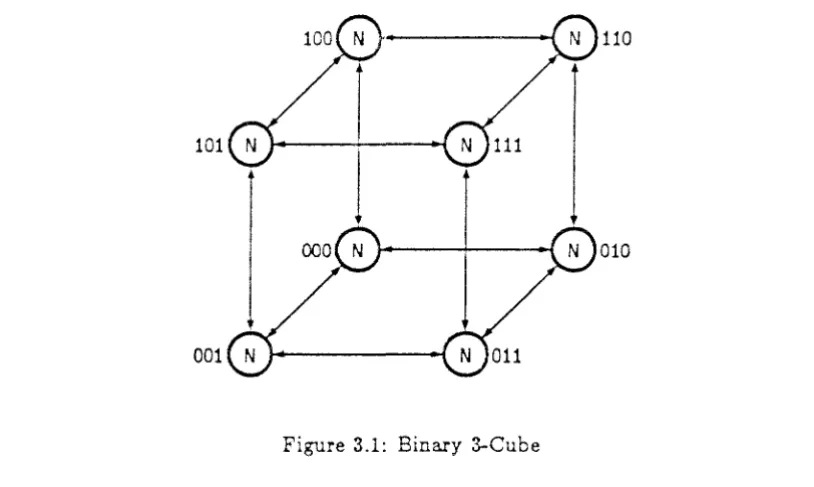
0 :::; j :::; n - 1}.A binary 3-cube with nodes labeled by address is shown in Figure 3.1.
An m-subcube of a binary n-cube is a set of Af = 2m nodes whose addresses are identical in all but m positions. An m-subcube is identified by an address that contains unknowns, represented by the character X, in the m bit positions in which its members' addresses may differ. For example, in Figure 3.1 the top of the 3-cube is the lXX subcube. The top front edge is the lXl subcube.
110
101
1
010001
Figure 3.1: Binary 3-Cube
the !XX subcube is a right subcube while the !Xl subcube is not. A node is a right 0-subcube, a singleton set, since it has zero Xs in its address. The corner node of a right subcube N[a] is the node with the lowest address in the subcube, N[min(a)]. The corner node address is the subcube address with all unknown bits set to zero. The upper nodes
of a right subcube N[a] are all the nodes in the subcube other than the corner node: the elements of the set
N[aj \ N[min(a)].
3.1.3
The Gray Code
The balanced cube uses a Gray code [56] to map the elements of an ordered set to the vertices of a binary n-cube. Consider an integer, I, encoded as a weighted binary vector,
bn-1, ... , bo, so that
n-1
I=
:L
bizi. (3.1)j=O
The reflected binary code or Gray code representation of
I,
a bit vectorG(I)
= 9n-1, ... , go,is generated by taking the modulo-2 sum of adjacent bits of the binary encoding for I
[image:39.523.53.460.101.344.2]ifi=n-1
Since the EB operation is linear, we can convert back to binary by swapping gi and bi
in equation 3.2. We use the function B(
J)
to represent the binary number whose Gray code representation is J.ifi<n-1
ifi=n-1
(3.3)
By repeated substitution of equation 3.3 into itself we can express bi as a modulo-2 summation of the bits of G(I).
n-1
b, =
L
9i (mod 2)(3.4)
j=i
While these equations serve as a useful recipe for converting between binary and Gray codes, we gain more insight into the structure of the code by considering a recursive list definition of the Gray code. For any integer, n, we can construct a list of N = 2" integers, gray(n), so that the
ph
element of gray(n) is an integer whose binary encoding is identical to the Gray encoding of I. The construction begins with the Gray code of length 1. At the ith step we double the length of the code by appending to the current list a reversed copy of itself with the ith bit set to one2 .gray(O) = [OJ.
(3.5)
gray(n) =append( gray(n - 1) , 2(n-l)
+
reverse(gray(n - 1)) ).(3.6)
It is this reversal that gives the code the symmetry and reflection properties that we will use in developing the balanced cube search algorithm.
In
the linear space of the ordered set, element I is adjacent to elements I± 1. In the cube space, however, the distance between two nodes is the Hamming distance between the node addresses: the number of bit positions in which the two addresses differ. For nodesA and B to be adjacent, they must be Hamming distance one apart, dn(A, B) = 1. The Hamming distance between I and I - 1, dnA(I) is given by the recursive equation.
3 (010)
Figure 3.2: Gray Code Mapping on a Binary 3-Cube
{
dHA(~)
+
1 if 211,Ii-
0dHA(I)
= 1 if 2AI
undefined if I = 0(3.7)
A plot of this function is shown in Figure 3.26 on page 60.
For example, in the case where I
=
lf-
and I - 1=
lf- -
1, the elements are at op-posite corners of the cube, distance n apart. The Gray code has the property thatdH(G(I), G(I
+
1)) = 1, VI 3 0 ~ I ~ (N -2).
Thus, if we map element I of the linear order to node G(I) of the binary n-cube, nodes that are adjacent in linear space are also adjacent in cube space. A Gray code mapping of integers onto a binary 3-cube is shown in Figure 3.2.3.1.4
The Balanced Cube
In
a balanced cube, each datum is associated with a right subcube, N[a;], and is stored in a constituent object in the corner node, N[min(ai)], of the subcube. Figure 3.3 shows the header for class Balanced Cube. A datum is composed of a key, N key, an object associated with the key, N objer.t, the dimension of the subcube, N dim, and a flag, N flag, that indicates the status of the su bcu be. The data are ordered so that ifclass superclass
instance variables
class variables locks
Balanced Cube Distributed Object
key
data dim flag
rwlock
the class name defines the order
object associated with key the dimension of the subcube status of subcube
none
implements readers and writers
Figure 3.3: Header for Class Balanced Cube
Harn.ming distance one apart.
For the remainder of this chapter I will refer to both cube addresses and to linear order addresses. A cube address is the physical address of a processing node. The parenthesized binary numbers in Figure 3.2 are cube addresses. A linear address is the position of a node in the linear order. For example, the integers (0-7) in Figure 3.2 are linear addresses. Linear addresses Alin are related to cube addresses Acube by (3.2) and
(3.4).
Alin
B(Acube)
(3.8)
Acube
= G(A!in)Upper nodes of the subcube N[a;] are flagged as slaves to the corner node by setting
N flag ._#slave. Any messages transmitted to an upper node
N[au]
are routed to the corne