Integral on Transcomplex Numbers
Tiago S. dos Reis, James A.D.W. Anderson,
Member, IAENG
Abstract—The usual complex integral is defined in terms of complex numbers in Cartesian form but transcomplex numbers are defined in polar form and almost all transcomplex numbers, with infinite magnitude, have no Cartesian form. However, there are eight infinite, transcomplex numbers which do have a Cartesian form and these can be used to define the transcomplex integral as the limit of sums of these eight numbers. Thus we introduce the transcomplex integral.
Index Terms—transcomplex integral, transcomplex deriva-tive, transcomplex number, transmathematics.
I. INTRODUCTION
T
HE transreal numbers [2] [10] totalise the real numbers by allowing division by zero in terms of three definite, non-finite numbers: negative infinity, −∞=−1/0; positive infinity, ∞ = 1/0; and nullity, Φ = 0/0. In earlier work, real elementary functions and real limits were extended to transreal form [1] [6], as were both real differential and in-tegral calculus [5] [7]. This extends real analysis to transreal analysis. Further to this work, a new transreal integral is being developed, but so far we have it only for the extended-real numbers [3].We are now in the process of extending complex analysis to transcomplex analysis. Starting with the transcomplex numbers [4] the transcomplex topology, elementary functions and limits were developed [8] [9]. In the present paper we develop the transcomplex integral and just as much of the transcomplex derivative as we need. This leaves a totalisation of the transcomplex derivative for future work, which will then extend complex analysis to transcomplex analysis. Thus the present paper can be seen as the penultimate step in extending complex analysis.
In order to understand this present paper, we advise the reader to review the transreal integral [7] and to review transcomplex numbers, their arithmetic, how their topology works, and how the elementary functions are defined on them [9].
The natural numbers have two different definitions, either including or excluding zero. The former definition is popular in Computer Science, the latter in Mathematics. Here we follow the mathematical conventionN={1,2,3, . . .}.
II. INITIALCONSIDERATIONS
In the complex domain, the integral along a curve is defined as follows. If f : [a, b] → C is a function then,
taking u : [a, b] → R and v : [a, b] → R such that
f = u+iv, f is integrable in [a, b] if and only if u and v are integrable in [a, b] and the integral of f in [a, b] is
Manuscript received October 31, 2018. Revised January 25, 2019. Tiago S. dos Reis is with the Federal Institute of Education, Sci-ence and Technology of Rio de Janeiro, Brazil, 27215-350 e-mail: [email protected]
J.A.D.W. Anderson is with the Department of Computer Science, School of Mathematical, Physical and Computational Sciences, Reading University, England, RG6 6AY e-mail: [email protected]
defined asRb
a f(t) dt:=
Rb
a u(t) dt+i
Rb
a v(t) dt. A smooth
path is a differentiable function γ : [a, b] → C such that
γ0 is continuous. Given a smooth path γ : [a, b] → C and
f :γ([a, b])→C,fis integrable onγif and only if(f◦γ)γ0
is integrable in[a, b]and the integral off onγ is defined as
R
γf(z) dz:=
Rb
a f(γ(t))γ 0(t) dt.
Notice that the definition of the complex integral is closely linked to the Cartesian form of complex numbers, a+ib wherea, b∈Randiis the imaginary unit. So we have a big
problem to define the integral in the transcomplex domain. Since almost all infinite transcomplex number cannot be written as a+ib with a, b ∈ RT, not all transcomplex
functions can be represented by u+iv withuandv being transreal functions.
Observe that only eight infinite transcomplex numbers can be written asa+ibwitha, b∈RT, namely, 10,
−1 0 ,
i 0,
−i 0 , 1+i
0 , −1+i
0 , −1−i
0 and 1−i
0 , which are: ∞+i0, −∞+i0, 0 +i∞,0 +i(−∞),∞+i∞,−∞+i∞,−∞+i(−∞)and
∞+i(−∞), respectively. Adding these eight numbers we can get an infinite number of infinite transcomplex numbers which, although they do not have Cartesian form, they are a sum of numbers which have Cartesian form. Note also these eight numbers are, in exponential form: ∞ei0,
∞eiπ, ∞eiπ
2, ∞e−iπ2, ∞eiπ4, ∞ei34π, ∞e−i34π, ∞e−iπ4, respectively. Summing numbers from these eight, we get numbers of the form∞eilπ
2n withl, n∈ {0}∪
N. Now notice
that 2ln, called dyadic rational numbers, are dense in R. Therefore few infinite transcomplex numbers have Cartesian form but every infinite transcomplex number is the limit of a sequence of numbers which are sums of numbers which have Cartesian form.
The transcomplex integral, which we define here, is closely grounded in the above fact. For each transcomplex function f we take(fn)n∈Nsuch thatlimn→∞fn=f andfn can be
written asPm
k=1(uk+ivk)for some m∈Nwhereuk and
vk are transreal functions.
III. THEINTEGRAL ONTRANSCOMPLEXNUMBERS
A series of complex numbers is defined as the sequence
(sn)n∈N where sn := Pni=1zi = z1 + · · · + zn and (zn)n∈
N ⊂ C. We define transreal series in the same way
[6]. But we need to be careful when defining series of transcomplex numbers because transcomplex addition is not associative. For example, z1+z2+z3 is not well defined
since(z1+z2) +z3 can be different fromz1+ (z2+z3).
Definition 1: Let(zn)n∈N⊂CT. We defineP1k=1zk :=
z1 and, for eachn≥2,Pnk=1zk:=
Pn−1
k=1zk
+zn. For
each n∈N denotesn :=P n
k=1zk. The sequence (sn)n∈N
is called a series of transcomplex numbers and is denoted byP
zn, eachsn is called apartial sum of Pzn andzn is
called then-th term of P
zn. We say that Pzn converges
Otherwise, Pz
n diverges or is divergent. When Pzn is
convergent we denoteP∞
k=1zk := limn→∞Pnk=1zk.
Definition 2: We denote
A:=C∪ {Φ} ∪n∞ei2lπn; l, n∈ {0} ∪
N o
and for each z ∈ A we define P
(ak+bki), named the
Cartesian form of z, in the following way:
I) If z ∈C then take a, b∈Rsuch that z =a+biand
define
a1:=a and ak := 0 for all k≥2 and
b1:=b and bk:= 0 for all k≥2.
II) If z= Φthen define
a1:= Φ and ak:= 0 for all k≥2 and
bk := 0 for all k∈N.
III) If z=∞then define
a1:=∞ and ak:= 0 for all k≥2 and
bk := 0 for all k∈N.
IV) Ifz∈n∞eilπ
2n; l, n∈ {0} ∪
N o
\ {∞}then taken∈ {0}∪Nandlodd withl∈ {1, . . . ,2n+1}such thatz=
∞ei2lπn and definea
k :=a (n, l)
k andbk:=b (n, l)
k where
a(kn, l)
k∈N
and
b(kn, l)
k∈N
are defined inductively in the following way:
Forn= 0:
a1(0,1):=−∞ and ak(0,1):= 0 for all k≥2,
b(0k,1):= 0 for all k∈N.
Forn= 1:
a(11,1):= 0 for all k∈N and
b1(1,1):=∞ and bk(1,1):= 0 for all k≥2
and
a(11,3):= 0 for all k∈N and
b1(1,3):=−∞ and bk(1,3):= 0 for all k≥2.
Forn≥2: for allk≥2,
i) if 0×2n−2< l≤1×2n−2 then
a1(n, l):=∞ and ak(n, l):=a(k−n−11, l)
b1(n, l):= 0 and bk(n, l):=b(k−n−11, l)
ii) if1×2n−2< l≤2×2n−2 then
a1(n, l):= 0 and ak(n, l):=a(n−1, l−2n
−2)
k−1
b1(n, l):=∞ and bk(n, l):=b(n−1, l−2n
−2)
k−1
iii) if2×2n−2< l≤3×2n−2 then
a1(n, l):= 0 and ak(n, l):=a(n−1, l−2 n−2)
k−1
b(1n, l):=∞ and b(kn, l):=b(k−n−11, l−2n−2)
iv) if3×2n−2< l≤4×2n−2 then
a1(n, l):=−∞ and ak(n, l):=a(n−1, l−2×2n
−2)
k−1
b1(n, l):= 0 and bk(n, l):=b(n−1, l−2×2 n−2)
k−1
v) if4×2n−2< l≤5×2n−2 then
a1(n, l):=−∞ and ak(n, l):=a(n−1, l−2×2n
−2)
k−1
b(1n, l):= 0 and bk(n, l):=b(n−1, l−2×2n
−2)
k−1
vi) if5×2n−2< l≤6×2n−2 then
a(1n, l):= 0 and a(kn, l):=a(k−n−11, l−3×2n−2)
b(1n, l):=−∞ and b(kn, l):=b(k−n−11, l−3×2n−2)
vii) if6×2n−2< l≤7×2n−2 then
a(1n, l):= 0 and ak(n, l):=a(n−1, l−3×2n
−2)
k−1
b1(n, l):=−∞ and bk(n, l):=b(n−1, l−3×2 n−2)
k−1
viii) if7×2n−2< l≤8×2n−2 then
a(1n, l):=∞ and a(kn, l):=a(k−n−11, l−4×2n−2)
b(1n, l):= 0 and bk(n, l):=b(n−1, l−4×2n
−2)
k−1 .
Remark 3: Notice that for all Cartesian form
P
(ak+bki), it follows that (ak)k∈N and (bk)k∈N
are sequences of transreal numbers which have just a finite number of non-zero elements. Because of this,
P∞
k=1(ak+bki)is nothing more than a finite sum. So that
we do not need to worry about convergence of series.
Proposition 4: Givenz∈ A andP(a
k+bki)its
Carte-sian form, it follows that
z= ∞
X
k=1
(ak+bki).
Proof: The result holds immediately from Definition 2.
Definition 5: Let D ⊂ CT and f : D → CT such that
f(D)⊂ A. For eachw∈D, denote the Cartesian form of f(w)asP(a
k(w) +bki(w)). For eachk∈N, denote asuk
the function uk : D → RT where uk(w) =ak(w) for all
w∈Dand asvkthe functionvk:D→RT wherevk(w) =
bk(w)for allw∈D. Of course,f =P ∞
k=1(uk+vki). We
callP(u
k+vki)theCartesian form of f.
Definition 6: For eachz∈CT we define(zn)n∈N, named
the related sequence to z, in the following way: If z ∈ A
then define zn := z for all n ∈ N; if z /∈ A then take
θ∈ (π,3π] such thatz =∞eiθ and, for each n∈N, take
ln:= maxt∈N; 2tπn < θ and define zn :=∞ei
lnπ 2n .
Proposition 7: For allz∈CT, the related sequence to z
converges toz.
Proof: Let z ∈ CT be arbitrary. If z ∈ A then the
result is immediate; if z /∈ A then take θ ∈ (π,3π] such thatz=∞eiθ and take∞eilnπ2n
n∈N
to z. Notice that, by Definition 6, for all n ∈ N, lnπ
2n < θ≤(ln+1)π
2n whence0< θ−
lnπ
2n ≤
π
2n. Takingntending to infinity in the latter inequality, we have thatlimn→∞lnπ
2n =θ whencelimn→∞∞eilnπ2n =∞eiθ=z.
Definition 8: LetD⊂CT andf :D→CT be arbitrary.
We define(fn)n∈N, namedthe related sequence of functions
tof, in the following way: for each w∈D, take (zn)n∈N,
the related sequence to f(w). For each n ∈N, define fn :
D→CT such thatf
n(w) =zn.
The metricdand the homeomorphismϕused henceforth are defined in [9].
Proposition 9: Let D ⊂ CT be arbitrary. For all f :
D →CT, the related sequence of functions tof converges
uniformly tof.
Proof: Let D ⊂ CT, f : D →
CT and (fn)n∈N be
the related sequence of functions to f. Let positive ε ∈ R
be arbitrary. For each w ∈ D with f(w) ∈ A/ , denote f(w) =∞eiθ(w), whereθ(w)∈(π,3π], and denote the
re-lated sequence tof(w)as∞eiln2(wn)π
n∈N
. As the function
g : R→ C, where g(x) =eix for all x∈ R, is uniformly
continuous in[0,3π], it follows that there is a positiveδ∈R
such that |eix −eiy| < ε whenever x, y ∈ [0,3π] and |x−y| < δ. Letm ∈N such that 2πm < δ. It follows that if n≥m then
θ(w)−
ln(w)π
2n
=θ(w)−
ln(w)π
2n ≤
π 2n < δ for all w ∈ D with f(w) ∈ A/ whence d(fn(w), f(w)) =
ϕ(fn(w)), ϕ(f(w))
=
1 1+1
∞
eiln(2wn)π − 1
1+1
∞
eiθ(w)
=
e
iln(2wn)π −eiθ(w)
< ε for all w ∈ D with f(w) ∈ A/ .
Furthermore, d(fn(w), f(w)) =d(f(w), f(w)) = 0< εfor
all n∈Nand for all w ∈D withf(w)∈ A. Whatever, if n≥mthend(fn(w), f(w))< εfor allw∈D.
Definition 10: Leta, b ∈R witha < b andf : [a, b] → CT such that f([a, b]) ⊂ A and take P(uk+ivk) its
Cartesian form. We say that f is integrable in [a, b] if and only ifuk andvk are integrable in [a, b]for allk∈N. Iff
is integrable in [a, b], theintegral off in[a, b]is defined as
Z b
a
f(t) dt= ∞
X
k=1
Z b
a
uk(t) dt+i
Z b
a
vk(t) dt
!
.
Definition 11: Leta, b∈ Rwith a < b,f : [a, b]→ CT
and(fn)n∈N be the related sequence of functions tof. We
say thatf isintegrable in[a, b]if and only iffnis integrable
in[a, b] for alln∈Nand
Rb
a fn(t) dt
n∈N
is convergent.
Iff is integrable in[a, b], theintegral off in[a, b]is defined as
Z b
a
f(t) dt= lim n→∞
Z b
a
fn(t) dt.
Remark 12: Notice that if f has Cartesian form then definitions 10 and 11 give the same result.
Definition 13: LetD⊂CT. A path inD is a continuous
function γ : [a, b] → D where a, b ∈ R and a < b. The
image of the functionγ is denoted by|γ|.
Remark 14: For every path γ, either |γ| = {Φ} or
Φ∈ |/ γ|. Indeed, as γ is continuous, Φis an isolated point and images of connected sets by continuous functions are connected ones, ifΦ∈ |γ|then|γ|={Φ}.
Now we define the derivative of a path. If γ(t) ∈
C then we have already the usual definition γ0(t) =
limh→0γ(t+hh)−γ(t). If γ(t) = Φ then γ ≡ Φ and we
define γ0(t) = Φ. We have a difficulty when γ(t) ∈ CT∞.
If γ(t) ∈ CT∞ we have two possibilities: either there is a
neighbourhoodUoftsuch thatγ(U)⊂CT∞orγ(U)∩C6=∅
for all neighbourhoodsU oft. In the first case, for alls∈U, γ(s) = ∞eiθ for some θ ∈ R. Hence, as γ is continuous,
γ(U)is an arc of the circle at infinity. Thus there is a path β inCsuch that γ(s) =∞β(s)for alls∈U and we define
γ0(t) =∞β0(t). In the second case, t∈γ−1(
C)so if γ is
differentiable inγ−1(C)we define γ0(t) = lims→tγ0(s) if
this limit exist.
Definition 15: Letγ: [a, b]→D⊂CT be a path andt∈
[a, b]. HenceforthγC0(t)denotes the usual complex derivative of γ int. We say that γ is differentiable in t if and only if one of the following conditions holds:
i) γ(t)∈Candγ is differentiable int in the usual sense.
In this case we define the derivative of γ in t as the usual derivative ofγ int, that is, γ0(t) :=γ0
C(t).
ii) γ(t) = Φ. In this case we define thederivative of γ in
t asΦ, that is, γ0(t) := Φ.
iii) γ(t) ∈ CT∞ and there is a path β in C and a
neigh-bourhood U of t such that γ(s) = ∞β(s) for all s ∈ U ∩[a, b]. In this case we define the derivative ofγ int as ∞β0(t), that is, γ0(t) :=∞β0(t).
iv) γ(t)∈CT
∞andt∈E, whereEis the set of all elements
sfrom [a, b]such that γ(s)∈Candγ is differentiable ins, and there is lims→tγC0(s). In this case we define thederivative ofγintaslims→tγC0(s), that is,γ0(t) := lims→tγC0(s).
Definition 16: Let γ: [a, b]→D be a path. We say that γis smooth whenγis differentiable andγ0 is continuous in
[a, b].
Definition 17: Letγ : [a, b]→CT be a smooth path and
f : |γ| → CT be a function. We say that f is integrable on γ if and only if (f ◦γ)γ0 is integrable in [a, b]. If f is integrable onγ, the integral off on γis defined as
Z
γ
f(z) dz:=
Z b
a
f(γ(t))γ0(t) dt.
Proposition 18: Every complex function of complex vari-able is integrvari-able in the usual sense if and only if it is integrable in the transcomplex sense. In other words: let γ : [a, b] → C be a smooth path and f : |γ| → C be a
function, it follows that f is integrable on γ in the usual sense if and only iff is integrable onγ in the transcomplex sense. Furthermore both integrals have the same value.
Proof: Let γ : [a, b] → C be a smooth path and f :
functionsu: [a, b]→Randv: [a, b]→R such thatu+vi is the Cartesian form of (f ◦γ)γ0.
It follows thatf is integrable onγin the usual sense if and only if (f ◦γ)γ0 is integrable in [a, b]in the usual sense if and only ifuandvare integrable in[a, b]in the usual sense if and only ifuandv are integrable in[a, b]in the transreal sense ([7], Proposition 49.a) if and only if, by Definition 10,
(f◦γ)γ0 is integrable in [a, b]in the transcomplex sense if
and only if, by Definition 17, f is integrable on γ in the transcomplex sense. And
Z
γ
C
f(z) dz=
Z b
a
C
((f◦γ)γ0)(t) dt=
Z b
a
R
u(t) dt+i
Z b
a
R
v(t) dt
=
Z b
a
u(t) dt+i
Z b
a
v(t) dt=
Z b
a
((f◦γ)γ0)(t) dt=
Z
γ
f(z) dz
where Rγ
C
f(z) dzdenotes the integral off onγin the usual
sense andRab
C
((f◦γ)γ0)(t) dtdenotes the integral of(f◦γ)γ0
in [a, b] in the usual sense and Rab
R
u(t) dt and Rab
R
v(t) dt
denote, respectively, the integral of uand v in [a, b] in the usual sense.
[image:4.595.326.540.55.168.2]Example 19: Let us calculate the integral of|z|along the semi-straight line from0 to∞i.
Fig. 1. A Semi-straight Line
Let f : CT →
CT where f(z) = |z| and γ : [0,1] → CT where γ(t) = 1−tt i. Note that γ is continuous and
differentiable with γ0(t) = (1−t1)2i. Thus
R
γf(z) dz =
Z 1
0
f(γ(t))γ0(t) dt =
Z 1
0
t
1−ti
1
(1−t)2i dt =
Z 1
0
t
1−t
1
(1−t)2idt=i
Z 1
0
t
(1−t)3 dt=∞i.
Example 20: Let us calculate the integral of z along the circle at infinity. Let f : CT → CT where f(z) = z and
γ : [−π, π] → CT where γ(t) = ∞eit. Note that γ is
continuous and differentiable with γ0(t) = ∞ie−it. Thus
R
γf(z) dz=
Z π
−π
f(γ(t))γ0(t) dt=
Z π
−π
∞eit∞ieit dt=
Z π
−π
∞e−it∞ieit dt =
Z π
−π
∞ie−iteit dt =
Z π
−π
∞i dt =
i
Z π
−π
∞dt=∞i×2π=∞i.
Fig. 2. A Semi-circle
Example 21: Let us calculate the integral of |z|12 along C, a semi-circle of centre1 and radius 12.
Notice that, for all z ∈ C, d(z,1) = 12 whence |ϕ(z)−
ϕ(1)|=12, henceϕ(z)−12
= 12. Asd(z,1) = 12for allz∈
C, we have thatΦ∈/C. Because of this, for allz∈C there isw∈BC(0,1)such thatz=ϕ−1(w). ThusCis made from
pointsϕ−1(w), with w∈
C, such thatϕ(ϕ−1(w))−12
=
1
2, that is,
w−12
= 12. But w−12
= 12 if and only if
w= 12+12eit for somet∈R. Therefore each point of Cis
given byϕ−1 1 2+
1 2e
it
= |
1 2+
1 2e
it|
1−|1 2+12eit|
eiArg(12+ 1 2e
it)
= 1
2−√2+2 cos(t)(1 + cos(t) +isin(t))for somet∈R.
Let us take γ :
−π 2,
π 2
→ CT, where γ(t) =
1
2−√2+2 cos(t)(1+cos(t)+isin(t)), and calculate the integral
of f : CT →
CT, where f(z) = |z|12, along |γ|. Firstly, note thatγ is continuous. Indeed, if t∈
−π 2,
π 2
\ {0} then, clearly γ is continuous in t and, furthermore, γ(0) = ∞ and limt→0γ(t) = ∞ whence γ is also
continuous in 0. Secondly, note that γ is differentiable. In fact, clearly γ is differentiable in −π
2, π 2
\ {0} with
γ0(t) =2 sin(t)
√
2+2 cos(t)−4 42−√2+2 cos(t)2
+i8 cos(t)−
√
2+2 cos(t)3 42−√2+2 cos(t)2 and limt→0γ0(t) = ∞ whence γ is differentiable in 0 with
γ0(0) =∞. Furthermoreγ0is continuous. Thusγis a smooth path.
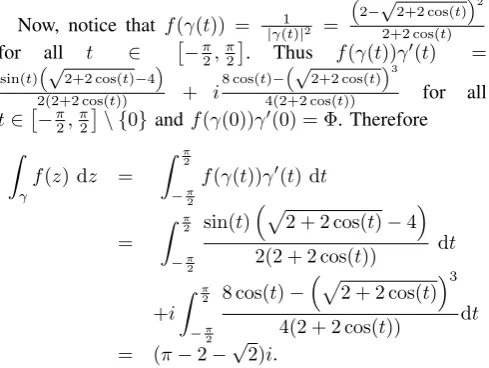
Now, notice that f(γ(t)) = |γ(1t)|2 =
2−√2+2 cos(t)2 2+2 cos(t)
for all t ∈
−π 2,
π 2
. Thus f(γ(t))γ0(t) = sin(t)√2+2 cos(t)−4
2(2+2 cos(t)) + i
8 cos(t)−√2+2 cos(t)3
4(2+2 cos(t)) for all
t∈
−π 2,
π 2
\ {0} andf(γ(0))γ0(0) = Φ. Therefore
Z
γ
f(z) dz =
Z π2
−π 2
f(γ(t))γ0(t) dt
=
Z π2
−π 2
sin(t)p2 + 2 cos(t)−4
2(2 + 2 cos(t)) dt
+i
Z π2
−π 2
8 cos(t)−p
2 + 2 cos(t) 3
4(2 + 2 cos(t)) dt = (π−2−√2)i.
Example 22: Let us calculate the integral of z along a semi-circle at infinity. Letf : CT → CT wheref(z) = z
and γ :
−π 2,
π 2
→ CT where γ(t) = ∞eit. Note
that γ is continuous and continuously differentiable with γ0(t) =∞ie−it. ThusRγf(z) dz=R
π 2
−π 2
[image:4.595.305.550.528.712.2]Rπ2
−π 2
∞eit∞ieit dt = Rπ2
−π 2
∞iei2t dt =
Rπ2
−π 2
∞ei(2t+π) dt = limn→∞Rπ2
−π 2
fn(t) dt where, for
each t ∈
−π 2,
π 2
, (fn(t))n∈N is the related sequence to
∞ei(2t+π).
Now, notice that, givenn∈N, from Definition 6 it follows
that, fn(t) = ∞ei(l−2n1)π for all t ∈ −2n+l−1
2n+1 π,−
2n+l
2n+1 π
, for each l ∈ {1, . . . ,2n+1}. Hence, given n ∈
N,
denoting the Cartesian form of fn as P
u(kn)+iv(kn) and denoting, for each l ∈ {1, . . . ,2n+1} and for each t ∈ −2n+l−1
2n+1 π,
−2n+l
2n+1 π
, the Cartesian form of fn(t) = ∞ei(l−2n1)π as Pa(n, l−1)
k +ib (n, l−1) k
, it follows that
Z π2
−π 2
fn(t) dt=
∞
X
k=1
Z π2
−π 2
u(kn)(t) dt+i
Z π2
−π 2
vk(n)(t) dt
!
=
∞
X
k=1
2n+1
X
l=1 −2n+l
2n+1π
Z
−2n+l−1 2n+1 π
a(kn, l−1)dt+i
2n+1
X
l=1 −2n+l
2n+1 π
Z
−2n+l−1 2n+1 π
b(kn, l−1)dt
=
∞
X
k=1
2n+1
X
l=1
a(kn, l−1)+i
2n+1
X
l=1
b(kn, l−1)
=
∞
X
k=1
(Φ +iΦ) = Φ.
Example 23: If γ: [a, b]→CT is the constant path γ≡
Φ then
Z
γ
f(z) dz = Φ for all f : {Φ} → CT. Indeed,
Z
γ
f(z) dz =
Z b
a
f(γ(t))γ0(t) dt =
Z b
a
f(Φ)×Φ dt =
Z b
a
Φ dt= Φ.
IV. CONCLUSION
Earlier, real elementary functions, real limits and both real differential and integral calculus were extended to transreal forms. This extended real analysis to transreal analysis.
We now introduce the transcomplex integral and, inciden-tally, the derivative for transcomplex functions whose domain is a real interval. In future work, totalising the transcomplex derivative would complete the task of extending the main elements of complex analysis to transcomplex analysis.
Taking these results all together, a very large part of practical computation is extended to transnumbers.
REFERENCES
[1] J. A. D. W. Anderson and T. S. dos Reis, “Transreal limits expose category errors in ieee 754 floating-point arithmetic and in mathemat-ics,” Lecture Notes in Engineering and Computer Science: Proceedings of The World Congress on Engineering and Computer Science 2014, WCECS 2014, 22-24 October, 2014, San Francisco, USA, pp 86–91. [2] J. A. D. W. Anderson, N. V¨olker, and A. A. Adams, Perspex machine viii: Axioms of transreal arithmetic. In Longin Jan Lateki, David M. Mount, and Angela Y. Wu, editors,Vision Geometry XV, volume 6499 ofProceedings of SPIE, pages 2.1–2.12, 2007.
[3] T. S. dos Reis, “Proper and improper Riemann integral in a single def-inition,” Proceeding Series of the Brazilian Society of Computational and Applied Mathematics. 5:010017-1–010017-7, 2016.
[4] T. S. dos Reis and J. A. D. W. Anderson, “Construction of the transcomplex numbers from the complex numbers,” Lecture Notes in Engineering and Computer Science: Proceedings of The World Congress on Engineering and Computer Science 2014, WCECS 2014, 22-24 October, 2014, San Francisco, USA, pp 97–102.
[5] T. S. dos Reis and J. A. D. W. Anderson, “Transdifferential and transintegral calculus,” Lecture Notes in Engineering and Computer Science: Proceedings of The World Congress on Engineering and Computer Science 2014, WCECS 2014, 22-24 October, 2014, San Francisco, USA, pp 92–96.
[6] T. S. dos Reis and J. A. D. W. Anderson, (2015) Transreal limits and elementary functions. In: Kim H., Amouzegar M., Ao S. (eds) Transactions on Engineering Technologies. Springer, Dordrecht, pp 209–225.
[7] T. S. dos Reis and J. A. D. W. Anderson, “Transreal calculus,” IAENG International Journal of Applied Mathematics, vol. 45, no. 1, pp 51–63, 2015.
[8] T. S. dos Reis and J. A. D. W. Anderson, “Transcomplex topology and elementary functions,” Lecture Notes in Engineering and Computer Science: Proceedings of The World Congress on Engineering 2016, WCE 2016, 29 June - 1 July, 2016, London, U.K., pp 164-169. [9] T. S. dos Reis and J. A. D. W. Anderson, “Transcomplex numbers:
properties, topology and functions,” Engineering Letters, vol. 25, no. 1. pp 90–103, 2017.