Land-Use Classification Using Convolutional
Neural Network with Bagging and
Reduced Categories
Noritaka Shigei, Kazuki Mandai, Satoshi Sugimoto, Ryoma Takaesu, and Yoichi Ishizuka
Abstract—In this paper, we tackle with the land-use classifica-tion from aerial photographs in the hilly and mountainous areas and apply two kinds of approaches to the problem. The one is the ensemble learning approach to improve the classification accuracy for overall classes, and the other is the optimization of the number of classes to improve the classification accuracy for coniferous forest. Our ensemble learning approach adopts Bagging and uses a Convolutional Neural Network (CNN) classifier as a weak learner. The optimization of the number of classes utilizes the spectral clustering algorithm and the confusion matrix of the classification result obtained by a CNN classifier. The effectiveness of the proposed approaches is demonstrated by numerical simulations.
Index Terms—convolutional neural network, land-use classi-fication, Bagging, aerial photograph
I. INTRODUCTION
I
N countries with few plains like Japan, it is unavoidable to develop hilly areas and their surroundings as residential or urban areas. In order to effectively implement disaster countermeasures, it is needed to grasp the land use and to identify the hazard areas. In particular, for landslide disasters due to rainy weather, which greatly depend on vegetation, the detection of coniferous forests being with high probability of occurrence of disaster[1] is important.Various types of land-use classification data exist. As one of them, in Japan, Ministry of Land, Infrastructure, Transport and Tourism (MLIT) provides the digital data of land-use classification in National Land Numerical Informa-tion (NLNI)[2]. The data was originally created from the 1:250,000 scale map of Geospatial Information Authority of Japan (GSI) in 1997 and has been updated based on the updated 1:250,000 scale map of GSI, satellite images, etc., in 1987, 1991, 1997, 2006, 2009 and 2014. In recent years, with the spread of unmanned airplanes, etc., aerial photographs can be easily taken. Utilization of aerial photographs in land use classification will lead to more accurate classification and speedup of updating.
Convolutional Neural Network (CNN)[3] is one of promis-sive methods for the land-use classification from aerial pho-tographs, because of its great success for many applications of image recognition. Application of CNN to the land-use classification has been extensively studied. In [4], the effectiveness of fine-tuning of pre-trained CNN is demon-strated. In [5], it is proposed to use multiple multiscale
N. Shigei and K. Mandai are with the Graduate School of Science and Engineering, Kagoshima University, 1-21-40 Korimoto, Kagoshima, Japan, e-mail: [email protected], [email protected]
S. Sugimoto, R. Takaesu and Y. Ishizuka are with Nagasaki University. This work was partially supported by JSPS KAKENHI Grant Number JP17K00170.
images as input. In [6], two-stage network consisting of pretrained network and trainable CNN is proposed. In [7], the effectiveness of the combination with sparse autoencoder is demonstrated. In [8], the combination of CNN and extreme learning is proposed. These proposed methods have been shown to be effective for the UC-Merced dataset[9], which is a benchmark dataset consisting of 21 land-use classes. However, in the benchmark dataset, coniferous forests, which are with high risk of disasters, are included in the forest class. Thus, it is an open problem whether the CNN based approach can accurately distinguish coniferous forests from other types of forests in the land-use classification problem. In this paper, we tackle with the land-use classification problem covering the hilly and mountainous areas and apply two kinds of approaches to the problem. The one is the ensemble learning approach to improve the classification accuracy for overall classes, and the other is the optimization of the number of classes to improve the classification accu-racy for coniferous forest. Our ensemble learning approach adopts the Bagging algorithm[10] and uses a CNN classifier as a weak learner. The optimization of the number of classes utilizes the spectral clustering algorithm[11] and the confusion matrix of the classification result obtained by a CNN classifier. The effectiveness of the proposed approaches is demonstrated for our original dataset sampled from the hilly and mountainous areas in Japan.
II. LAND-USECLASSIFICATIONUSINGCNNFROM
AERIALPHOTOGRAPHS
This section describes the land-use classification problem including specific classes and the CNN classifier used as the basic model in this paper.
A. Land-Use Classification for Hilly and Mountainous Areas
(a) (b) (c)
(d) (e) (f)
(g) (h) (i)
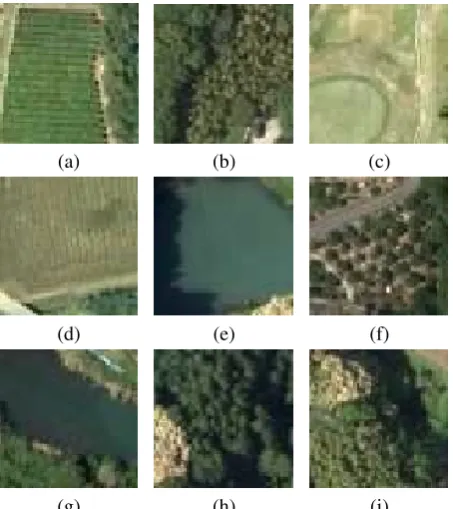
Fig. 1. Class examples of our dataset: (a) tea plantation, (b) bamboo forest, (c) golf course, (d) field, (e) pond, (f) orchard, (g) river, (h) broadleaf forest and (i) coniferous forest (Source: GSI tiles).
B. CNN Classifier
In this paper, we use CNN based on LeNet[3] as the basic model of classifiers applied to the land-use classification problem. The structure of CNN is shown in Figure 2. The network consists of input layer, three pairs of convolution and pooling layers, fully-connected layer and softmax layer. The input layer accepts an RGB color image of sizeN×N consisting of three channels. The output f(k) for k ∈ [K]
corresponds to the probability that the input image belongs to the class k, where [K] = {1,2,· · ·, K}. Thus, kmax =
arg max
k∈[K]
f(k)is the class determined by the CNN classifier.
In Figure 2,nci,kci,sciandpcifori∈[3]are parameters for i-th convolution layer and are the number of filters, the filter size, the interval between filter applications and the number of pixels added to the input, respectively. The parametersppi, kpi and spi are for i-th pooling layer and are the pooling method (such as max, average and stochastic), the filter size and the interval between filter applications, respectively.
III. IMPROVEMENT OFCLASSIFICATIONACCURACY
In this section, we present two types of methods for improving the classification accuracy.
A. Bagging based on CNN
Bagging (Bootstrap AGGregatING)[10] is one of ensemble learning methods, in which the accuracy of the classifier or regressor is improved by combining multiple learners into one classifier or regressor. In general, since the performance of each learner is lower than the original one, the learner in ensemble learning is called weak learner. It is known that Bagging is effective for unstable procedures such as neural networks, classification and regression trees, where unstable means that small changes in data have a great influence on
learning. Therefore, in this paper, we propose that CNN, which is a kind of neural networks, is used as a weak learner. LetD be the training data set. Let M be the number of weak learners. LetNs be the number of data items for each
weak learner. The algorithm of the learning stage of Bagging is as follows:
Step 1: Generate M data sets D1, D2, · · ·, DM, each of sizeNs, by randomly sampling fromD with replacement.
Step 2:For each m∈[M], trainm-th weak learner Lmby
using data setDmas training data. □
In Bagging, the classifier or regressor is constructed by aggregating the outputs of the weak learners. In general, the majority vote and the average are used for classifier and regressor, respectively. In this paper, we construct the classifier by aggregating the outputs of the weak learners based on the accuracy of each weak learner. Letfm(k)be the k-th output from softmax layer of m-th weak learner. Let a(mk) be the m-th weak learner’s recall for the class k as follows:
a(mk)=|D(m, k)|
|D(k)| , (1)
where D(k) is the set of data items of class k in D and D(m, k) is the set of data items in D that Lm classifies as classk. Then, the aggregated classification result ˆk is as follows:
ˆ
k= arg max
k∈[K]
∑
m∈[M]
a(mk)fm(k)
. (2)
B. Reduction of the number of classes
In general, the classification accuracy in classification problems decreases as the number of classes increases. When the recall of a particular class is important, the number of classes should be reduced so as to maximize the obtained recall rate. In this paper, we propose utilize spectral clus-tering (SC) to reduce the number of classes. SC is the method for dividing the data set into subsets according to the similarity defined between all pairs of data[11]. In general, the similarity used in SC is defined by a similarity matrix S = (sij), where S is a symmetric matrix and sij ≥ 0 represents the similarity betweeni-th and j-th data points. Given a similarity matrixS, SC can divide the data set into subsets by using the eigenvalues ofS.
In order to apply SC to the reduction of the number of classes, we propose to utilize a confusion matrixC = (cij) to make the similarity matrixS. The confusion matrixC is obtained from the classification result of a classifier of CNN solving the classification problem withK classes, wherecij is the ratio of the data items classified as class j by the classifier inD(i).cij is considered to represent how similar the classiand classj are. Since it is not guaranteed thatC is symmetric,C is converted into theS as follows:
sij = {
cii fori=j cij+cji
2 fori̸=j.
(3)
The procedure for obtaining the re-assignment of the classes with a reduced number of classesKredis as follows:
Letktarget∈[K]be the target class whose recall rate should
[image:2.595.57.284.52.307.2]Fig. 2. The used CNN model (Source of input image: GSI tiles).
Step 1: Let K ←[K], where K is the set of classes to be applied SC. Let Klist ← {K}, where each element of Klist is the set of classes assigned to the same re-assigned class.
Step 2:Construct the similarity matrix S of size|K| × |K| from the confusion matrix C. Apply SC to the similarity matrix S and divide |K| classes in K into two subsets K1 andK2. LetKlist← Klist\ {K} ∪ {K1,K2}.
Step 3:If there exists the set of classesK′∈ Klistsuch that
K′={ktarget}, thenKlistis a candidate of re-assignment of
classes. If |Klist|=K−1, then terminate the procedure.
Step 4: LetK ← arg min
K′∈{K1,K2}
sim(K′), wheresim(K)is the similarity among the elements inK. Go to Step 2. □ Any of candidates obtained in Step 3 has smaller number of classes Kred=|Klist| then the original oneK. The best
one among the candidates is determined by using numerical simulations.
IV. NUMERICALSIMULATION
In order to confirm the effectiveness of the proposed methods, we perform numerical simulations. The simulation conditions are as follows: The number of used images is 450 in total and is 50 for each ofK = 9 classes. The image is obtained from the database of Geospatial Information Au-thority of Japan (GSI). The parameters for CNN is shown in Table I, where the parameters used for Bagging are selected so that the number of weights used in CNN is smaller than in the conventional case. Every evaluation values are calculated by 5-fold cross validation with 450 images. That is, 450 images are divided into five subsets of 90 images in which the number of images for each class is equally 10, and for each of five subsets, the subset is used as test data set and the other four subsets are used as training data set. All the evaluation values are averages of five values obtained by the five runs using five test data sets.
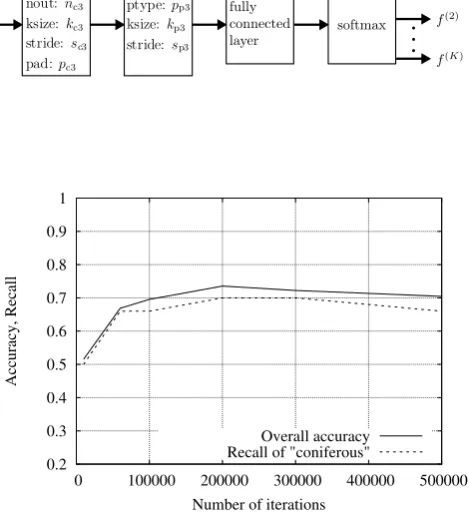
Firstly, the conventional CNN is evaluated for the number of training iterations ranging from 10,000 to 500,000. Figure 3 shows the overall accuracy and the recall for class “conifer-ous” versus the number of training iterations. Note that, since class “coniferous” is with high risk of disasters as mentioned in the introduction, in this paper, class “coniferous” will be assumed to be the target class. The overall accuracy is the ratio of correctly identified patterns of every classes to all the patterns. The recall for class A is the ratio of correctly identified patterns of class A to all the patterns. According to Figure 3, the best overall accuracy and the best recall are 0.736 and 0.70 at the number of training iterations 200,000, respectively. In the conventional CNN, the accuracy and the recall are not improved even if the number of training iterations increases.
Secondly, the conventional CNN and the Bagging based on CNN are compared. The Bagging based on CNN is evaluated
0.2 0.3 0.4 0.5 0.6 0.7 0.8 0.9 1
0 100000 200000 300000 400000 500000
Accuracy, Recall
[image:3.595.307.542.72.330.2]Number of iterations Overall accuracy Recall of "coniferous"
Fig. 3. The overall accuracy and the recall for class “coniferous” versus the number of training iterations.
TABLE I
PARAMETERS USED FORCNN.
Param. Conv. Bagging
nc1 32 8
kc1 5×5 5×5
sc1 1 1
pc1 2 2
pp1 MAX MAX
kp1 3×3 3×3
sp1 2 2
nc2 32 32
kc2 5×5 5×5
sc2 1 1
pc2 2 2
pp2 AVE AVE
kp2 3×3 3×3
sp2 2 2
nc3 64 32
kc3 5×5 5×5
sc3 1 1
pc3 2 2
pp3 AVE AVE
kp3 3×3 3×3
sp3 2 2
with the number of weak learners M ranging from 2 to 10. In the following all simulations, the number of training iterations for the conventional CNN is 600,000 and that for weak learners of Bagging is 100,000. Table II shows the recall for each of 9 classes and the overall accuracy. The best accuracy for each evaluation item is in bold. The result shows the following tendencies.
TABLE II
THE RECALL FOR EACH CLASS AND THE OVERALL ACCURACY OF CONVENTIONALCNNANDBAGGING BASED ONCNN.
Method M tea bam. golf fie. pond orch. riv. bro. con. Overall accuracy Conventional – 0.76 0.74 0.86 0.66 0.82 0.20 0.54 0.38 0.66 0.669
2 0.74 0.84 1.00 0.76 0.82 0.64 0.68 0.58 0.70 0.751
3 0.78 0.78 0.98 0.86 0.84 0.70 0.62 0.58 0.74 0.764
4 0.86 0.82 0.98 0.86 0.80 0.70 0.62 0.60 0.70 0.771
5 0.84 0.82 0.98 0.84 0.84 0.70 0.62 0.56 0.70 0.767
Bagging 6 0.88 0.82 0.98 0.84 0.84 0.74 0.68 0.56 0.72 0.784
7 0.86 0.84 1.00 0.88 0.84 0.72 0.62 0.56 0.70 0.780
8 0.86 0.84 0.98 0.88 0.82 0.74 0.66 0.54 0.72 0.782
9 0.84 0.82 0.98 0.86 0.82 0.72 0.64 0.52 0.74 0.771
10 0.84 0.82 0.98 0.86 0.84 0.72 0.64 0.50 0.74 0.771
TABLE III
THE RECALL,PRECISION ANDF1-SCORE FOR THE TARGET CLASS“CONIFEROUS”.
(a) For conventional CNN with/without RNC.
Kred= 5 Kred= 6 Kred= 7 Kred= 8 K= 9
Rec. Prec. F1 Rec. Prec. F1 Rec. Prec. F1 Rec. Prec. F1 Rec. Prec. F1
0.74 0.771 0.755 0.68 0.708 0.694 0.76 0.691 0.724 0.78 0.736 0.757 0.66 0.717 0.688
(b) For Bagging based on CNN with/without RNC.
Kred= 5 Kred= 6 Kred= 7 Kred= 8 K= 9
M
Rec. Prec. F1 Rec. Prec. F1 Rec. Prec. F1 Rec. Prec. F1 Rec. Prec. F1
2 0.66 0.767 0.710 0.70 0.795 0.745 0.72 0.818 0.766 0.68 0.810 0.739 0.70 0.761 0.729 3 0.72 0.800 0.758 0.74 0.804 0.771 0.74 0.771 0.755 0.74 0.787 0.763 0.74 0.771 0.755
4 0.72 0.800 0.758 0.74 0.804 0.771 0.76∗ 0.792 0.776 0.74 0.804 0.771 0.70 0.761 0.729 5 0.74 0.804 0.771 0.72 0.800 0.758 0.76∗ 0.809 0.784 0.74 0.804 0.771 0.70 0.761 0.729 6 0.72 0.800 0.758 0.72 0.800 0.758 0.76∗ 0.826∗ 0.792∗ 0.72 0.818 0.766 0.72 0.766 0.742 7 0.68 0.791 0.731 0.70 0.795 0.745 0.74 0.804 0.771 0.72 0.800 0.758 0.70 0.761 0.729 8 0.68 0.791 0.731 0.72 0.800 0.758 0.74 0.822 0.779 0.72 0.800 0.758 0.72 0.766 0.742 9 0.70 0.795 0.745 0.72 0.800 0.758 0.74 0.804 0.771 0.72 0.783 0.750 0.74 0.771 0.755
10 0.70 0.795 0.745 0.74 0.787 0.763 0.72 0.818 0.766 0.72 0.800 0.758 0.74 0.771 0.755
• Larger number of weak learnersM does not necessarily give better results. In other words, there exists some optimal number of weak learners. For overall accuracy, M = 6is the best choice.
Thirdly, the effect of the Reduction of the Number of Classes (RNC) presented in III-B is evaluated. The aim of RNC is to improve the classification accuracy of some specific (target) class. As mentioned in the introductions mentioned, since coniferous forests are with high risk of disasters, the class “coniferous” is assumed to be the target class. The procedure of the evaluation is as follows: 1) perform the conventional CNN for K = 9, 2) perform the procedure presented in III-B with the confusion matrix C obtained by 1) and 3) perform the evaluated methods such as the conventional CNN and the Bagging for each ofKred’s
obtained in 2). In 2), the following four candidates for re-assignment of classes with the reduced number of classes Kred= 5, 6, 7, 8 are obtained:
• 5 classes: {(a), (f), (g)}, {(b)}, {(c), (d), (e)}, {(h)},
{(i)}
• 6 classes:{(a)},{(b)},{(c), (d), (e)},{(f), (g)},{(h)},
{(i)}
• 7 classes: {(a)}, {(b)}, {(c), (d), (e)}, {(f)}, {(g)},
{(h)},{(i)}
• 8 classes: {(a)}, {(b)}, {(c), (d)}, {(e)}, {(f)}, {(g)},
{(h)},{(i)}
Table III shows the recall, precision and F1 score for the
target class “coniferous”. Table III.(a) shows the results of conventional CNN with/without RNC, where the cases of Kred= 5, 6, 7 and 8 are with RNC and the case ofK= 9is
without RNC. In the table, the best value for each evaluation
item is in bold. The result shows the following tendencies.
• For the conventional CNN, the RNC improves all of recall, precision and F1 score.
• In particular, the recall rate forKrad= 8of RNC is 12
percent point better than the one without RNC, that is forK= 9.
• It seems that larger values ofKredprovide better recall
rates.
Table III.(b) shows the results of Bagging based on CNN with/without RNC. The best value of an evaluation item for eachKredorKis in bold and the best value of an evaluation
item in the table is marked with an asterisk “*”. The result shows the following tendencies.
• For Bagging without RNC, that is, K = 9, it seems that any of recall, precision and F1 score does not
depend on the number of weak learners M. However, for any M, the Bagging without RNC achieves better recall, precision and F1 score than the conventional
CNN without RNC.
• For Bagging with RNC, that is,Kred= 5, 6, 7 and 8,
like the recall and the overall accuracy in Table II, larger number of weak learners M does not necessarily give better results. In other words, there exists some optimal number of weak learners.M = 5,M = 3or 4,M = 6
and M = 6 or 7 are best for Kred = 5, 6, 7 and 8,
respectively.
Finally, Table IV summarizes the best recall, precision and F1 score of target class “coniferous” for each of CNN,
TABLE IV
THE BEST RECALL,PRECISION ANDF1SCORE OF TARGET CLASS “CONIFEROUS”FORCNNANDBAGGING WITH/WITHOUTRNC.
Method K/Kred M Rec. Prec. F1
CNN 9 – 0.66 0.717 0.688
Bagging 9 3,9,10 0.74 0.771 0.755
CNN with RNC 8 – 0.78 0.736 0.755
Bagging with RNC 7 6 0.76 0.826 0.792
• Bagging, RNC and these combinations are better than the conventional CNN in any of recall, precision and F1
score.
• CNN with RNC achieves the best recall. Therefore, the combination of CNN and RNC would be effective for improving the recall.
• Bagging achieves the best precision and F1 score, and
its recall is relatively high. Therefore, the combination of Bagging and RNC would be effective for realizing the best trade-off between recall and precision.
V. CONCLUSIONS
We demonstrate that the proposed Bagging can improve the overall accuracy. Concerning to the improvement of the classification accuracy of the target class “coniferous”, it is considered that the Bagging based on CNN has an effect on improving the precision, and the RNC is effective in improving the recall. In addition, the combination of Bagging and RNC improves both of recall and precision.
Future works include applying other ensemble methods such as boosting to the problem and verification with the large number of data. In addition, since Bagging is suit-able for parallel implementation, it will be considered to implement Bagging by using secure multiparty computation (SMC)[12], which is a secure calculation method on cloud server.
REFERENCES
[1] K. Tajiri, H. Nakayama and S. Imaizumi, “Statistical Analysis of Slope-failure at Kumamoto Prefecture using Geotechnical Information Data Base system,”Soils and Foundations, vol. 32, issue 2, pp. 159-168, Jun. 1992 (in Japanese).
[2] Ministry of Land, Infrastructure, Transport, and Tourism, “National Land Numerical Information Download Service,” 2016.
[3] Y. LeCun, L. Bottou, Y. Bengio and P. Haffner, “Gradient-Based Learning Applied to Document Recognition,”Proc. of the IEEE, vol. 86, no. 11, pp. 2278-2324, 1998.
[4] M. Castelluccio, G. Poggi, C. Sansone and L. Verdoliva, “Land Use Classification in Remote Sensing Images by Convolutional Neural Networks,”arXiv preprint arXiv:1508.00092, 2015.
[5] F. P. S. Luus, B. P. Salmon, F. van den Bergh and B. T. J. Maharaj, “Multiview Deep Learning for Land-Use Classification,”IEEE Geo-science and Remote Sensing Letters, vol. 12, no. 12, pp. 2448-2452, 2015.
[6] D. Marmanis, M. Datcu, T. Esch and U. Stilla, “Deep Learning Earth Observation Classification Using ImageNet Pretrained Networks,”
IEEE Geoscience and Remote Sensing Letters, vol. 13, no. 1, pp. 105-109, 2016.
[7] E. Othman, Y. Bazi, N. Alajlan, H. Alhichri and F. Melgani, “Using Convolutional Features and a Sparse Autoencoder for Land-Use Scene Classification,”International Journal of Remote Sensing, vol. 37, issue 10, pp. 2149-2167, 2016.
[8] Q. Weng, Z. Mao, J. Lin and W. Guo, “Land-Use Classification via Extreme Learning Classifier Based on Deep Convolutional Features,”
IEEE Geoscience and Remote Sensing Letters, vol. 14, no. 5, pp. 704-708, 2017.
[9] Y. Yang and S. Newsam, “Bag-of-Visual-Words and Spatial Exten-sionsfor Land-Use Classification,”Proc. of Int. Conf. on Advances in Geographic Information Systems, pp. 270-279, 2010.
[10] L. Breiman, “Bagging Predictors,” Machine Learning, vol. 24, pp. 123-140, 1996.
[11] J. Shi and J. Malik, “Normalized Cuts and Image Segmentation,”IEEE Trans. on Pattern Analysis and Machine Intelligence, vol. 22, no. 8, pp. 888-905, 2000.