Automated Negotiation for Grid Notification Services
Richard Lawley1, Keith Decker2, Michael Luck1, Terry Payne1, and Luc Moreau1
1
Department of Electronics and Computer Science, University of Southampton, UK
{ral01r,mml,trp,L.Moreau}@ecs.soton.ac.uk
2 Computer and Information Sciences Department, University of Delaware, Newark, DE 19716
Abstract. Notification Services mediate between information publishers and
con-sumers that wish to subscribe to periodic updates. In many cases, however, there is a mismatch between the dissemination of these updates and the delivery pref-erences of the consumer, often in terms of frequency of delivery, quality, etc. In this paper, we present an automated negotiation engine that identifies mutually acceptable terms; we study its performance, and discuss its application to a Grid Notification Service. We also demonstrate how the negotiation engine enables users to control the Quality of Service levels they require.
1
Introduction
Notification services play an important role within distributed systems, by acting as in-termediaries responsible for the asynchronous delivery of messages between publishers and consumers. Publishers (such as information services) provide information which is then filtered and delivered to subscribed consumers [1–3] based on a specification of topic and delivery parameters. Notification service features include persistent, reliable delivery and prioritisation of messages. Notifications may include announcements of changes in the content of databases [4], new releases of tools or services, and the ter-mination of workflow execution. Notification services can also be used for replicating service directory contents [5]. As such, the Grid community has recognised the essential nature of notification services such as the Grid Monitoring Architecture [6], the Grid Notification Framework [7], the logging interface of the Open Grid Services Architec-ture [8] and peer-to-peer high performance messaging systems like NaradaBrokering [9]. They are also core architectural elements within the MyGrid [10] project.
have preferences about the way notifications should be published, yet current notifica-tion service technologies provide no support for determining a set of parameters that would be acceptable to both parties.
Automatically finding mutually acceptable notification parameters for a set of terms (e.g. price, bandwidth, etc) can be viewed as a search for an optimum in a multidimen-sional space. A cooperative approach requires both parties to make valuation functions and preferences available to a search component. Here, preferences and utility functions are shared, enabling the optimal values to be found. However, it is not always possible to share preferences and valuation functions freely — businesses may view preferences as private, and valuations may be linked to a locally sensed environment. In these situ-ations, an automatic search is not possible, as an optimum cannot be calculated. These situations require competitive approaches using mechanisms such as negotiation. Var-ious approaches exist; in this paper we present a bilateral negotiation framework [11] that is applicable to the context of notification service negotiation.
Our contributions are a practical implementation of an automatic negotiation en-gine, a study in terms of performance of bilateral negotiation and a study of negotiation in the specific context of notification services. This paper is organised as follows. Sec-tion 2 discusses negotiaSec-tion in general. SecSec-tion 3 describes the design of our system. In Section 4 we study the negotiation engine in general and more specifically in Section 5. We discuss related work in Section 6 and conclude in Section 7.
2
Negotiation
Negotiation is the process by which two or more parties exchange proposals in order to reach a mutually acceptable agreement on a particular matter. Parties in negotiation exchange proposals [12] that are either accepted or rejected. Rejection involves either turning down the proposal and allowing another to be sent or submitting a counter-proposal, so that both parties converge towards an agreement. Utility functions (used to evaluate a proposal) and preferences (defining an acceptable range of values for each term) remain private and, because they are stored locally, can be linked to external con-ditions such as resource levels. For this reason, it is not practical to use cooperative searching in a Grid environment, where limited system resources need to be allocated. One solution is Faratin’s negotiation decision functions [11] algorithm, which is a bi-lateral negotiation model that allows external resource functions to be used to evaluate proposals and generate counter-proposals.
start of a negotiation and a time-dependent one nearer the deadline. Utility functions evaluate the utility of a single negotiation term in a proposal. These can be simple linear functions or more complex callback functions to link the utility to resource conditions. The utility of a proposal is a weighted summation of the utility of the elements within the proposal. Proposals become acceptable when the counter-proposal generated has lower utility than the incoming proposal. Faratin’s algorithm is the basis for the rest of this paper.
3
Negotiation Engine Description
Our system is intended to allow applications to be programmed without specific knowl-edge of negotiation protocols. The actual negotiation mechanism is based on the work of Faratin [11], which allows a host to easily supply external conditions, such as re-source levels, as inputs into the negotiation process without knowing how to negotiate. Negotiations take place between a requester and a requestee, and we assume that there is always an item that is the subject of the negotiation. The conditions being ne-gotiated over are called negotiation terms, and can be such things as cost or duration. A conversation between a requester and requestee, where proposals are exchanged, is called a negotiation thread. Each party has a set of preferences, which consist of two values: an ideal value and a reservation value. The ideal value represents the initial negotiating value (i.e. the value the party would like to get in an ideal world) while the reservation value is the limiting point of concession. Values beyond the reservation value are unacceptable, and the negotiation will fail if it is not possible to find a value that satisfies all preferences. The negotiations in this system work to deadlines that are measured in terms of the number of messages exchanged between the two parties — the negotiation thread length. We refer to the application containing the negotiation component as a host and to the complete system as the negotiation engine.
Although we conceptually regard the negotiation engine as an entity shared by the requester and requestee, it has been implemented as negotiation components distributed between each party. This approach maintains privacy of preferences and utility func-tions.
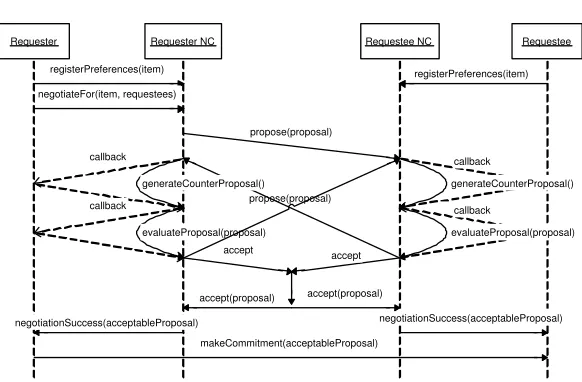
A description of the negotiation process is depicted in Figure 1. Before a negotia-tion starts, both parties initialise their negotianegotia-tion components with their preferences. Then, negotiation process proper is initiated with the requester sending a proposal to the requestee. The communication mechanism is left for the host to implement.
As discussed in the previous section, when a proposal is received by partyp, a counter-proposal is generated. Usingp’s utility functions, p’s negotiation component determines if the utility of the counter-proposal is higher than the incoming proposal. If so, the counter-proposal is sent. This cycle continues until the incoming proposal has a higher utility, at which point an acceptance message is sent. Both negotiation compo-nents then give their hosts a successful proposal. Note that acceptance of a proposal is not a commitment — it is left to the host to commit, allowing negotiations with many parties.
callback callback
Requester Requester NC Requestee NC Requestee
registerPreferences(item) registerPreferences(item)
negotiateFor(item, requestees)
propose(proposal)
accept
negotiationSuccess(acceptableProposal) negotiationSuccess(acceptableProposal)
makeCommitment(acceptableProposal)
generateCounterProposal()
evaluateProposal(proposal) generateCounterProposal()
evaluateProposal(proposal) propose(proposal)
accept
accept(proposal) callback
[image:4.612.162.453.105.296.2]accept(proposal) callback
Fig. 1. Sequence diagram showing message flow during a negotiation
by means of a failure message for reasons such as a system shutting down or a deal being made with another party.
4
Experimental Evaluation of Negotiation Engine
To verify the suitability of our negotiation engine for a Grid notification service, we must check that it scales up predictably to handle more negotiation terms, and longer negotiations, without any adverse performance. To determine that this component is suitable for our purposes, we performed a number of experiments.
4.1 Experiment Setup
The set of varying factors such as acceptable ranges and deadlines are grouped into an environment. Running two negotiations in the same environment produces identical results. As there is an infinitely large space of environments we generated a range of random environments using the methods from Faratin [11].
For each term, a fixed valueminr was chosen, representing the requester’s reser-vation value. Random values within predefined ranges were assigned to the parameters
Θr,ΘeandΦ, whereΘrrepresents the size of the acceptable region for the requester
r,Θerepresents the size of the acceptable region for requesteee, andΦrepresents the
degree of overlap between the acceptable ranges, with 0.99 indicating almost no overlap and 0 indicating complete overlap. These parameters are illustrated in Figure 2.
We used six tactics — three from the time-dependent and three from the resource-dependent families as in [11]. Utility functions are linear functions based on the prefer-ences.
-Θe
Θr Optn
nei n
e r nr
r n
r i Φ
nei= requestee ideal value
nri = requester ideal value
ne
[image:5.612.151.466.121.177.2]r= requestee reservation value nrr= requester reservation value
Fig. 2. Effect of environment parameters on preferences, also showing optimal value
us to build up some average values demonstrating the sort of results we should expect from a real-world implementation.
As the design of the system is independent of any communication mechanism we coupled the negotiation components together directly using method calls. Experiments measuring time only examined execution time.
4.2 Hypotheses and Results
The experiments described in this section were intended to determine the effects of varying both the deadline for negotiations and the number of negotiation terms. We consider the number of messages exchanged in a negotiation to be the primary com-ponent of time, as the dominant factor for message exchange in a real system is the transmission time. By contrast, transmission time in our experiments is very low, since the components are coupled by method calls, but we also measured execution time at the end of this section.
Variable Deadline Sometimes, negotiations should be completed within short
dead-lines, but this yields worse results than long deadlines [11]. To examine how the utility varies with the deadline we varied the deadline between 1 and 100 messages, using a single negotiation term.
Hypothesis: With short deadlines the utility to both parties is poor. As deadlines
increase, utility also increases, but at a decreasing rate, since a utility of 1 would indi-cate that no concessions were made, and is unlikely. The percentage of successful deals made increases as the deadline increases.
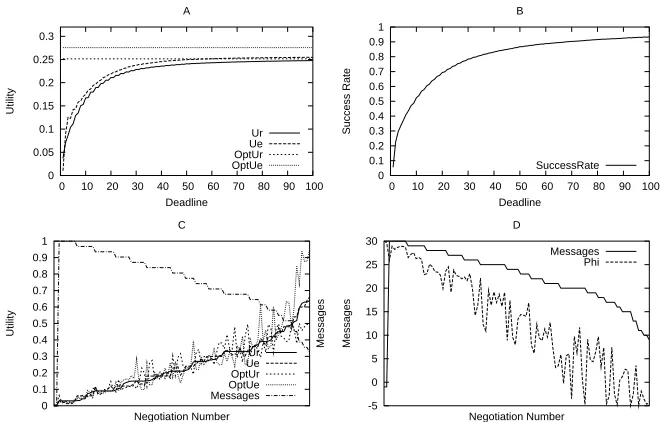
Figure 3A shows that the utility (UrandUe) for both parties is low for short
dead-lines. As the deadline increases, the utility also increases. The average optimal utilities (OptrandOpte) are plotted on the graph — these are time-independent and therefore
constant. They appear to be asymptotes to the utility curve. Figure 3B shows that the percentage of successful negotiations has a similar curve, fitting our assumption that there is a predictable curve that can be used to determine the effect of limiting the dead-lines of negotiations. This can be used to determine what sort of values should be used to limit the length of a negotiation thread without trading-off too much utility.
0 0.05 0.1 0.15 0.2 0.25 0.3
0 10 20 30 40 50 60 70 80 90 100
Utility Deadline A Ur Ue OptUr OptUe 0 0.1 0.2 0.3 0.4 0.5 0.6 0.7 0.8 0.9 1
0 10 20 30 40 50 60 70 80 90 100
Success Rate Deadline B SuccessRate 0 0.1 0.2 0.3 0.4 0.5 0.6 0.7 0.8 0.9 1 Utility Messages Negotiation Number C Ur Ue OptUr OptUe Messages -5 0 5 10 15 20 25 30 Messages Negotiation Number D Messages Phi
Fig. 3. A) Utilities, B) Success Rate, C) Utility vs. time used, D) Time vs.Φ
used in a negotiation ranges between 30% and 100% of the available time. There ap-pears to be an interesting trend where the utility increased as the number of messages decreased. Our explanation for this is that the negotiations taking less time and giving greater utility have a better environment to negotiate in. The parameter of the environ-ment that has the most significance isΦ, controlling the amount of overlap between the acceptable regions. This is plotted against the number of messages exchanged in Fig-ure 3D, confirming this theory — negotiation finishes quicker with better negotiation environments and gives a greater overall utility.
Multiple Negotiation Terms If this negotiation engine were to be deployed in the
notification service, it would not be negotiating over a single negotiation term. There would be many terms, so we must ensure that the system scales up as the number of terms increases. In consequence, the negotiations were evaluated with the number of negotiation terms set at every value between 1 and 25. The experiments used deadlines of between 30 and 60 messages.
Hypothesis: As the number of negotiation terms increases, the number of messages
[image:6.612.141.471.118.329.2]0 0.05 0.1 0.15 0.2 0.25 0.3
0 5 10 15 20 25
Utility
Number of Terms A
Ur Ue OptUr OptUe
0 2 4 6 8 10 12 14
0 5 10 15 20 25
Time (ms)
[image:7.612.135.465.119.223.2]Number of Terms B
Fig. 4. Variable number of negotiation terms: A) Utilities of outcome, B) Time Taken
Figure 4A shows that the average utility achieved with a varying number of negoti-ation terms remains fairly constant, and does not begin to drop with respect to the num-ber of terms. Similarly, Figure 4B shows that the time appears to be increasing linearly. While there are a few deviations upwards of the linear trend, these can be explained by garbage collection being triggered in the execution environment.
Execution Time To confirm that the time taken for negotiation increases linearly with
the number of messages exchanged, we measured the execution time for the negotiation to complete, averaged over 100 times to reduce inaccuracies. For a given number of messages exchanged, we recorded the average, minimum and maximum times taken for negotiations exchanging that quantity of messages. The deadlines in this experiment were between 30 and 60 messages.
Hypothesis: As the number of messages exchanged between negotiations takes
place, the corresponding increase in real time taken will be linear.
As shown in Figure 5 there is a wide range of results for each number of messages exchanged. However, the average line is close to the minimum, indicating that few results are significantly higher than average. (We have explained the higher results as garbage collection in Java.) Failed negotiations are plotted as 0 messages, although they always take up to their deadline to complete, because reaching the deadline implies
0 5 10 15 20 25 30 35
0 10 20 30 40 50 60
Time (ms)
Number of Messages Mean Time
[image:7.612.223.387.533.639.2]Min Time Max Time
-0.1 0 0.1 0.2 0.3 0.4 0.5 0.6 0.7 0.8 0.9
0 50000 100000 150000 200000 250000 300000
Provider Utility
[image:8.612.223.394.116.226.2]Expected number of queries
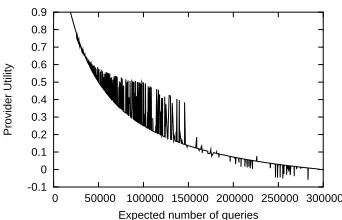
Fig. 6. Provider utility against expected number of calculations
failure. Since the time taken for failed negotiations is approximately the same as with high numbers of messages, we conclude that the time taken is linearly related to the number of messages exchanged.
5
Evaluation for the Notification Service
We chose a specific case from the bioinformatics field as an example use of the notifica-tion service. The SWISS-PROT Protein Knowledgebase is a curated protein sequence database providing a high level of annotation, minimal redundancy and high integra-tion with other databases [13]. Over the past 14 months it has grown by 20% with approximately 200 changes per day. As an example, we assume 1000 subscribers are interested in anything that matches 100 different sequences, and a particular similarity search takes 1 second and can be run iteratively to refine results. To provide the notifi-cations, the provider runs the similarity search after data has been added or annotated. Although subscribers are happy to receive updates every few hours, this would place an unacceptable load on the provider. For example, daily searches iterated 5 times require five million searches per day.
We use two negotiation terms for this experiment. Frequency represents the maxi-mum number of hours between notifications: for the provider, this is between 24 and 168 hours, whereas for the consumer it is between 5 and 120 hours. The second term is the number of iterations of the search. The provider prefers this to be between 1 and 3, the client between 1 and 5. The preferences for the provider are kept constant and a ran-dom variation is introduced into the client preferences to simulate different clients. Ne-gotiation deadlines are between 30 and 60 messages. After running the neNe-gotiations, the average value for the frequency was 67.6 hours and the number of iterations was 2.31 iterations. This works out as 651,000 searches per day, a reduction of 87%. The aver-age utilities over the experiments were 0.39 for the consumer and 0.30 for the provider. Figure 6 shows that the provider utility decreases as the number of computations in-creases. The curve would have been smoother if we had weighted the utility of each term differently, as they influence the number of calculations in different ways.
provider has to carry out to do so, indicating that a better Quality of Service can be achieved by using negotiation to establish QoS terms.
6
Related Work
There has been much research in automated negotiation. Bartolini et al. [14] produced a framework for negotiation allowing different types of negotiations to be specified using rules. We chose not to use this, as we wanted the two parties to be able to communicate directly rather than to use a third party to carry out the negotiation. Jennings et al. [15] give some details on a framework for automated negotiation, which focuses on rules of negotiation, and allowing many different types of negotiation to be carried out within the same framework. The RFC1782 [16] describes a simple extension to Trivial File Transfer Protocol (TFTP) to allow option negotiation prior to the file transfer. Although the idea is similar in principle, there is no economically sound model of negotiation used.
A number of examples of subscription services have been identified in the Grid community, allowing the information to be used for monitoring or rescheduling of al-locations [17]. The Grid monitoring architecture [6] is a distributed architecture allow-ing monitorallow-ing data to be collected by distributed components. The Grid Notification Framework [7] allows information about the existence of a grid entity, as well as prop-erties about its state, to be propagated to other grid entities. NaradaBrokering [9] is a peer-to-peer event brokering system supporting asynchronous delivery of events to sen-sors, high end performance computers and handheld devices. The Open Grid Services architecture [8] has also identified a logging service as an essential component: it also relies on producer and consumer interfaces. None of these notification services support negotiation and might benefit from our work.
7
Conclusion and Future Work
This paper has presented our design for a negotiation engine for inclusion in a Notifi-cation Service. We have presented our reasons for choosing a competitive negotiation method and shown how our negotiation engine works. We have also shown that the per-formance of the system is predictable and does not have any adverse effects when used with many negotiation terms.
Further development of this work is ongoing, and we have identified several areas we would like to proceed with. In our current system all negotiation terms are indepen-dent and negotiations concede on all of them. We would like to investigate introducing dependencies between negotiation terms and the possibilities of trading off one term against another. Negotiations currently take place between a requester and a notifica-tion service. We envisage a system where negotianotifica-tions are chained between consumer, notification service and provider, and will examine negotiation in this situation.
Acknowledgements
This research is funded in part by EPSRC myGrid project (ref. GR/R67743/01).
References
1. Java Message Service API. http://java.sun.com/products/jms/ (1999)
2. Object Management Group: Event service specification. www.omg.org (2001) 3. Object Management Group: Notification service specification. www.omg.org (2002) 4. Oinn, T.: Change events and propagation in mygrid. Technical report, European
Bioinfor-matics Institute (2002)
5. UDDI version 3 features list.www.uddi.org(2001)
6. Tierney, B., Aydt, R., Gunter, D., Smith, W., Swany, M., Taylor, V., Wolski, R.: A grid monitoring architecture. Technical report, GGF Performance Working Group (2002) 7. Gullapalli, S., Czajkowski, K., Kesselman, C.: Grid notification framework. Technical
Re-port GWD-GIS-019-01, Global Grid Forum (2001)
8. Foster, I., Gannon, D., Nick, J.: Open grid services architecure: A roadmap. Technical report, Open Grid Services Architecture Working Group (2002)
9. Fox, G., Pallickara, S.: The narada event brokering system: Overview and extensions. Tech-nical report, Community Grid labs, Indiana University (2001)
10. myGrid Project: mygrid website. http://www.mygrid.org.uk/ (2003)
11. Faratin, P., Sierra, C., Jennings, N.R.: Negotiation decision functions for autonomous agents. International Journal of Robotics and Autonomous Systems 24 (1998) 159–182
12. Sierra, C., Jennings, N.R., Noriega, P., Parsons, S.: A framework for argumentation-based negotiation. In: Intelligent Agents IV: 4th International Workshop on Agent Theories Archi-tectures and Languages, (Springer)
13. EBI: Swiss-prot website. http://www.ebi.ac.uk/swissprot/ (2003)
14. Bartolini, C., Preist, C., Jennings, N.R.: Architecting for reuse: A software framework for automated negotiation. In: 3rd International Workshop on Agent-Oriented Software Engi-neering, Bologna, Italy (2002) 87–98
15. Jennings, N.R., Parsons, S., Sierra, C., Faratin, P.: Automated negotiation. In: 5th Interna-tional Conference on the Practical Application of Intelligent Agents and Multi-Agent Sys-tems, Manchester, UK (2000) 23–30
16. Malkin, G., Harkin, A.: TFTP option extension (rfc 1782). Technical report, Network Work-ing Group (1995)