Effects of textured compression socks on postural control
in physically active elderly individuals
WOO, M.T., DAVIDS, K <http://orcid.org/0000-0003-1398-6123>,
LIUKKONEN, J., JAAKKOLA, T. and CHOW, J.Y.
Available from Sheffield Hallam University Research Archive (SHURA) at:
http://shura.shu.ac.uk/8192/
This document is the author deposited version. You are advised to consult the
publisher's version if you wish to cite from it.
Published version
WOO, M.T., DAVIDS, K, LIUKKONEN, J., JAAKKOLA, T. and CHOW, J.Y. (2014).
Effects of textured compression socks on postural control in physically active elderly
individuals. Procedia Engineering, 72, 162-167.
Copyright and re-use policy
See
http://shura.shu.ac.uk/information.html
Procedia Engineering 72 ( 2014 ) 162 – 167
1877-7058 © 2014 Elsevier Ltd. This is an open access article under the CC BY-NC-ND license
(http://creativecommons.org/licenses/by-nc-nd/3.0/).
Selection and peer-review under responsibility of the Centre for Sports Engineering Research, Sheffield Hallam University doi: 10.1016/j.proeng.2014.06.028
ScienceDirect
The 2014 conference of the International Sports Engineering Association
Effects of Textured Compression Socks on Postural Control in
Physically Active Elderly Individuals
Woo, M.T
a,b, Davids, K
b,c, Liukkonen, J
b, Jaakkola, T
b, Chow, J. Y
d*
aRepublic Polytechnic, 9 Woodlands Avenue 9, 738964, SingaporebFiDiPro Programme, University of Jyväskylä, P.O.Box 35, 40014, Finland cCentre for Sports Engineering Research, Sheffield Hallam University, S10 2BP, United Kingdom dNational Institute of Education, National Technological University, 1 Nanyang walk, 637616, Singapore
Abstract
The aim of this investigation was to analyze the role of textured compression socks on somatosensory function in a sample of physically active elderly individuals when performing a static balancing task. Both textured insoles and athletic tape are deemed to be beneficial for enhancing proprioception because of the capacity for exploiting availability of “sensorimotor system noise”, which enhances movement control and individuals’ joint position perception. It was hypothesized that the compression feature in knee length socks would provide greater stimulation to lower leg mechanoreceptors, and help participants achieve better balance control. Participants (N=8) performed a 30-s Romberg static balance test protocol under three conditions (barefoot; wearing commercial socks; wearing textured compression socks), in a counterbalanced order, with four levels of performance difficulty: (1) standing on a stable surface with open eyes (SO); (2) a stable surface with closed eyes (SC); (3) a foam surface with open eyes (FO); and (4) a foam surface with closed eyes (FC). Two commonly investigated recurrence quantification analysis (RQA) measures (% Det and entropy) were extracted from the recurrence plot for multivariate analysis of variance (MANOVA). There were no significant interactions between the levels of performance difficulty and the sock treatments, p> 0.05 for both % Det and entropy in both Anterior-posterior (AP) and medial-lateral (ML) directions. There was no significant main effect of sock treatments, P> 0.05). However, a main effect for performance difficulty on % Det and entropy was observed in both AP and ML directions. The RQA measures demonstrated that the sensory systems in elderly individuals are able to aid the adaptive re-organization of postural behaviour in response to changing task constraints (performance difficulty levels).
© 2014 The Authors. Published by Elsevier Ltd.
* Corresponding author. Tel.: +65-86665629; fax: +65- 64151310. E-mail address: [email protected]
© 2014 Elsevier Ltd. This is an open access article under the CC BY-NC-ND license (http://creativecommons.org/licenses/by-nc-nd/3.0/).
163 M.T. Woo et al. / Procedia Engineering 72 ( 2014 ) 162 – 167
Keywords: Compression socks; Recurrence Quantification Analysis (RQA); Balance Control.
1. Introduction
The postural control system is responsible for keeping the projection of the centre of mass within the limits of the supporting area Massion (1994), and regulating the body’s position in space for the purpose of orientation and balance Lacour et al. (2008). It functions through the interaction of multiple sensorimotor processes Horak (2006), providing information from somatosensory, visual, and vestibular systems during performance Frank and Patla (2003). The somatosensory system (both tactile and proprioceptive systems) provides the greatest information (70%) to healthy individuals for postural control in a stable and well-lit environment Peterka (2006). Tactile stimulation, detected by cutaneous mechanoreceptors in the lower legs and the soles of the feet, provides information to the central nervous system (CNS) about body position and pressure distribution at the foot surface Hijmans et al. (2007); Kavounoudias et al. (1998) to achieve postural equilibrium Menant et al. (2008). Furthermore, proprioceptive inputs received by joint receptors provide individuals with information needed for balance control Hijmans et al. (2007).
However, inevitably these sensory systems (vision, somatosensory, and vestibular) and neuromuscular systems tend to deteriorate with age Rose (2010); particularly, the tactile-proprioceptive feedback and proprioception sensors of the somatosensory system Qiu et al. (2012). For example, changes in cutaneous sensitivity and receptor morphology have been observed as people age. These changes are associated with a reduction in neural activity, which increases the sensory and vibration threshold, and has put elderly individuals at greater risk of falls Perry (2006); Rose (2010). Such deterioration in ageing systems can cause delays in regulating stabilization control systems, possibly leading to falls, due to loss of capacity to restore upright control following a loss of balance Lajoie and Gallagher (2004); Moscufo et al. (2012); Rose (2010).
To counter ageing effects on postural control sensory systems, footwear has become the focus of attention in somatosensory studies; findings suggest a positive relationship between balance/postural control and somatosensory feedbacks contributed by footwear especially in textured insoles Davids et al. (2003); Hijmans et al. (2007); Losa Iglesias et al. (2012); Menant et al. (2008); Qiu et al. (2012); Sungkarat et al. (2011). They are deemed to be beneficial because they increase the sensitivity of plantar cutaneous afferent information sent to the Central Nervous System (CNS) Corbin et al. (2007); Menant et al. (2008). Furthermore, Davids et al. (2003) suggested that textured insoles exploit the “sensorimotor system noise”, which enhances movement control and individuals’ joint position perception. Additionally, strips and athletic tape pasted at the anterior and posterior parts of an ankle also appear to be of benefit for enhancing proprioception, particularly in the weight acceptance phase of walking or running Simoneau et al. (1997). However, results have clarified that strips and athletic tape do not benefit performance in weight-bearing tasks such as maintaining standing balance or the stance phase of walking or running. This might be due to the absence of mechanical stresses, and lack of pressure on related underlying structures. Nevertheless, localized compression on the ankle only improves joint position sense in elderly people, but not static balance performance Hijmans et al. (2009).
A meta-analysis by Orth and colleagues (2013) concluded that a simple stimulation of cutaneous receptors in the feet, via added texture, could improve perceptual-motor system functionality for elderly individuals. They did note that most existing research had focused on studying the role of textured surfaces for postural control and balance, and there is some limited work that has sought to ascertain effects of textured footwear in balance/postural control by reducing postural sway (e.g., Hlavackova and Vuillerme (2012); Losa Iglesias et al. (2012); Orth et al. (2013); Qiu et al. (2012); Sungkarat et al. (2011)). Additionally, the role of compression socks on supporting somatosensory feedback that emerges from pressure on cutaneous and joint receptors of the lower leg has not yet received adequate attention in postural control research. Research on compression socks has mainly been reported in clinical and sport science journals, with the focus on physiological benefits of compression socks on blood circulation Ali et al. (2010); Blättler and Zimmet (2008).
A pertinent question relates to whether wearing textured compression socks may provide beneficial effects in influencing postural and balance control in daily living activities in an elderly population. Based on these findings, it might be possible that the textured parts (coarse surfaces) of the socks (located at the soles of the feet; medial, lateral and posterior sides of the ankles; anterior and proximal to the tibia bones) would exploit the “sensorimotor system noise” and increase proprioception. The added compression feature in the knee length socks would provide greater stimulation to the lower leg mechanoreceptors, and help participants achieve better balance control. In addition, there is a possibility that use of textured, compression socks would enhance the afferent sensory inputs from the feet to enhance the function of the balance control system in an ageing CNS.
The aim of this investigation was to investigate effects of wearing textured compression socks on somatosensory function in elderly people during a static balancing task. It is hypothesized that better postural stability will be achieved under static task constraints by wearing clinical textured compression socks, since they might enhance plantar cutaneous sensations, providing information that can decrease postural sway in elderly individuals.
2. Method 2.1 Participants
Eight (3 males and 5 females) mobile, elderly individuals (age: 70.9 ± 5.9years, height: 1.56 ± 0.06m and weight: 49.9 ± 6.6kg), without any muscular, neurological and cardiovascular diseases, and who were free from stroke and brain injuries were recruited via convenience sampling in Singapore. Voluntary and informed consent were obtained from all participants, and the procedures used in the study were in accordance with the ethical guidelines from Nanyang Technological University, Singapore.
2.2 Apparatus and Tasks
Three different conditions (barefoot; wearing commercial socks; wearing textured compression socks), in a counterbalanced order, were administered to participants while they performed a static balance task. Textured socks with clinical level compression of 15-40 mmHg pressure (Zeropoint, Finland), and textured and non-compression models commercial socks (Mizuno, Japan) of similar thickness were used in all testing conditions. The tasks required participants to maintain an upright static stance (standing) for 30 seconds on a force platform (Kistler, USA), in four levels of performance difficulty: (1) standing on a stable surface with open eyes (SO); (2) a stable surface with closed eyes (SC); (3) a foam surface with open eyes (FO); (4) a foam surface with closed eyes (FC).
2.3 Procedure
A repeated-measures design was used to determine effects on balance and postural control of three different conditions – barefoot; wearing commercial socks; wearing textured compression socks. To prevent carryover/order effects, the sequence of the conditions and performance difficulty was randomised. Before data collection, participants undertook three trials for the static balance task to familiarize themselves with the testing protocols. A 30-s Romberg test protocol was used in all conditions for the four levels of performance difficulty. Participants were instructed to stand as still as possible with feet together, arms by side, and focused on a reference point marked on the wall. For the unstable surface, a 10-cm thick foam pad (30kg/m3 density) was placed on top of
the balance platform to create a more challenging surface for the participants. The foam pad limited the somatosensory information available for postural control during standing; this made the static task more challenging than standing on a firm, flat surface Pelleccia and Sockley (n.a). A rest period of 5-minutes was given to participants between each condition. The tests were repeated if a participant lost balance on the platform. After each testing condition, participants were asked to rate and record their perceptions of comfort towards the socks on a survey form.
2.4 Data reduction and statistical analysis
165 M.T. Woo et al. / Procedia Engineering 72 ( 2014 ) 162 – 167
Quantification Analysis (RQA) was performed on the raw data. The important input parameters of RQA included: time delay = 0.04s, embedding dimension = 10, radius = 10%, norm = Euclidean, rescaling = mean distance and line length = 2. The most reliable features of RQA reported in this study were the percentage of recurrent points falling on line segments parallel to the diagonal identity line as recurrent (% Det) and complexity of the deterministic structure (Entropy) Mazaheri et al. (2010). RQA measures (% Det & Entropy) across two within-participant factors (conditions and performance difficulty) were compared using a repeated-measure, multivariate analysis of variance (MANOVA). Post-hoc tests were performed for each RQA measure. Results were reported as means and standard error (SE). Alpha level was set at 0.05 for all statistical analyses.
3. Results
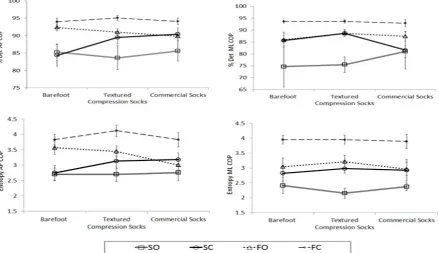
A MANOVA revealed no significant interaction effects between the level of performance difficulty and the conditions (F (1, 14) = 0.296, r = 0.14, p> 0.05) for both % Det and entropy in all directions (Figure 1). However, analysis revealed significant multivariate performance difficulty levels effects for both AP COP (F (18, 243) =5.08, p<0.001), and ML COP (F (18, 243) =5.132, p<0.001). Follow up univariate testing revealed that the main effect of performance difficulty levels was significant for both % Det and entropy in AL (F (3, 84) = 12.91, p<0.001; F (3, 84) =16.754, p<0.001) and ML (F (3, 84) = 9.07, p<0.001; F (3, 84) = 25.49, p<0.001) directions (Table 1), but not for sock treatments.
[image:5.544.54.494.344.597.2]The survey results showed that most of the participants (N=7) felt comfortable wearing the compression socks during the tests. They reported that the tightness provided them with more somatosensory information, especially at the ankle and calf areas. However, the qualitative analysis revealed that 5 out of 8 participants would not want to wear the compression socks for their daily activities due to the difficulty of putting the socks on. They mentioned that longer time, finger strength, and external apparatus were needed to put on the socks.
Table 1. RQA measures of postural difficulty levels (Mean (SE)).
SO SC FO FC F values P-value
%Det AP 84.84 (1.15)* 88.09 (1.15)* 91.08 (1.15)** 94.46 (1.15) 12.906 < 0.001
ML 77.05 (2.24)* 85.27 (2.24) 87.31 (2.24)** 93.4 (2.24) 9.067 < 0.001
Entropy AP 2.72 (0.13)* 3.02 (0.13)* 3.34 (0.13) 3.93(0.13) 16.754 < 0.001
ML 2.31 (0.13)* 2.91 (0.13)* 3.07 (0.13)** 3.93 (0.13) 25.493 < 0.001
*Significant difference from FC (pİ0.005) **Significant difference from SO (p<0.05)
4. Discussion
The purpose of the study was to investigate effects of textured compression socks on postural control in a static balance task. Contrary to our hypothesis, there were no significant main effects for the lightly-textured compression socks in postural control. Generally, the three conditions revealed equal effects on COP regulation in all levels of performance difficulty (Figure 1). Both textured compression and commercial socks displayed similar functions in the regularization of AP and ML motions, as seen in barefoot condition despite the higher complexity (higher entropy) and deterministic (higher % Det) features of both AP and ML COP. It is possible that the sensory systems (both vision and somatosensory) of healthy, mobile elderly individuals are capable of adapting (proactively as well as reactively) functional postural behaviours to meet the demand of a task.
However, significant differences were found within the various levels of performance difficulty (Table 1). The current results suggest that, when the postural conditions become more challenging, increasing from SO to FC, the % Det and entropy in both directions (AP & ML) increased proportionately. The observed changes in COP fluctuation suggest that modifications of postural regulation occurred in this group of participants. These findings are consistent with previous data reported by Riley et al (1999) and Pellechia & Shockley (n.a), where the increase in % Det indicated higher COP regularity when the task became more difficult (i.e., removing the visual feedback; cognitive task – counting back by 3s). Riccio (1993) regarded the variability of sway structure (COP regulation) as functional, which may have enhanced the flow of information within the sensory systems and facilitated the perceptual control of stance see Riley et al. (2003). The current results of RQA measures demonstrated that the sensory systems in elderly individuals are able to adaptively organize postural behaviour in response to changing constraints (performance difficulty levels).
The current findings showed that simple tactile stimulation and localised knee high compression did not enhance perception of somatosensory information from cutaneous mechanoreceptors among physically active elderly individuals with a low risk of falling. Future studies might seek to study performance of other samples of elderly individuals, including those categorized as having a medium/high risk of falling. Furthermore, researchers suggested that elderly individuals’ sensory and vibration threshold is higher and that less neural activity is observed as people age Perry (2006); Rose (2010). In light of these data, further research is needed to examine the effect of compression duration on performance of a balance task. Elderly individuals might need to wear the compression socks for a longer period of time in order for the sensory systems to become habituated to them before performing a balance control task.
Acknowledgements
We acknowledge the support from the compression sock manufacturer: ZeroPoint, Finland (www.zp.fi).
References
Ali, A., Creasy, R. H., Edge, J. A., 2010. Physiological effects if wearing graduated compression stockings during running. Eur J Apply Physiol, 109, 1017–1025. Doi: 10.1007/s00421-010-1447-1.
Blättler, W., Zimmet, S. E., 2008. Compression therapy in venous disease. Phlebology, 23, 203–205. doi: 10.1258/phleb.2008.081004. Corbin, D. M., Hart, J. M., Palmieri-Smith, R., Ingersoll, C. D., Hertel, J., 2007. The effecy of textured insoles on postural control in double and
167 M.T. Woo et al. / Procedia Engineering 72 ( 2014 ) 162 – 167
Davids, K., Shuttleworth, R., Button, C., Renshaw, I., Glazier, P., 2003. "Essential noise" - enhancing variability of informational constraints benefits movement control: a comment on waddington and adams. Br J Sports Med, 38, 601–605. doi: 10.1136/bjsm.2003.007427. Frank, J. S., Patla, A. E., 2003. Balance and mobility challenges in older adults implications for preserving community mobility. Am J Prev
Med, 25, 3Sii, 157–163. doi: 10.1016/S0749-3797(03)00179-X.
Hijmans, J. M., Geertzen, J. H. B., Dijkstra, P. U., Postema, K., 2007. A systematic review of the effects of shoes and other ankle or foot appliances on balance in older people and people with peripheral nervous system disorders. Gait & Posture, 25, 316–323.
Hijmans, J. M., Zijlstra, W., Geertzen, J. H. B., Hof, A. L., Postema, K., 2009. Foot and ankle compression improves joint position sense but not bipedal stance in older people. Gait & Posture, 29, 322–325.
Hlavackova, P., Vuillerme, N., 2012. Do somatosensory conditions from the foot and ankle affect postural responses to plantar-flexor muscles fatigue during bipedal quiet stance? Gait & Posture, 36, 16–19.
Horak, F. B., 2006. Postural orientation and equilibrium: what do we need to know about neural control of balance to prevent falls? Age and Ageing, 35 - S2, ii7 - ii 11. doi: 10.1093/ageing/afl077.
Kavounoudias, A., Roll, R., Roll, J. P., 1998. The plantar sole is a dynamometric map for human balance control. NeuroReport, 9, 3247–3252. Lacour, M., Bernard-Demanze, L., Dumitrescu, M., 2008. Postural control, aging, and attention resources: Models and posture-analysis
methods. Neurophysiologie Clinique, 38, 411–421. doi: 10.1016/j.neucli.2008.09.005.
Losa Iglesias, M. E., de Bengoa Vallejo, R. B., Palacios Pena, D., 2012. Impact of soft and hard insole density on postural stability in older adults. Geriatric Nursing, 33,4, 264–271.
Massion, J., 1994. Postural control system. Curr Opin Neurobiol, 4, 877–887.
Mazaheri, M., Negahban, H., Salavati, M., Sanjari, M. A., Parnianpour, M., 2010. Reliability of recurrence quantification analysis measures of the center of pressure during standing in individuals with musculoskeletal disorders. Medical Engineering & Physics, 32, 808–812. doi: 10.1016/j.medengphy.2010.04.019.
Menant, J. C., Steele, J. R., Menz, H., B. Menz., Munro, B. J., Lord, S. R., 2008. Optimizing footwear for older people at risk of falls. Journal of Rehabilitation Research & Development, 45,8, 1167–1182. doi: 10.1682/JRRD.2007.10.0168.
Moscufo, N., Guttmann, C. R. G., Meier, D., Csapo, I., Hildenbrand, P. G., Healy, B. C., Schmidt, J. A., Wolfson, L., 2009. Brain regional lesion burden and impaired mobility in the elderly. [In Press]. Neurobiology of Aging.
Pellecchia, G. L., Shockley, K., n.a. Application of recurrence quantification analysis: influence of cognitive activity on postural fluctuation. Perry, S. D., Tschirhart, E., Aqui, A., Tuer, P., 2007. Effects of sock-insole friction characteristics on dynamic balance control. Paper presented
at the XXI ISB Congress.
Peterka, R. J., Black, F. O., 1990. Age-related changes in human posture control: sensory organization test. J. Vestib. Res., 1, 73–85.
Qiu, F., Cole, M. H., Davids, K. W., Hennig, E. M., Silburn, P. A., Netscher, H., Kerr, G. K., 2012. Enhanced somatosensory information decreases postural sway in older people. Gait & Posture, 35, 630–635.
Riley, M. A., Balasubramaniam, R., Turvey, M. T., 1999. Recurrence quantification analysis of postural fluctuations. Gait & Posture, 9, 65–78. Riley, M. A., Clark, S., 2003. Recurrence analysis of human postural sway during the sensory organization test. Neuroscience Letters, 342, 45–
48. doi: 10.1016/S0304-3940(03)00229-5.
Rose, D. J., 2010. Fallproof! : A comprehensive balance and mobility training program. Champaign, IL: Human Kinetics.