Managing the unknown : a plan to manage workload
fluctuations and operating resources in a professional
practice
CARTER, Ben and LAYCOCK, Elizabeth
<http://orcid.org/0000-0003-3758-6829>
Available from Sheffield Hallam University Research Archive (SHURA) at:
http://shura.shu.ac.uk/21877/
This document is the author deposited version. You are advised to consult the
publisher's version if you wish to cite from it.
Published version
CARTER, Ben and LAYCOCK, Elizabeth (2016). Managing the unknown : a plan to
manage workload fluctuations and operating resources in a professional practice.
Sheffield Hallam University Built Environment Research Transactions, 8 (1), 56-71.
Copyright and re-use policy
See http://shura.shu.ac.uk/information.html
56
MANAGING THE UNKNOWN - A PLAN TO
MANAGE WORKLOAD FLUCTUATIONS
AND OPERATING RESOURCES IN A
PROFESSIONAL PRACTICE.
Ben Carter4 and Liz Laycock
Ben Carter studied BSC (Honours) Quantity Survey at Sheffield
Hallam University and graduated in 2016. Liz Laycock is a member of
staff in the Department of the Natural and Built Environment at
Sheffield Hallam University who supervised the research.
Change affects companies in all industries, a business’s ability to forecast and manage change are critical to its long terms success. This research aimed to acknowledge the causes and frequency of change and develop methods by which a company operating in the construction industry could manage its workload and operating resources. Through reviewing existing literature and conducting primary resource specific to the nature of the company the research was able to tailor its proposal with the aim that its implementation provides a positive benefit to recipients. The main findings of the study were that whilst both internal and external causes of fluctuation impact on workload and operating resources and that the frequency of fluctuation is varied, there are methods by which these fluctuations can be managed through the introduction of company processes and procedures. In summary, a company’s ability to manage change and
fluctuation in workload is dependent on its ability to ascertain the nature of changes it is likely to experience and to ensure its operating practices reflect these changes.
Keywords: Operating Resources, Workload, Change, Management
4
57
INTRODUCTION
It is well established that the construction industry is prone to fluctuations in output (Rhodes 2015), these fluctuations are caused by factors ranging from national economic performance and government policy on a macro level, to seasonal patterns and the availability of finance on a micro level (Barrett 1993). The extent to which these causes impact on the stability of individual companies varies, depending on which sectors of the industry a company operates in and, more specifically, the processes and procedures a company maintains to manage such fluctuations. Forecasting fluctuations and planning to manage change are therefore critical to the long term success of any business in the construction industry. The research conducted was a case study specific to one company operating within the construction industry in an attempt to develop a workload management plan that could be proposed for implementation as part of a its strategic management plan. The aims of the study, specific to the company, were as follows:
Establish the extent and common causes of fluctuation in workload at a selected company.
Identify existing management methods/techniques and assess whether these methods are suitable for use within the company.
Determine any common suggestions as to how workloadfluctuations could be managed within the company and any barriers to implementation.
Propose a management tool/strategy to assist in the monitoring/forecasting of workload at the company.The study identified existing methods of workload fluctuation management used within the industry and identified the causes of workload fluctuation the company experiences. Through further research the study was able to assess the suitability of existing methods for implementation and acknowledge potential barriers as well as develop a proposal tailored specifically to the needs of the company.
RESEARCH METHOD
58
researcher with a level of information on aspects of management that apply to the subject area. A company profile was developed in order to determine the characteristics of the business and to ensure the final proposal was bespoke, recognising key details with regards to the nature of the business and existing procedures. This information was used to develop primary research that was tailored specifically to the aims of the study in the form of questionnaires. The primary research enabled the researcher to identify the current causes of workload fluctuations, potential solutions to reduce the impact of these causes and specific details relating to both topics.
The questionnaire defined terminology where relevant to minimise the risk of ambiguity and was deliberately distributed to a selective sample, all
employees of the studies company, to maximise the validity of the responses and the chance of success with any future implementation. Consultation with other construction professionals during the development of the proposal made it possible for the study to acknowledge existing management techniques in practice and for it to draw on these when adapting and refining the proposal. It was recognised that the nature of the study limited the extent to which the results it sought to provide could be applicable to a wider audience however, it was considered the research methods utilised were appropriate considering the aims of the study were specific to one company.
LITERATURE REVIEW
Strategic Management
Henri Fayol identified forecasting and planning as being one of the seven principles of management, the purpose of these actions being to “give firms an outward and forward looking perspective, so that changes can be
anticipated and, at least, accommodated, if not capitalised on” Barrett (1993). The benefits of these actions were acknowledged by Ansoff (1984) as
providing a tool to “position and relate the firm to its environment in a way which will ensure its continued success and make it secure from surprises”. The study focused in depth on business level strategic management, which is concerned with “competing for customers, generating value from the
resources and the underlying principles of the sustainable competitive
advantages of those resources over rival companies” Rees and Smith (2014). In the context of the study, strategic management related to ensuring the company is conscious of and makes informed decisions regarding workload and resource, both current and future, to deliver against the business
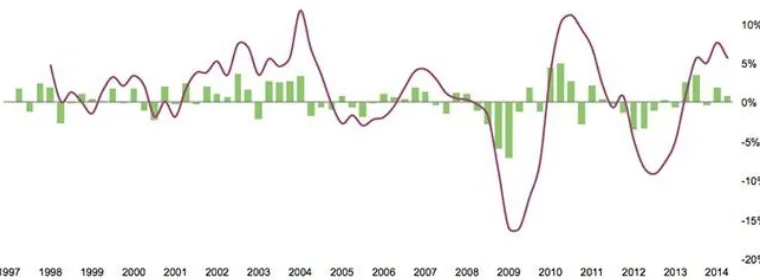
59 cash generating organisations as opposed to asset rich; one of the keys to business success is therefore managing workload and the associated revenues they generate during periods of fluctuation in workload. The study had identified reasons why workload in the construction industry is cyclical, it also identified that the industry typically follows a ‘boom and slump’ pattern, as opposed to gradual rises and falls, shown in Figure 1.
Figure 1 Example of ‘boom and slump’ pattern in UK construction
industry – Quarterly and yearly rates of output change (ONS, 2014).
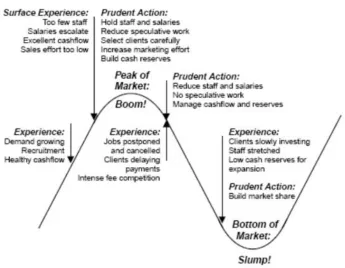
It is considered that in order for a company to maintain success over the longer term, practice management during the ‘boom’ period should include the creation of cash reserves typically facilitated by the moderating of profit taking, for these to be drawn on during the ‘slump’ period. One of the main benefits of this action is that during the early stages of a slump and
constriction in work streams and associated revenues, the business is better placed to manage the requirement to reduce staff numbers and pay. This aids in maintaining the morale of those still in employment and preventing a more chaotic situation regarding resources whereby employees perceive
60
Figure 2. Example of practice management experiences and actions
over the economic cycle (Hedley Smyth 2011).
Human Resource Management
61 achieving organisational objectives”; and are generally seen as covering six categories:
1. Product or service quantity 2. Product or service quality 3. Financial outcomes 4. Timeliness
5. Innovation
6. Stakeholder reactions
Gilbert (1978) stated that the main factors that affect a person’s performance are:
1. Knowledge 2. Skill
3. Environment 4. Motivation
The study noted factors 1 and 2 but did not conduct further research on them during the literature review on the assumption that the company employees possess at least the general knowledge and basic skills required to fulfil their roles. Further research was undertaken on Environment and Motivation as it was considered these factors have strong links to workload management and operating resources.
Environment:
62
Motivation:
The environment in which an employee operates can, in part, contribute to their levels of motivation and therefore their ability to produce results. Pinder (1998) defined motivation as “a set of energetic forces that originate both within and beyond an individual’s being, to initiate work-related behaviour and to determine its form, direction, intensity and duration”.
[image:8.525.107.472.216.373.2]Classic motivation theories identify a number of ‘high order’ and ‘low order’ needs as to what motivates an individual, these are shown in Figure 3:
Figure 3. Classic motivational theories - ‘high order’ and ‘low order’
needs (Shields 2012).
Shields (2012) suggests that the constant thread across the classical theories is that motivation is “a by-product of the quest to satisfy our needs as people and workers” it is also noted that on this basis the factors that motivate employees will change according to their personal needs.
The study did not attempt to directly influence employee motivation however the proposal will attempt to improve the general operating of the business and it is noted that indirectly this may have an impact on employee motivation.
Change Management
63 1. Environment – Shifts in economy, competitive pressures and
legislative changes lead to demand for strategic change.
2. Business Relationships – Developments in new/existing relationships require change in the organisational structure.
3. Technology – Shifts having an impact on content of work.
4. People – New entrants to organisations with different educational or cultural backgrounds that require change.
Lynch (2012) notes that “there is a need to define more precisely the causes that apply to a particular organisation” and that in practice this will “prove more useful when it comes to managing strategic change”. Handy (1989) states that “those who know why changes come waste less effort in protecting themselves or in fighting the inevitable”, this could be interpreted as, for companies who, as part of a strategic management plan attempt to forecast change, there could be as many benefits as drawbacks to the change, this point being of paramount importance relative to the aims of this study. Kreitl et al (2002) notes that firms engaged in growth typically experience uneven workloads as continuously targeting potential clients and identifying future pipelines of work runs alongside existing workload that may include repeat business from clients. Issues caused during growth periods include under capacity of resources, a consequence of which was recognised by Hedley-Smyth (2011) citing Bayer and Gann (2006) as “some projects are allocated resources that lead to other projects in the overall work portfolio
experiencing missing deadlines and stressed working”. The study was focused on the management of change to some extent entirely; it aimed to identify the reasons for change (fluctuation in workload) and the reasons for these changes (causes), and then attempted to manage these changes through the development of its proposal.
RESULTS
Objective 1 - Establish the extent and common causes of fluctuation in workload at the selected company.
64
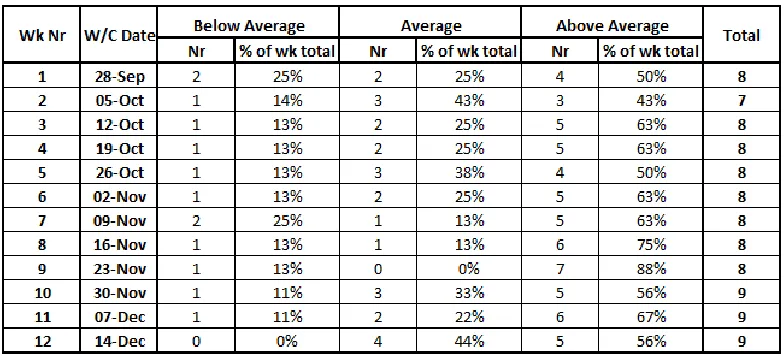
Table 4. Workload levels throughout researched period, each response
as a percentage of total responses per week (source: Author).
Employees reported that they experienced frequent fluctuations in this workload, 78% experienced fluctuations daily with the remaining 22% experiencing them weekly. Considering the findings of the literature regarding change and the capacity of resource, it was concluded that a consistently above average workload level coupled with frequent fluctuations in workload could be impacting on the businesses ability to perform over a sustained period. It was however recognised that the research was limited to a twelve-week period, that this could not be representative of operating levels annually and that the research period may have correspondent with a peak in workload levels at the company. The potential causes of fluctuations in workload were split into two categories, those that the business contributed towards (internal) and those that were generated by others (external). It was considered different types of causes would likely require alternative
65
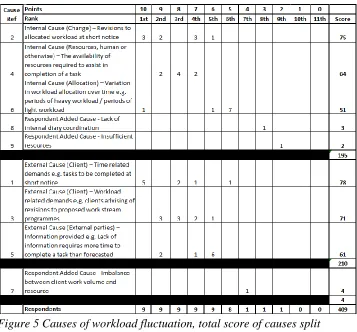
Figure 5 Causes of workload fluctuation, total score of causes split
between internal / external cause (source: Author).
By allocating a score to each cause in line with its frequency ranking, the study was able to identify those causes that impact more / less on workload. Splitting these causes into the internal / external groupings, the study determined that whilst external causes scored a slightly higher total overall than internal and that the range of individual causes scored between 51 – 75, no single cause or source of causes scored highly enough for it to be
determined that it was the single main cause of fluctuation in workload at the company (Figure 5).
66
The literature review provided the researcher with details of existing management techniques, notably Gantt charts and arrow diagrams however the level of information that could be obtained was not considered sufficient for the study to use it in isolation. Arrow diagrams were considered for implementation during the literature review stage of the study, whilst it was noted they could provide a benefit for the sequencing of events for individual projects, they were considered unsuitable for implementation within the management proposal as the format of these diagrams do not provide the required levels of flexibility for a company whose workload is varied in duration and one that requires several layers of information to be presented and easily interpreted for the document to be beneficial to the user. With Gantt charts it was established that in their basic format they provide not only a visual overview of activities over time but also that their format would enable supplementary information to be included in the document and that these features could form the basis for this format of tool to be utilised within the proposal.
To supplement the information gathered during the literature review stage, the study consulted with industry professionals in an attempt to establish the extent to which the theories were already being or could be used in practice as well as any additional methods by which businesses operating in the
construction industry manage their workload and operating resources. These consultations established that Gantt charts are widely used in the planning of not only on-site activities but also business management within the industry. The study recognised a number of features already in use that could be of benefit to the company including the ability to visualise not only current and future volumes of workload and resource commitment but also the intensity of these commitments and the ability for these commitments to be
categorised. The consultation process also highlighted the limitations of a Gantt chart when used in isolation, for example they cannot be relied upon to encompass all elements of business management that a company operating in the construction industry has to consider. In addition to this it identified other management processes currently in use that were deemed relevant to the study including:
The allocation of resources being specific to a particularworkload to improve communications and operating efficiencies.
The holding of meetings at a suitable frequency to facilitate the67
The ongoing review of workload and resources to ensurecommitments deliver against business objectives.
The standardising, where feasible, of internal operating practices to minimise the time cost of resources operating across varied work streams.Objective 3 - Determine any common suggestions as to how workload fluctuations could be managed within the company and any barriers to implementation.
The study asked respondents for suggestions on action that could be taken in an attempt to manage the causes of workload fluctuation identified in objective 1, it was considered that the respondents were best placed to make these suggestions as they were informed on the relationships between the company / its clients and the existing internal process at the company. With regards to causes originating externally, whilst a number of respondents considered that no action was possible, based on the fact that as a service provider, the requirements of the client would always be the primary driver of actions at the company, other suggested actions included:
The employment of additional resources – on the basis this would increase overall capacity which, if current workload levels were maintained, would improve the resources ability to react to / manage unforeseen events / requests.
Improve internal processes / procedures relating to prioritisation of workload / managing of workload conflicts and internal / external communication.
A review of the internal approach to client engagement including number / nature of clients and levels of confirmed workload.Suggestions regarding internal causes included:
1. An improved balance between workload and resources i.e.
supplementary resources / reduction in workload or a combination of the two.
2. Streamlining of resources / lines of communication specific to a particular work stream i.e. lead professional / administrative resource. 3. Improved internal communication – Through the introduction of a
68
It was considered that there were no specific barriers to any of the above suggestions being implemented regarding both internal and external causes, however the study noted the requirement for each suggestion to be tailored specifically, not only to the business aims at the company but also its current processes, noting that any actions could result in change and the potential to impact on current operating arrangements. All were considered further in objective four.
Objective 4 - Propose a management tool/strategy to assist in the monitoring/forecasting of workload at the company.
In developing the proposed management tool/strategy, the study considered the findings of the literature review and primary research as well as the information it had obtained whilst compiling the company profile on the company. The study acknowledge the potential limitations of restricting the proposal to one format as established in objective two and therefore included both a management tool and strategy proposal for implementation. The details of each being summarised below:
Management Document:
Excel workbook in Gantt chart format to provide a visual representation of workload over time. Provides the ability for all workload to be included in one document and easily interpreted. The document includes an overview of all confirmed and tentative workload over six months to consider the volume of workload and frequency of fluctuation as well as formatting to denote where information is to be confirmed / contains discrepancies. The study proposes that this document forms the basis of workload management practise at the company and is supplemented by the strategy proposal.
Strategy Proposal:
Monthly Team Meetings:
To facilitate the sharing of general information, meetings proposed to acknowledge that not all considerations that must be made relating to workload / resource can be done so by the use of a document in isolation. Meetings proposed as monthly to consider the availability of resources.
Professional & Administrative Resource Allocation:
One professional and one administrative resource to be allocated as the lead for each work stream at the company, the professional lead being responsible for undertaking the majority of projects and for the internal / external
69 responsible for all administrative tasks and for compiling of information associated with that work stream. Strategy proposed on the basis it would improve operating organisation and efficiency. The strategy also proposed that at least one additional administrative resource be trained in the operating systems for each work stream. It was acknowledged that this required a time commitment to accomplish but it was considered that this action would enable shortfalls in administrative resources to be overcome i.e. employee holiday.
Fluctuations in Workload:
The strategy proposed that when fluctuations of a short term nature require supplementary resources, the lead professional resource for each work stream is responsible for ensuring all information required to undertake a particular task is available to ensure fluctuations are managed with a degree of order. Perceived fluctuations of a long term nature are to be acknowledged by the lead resource and discussed with the company management to determine actions required.
Client Appraisal:
The study determined that an internal appraisal of existing clients
should be undertaken in order to ensure current and forecasted
commitments deliver against the medium / long term aims of the
business and whether any action relative to these aims is required by
the company management.
CONCLUSION
The aim of the study was to develop a management tool/strategy that could be implemented to assist the company in managing workload fluctuations and operating resource. The study undertook a literature review to develop an understanding of information associated with its aims and objectives, whilst an appropriate level of specific information could not be obtained, the review established a number of aspects of general business management that applied to the study and were deemed to require further consideration. Each aspect explored provided information for and direction to the proposal as well as making the researcher aware of some of the limitations as to what the proposal could seek to achieve from the perspective of overall company management.
70
how workload fluctuations could be managed as specified in the studies objectives, in addition it facilitated the researcher to identify any common themes and those strongly supported by existing resources. The study
therefore considers that objectives 1 - 3 were completed to a satisfactory level but notes that the research was limited in that reasoning behind responses could not be determined and that with hindsight this may have been of benefit to the study overall. Objective 4 was completed having reviewed the findings of objectives 1 -3. The studies proposal was presented in an alternative fashion to that originally intended in that it was possible to deliver against objective 4 and propose a management tool/strategy for implementation however further research has been recommended prior to implementation.
References:
Ansoff, 1984. Implanting strategic management. Prentice/Hall International.
Banfield and Kay, 2012. Introduction to Human Resource. Second edition. Oxford University Press.
Barrett, 1993. Profitable Practice Management for the Construction Professional. E&FN Spon.
Gilbert, 1978. Human Competence. Engineering Worthy Performance. Pfeiffer.
Handy, 1989. The Age of Unreason. Business Books.
Hedley-Smyth, 2011. Managing the Professional Practice: In the Built Environment. Wiley Blackwell.
Kreitl et al 2002. Corporate Growth of Engineering Consulting Firms a European Review. Article in Construction Management and Economics 20(5):437-448 · February 2002
Lynch, 2012. Strategic Management. Sixth Edition. Pearson.
Office of National Statistics, 2014. Available at
http://www.building.co.uk/market-forecast-rolling-on/5071832.article Accessed 13th November 2015
Pinder, 1998. Work Motivation in Organizational Behaviour. Prentice Hall.
71 Rhodes, 2015. House of Commons Briefing Paper Number 01432
“Construction Industry: Statistics and Policy. Available at
http://researchbriefings.files.parliament.uk/documents/SN01432/SN0 1432.pdf Accessed 13th November 2015.
Shields, 2012. Managing Employee Performance and Reward (Concepts, Practices & Strategies). Cambridge University Press
Smyth, 2011. Managing the Professional Practice in the built environment. Blackwell Publishing Limited.
Thompson, Scott and Martin, 2014. Strategic Management: Awareness and Change. Seventh Edition. Cengage Learning EMEA
Tichy, 1983. Managing Strategic Change. Wiley.
Watson, 2002. Organising and Managing Work. Second Edition. Pearson Education.