Information and communications technology in
government, an historical perspective
KEEFE, Terry and CROWTHER, Paul
Available from Sheffield Hallam University Research Archive (SHURA) at:
http://shura.shu.ac.uk/9840/
This document is the author deposited version. You are advised to consult the
publisher's version if you wish to cite from it.
Published version
KEEFE, Terry and CROWTHER, Paul (2015). Information and communications
technology in government, an historical perspective. In: 15th European Conference
on eGoverment (ECEG) 2015, University of Portsmouth, UK, 18-19 June 2015. (In
Press)
Copyright and re-use policy
See
http://shura.shu.ac.uk/information.html
Sheffield Hallam University Research Archive
Information and Communications
Technology in Government, an
Historical Perspective
AuthorsTerence Keefe, Dr Paul Crowther
Sheffield Hallam University, Sheffield, UK
[email protected]@shu.ac.uk
Abstract
The purpose of this paper is to address a paradox in e-Government, namely a reputation for failure existing alongside an apparent reality of successful implementation. There are frequent and much publicised stories and statistics about the high rate of failure in e-government projects. Yet at the same time as there seems to be an almost universal adoption of Information and Communications Technologies by governments at all levels, local and national. Our approach is to explore e-Government's origins for an explanation, examining the issue from a historical perspective to see if there are lessons to be learned about the future development and implementation of e-Government.
This study and analysis addresses the similarities and differences between the present situation and what has happened in the past. The aim is to use the perspective of history to comment upon the longer term issues and questions which have an impact upon the success and failure of e-Government projects. The study is focused on developments in the UK, but with some reference to experiences in the US, Canada and Australia. The bulk of the research comes from a library search of government studies and reports, supplemented by informal conversations with participants conducted over the last few years.
We looked at the history of government Information Technology in the UK from its early role automating data processing to the point now where it is arguably an indispensable mechanism at the heart of both the operation of public administration and the relationship between citizens and government. The analysis suggests that the impact and implications of e-Government have evolved beyond improvements to operational efficiency and better service delivery.
The outcomes are a number of observations about the way in which e-Government projects have come to be managed and assessed, together with some core questions to be answered by further research and discussion. Specifically questions are raised about the strategic nature of e-Government and how their value has come to be assessed. We ask whether it is helpful for e-Government to be regarded as a strategic aim as opposed to a strategic enabler, and whether the answer the answer contributes to a mistaken view of e-Government's success.
Keywords
e-Government, Computing, Government. Public Sector, Project Management
1.
Introduction
" The o l a to i flue e the hu a futu e is to speak a out the past i a s it did ot speak of itself." Richard Rorty (DeBakcsy, 2015)
points towards an almost universal adoption of Information and Communications Technologies by governments at all levels, local and national (Schwester, 2011).
I he i t odu tio to the ECEG i i t a k P a ti e, Theo a d K o ledge D Mi haele e Co poi ts out that ost o k to date has o e t ated o its E-Government) practice, such as technology adoption a d diffusio , poli age das, i pa ts (Cox, 2014). E-government is the current topic and the immediate issues are practical and applied in nature. It is natural to address research and analysis towards those current issues but does this mean that more fundamental questions about the nature of E-government and how they might contribute to current issues are not addressed.
Information Technology has been a factor in government and public administration since WWII when its potential to radically improve the way in which data and information could be managed first emerged, with the first application in the 1950s when computers were used to collate US census information.
The years since have seen many e-government initiatives and projects resulting over time in fundamental changes to the operation and delivery of government. In this paper we ask: what can be learned about delivering digital government from examining what has gone before looked at from the added perspectives which hindsight can provide.
In this paper I will seek to develop a better and fuller understanding of this paradox, if indeed it is a paradox, by looking into the roots and origins of e-government in the shape of the adoption of computing and ICT into government, and to examine that adoption has evolved through integration and development into the situation we find today. The aim is to see if a view from an historical distance can provide a more complete picture of the domain.
The study will focus on the post-war UK government experience but with some reference to the experience of other mature industrial democracies.
2.
Definitions
In their article on E-Government as a field of study Grönlund and Horan provide a useful overview of the emergence of E-government applications as well as a valuable set of scoping definitions (Grönlund & Horan, 2004). This paper will adopt the definition used by the European Union as quoted in the Grönlund and Horan paper.
E-Government is the use of Information and Communication Technologies in public administrations combined with organisational change and e skills i o de to i p o e pu li se i es a d de o ati p o esses .
Elsewhere we will try to use the terminology as it was used in the period being described, for example Co puti g , ICT , a d IT ut the e is o atte pt o lai to a p e isio in this.
3.
Background
E-government is challenged. In a paper delivered to ECEG 2013 the authors argued that the challenges go beyond those experienced in generic IT projects (Keefe, et al., 2012). It may be that they are not project management issues at all but relate instead to the nature of the public administration environment.
The role played by computers and information technology in UK and other Western governments has evolved from a data processing role, through operational support functions and moving into service delivery and regulatory support activities over the last twenty-five years. As the range and scale of IT integration into government has grown, so the range and scale of challenges, problems and failures have also grown. A historical analysis of IT in government suggests that both impact and implications go beyond improvements to operational efficiency and better service delivery, raising questions about their impact on democratic process and decision making.
understanding of how the role and importance of Information Technology in government and public administration has evolved. The hope in writing this paper is that greater awareness of these wider and more fundamental impacts will aid digital government leaders in understanding the nature of, and resolution to the challenges they must overcome.
4.
Research Methodology
The study will focus mainly on developments in the UK, but with some reference to experiences in the US, Canada and Australia. The bulk of the research will come from a library search of histories of public administration, supplemented with government studies and reports. It will also draw from discussions with a small number of participants from within the public administration and from facilitating organisations such as management consultancies.
The research methodology underpinning this paper comprises desk research mixed with a range of discussions with a small number of participants from within the public administration and from facilitating organisations such as management consultancies.
5.
Findings
5.1
Historical Research
This part of the analysis is based upon a number of UK government reports and papers, starting with, and concentrating on, one from 1984 and concluding with one from 2011.
5.1.1
The 1970s and 1980s - before the Internet
In a 1984 report by the UK National Audit Office looking back over the previous 10 years the authors noted that:
i ade uate p oje t a age e t a d i suffi ie t se io staff a d use i ol e e t, togethe ith the failu e to adopt suitable design and development procedures, were major factors in the difficulties encountered in all the p oje ts e ie ed (Gordon Downey, Comptrollerand AuditorGeneral, National Audit Office, 1984).
The study identified four major computing projects which had hit major problems, but they made the point there were more.
Health Department. A Local Office support system started in 1977 and abandoned in at a cost of £18million and none of the hoped for benefits. This must surely be a candidate for one of the first E-government failures.
Manpower Service Commission (MSC) A youth training support system which overshot a budget of £600k by £1.2million and rising while only achieving a quarter of the anticipated benefits;
HM Stationery Office (HMSO) A publication stock control and distribution support system which was running 3 years late in delivering any of the anticipated £2million benefits
Lo d Cha ello ’s Depa t e t LCD A suppo t s ste fo Cou t Cou ts hi h as u i g ea s late, would at best only deliver £90k of the expected £1.7million savings and which would cease to be cost effective if it encountered any further delays.
While the problems and costs may seem familiar, the response from government managers and the analysis by the report authors provides considerable food for thought. In all four cases the Department senior management stated that the experience and cost were far from nugatory. The Health Department and MSC initiated new projects to replace the failures. Both were successful. The LCD and HMSO reviewed their strategy and adopted a new approach to computerising operations based on incremental development of smaller systems. (Gordon Downey, Comptrollerand AuditorGeneral, National Audit Office, 1984)
The report recommendations are interesting in that they did not question the need for the projects, nor did they seek to allocate blame or criticise decision makers. Two aspects of the report findings are of particular interest.
Management skills and methods. In all cases the report highlighted issues around the management of the human Computing resources as a primary source of problems, but not to blame computing staff. Instead the report recognised the need to develop management disciplines and methods appropriate to computing as a profession. One outcome was that the Treasury section responsible for computing initiated a number of projects aimed at developing a core set of management methodologies and standards.
Strategic planning The report's authors consistently referred to the need for computer supported projects to
be planned and managed within a strategic framework, recommendations which were accepted and implemented with some enthusiasm, possible because they were backed by HM Treasury. Computer projects were seen as a resource to achieve a strategic initiative. Implementing new policy is always challenging, involving learning from experience. It is worth bearing in mind that these activities were taking place at a period when Strategic Planning was the leading management discipline, a discipline which above all required command of information (Mintzberg, 1994; Drucker, 1974).
5.1.2
The 1990s to 2005 - the Birth of e-Government
Many writers pinpoint this period as the time when e-government as we now think of it was born with the emergence of the World Wide Web together with publicly accessible networking infrastructure (Ho, 2002). In the UK developments in IT coincided with a shift in Government thinking about its relationship with its citizens, mirroring a similar in the business world with the focus moving to quality of service and re-engineering business processes. In the UK this shift manifested itself in moves to make service provision more customer focused and for public servants to adopt a more outward looking approach seeking to build a more open relationship with citizens. Similar shifts in thinking and public sector behaviour could be seen in Canada, Australia and Germany. The tool, if not the driver, was the internet. Other scholars will discuss whether this was part of a wider change in society and government (Ramadhan, et al., 2011), but for the e-government historian there were two significant developments, both related to the concept of transforming government. First was the use of the Web to build a new, more direct relationship with citizenry through the means of online consultations. Second was the adoption of a business process view of public service delivery underpinned by, and depende t upo , I fo atio Te h olog . A White Pape titled Mode isi g Go e e t des i ed the i te tio a d i di idual depa t e ts the de eloped st ategies a d p og a es under the Information Age Government banner.
Even before this there was recognition at senior Civil Service levels that the world had changed and that the process of governing depended upon IT. An illustration of this was in 1995 when a department newly formed from the merger of three previous departments created a project to integrate three core office support systems into one, resulting in a single office desktop with 20,000 users serving a workforce of 60,000. The integrated system was a mix of operating systems and office applications. It was inherently unstable and inevitably the day came when the whole thing crashed. It was restored after three weeks at considerable cost. The interesting thing was that the reaction of the Departmental management, official and political, was to say that this situation could never be allowed to happen again in the realisation that even at that date a public facing government department could not deliver its services and meet its obligations without reliable IT support. The result was a strategy and funded programme to build a resilient single departmental IT platform. Fits in with HO situation in US talking about the paradigm shift brought about by the growth of IT in government provision of services. (Ho, 2002)
identified a range of social aims which could be achieved through the use of online facilities, for example social inclusion (e-inclusion) and participation in democracy (e-democracy) among others while public services themselves went through a process of modernisation (e-administration). It was at this point that the paradox referred to at the beginning of the paper emerged. A later report delivered in 2010 describes how a number of these initiatives resulted in dismal and expensive failure. Yet it is undeniable that by 2010 that IT had pervaded most if not all aspects of the provision of public services in the UK, the interface with citizens and the administration behind it.
5.2
The Participant Experience
The contents of this section come from informal conversations with a range people involved in some way in Government IT projects over the last 50 years. While they cannot be regarded as having been collected using a rigorous research methodology, they are valid as recollections and retrospective opinions from people involved at the time.
A Senior Civil Servant (Grade 5) stressed that it was important to understand that implementing new policy is always challenging, and involved learning from experience as a matter of course. Even without computers, though he had little experience of such a situation, there were always programmes and activities that did not work the first time around, often at great expense. Even though the 1980s were a very difficult period economically and politically, especially in the public sector, there was a certain adventure about using computers, and there were significant advantages. In particular computers provided an opportunity to implement new policies which would not have been considered before because of the need to staff a new administrative bureaucracy to support them. Computer systems meant new programs could be integrated into existing local and regional offices, though it was often not as straightforward as we had hoped.
Another said:
The g eat thi g a out usi g o pute s i ou o k as that the allo ed us to do so u h o e ith information. Even if they did not do some of the things we had been promised, they always seemed to open up e oppo tu ities.
For an IT manager in the 1990s the important thing was not to lose sight of what was important to the Department, essentially the need to satisfy the political will. "The reason they got in trouble (referring to a major IT project which had recently been cancelled) was that the politicians could no longer understand what the project was there to achieve."
An IT manager from an earlier period had a different viewpoint saying that in many ways it was much less complicated in that IT, or Computing, was not part of the main policy and administrative functions. Computing staff were told what was needed and then expected to get on with it. The interviewee described a general situation where there was great pressure on deadlines and budgets but without anyone in a senior operational management position feeling confident or competent enough to tell Computing departments how to do the job. In effect the systems were built and delivered on the basis that front office operations would be adapted to make them fit. This changed during the 90s when computing had to get involved in the business, and the business had to get involved in computing. In comparing the autonomy of these early years with today's more inclusive approach to managing IT the interviewee's opinion was summed up The e d esult as u h the sa e.
Finally, a private sector consultant from one of the big four consultancy firms commenting on the process of developing an organisation wide, business led Information Systems strategy observed that in his experience public sector senior managers were much more prepared to tolerate IT failures than their private sector counterparts as long as they could see a way forward in meeting their business objectives. They were also more willing to use IT projects as an arena in which to battle for competing objectives.
6.
Discussions
So what lessons have been learned from this brief retrospective investigation?
Successive UK governments in those formative decades focused decisions on achievement of political and social aims and appear to have accepted that Information Technology solutions were not always achieved at the first attempt. It might be argued that such tolerance is an expense that cannot be accommodated in the austerity era following the 2007 financial crash, but it is worth remembering that the UK, along with other industrialised countries, was in a similar if not worse economic position during the 1970s and 80s.
The lessons learned focused on the manner in which Information Technology was managed, with a strong emphasis on developing an IT specific management discipline. As a result both the UK and the US government championed the development of IT professional behaviour, management methods and standards such as PRINCE IT project Management and ITIL standards. Ironically these methods, which have proved their value on a global scale, were picked out as a major cause of IT project failure by the writers of the 2010 Fatal Error report.
In the UK Information Technology was firmly embedded as part of the public service infrastructure by the early 1990s. Threats to quality of service were still an issue, but by the early 2000s the evidence from services such as those delivering online health advice (NHS Direct), and online lifelong learning opportunities (UfI Learndirect) for example was that the newer technology enhanced the quality and scope of public service delivery. Comparison of the experience of local administrative staff in the UK with those described in the admittedly much more thorough study by Kersten Grunden (2012) in Sweden suggests a significant difference of attitude among those having to work with new e-government systems. Grunden describes a situation where office staff lacked confidence and experience in the use of e-government systems, favouring more traditional paper based administrative processes and being concerned that the quality of service would be diminished (Grunden, 2012).
7.
Future Research Questions
Pe haps the fi st thought is, ha e e all got it o g, that the e is o su h thi g as e-go e e t . Ce tai l the e is E , the u i uitous p ese e of I fo atio Te h ologies a d the I te et ithi the a hi e of government, the provision of public services and the relationship between government and governed; and there is government. But maybe they are two different concepts, one a tool, the other a purpose. Looking back on the evolution of e-government in the UK one might ask how it is that Information and Communications Technologies which were seen as a means for achieving effective delivery of public services, can have become the desired end in themselves. In their article Davison, Wagner and Ma identified a number of governments adopting e-government as a strategic objective rather than a means to achieving political or social objectives. Now it may be that the intention was to identify the strategic importance of e-government in the achievement of wider social, economic and political aims but the suspicion is that government decision makers are confused about this (Davison, et al., 2005), and this could be a potentially dangerous confusion.
scapegoat for delay and soaring budget, though it does appear that some elements of the programme will be continued.
A further question is whether the judgement of success or failure is based too much on the assumption that e-Government projects are similar in scope and complexity to reputedly successful private sector IT projects. Certainly UK governments have consistently sought to apply lessons and good practice from the private sector but it appears from the reports quoted earlier that until 2011 there was a prevailing view that many government projects sought to take IT into new territory in terms of scale and complexity. The Fatal Error report (Institute for Government, 2011) signalled a marked change in attitude with its recommendations for managing government IT being rooted firmly in the belief that what works for Private Sector IT must work for Government. It is my view, discussed in an earlier ECEG paper (Keefe, et al., 2013), that this is at best a dangerous assumption as it risks losing the value of learning from experience and inhibiting innovation.
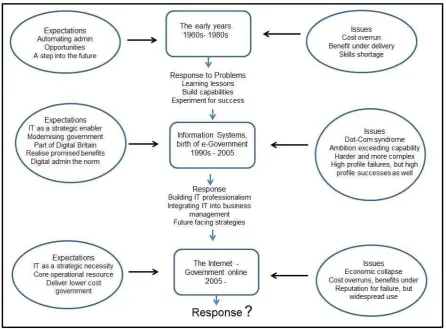
[image:8.595.75.522.324.653.2]The diagram below summarises findings and demonstrates the historical flow from the introduction of computing into government through to its emergence as e-Government. It finishes with a question mark for the future, asking whether, for the UK at least, innovation and leadership in the use of IT as a transformative tool is on the point of being abandoned and whether IT is now seen as little more than a resource which needs to do better.
Figure 1 From Computing to e-Government
8.
Conclusions
management approaches in support of policy business objectives to the point where the technology has become the strategic aim in its own right. At some point during the emergence of e-Government during the 1990s and early 2000s there has been what Ho describes as a Paradigm Shift in how e-Government is perceived (Ho, 2002).
The second is the attitude towards success and failure where again there appears, with hindsight anyway, to have been a shift, in this case from tolerance of problems as lessons learned, to a position where Government IT, and that includes e-government, is expected to work first time.
There are many questions and issues left to explore, and perhaps very few answers. When starting this paper we set out to see what answers, if any, a short and geographically limited history of this topic could provide. Answers are few. What we believe history has been able to do is identify questions which need to be answered if the full potential of e-Government is to be realised.
References
Abdelsalam, H., Reddick, C. G. & ElKadi, H., n.d. Success and Failure of Local E- Government Projects:
Lessons Learned from Egyp. In: s.l.:s.n.
Al-Rashid, H., 2010.
Examining Internal Challenges to E-Government Implementation from System
Users Perspective.
Abu Dhabi, s.n.
Bikfalvi, A., 2012.
D2.2 Analysis of administrative burdens reduction and service improvements after
project activities,
Girona: UdG.
Codagnone, C. & Wimmer, M. A., 2007.
Roadmapping eGovernment Research Visions and Measures
towards Innovative Governments in 202,
s.l.: eGovRTD2020 Project Consortium.
Cox, M., 2014.
Mini Track: Practice, Theory and Knowledge.
[Online]
Available at: http://academic-conferences.org/pdfs/ECEG_2015-cfp_MT_Cox.pdf
[Accessed December 2014].
Davison, R. M., Wagner, C. & Ma, L. C. K., 2005. From government to e-government: a transition
model.
Information Technology and People,
18(3), pp. 280-299.
DeBakcsy, D., 2015. Recovering from Rorty.
Philosophy Now,
Issue January 2015.
Drucker, P., 1974.
Management Tasks and Responsibilities.
New York: Butterworth and Heineman.
European Court of Auditors, 2011.
Have the e-government projects supported by ERDF been
effective?,
Luxembourg: EU Union.
Gordon Downey, Comptrollerand AuditorGeneral, National Audit Office, 1984.
Management and
Control of the Development of Administrative Computing in Goverment Departments,
London, UK:
Her Majestys Staionery Office.
Grant Thornton, 2011.
Project Management in e-Governance ,
s.l.: NISG, PMI.
Grönlund, Å. & Horan, T. A., 2004. Introducing e-Gov: History, Definitions, and Issues.
Grunden, K., 2012. A social perspective on the implementation of e-government: a longitudunal
study at the County administration of Sweden.. In: F. Bannister, ed.
Case Studies in E_Government.
Reading: Academic Publishing International, pp. 120-144.
Heeks, R., 2006.
Implementing and managing egovernment: an international text.
London: Sage.
Highsmith, J. A., 2010.
Agile project management: creating innovative products.
2nd ed. s.l.:Addison
Wesley Professional.
Ho, A. T. K., 2002. Reinventing Local Govenment and the E-government Initiative.
Public
Administration Review,
62(4), pp. 434-444.
Institute for Government, 2011.
Fatal Error. Fixing the flaws in Government IT,
s.l.: Blackberry.
Janowski, T., Ojo, A. & Estevez, E., 2007.
A Project Framework for e-Government,
s.l.: UNU-IIS.
Johnson, G. & Scholes, K., 2001.
Exploring Public Sector Strategy.
London: Pearson.
Keefe, T., Bikfalvi, A., Beer, M. & De La Rosa, J. L., 2013.
A case study analysis of factors determining
success or failure for participants in collabrative innovation projects in e-governemnt.
s.l., Academic
Publishing International.
Keefe, T. N., 2012.
Professional Ethics Analytical Framework.
Sheffield: s.n.
Keefe, T. N., Bikfalvi, A., Beer, M. & De la Rosa, J. L., 2012.
ISAC6+ Delivering Smarter Administration
through innovation - a Benefits Realisation approach to ensuring success..
s.l., Academic Conferences
and Publishing International Limited.
Longford, G., 2002.
Rethinking E-Government: Dilemmas of Public Service, Citizenship and Democracy
in the Digital Age,
s.l.: University of Ottaw.
Marchewka, J. T., 2013.
Information technology project management.
4th ed. New Jersey: Wiley.
Melin, U. & Axelsson, K., 2009. MANAGING E-GOVERNMENT PROJECTS
–
A COMPARATIVE CASE
STUDY OF TWO INTER -ORGANIZATIONAL E -SERVICE DEVELOPMENT INITIATIVES.
Transforming
Government: People, Process and Policy,
3(3), pp. 248 - 270.
Mintzberg, H., 1994.
The rise and fall of strategic planning.
New York: Simon & Schuster.
National Audit Office, 2012.
Assurance for major projects,
London: The Stationaery Office.
Ramadhan, A., Sensuse, D. I. & Arymurthy, A. M., 2011. Postmodernism in E-Government.
International Journal of Computer Science Isues,
8(4), pp. 623-629.
Rosa, J. L. d. l., 2012.
A unique Eu
ropean citizens’ attention service, Girona: UDG.
Schwester, R., 2011. Examining the Barriers to E-Government Adoption. In: L. Worrall, ed.
Leading
Issues in e-Government Research.
Reading: Academic Publications International, pp. 32-50.