Adaptive noise cancelling and time–frequency techniques
for rail surface defect detection
LIANG, Bo, IWNICKI, S., BALL, A. and YOUNG, Andrew E
Available from Sheffield Hallam University Research Archive (SHURA) at:
http://shura.shu.ac.uk/9091/
This document is the author deposited version. You are advised to consult the publisher's version if you wish to cite from it.
Published version
LIANG, Bo, IWNICKI, S., BALL, A. and YOUNG, Andrew E (2015). Adaptive noise cancelling and time–frequency techniques for rail surface defect detection.
Mechanical Systems and Signal Processing, 54, 41-51.
Copyright and re-use policy
See http://shura.shu.ac.uk/information.html
Sheffield Hallam University Research Archive
1
Adaptive Noise Cancelling and Time-frequency Techniques for
Rail Surface Defect Detection
B. Liang*1 S. Iwnicki2, A. Ball2 and A.E. Young1 1
Department of Engineering and Math Sheffield Hallam University, Sheffield S1 1WB, UK
2
School of Computing and Engineering
University of Huddersfield, Huddersfield HD1 3DH, UK
*Correspondence author [email protected]
Abstract
Adaptive noise cancelling (ANC) is a technique which is very effective to remove additive noises from the contaminated signals. It has been widely used in the fields of telecommunication, radar and sonar signal processing. However it was seldom used for the surveillance and diagnosis of mechanical systems before late of 1990s. As a promising technique it has gradually been exploited for the purpose of condition monitoring and fault diagnosis. Time-frequency analysis is another useful tool for condition monitoring and fault diagnosis purpose as time-frequency analysis can keep both time and frequency information simultaneously. This paper presents an ANC and time-frequency application for railway wheel flat and rail surface defect detection. The experimental results from a scaled roller test rig show that this approach can significantly reduce unwanted interferences and extract the weak signals from strong background noises. The combination of ANC and time-frequency analysis may provide us one of useful tools for condition monitoring and fault diagnosis of railway vehicles.
Key words:adaptive noise cancelling, wheel-rail contact, time-frequency analysis, signal processing
1. Introduction
2
monitoring [1]. Then this technique was widely used in telecommunication, radar and sonar signal processing because of its good performance in applications of noise reduction. The results from experiments of speech enhancement and speech recognition are especially encouraging [2-3]. After the late 1990s, ANC has also found its application in the area of condition monitoring and fault diagnosis [4-6].
The signal analysis techniques for condition monitoring can be classified into time-domain analysis, frequency-time-domain analysis, and joint time-frequency time-domain analysis. The time-domain analysis methods are to identify the quantities of a signal related to its time behaviour such as the maximum amplitude, root mean square (rms) value, kurtosis and crest factor of a signal, while the frequency-domain analysis methods are to analyse the contents of a signal related to its frequency behaviour, like power spectrum, cepstrum and higher-order spectrum of a signal.[7-11]. Since machinery operating in non-stationary mode generates a signature which at each instant of time has a distinct frequency, it is desirable to use time-frequency analysis technique to see how frequency changes with time. Time-frequency analysis techniques had found limited use in the past, except for the last two decades, primarily due to their very high computational complexity and the lack of adequate computing resources of the time. However the fast advances of computers in the last 10 years and the outstanding potential of new time-frequency method like wavelet transform has made them recently a very active area of research [12-16].
Rail and wheel faults like rail surface crack, squats, corrugation, and wheel flat can cause large dynamic contact forces at the wheel–rail interface and lead to fast deterioration of the track. Early detection of such defects is very important for timely maintenance. Extensive theoretical and experimental works have been carried out to investigate what is the best way to identify rail and wheel faults. Jun et al [17] suggested a method of estimating irregularities in railway tracks using acceleration data measured from high-speed trains. A mixed filtering approach was proposed for stable displacement estimation and waveband classification of the irregularities in the measured acceleration. Kawasaki and Youcef-Toumi [18] presented a method based on the car-body acceleration for track condition monitoring. But the car-body acceleration is highly dependent on the primary and the secondary suspension, so the effect of the track irregularities is difficult to extract from such data. Marija and Zili et al [19] attempted to determine a quantitative relationship between the characteristics of the accelerations and the track defects, axle box acceleration at a squat. The dynamic contact was simulated through finite element modeling. Belotti et al [20] presented a method of wheel flat detection using a wavelet transform method. In their study, a series of accelerometers were put under the rail bed to detect the impact force caused by a wheel flat and the signals were analysed based on the wavelet property of variable time-frequency resolution.
Wigner-Ville-3
Transform, Choi-Williams-Transform and Wavelet Transform). In section 3 the experimental test rig is described. Experimental results and discussion are shown in section 4. Finally conclusions are given in section 5.
2. ANC and time-frequency analysis theories
2.1.Adaptive noise cancelling technique
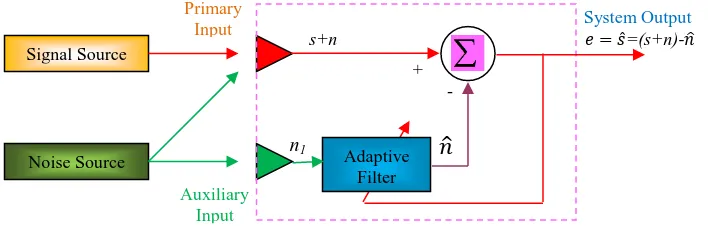
The principal of ANC is that it makes use of an auxiliary or reference input derived from one or more sensors located in points in the noise or unwanted signal field where the concerned signal is weak. The input is filtered and subtracted from a primary input containing both signal and noise. Because the filtering and subtraction are controlled by an appropriate adaptive process, noise reduction can be accomplished with little distorting the signal or increasing the output noise level. Figure 1 presents the basic philosophy of ANC. It can be seen that the primary input is a combination of the signal source s and the noise source n. The auxiliary input is the noise source n1 which is
correlated with the primary input noise source n and is filtered to produce an estimation of the noise source 𝒏̂. The system output 𝒔̂ is the source estimation which is the signal s plus noise source n, and then minus the estimation of noise source 𝒏̂ with the adaptive
filter. If n and 𝑛̂ are close enough, a better estimation of signal source 𝑠̂ can be obtained.
However there are some conditions attached for this method. The first condition is that the signal source s is uncorrelated with noise signal n and n1. The second condition is that in order to produce the best estimation of the signal source the ANC system output e has to be minimized in term of least means square of power as follows [21]:
𝒆 = 𝒔̂ = (𝒔 + 𝒏) − 𝒏̂ (1)
Squaring equation 1 and taking expectations in consideration of the first condition mentioned above produces,
𝐸[𝒆2] = 𝐸[𝒔̂2] = 𝐸[𝒔2] + 𝐸[(𝒏 − 𝒏̂)2] + 2𝐸[𝒔(𝒏 − 𝒏̂)] = 𝐸[𝒔2] + 𝐸[(𝒏 − 𝒏̂)2] (2)
If the item 𝐸[(𝒏 − 𝒏̂)2] is minimized in the least square means, the best least square estimate of the signal 𝒔̂ can be achieved with
𝐸[𝒆2] = 𝐸[𝒔̂2] = 𝐸[𝒔2] (3)
The least mean squares (LMS) algorithm is used for adjusting the filter coefficients to minimize the cost function. Compared to recursive least squares (RLS) algorithms, the LMS algorithms do not involve any matrix operations. Therefore, the LMS algorithms require fewer computational resources and memories than the RLS algorithms. The implementation of the LMS algorithms also is less complicated than the RLS algorithms. To minimize the mean square error 𝐸[𝒆2] the gradient of 𝐸[𝒔2]with respect to weights w can be set to zero. That is
4 which yields the Wiener equation
𝒘 = 𝑹−1𝑷 (5)
Where R=E[(n1)·(n1)T] is the auxiliary inputs correlation matrix and P=E[(s+n)·(n1)] is the cross-correlation column vector between the primary and the auxiliary inputs.
2.2.Time-frequency analysis techniques
Time-frequency analysis techniques had found limited use in the past, except for the last two decades, primarily due to their very high computational complexity and the lack of adequate computing resources of the time. However the fast advances of computers in the last 10 years and the outstanding potential of new time-frequency method like wavelet transform has made them recently a very active area of research. The most commonly used time-frequency presentation is the Short-Time-Fourier-Transform (STFT), which was originated from the well-known Fourier transform. In STFT time-localization can be achieved by first windowing the signal so as to cut off only a well-localized slice of s(t) and then taking its Fourier Transform. The STFT of a signal s(t) can be defined as [22]
𝑆𝑇𝐹𝑇𝑠(𝑡, 𝜔) = ∫ ℎ(𝜏 − 𝑡)𝑠(𝑡)𝑒∞ −𝑗𝜔𝑡
−∞ 𝑑𝑡 (6)
Where τ and ω denote the time of spectral localization and Fourier frequency, respectively, and h(τ-t) denotes a window function. However the STFT has some problems with dynamic signals due to its limitations of fixed window width.
Another well-known time-frequency representation is the Wigner-Ville transform. The Wigner transform was developed by Eugene Wigner in 1932 to study the problem of statistical equilibrium in quantum mechanics and was first introduced in signal analysis by the French scientist, Ville about 15 years later. It is commonly known in the signal processing community as the Wigner-Ville Transform [23].
𝑛̂
Signal Source
Noise Source Adaptive
Filter
System Output
+ - s+n
n1
Primary Input
[image:5.612.138.492.213.326.2]Auxiliary Input
Figure 1 The adaptive noise cancelling concept
5
Given a signal s(t), its Wigner-Ville transform is defined by
𝑊𝑉𝑠(𝑡, 𝜔) = ∫ 𝑠−∞∞ (𝑡 + 𝜏 2)𝑠⁄ ∗(𝑡 − 𝜏 2⁄ )𝑒−𝑗𝜔𝜏𝑑𝜏 (7)
The Wigner-Ville transform 𝑊𝑠(𝑡, 𝜔) essentially amounts to considering inner products of copies of 𝑠(𝑡 + 𝜏)𝑒−𝑗𝜔𝜏 of the original signal shifted in time-domain with the corresponding reversed copy 𝑠(−𝑡 + 𝜏)𝑒𝑗𝜔𝜏. Simple geometrical considerations show that such a procedure provides insights into the time-frequency content of a signal. From the definition of equation (7) it can be seen that the calculation of Wigner-Ville transform requires infinite quantity of the signal, which is impossible in practice. One practical method is to add a window h(τ) to the signal. That leads to a new version of the Wigner-Ville transform as follows:
𝑃𝑊𝑉𝑠(𝑡, 𝜔) = ∫ ℎ(𝜏)𝑠−∞∞ (𝑡 + 𝜏 2)𝑠⁄ ∗(𝑡 − 𝜏 2⁄ )𝑒−𝑗𝜔𝜏𝑑𝜏 (8)
Which is called pseudo-Wigner–Ville (PWV) representation.
However there is a well-known drawback of using Wigner-Ville distribution. The interference or cross-terms exist between any two signals due to the fact the Wigner-Ville transform is a bilinear transform. For example, if a signal consists of signal 1 and signal 2, the Wigner-Ville transform of the signal is
𝑃𝑊𝑉𝑠(𝑡, 𝜔) = 𝑃𝑊𝑉𝑠1(𝑡, 𝜔) + 𝑃𝑊𝑉𝑠2(𝑡, 𝜔) + 2ℛ𝑒(𝑃𝑊𝑉𝑠1,𝑠2(𝑡, 𝜔)) (9)
Where 𝑃𝑊𝑉𝑠1,𝑠2(𝑡, 𝜔) = ∫ ℎ1−∞∞ (𝜏)𝑠1(𝑡 + 𝜏 2) · ℎ⁄ 2(𝜏)𝑠2∗(𝑡 − 𝜏 2⁄ )𝑒−𝑗𝜔𝜏𝑑𝜏 is called the cross term Wigner-Ville transform of signal 1 and signal 2. In order to get rid of the cross-term a smoothed pseudo Wigner-Ville transform (SPWVT) has to be used.
As the Wigner-Ville transform can be generalized to a large class of time-frequency representations called Cohen’s class representations, one of natural choices is to select some Cohen’s kernel functions which can suppress the cross-term. The Choi–Williams Transform (CWT) is one of them. CWT was first proposed by Hyung-Ill Choi and William J. Williams in 1989 [24]. This distribution function adopts exponential kernel to suppress the cross-term. The CWT mathematical definition of a signal s is
𝐶𝑊𝑠(𝑡, 𝜔) = ∬ 1 √4𝜋𝜏2
𝜎
∞
−∞ 𝑒
−(𝜇−𝑡)2𝜎24𝜏2
6
Finally another relatively new time-frequency analysis technique is the wavelet transform (WT). Unlike Fourier analysis which breaks up a signal into sine waves of various frequencies wavelet analysis is to decompose a signal into shifted and scaled versions of the original (or mother) wavelet. One major advantage provided by wavelets is the ability to perform local analysis. Because wavelets are localized in time and scale, wavelet coefficients are able to localize abrupt changes in smooth signals. Also the WT is good at extracting information from both time and frequency domains. However the WT is sensitive to noise.
For a signal s(t), the WT transform can be given as [25]
𝑊𝑇𝑠𝜓(𝜏, 𝑥) = 𝛹𝑠𝜓(𝜏, 𝑥) =√|𝑥|1 ∫ 𝑠(𝑡)𝜓∞ ∗(𝑡 − 𝜏 𝑥⁄ )
−∞ 𝑑𝑡 (11)
Where ψ(t-τ/x) is the mother wavelet with a dilation x and a translation τ which is used for localization in frequency and time.
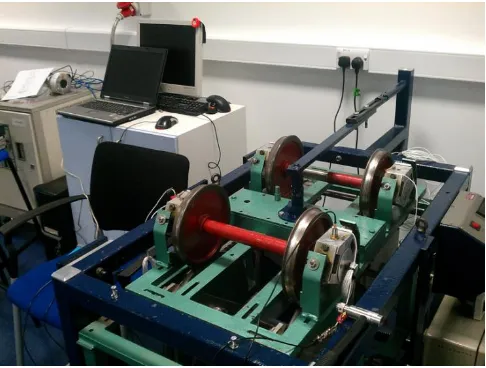
3. The roller test rig and experiments set up
7
Table 1 The parameters for the roller rig
Parameter Full size 1/5 scale
wheelset mass 1850 kg 14.8 kg
wheelset rotational inertia 174 kgm2 0.056 kgm2 wheelset roll/yaw inertia 935 kgm2 0.300 kgm2
bogie mass 2469 kg 19.75 kg
bogie roll inertia 1130 kgm2 0.361 kgm2
bogie yaw inertia 2142 kgm2 0.685 kgm2
wheel diameter 0.914 m 0.182 m
gauge 1.435 m 0.287 m
wheelbase 2.5 m 0.5 m
[image:8.612.180.495.299.417.2]speed v v/5
Figure 2 The primary and auxiliary inputs of the ANC filter
Figure 3 The photo of the 1/5 roller test rig
Output Primary input
Auxiliary input ANC Roller surface defect
Bogie
frame Rollers Wheelset
[image:8.612.186.429.491.675.2]8
4. Experimental results and discussions
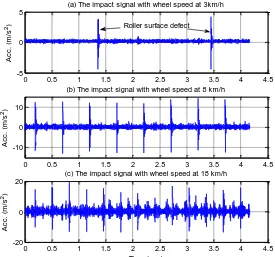
In figure 4, a series of impact vibration pulses caused by a roller surface defect under three different wheelset running speeds are presented. When the wheelset running speed is low, the clear impact pulses caused by the roller surface defect can be seen (figure 4(a)). However as the wheelset running speed rises, the roller surface defect impact pulses will be contaminated by wheel flange contact and some other unknown noises as shown in figure 4(c). Some kinds of signal processing techniques are necessary in order to eliminate the unwanted noises. Figure 5 presents the corresponding spectra of the impact vibration under different wheelset running speeds. It shows that when wheelset speed is low, the impact caused by the defect can only excite some higher frequency content of the wheelset system (between 2000-2500Hz). As the wheelset speed continues to rise as indicated in figure 5(b)-(c), the higher frequency caused by the impact diminished and the lower band natural frequencies 300-400Hz, 600-650Hz and 1100-1300Hz became the dominant frequencies in the spectrum because the creep forces between wheel and rail were increased with the wheelset rotating speed rising.
9
Figure 4 The impact vibration signals caused by roller surface defects under different wheelset running speeds
Figure 5 The impact vibration spectra under different wheelset running speeds
0 0.5 1 1.5 2 2.5 3 3.5 4 4.5
-20 0 20
Time (sec)
A
c
c
.
(m
/s
2)
(c) The impact signal with wheel speed at 18 km/h
0 0.5 1 1.5 2 2.5 3 3.5 4 4.5
-10 0 10
A
c
c
.
(m
/s
2)
(b) The impact signal with wheel speed at 8 km/h
0 0.5 1 1.5 2 2.5 3 3.5 4 4.5
-5 0 5
A
c
c
.
(m
/s
2)
(a) The impact signal with wheel speed at 3km/h
Roller surface defect
0 500 1000 1500 2000 2500 3000
0 0.05 0.1
(a) The impact spectrum with wheel speed at 3km/h
0 500 1000 1500 2000 2500 3000
0 0.05 0.1
N
o
rm
a
li
z
e
d
A
m
p
li
tu
d
e (b) The impact spectrum with wheel speed at 8km/h
0 500 1000 1500 2000 2500 3000
0 0.05 0.1
Frequency (Hz)
10
Figure 6 The ANC cancellation effect for wheelset running at 3km/h
Figure 7 The ANC cancellation effect for wheelset running at 15km/h
0 1 2 3 4
-5 0 5
A
C
C
.(
m
/s
2)
(b) The auxilitary input
0 1 2 3 4
-5 0 5
(a) The primary input
0 1 2 3 4
-5 0 5
Time (sec) (c) The ANC filter input
0 0.5 1 1.5 2 2.5
-10 0 10
Time (sec)
A
c
c
.
(m
/s
2)
(c) The ANC filter output
0 0.5 1 1.5 2 2.5
-10 0 10
A
c
c
.
(m
/s
2)
(b) The auxilitary input
0 0.5 1 1.5 2 2.5
-10 0 10
A
c
c
.
(m
/s
2)
11
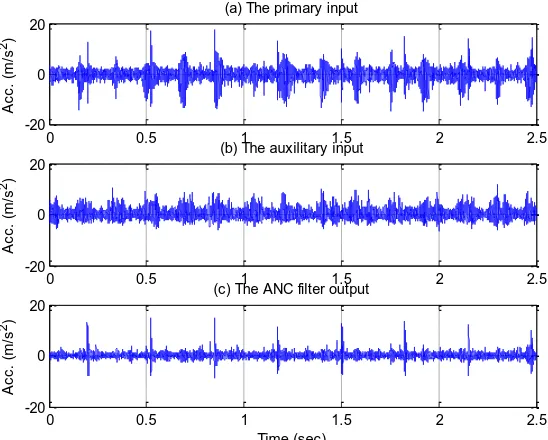
Figure 8 The ANC cancellation effect for wheelset running at 25km/h
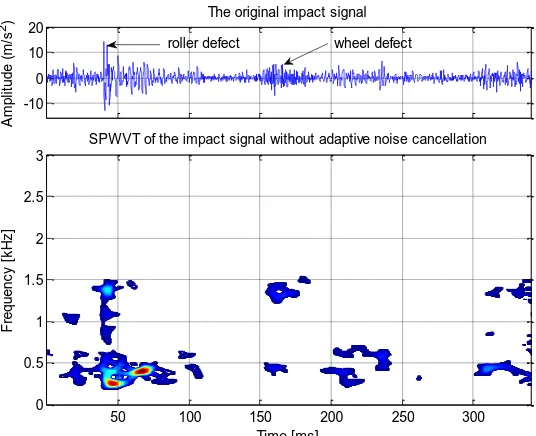
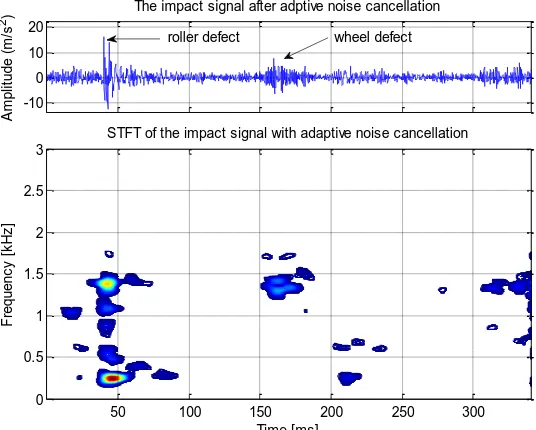
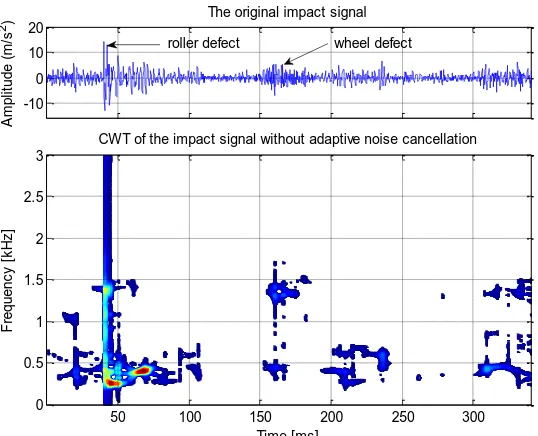
A further investigation was made to combine the ANC processing with time-frequency analysis because time-frequency analysis has the advantage of presenting time and frequency information simultaneously. Four time-frequency transform techniques (SPWVT, STFT, CWT and WT) were used for one of impact signals with and without ANC processing. Figure 9 shows the SPWVT result for the impact signal without ANC processing. It can be seen there is an unknown noise exists at about 75ms in time domain and 400Hz in the frequency domain without the ANC processing. However after the ANC processing, the noise was removed and a better and clearer SPWVT result was achieved (figure 10) with the enhanced frequency components at 1.4 kHz for roller surface defect and wheel defect. The same signal was also analysed by STFT and given in figure 11-12. The STFT analysis presents very similar result with SPWVT but with slightly lower resolution in time and frequency domains. The Choi–Williams Transform (CWT) of the impact signal was shown in figure 13-14. Due to the fact the kernel gain does not decrease along the axis in the frequency domain, a rather long smear bar appears with the roller surface defect pulse in the frequency axis. Despite of this disadvantage, CWT can still give a good time and frequency resolution for the roller surface defect signal. Finally wavelet transform (WT) analysis was carried out for the signal with and without ANC processing (figures 15-16). It can be seen that WT demonstrates a good ability to localize the information in time and frequency domains. However because WT is sensitive to noises, figures 15-16 do show some tiny variations caused by random noises.
0 0.5 1 1.5 2 2.5
-20 0 20
A
c
c
.
(m
/s
2)
(a) The primary input
0 0.5 1 1.5 2 2.5
-20 0 20
A
c
c
.
(m
/s
2)
(b) The auxilitary input
0 0.5 1 1.5 2 2.5
-20 0 20
Time (sec)
A
c
c
.
(m
/s
2)
12
[image:13.612.161.429.74.292.2]Figure 9 SPWVT of the impact signal without ANC processing
Figure 10 SPWVT of the impact signal with ANC processing -10 0 10 20 A m p lit u d e ( m /s 2)
The original impact signal
SPWVT of the impact signal without adaptive noise cancellation
Time [ms] F re q u e n c y [ k H z ]
50 100 150 200 250 300
0 0.5 1 1.5 2 2.5 3
roller defect wheel defect
-10 0 10 20 A m p lit u d e ( m /s 2)
The impact signal after adaptive noise cancellation
SPWVT of the impact signal with adaptive noise cancellation
Time [ms] F re q u e n c y [ k H z ]
50 100 150 200 250 300
0 0.5 1 1.5 2 2.5 3
13
Figure 11 STFT of the impact signal without ANC processing
Figure 12 STFT of the impact signal with ANC processing
-10 0 10 20 Am p lit u d e (m /s 2)
The original impact signal
STFT of the impact signal without adaptive noise cancellation
Time [ms] F re q u e n c y [ k H z ]
50 100 150 200 250 300
0 0.5 1 1.5 2 2.5 3 wheel defect roller defect -10 0 10 20 A m p lit u d e ( m /s 2)
The impact signal after adptive noise cancellation
STFT of the impact signal with adaptive noise cancellation
Time [ms] F re q u e n c y [ k H z ]
50 100 150 200 250 300
[image:14.612.161.429.331.546.2]14
[image:15.612.161.431.302.534.2]Figure 13 CWT of the impact signal without ANC processing
Figure 14 CWT of the impact signal with ANC processing -10 0 10 20 A m p lit u d e ( m /s 2)
The original impact signal
CWT of the impact signal without adaptive noise cancellation
Time [ms] F re q u e n c y [ k H z ]
50 100 150 200 250 300
0 0.5 1 1.5 2 2.5 3
roller defect wheel defect
-10 0 10 20 A m p lit u d e ( m /s 2)
The impact signal after adaptive noise cancellation
CWT of the impact signal with adaptive noise cancellation
Time [ms] F re q u e n c y [ k H z ]
50 100 150 200 250 300
0 0.5 1 1.5 2 2.5 3
15
[image:16.612.153.455.218.521.2]Figure 15 WT of the impact signal without ANC processing
Figure 16 WT of the impact signal with ANC processing
5. Conclusions
In this study, an adaptive noise cancelling (ANC) technique with time-frequency signal processing was proposed to detect rail surface defects. A series of experiments was carried out on a 1/5 scale roller test rig. The experiment results demonstrated that if a wheelset is running at low speed the ANC method is less attractive because of the good original signal-to-noise ratio in the vibration signal. However if a wheelset is running at relatively high speed, there is a significant level of noise presented. For example, the wheel flange contacts between wheel and rail can contaminate the wanted signal caused by rail surface defects and makes the detection difficult. The experiments proved that ANC could be an effective way to eliminate this unwanted noise.
-10 0 10 20 A m p li tu d e ( m /s
2 ) The original impact signal
Time (ms) F re q u e n cy ( H z)
WT of the impact signal without adaptive noise cancellation
0 50 100 150 200 250 300
0 500 1000 1500 2000 2500
roller defect wheel defect
-10 0 10 20 A m p li tu d e ( m /s 2 )
The impact signal after adaptive noise cancellation
Time (ms) F re q u e n cy ( H z)
WT of the impact signal with adaptive noise cancellation
0 50 100 150 200 250 300
0 500 1000 1500 2000 2500
16
Further investigation about time-frequency analysis techniques was also made for rail surface defects. Four time-frequency analysis methods (STFT, SPWVT, CWT and WT) were tested. The results show all four frequency methods can present proper time-frequency information for the vibration generated by wheel flat and rail surface defects. However they have different advantages and disadvantages. The SPWVT gives a better representation with a both time and frequency resolutions while WT shows good localisations in both time and frequency dimensions. STFT presents slightly lower resolutions in time and frequency axes. CWT displays reasonable information of the roller surface defect signal in time and frequency domains but with some smear disadvantage effects in frequency domain caused by its inherited problem. Despite of this drawback CWT is still a good alternate choice for the time-frequency analysis. The combination of the ANC technique and an appropriate time-frequency analysis method like SPWVT and WT may provide a very useful tool for condition monitoring and fault diagnosis in the railway industry.
References
1. Bernard, W.J. etc Adaptive noise cancelling: principles and applications, Proceedings of the IEEE, Vol.63, No.12, December. 1975, pp1672-1716
2. Van Compernolle, D. etc, Speech recognition in noisy environment with the aid of microphone arrays, Proceedings of the Eurospeech, Paris, France, 1989, pp657-666
3. Shields, P.W. and Campell, D.R. Speech enhancement using a multi-microphone sub-band adaptive noise canceller, Proceedings of Eurospeech, Budapest, Hungary, 1999, pp2559-2566
4. Shao, Y. and Nezu, K. Detection of self-aligning roller bearing fault using asynchronous adaptive noise cancelling technology, JSME International Journal, Series, Vol.42 (1), 1999, pp33-43
5. Randall, R.B., Bearing diagnosis in helicopter gearboxes, Proceedings of the 14th International Congress, Vol.1, UK 2001, pp434-453
6. Ayala, Botto, M. etc, Intelligent active noise control applied to a laboratory railway coach model, Control Engineering Practice, Vol.13, Issue 4, 2005, pp473-484
7. I. Yesilyurt, Fault detection and location in gears by the smoothed instantaneous power spectrum distribution, NDT & E International, Volume 36, Issue 7, October 2003
8. Peng Chen, Masatoshi Taniguchi, Toshio Toyota, Zhengja He, Fault diagnosis method for machinery in unsteady operating condition by instantaneous power spectrum and genetic programming, Mechanical Systems and Signal Processing, Volume 19, Issue 1, 2005
9. R.B. Randall, Cepstrum analysis, Encyclopedia of Vibration, 2001
17
11.L. Saidi, F. Fnaiech, H. Henao, G-A. Capolino, G. Cirrincione, Diagnosis of broken-bars fault in induction machines using higher order spectral analysis, ISA Transactions, Volume 52, Issue 1, 2013
12.Zhipeng Feng, Ming Liang, Fulei Chu, Recent advances in time–frequency analysis methods for machinery fault diagnosis: A review with application examples, Mechanical Systems and Signal Processing, Volume 38, Issue 1, 2013 13.N. Baydar and A. Ball, A comparative study of acoustic and vibration signals in
detection of gear failure using Wigner-Ville distribution, Mechanical Systems and Signal Processing, Vol.15, 2001
14.V.V. Polyshchuk, F. K. Choy and M. J. Braun, Gear fault detection with Time-frequency based parameter NP4, International Journal of Rotating Machinery, Vol.8, No. 1, 2002
15.Ervin Sejdić, Igor Djurović, Jin Jiang, Time–frequency feature representation using energy concentration: An overview of recent advances, Digital Signal Processing, Volume 19, Issue 1, 2009
16.N. Saravanan, K.I. Ramachandran, Incipient gear box fault diagnosis using discrete wavelet transform (DWT) for feature extraction and classification using artificial neural network (ANN), Expert Systems with Applications, Volume 37, Issue 6, 2010
17.Jun Seok Lee, Sunghoon Choi, et al, A mixed filtering approach for track condition monitoring using accelerometers on the axle box and bogie, IEEE Transactions on Instrumentation and Measurement, Vol.61, No.3, March, 2012
18.J. Kawasaki and K. Youcef-Toumi, Estimation of rail irregularities, Proceedings American Control Conference., Anchorage, USA, May 2002
19.Marija Molodova, Zili Li and Rolf Dollevoet, Axle box acceleration: Measurement and simulation for detection of short track defects, Wear, Vol.271, No.3, 2011
20.V. Belotti, F. Crenna, R. C. Michelini, and G. B. Rossi, Wheel-flat diagnostic tool via wavelet transform, Mechanical Systems and Signal Processing Vol. 20, No.2, 2006
21.Wiener, N. Extrapolation, interpolation and smoothing of stationary time series with engineering applications, New York, Wiley, 1949
22.Hlawatsch, F. and Auger, F. Time-frequency analysis, John Wiley & Sons Inc, USA 2005
23.Qian, S. Introduction to time-frequency and wavelet transforms, Prentice Hall, London, 2002
24.Sardy, S. and Tseng, P. Robust wavelet de-noising, IEEE Trans. of Signal Processing, Vol.49 (6), 2001