Misattribution Procedure
WILLIAMS, Amanda, STEELE, Jennifer R and LIPMAN, Corey
Available from Sheffield Hallam University Research Archive (SHURA) at: http://shura.shu.ac.uk/10195/
This document is the author deposited version. You are advised to consult the publisher's version if you wish to cite from it.
Published version
WILLIAMS, Amanda, STEELE, Jennifer R and LIPMAN, Corey (2016). Assessing children’s implicit attitudes using the Affect Misattribution Procedure. Journal of Cognition and Development, 17 (3), 505-525.
Copyright and re-use policy
See http://shura.shu.ac.uk/information.html
Assessing children’s implicit attitudes using the Affect Misattribution Procedure
Amanda Williams
Jennifer R. Steele
Corey Lipman
York University
Toronto, Ontario, Canada
** Accepted for publication in the Journal of Cognition and Development**
Please note recent affiliation change: Amanda Williams (Sheffield Hallam University).
Please address correspondence to Amanda Williams, Department of Psychology, Sociology, and
Politics, Collegiate Crescent Campus, Sheffield Hallam University, Sheffield, UK, S10 2LD;
Phone: (011) 0114-225-5394; Email: [email protected]
This research was supported by a SSHRC-SRG and a CFI-LOF grant awarded to the second
author.
We would like to thank members of the Interpersonal and Social Cognition Lab for their
helpful comments and their assistance with data collection. We would also like to thank the Ontario
Science Center administration as well as parents and children who very generously provided us with
Abstract
In the current research we examined whether the Affect Misattribution Procedure (AMP; Payne
et al., 2005) could be successfully adapted as an implicit measure of children’s attitudes. We
tested this possibility in three studies with 5 to 10 year old children. In Study 1 we found
evidence that children misattribute affect elicited by attitudinally positive (e.g., cute animals) and
negative (e.g., aggressive animals) primes to neutral stimuli (inkblots). In Study 2, we found
that, as expected, children’s responses following flower and insect primes were moderated by
gender. Girls (but not boys) were more likely to judge inkblots as pleasant when they followed
flower primes. Children in Study 3 showed predicted affect misattribution following happy as
compared to sad face primes. In addition, children’s responses on this child-friendly AMP
predicted their self-reported empathy; the greater children’s spontaneous misattribution of affect
following happy and sad primes, the more children reported feeling the joy and pain of others.
These studies provide evidence that the AMP can be adapted as an implicit measure of children’s
attitudes and the results of Study 3 offer novel insight into individual differences in children’s
affective responses to the emotional expressions of others.
Word Count: 194
Keywords: implicit attitudes, implicit measures, affect misattribution, affective priming,
Assessing children’s implicit attitudes using the Affect Misattribution Procedure
For the past twenty years, implicit social cognition has been a main area of inquiry within
social psychology and other related disciplines (see Gawronski & Payne, 2010). Research in this
area has aimed to circumvent the many limitations of self-report measures by examining the
automatic associations that often guide our social judgments and behaviors. In order to
accomplish this goal, a variety of measures designed to assess automatic affective evaluations
have been created, with the Implicit Association Test (IAT; Greenwald, McGhee, & Schwartz,
1998) and sequential evaluative priming tasks (see Wentura & Degner, 2010, for a review) being
among the measures most frequently administered to adults (Nosek, Hawkins, & Frazier, 2011).
More recently, a new measure has been developed which is rapidly gaining in popularity: the
Affect Misattribution Procedure (AMP; Payne, Cheng, Govorun, & Stewart, 2005). The goal of
the present research was to develop a modified child-friendly version of the AMP and examine
whether this could be used as an implicit measure of children’s attitudes.
The term implicit is often used to describe measures that are completed without
introspection, conscious intention, or deliberate processing of the construct of interest (Nosek,
Greenwald, & Banaji, 2007). Although a great deal of research with adults has made use of
implicit measures over the last two decades, it has only been in the last ten years that a handful of
researchers have begun to modify these measures to assess children’s attitudes (see Olson &
Dunham, 2010, for a review). As with adults, these methods have the potential to provide
greater insight into attitudes and beliefs that might not be accessible to children through
introspection alone. In addition, they have the ability to tap into social cognitions that children
might be unwilling to share, particularly at specific stages of development when their awareness
2005). The AMP, which was developed for use with adults (e.g., Gawronski, Cunningham,
LeBel, & Deutsch, 2010; Inzlicht, Gutsell, & Legault, 2012; Payne, Burkley, & Stokes, 2008;
Payne, Govorun, & Arbuckle, 2008; Payne, Hall, Cameron, & Bishara, 2010), has the potential
to be a useful new implicit measure of children’s attitudes.
The AMP builds on the classic principle that it is common for people to make
misattributions about the origin of their thoughts, feelings, and behaviors (see Loersch & Payne,
2011; Payne et al., 2005; Payne et al., 2010, for reviews). Although people often believe that
their judgments are under their conscious control, research has consistently demonstrated that
subtle cues or primes in our environment can profoundly impact our cognitions, affect, and
behavior (Hofmann & Wilson, 2010; Loersch & Payne, 2011). Building on this notion, in the
AMP participants are presented with multiple trials in which they are briefly exposed to a prime
(e.g., a smiling or crying face; 75 ms), a blank screen (125 ms), and a neutral target (e.g., an
inkblot, 100 ms), which is masked until the participant indicates whether they believe the neutral
target image to be more or less visually pleasing than average (Payne et al., 2005). If the primes
automatically elicit affect (e.g., a prime of a smiling face elicits positive affect), this will be
misattributed to the neutral target (e.g., inkblot), increasing the probability that the judgment of
the neutral target will be biased in the direction of the prime (e.g., as more visually pleasing than
average). Affect misattribution occurs when the affect that is automatically activated by the
prime is subsequently misattributed to the neutral target (i.e., inkblots are judged as more
visually pleasing following happy primes as compared with sad primes).
The AMP is an implicit measure of attitudes due to the uncontrollable and unintentional
nature of misattribution following affect-laden primes. Although participants provide an explicit
intentional responding as participants are unable to correct for the affect activated by the prime
(Payne et al., 2005). Across several studies, even when adult participants were motivated to
appear unbiased or were instructed to control for the influence of the prime, their judgments of
neutral targets were systematically influenced by the valence of the preceding prime (Payne et
al., 2013; Payne, Burkley, et al., 2008; Payne et al., 2005; cf. Bar-Anan & Nosek, 2012).
Although this type of affect misattribution has been repeatedly demonstrated with adults,
researchers have yet to determine whether similar effects emerge with children.
For a number of reasons, the AMP has the potential to be a particularly valuable measure
for use with children. Relative to other implicit measures that have been adapted for older
children (see Degner & Wentura, 2010), the AMP requires a small number of trials, uses
straightforward instructions, and effects are not based on response latencies, which can be influenced by children’s focus and/or temporary distractions. In addition, the task structure of
the AMP allows researchers to easily create absolute attitude estimates towards each target group
of interest in addition to a relative score (e.g., Payne et al., 2005; see also Bar-Anan & Nosek,
2014). Without diminishing the importance of research with other child-friendly implicit
measures that has been conducted to date, due to the methodological and practical benefits
offered by the AMP, we believe that this measure has the potential to be another valuable tool for researchers interested in studying children’s implicit cognition.
Overview
The primary goal of the current research was to determine whether children in middle (5 to
7 years) and late (8 to 10 years) childhood1 would show misattribution effects following
affect-laden primes. In Study 1 we primed children with attitudinally positive and negative images
affective priming task for children) that were quickly replaced by neutral targets (inkblots) that
children assessed as being pleasant or unpleasant. We anticipated that both younger and older
children would show misattribution effects and be more likely to judge inkblots following
positive primes (e.g., cute animals) as pleasant than inkblots following negative primes (e.g.,
aggressive animals). In Study 2 we presented different nonsocial attitude objects (flowers and
insects) as affect-laden primes (Greenwald et al., 1998; see also Baron & Banaji, 2006, for a
similar validation procedure with a child-friendly IAT) and we manipulated the duration of
primes and targets to determine whether specific timing parameters optimized effects on the
child-friendly AMP (ch-AMP). We again anticipated a misattribution effect. However, based on
previous research that found boys to have more ambivalent attitudes toward flowers and insects
(Baron & Banaji, 2006; Cvencek, Greenwald, & Meltzoff, 2011), we expected this effect to be
moderated by gender, with boys showing an attenuated priming effect.
The goal of Study 3 was to further our understanding of the development of children’s
implicit social cognition by using the ch-AMP to examine whether affect misattribution would
occur when happy and sad faces served as primes. Emotional expression conveys important
social informationthat influences person perception (see Freeman, Johnson, Adams, & Ambady,
2012, for a review), and the processing of emotional expression can occur automatically, under
conditions of limited awareness (Rohr, Degner, & Wentura, 2012). Furthermore, the ability to
detect, decode, and respond to facial expressions is a key component of emotional competency
and these skills have been shown to contribute to important aspects of development, such as peer
relations, academic success, and positive health-related behaviors across the lifespan (see
Buckley & Saarni, 2006, for a review). These skills can be critical for successfully navigating
others in order to appropriately regulate one’s own behavior during social interactions (Buckley
& Saarni, 2006). In Study 3 we examined whether children would show affect misattribution on
the ch-AMP in response to happy and sad primes. Consistent with what has been found with
adults (e.g., Donges, Kersting, & Suslow, 2012; Rohr et al., 2012), we anticipated a
misattribution effect for these socially-relevant targets, with children showing an implicit
preference for happy as compared to sad target faces.
In Study 3 we also sought to extend this research by examining whether individual differences in children’s implicit social cognition as measured by this ch-AMP could predict
self-reported empathy. Given that empathy has been defined as “vicarious affective arousal
resulting from an identification with the emotional state of another person” (Chapman,
Zahn-Waxler, Cooperman, & Iannotti, 1987, p. 140), we anticipated that children who spontaneously
experience more intense affect in response to emotion-laden prime images, as indicated by
stronger priming effects, would report feeling more pronounced empathy toward others. Such a finding would be the first demonstration that children’s automatic affective response toward
smiling and crying targets can predict their self-reported empathetic responses.
Study 1
The goal of Study 1 was to examine children’s affect misattribution following attitudinally
positive and negative primes using a procedure modeled after Payne et al. (2005).
Method
Participants
Seventy children were recruited from and tested in a community setting in the Greater
Toronto Area. The sample included 30 younger children aged 5 to 7 years (15 boys, 15 girls;
median age = 9 years). The racial/ethnic composition of the sample was 68% White, 20%
multiracial, 6% East/Southeast Asian, 3% Latin American, and 3% South Asian or Middle
Eastern. Parental permission was obtained prior to participation.
Procedure
As part of a larger study, participants completed an AMP (Payne et al., 2005) that was
modified slightly to be appropriate for use with children (ch-AMP). Children were told that they would play a “decision game” in which they would see briefly presented inkblots.2
After
showing each child what a typical inkblot looks like, children were told that their task was to indicate whether each inkblot was “nice looking” or “not so nice looking” by pressing one of two
computer keys. The keys associated with the response options were counterbalanced between
participants and children were encouraged to make use of both of these response options. To
provide an ostensible rationale for showing prime images and to circumvent controlled
responding while ensuring that children attended to the primes, participants were told that each
inkblot would be preceded by a picture that they should try to remember because they might be
asked about these pictures later. It was stressed that “this picture will just let you know that the
inkblot is coming” and that children were to make decisions about the inkblot.
Each trial began with a blank screen for 540 to 1020 ms, followed by a prime presented for
75 ms, a blank screen for 75 ms, a neutral inkblot for 125 or 150 ms,3 and a mask that remained
on screen until a response was made. Following ten practice trials in which shapes were
presented as primes, children completed two critical blocks, each including sixteen trials. In
each block children were sequentially and randomly presented with one of eight positive (e.g.,
puppies, a bunny) and eight negative (e.g., a growling bear, an attacking shark) prime images
Each prime was followed by an inkblot that was randomly selected without replacement from a
set of eighty. The two critical blocks were separated by a break screen that provided children
with the opportunity to rest and ask questions. Throughout the task a header with the word “unpleasant” above a simple line drawing of a frowning face and the word “pleasant” above a
simple line drawing of a smiling face remained at the top of the screen to remind participants of
their response options. Using the procedure outlined by Payne et al. (2005, Study 1), responses
demonstrated acceptable internal consistency (α = .73).
Results and Discussion
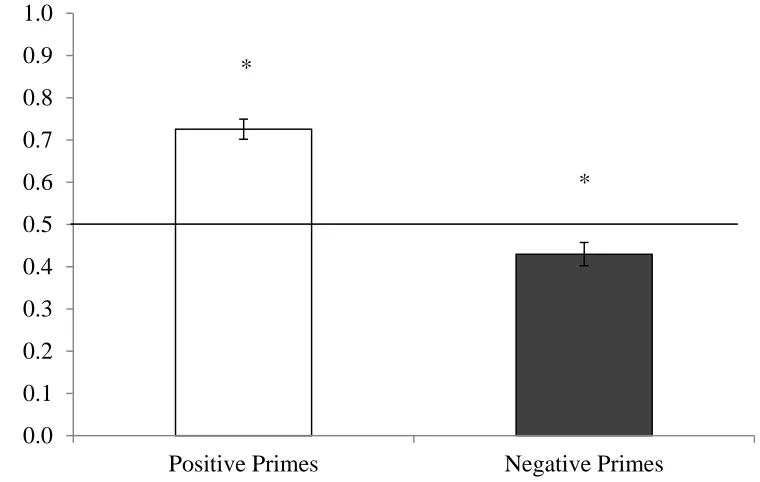
The proportion of inkblots judged favorably was calculated separately for trials presenting
positive and negative primes (Payne et al., 2005). The responses of six children were removed
because they either intentionally rated the prime image (n = 3) or used the same response key for
every item (n = 3). A 2 (prime valence: positive vs. negative) × 2 (participant gender: boys vs.
girls) × 2 (participant age: younger vs. older) analysis of variance (ANOVA) with the first factor
within-subjects revealed a main effect of prime valence, F(1, 60) = 56.47, p < .001, ηp2 = .49;
children were more likely to judge inkblots as pleasant when they followed positive as compared
to negative primes (Figure 1). When comparing the priming effects to chance (.5), children were
reliably more likely to judge inkblots following positive primes as pleasant, t(63) = 9.38, p <
.001, d = 1.17, and inkblots following negative primes as unpleasant, t(63) = -2.57, p = .01, d =
.32. This priming effect did not differ by participant gender or age, Fs < 2.10, ps > .15, ηp2s <
.04.
Insert Figure 1 about here
This result demonstrates that children as young as 5 years of age show priming effects.
affective responses in children which can subsequently be misattributed to a neutral target. As
such, these data suggest that a modified version of the AMP can be used to assess children’s
implicit cognition, even early in development (i.e., 5 to 7 years of age). In Study 2, we sought to
extend these initial findingsby (a) examining the effect of manipulating presentation times for
primes and targets and (b) presenting primes that have been used previously in research
examining implicit attitudes: flowers and insects.
Study 2
In Study 2 we again examined whether children would show affect misattribution
following attitudinally valenced primes. Flowers and insects were selected as primes because
previous research has demonstrated that both adults (Baron & Banaji, 2006; Greenwald et al.,
1998) and children (Baron & Banaji, 2006; Cvencek, Greenwald, & Meltzoff, 2011; Thomas,
Smith, & Ball, 2007) typically demonstrate an implicit preference for flowers in comparison to
insects and as such it has been argued that “the ability to detect a preference for flowers (relative
to insects) indicates that the measure is working” (Cvencek, Greenwald, & Meltzoff, 2011, p.
196; see also Baron & Banaji, 2006; Greenwald et al., 1998). In addition, this relative preference
is typically more pronounced for girls as compared to boys (Baron & Banaji, 2006; Cvencek,
Greenwald, & Meltzoff, 2011). Therefore, using these primes provided us with the opportunity
to examine whether a similar gender difference would emerge on a ch-AMP.
After the ch-AMP, children completed a child-friendly flower-insect IAT (ch-IAT)
comparable to what has been used in previous research (Baron & Banaji, 2006; Cvencek,
Greenwald, & Meltzoff, 2011). When completing the ch-IAT, participants categorize images
into superordinate groups, and reaction times are used to create a relative score (preference for
categorized into superordinate groups. Instead, responses following each prime (e.g., sunflower
or wasp) are compiled to estimate implicit preference for single categories (e.g., flowers or
insects), which can be combined into a relative preference score (positivity toward flowers
relative to insects).
In Study 2 we anticipated that attitude estimates on these two implicit measures would
show a similar pattern of results, despite these differences in task structure. We anticipated that
by 5 years of age, children would have developed affective responses to the categories of flowers
and insects (Baron & Banaji, 2006; Cvencek, Greenwald, & Meltzoff, 2011) and towards
specific exemplars from these categories, such as a sunflower or wasp. However, given that
affective responses elicited by categories (e.g., insects) and individual exemplars from the
categories (e.g., a wasp) can differ (Degner & Wentura, 2010; Fazio & Olson, 2003; Livingston
& Brewer, 2002; Olson & Fazio, 2003), we expected to find a small, if any, relationship between children’s responses on the two measures.
In addition, we expected that girls in our sample would demonstrate an implicit preference
for flowers as compared to insects on both the ch-AMP and ch-IAT; such a finding would be
consistent with gender differences found in previous studies that used a ch-IAT (e.g., Baron &
Banaji, 2006; Cvencek, Greenwald, & Meltzoff, 2011). We also predicted that for boys, who are
culturally encouraged to have a less positive orientation toward flowers and a more positive
orientation toward insects than girls (Cvencek, Greenwald, & Meltzoff, 2011), this pro-flower
bias would be attenuated.
A second goal of this study was to examine whether the priming effect would be
moderated by different timing parameters for the ch-AMP. In line with more recent procedural
2012, Study 2; Inzlicht et al., 2012; Payne et al., 2010, Study 1; see also Payne et al., 2005, Study
3) and as a within-subjects variable we manipulated the duration of the primes and targets.
Based on previous research with adults (Payne et al., 2005, Studies 3 and 4) we expected priming
effects to emerge regardless of the duration of the stimuli. Nonetheless, we manipulated the
timing to determine whether priming effects would be more pronounced under specific
parameters.
Method
Participants
Fifty-seven children were recruited from and tested in a community setting in the Greater
Toronto Area. The sample included 30 younger children aged 5 to 7 years (13 boys, 17 girls;
median age = 6 years) and 27 older children aged 8 to 10 years (14 boys, 13 girls; median age =
9 years). The racial/ethnic composition of the sample was 54% White, 21% East/Southeast
Asian, 16% multiracial, and 9% South Asian.
Procedure
After obtaining parental permission, children completed a ch-AMP. The task was similar
to Study 1, with the exception that the instructions were changed to be more consistent with
those used for adults (Payne et al., 2005). Children were told:
To warn you that the inkblot is coming, you will see a real-life image before each inkblot.
Since we are interested in what you think only of the inkblot, try not to let this picture
change your answers. Please tell us about the inkblot as best you can, no matter what
picture (is) in front of it.
In each trial participants viewed a prime followed by an inkblot and a mask that remained
participants first completed two paper-based practice trials presenting one positive (i.e., dolphin)
and one negative (i.e., garbage) prime image (International Affective Picture System [IAPS];
Lang, Bradley, & Cuthbert, 2005). The paper-based trials were comparable to the computerized
ch-AMP trials, with the exception that stimuli were presented on paper. The experimenter
rapidly presented the child with a blank sheet of paper, followed by a paper containing a prime
image, then a picture of an inkblot, and finally a printed copy of a mask image. Once the mask
was covering the other sheets of paper, children were asked to verbally identify whether the inkblot was “nice” or “not so nice” and point to the corresponding computer key that they would
use in the upcoming computer task. During these paper-based practice trials the experimenter
emphasized that children were to judge the inkblots and not the real-life images. The
paper-based trials were followed by ten practice trials completed on the computer. To familiarize
children with each of the timing parameters (see below), in the computer-based practice trials
stimuli were presented for the same duration as in the standard (n = 4), long prime (n = 3), and
long target (n = 3) conditions. To ensure that children were judging the inkblots, after the first
practice trial on the computer children were asked “what were you judging?” If a child reported
judging the real-life image or the mask, it was stressed that the task required them to judge the
inkblot.
After the practice trials, participants completed three blocks containing the critical trials.
Each block contained 24 trials which included eight pictures of flowers (e.g., sunflower, violet,
roses, chrysanthemum), eight pictures of insects (e.g., beetles, wasps, cockroaches, mosquito),
and eight neutral grey squares (Payne et al., 2005) as the primes, each presented individually and
in random order. Prime and target durations were manipulated within-subjects and each
primes were presented for 75 ms and inkblots for 225 ms. In the long prime condition, primes
were presented for 425 ms and inkblots for 225 ms. In the long target condition, primes were
presented for 75 ms and inkblots for 675 ms. Each block was separated by a break screen,
during which children were reminded that their task was to judge the inkblots.
Participants then completed a picture-based IAT (Greenwald et al., 1998) that was reduced
in length in order to be child-friendly (ch-IAT; Cvencek, Greenwald, & Meltzoff, 2011; Rutland
et al., 2005; Williams & Steele, 2011). In one critical block participants categorized color
images of flowers (i.e., daisies, sunflowers, plumeria, and a chrysanthemum; n = 4) and positive
objects (i.e., a bunny, a seal, a birthday party, and Disney characters; n = 4) using one computer
key, and color images of insects (i.e., a wasp, a mosquito, a swarm of wasps, and cockroaches; n
= 4) and negative objects (i.e., a garbage can, litter, a gas can, a collapsed house; n = 4; IAPS;
Lang et al., 2005) using another computer key. In the other critical block the keys used to
identify flowers and insects were reversed; insects and positive objects were categorized with
one computer key, and flowers and negative objects were categorized with another. The critical
blocks consisted of 12 “practice” and 20 “test” trials (Greenwald, Nosek, & Banaji, 2003;
Rutland et al., 2005) and were counterbalanced between participants. Throughout the task
pictorial headers representing the categories (i.e., simple line drawings of a smiling face,
frowning face, flower, and insect) were appropriately positioned in upper left and right corners of
the screen. Incorrect responses were identified with a blue “X” and a correct response was
required to move the task forward. Responses on the ch-AMP (α = .67) and ch-IAT (α = .83; as
per Bosson, Swann, & Pennebaker, 2000) demonstrated comparable internal consistency to what
has been previously found with adults (Payne et al., 2005; Williams & Steele, 2011).
Child-friendly Affect Misattribution Procedure (ch-AMP)
To examine whether children demonstrated affect misattribution, the proportion of inkblots
judged favorably following flower, neutral, and insect primes was calculated separately for the
three duration conditions. The data from two children were removed from the ch-AMP analyses
either because they intentionally rated the prime image (n = 1) or used the same response key for
every item (n = 1). Responses were analyzed using a 3 (prime: flower vs. neutral vs. insect) × 3
(duration: standard vs. long prime vs. long target) × 2 (participant gender: boy vs. girl) × 2
(participant age: younger vs. older) ANOVA with the first two factors within-subjects.
Regardless of duration condition or participant age, Fs < 2.25, ps > .13, ηp2s < .05, the expected
linear trend for the priming effect emerged, F(1, 51) = 4.40, p = .04, p2 = .08, and this was
qualified by a prime by gender interaction, F(2, 102) = 3.03, p = .05, p2 = .06 (Figure 2).
Insert Figure 2 about here
To decompose the prime by gender interaction, 3 (prime: flower vs. neutral vs. insect)
within-subjects ANOVAs were conducted separately for boys and girls. For boys, no significant
effect emerged, F(2, 48) = .65, p = .53, ηp2 = .03, F(1, 24) = .02, p = .88, ηp2 = .001, for the linear
trend. By contrast, girls demonstrated a main effect of prime, F(2, 58) = 4.19, p = .02, p2 = .13,
F(1, 29) = 7.09, p = .01, p2 = .20, for the linear trend. Girls were more likely than chance (.5) to
judge inkblots following flower primes as pleasant, t(29) = 3.43, p = .002, d = .63. Judgments of
inkblots following neutral, t(29) = 1.20 p = .24, d = .22, and insect primes, t(29) = .38, p = .71, d
= .07, did not differ significantly from chance. As expected, girls were also more likely than
boys to judge inkblots following flower primes as pleasant, t(53) = 2.55, p = .01, d = .69. There
were no significant differences between girls’ and boys’ ratings following neutral, t(53) = .40, p
Child-friendly Implicit Association Test (ch-IAT)
The improved scoring algorithm outlined by Greenwald et al. (2003, see also Bar-Anan &
Nosek, 2014) was used to create D scores. No participants were removed on the basis of fast
responding (i.e., >10% of responses falling below 300 ms), however trials with response
latencies greater than 10,000 ms were eliminated (< 1% of responses). As recommended by
Cvencek, Meltzoff, and Greenwald (2011), we also removed children with a high error rate (i.e.,
> 35% of responses were incorrect; n = 2) or slow responding (i.e., average response latency was
> 3 SD greater than mean response for the sample; no children met this criteria) from the
analyses involving the ch-IAT. For each child, the mean response latency for practice congruent
trials (i.e., flower + pleasant/insect + unpleasant) was subtracted from the mean response latency
of the practice incongruent trials (i.e., flower + unpleasant/insect + pleasant) and divided by the standard deviation of each child’s responses on all of the practice trials combined. A similar
score was created based on responses to test trials and the two scores were averaged into a single
D score, where higher values indicate greater preference for flowers relative to insects.
To examine whether a similar gender difference would emerge on the ch-IAT, D scores
were analyzed with a 2 (participant gender: boy vs. girl) × 2 (participant age: younger vs. older)
between-subjects ANOVA. A main effect of gender emerged, F(1, 51) = 4.47, p = .04, ηp2 = .08,
such that girls showed a stronger relative preference for flowers over insects (D = .67, SD = .44)
as compared to boys (D = .41, SD = .56). No other effects emerged, Fs < 2.40, ps > .12, ηp2s <
.05. One-sample t-tests comparing D scores to 0 revealed that both boys, t(25) = 3.75, p = .001,
d = .74, and girls, t(28) = 8.34, p < .001, d = 1.55, demonstrated an implicit preference for
flowers relative to insects.
To examine whether the implicit measures were correlated, we first converted responses on
the ch-AMP into a relative preference score in order to make it more comparable to the ch-IAT
D scores (e.g., Bar-Anan & Nosek, 2012, 2014). We did this by subtracting the proportion of
pleasant responses following insect primes from the proportion of pleasant responses following
flower primes (Bar-Anan & Nosek, 2014; Payne et al., 2005). As such, higher scores indicate a
relative preference for flowers over insects. Although in the anticipated direction, children’s
responses on the ch-AMP and ch-IAT were not significantly related, r = .24, p = .09. In
addition, given the gender difference observed on these measures, we examined whether the
scores of boys or girls would be significantly correlated. They were not for boys, r = .12, p =
.59, or for girls, r = .26, p = .17, despite the similar pattern of results that emerged on both of
these measures. We also examined the relationship between each of the absolute attitude
estimates on the ch-AMP and the ch-IAT D scores. We first controlled for baseline responding
by subtracting the proportion of pleasant responses following neutral primes from the proportion
of pleasant responses following the flower and insect primes, respectively (Bar-Anan & Nosek,
2012, 2014; Payne et al., 2005); higher scores indicate more automatically activated positivity in
response to category primes as compared to neutral primes. Responses following flower primes
were not significantly related to D scores, r = .13, p = .37, nor were responses following insect
primes, r = -.16, p = .25.
In sum, in line with our hypotheses, a gender difference emerged on both implicit
measures, with girls demonstrating greater implicit preference for flowers as compared to boys.
Given that girls are culturally encouraged to have more positive attitudes toward flowers relative
to boys (e.g., Cvencek, Greenwald, & Meltzoff, 2011) it is perhaps not surprising that even when
positive affect for girls that was reliably misattributed to the neutral inkblots. Taken together,
these findings provide additional evidence that the ch-AMP can be effectively used as an implicit
measure of attitudes in childhood.
It is worth noting, however, that the ch-AMP failed to produce a significant gender
difference in priming effects for insects. Although it is possible that this is due to a shortcoming
with this measure when adapted for use with children, given our other results we believe that a
more likely explanation is that both boys and girls feel some degree of ambivalence toward
insects who can produce temporary discomfort or harm (e.g., a wasp sting) but also pique
curiosity, provide benefits to our ecosystem (e.g., pollination), and be a source of entertainment
when featured in storybooks and cartoons. As such, it is likely that these exemplars were not
sufficiently consistent at spontaneously evoking negative affect that could be subsequently
misattributed. It is also possible that previously established gender effects on flower-insect
ch-IATs (Baron & Banaji, 2006; Cvencek, Greenwald, & Meltzoff, 2011) largely reflect gender
differences in attitudes toward flowers and/or attitudes toward the larger category ‘insects’. This
latter possibility is consistent with the larger effect sizes that emerged for the ch-IAT as
compared to the ch-AMP, a point that is returned to in the General Discussion. These
possibilities once again highlight the importance of having multiple measures available in order
to gain a more nuanced understanding of children’s implicit cognition.
Study 3
In Studies 1 and 2 we established the ch-AMP as a potential implicit measure of children’s
attitudes by demonstrating that primes could elicit predictable affective responses that were
subsequently misattributed to neutral stimuli. In Study 3 we aimed to extend these findings by
specifically happy and sad faces. We selected these affect-laden faces as our socially-relevant
targets because having the ability to spontaneously and rapidly identify and react to others’
emotions is important for successfully navigating social interactions (Burkley & Saarni, 2006),
and we therefore anticipated that, like adults, children would have developed this ability.
Accordingly, we anticipated that, like adults (e.g., Donges et al., 2012; Rohr et al., 2012),
children would show predictable priming effects toward the members of these groups, with
children providing more pleasant responses following smiling as opposed to crying primes. This
pattern of results would provide some initial evidence that the ch-AMP can be used to assess children’s implicit social cognition and that viewing happy and sad target faces spontaneously
evokes predictable affect in children. As in Study 2, we also administered a comparable
ch-IAT.4 Consistent with our previous results, we predicted that attitude estimates on the ch-AMP
and ch-IAT would show a similar pattern, with children demonstrating an implicit preference for
happy relative to sad faces on both measures. However, given the differences in the task
structure we again anticipated a small, if any, relationship between the two measures.
A second goal of Study 3 was to examine whether individual differences in affect
misattribution could predict empathy. Empathy has been defined as “vicarious affective arousal
resulting from an identification with the emotional state of another person” (Chapman et al.,
1987, p. 140). Accordingly, individuals high in empathy are more likely to share in another's
emotional state, an ability that has been linked to prosocial behavior and social competence
across childhood (e.g., Eisenberg & Miller, 1987). Because attitudes measured by the ch-AMP
reflect affect that is automatically activated by individual prime images (Payne et al., 2005) and
empathy is an emotional reaction to the experiences of another person, we anticipated that
spontaneously experience more intense emotions in response to these affect-laden prime images,
as evidenced by stronger priming effects, would report greater empathy toward others. This
finding would provide important new evidence that individual differences in implicit attitudes as
measured by affect misattribution can predict children’s self-reported feelings toward others. In
addition, because some have suggested that the IAT measures implicit attitudes toward
categories (Greenwald et al., 1998) that may reflect both culturally shared assumptions and
personal beliefs (see Fazio & Olson, 2003; Teige-Mocigemba, Klauer, & Sherman, 2010, for
reviews), we were less certain whether responses on the ch-IAT would similarly predict
empathy. Therefore, we examined the relationships between children’s responses on both
implicit measures and their self-reported empathy. To test the incremental validity of the
implicit measures, we specifically examined whether the ch-AMP would predict self-reported
empathy above and beyond the ch-IAT.
Method
Participants
Eighty-four children were recruited from and tested in a community setting in the Greater
Toronto Area. The sample included 35 younger children aged 5 to 7 years (17 boys, 18 girls;
median age = 6 years) and 49 older children aged 8 to 10 years (27 boys, 22 girls; median age =
9 years). The racial/ethnic composition of the sample was 52% White, 17% East/Southeast
Asian, 17% South Asian or Middle Eastern, and 14% multiracial.
Procedure
After obtaining parental permission, children completed a ch-AMP. As in Study 2,
participants were told that they would be shown a real-life image to signal that an inkblot was
picture. The timing from the long prime condition in Study 2 was used because informal
observation suggested that this was the most engaging timing parameter for children. In each
trial participants viewed a prime for 425 ms followed by an inkblot for 225 ms and a mask that
remained on screen until a response was made. Children first completed two paper-based
practice trials followed by ten practice trials on the computer.
After the practice trials, participants completed two blocks of critical trials. Each block
contained 24 trials which included eight pictures of a happy face (i.e., a boy [n = 4] or girl [n =
4] who was smiling or laughing), eight pictures of a sad face (i.e., a boy [n = 4] or girl [n = 4]
who was crying or pouting), and eight neutral grey squares (Payne et al., 2005) as the primes.
Each prime was presented individually and in a random order. Each block was separated by a
break screen, during which children were reminded that their task was to judge the inkblots. To
remove the potential confound of emotive content from judgments of the inkblots, the header
images used in Studies 1 and 2 were modified slightly. In the current study, the word “unpleasant” appeared above a simple line drawing of a raincloud and the word “pleasant”
appeared above a simple line drawing of the sun.
Participants then completed a picture-based ch-IAT as in Study 2. Positive objects
included images of kittens, puppies, a beautiful vista, and Disney characters (n = 4) and negative
objects included images of an overflowing garbage can, litter, a gas can, and a collapsed house (n
= 4; IAPS; Lang et al., 2005). The flower images were replaced with happy faces (i.e., 2 boys
and 2 girls who were smiling) and the insect images were replaced with sad faces (i.e., 2 boys
and 2 girls who were crying). Throughout the task pictorial headers representing the categories
(i.e., simple line drawings of a rain cloud and the word “unpleasant,” the sun and “pleasant,” a
positioned in upper left and right corners of the screen to remind children of their response
options. Incorrect responses were identified with a blue “X” and a correct response was required
to move the task forward. Responses on the ch-AMP (α = .73) and ch-IAT (α = .74)
demonstrated comparable internal consistency to what has been previously found with adults
(Payne et al., 2005; Williams & Steele, 2011).
Finally, children completed three items modified from Nesdale, Griffith, Durkin, and
Maass (2005) to assess empathy. Children responded to items asking whether they feel empathy
when someone is hurt (“When you see a boy or girl being hurt how upset do you get?”), crying
("When you see a child who is crying how much do you feel like crying too?"), and happy
(“When you see someone who is happy how happy do you feel?”) using a 4-point unipolar scale
that ranged from 1 (Not At All) to 4 (Very), α = .52. Each point on the scale was identified by a
cartoon face with an expression that systematically increased in size (i.e., Not At All was
accompanied by a neutral face and Very was accompanied by an extremely sad [Questions 1 and
2] or happy [Question 3] face).
Results and Discussion
Child-friendly Affect Misattribution Procedure (ch-AMP)
To examine whether children demonstrated affect misattribution in response to our social
stimuli, the proportion of inkblots judged favorably following happy, neutral, and sad primes was
calculated separately. The data from nine children were removed from the analyses either
because they indicated rating the prime image at least some of the time (n = 3), used the same
response key for every item (n = 2), or expressed an awareness of the purpose of the task (e.g.,
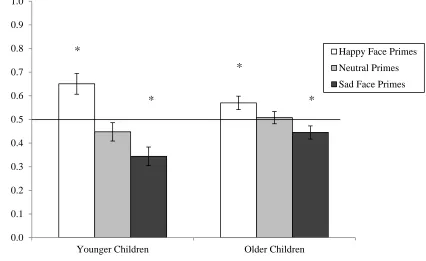
that the primes would influence their responses; n = 4). Responses were analyzed using a 3
younger vs. older) ANOVA with the first factor within-subjects. Although not directly relevant
to the current theorizing, a main effect of gender emerged. Regardless of the preceding prime,
girls (M = .55, SD = .11) were more likely to judge inkblots as pleasant as compared to boys (M
= .45, SD = .13), F(1, 71) = 13.87, p < .001, ηp2 = .16. Importantly, the expected linear trend for
the priming effect emerged, F(1, 71) = 35.07, p < .001, p2 = .33, and this was qualified by a
prime by age interaction, F(2, 142) = 4.52, p = .01, p2 = .06 (Figure 3). No other effects
emerged, Fs < 2.50, ps > .11, ηp2s < .04.
Insert Figure 3 about here
To decompose the interaction, within-subjects ANOVAs were conducted separately for
younger and older children. Younger children demonstrated a significant priming effect, F(2,
62) = 17.57, p < .001, p2 = .36; F(1, 31) = 23.72, p < .001, p2 = .43, for the linear trend.
Younger children were significantly more likely to judge inkblots following happy primes as
pleasant, t(31) = 3.44, p = .002, d = .61, and inkblots following sad primes as unpleasant, t(31) =
-3.97, p < .001, d = .70, relative to chance (.5). Judgments of inkblots following neutral primes
did not differ significantly from chance, t(31) = -1.36, p = .18, d = .24. A priming effect also
emerged for the older children, F(2, 84) = 5.38, p = .006, p2 = .11; F(1, 42) = 8.81, p = .005, p2
= .17 for the linear trend. When comparing the priming effects to chance (.5), older children
were more likely to judge inkblots following happy primes as pleasant, t(42) = 2.47, p = .02, d =
.38, and inkblots following sad primes as unpleasant, t(42) = -1.98, p = .05, d = .30. Judgments
of inkblots following neutral primes did not differ significantly from chance, t(42) = .28, p = .78,
d = .04. Although similar priming effects emerged for both age groups, younger children were
t(73) = -2.16, p = .03, d = .43. Responses to inkblots following happy, t(73) = 1.61, p = .11, d =
.32, and neutral, t(73) = -1.34, p = .19, d = .27, primes did not differ by age.
Child-friendly Implicit Association Test (ch-IAT)
To examine whether a similar pattern of results emerged on the ch-IAT, D scores were
created as outlined in Study 2. Trials with response latencies greater than 10,000 ms were
eliminated (i.e., < 1% of responses; Greenwald et al., 2003), and participants with high error
rates (i.e., > 35% of responses were incorrect; n = 4) and slow response latencies (i.e., individual
average response latency > 3 SD greater than mean response for the sample; n = 1) were
removed from analyses involving the IAT (Cvencek, Meltzoff, & Greenwald, 2011). A 2
(participant gender: boy vs. girl) × 2 (participant age: younger vs. older) between-subjects
ANOVA did not reveal any significant main effects or interactions, Fs < .60, ps > .44, ηp2s < .01.
One sample t-tests comparing the D scores to 0 revealed that both younger (D = .97, SD = .26),
t(29) = 20.12, p < .001, d = 3.67, and older (D = .92, SD = .35), t(48) = 18.55, p < .001, d = 2.65,
children demonstrated an implicit preference for happy relative to sad faces.
Relationship between the Measures
To examine the relationship between these implicit measures, we created a ch-AMP
preference score that mirrored the ch-IAT D score by subtracting the proportion of pleasant
responses following sad primes from the proportion of pleasant responses following happy
primes (Bar-Anan & Nosek, 2014; Payne et al., 2005); higher scores indicate more pleasant
responses following happy versus sad primes. Again, although in the anticipated direction,
responses on the ch-AMP and ch-IAT were not significantly correlated, r = .18, p = .14.
Because an interaction with age emerged on the ch-AMP, we also examined whether the scores
however, they were not. Finally, we created absolute attitude estimates by subtracting the
proportion of pleasant responses following neutral primes from the proportion of pleasant
responses following happy and sad primes, respectively (Bar-Anan & Nosek, 2012, 2014; Payne
et al., 2005). Although in the anticipated direction, neither the responses following happy
primes, r = .10, p = .39, nor responses following sad primes, r = -.13, p = .28, were significantly
correlated with ch-IAT D scores.
Empathy
To examine whether self-reported empathy would be predicted by each implicit measure,
we first averaged the three empathy items into a single score, with higher values indicating
greater empathy (M = 3.04, SD = .64). Empathy was positively correlated with the relative
ch-AMP preference score (r = .39, p < .001). Empathy was also significantly correlated with the
absolute attitude estimate for sad (r = -.33, p = .004), but not happy (r = .19, p = .10) primes.
Finally, despite a lack of relationship between the ch-AMP and the ch-IAT, empathy was also
significantly related to the ch-IAT (r = .24, p = .03).
To examine the incremental validity of the ch-AMP in predicting self-reported empathy
over and above the ch-IAT, we performed hierarchical regression analyses. In Step 1 we
controlled for age of participant (effect coded as -1 for younger children, 1 for older children)
and gender of participant (effect coded as -1 for girls, 1 for boys) as responses on the ch-AMP
differed by these variables. In Step 2 we entered the ch-IAT D scores and in Step 3 we entered
the ch-AMP preference score. The model was not significant at the first step, F(2, 68) = .45, p =
.64, R2 = .01. However, including the ch-IAT in the second step significantly increased the amount of variance explained, ΔF(1, 67) = 4.74, p = .03, ΔR2 = .07 The ch-IAT was
< .12), ts < 1.0, ps > .35. In Step 3, the ch-AMP significantly increased the amount of variance
explained, ΔF(1, 66) = 15.63, p < .001, ΔR2 = .18. As expected, when entered in the model the
ch-AMP significantly predicted empathy (β = .45), t = 3.95, p < .001; however, the ch-IAT was
no longer a significant predictor (β = .20), t = 1.84, p = .07. Age also significantly predicted
empathy in the third step, (β = .24), t = 2.14, p = .04, with older children expressing greater
empathy than younger children. Gender did not reliably contribute to the model, (β = .17), t =
1.61, p = .11. In line with our expectations, controlling for participant age and gender, children’s
misattributed affect in response to happy and sad primes, as measured by the ch-AMP preference
score, was significantly related to their self-reported empathy.5
The results of this study provide further evidence that the ch-AMP can be successfully
used as an implicit measure of children’s attitudes. In line with our hypotheses, children
demonstrated affect misattribution following happy and sad primes. Replicating previous effects
with adults (e.g., Donges et al., 2012; Rohr et al., 2012), both younger and older children showed
the anticipated priming effect on the ch-AMP, providing additional evidence that this measure
can be used to assess implicit social cognition in childhood. Somewhat unexpectedly, this effect
was more pronounced for our younger participants. This age difference could reflect younger children’s increased tendency to focus on perceptual cues when processing others (Aboud,
2008), a finding worthy of future investigation. In addition, girls, as compared to boys, were
more likely to judge inkblots as pleasant, regardless of the proceeding prime. Similar age and
gender effects did not emerge on the ch-IAT.
Importantly, in the current study we also found that individual differences in children’s
responses on the ch-AMP were related to empathy. Spontaneous affect misattribution in
joy and pain of others. A similar relationship emerged between children’s self-reported empathy
and their implicit associations on the ch-IAT, although not as consistently; when both measures
were entered into the model, responses on the ch-AMP accounted for more variance in children’s
empathy than the ch-IAT, and the ch-IAT D score no longer significantly contributed to the
model. This is the first study to demonstrate that children’s self-reported empathic feelings
toward others can be predicted by their responses on a child-friendly implicit measure.
General Discussion
The results from these three studies provide evidence that with slight procedural changes,
the AMP can be a valid and reliable implicit measure of children’s attitudes. In Study 1, children
demonstrated evidence of affect misattribution; they were more likely to judge neutral inkblots
following positively valenced primes as pleasant as compared to inkblots following negatively
valenced primes. In Study 2, predicted gender differences in children’s attitudes emerged on the
ch-AMP. Mirroring the pattern of bias typically found on a more established measure, girls
showed a greater implicit preference for flowers relative to boys. Finally, in Study 3, we
provided evidence that the ch-AMP can be used as an implicit measure to assess children’s
affective responses towards social targets, specifically happy and sad children. As expected,
children showed more positive affect misattribution following smiling as opposed to crying
primes. In addition to providing further evidence for the validity of the ch-AMP, the results of
Study 3 also provide the empirically novel and theoretically interesting finding that individual
differences in priming effects on this ch-AMP are significantly related to self-reported empathy.
There are several important aspects of these findings. From a practical standpoint, the
results of Studies 2 and 3 reinforce the value of having different implicit measures of attitudes
the ch-AMP and the ch-IAT in Studies 2 and 3, responses on these measures were not
significantly correlated, even when examining the relationship between both the absolute and
relative scores on the ch-AMP and the ch-IAT D scores. In addition, in Study 3 implicit
preferences measured by the ch-AMP accounted for more variance in self-reported empathy than
the ch-IAT. Finally, there were notable differences across the studies in the effect sizes on each
measure, with the magnitude of effects being larger on the ch-IAT as compared to the ch-AMP,
possibly because participants demonstrated stronger implicit associations toward categories (as
measured by the ch-IAT), as opposed to exemplars who may or may not be spontaneously
viewed through a categorical lens (as measured by the ch-AMP; Degner & Wentura, 2010; Fazio
& Olson, 2003; Livingston & Brewer, 2002; Olson & Fazio, 2003). Together these findings are
consistent with the possibility that the ch-AMP and ch-IAT assess distinct constructs (e.g.,
Payne, Govorun et al., 2008; see also Degner & Wentura, 2010; Fazio & Olson, 2003; Olson &
Fazio, 2003, for similar arguments with evaluative priming tasks). However, this interpretation
requires caution. Given that correlations between implicit measures and effect sizes can be
attenuated by measurement error (e.g., method-related variance, internal consistency; Bar-Anan
& Nosek, 2014; Baugh, 2002; Cunningham, Preacher, & Banaji, 2001) and that our studies may
have been underpowered, future research is needed to provide additional evidence for the
possibility that, even for young children, these measures tap into different constructs (e.g.,
Bar-Anan & Nosek, 2014; Degner & Wentura, 2010; Fazio & Olson, 2003; Gawronski & De
Houwer, 2014; Olson & Fazio, 2003).
The relationship between children’s affect misattribution following happy and sad primes
and empathy is theoretically interesting in its own right. Although our empathy measure is
relationship between children’s empathy and their automatic response toward affect-laden faces.
This finding provides new insight into children’s implicit social cognition by suggesting that children’s self-reported experience of empathy might be intimately connected to the intensity of
affect that they experience and/or their inability to inhibit this emotional response when seeing a
child experiencing joy or sadness. Empathy is often defined as the ability to vicariously
experience the feelings of others (Chapman et al., 1987; Eisenberg & Miller, 1987), and research
has supported the link between children’s self-reported empathy and the activation of brain
regions associated with emotional processing (see Pfeifer & Dapretto, 2009, for a review).
Contributing to this emerging body of work, the results of Study 3 demonstrate that self-reported
empathy is related to children’s affective experiences. We provide direct evidence that
children’s spontaneous affect misattribution towards happy and sad target faces is related to their
subjective experience of empathy. Children who were more likely to automatically feel what
others feel expressed higher levels of empathy.
Given that the ch-AMP allows for the examination of absolute evaluations and does not
require that targets be categorized, it has the potential to be a valuable tool for future research
examining the development of implicit cognition. Responses on the ch-AMP can be easily
decomposed to estimate implicit attitudes toward single categories, for example, flowers and
insects in Study 2 and happy and sad faces in Study 3. This is an important feature of this
measure. The results of the ch-AMP allow us to assess girls’ attitudes toward flowers in
isolation of their attitudes toward insects in Study 2 and conclude that, as expected, girls show
implicit positivity toward flowers. We extended these findings to socially-relevant primes in
Study 3 and found that individual differences in children’s automatically activated affect on the
Based on the findings of our latter two studies, it seems quite plausible that different
implicit measures of attitudes may provide researchers with unique insights regarding the nature
and emergence of children’s attitudes (e.g., Degner & Wentura, 2010; Williams, Steele, &
Durante, 2012). For example, research examining children’s racial attitudes using the ch-IAT
suggests that implicit pro-White relative to Black biases emerge early and remain stable across
development (Baron & Banaji, 2006; Olson & Dunham, 2010; Rutland et al., 2005; cf. Cvencek, Nasir, O’Connor, Wischnia, & Meltzoff, in press, who found developmentally-related changes in
academic-race stereotypes). However, recent findings with evaluative priming tasks instead
suggest that implicit racial bias, in the form of prejudice toward outgroups, develops later in life,
emerging only in early adolescence (Degner & Wentura, 2010; see also Aboud & Steele,
forthcoming). Using implicit measures, like the ch-AMP, that do not require that racial
exemplars be categorized by race and that allow for responses to be decomposed into absolute
evaluations of categories will likely provide more nuanced insight into implicit social cognition
across development. This is particularly important when creating age-appropriate interventions
designed to improve social interactions across childhood. Because the ch-AMP can be used with
young children (i.e., 5-year-olds), this measure provides an opportunity to more fully examine
the emergence of implicit attitudes early in childhood, when these associations are first being
acquired.
It should be noted that the AMP is just one of several measures available to assess adults’
implicit cognition, each of which presents different methodological strengths and challenges. In
conjunction with the success of validating the traditional IAT and different priming measures for
use with children, it would be useful to adapt additional IAT-based measures and scoring
(Nosek & Banaji, 2001), and Quad model (Conrey, Sherman, Gawronski, Hugenberg, & Groom,
2005), that allow for responses to be decomposed into evaluations of single categories. Having
more measurement tools and techniques from which to draw will only serve to increase our
understanding of how these associations form and change across the lifespan.
One potential criticism of the ch-AMP is that it can be sensitive to demand characteristics
and that some participants may intentionally judge primes which would undermine the implicit
nature of the measure (Bar-Anan & Nosek, 2012; cf. Payne et al., 2013). In our studies we found
that a handful of children judged the prime images (n = 3, 4% in Study 1; n = 1, 2% in Study 2; n
= 3, 3.5% in Study 3) and these participants were removed from the analyses. Although it is
possible that other children judged the primes we feel that, based on the data, this is unlikely. If
the sample of retained children had judged primes instead of targets, we might expect more
extreme (and internally consistent) responses than what was observed (see Bar-Anan & Nosek,
2012). In order to remove the confound of controlled priming effects it is essential that
instructions emphasize the importance of judging the neutral target image and that debriefing
procedures include questions to ensure that the results represent unintentional attitude effects.
Although emphasized in each study, the procedure used in Studies 2 and 3 highlighted this to a
greater extent; in line with the instructions used previously by Payne et al. (2005), we
emphasized that responses toward the inkblot should be made regardless of the preceding prime
image. As such, we would recommend that researchers aiming to make use of this measure
administer the ch-AMP with instructions that are similar to those used in our latter two studies.
Given the surge of research examining implicit social cognition (see Gawronski & Payne,
2010, for a review) it is not surprising that theories are being developed and methods are being
emerging questions about children’s implicit cognition, it will be critical to develop measures
that are appropriate for use with children. In the present research we provided initial evidence
that the AMP is a valid,internally reliable, and simple implicit measure that can easily be
References
Aboud, F. E. (2008). A social-cognitive developmental theory of prejudice. In S.M. Quintana &
C. McKown (Eds.), Handbook of race, racism, and the developing child (pp. 55-71).
Hoboken, NJ: John Wiley and Sons.
Aboud, F. E., & Steele, J. R. (forthcoming). Theoretical perspectives on implicit and explicit
prejudice development. In A. Rutland, D. Nesdale, & C. S. Brown (Eds), The
Wiley-Blackwell Handbook of Group Process in Children and Adolescents. New Jersey:
Wiley-Blackwell.
Bar-Anan, Y., & Nosek, B. A. (2012). Reporting intentional rating of the primes predicts
priming effects in the Affective Misattribution Procedure. Personality and Social
Psychology Bulletin, 38, 1194-1208. doi: 10.1177/0146167212446835
Bar-Anan, Y., & Nosek, B. A. (2014). A comparative investigation of seven implicit measures
of social cognition. Behavior Research Methods, 46, 668-688. doi:
10.3758/s13428-013-0410-6
Baron, A. S., & Banaji, M. R. (2006). The development of implicit attitudes: Evidence of race
evaluations from ages 6 and 10 and adulthood. Psychological Science, 17, 53-58. doi:
10.1111/j.1467-9280.2005.01664.x
Baugh, F. (2002). Correcting effect sizes for score reliability: A reminder that measurement and
substantive issues are linked inextricably. Educational and Psychological Measurement,
62, 254-263. doi: 10.1177/0013164402062002004
Bosson, J. K., Swann, W. B., & Pennebaker, J. W. (2000). Stalking the perfect measure of
implicit self-esteem: The blind men and the elephant revisited? Journal of Personality and
Buckley, M., & Saarni, C. (2006). Skills of emotional competence: Developmental implications.
In J. Ciarrochi, J. R. Forgas, & J. D. Mayer (Eds), Emotional intelligence in everyday life
(2nd ed.). Hove, England: Taylor & Francis. Chapman, M., Zahn-Waxler, C., Cooperman,
G., & Iannotti, R. (1987). Empathy and responsibility in the motivation of children's
helping. Developmental Psychology,23, 140-145. doi: 10.1037/0012-1649.23.1.140
Chapman, M., Zahn-Waxler, C., Cooperman, G., & Iannotti, R. (1987). Empathy and
responsibility in the motivation of children’s helping. Developmental Psychology, 23,
140-145. doi: 10.1037/0012-1649.23.1.140
Conrey, F. R., Sherman, J. W., Gawronski, B., Hegenberg, K., & Groom, C. J. (2005).
Separating multiple processes in implicit social cognition: The Quad model of implicit task
performance. Journal of Personality and Social Psychology, 89, 469-487. doi:
10.1037/0022-3514.89.4.469
Cunningham, W. A., Preacher, K. J., & Banaji, M. R. (2001). Implicit attitude measures:
Consistency, stability, and convergent validity. Psychological Science, 12, 163-170. doi:
10/1111/1467-9280.00328
Cvencek, D., Greenwald, A. G., & Meltzoff, A. N. (2011). Measuring implicit attitudes of
4-year-olds: The preschool Implicit Association Test. Journal of Experimental Child
Psychology, 190, 187-200. doi: 10.1016/j.jecp.2010.11.002
Cvencek, D., Meltzoff, A. N., & Greenwald, A. G. (2011). Math-gender stereotypes in
elementary school children. Child Development, 82, 766-779. doi:
Cvencek, D., Nasir, N. S., O’Connor, K., Wischnia, S., & Meltzoff, A. N. (in press). The
development of math–race stereotypes: “They say Chinese people are the best at math.” Journal of Research on Adolescence. doi: 10.1111/jora.12151
Degner, J., & Wentura, D. (2010). Automatic activation of prejudice in children and adolescents.
Journal of Personality and Social Psychology, 98,356-374. doi: 10.1037/a0017993
Donges, U., Kersting, A., & Suslow, T. (2012). Women’s greater ability to perceive happy facial
emotion automatically: Gender differences in affective priming. PLoS ONE, 7, 1-5. doi:
10.1371/journal.pone.0041745
Dunham, Y., Baron, A. S. & Banaji, M. R. (2006). From American city to Japanese village: A
cross-cultural investigation of implicit race attitudes. Child Development, 77, 1268-1281.
doi: 10.1111/j.1467-8624.2006.00933.x
Eisenberg, N., & Miller, P. A. (1987). The relation of empathy to prosocial and related
behaviors. Psychological Bulletin, 101, 91-119. doi: 10.1037/0033-2909.101.1.91
Fazio, R. H., & Olson, M. A. (2003). Implicit measures in social cognition research: Their
meaning and uses. Annual Review of Psychology, 54,297-327. doi:
10.1146/annurev.psych.54.101601.145225
Freeman, J. B., Johnson, K. L., Adams, R. B. Jr., & Ambady, N. (2012). The social-sensory
interface: Category interactions in person perception. Frontiers in Integrative
Neuroscience, 8, 1-13. doi: 10.3389/fnint.2012.00081
Gawronski, B., Cunningham, W. A., LeBel, E. P., & Deutsch, R. (2010). Attentional influences
on affective priming: Does categorization influence spontaneous evaluations of multiply
categorizable objects? Cognition and Emotion, 24, 1008-1025. doi:
Gawronski, B., & De Houwer, J. (2014). Implicit measures in social and personality psychology.
In H. T. Reis & C. M. Judd (Eds.), Handbook of research methods in social and
personality psychology (2nd ed., pp. 283-310). New York, NY: Cambridge University
Press.
Gawronski, B., & Payne, B. K. (2010). Handbook of implicit social cognition. New York, NY:
Guilford Press.
Greenwald, A. G., McGhee, D. E., & Schwartz, J. L. K. (1998). Measuring individual
differences in implicit cognition: The implicit association test. Journal of Personality and
Social Psychology, 74, 1464-1480. doi: 10.1037/0022-3514.74.6.1464
Greenwald, A. G., Nosek, B. A., & Banaji, M. R. (2003). Understanding and using the implicit
association test: I. An improved scoring algorithm. Journal of Personality and Social
Psychology, 85, 197-216. doi: 10.1037/0022-3514.85.2.197
Hofmann, W., & Wilson, T. D. (2010). Consciousness, introspection, and the adaptive
unconscious. In B. Gawronski & B. K. Payne (Eds.), Handbook of implicit social
cognition: Measurement, theory, and applications (pp. 197-215). New York, NY: Guilford
Press.
Inzlicht, M., Gutsell, J. N., & Legault, L. (2012). Mimicry reduces racial prejudice. Journal of
Experimental Social Psychology, 48, 361-365. doi:10.1016/j.jesp.2011.06.007
Karpinski, A., & Steinman, R. B. (2006). The single category implicit association test as a
measure of implicit social cognition. Journal of Personality and Social Psychology, 91,