How performance analysis of elite long jumping can inform
representative training design through identification of key
constraints on competitive behaviours
MCCOSKER, Chris <http://orcid.org/0000-0002-7160-2987>, RENSHAW, Ian <http://orcid.org/0000-0003-3694-9915>, GREENWOOD, Daniel, DAVIDS, Keith <http://orcid.org/0000-0003-1398-6123> and GOSDEN, Edward
Available from Sheffield Hallam University Research Archive (SHURA) at:
http://shura.shu.ac.uk/23790/
This document is the author deposited version. You are advised to consult the publisher's version if you wish to cite from it.
Published version
MCCOSKER, Chris, RENSHAW, Ian, GREENWOOD, Daniel, DAVIDS, Keith and GOSDEN, Edward (2019). How performance analysis of elite long jumping can inform representative training design through identification of key constraints on competitive behaviours. European Journal of Sport Science, 1-9.
Copyright and re-use policy
See http://shura.shu.ac.uk/information.html
Sheffield Hallam University Research Archive
How performance analysis of elite long jumping can inform representative training 1
design through identification of key constraints on competitive behaviours 2
Chris McCosker a, b
3
Queensland University of Technology 4
Ian Renshaw a, b
5
Queensland University of Technology 6
Daniel Greenwood c
7
Australian Institute of Sport 8
Keith Davids d
9
Sheffield Hallam University 10
Edward Gosden a
11
Queensland University of Technology 12
13
a Institute of Health and Biomedical Innovation, Queensland University of Technology, Brisbane, 14
Australia 15
b School of Exercise & Nutrition Sciences, Queensland University of Technology, Brisbane, Australia 16
c Movement Science, Australian Institute of Sport, Bruce, Australia 17
d Centre for Sports Engineering Research, Sheffield Hallam University, Sheffield, UK 18
19
Correspondence concerning this article should be addressed to Chris McCosker, 20
School of Exercise & Nutrition Sciences, Queensland University of Technology, 21
Brisbane, Australia; Email: [email protected] 22
Abstract 24
Analysing performance in competitive environments enables identification of key 25
constraints which shape behaviours, supporting designs of more representative 26
training and learning environments. In this study, competitive performance of 244 27
elite level jumpers (male and female) was analysed to identify the impact of candidate 28
individual, environmental and task constraints on performance outcomes. Findings 29
suggested that key constraints shaping behaviours in long jumping were related to: 30
individuals (e.g., particularly intended performance goals of athletes and their impact 31
on future jump performance); performance environments (e.g., strength and direction 32
of wind) and tasks (e.g., requirement for front foot to be behind foul line at take-off 33
board to avoid a foul jump). Results revealed the interconnectedness of competitive 34
performance, highlighting that each jump should not be viewed as a behaviour in 35
isolation, but rather as part of a complex system of connected performance events 36
which contribute to achievement of competitive outcomes. These findings highlight 37
the potential nature of the contribution of performance analysis in competitive 38
performance contexts. They suggest how practitioners could design better training 39
tasks, based on key ecological constraints of competition, to provide athletes with 40
opportunities to explore and exploit functional intentions and movement solutions 41
high in contextual specificity. 42
43
Keywords: Performance analysis, long jump, representative learning design, 44
ecological dynamics, interacting constraints 45
46
47
How performance analysis of elite long jumping can inform representative training 49
design through identification of key constraints on competitive behaviours 50
51
Performance analysis in sport competition provides a quantitative link 52
between application, science and theory through an objective audit of athlete or team 53
behaviours (Hughes & Bartlett, 2002; McGarry, 2009). Performance is traditionally 54
described through evidence gained from notational analysis using competition, 55
technical and tactical indicators, as well as biomechanical technique descriptors 56
using kinematic and kinetic variables. In sports like track and field, performance 57
analysis has predominantly taken the form of movement analysis. For example, in 58
long jump, most analyses have been driven by biomechanical (e.g., Bridgett & 59
Linthorne, 2006; Hay, 1993) and motor control research (e.g., Glize & Laurent, 60
1997; Montagne, Glize, Cornus, Quaine, & Laurent, 2000) in controlled, 61
experimental or training environments (for an exception see Hay, 1988). Whilst 62
these studies have increased understanding of performance variables, insufficient 63
attention has been paid to analysing how long jump performance under the specific 64
constraints of competition environments might impact self-regulation in athletes. 65
Performance analysis, investigating competition behaviours, could enrich 66
understanding of self-regulatory interactions of athletes with the environment during 67
practice, revealing links between strategies, psychological states, emotions and 68
actions in individual athletes (Anderson, 2018; Hughes & Bartlett, 2002). 69
With a large range of variables available to analyse during long jump 70
competition performance, it is important that selection and interpretation of data are 71
guided by an appropriate theoretical framework. One proposed framework is 72
learning in a variety of sport contexts (Araújo, Davids, & Hristovski, 2006; Vilar, 74
Araújo, Davids, & Button, 2012; Warren, 2006). Ecological dynamics proposes how 75
human behaviour emerges through continuous interactions with affordances 76
(opportunities for action) available during performance, as multiple constraints act 77
on the (athlete-environment) system (Araújo et al., 2006; Araújo, Davids, & Passos, 78
2007; Gibson, 1979), providing rich information for self-regulation. Adopting this 79
theoretical framework to guide the analysis and interpretation of performance in long 80
jump, moves performance analysis beyond merely documenting discrete variables 81
from isolated events within competition. Such an approach allows for the 82
recognition of the conditioned coupling evident in dynamic performance 83
environments where constraints are deeply intertwined to shape athlete performance 84
(Vilar et al., 2012). Practically, identifying these constraints provide practitioners 85
with the opportunity to enhance the development of representative training designs 86
where intentions, perceptions and actions emerge in faithful simulations of a 87
performer’s actions in competition (Pinder, Davids, Renshaw, & Araújo, 2011). 88
Current empirical research on how ecological dynamics can enrich 89
performance analysis highlights the unique interactions of individual, environmental 90
and task constraints that shape the emergence of athlete performance behaviours 91
(Travassos, Duarte, Vilar, Davids, & Araújo, 2012; Vilar, Araújo, Davids, & Bar-92
Yam, 2013; Vilar et al., 2012). Previous research on personal constraints suggest that 93
a key variable that shapes the perception-action couplings of athletes is specific 94
intentions during performance. Athlete intentionality concerns the adoption of 95
specific performance goals (i.e., winning a competition, making the podium, 96
qualifying for a final, jumping conservatively to avoid a 'no-jump'), constrained by 97
(Araújo, Davids, & Renshaw, 2018). To exemplify, intentions to make a ‘safe’ jump 99
or a jump for maximal distance clearly influence running velocity and foot 100
placement error on the take-off board (Bradshaw & Sparrow, 2000; Maraj, Allard, & 101
Elliot, 1998). This practical example illustrates how athletes might deliberately adapt 102
movement behaviours in order to complete a task in a specific way, related to current 103
performance goals or competitive needs. The successful (or unsuccessful) execution 104
of specific performance strategies is likely to impact future jump performance as the 105
athlete adapts to his/her emerging needs in an unfolding competitive event, with 106
interconnected performance trials. Each jump within a competition comprises a 107
complex system, a series of connected events to influence overall competitive 108
performance outcomes (Renshaw & Gorman, 2015). This complex system of 109
competitive jumps can be perturbed by emerging cognitive-emotional-physical 110
demands at a specific performance event (Headrick, Renshaw, Davids, Pinder, & 111
Araújo, 2015). 112
Environmental constraints, including physical (i.e., wind, ambient light, 113
temperature, altitude, air density) and social variables (i.e., family support, peer 114
groups, an evaluating audience and cultural norms) can also influence athletic 115
performance. In long jumping, the influence of wind speed and direction on jump 116
performance is unique as stability of running and jump components can be perturbed 117
during task execution. Mathematical modelling has suggested influences on long 118
jump distance of between 0.08-0.12 m for a 1 m/s increase or decrease in wind 119
velocity (de Mestre, 1991; Ward-Smith, 1985). The effects from drag during the 120
aerial phase and running velocity during the approach run are primary causes of an 121
increase in jump performance (Ward-Smith, 1985). The influence of wind on jump 122
direction of an athlete's run-up if there is a change in weather conditions during 124
competition (Competition Rules 2014-2015, 2013). This type of environmental 125
constraint emphasises the importance of attunement to potential variability in 126
performance conditions when preparing for competition by elite athletes. 127
Task constraints are more specific to performance contexts than 128
environmental constraints (Davids, Button, & Bennett, 2008) and include the rules of 129
a sport. In long jumping, the key rule is the requirement to keep the front foot behind 130
the take-off line to register a legal jump, constraining run-up strategies. Research on 131
the run-up approach in long jumping (e.g., Lee, Lishman, & Thomson, 1982; 132
Montagne et al., 2000) has demonstrated that the presence of the take-off board, in 133
comparison to jumping conditions with no take-off board, led to changes in foot 134
placement throughout the entire run-up as well as lower levels of footfall variability 135
(Maraj, 1999). The need to intercept an object or surface, such as a 20cm wide take-136
off board, when completing a task nested at the end of a run-up (i.e., jumping) has 137
important implications for training design. Gait regulation strategies in run-ups with 138
the absence of a nested jumping task show few similarities with performance in tasks 139
requiring a jump at the end (Bradshaw & Aisbett, 2006; Glize & Laurent, 1997). 140
Identifying interacting constraints that shape exploration and utilisation of 141
affordances (opportunities for action) in competition provides practitioners with a 142
better understanding of the performance environment, thereby enhancing their 143
capacity to design more effective practice tasks. Ecological dynamics proposes how 144
training environments could be designed to provide athletes with opportunities to 145
attune and calibrate their intentions, perceptions and actions in the landscape of 146
affordances representative of competitive performance (Pinder et al., 2011). Such 147
performance environment, ready to self-regulate their behaviours as a competitive 149
event unfolds. Currently, there is limited research investigating the constraints of 150
competition in long jumping and there is a need for a more in-depth analysis of 151
performance in elite long jump competitions. Consequently, this study aimed to 152
investigate how performance analysis, under the framework of ecological dynamics, 153
can lead to the identification of more contextual information for the design of 154
practice environments. These sources of information could better reflect the 155
intertwined interactions that emerge in between athlete intentions, perceptions and 156
actions in adapting to changing event conditions. Elite level long jumping will be 157
used as the exemplar, with key individual, environment and task constraints 158
identified through the statistical analysis of elite long jump competitions held 159
between 1999 and 2016. These competitions will include Olympic Games, World 160
Championships and Diamond league competitions. 161
162
Methods 163
Results from 108 (men = 56; women = 52) elite level long jump competitions 164
were obtained from publicly available online databases (www.iaaf.org.au & 165
www.diamondleague.com). These competitions included Diamond League 166
competitions staged between 2011-2016 (men = 42; women = 39) and World 167
Championship (men = 9; women = 8) and Olympic Game (men 5; women = 5) 168
competitions between 1999-2016. These events covered a total of 244 athletes 169
(male= 140; female=104) with 5 393 jumps (male = 2783; women = 2608) available 170
for analysis. Two jumps under 2 m were excluded as outliers in the men’s dataset as 171
Only performances of athletes in competitions where all wind (m/s) and horizontal 173
jump distance (m) data were available, were included in the analysis. 174
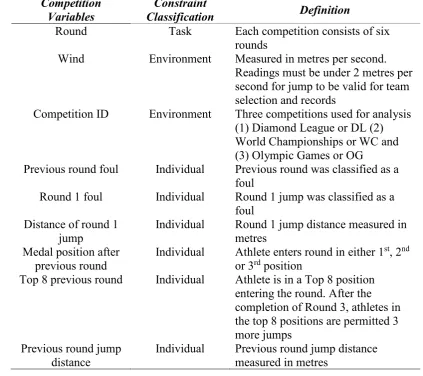
Candidate variables that may potentially impact on performance were 175
selected using an ecological dynamics rationale and the experiential knowledge of 176
elite long jumping coaches identified in previous research (e.g., Greenwood, Davids, 177
& Renshaw, 2012) (Table 1). For example, wind was selected as a candidate 178
environmental variable, since mathematical modelling has suggested that a 1m/s 179
increase or decrease in wind velocity has a 0.08-0.12 m impact on jump distance in 180
long jump (de Mestre, 1991; Ward-Smith, 1985). The conceptualisation that each 181
jump forms a part of a complex system, formed by a series of connected events 182
(Renshaw & Gorman, 2015), supports the inclusion in the analysis of performance 183
variables including previous round foul, round 1 foul, distance of round 1 jump, 184
medal position after previous foul, top 8 previous round and previous round jump 185
distance. It was predicted that these variables might impact the intentions or strategy 186
implemented by athletes throughout a competitive event, and subsequent movement 187
(re)organisation, depending on their competitive needs at a specific point in time 188
(Bradshaw & Sparrow, 2000; Maraj et al., 1998). 189
#### Table 1 near here #### 190
To determine the effects of competition on jump distance, descriptive 191
statistics were calculated for each competition type with median jump distance 192
values compared using a Kruskal-Wallis test with a Bonferroni correction for 193
multiple comparisons (p < .001). Effects of year of performance on jump distance 194
was calculated using multiple linear regression (p < .001) and effects of round on 195
(Tukey’s HSD) determined where differences existed if statistically significant 197
differences were found. 198
To determine the variables that best predicted horizontal distance jumped, a 199
linear mixed model with main effects, interactions and random intercepts was 200
constructed. Univariate tests were first conducted to determine variables of 201
significance. Variables tested for statistical significance appear in Table 1 (excluding 202
‘Previous round jump distance’). These variables were explored in order of 203
significance to determine the most parsimonious model explaining the most 204
variability and were assessed using Aikake’s Information Criterion (AIC). Two-way 205
interactions only were considered for the purposes of the analysis. Statistical 206
significance level was set at p = .05. 207
Descriptive statistics were calculated on jump classification (legal and foul 208
jumps) with the effects of competition, round and time (years), on foul jumps made, 209
determined using chi-square test for association and effect sizes. To determine 210
variables which best predicted foul jumps, binary logistic regression was used. 211
Variables included in the regression calculation were identical to those used in 212
predicting jump distance with the addition of ‘Previous round jump distance’. 213
Results 214
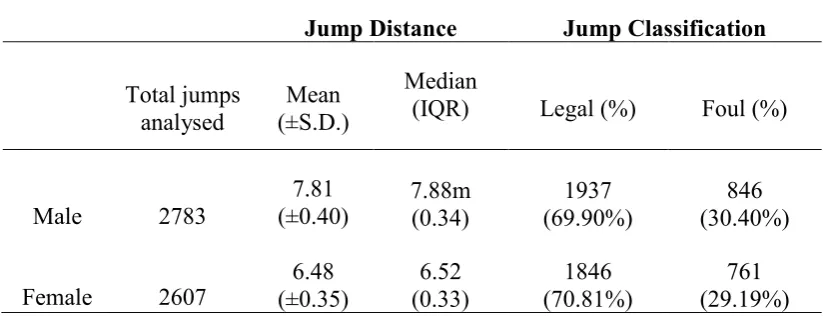
Table 2 provides descriptive statistics for jump distance and jump 215
classification across all competitions for both men’s and women’s competitions. 216
Multiple linear regression showed a statistically significant effect of the year of the 217
competition (p < .001) with mean distance jumped decreasing by 1.2 cms per year 218
for both men and women. The frequencies of foul jumps showed a significant annual 219
effect in women’s competitions only, but the effect size was small (χ2 = 25.6, p =
220
#### Table 2 near here #### 222
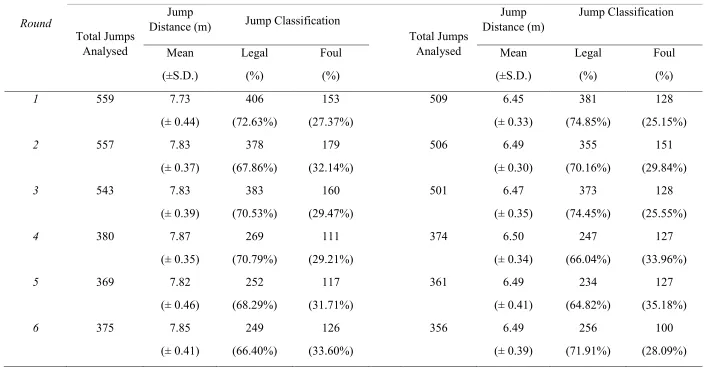
Table 3 provides descriptive statistics of the effects of round on distance 223
jumped and foul jumps recorded for male and female competitions. Analysis of 224
variance demonstrated a significant effect of round (F (5, 1931) = 5.425, p = .003) on 225
distance jumped for male competitions only. Post hoc testing indicated significant 226
differences in distances jumped between Round 1 and 2 (p = .005), Round 1 and 3 (p
227
= .008), Round 1 and 4 (p = .000) and Round 1 and 6 (p = .004). Overall, the number 228
of foul jumps was significantly different between rounds (χ2 = 17.9, p = .003) for
229
female competitions only, with a small effect size (Phi = 0.083). For both men and 230
women, total percentage of fouls was higher in the last three rounds (men: 31.49% & 231
women: 32.45%), compared to the first three rounds (men: 29.66% & women: 232
26.85%). 233
#### Table 3 near here #### 234
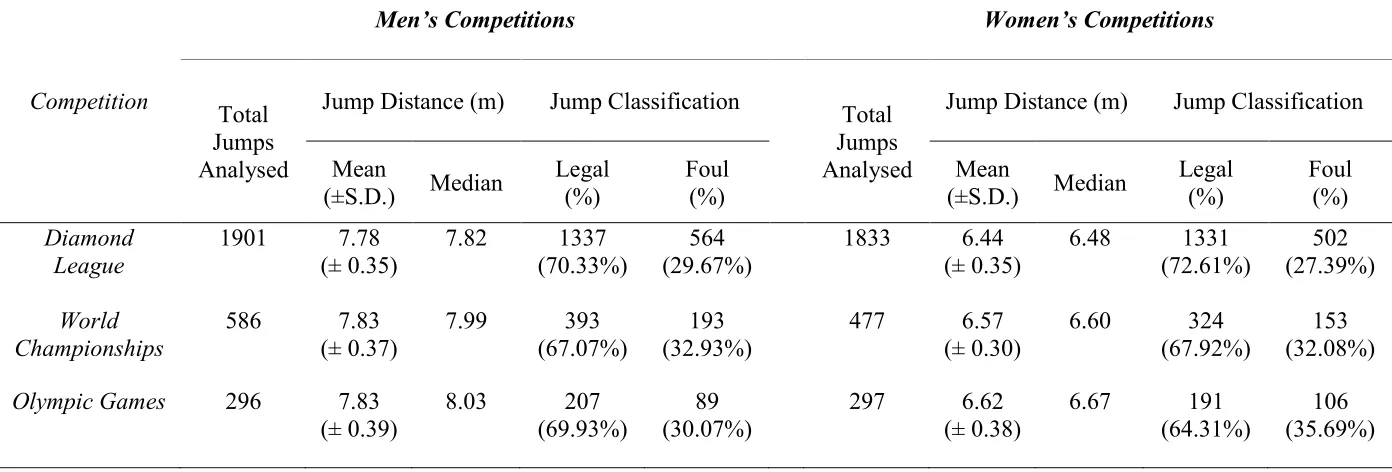
Data on effects of competition on jump distance and classification for both 235
male and female competitions are provided in Table 4. For men, median (non-normal 236
distribution) jump distance for Diamond League (7.82 m) was significantly (p < 237
.001) shorter than World Championship (7.99 cm) and Olympic Games (8.03 cm). In 238
the female competitions, median distances (p < .001) and overall number of foul 239
jumps were significantly different between competition types (Pearson Chi Square = 240
10.87, p = .004, Phi = 0.065). 241
#### Table 4 near here #### 242
In determining the best predictors of jump distance in male competitions, the 243
main effects model showed a significant difference of competition type between 244
Olympic Games and both Diamond Leagues and World Championships. Estimated 245
jump distance value 16.8 cm (S.E. 0.64) less than that observed in Olympic Games 247
with World Championships found to be 8.6 cm (S.E.0.70) less. Of the other 248
variables, the largest effect on jump distance was found to be Round 1 jump distance 249
(coefficient = 0.374). Effects of wind (1 m/s increase in tailwind or reduction in 250
headwind) increased jump distance by 4.2 cm. In the interactions model, ‘in medal 251
position after last round’ with competition type, was significantly different between 252
the Olympic Games and Diamond Leagues (p = .006) only. Estimated marginal 253
means suggested that a jump into a medal position increased the value of the 254
subsequent round jump distance. Interactions of ‘Distance of Round 1 jump’ with 255
competition type were also significantly different between the Olympic Games and 256
the World Championships (p < .001). 257
For the women’s competitions, a statistically significant difference was 258
found between jump distance observed in Diamond Leagues and Olympic Games, 259
with Diamond Leagues values being 12.8 cm shorter (S.E. 0.035) than Olympic 260
Games, based on the estimated marginal means. Other variables found to be of 261
significance in the main effects model were ‘Round 1 jump distance’ (coefficient = 262
.219), ‘Medal position after previous round’ (coefficient = 0.113), and the effect of 263
wind (5 cm increase in jump distance for 1 m/s increase in tailwind or reduction in 264
headwind). No variables within the interactions model were significant. 265
In determining the best predictors of foul jumps, no factor or covariate was 266
predictive of a foul jump in male competitions. Despite this observation, two factors 267
in the current model appear to increase the odds of a given jump being a foul, albeit 268
not statistically significantly. If a Round 1 jump was a foul, then the odds of the next 269
jump being a foul increased by a factor of 1.67 - regardless of the round. 270
resulting in a foul, was 1.56 higher than if it had not been a foul. For female 272
competitions, initial investigation showed that practically every factor measured was 273
a significant predictor of foul jumps, but the final, most parsimonious model 274
contained three terms: round, distance of first jump and previous jump being a foul. 275
The odds of foul jumps (compared to round 1) are significantly increased in rounds 4 276
(OR 1.615) and round 5 (OR 1.530). For distance of first round jump, a unit increase 277
(metre) in distance increased the odds of the next jump being a foul by a factor of 278
1.89. Thus, if an athlete made a first jump of 6.50 m, the odds of any remaining jump 279
in the competition being a foul were increased by a factor of 1.89, compared to a 280
competitor who made a first jump of 5.50 m. Furthermore, if an athlete recorded a 281
foul in the previous round, then the odds of recording a second foul in succession 282
were increased by a factor of 1.50. 283
Discussion 284
In this study, we sought to identify how the analysis of competition data, 285
framed by concepts from ecological dynamics, can provide a more nuanced 286
understanding of long jump performance. This relationship between performance 287
analysis and key tenets of the theory of ecological dynamics could assist 288
practitioners in designing more effective training environments to reflect the 289
intertwined interactions between intentions, perceptions and actions of athletes in 290
performance. Analysis of competitive performance data of elite male and female 291
long jumpers revealed that elite long jumping is defined by a mean jump distance of 292
7.81 m for men and 6.48 m for women. Interestingly, mean jump distance decreased 293
by 1.2 cm per year for both men and women. In classifying jump outcomes, the 294
and women. The stagnation of long jump performance over time raises important 296
questions, given advances in technology and sport sciences (e.g., Balague, Torrents, 297
Hristovski, & Kelso, 2016; Pluijms, Canal-Bruland, Kats, & Savelsbergh, 2013) and 298
potentially point to the need to carefully consider training designs to enhance 299
performance. 300
Findings revealed how continuous interactions of individual, task and 301
environmental constraints influenced elite long jumping performance. The personal 302
constraint of an athlete's (tactically defined) intentions continuously shape 303
perception-action couplings during competition. It is these intentions, embedded 304
within specific performances, that frame the interactions of athletes with task and 305
environmental constraints to facilitate adaptive behaviours (Araújo et al., 2018). For 306
example, the lowest value for mean jump distance and lowest percentage of fouls 307
found in Round 1 suggests athlete intentionality on the first jump could be to record 308
a ‘safe’ jump. Round 1 jumps were also significantly shorter than jumps in Rounds 309
2, 3, 4 and 6 in the men’s competitions. The notions of a ‘safe’ jump could be 310
interpreted as an athlete's deliberate adaptation of perception-action couplings (i.e., 311
decrease in run-up velocity) to intentionally match his or her specific needs to the 312
competition demands at specific points in time (Araújo et al., 2018; Maraj et al., 313
1998). The importance of the first round was also highlighted by its role in 314
predicting jump distance and fouls in future rounds across the competition. This 315
relationship between jump performances demonstrates that each jump is connected 316
and forms an event (Gibson, 1979) influencing emergent jump performance 317
(Renshaw & Gorman, 2015). The outcome of round 1 is, therefore, likely to impact 318
the athlete's intentions in subsequent rounds, depending on the needs of the athlete at 319
couplings, will be strongly influenced by an athlete's own goals, competitors’ 321
performances and ultimately the rules of the sport (only the top 8 athletes at the end 322
of round 3, get three further jumps). For example, after a round 1 foul, an athlete 323
may place more emphasis on making a ‘safe’ jump (i.e., speed/accuracy trade-off) in 324
round 2 in order to increase the chances of making a legal jump that enables him/her 325
to receive three additional jumps after round 3. This conceptualisation of emergent 326
behaviours in long jump is an important development in better understanding 327
performance as a series of complex interconnected events rather than seeing training 328
as a series of isolated jumps, with important implications for training design. 329
The environmental constraint of wind was identified as a key influence on 330
long jump competitive performance. A 1 m/s increase in tailwind (or decrease in 331
headwind) increased jump distance for both women (by 5.0 cm) and men (by 4.2 332
cm). Previous research has attempted to determine the aerodynamic effects of wind 333
on jump performance (de Mestre, 1991; Ward-Smith, 1985) using mathematical 334
modelling. However, to date, no research has reported in-competition data. 335
Evidence on the impact of wind as an environmental constraint on jump performance 336
highlights the relevance of training designs which include experiences in variable 337
wind conditions. 338
As expected, a major task constraint is rule-based: that a 'no jump' is recorded 339
unless the take-off foot is behind the foul line. Satisfying this influential constraint 340
shapes athletes’ behaviours and actions in seeking to intercept the take-off board 341
with the front foot. Foul jumps (at any time in a competition) were seen to increase 342
the odds of subsequent fouls later in the competition. With almost a third (men: 343
30.40% and women: 29.19%) of jumps being classified as fouls, each athlete’s 344
For example, a foul jump in Round 1 increases pressure on an athlete to accurately 346
hit the take-off board in Rounds 2 and 3, whilst also needing to jump for distance to 347
qualify for the final three jumps. This increase in psychological and emotional 348
demands, along with the known implications for run-up velocity and foot placement 349
error on the take-off board when jumping for distance, defines how interactions 350
between different constraints impact behaviour in elite long jump performance. 351
The findings of the current study have important implications for the design 352
of representative training environments. Long jump coach education resources (e.g., 353
Brown, 2013) typically fail to consider how competition behaviours can be invited 354
through the design of training environments. Simulating conditions of competitive 355
performance allows practitioners to model environmental and task constraints to 356
shape intentions, perceptions and actions influencing performance in elite long 357
jumping. Our analyses of elite competition revealed that the most influential 358
interactions were between: athlete intentionality, effect of wind (direction and speed) 359
and rules of the sport. 360
Identification of athlete intentions in the form of competition strategies 361
highlights the need for training to focus on adaptations needed to achieve specific 362
outcome goals, with athletes training in a series of connected jumps that replicate the 363
demands of competition. This form of 'within-session periodisation' can be achieved 364
by the creation of specific ‘vignettes’ for athletes, that seek to simulate the physical, 365
emotional and psychological demands of competitive performance environments 366
(Headrick et al., 2015). An exemplar scenario could focus on the context when an 367
athlete has fouled in the first two rounds and must record a jump of sufficient 368
distance in round 3 to qualify for a further three jumps. In this way, the reduction of 369
of highlighting focus on a single performance trial, which simulates competition 371
conditions. In this way practice task design could involve 'repetition without 372
repetition' as advocated by Bernstein (1967), for example, challenging athletes to 373
calibrate their actions (Van Der Kamp & Renshaw, 2015) to exploit variable wind 374
speeds and direction. Asking athletes to complete the run-up and jump in variable 375
wind speeds and direction during training will facilitate their attunement to variable 376
weather conditions and adaptation of movement patterns accordingly. Exploitation of 377
this environmental constraint in training will promote 'dexterity' (Bernstein, 1967) in 378
athletes and simulate the level of uncertainty that exists in competitive performance. 379
The high percentage of fouls across all competitions for both men and women, 380
suggests that there may be a failure to give due emphasis to the importance of legal 381
jumps in practice conditions (e.g., Brown, 2013). Whilst allowing fouls in training 382
may increase trial repetition (practice volume) and reduce performance complexity, 383
this approach fails to simulate the individual-environment relationships that 384
performers forge in the competition environment (Davids & Araújo, 2010; Renshaw, 385
Chow, Davids, & Hammond, 2010). Coaches need to recognise the take-off board as 386
a key affordance that athletes must attune to in order to enable the development of 387
functional perception-action couplings required in competition. 388
389
Conclusions 390
In summary, the theoretical framework of ecological dynamics suggests that 391
a more nuanced understanding of the complexities of long jump performance could 392
facilitate the design of more representative practice environments by practitioners. 393
environments can enhance practice designs, following recent conceptualisation of the 395
use of ‘gold standard’ data in understanding sports performance constraints 396
(Anderson, 2018). Results from this study revealed three key constraints that shape 397
performance behaviours in both male and female elite long jumping: (i) athlete 398
intentionality, (ii) wind effects on run-up and jump phases, and (iii), adhering to 399
rules of the sport. The integrated manipulation of these key constraints in training 400
can provide opportunities for athletes to adapt to major physical and emotional 401
demands of performance environments. The use of ecological dynamics to guide the 402
analysis of competition data shows how performance analysis can be enhanced to 403
enrich the understanding of athlete interactions during competition. Recognising the 404
conditioned coupling evident in dynamic performance environments is a critical 405
advancement in understanding movement behaviours in individual sports. 406
Our findings suggested the need to move beyond reductionist approaches to 407
studying long jumping, currently provided by isolated biomechanical analysis of 408
single jumping events (Mendoza, Nixdorf, Isele, & Gunther, 2009). Future work 409
needs to embrace the complexity of competitive long jumping and adopt a more 410
inter-disciplinary approach to performance analysis in context. Future research could 411
also further our understanding of influential constraints on long jump performance 412
through accessing the experiential knowledge of expert coaches and athletes. 413
Integrating experiential knowledge with theoretical concepts and research data 414
would enhance understanding of interacting constraints impacting long jump 415
performance. It would also provide a basis for analysing how key long jumping 416
performance variables (such as in the run-up) may be shaped by competitive 417
performance contexts. This integrated approach would reveal informational 418
run-ups in sport tasks like long jumping, cricket bowling and gymnastics vaulting 420
(Greenwood, Davids, & Renshaw, 2014). 421
Disclosure Statement 422
No potential conflict of interest was reported by the authors. 423
Funding 424
The author(s) received no financial support for the research, authorship, and/or 425
publication of this article. 426
References 427
Anderson, E. (2018, 6-8 June ). Representative movement behaviour measurement in
428
sport: Gold standard measurements versus gold standard data. Paper
429
presented at the Measuring Behaviour, Manchester, United Kingdom. 430
Araújo, D., Davids, K., & Hristovski, R. (2006). The ecological dynamics of 431
decision making in sport. Psychology of Sport and Exercise, 7, 653-676. 432
Araújo, D., Davids, K., & Passos, P. (2007). Ecological validity, representative 433
design, and correspondence between experimental task constraints and 434
behavioral setting: Comment on Rogers, Kadar, and Costall (2005). 435
Ecological Psychology, 19(1), 69-78. doi:10.1080/10407410709336951.
436
Araújo, D., Davids, K., & Renshaw, I. (2018). Cognition, emotion and action in 437
sport: An ecological dynamics perspective. In G. Tenenbaum & R. Eklund 438
(Eds.), Handbook of Sport Psychology (4th ed.). 439
Balague, N., Torrents, C., Hristovski, R., & Kelso, J. A. S. (2016). Sport science 440
intergration: An evolutionary synthesis. European Journal of Sport Science. 441
Bernstein, N. A. (1967). The Control and Regulation of Movements. London: 443
Pergamon Press. 444
Bradshaw, E., & Aisbett, B. (2006). Visual guidance during competition 445
performance and run through training in long jumping. Sports Biomechanics,
446
5(1), 1-14. 447
Bradshaw, E., & Sparrow, W. (2000). The speed-accuracy trade off in human gait 448
control when running towards targets. Journal of Applied Biomechanics, 16, 449
331-341. 450
Bridgett, L. A., & Linthorne, N. P. (2006). Changes in long jump take-off technique 451
with increasing run-up speed. Journal of Sports Sciences, 24(8), 889-897. 452
doi:10.1080/02640410500298040. 453
Brown, E. (2013). A guide to teaching athletics in the school curriculum. 454
Queensland. 455
Competition Rules 2014-2015. (2013). Monaco: International Association of
456
Athletics Federations Retrieved from http://iaaf.org.au. 457
Davids, K., & Araújo, D. (2010). The concept of organismic of asymmetry in sport 458
science. Journal of Science and Medicine in Sport, 13(6), 633-640. 459
Davids, K., Button, C., & Bennett, S. (2008). Dynamics of skill acquistion: A
460
constraints-led approach. Champaign, IL: Human Kinetics.
461
de Mestre, N. (1991). A mathematical analysis of wind effects on a long-jumper. The
462
ANZIAM Journal, 33(1), 65-76. doi:10.1017/S0334270000008626.
463
Gibson, J. J. (1979). The Ecological approach to visual perception. Boston, MA: 464
Houghton Mifflin. 465
Glize, D., & Laurent, M. (1997). Controlling locomotion during the acceleration 466
Greenwood, D., Davids, K., & Renshaw, I. (2012). How elite coaches' experiental 468
knowledge might enhance empirical research on sport performance. 469
International Journal of Sports Science & Coaching, 7(2), 411-422. 470
Greenwood, D., Davids, K., & Renshaw, I. (2014). Experiential knowledge of expert 471
coaches can help identify informational constraints on performance of 472
dynamic interceptive actions. Journal of Sports Sciences, 32(4), 328-335. 473
doi:10.1080/02640414.2013.824599. 474
Hay, J. (1988). Approach strategies in the long jump. International Journal of Sport
475
Biomechanics, 4, 114-129.
476
Hay, J. (1993). Citius, altius, longius:The biomechanics of jumping for distance. 477
Journal of Biomechanics, 26(1), 7-21.
478
Headrick, J., Renshaw, I., Davids, K., Pinder, R. A., & Araújo, D. (2015). The 479
dynamics of expertise acquisition in sport: The role of affective learning 480
design. Psychology of Sport and Exercise, 16, 83-90. 481
doi:10.1016/j.psychsport.2014.08.006. 482
Hughes, M., & Bartlett, R. (2002). The use of performance indicators in performance 483
analysis. Journal of Sports Sciences, 20(10), 739-754. 484
Lee, D., Lishman, J., & Thomson, J. (1982). Regulation of gait in long jumping. 485
Journal of Experimental Psychology, 8(3), 448-459.
486
Maraj, B. (1999). Evidence for programmed and visually controlled phases of the 487
triple jump approach run. New Studies in Athletics, 14(1), 51-56. 488
Maraj, B., Allard, F., & Elliot, D. (1998). The effect of nonregulatory stimuli on the 489
triple jump approach run. Research Quarterly for Exercise and Sport, 69(2), 490
McGarry, T. (2009). Applied and theoretical perspectives of performance analysis in 492
sport: Scientific issues and challenges. International Journal of performance
493
analysis in sport, 9(1), 128-140. 494
Mendoza, L., Nixdorf, E., Isele, R., & Gunther, C. (2009). Biomechanical analyses
495
of selected events at the 12th IAAF World Championships in Athletics, Berlin
496
15-23 August 2009. Retrieved from Germany:
497
Montagne, G., Glize, D., Cornus, S., Quaine, F., & Laurent, M. (2000). A 498
perception-action coupling type of control in long jump. Journal of Motor
499
Behaviour, 32(1), 37-43.
500
Pinder, R., Davids, K., Renshaw, I., & Araújo, D. (2011). Representative learning 501
design and functionality of research and practice in sport. Journal of Sport &
502
Exercise Psychology, 33, 146-155.
503
Pluijms, J., Canal-Bruland, R., Kats, S., & Savelsbergh, G. (2013). Translating Key 504
methodological issues into technological advancements when running in situ 505
experiments in sports. International Journal of Sports Science & Coaching,
506
8(1), 89-103. 507
Renshaw, I., Chow, J. W., Davids, K., & Hammond, J. (2010). A constraints-led 508
perspective to understanding skill acquistion and game play: A basis for 509
integration of motor learning theory and physical education praxis? Physical
510
Education & Sport Pedagogy, 15(2), 117-137.
511
Renshaw, I., & Gorman, A. (2015). Challenges to capturing expertise in the field. In 512
J. Baker & D. Farrow (Eds.), Routledge Handbook of Sport Expertise (Vol. 513
Travassos, B., Duarte, R., Vilar, L., Davids, K., & Araújo, D. (2012). Practice task 515
design in team sports: Representativeness enhanced by increasing 516
opportunities for action Journal of Sports Sciences, 30(13), 1447-1454. 517
Van Der Kamp, J., & Renshaw, I. (2015). Information movement coupling as a 518
hallmark of sports expertise. In J. Baker & D. Farrow (Eds.), Routledge
519
Handbook of Sport Expertise. London, UK: Routledge.
520
Vilar, L., Araújo, D., Davids, K., & Bar-Yam, Y. (2013). Science of winning soccer: 521
emergent pattern-forming dynamics in Association Football. Journal of
522
Systems Science and Complexity, 26, 73-84.
523
Vilar, L., Araújo, D., Davids, K., & Button, C. (2012). The role of ecological 524
dynamics in analysing performance in team sports. Sports Medicine, 42(1), 1-525
10. 526
Ward-Smith, A. J. (1985). The Influence on Long Jump Performance of the 527
Aerodynamic Drag Experienced During the Approach and Aerial Phases. 528
Journal of Biomechanical Engineering, 107(4), 336-340.
529
doi:10.1115/1.3138566. 530
Warren, W. H. (2006). The dynamics of perception and action. Psychological
531
Review, 113(2), 358-389. doi:10.1037/0033-295X.113.2.358.
Tables 533
Table 1.Competition variables and definitions 534
Competition
Variables Classification Constraint Definition
Round Task Each competition consists of six rounds
Wind Environment Measured in metres per second. Readings must be under 2 metres per second for jump to be valid for team selection and records
Competition ID Environment Three competitions used for analysis (1) Diamond League or DL (2) World Championships or WC and (3) Olympic Games or OG
Previous round foul Individual Previous round was classified as a foul
Round 1 foul Individual Round 1 jump was classified as a foul
Distance of round 1
jump Individual Round 1 jump distance measured in metres Medal position after
previous round Individual Athlete enters round in either 1
st, 2nd
or 3rd position
Top 8 previous round Individual Athlete is in a Top 8 position entering the round. After the completion of Round 3, athletes in the top 8 positions are permitted 3 more jumps
Previous round jump
Table 2.Jump distance and classification – men and women 535
Jump Distance Jump Classification
Total jumps
analysed (±S.D.) Mean
Median
(IQR) Legal (%) Foul (%)
Male 2783 (±0.40) 7.81 7.88m (0.34) (69.90%) 1937 (30.40%) 846
Table 3.Jump distance and classification by round – men and women 536
Round
Men’s Competitions Women’s Competitions
Total Jumps Analysed
Jump
Distance (m) Jump Classification
Total Jumps Analysed
Jump
Distance (m) Jump Classification Mean (±S.D.) Legal (%) Foul (%) Mean (±S.D.) Legal (%) Foul (%)
1 559 7.73
(± 0.44)
406 (72.63%)
153 (27.37%)
509 6.45
(± 0.33)
381 (74.85%)
128 (25.15%)
2 557 7.83
(± 0.37)
378 (67.86%)
179 (32.14%)
506 6.49
(± 0.30)
355 (70.16%)
151 (29.84%)
3 543 7.83
(± 0.39)
383 (70.53%)
160 (29.47%)
501 6.47
(± 0.35)
373 (74.45%)
128 (25.55%)
4 380 7.87
(± 0.35)
269 (70.79%)
111 (29.21%)
374 6.50
(± 0.34)
247 (66.04%)
127 (33.96%)
5 369 7.82
(± 0.46)
252 (68.29%)
117 (31.71%)
361 6.49
(± 0.41)
234 (64.82%)
127 (35.18%)
6 375 7.85
(± 0.41)
249 (66.40%)
126 (33.60%)
356 6.49
(± 0.39)
256 (71.91%)
Table 4. Jump distance and classification by competition – men and women 537
Competition
Men’s Competitions Women’s Competitions
Total Jumps Analysed
Jump Distance (m) Jump Classification Total Jumps Analysed
Jump Distance (m) Jump Classification
Mean
(±S.D.) Median Legal (%) Foul (%) (±S.D.) Median Mean Legal (%) Foul (%)
Diamond
League 1901 (± 0.35) 7.78 7.82 (70.33%) 1337 (29.67%) 564 1833 (± 0.35) 6.44 6.48 (72.61%) 1331 (27.39%) 502
World
Championships 586 (± 0.37) 7.83 7.99 (67.07%) 393 (32.93%) 193 477 (± 0.30) 6.57 6.60 (67.92%) 324 (32.08%) 153
Olympic Games 296 7.83