Through connectivity in applied computer systems –
ADMOS and MARWIN projects
RODRIGUES, Marcos <http://orcid.org/0000-0002-6083-1303> and KORMANN, Mariza
Available from Sheffield Hallam University Research Archive (SHURA) at: http://shura.shu.ac.uk/10292/
This document is the author deposited version. You are advised to consult the publisher's version if you wish to cite from it.
Published version
RODRIGUES, Marcos and KORMANN, Mariza (2015). Through connectivity in applied computer systems – ADMOS and MARWIN projects. In: 5th Annual International Scientific Conference on Education, Science, Innovations ESI 2015, Pernik, Bulgaria, June 10-11, 2015. (Unpublished)
Copyright and re-use policy
See http://shura.shu.ac.uk/information.html
Through Connectivity in Applied Computer
Systems – ADMOS and MARWIN Projects
The GMPR 3D scanning technologies
3D with single image
Chapter 3 – Structured light scanning
[image:3.720.275.516.206.410.2] [image:3.720.557.680.224.384.2]3.1 THE LAYOUT OF OUR SCANNER
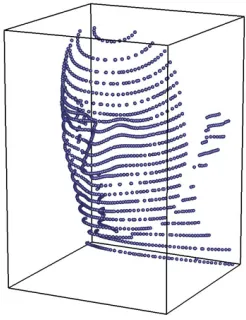
Figure 3.1 illustrates the basic concept of a structured light scanner which utilizes a pattern of horizontal stripes. A projector is utilized to cast the pattern onto the surface of a target object, and a camera captures an image of the scene. Information retrieved from the image is combined with the geometric relationship between the projector and camera in order to reconstruct a cloud of points in 3D. This is possible because each stripe corresponds to a sheet of light originating from the centre of the projector lens and the image reveals where those sheets hit the target surface.
recorded image
←−
projector camera
target object
reconstructed point cloud
Figure 3.1: A series of parallel stripes is projected onto the surface of an object. A recorded image of this scene reveals the shape of the surface along those stripes, and can be used to reconstruct a 3D point cloud.
We define a Cartesian coordinate system spanning a 3D space in which the scanner is cali-brated and in which the surface can be reconstructed. Refer to Figure 3.2(a). The axes are chosen in relation to the projector such that: theX-axis coincides with the central projector
axis; the X–Y plane coincides with the horizontal sheet of light cast by the projector; and
the system origin is at an arbitrary, but fixed and known, distanceDp>0 from the centre of
the projector lens. We call the space spanned by these axes thesystem space.
29 Chapter 3 – Structured light scanning
3.1 THE LAYOUT OF OUR SCANNER
Figure 3.1 illustrates the basic concept of a structured light scanner which utilizes a pattern of horizontal stripes. A projector is utilized to cast the pattern onto the surface of a target object, and a camera captures an image of the scene. Information retrieved from the image is combined with the geometric relationship between the projector and camera in order to reconstruct a cloud of points in 3D. This is possible because each stripe corresponds to a sheet of light originating from the centre of the projector lens and the image reveals where those sheets hit the target surface.
recorded image
←−
projector camera
target object
reconstructed point cloud
Figure 3.1: A series of parallel stripes is projected onto the surface of an object. A recorded image of this scene reveals the shape of the surface along those stripes, and can be used to reconstruct a 3D point cloud.
We define a Cartesian coordinate system spanning a 3D space in which the scanner is cali-brated and in which the surface can be reconstructed. Refer to Figure 3.2(a). The axes are chosen in relation to the projector such that: theX-axis coincides with the central projector
axis; the X–Y plane coincides with the horizontal sheet of light cast by the projector; and
the system origin is at an arbitrary, but fixed and known, distanceDp>0 from the centre of
the projector lens. We call the space spanned by these axes the system space.
29
Each light plane is uniquely
The MARWIN Project
FP7 Research for the Benefit of SMEs
MARWIN: SHU work on various tasks
Marcos Rodrigues, Mariza Kormann
3D Scanner Development
Registration and fusion of 3D models
GMPR scanner design
A beam splitter allows for visible and
near-infrared cameras to be fitted
Full design integrated into a
robotic arm
Scanning a part with the robot
Automatic registration with CAD models
Scanned patches are fused and registered
Lecture Notes in Computer Science 7the two sets of points pi andqi are paired to each other. The registration goal is to estimate the parameters (R,t) rotation matrix and translation vector by minimising the following objective function:
F(R,t) = m � i=1 N i � j=1
pi,jd2(Rpi,j+t, Sk) + n � k=1 N k � l=1
qk,ld2(RTp �
k,l−RTt, Si) (9)
From the objective function in (9) the distance minimisation between the two sets of points is performed in a least squares sense:
f(R,t) = 1
N
N �
i=1
||Rpi+t,qi||2 (10)
[image:10.720.101.711.126.524.2]When the transformation model (R,t) has been estimated, transform every point in the CAD model. This iteration is repeated until convergence to a minimum set threshold or when a predefined number of iterations is reached.
Fig. 4.Visibility constraints and registration. Top row (left and middle): model is re-oriented to display desired surface; (right): hidden surfaces are removed from a selected model. Bottom row (left): initial position; (right): after registration.
The proposed visibility constraints are necessary for partial registration, as the ICP is guaranteed to fail if one tries to register both sets of data without adequate constraints. The method is that the user will pre-orient the CAD model
Lecture Notes in Computer Science 7
the two sets of pointspi andqi are paired to each other. The registration goal is to estimate the parameters (R,t) rotation matrix and translation vector by minimising the following objective function:
F(R,t) = m � i=1 N i � j=1
pi,jd2(Rpi,j+t, Sk) + n � k=1 N k � l=1
qk,ld2(RTp �
k,l−RTt, Si) (9)
From the objective function in (9) the distance minimisation between the two sets of points is performed in a least squares sense:
f(R,t) = 1
N
N
�
i=1
||Rpi+t,qi||2 (10)
When the transformation model (R,t) has been estimated, transform every point in the CAD model. This iteration is repeated until convergence to a minimum set threshold or when a predefined number of iterations is reached.
Fig. 4.Visibility constraints and registration. Top row (left and middle): model is re-oriented to display desired surface; (right): hidden surfaces are removed from a selected model. Bottom row (left): initial position; (right): after registration.
The proposed visibility constraints are necessary for partial registration, as the ICP is guaranteed to fail if one tries to register both sets of data without adequate constraints. The method is that the user will pre-orient the CAD model
Registration goal is to estimate R,t:
Welding sequence
The ADMOS Project
ADMOS: SHU work on various tasks
Marcos Rodrigues, Mariza Kormann
Privacy Regulations
Modelling and System Design
Hardware and Electronics Design
Client Side Software Development: tracking, gender
and age estimation
Hardware and Electronics Design
Optics and lighting
Client Side Software Development
Firmware and control s/w development
Real time processing:
1. face detection and tracking
2. eye tracking
3. other feature tracking (mouth, nose)
4. cropping the various face-ROI
5. gender classification
6. age estimation
7. save statistical info to an xml file
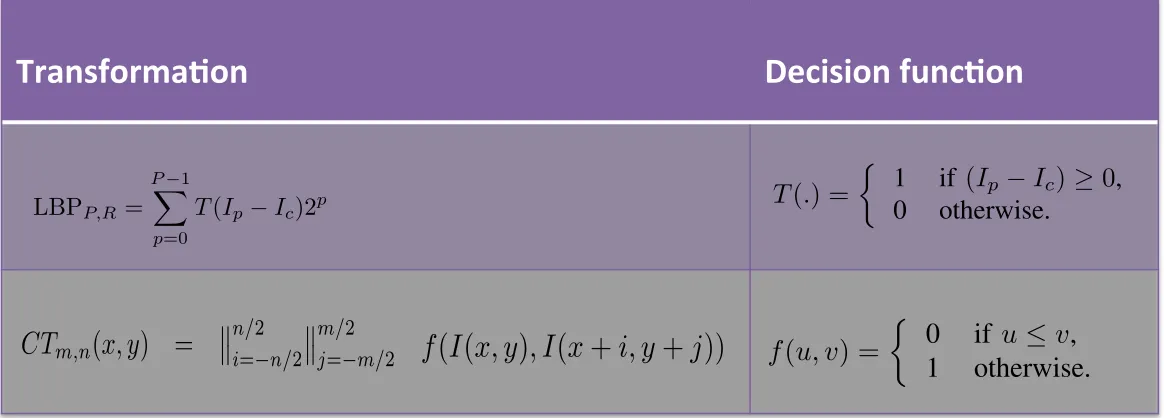
Transforma*on
Decision func*on
Binary patterns
LBP, CT and MCT
18TH INTERNATIONAL CONFERENCE ON CIRCUITS, SYSTEMS, COMMUNICATIONS AND COMPUTERS (CSCC 2014) 3
Fig. 1. The proposed method: histograms from LBP, CT and MCT are transformed by DCT. Both original histograms and their DCT are compared through SVM.
same images building training and test sets
for both classes, with kernel window size
3
×
3
;
4) Apply the discrete cosine transform to the
outputs from steps 1–3;
5) Use SVM for training and testing all data
from steps 1–4.
The proportion of data that is used for training
and testing can vary considerably; in this paper we
use 70–30 (70% of all data for training and 30%
for testing).
A. The Census Transform – CT
The Census Transform has been proposed in [14]
as a grey-level operator over a local neighbourhood.
It applies to an image kernel of size
m
×
n
:
CT
m,n(
x, y
) =
�
�
n/2i=−n/2
�
�
m/2j=−m/2
(1)
f
(
I
(
x, y
)
, I
(
x
+
i, y
+
j
))
where the operator
||
is a bit-wise concatenation of
f
(
u, v
)
which is defined as
f
(
u, v
) =
�
0 if
u
≤
v
,
1 otherwise.
Various modifications have been suggested to
the original CT transform such as centre-symmetric
weighted kernel [15] and a modified CT using the
mean of the centre pixel [16]. Typical window sizes
are
3
×
3
,
5
×
5
and
9
×
7
as their concatenated binary
results fit into 8, 32 or 64 bit. Experiments have
shown (e.g. [17]) that using a kernel window of
5
×
5
is a good compromise between speed and accuracy.
The Modified Census Transform (MCT) as used
in this paper is similarly defined as in equation 1.
The difference is that instead of using the grey
level intensity of the centre pixel, the average of
the kernel window intensity is used.
B. Local Binary Patterns – LBP
Local binary patterns [2], [18], [19], [20] are
grey-scale operators defined over local
neighbour-hood pixels. It was originally defined using a
3
×
3
array of pixels, but many implementations
con-sider larger radii. The value of the centre pixel
is compared with its neighbours and the result
(greater or smaller) expressed as a binary number
and concatenated over all pixels considered. The
concatenated array of binary numbers is normally
converted to grey scale from which histograms are
produced. LBP can be expressed over
P
sampling
points on a circle of radius
R
where the value of
the centre pixel
(
x, y
)
is expressed as:
LBP
P,R=
P
�
−1p=0
T
(
I
p−
I
c)2
p,
(2)
where
I
p−
I
cis the difference of pixel intensity
in the grey level between a current pixel and centre
pixel of the kernel window.
P
is the number of
pix-els on a circle of radius
R
, and
T
is a thresholding
function defined as:
T
(
.
) =
�
1 if
(
I
p−
I
c)
≥
0
,
0 otherwise.
In order to improve the discriminating power
of LBPs, images are normally defined in blocks
MCT is similar to CT, except that it uses the average intensity of the kernel window as the intensity of the centre pixel.
18TH INTERNATIONAL CONFERENCE ON CIRCUITS, SYSTEMS, COMMUNICATIONS AND COMPUTERS (CSCC 2014) 3
Fig. 1. The proposed method: histograms from LBP, CT and MCT are transformed by DCT. Both original histograms and their DCT are compared through SVM.
same images building training and test sets for both classes, with kernel window size 3×3; 4) Apply the discrete cosine transform to the
outputs from steps 1–3;
5) Use SVM for training and testing all data from steps 1–4.
The proportion of data that is used for training and testing can vary considerably; in this paper we use 70–30 (70% of all data for training and 30% for testing).
A. The Census Transform – CT
The Census Transform has been proposed in [14] as a grey-level operator over a local neighbourhood. It applies to an image kernel of size m×n:
CTm,n(x, y) =
� �n/2
i=−n/2 � �m/2
j=−m/2 (1)
f(I(x, y), I(x+i, y+j))
where the operator || is a bit-wise concatenation of
f(u, v) which is defined as
f(u, v) =
�
0 if u≤ v,
1 otherwise.
Various modifications have been suggested to the original CT transform such as centre-symmetric weighted kernel [15] and a modified CT using the mean of the centre pixel [16]. Typical window sizes are 3×3, 5×5 and 9×7 as their concatenated binary results fit into 8, 32 or 64 bit. Experiments have shown (e.g. [17]) that using a kernel window of 5×5 is a good compromise between speed and accuracy. The Modified Census Transform (MCT) as used in this paper is similarly defined as in equation 1. The difference is that instead of using the grey level intensity of the centre pixel, the average of the kernel window intensity is used.
B. Local Binary Patterns – LBP
Local binary patterns [2], [18], [19], [20] are grey-scale operators defined over local neighbour-hood pixels. It was originally defined using a 3×3 array of pixels, but many implementations con-sider larger radii. The value of the centre pixel is compared with its neighbours and the result (greater or smaller) expressed as a binary number and concatenated over all pixels considered. The concatenated array of binary numbers is normally converted to grey scale from which histograms are produced. LBP can be expressed over P sampling
points on a circle of radius R where the value of
the centre pixel (x, y) is expressed as:
LBPP,R = P�−1
p=0
T(Ip −Ic)2p, (2)
where Ip − Ic is the difference of pixel intensity in the grey level between a current pixel and centre pixel of the kernel window. P is the number of
pix-els on a circle of radius R, and T is a thresholding
function defined as:
T(.) =
�
1 if (Ip−Ic)≥ 0, 0 otherwise.
In order to improve the discriminating power of LBPs, images are normally defined in blocks 18TH INTERNATIONAL CONFERENCE ON CIRCUITS, SYSTEMS, COMMUNICATIONS AND COMPUTERS (CSCC 2014) 2
lip detection algorithms. The method is described in Section II, experimental results are presented in Section III with a conclusion in Section IV.
II. METHOD
In order to perform real-time gender classifica-tion, a number of steps are necessary. First faces must be detected in the image and this is achieved through the Viola-Jones method [10], [11] available from OpenCV libraries. An unconstrained image may contain a number of faces and each region of interest ROI containing a face must be processed independently and the detected gender must be assigned to a corresponding data structure (to that region of interest). The data structure thus, will contain a gender attribute such that to avoid un-necessary multiple calls to the gender classification function if a particular tracked face has already a gender definition. This applies to the tracking of faces over multiple frames, but these aspects are not discussed further in this paper. Instead the focus is on sensitivity analysis over selected regions of the face.
Sensitivity analysis starts with testing aspect ratios of the ROI concerning the selected facial region. The Viola-Jones method yields a ROI with aspect ratio of 1 : 1. The method, however, suffers
from false positive detection: due to the simplicity of the Haar-like features used, some of the detected face objects are not faces at all. In order to verify whether or not it is a face, a number of constraints are imposed namely, a face must have two eyes and a lip. To verify the constraints each ROI is taken in turn. First eye detection is performed in the knowledge that right and left eyes are located in the first and second quadrants of the ROI, and lip detection in the knowledge that the lip is spread over the third and fourth quadrants. An example of a verified face is depicted in Figure 1. If the ROI satisfies these constraints then proceed to gender classification. Note that eye detection is a specific requirement of the ADMOS project but very useful in the context of sensitivity analysis presented here as the size of a larger ROI (of aspect ratio of 3:4) is determined from the eye locations.
Fig. 1. Face, eyes, and lip detection in real time with annotated face ROI of aspect ratio1 : 1
Local binary patterns [2], [4] are grey-scale operators useful for texture classification defined over local neighbourhood pixels. It was originally defined using a 3×3 array of pixels. The value of
the centre pixel is compared with its neighbours and the result (greater or smaller) expressed as a binary number and summed over all pixels considered. LBP can be expressed over P sampling points on a circle of radius R where the value of the centre pixel (x, y) is expressed as:
LBPP,R = P�−1
p=0
T(Ip−Ic)2p, (1)
where Ip and Ic refer to the pixel intensity in the
grey level of the centre pixel and of P pixels on a circle of radiusR, andT is a thresholding function with T(.) = 1 if (Ip − Ic) ≥ 0 or T(.) = 0
otherwise. Normally images are defined in blocks from which individual LBPs are calculated and then concatenated into a single histogram. The analysis of such histograms can be used to differentiate tex-ture patterns. The size of the block under analysis can vary and this obviously will be reflected in the LBP histogram.
In order to improve the robustness and
discrimi-18TH INTERNATIONAL CONFERENCE ON CIRCUITS, SYSTEMS, COMMUNICATIONS AND COMPUTERS (CSCC 2014) 3
Fig. 1. The proposed method: histograms from LBP, CT and MCT are transformed by DCT. Both original histograms and their DCT are compared through SVM.
same images building training and test sets
for both classes, with kernel window size
3
×
3
;
4) Apply the discrete cosine transform to the
outputs from steps 1–3;
5) Use SVM for training and testing all data
from steps 1–4.
The proportion of data that is used for training
and testing can vary considerably; in this paper we
use 70–30 (70% of all data for training and 30%
for testing).
A. The Census Transform – CT
The Census Transform has been proposed in [14]
as a grey-level operator over a local neighbourhood.
It applies to an image kernel of size
m
×
n
:
CTm,n
(
x, y
) =
�
�
n/i=2−n/2�
�
m/j=−2m/2(1)
f
(
I
(
x, y
)
, I
(
x
+
i, y
+
j
))
where the operator
||
is a bit-wise concatenation of
f
(
u, v
)
which is defined as
f
(
u, v
) =
�
0 if
u
≤
v
,
1 otherwise.
Various modifications have been suggested to
the original CT transform such as centre-symmetric
weighted kernel [15] and a modified CT using the
mean of the centre pixel [16]. Typical window sizes
are
3
×
3
,
5
×
5
and
9
×
7
as their concatenated binary
results fit into 8, 32 or 64 bit. Experiments have
shown (e.g. [17]) that using a kernel window of
5
×
5
is a good compromise between speed and accuracy.
The Modified Census Transform (MCT) as used
in this paper is similarly defined as in equation 1.
The difference is that instead of using the grey
level intensity of the centre pixel, the average of
the kernel window intensity is used.
B. Local Binary Patterns – LBP
Local binary patterns [2], [18], [19], [20] are
grey-scale operators defined over local
neighbour-hood pixels. It was originally defined using a
3
×
3
array of pixels, but many implementations
con-sider larger radii. The value of the centre pixel
is compared with its neighbours and the result
(greater or smaller) expressed as a binary number
and concatenated over all pixels considered. The
concatenated array of binary numbers is normally
converted to grey scale from which histograms are
produced. LBP can be expressed over
P
sampling
points on a circle of radius
R
where the value of
the centre pixel
(
x, y
)
is expressed as:
LBP
P,R=
P�
−1p=0
T
(
Ip
−
Ic
)2
p,
(2)
where
Ip
−
Ic
is the difference of pixel intensity
in the grey level between a current pixel and centre
pixel of the kernel window.
P
is the number of
pix-els on a circle of radius
R
, and
T
is a thresholding
function defined as:
T
(
.
) =
�
1 if
(
Ip
−
Ic
)
≥
0
,
0 otherwise.
In order to improve the discriminating power
of LBPs, images are normally defined in blocks
18TH INTERNATIONAL CONFERENCE ON CIRCUITS, SYSTEMS, COMMUNICATIONS AND COMPUTERS (CSCC 2014) 3
Fig. 1. The proposed method: histograms from LBP, CT and MCT are transformed by DCT. Both original histograms and their DCT are compared through SVM.
same images building training and test sets
for both classes, with kernel window size
3
×
3;
4) Apply the discrete cosine transform to the
outputs from steps 1–3;
5) Use SVM for training and testing all data
from steps 1–4.
The proportion of data that is used for training
and testing can vary considerably; in this paper we
use 70–30 (70% of all data for training and 30%
for testing).
A. The Census Transform – CT
The Census Transform has been proposed in [14]
as a grey-level operator over a local neighbourhood.
It applies to an image kernel of size
m
×
n
:
CT
m,n(
x, y
) =
�
�
n/2i=−n/2
�
�
m/2j=−m/2
(1)
f
(
I
(
x, y
)
, I
(
x
+
i, y
+
j
))
where the operator
||
is a bit-wise concatenation of
f
(
u, v
)
which is defined as
f
(
u, v
) =
�
0 if
u
≤
v
,
1 otherwise.
Various modifications have been suggested to
the original CT transform such as centre-symmetric
weighted kernel [15] and a modified CT using the
mean of the centre pixel [16]. Typical window sizes
are
3
×
3,
5
×
5
and
9
×
7
as their concatenated binary
results fit into 8, 32 or 64 bit. Experiments have
shown (e.g. [17]) that using a kernel window of
5
×
5
is a good compromise between speed and accuracy.
The Modified Census Transform (MCT) as used
in this paper is similarly defined as in equation 1.
The difference is that instead of using the grey
level intensity of the centre pixel, the average of
the kernel window intensity is used.
B. Local Binary Patterns – LBP
Local binary patterns [2], [18], [19], [20] are
grey-scale operators defined over local
neighbour-hood pixels. It was originally defined using a
3
×
3
array of pixels, but many implementations
con-sider larger radii. The value of the centre pixel
is compared with its neighbours and the result
(greater or smaller) expressed as a binary number
and concatenated over all pixels considered. The
concatenated array of binary numbers is normally
converted to grey scale from which histograms are
produced. LBP can be expressed over
P
sampling
points on a circle of radius
R
where the value of
the centre pixel
(
x, y
)
is expressed as:
LBP
P,R=
P�
−1p=0
T
(
I
p−
I
c)2
p,
(2)
where
I
p−
I
cis the difference of pixel intensity
in the grey level between a current pixel and centre
pixel of the kernel window.
P
is the number of
pix-els on a circle of radius
R
, and
T
is a thresholding
function defined as:
T
(
.
) =
�
1 if
(
I
p−
I
c)
≥
0,
0 otherwise.
[image:16.720.70.652.222.431.2]Applying binary patterns to face images
Visualizing the differences on images
18TH INTERNATIONAL CONFERENCE ON CIRCUITS, SYSTEMS, COMMUNICATIONS AND COMPUTERS (CSCC 2014)
5
Fig. 2. Examples of image data from the FEI database.
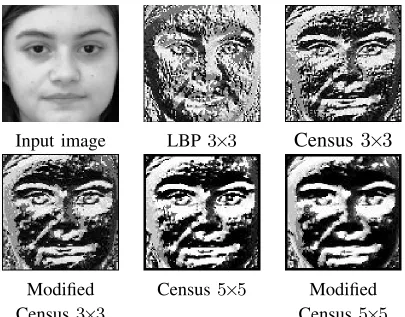
Input image
LBP
3
×
3
Census
3
×
3
Modified
Census
5
×
5
Modified
Census
3
×
3
Census
5
×
5
Fig. 3. LBP, Census and Modified Census over an input image.
and this is left for further studies. Here we report
on LBP, CT and MCT with constant
3
×
3
kernel
window.
Following results described in [13] we use the
face regions labeled as FULL face, TOP and
BOT-TOM half of the face. Histograms for LBP, CT
and MCT were evaluated as described in
Sec-tion II. From these we also built concatenated
histograms for FULL
||
TOP, FULL
||
BOTTOM, and
TOP
||
BOTTOM. Furthermore, we also built
con-catenated histograms of LBP
||
CT and LBP
||
MCT
for all cases. The histograms were then separated
into training and test sets and subject to the SVM
discrimination method.
TABLE I
A
CCURACY OF HISTOGRAM-
BASED CLASSIFICATION(%)
Face ROI &
LBP
||
LBP
||
Method
LBP
CT
MCT
CT
MCT
FULL
Female
80.6
87.1
67.7
83.9
77.4
Male
90.3
93.5
83.9
90.3
83.9
TOP
Female
83.9
87.1
74.7
83.9
80.6
Male
96.8
87.1
77.4
90.3
90.3
BOTTOM
Female
80.6
74.2
67.7
71.0
74.2
Male
93.5
93.5
93.5
96.8
93.5
FULL
||
TOP
Female
83.4
87.1
77.4
77.4
87.1
Male
93.5
93.5
87.1
96.8
87.1
FULL
||
BOTTOM
Female
83.9
87.1
64.5
71.0
77.4
Male
90.3
93.5
90.3
96.8
96.8
TOP
||
BOTTOM
Female
80.6
67.7
74.2
83.9
80.6
Male
96.8
100.0
90.3
93.5
93.5
Mean
87.9
87.6
79.0
86.3
85.2
STD
6.4
8.9
9.9
9.4
7.3
Mean Female
82.2
81.7
71.0
78.5
79.6
Mean Male
93.5
93.5
87.1
94.1
90.9
Abs difference
11.4
11.8
16.1
15.6
11.3
Results for histogram-based classification are
tab-ulated in Table I. The summary refers to training
on 60 data sets (30 female, 30 male) and 60 test
sets. The best result is for LBP applied to the TOP
half of the face, and this confirms previous results
as reported in [13]. Overall, the LBP technique
is shown to be superior to CT and MCT and the
concatenated combinations with the overall lowest
standard deviation of 6.4. Furthermore, it is
ob-served that there is a bias towards more accurate
male classification as reported in all papers in the
literature; this is the case for all combinations used.
The reasons for this behaviour are not yet clear.
[image:17.720.163.568.200.517.2]LBP processing
ROI sensitivity analysis
Male subjects tend to be
classified with higher
accuracy.
This agrees with all results
reported in the literature.
No explanation for this
behaviour is offered at this
stage.
18TH INTERNATIONAL CONFERENCE ON CIRCUITS, SYSTEMS, COMMUNICATIONS AND COMPUTERS (CSCC 2014) 5
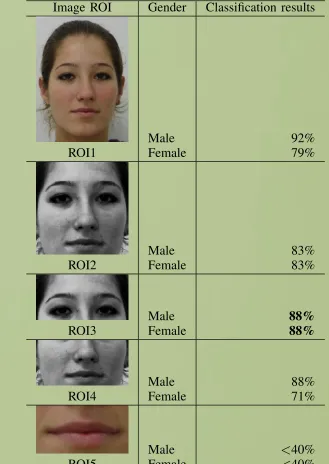
TABLE I
COMPARATIVE ANALYSIS OF IMAGE REGIONS
Image ROI Gender Classification results
Male 92%
ROI1 Female 79%
Male 83%
ROI2 Female 83%
Male 88%
ROI3 Female 88%
Male 88%
ROI4 Female 71%
Male <40%
ROI5 Female <40%
to detect both classes with good accuracy. ROI4
(consisting of the bottom half of ROI2) retained its
previous accuracy for male subjects at 88% but for
female the performance decreased substantially to
71%. This shows that the region does not contain
enough variation in texture to guarantee robust
classification, which is somewhat surprising. Before
testing this ROI, it was expected that, due to facial
hair and skin texture variations on either shaved and
unshaved faces, male and female subjects would be
detected with the highest degree of accuracy. Finally
ROI5 has proved to be problematic as automatic lip
detection failed in about half of the data (multiple
lip detection was deemed a failure). Thus the lack
of robust lip detection rendered this ROI unstable
and the statistics reported here at less than 40% are
just an indication of performance.
Since this research is only interested in the
minimum ROI with highest performance, results
demonstrate that ROI3 is the most promising one.
The high variance caused by skin texture, eyebrows,
eyes, and portions of hair mean that the region can
be further exploited for more robust classification.
With this information, it is now possible to focus
on improvements to LBP and to the classification
algorithms. The obvious avenues to explore include
the use the Fisher’s criterion and SVM-support
vec-tor machines. In particular, SVM holds the highest
promise as it is a technique designed to maximising
the margin between canonical hyperplanes
sepa-rating the two classes. With a higher margin, the
probability of misclassification naturally decreases
and it should be possible to achieve higher accuracy
for both male and female subjects.
IV. C
ONCLUSIONThis paper has presented a sensitivity analysis of
gender classification based on LBP and
eigenvec-tor decomposition over 5 regions of interest. The
adopted methodology was directed towards testing
the LBP algorithm over the selected regions to
determine the smaller region of interest yielding
the best classification results. Images from a public
database were used on which automatic detection
of the face region, eyes, and lips were performed
resulting in the various regions of interest being
defined. Classification results show that the region
containing parts of the nose, eyes and front are the
most reliable, with an overall accuracy of 88% for
both male and female subjects.
[image:19.720.331.660.61.525.2]Comparative analysis of binary patterns
DCT-Discrete Cosine Transform
The length of coefficients
y
is the same size as the original signalz
.18TH INTERNATIONAL CONFERENCE ON CIRCUITS, SYSTEMS, COMMUNICATIONS AND COMPUTERS (CSCC 2014) 4
from which individual LBPs are calculated and then
concatenated into a single histogram. The analysis
of such histograms can be used to differentiate
texture patterns. A number of variants to LBP have
been proposed in the literature (e.g. [3], [4], [5]).
In the experiments reported in this paper we only
consider the original LBP definition.
C. The Discrete Cosine Transform – DCT
The DCT transform and its variants have been
used in a number of contexts most notably in image
and video compression (e.g. [21], [22], [23]). DCT
is a close relative to the discrete Fourier transform
as it defines a sequence of data in terms of the
sum of the cosine functions at different frequencies.
There are many versions of the DCT and here
we use the unitary discrete cosine transform as
defined in Matlab [24]. The DCT transform of a
one-dimensional signal
z
(in our case
z
is an image
histogram) is expressed as:
y
(
k
) =
w
(
k
)
N
�
n=1
z
(
n
) cos(
π
(2
n
−
1)(
k
−
1)
2
N
)
(3)
for
k
= 1
,
2
, . . . N
where
N
is the length of the
signal and
w
(
k
) =
�
1
/
√
N
for
k
= 1
,
�
2
/N
for
2
≤
k
≤
N .
(4)
The length of the coefficients
y
is the same as
the original signal
z
. A useful property of the
DCT is that normally it is only necessary a few
coefficients to reconstruct the signal; most signals
can be described with over 99% accuracy by using
only a handful of coefficients. Here we choose to
use all coefficients for improved accuracy.
D. Support Vector Machines – SVM
In pattern recognition tasks, algorithms for linear
discriminant functions can be used either over the
raw or original data features or in a transformed
space that can be defined by nonlinear
transforma-tions of the original variables (e.g. DCT applied
to the LBP and CT histograms as proposed in
this paper). Support vector machines are algorithms
that implement a mapping of pattern vectors to a
higher dimensional feature space and find a ‘best’
separating hyperplane between the data set. The
best hyperplane is commonly referred to as the
maximal margin hyperplane, as it is defined where
the closest points between classes are at maximum
distance [25].
Given a set of
M
training samples (
l
i,
x
i) where
l
iis the associated class label (
l
i∈
{−
1
,
1
}
) of
vector
x
iwhere
x
i∈
R
N, a SVM classifier finds
the optimal hyperplane that maximises the margin
between classes
l
i:
f
(
x
) =
M
�
i=1
l
iα
i·
k
(
x
,
x
i) +
b
(5)
where
k
(
x
,
x
i)
is a kernel function,
b
is a bias and
the sign of
f
(
x
)
is used to determine the class
membership of vector
x
. For a two-class problem
(e.g. the case of gender classification) a linear SVM
might suffice. In this case, the kernel function is a
dot product in the input space.
III. E
XPERIMENTAL RESULTSA public database as described in [13] is used
here, details of the database can be found in [26].
It contains 2,779 images of even balanced number
of male and female subjects captured with large
variations in pose and illumination. In [13] a set of
50 male and 50 female subjects were used; although
all subjects were not in strictly frontal pose, there
was not much variation in illumination in that
dataset. Here we expand the dataset by including
images with uneven illumination. We used the entire
set of 99 male and 99 female subjects (one subject
was removed from each original set of 100 as they
appear to be repeated). The selected data allows
the testing of algorithms in a realistic scenario of
uneven illumination. Examples of selected images
from the database are depicted in Figure 2.
First, we performed a visual comparison of LBP,
CT and MCT using a
3
×
3
kernel window. We
proceeded to perform a CT and MCT using a
5
×
5
window as shown in Figure 3. It is not clear
whether or not simply increasing the kernel size
would impact on gender classification performance
18TH INTERNATIONAL CONFERENCE ON CIRCUITS, SYSTEMS, COMMUNICATIONS AND COMPUTERS (CSCC 2014) 4from which individual LBPs are calculated and then
concatenated into a single histogram. The analysis
of such histograms can be used to differentiate
texture patterns. A number of variants to LBP have
been proposed in the literature (e.g. [3], [4], [5]).
In the experiments reported in this paper we only
consider the original LBP definition.
C. The Discrete Cosine Transform – DCT
The DCT transform and its variants have been
used in a number of contexts most notably in image
and video compression (e.g. [21], [22], [23]). DCT
is a close relative to the discrete Fourier transform
as it defines a sequence of data in terms of the
sum of the cosine functions at different frequencies.
There are many versions of the DCT and here
we use the unitary discrete cosine transform as
defined in Matlab [24]. The DCT transform of a
one-dimensional signal
z
(in our case
z
is an image
histogram) is expressed as:
y
(
k
) =
w
(
k
)
N
�
n=1
z
(
n
) cos(
π
(2
n
−
1)(
k
−
1)
2
N
)
(3)
for
k
= 1
,
2
, . . . N
where
N
is the length of the
signal and
w
(
k
) =
�
1
/
√
N
for
k
= 1
,
�
2
/N
for
2
≤
k
≤
N .
(4)
The length of the coefficients
y
is the same as
the original signal
z
. A useful property of the
DCT is that normally it is only necessary a few
coefficients to reconstruct the signal; most signals
can be described with over 99% accuracy by using
only a handful of coefficients. Here we choose to
use all coefficients for improved accuracy.
D. Support Vector Machines – SVM
In pattern recognition tasks, algorithms for linear
discriminant functions can be used either over the
raw or original data features or in a transformed
space that can be defined by nonlinear
transforma-tions of the original variables (e.g. DCT applied
to the LBP and CT histograms as proposed in
this paper). Support vector machines are algorithms
that implement a mapping of pattern vectors to a
higher dimensional feature space and find a ‘best’
separating hyperplane between the data set. The
best hyperplane is commonly referred to as the
maximal margin hyperplane, as it is defined where
the closest points between classes are at maximum
distance [25].
Given a set of
M
training samples (
l
i,
x
i) where
l
iis the associated class label (
l
i∈
{−
1
,
1
}
) of
vector
x
iwhere
x
i∈
R
N, a SVM classifier finds
the optimal hyperplane that maximises the margin
between classes
l
i:
f
(
x
) =
M
�
i=1
l
iαi
·
k
(
x
,
x
i) +
b
(5)
where
k
(
x
,
x
i)
is a kernel function,
b
is a bias and
the sign of
f
(
x
)
is used to determine the class
membership of vector
x
. For a two-class problem
(e.g. the case of gender classification) a linear SVM
might suffice. In this case, the kernel function is a
dot product in the input space.
III. E
XPERIMENTAL RESULTSA public database as described in [13] is used
here, details of the database can be found in [26].
It contains 2,779 images of even balanced number
of male and female subjects captured with large
variations in pose and illumination. In [13] a set of
50 male and 50 female subjects were used; although
all subjects were not in strictly frontal pose, there
was not much variation in illumination in that
dataset. Here we expand the dataset by including
images with uneven illumination. We used the entire
set of 99 male and 99 female subjects (one subject
was removed from each original set of 100 as they
appear to be repeated). The selected data allows
the testing of algorithms in a realistic scenario of
uneven illumination. Examples of selected images
from the database are depicted in Figure 2.
First, we performed a visual comparison of LBP,
CT and MCT using a
3
×
3
kernel window. We
proceeded to perform a CT and MCT using a
5
×
5
window as shown in Figure 3. It is not clear
whether or not simply increasing the kernel size
would impact on gender classification performance
18TH INTERNATIONAL CONFERENCE ON CIRCUITS, SYSTEMS, COMMUNICATIONS AND COMPUTERS (CSCC 2014) 4
from which individual LBPs are calculated and then
concatenated into a single histogram. The analysis
of such histograms can be used to differentiate
texture patterns. A number of variants to LBP have
been proposed in the literature (e.g. [3], [4], [5]).
In the experiments reported in this paper we only
consider the original LBP definition.
C. The Discrete Cosine Transform – DCT
The DCT transform and its variants have been
used in a number of contexts most notably in image
and video compression (e.g. [21], [22], [23]). DCT
is a close relative to the discrete Fourier transform
as it defines a sequence of data in terms of the
sum of the cosine functions at different frequencies.
There are many versions of the DCT and here
we use the unitary discrete cosine transform as
defined in Matlab [24]. The DCT transform of a
one-dimensional signal
z
(in our case
z
is an image
histogram) is expressed as:
y
(
k
) =
w
(
k
)
N
�
n=1
z
(
n
) cos(
π
(2
n
−
1)(
k
−
1)
2
N
)
(3)
for
k
= 1
,
2
, . . . N
where
N
is the length of the
signal and
w
(
k
) =
�
1
/
√
N
for
k
= 1
,
�
2
/N
for
2
≤
k
≤
N .
(4)
The length of the coefficients
y
is the same as
the original signal
z
. A useful property of the
DCT is that normally it is only necessary a few
coefficients to reconstruct the signal; most signals
can be described with over 99% accuracy by using
only a handful of coefficients. Here we choose to
use all coefficients for improved accuracy.
D. Support Vector Machines – SVM
In pattern recognition tasks, algorithms for linear
discriminant functions can be used either over the
raw or original data features or in a transformed
space that can be defined by nonlinear
transforma-tions of the original variables (e.g. DCT applied
to the LBP and CT histograms as proposed in
this paper). Support vector machines are algorithms
that implement a mapping of pattern vectors to a
higher dimensional feature space and find a ‘best’
separating hyperplane between the data set. The
best hyperplane is commonly referred to as the
maximal margin hyperplane, as it is defined where
the closest points between classes are at maximum
distance [25].
Given a set of
M
training samples (
l
i,
x
i) where
l
iis the associated class label (
l
i∈
{
−
1
,
1
}
) of
vector
x
iwhere
x
i∈
R
N, a SVM classifier finds
the optimal hyperplane that maximises the margin
between classes
l
i:
f
(
x
) =
M
�
i=1
l
iα
i·
k
(
x
,
x
i) +
b
(5)
where
k
(
x
,
x
i)
is a kernel function,
b
is a bias and
the sign of
f
(
x
)
is used to determine the class
membership of vector
x. For a two-class problem
(e.g. the case of gender classification) a linear SVM
might suffice. In this case, the kernel function is a
dot product in the input space.
III. E
XPERIMENTAL RESULTSA public database as described in [13] is used
here, details of the database can be found in [26].
It contains 2,779 images of even balanced number
of male and female subjects captured with large
variations in pose and illumination. In [13] a set of
50 male and 50 female subjects were used; although
all subjects were not in strictly frontal pose, there
was not much variation in illumination in that
dataset. Here we expand the dataset by including
images with uneven illumination. We used the entire
set of 99 male and 99 female subjects (one subject
was removed from each original set of 100 as they
appear to be repeated). The selected data allows
the testing of algorithms in a realistic scenario of
uneven illumination. Examples of selected images
from the database are depicted in Figure 2.
First, we performed a visual comparison of LBP,
CT and MCT using a
3
×
3
kernel window. We
proceeded to perform a CT and MCT using a
5
×
5
window as shown in Figure 3. It is not clear
whether or not simply increasing the kernel size
would impact on gender classification performance
Decomposes a signal and defines it as a
Comparative analysis of binary patterns
DWT-Discrete Wavelet Transform
2.4 The Discrete Wavelet Transform – DWT
The DWT transform [17, 41, 42, 43] is a time-scale representation of a signal obtained using digital filtering techniques in which the signal to be analysed is passed through filters with different cutoff frequencies at different scales. The technique is realised by iteration and the resolution of the signal which determines the amount of information in the signal can be controlled by subsampling (up and down) operations. For a given signal two sets of coefficients are computed referred to as theapproximation coefficientsA
and detail coefficientsD. The A coefficients are obtained by convolving the signal with a low-pass filter and the D are obtained
by convolving with a high-pass filter.
As the signal is decomposed by the half band filters this results in signals spanning only half the frequency band. This doubling of frequency resolution reduces uncertainty in frequency by half. Following Nyquist’s rule the signal can now be down sampled by discarding half the samples with no loss of information. The result is that while the half band low pass filtering removes half the frequencies thus halving the resolution, a decimation by 2 halves the time resolution and thus doubles the scale.
Convolving the signalz(n)with a half band digital low pass filter with impulse response h(n)can be defined in discrete time
as [44]:
x(n)h(n) = ∞ �
k=−∞
x(k)h(n−k) (5)
Applying the Nyquist rule by subsampling the signal by 2 can be represented as
y(n) = ∞ �
k=−∞
h(k) x(2n−k) (6)
Equation 6 is used for both high pass and low pass filtering operations. This one level decomposition can be expressed as:
yhigh =
�
n
x(n)g(2k−n) (7)
ylow =
�
n
x(n)h(2k−n) (8)
where yhigh and ylow are the outputs of high and low pass filters after decimation by 2. In order to reconstruct the original signal the procedure is straightforward given that half-band filters form orthonormal bases. At every level of decomposition the signal is up sampled by two, filtered through high pass and low pass synthesis filters g�(n)and h�(n) and then summed over. Thus, for
every level of decomposition the recovered signal is represented as:
x(n) = ∞ �
k=−∞
(yhigh(k).g(−n+ 2k)) (ylow(k).h(−n+ 2k)) (9)
It is important to note that if the filters are not ideal half band, then perfect reconstruction is not possible. While it is clear that ideal filters are not possible to realise, some filters under some conditions can provide perfect reconstruction. The most used and accurate ones are the Daubechie’s filters also known as Daubechies wavelets [42] and these are the ones used in the experimental results described in Section 4.
2.5 Eigenvector Decomposition
The set of measures for gender classification is defined by the histogram produced as a result of applying LBP/CT/MCT to the image ROI. It subsumes a large number of variables and the purpose is to identify which ones are more relevant to the problem at hand. Here the problem is approached by analysis of variance, or principal values. There are at least three ways a set of principal components can be derived [20]. Ifmi is the set of original variables, then they can be expressed as a linear combination ψ:
ψi = p �
j=1
aijmj (10)
The Hotelling approach as described in [20] is used in which the purpose is to find a linear separation for which the sum of the squares of perpendicular distances is a maximum, that is, the choice is to maximise the variance ofψ. This is a common approach to the problem based on first determining the scatter matrix S by subtracting all values from their mean. Then the covariance
matrix is estimated asΣ = SST. The principal components are determined by performing an eigenvector decomposition of the
symmetric positive definite matrixΣand then using the eigenvalues as coefficients in a linear combination of the original variables
m.
In order to determine class membership, the method is to define a training set in which ground truth representative of male and female images are used and classified accordingly. The leave-one-out technique can be used at testing stage if the number of samples is small. The principle is that the closest vector in the database real class is the proposed class for the testing vector.
2.4 The Discrete Wavelet Transform – DWT
The DWT transform [17, 41, 42, 43] is a time-scale representation of a signal obtained using digital filtering techniques in which
the signal to be analysed is passed through filters with different cutoff frequencies at different scales. The technique is realised by
iteration and the resolution of the signal which determines the amount of information in the signal can be controlled by subsampling
(up and down) operations. For a given signal two sets of coefficients are computed referred to as the
approximation coefficients
A
and
detail coefficients
D
. The
A
coefficients are obtained by convolving the signal with a low-pass filter and the
D
are obtained
by convolving with a high-pass filter.
As the signal is decomposed by the half band filters this results in signals spanning only half the frequency band. This doubling
of frequency resolution reduces uncertainty in frequency by half. Following Nyquist’s rule the signal can now be down sampled
by discarding half the samples with no loss of information. The result is that while the half band low pass filtering removes half
the frequencies thus halving the resolution, a decimation by 2 halves the time resolution and thus doubles the scale.
Convolving the signal
z
(
n
)
with a half band digital low pass filter with impulse response
h
(
n
)
can be defined in discrete time
as [44]:
x
(
n
)
h
(
n
) =
∞
�
k=−∞
x
(
k
)
h
(
n
−
k
)
(5)
Applying the Nyquist rule by subsampling the signal by 2 can be represented as
y
(
n
) =
∞
�
k=−∞
h
(
k
)
x
(2
n
−
k
)
(6)
Equation 6 is used for both high pass and low pass filtering operations. This one level decomposition can be expressed as:
y
high=
�
n
x
(
n
)
g
(2
k
−
n
)
(7)
y
low=
�
n
x
(
n
)
h
(2
k
−
n
)
(8)
where
y
highand
y
loware the outputs of high and low pass filters after decimation by 2. In order to reconstruct the original signal
the procedure is straightforward given that half-band filters form orthonormal bases. At every level of decomposition the signal
is up sampled by two, filtered through high pass and low pass synthesis filters
g
�(
n
)
and
h
�(
n
)
and then summed over. Thus, for
every level of decomposition the recovered signal is represented as:
x
(
n
) =
∞
�
k=−∞
(
y
high(
k
)
.g
(
−
n
+ 2
k
)) (
y
low(
k
)
.h
(
−
n
+ 2
k
))
(9)
It is important to note that if the filters are not ideal half band, then perfect reconstruction is not possible. While it is clear that
ideal filters are not possible to realise, some filters under some conditions can provide perfect reconstruction. The most used and
accurate ones are the Daubechie’s filters also known as Daubechies wavelets [42] and these are the ones used in the experimental
results described in Section 4.
2.5 Eigenvector Decomposition
The set of measures for gender classification is defined by the histogram produced as a result of applying LBP/CT/MCT to the
image ROI. It subsumes a large number of variables and the purpose is to identify which ones are more relevant to the problem at
hand. Here the problem is approached by analysis of variance, or principal values. There are at least three ways a set of principal
components can be derived [20]. If
m
iis the set of original variables, then they can be expressed as a linear combination
ψ
:
ψ
i=
p�
j=1
a
ijm
j(10)
The Hotelling approach as described in [20] is used in which the purpose is to find a linear separation for which the sum of the
squares of perpendicular distances is a maximum, that is, the choice is to maximise the variance of
ψ
. This is a common approach
to the problem based on first determining the scatter matrix
S
by subtracting all values from their mean. Then the covariance
matrix is estimated as
Σ
=
SS
T. The principal components are determined by performing an eigenvector decomposition of the
symmetric positive definite matrix
Σ
and then using the eigenvalues as coefficients in a linear combination of the original variables
m
.
In order to determine class membership, the method is to define a training set in which ground truth representative of male
and female images are used and classified accordingly. The leave-one-out technique can be used at testing stage if the number of
samples is small. The principle is that the closest vector in the database real class is the proposed class for the testing vector.
2.4 The Discrete Wavelet Transform – DWT
The DWT transform [17, 41, 42, 43] is a time-scale representation of a signal obtained using digital filtering techniques in which the signal to be analysed is passed through filters with different cutoff frequencies at different scales. The technique is realised by iteration and the resolution of the signal which determines the amount of information in the signal can be controlled by subsampling (up and down) operations. For a given signal two sets of coefficients are computed referred to as theapproximation coefficientsA
and detail coefficientsD. The Acoefficients are obtained by convolving the signal with a low-pass filter and the D are obtained
by convolving with a high-pass filter.
As the signal is decomposed by the half band filters this results in signals spanning only half the frequency band. This doubling of frequency resolution reduces uncertainty in frequency by half. Following Nyquist’s rule the signal can now be down sampled by discarding half the samples with no loss of information. The result is that while the half band low pass filtering removes half the frequencies thus halving the resolution, a decimation by 2 halves the time resolution and thus doubles the scale.
Convolving the signalz(n)with a half band digital low pass filter with impulse responseh(n)can be defined in discrete time
as [44]:
x(n)h(n) =
∞
�
k=−∞
x(k)h(n−k) (5)
Applying the Nyquist rule by subsampling the signal by 2 can be represented as
y(n) =
∞
�
k=−∞
h(k)x(2n−k) (6)
Equation 6 is used for both high pass and low pass filtering operations. This one level decomposition can be expressed as:
yhigh =
�
n
x(n)g(2k−n) (7)
ylow =
�
n
x(n)h(2k−n) (8)
whereyhigh and yloware the outputs of high and low pass filters after decimation by 2. In order to reconstruct the original signal
the procedure is straightforward given that half-band filters form orthonormal bases. At every level of decomposition the signal is up sampled by two, filtered through high pass and low pass synthesis filtersg�(n)andh�(n)and then summed over. Thus, for
every level of decomposition the recovered signal is represented as:
x(n) =
∞
�
k=−∞
(yhigh(k).g(−n+ 2k)) (ylow(k).h(−n+ 2k)) (9)
It is important to note that if the filters are not ideal half band, then perfect reconstruction is not possible. While it is clear that ideal filters are not possible to realise, some filters under some conditions can provide perfect reconstruction. The most used and accurate ones are the Daubechie’s filters also known as Daubechies wavelets [42] and these are the ones used in the experimental results described in Section 4.
2.5 Eigenvector Decomposition
The set of measures for gender classification is defined by the histogram produced as a result of applying LBP/CT/MCT to the image ROI. It subsumes a large number of variables and the purpose is to identify which ones are more relevant to the problem at hand. Here the problem is approached by analysis of variance, or principal values. There are at least three ways a set of principal components can be derived [20]. Ifmi is the set of original variables, then they can be expressed as a linear combinationψ:
ψi = p
�
j=1
aijmj (10)
The Hotelling approach as described in [20] is used in which the purpose is to find a linear separation for which the sum of the squares of perpendicular distances is a maximum, that is, the choice is to maximise the variance ofψ. This is a common approach
to the problem based on first determining the scatter matrix S by subtracting all values from their mean. Then the covariance
matrix is estimated asΣ = SST. The principal components are determined by performing an eigenvector decomposition of the
symmetric positive definite matrixΣand then using the eigenvalues as coefficients in a linear combination of the original variables
m.
In order to determine class membership, the method is to define a training set in which ground truth representative of male and female images are used and classified accordingly. The leave-one-out technique can be used at testing stage if the number of samples is small. The principle is that the closest vector in the database real class is the proposed class for the testing vector.
2.4 The Discrete Wavelet Transform – DWT
The DWT transform [17, 41, 42, 43] is a time-scale representation of a signal obtained using digital filtering techniques in which the signal to be analysed is passed through filters with different cutoff frequencies at different scales. The technique is realised by iteration and the resolution of the signal which determines the amount of information in the signal can be controlled by subsampling (up and down) operations. For a given signal two sets of coefficients are computed referred to as theapproximation coefficientsA
anddetail coefficientsD. The Acoefficients are obtained by convolving the signal with a low-pass filter and theD are obtained
by convolving with a high-pass filter.
As the signal is decomposed by the half band filters this results in signals spanning only half the frequency band. This doubling of frequency resolution reduces uncertainty in frequency by half. Following Nyquist’s rule the signal can now be down sampled by discarding half the samples with no loss of information. The result is that while the half band low pass filtering removes half the frequencies thus halving the resolution, a decimation by 2 halves the time resolution and thus doubles the scale.
Convolving the signalz(n)with a half band digital low pass filter with impulse responseh(n)can be defined in discrete time
as [44]:
x(n)h(n) =
∞
�
k=−∞
x(k)h(n−k) (5)
Applying the Nyquist rule by subsampling the signal by 2 can be represented as
y(n) =
∞
�
k=−∞
h(k)x(2n−k) (6)
Equation 6 is used for both high pass and low pass filtering operations. This one level decomposition can be expressed as:
yhigh =
�
n
x(n)g(2k−n) (7)
ylow =
�
n
x(n)h(2k−n) (8)
whereyhigh and ylow are the outputs of high and low pass filters after decimation by 2. In order to reconstruct the original signal
the procedure is straightforward given that half-band filters form orthonormal bases. At every level of decomposition the signal is up sampled by two, filtered through high pass and low pass synthesis filtersg�(n)andh�(n)and then summed over. Thus, for
every level of decomposition the recovered signal is represented as:
x(n) =
∞
�
k=−∞
(yhigh(k).g(−n+ 2k)) (ylow(k).h(−n+ 2k)) (9)
It is important to note that if the filters are not ideal half band, then perfect reconstruction is not possible. While it is clear that ideal filters are not possible to realise, some filters under some conditions can provide perfect reconstruction. The most used and accurate ones are the Daubechie’s filters also known as Daubechies wavelets [42] and these are the ones used in the experimental results described in Section 4.
2.5 Eigenvector Decomposition
The set of measures for gender classification is defined by the histogram produced as a result of applying LBP/CT/MCT to the image ROI. It subsumes a large number of variables and the purpose is to identify which ones are more relevant to the problem at hand. Here the problem is approached by analysis of variance, or principal values. There are at least three ways a set of principal components can be derived [20]. Ifmiis the set of original variables, then they can be expressed as a linear combinationψ:
ψi = p
�
j=1
aijmj (10)
The Hotelling approach as described in [20] is used in which the purpose is to find a linear separation for which the sum of the squares of perpendicular distances is a maximum, that is, the choice is to maximise the variance ofψ. This is a common approach
to the problem based on first determining the scatter matrix S by subtracting all values from their mean. Then the covariance
matrix is estimated asΣ = SST. The principal components are determined by performing an eigenvector decomposition of the
symmetric positive definite matrixΣand then using the eigenvalues as coefficients in a linear combination of the original variables
m.
Comparative analysis
of binary patterns
Raw histograms
Tested on public databases
Classification results
Real time and privacy requirements
Conclusions
LBP + Eigenvector decomposition: top half of the face most significant Binary patterns + SVM: LBP is slightly superior to CT/MCTBinary patterns + DCT + SVM: CT is clearly the superior technique Also, bias towards male subjects is removed
CT has the smallest standard deviation of all techniques Real-time performance: enabled by multiple threads using multi-level queues