Effect of the fabrication technique on the thermoelectric
performance of Mg-based compounds—A case study of
n-Type Mg2Ge
SANTOS, Rafael, DOU, Shi Xue, VASHAEE, Daryoosh and AMINORROAYA
YAMINI, Sima <http://orcid.org/0000-0002-2312-8272>
Available from Sheffield Hallam University Research Archive (SHURA) at:
http://shura.shu.ac.uk/17372/
This document is the author deposited version. You are advised to consult the
publisher's version if you wish to cite from it.
Published version
SANTOS, Rafael, DOU, Shi Xue, VASHAEE, Daryoosh and AMINORROAYA
YAMINI, Sima (2017). Effect of the fabrication technique on the thermoelectric
performance of Mg-based compounds—A case study of n-Type Mg2Ge. ACS
Omega, 2 (11), 8069-8074.
Copyright and re-use policy
See
http://shura.shu.ac.uk/information.html
Sheffield Hallam University Research Archive
E
ff
ect of the Fabrication Technique on the Thermoelectric
Performance of Mg-Based Compounds
A Case Study of n
‑
Type
Mg
2
Ge
Rafael Santos,
†Shi Xue Dou,
†Daryoosh Vashaee,
‡and Sima Aminorroaya Yamini
*
,†,§†Australian Institute of Innovative Materials (AIIM), Innovation Campus, University of Wollongong, Squire Way, North Wollongong, New South Wales 2500, Australia
‡Electrical and Computer Engineering Department, North Carolina State University, Raleigh, North Carolina 27606, United States
§Department of Engineering and Mathematics, Sheffield Hallam University, City Campus, Sheffield S1 1WB, U.K.
*
S Supporting InformationABSTRACT: High performance, low cost, and low toxicity have been the main characteristics associated with magnesium-based thermoelectric materials. Nevertheless, the high volatility of magnesium creates challenges in the synthesis of these materials. In this work, n-type Mg2Ge is synthesized using a solid-state technique, fully characterized, and compared with Mg2Ge fabricated through different processes. We have found that Bi
is an ineffective dopant in Mg2Ge and precipitates into Mg2Bi3. Regardless of the technique used, the loss of Mg by evaporation and formation of precipitates in Bi-doped samples resulted in a low charge carrier concentration and, consequently, a low power factor. The precipitates significantly reduced the lattice thermal conductivity, however, leading to afigure-of-merit,zT, of 0.4 at 725 K, improving the previously reportedfi gure-of-merit, zT, of 0.2 for Sb-doped Mg2Ge. This work highlights the impact of the
fabrication technique on the thermoelectric performance of Mg-based compounds.
■
INTRODUCTIONMagnesium-based thermoelectric materials have garnered considerable attention because of their promising performance, low cost, and environmental friendliness.1,2Mg2X (X = Si, Ge,
and Sn) compounds crystallize in theFm3mspace group, and they exhibit similar electronic band structures and a split conduction band. Recent studies have focused on the thermoelectric performance of n-type ternary3−5 and quater-nary4,6,7alloys of Mg2Si, Mg2Ge, and Mg2Sn in various ratios to
improve their conversion efficiency, defined by the fi gure-of-merit,zT= S2T/ρκ
tot, whereSis the Seebeck coefficient, Tis
the absolute temperature,ρis the electrical resistivity, andκtotis
the total thermal conductivity, through the convergence of conduction bands8,9 and increased mass-difference phonon scattering.10−12 The binary compounds have received limited attention, however, because of their relatively low perform-ances, especially Mg2Ge, with three reports on n-type bulk
samples10,13,14 and only one report on the thin film p-type Mg2Ge.
15
It is of great interest to understand the transport properties of these binary compounds and their interactions with the most common dopants to correctly design alloys with higher thermoelectric performance.
The fabrication of Mg-based semiconductors encounters intrinsic challenges because of the low vapor pressure and high reactivity of magnesium with potential crucibles. A large number of fabrication methods have been employed to synthesize Mg-based thermoelectric materials, including low-temperature ball milling,8,16 solid-state reaction,12,17 one-step
sintering by spark plasma sintering (SPS) using MgH2 as a
precursor for Mg,14,18melting and casting using crucibles made of tantalum,19 alumina sealed with B2O3,20 boron nitride,7
graphite,12 and molybdenum foil21 to avoid the reaction of magnesium with quartz, where these are sealed under vacuum. Here, we have synthesized n-type Mg2Ge bulk samples by
doping with Bi and Sb through the solid-state reaction. The transport properties of these samples are compared with those of previous studies,10,13including our recent report on n-type Mg2Ge samples, fabricated via one-step SPS of elemental Ge
and Bi/Sb with MgH2.14A maximumzT of ∼0.4 at 725 K is
achieved for Mg2Ge0.98Bi0.02, an improvement over the zT of
0.2 for the Sb-doped Mg2Ge 13
because of a significant decrease in the thermal conductivity, while obtaining a similar power factor (PF). Our work underscores the impact that different synthesis techniques have on the properties of Mg-based thermoelectrics and the difficulty in comparing these materials when they are synthesized by different methods.
■
RESULTS AND DISCUSSIONX-ray diffraction (XRD) patterns of the sintered Mg2Ge1−xBix
(x= 0.01, 0.02, and 0.03) and Mg2Ge1−ySby(y= 0.02) samples
(Figure 1) can be indexed to the cubic CaF2structure (Fm3m
Received: September 18, 2017
Accepted: November 7, 2017
Published: November 17, 2017
Article
http://pubs.acs.org/journal/acsodf
Cite This: ACS Omega 2017, 2, 8069-8074
space group) of Mg2Ge. Small amounts of the secondary phase
Mg2Bi3were detected in the Bi-doped samples with x= 0.02 and 0.03. The inset ofFigure 1shows the increase in the lattice parameter of Mg2Ge with the increasing dopant concentration, as larger atoms of Bi and Sb substitute Ge atoms.22 The difference between the lattice parameters of the samples with a Bi content of x = 0.02 and 0.03 is insignificant, which is consistent with the detection of Mg2Bi3 in these samples, suggesting that Bi added beyond 0.67 at. % has formed precipitates. The observed solubility of Bi in Mg2Ge obtained in the current study using a solid-state synthesis technique is significantly higher than 0.17 at. % in our previous report, based on the one-step SPS synthesis of Mg2Ge.14The latter method
comprises a single step at a lower temperature that relies on the rapid reaction of Ge and MgH2upon hydrogen liberation, with
an extremely short time for homogenization. The reaction of Mg with Bi also appears to have been preferred in the one-step SPS synthesis, reducing the amount of Bi available for doping. As the Mg2Bi3precipitates were already formed, the subsequent
annealing step had no effect beyond stabilization of the structure. In this work, the mixture was reacted in two stages at
a higher temperature for a prolonged time, with grinding and homogenization of the powder in the interval between the stages, allowing for better dissolution of Bi in Mg2Ge. Mg2Bi3 precipitates still formed, however, albeit only at higher concentrations of Bi.
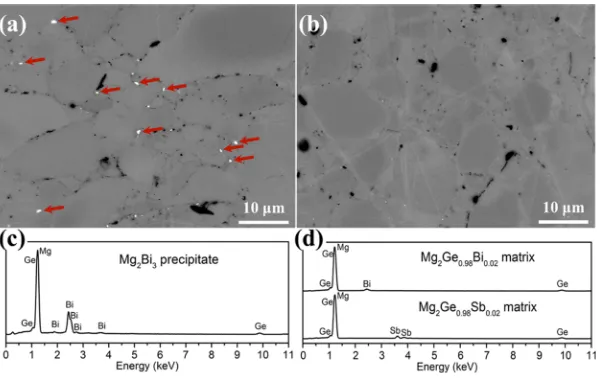
The backscattered electron microscopy (BSE) images of both Bi- and Sb-doped samples at the same dopant concentration ofx= 0.02 andy= 0.02 (0.67 at. %) confirmed the presence of precipitates with high atomic number at grain boundaries (particle size < 1 μm), which are indicated by arrows in Figure 2a, for the Bi-doped sample. The energy-dispersive spectroscopy (EDS) analysis (Figure 2c,d) reveals that these precipitates are rich in Bi, confirming the presence of the Mg2Bi3phase detected by XRD. We have also detected that
these precipitates in the Bi-doped samples are synthesized by a one-step SPS process.14 The Sb-doped sample is free of precipitates (Figure 2b).
Temperature-dependent Seebeck coefficient (S), electrical resistivity (ρ), and PF, where PF =S2/ρ, for Mg
2Ge1−xBix(x=
0.01, 0.02, and 0.03) and Mg2Ge1−ySby(y= 0.02) samples are
shown inFigure 3. All samples show a linear dependence of the Seebeck coefficient with a temperature of up to∼650 K, where it reaches a plateau (Figure 3a). Bi doping reduces the absolute
Sfrom∼210 μV/K forx= 0.01 to −190μV/K forx= 0.02, after which it remains roughly constant, showing that further addition of Bi leads to an insignificant increase in the charge carrier concentration (Table 1),n, on which the position of the Fermi level and consequently the Seebeck coefficient are dependent. This result is consistent with the observation of Bi-rich precipitates formed at grain boundaries in the x = 0.02 sample. The Sb-doped sample exhibits a lower absolute S
compared to the similarly Bi-doped samples,x= 0.02 and 0.03. The measured charge carrier concentrations of these samples are very similar (Table 1), indicating a comparable position of the Fermi level in relation to the bottom of the conduction band. According toeq 1
π
=
ℏ ⎜ ⎟ * +
⎛ ⎝
⎞ ⎠
S k T
e n m r
2
3 3 (1 )
B2 2
2/3
(1)
[image:3.625.79.279.68.229.2]wherekBis the Boltzmann constant,eis the electron charge,ℏ is the reduced Planck constant, m* is the density of states
Figure 1.Room-temperature XRD patterns of Mg2Ge1−xBix(x= 0.01,
0.02, and 0.03) and Mg2Ge1−ySby(y= 0.02) samples. The inset shows
the lattice parameter as a function of the dopant type and content, as obtained by Rietveld refinement. Trace amounts of Mg2Bi3 were
detected in the Bi-doped samples withx= 0.02 and 0.03.
Figure 2.BSE images of Mg2Ge0.98X0.02: (a) X = Bi and (b) X = Sb. Representative EDS spectra of (c) Mg2Bi3precipitates (indicated by the arrows
in (a)) and (d) Mg2Ge0.98X0.02(X = Bi and Sb).
ACS Omega Article
DOI:10.1021/acsomega.7b01389
ACS Omega2017, 2, 8069−8074
[image:3.625.164.465.540.729.2]effective mass, andris the scattering parameter.23Note that the Seebeck coefficient is proportional to m* +r
n
(1 )
2/3 . The carrier concentration values of samples doped with Bi and Sb are similar. Therefore, the difference in the Seebeck coefficient must arise from the differences in the effective mass, suggesting that Sb and Bi have different effects on the electronic band structure, as the scattering mechanism is unlikely to change between the dopants.
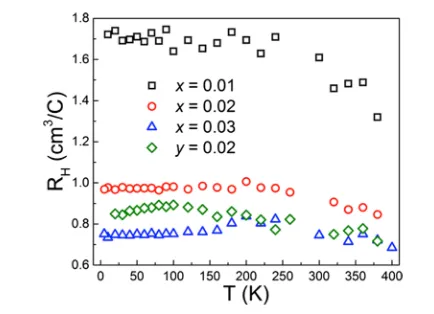
The electrical resistivity of the samples initially decreases with temperature, showing the typical behavior of intrinsic semiconductors, and exhibits metallic behavior at higher temperatures (Figure 3b). The magnitude and temperature of this behavioral change decrease with the dopant concentration, as the thermal energy needed to promote carriers to the conduction band decreases with the charge carrier concen-tration.24This effect is only visible because of the relatively low charge carrier concentrations in the current study, even atx= 0.03, as displayed inFigure 4, where a rapid decrease in the Hall
coefficient (RH) above∼200 K indicates the thermal excitation of electrons to the conduction band. The room-temperature Hall carrier mobility (Table 1),μH, has increased slightly by the
addition of Bi. This is due to very low charge carrier concentrations of lightly doped samples, which show the behavior of transport properties of the nondegenerate semi-conductor.
The stoichiometry of Mg is known to have a significant effect on the electrical characteristics of Mg-based thermoelectric materials.25 Each excess Mg atom occupies interstitial sites, contributing two electrons to the conduction band,25whereas each Mg atom vacancy acts either as a double hole donor26,27or as an electron trap localized within the band gap.28Regardless of the principle regulating Mg vacancies, Mg deficiency severely decreases the carrier concentration of n-type samples. This explains the much lower electron carrier concentration obtained in the current study, n ≈ 1018 cm−3, compared to the similarly Sb-doped Mg2Ge,13 which resulted in a room-temperature electrical resistivity of 0.195 mΩ·cm and a carrier concentration of 5.8 × 1020 cm−3 for Mg
2.2Ge0.99Sb0.01 with
excess Mg. The deficiency of Mg (z) in Mg2−zGe1−xBix and
Mg2−zGe1−ySbywas estimated using = −
×
(
)
z 1 V n x
2 4 , whereV
is the unit cell volume,nis the carrier concentration, andxis the dopant stoichiometry, and the results are displayed inTable 1. This equation estimates the Mg deficiency by considering Bi atoms and Mg vacancies as the only sources of charge carriers/ vacancies in the system, that is, assuming that there are no Mg2Bi3precipitates.
The bipolar effect is observed at temperatures above∼650 K in the Seebeck coefficient plot (Figure 3a), similar to our previous study.14 This effect is not visible on the thermal conductivity plot as a function of temperature (Figure 5a) because of the negligible bipolar component of the thermal conductivity29(κb) (Figure S1 of theSupporting Information).
The total (κtot) and lattice (κlat) thermal conductivities of the
[image:4.625.67.563.67.188.2]samples are shown in Figure 5a. The Wiedemann−Franz relation,κe=L0T/ρ, is used to calculate the electronic thermal Figure 3.Temperature dependence of the (a) Seebeck coefficient, (b) electrical resistivity, and (c) PF of Mg2Ge1−xBix(x= 0.01, 0.02, and 0.03) and
Mg2Ge1−ySby(y= 0.02).
Table 1. Room-Temperature Seebeck Coefficient, Electrical Resistivity, Hall Coefficient (RH), Carrier Concentration (n), and
Hall Mobility (μH)a
S(μV/K) ρ(mΩ·cm) RH(cm3/C) n(1018cm3) μH(cm2/V s) z
Bi = 0.01 209.6 9.9 1.54 4.1 154 0.005
Bi = 0.02 193.6 5.9 0.92 6.8 154 0.010
Bi = 0.03 194.0 4.3 0.76 8.4 172 0.015
Sb = 0.02 148.7 5.7 0.78 8.0 136 0.010
aThefinal Mg deficiency,z, in Mg
2−zGe1−xBix(x= 0.01, 0.02, and 0.03) and Mg2−zGe1−ySby(y= 0.02) was estimated based on the measured carrier
concentration.
Figure 4. Temperature dependence of the Hall coefficient for
Mg2Ge1−xBix(x= 0.01, 0.02, and 0.03) and Mg2Ge1−ySby(y= 0.02)
[image:4.625.69.286.564.721.2]conductivity, where L0 is the Lorenz number and ρ is the electrical resistivity. The Lorenz number used in the calculation ofκeis the theoretical limit for degenerate semiconductors 2.45 ×10⁻⁸V2K−2.30
The lattice and bipolar thermal conductivities of all samples are calculated by deducting the electronic contribution to the total thermal conductivity usingκtot=κlat+
κe + κb (Figure 5a inset). The lattice thermal conductivity
dominates κtot in all samples, and it decreases with the
temperature and Bi dopant concentration. Even though the charge carrier density increased slightly with the added dopant, the electronic component of the thermal conductivity is too small to significantly contribute to the total thermal conductivity.
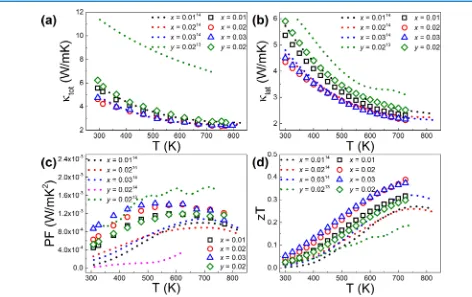
The total thermal conductivity of the samples produced in the current study is much lower than that in the previous report on heavily doped n-Mg2Ge13(Figure 6a).Figure 6b shows that
the lattice thermal conductivity in the previous report is similar to that of the Sb-doped sample in the current study, which is evidence of the significantly lower contribution of the electronic thermal conductivity, originating from the low carrier concentration of our samples. The lattice thermal conductivity of the Bi-doped samples is lower than that of the Sb-doped one owing to the increased phonon scattering by Mg2Bi3
precipitates and point defects. Moreover, the effect of the precipitates is visible in the significant decrease in the lattice thermal conductivity with the increased Bi concentration. The formation of Mg2Bi3leads to further depression of the electron
concentration by reducing the amount of available Bi, which acts as an electron donor in Mg2Ge, and by leading to the
[image:5.625.122.504.69.209.2]additional loss of Mg from the matrix. Furthermore, the low charge carrier concentration of the samples produced in this work makesκepractically negligible, representing only∼4% of Figure 5.Temperature dependence of the (a) total thermal conductivity (with the sum of the lattice and bipolar components as an inset) and (b) figure-of-merit,zT, of Mg2Ge1−xBixand Mg2Ge1−ySby.
Figure 6.Temperature dependence of the (a) total thermal conductivity, (b) lattice component of the thermal conductivity, (c) PF, and (d)fi gure-of-merit,zT, of Mg2Ge1−xBix(x= 0.01, 0.02, and 0.03) and Mg2Ge1−ySby(y= 0.02) samples from this work compared with other reports on
n-Mg2Ge.13,14
ACS Omega Article
DOI:10.1021/acsomega.7b01389
ACS Omega2017, 2, 8069−8074
[image:5.625.71.543.241.538.2]κtot, whereas in highly doped Mg2Ge, 13
it accounts for∼50%. Despite the significantly higher electrical resistivity obtained in the previous report14and in this work, when compared to the heavily Sb-doped Mg2Ge,13 our samples exhibit a similar PF
(Figure 6c). The final zT of our samples is therefore higher, owing to the reduced thermal conductivity (Figure 6d). These results suggest that studying the interaction of Bi with highzT
Mg-based thermoelectrics alloyed with Ge might be of interest to improve our understanding of their high performance and perhaps guide further improvements. To take advantage of the impact of precipitates on the thermal conductivity while maintaining low electronic resistivity, we suggest a double-doping approach with Sb and Bi.
■
CONCLUSIONSn-type Mg2Ge bulk samples doped with Bi or Sb were synthesized via a solid-state reaction and compared with previous reports on n-type Mg2Ge fabricated by different processes. Despite the attempt to compensate for the Mg loss in the current study, all samples exhibited deficiency of magnesium, heavily depressing the charge carrier concentration. Furthermore, Bi reacted with Mg to form Mg2Bi3precipitates, leading to further Mg loss and reduced doping of Mg2Ge by Bi.
This led to a high electrical resistivity, a high Seebeck coefficient, and a low lattice thermal conductivity, whereas the electronic thermal conductivity was negligible. This resulted in a maximumzT of∼0.4 at 725 K for Mg2Ge0.98Bi0.02. These
results highlight the impact of the fabrication technique on the magnesium stoichiometry in Mg-based thermoelectric com-pounds and indicate that Bi is an unsuitable dopant for Mg2Ge.
■
MATERIALS AND METHODSMagnesium turnings (Mg, Alfa Aesar, 99.98%), germanium powder (Ge, Alfa Aesar, 99.999%), bismuth powder (Bi, Alfa Aesar, 99.999%), and antimony shots (Sb, Alfa Aesar, 99.999%) were used to synthesize Mg2Ge1−xBix(x= 0.01, 0.02, and 0.03)
and Mg2Ge1−ySby (y = 0.02). Stoichiometric mixtures of elements were sealed in a boron nitride-coated vacuum-sealed quartz ampoule, with 50 wt % extra Mg to compensate for losses during the synthesis processes. The required amount of extra magnesium was optimized to obtain a single-phase compound, that is, free of unreacted Ge, as determined by the XRD analysis. This approach was necessary to directly compare the impact of different synthesis techniques on the character-istics of Mg2Ge samples with added Bi and Sb. The mixtures were reacted at 1123 K for 30 min and annealed at 673 K for 10 h. The product was hand-ground to afine powder in an agate mortar and pestle, and the resulting powders were sintered in a 12 mm graphite die using SPS at 1073 K and an axial pressure of 50 MPa for 1 h under vacuum. All material and powder handling and preparation were performed in a glovebox under a positive-pressure argon atmosphere.
The crystal structure and phase characterization were obtained with a MAC Science X-ray diffractometer with Cu Kα radiation (λ = 1.544 Å, 40 kV, 25 mA). The obtained powder XRD patterns werefitted using Rietveld refinement to estimate the lattice parameters of the synthesized samples. The microstructure and phase composition of the Mg2Ge1−xBixand
Mg2Ge1−yBiy samples were analyzed by a scanning electron microscopy (SEM; JEOL 7001F SEM) instrument, with the SEM equipped with EDS. The thermal diffusivity (D) was obtained using the laserflash method with a Linseis LFA 1000
instrument and used to calculate the thermal conductivity (κ), from κ = d·D·Cp. The density (d) was measured using
dimensions and weight of the sample, whereas the heat capacity (Cp) was obtained from the literature.8,31,32 The Seebeck
coefficient (S) and the electrical conductivity (σ) were obtained using the slope method in a quasi-steady-state mode of a Linseis LSR-3 instrument, with temperature differences between the probes of 2−10 K in the parallelepiped-shaped samples. Hall effect measurements were performed using a Physical Property Measurement System from Quantum Design from 5 to 400 K.
■
ASSOCIATED CONTENT*
S Supporting InformationThe Supporting Information is available free of charge on the
ACS Publications websiteat DOI:10.1021/acsomega.7b01389. Lattice and bipolar conductivity as a function of inverse temperature (PDF)
■
AUTHOR INFORMATIONCorresponding Author
*E-mail: [email protected](S.A.Y.). ORCID
Sima Aminorroaya Yamini: 0000-0002-2312-8272
Notes
The authors declare no competingfinancial interest.
■
ACKNOWLEDGMENTSWe would like to thank Australian Research Council (ARC) LP120200289 and ARC Discovery Early Career Award DE130100310 forfinancial support.
■
REFERENCES(1) LeBlanc, S.; Yee, S. K.; Scullin, M. L.; Dames, C.; Goodson, K. E. Material and manufacturing cost considerations for thermoelectrics.
Renewable Sustainable Energy Rev.2014,32, 313−327.
(2) Zaitsev, V. K.; Fedorov, M. I.; Eremin, I. S.; Gurieva, E. A. Thermoelectrics on the Base of Solid Solutions of Mg2BIVCompounds
(BIV=Si, Ge, Sn). InThermoelectrics Handbook: Macro to Nano; Rowe,
D. M., Ed.; CRC Press: Boca Raton, FL, USA, 2006; Chapter 29. (3) Zheng, L.; Zhang, X.; Liu, H.; Li, S.; Zhou, Z.; Lu, Q.; Zhang, J.; Zhang, F. Optimized nanostructure and thermoelectric performances of Mg2(Si0.4Sn0.6)Sbxsolid solutions by in situ nanophase generation.J. Alloys Compd.2016,671, 452−457.
(4) Mao, J.; Kim, H. S.; Shuai, J.; Liu, Z.; He, R.; Saparamadu, U.; Tian, F.; Liu, W.; Ren, Z. Thermoelectric properties of materials near the band crossing line in Mg2Sn−Mg2Ge−Mg2Si system.Acta Mater. 2016,103, 633−642.
(5) Liu, W.; Zhou, J.; Jie, Q.; Li, Y.; Kim, H. S.; Bao, J.; Chen, G.; Ren, Z. New insight into the material parameter B to understand the enhanced thermoelectric performance of Mg2Sn1−x−yGexSby. Energy Environ. Sci.2016,9, 530−539.
(6) Kutorasinski, K.; Tobola, J.; Kaprzyk, S.; Khan, A. U.; Kyratsi, T. Electronic Structure and Thermoelectric Properties of Pseudoquater-nary Mg2Si1‑x‑yGey-Based Materials.J. Electron. Mater.2014,43, 3831−
3837.
(7) Yin, K.; Su, X.; Yan, Y.; You, Y.; Zhang, Q.; Uher, C.; Kanatzidis, M. G.; Tang, X. Optimization of the Electronic Band Structure and the Lattice Thermal Conductivity of Solid Solutions According to Simple Calculations: A Canonical Example of the Mg2Si1−x−yGexSnyTernary
Solid Solution.Chem. Mater.2016,28, 5538−5548.
material Mg2Sn0.75Ge0.25for high power generation.Proc. Natl. Acad. Sci. U.S.A.2015,112, 3269−3274.
(9) Zaitsev, V. K.; Fedorov, M. I.; Gurieva, E. A.; Eremin, I. S.; Konstantinov, P. P.; Samunin, A. Y.; Vedernikov, M. V. Highly effective Mg2Si1−xSnx thermoelectrics. Phys. Rev. B: Condens. Matter Mater. Phys.2006,74, 045207.
(10) Nolas, G. S.; Wang, D.; Lin, X. Synthesis and low temperature transport properties of Mg2Ge1−ySby.Phys. Status Solidi RRL2007,1,
223−225.
(11) Tani, J.-i.; Kido, H. Lattice dynamics of Mg2Si and Mg2Ge
compounds from first-principles calculations.Comput. Mater. Sci.2008,
42, 531−536.
(12) Vlachos, N.; Hatzikraniotis, E.; Mihailescu, C. N.; Giapintzakis, J.; Kyratsi, T. The Effect of Ge on Mg2Si0.6−xSn0.4Gex Materials. J. Electron. Mater.2014,43, 3844−3851.
(13) Gao, H. L.; Zhu, T. J.; Zhao, X. B.; Deng, Y. Influence of Sb doping on thermoelectric properties of Mg2Ge materials.Intermetallics 2015,56, 33−36.
(14) Santos, R.; Nancarrow, M.; Dou, S. X.; Yamini, S. A. Thermoelectric performance of n-type Mg2Ge.Sci. Rep.2017,7, 3988.
(15) Chuang, L.; Savvides, N.; Tan, T. T.; Li, S. Thermoelectric Properties of Ag-doped Mg2Ge Thin Films Prepared by Magnetron
Sputtering.J. Electron. Mater.2009,39, 1971−1974.
(16) Polymeris, G. S.; Vlachos, N.; Khan, A. U.; Hatzikraniotis, E.; Lioutas, C. B.; Delimitis, A.; Pavlidou, E.; Paraskevopoulos, K. M.; Kyratsi, T. Nanostructure and doping stimulated phase separation in high-ZT Mg2Si0.55Sn0.4Ge0.05compounds.Acta Mater.2015,83, 285−
293.
(17) Zhang, Q.; Zheng, Y.; Su, X.; Yin, K.; Tang, X.; Uher, C. Enhanced power factor of Mg2Si0.3Sn0.7 synthesized by a
non-equilibrium rapid solidification method.Scr. Mater.2015,96, 1−4. (18) Chen, S.; Zhang, X.; Fan, W.; Yi, T.; Quach, D. V.; Bux, S.; Meng, Q.; Kauzlarich, S. M.; Munir, Z. A. One-step low temperature reactive consolidation of high purity nanocrystalline Mg2Si. J. Alloys Compd.2015,625, 251−257.
(19) Farahi, N.; Prabhudev, S.; Botton, G. A.; Zhao, J.; Tse, J. S.; Liu, Z.; Salvador, J. R.; Kleinke, H. Local structure and thermoelectric properties of Mg2Si0.977−xGexBi0.023(0.1≤x≤0.4). J. Alloys Compd. 2015,644, 249−255.
(20) Gao, H.; Zhu, T.; Liu, X.; Chen, L.; Zhao, X. Flux synthesis and thermoelectric properties of eco-friendly Sb doped Mg2Si0.5Sn0.5solid
solutions for energy harvesting.J. Mater. Chem.2011,21, 5933. (21) Zhang, L.; Xiao, P.; Shi, L.; Henkelman, G.; Goodenough, J. B.; Zhou, J. Suppressing the bipolar contribution to the thermoelectric properties of Mg2Si0.4Sn0.6by Ge substitution.J. Appl. Phys.2015,117,
155103.
(22) Tani, J.-i.; Takahashi, M.; Kido, H. First-principles calculation of impurity doping into Mg2Ge.J. Alloys Compd.2009,485, 764−768.
(23) Tang, Y.; Gibbs, Z. M.; Agapito, L. A.; Li, G.; Kim, H.-S.; Nardelli, M. B.; Curtarolo, S.; Snyder, G. J. Convergence of multi-valley bands as the electronic origin of high thermoelectric performance in CoSb3 skutterudites. Nat. Mater. 2015, 14, 1223− 1228.
(24) Chien, C. L.; Westgate, C. R.The Hall Effect and Its Applications; Springer: New York, 1980.
(25) Du, Z.; Zhu, T.; Chen, Y.; He, J.; Gao, H.; Jiang, G.; Tritt, T. M.; Zhao, X. Roles of interstitial Mg in improving thermoelectric properties of Sb-doped Mg2Si0.4Sn0.6solid solutions.J. Mater. Chem. 2012,22, 6838.
(26) Tobola, J.; Kaprzyk, S.; Scherrer, H. Mg-Vacancy-Induced Semiconducting Properties in Mg2Si1−xSbxfrom Electronic Structure
Calculations.J. Electron. Mater.2009,39, 2064−2069.
(27) Kato, A.; Yagi, T.; Fukusako, N. First-principles studies of intrinsic point defects in magnesium silicide.J. Phys.: Condens. Matter
2009,21, 205801.
(28) Zhang, L.; Xiao, P.; Shi, L.; Henkelman, G.; Goodenough, J. B.; Zhou, J. Localized Mg-vacancy states in the thermoelectric material Mg2−δSi0.4Sn0.6.J. Appl. Phys.2016,119, 085104.
(29) Zhao, L. D.; Wu, H. J.; Hao, S. Q.; Wu, C. I.; Zhou, X. Y.; Biswas, K.; He, J. Q.; Hogan, T. P.; Uher, C.; Wolverton, C.; Dravid, V. P.; Kanatzidis, M. G. All-scale hierarchical thermoelectrics: MgTe in PbTe facilitates valence band convergence and suppresses bipolar thermal transport for high performance.Energy Environ. Sci.2013,6, 3346.
(30) Rowe, D. M.Thermoelectrics Handbook: Macro to Nano, 1st ed.; CRC Press, Taylor & Francis Group: Boca Raton, FL, 2006.
(31) Bessas, D.; Simon, R. E.; Friese, K.; Koza, M.; Hermann, R. P. Lattice dynamics in intermetallic Mg2Ge and Mg2Si.J. Phys.: Condens. Matter2014,26, 485401.
(32) Wang, H.; Jin, H.; Chu, W.; Guo, Y. Thermodynamic properties of Mg2Si and Mg2Ge investigated by first principles method.J. Alloys Compd.2010,499, 68−74.
ACS Omega Article
DOI:10.1021/acsomega.7b01389
ACS Omega2017, 2, 8069−8074