Mathematics at your fingertips: Testing a finger-training
intervention to improve quantitative skills
JAY, Tim <http://orcid.org/0000-0003-4759-9543> and BETENSON, Julie
Available from Sheffield Hallam University Research Archive (SHURA) at:
http://shura.shu.ac.uk/15671/
This document is the author deposited version. You are advised to consult the
publisher's version if you wish to cite from it.
Published version
JAY, Tim and BETENSON, Julie (2017). Mathematics at your fingertips: Testing a
finger-training intervention to improve quantitative skills. Frontiers in Education, 2, p.
22.
Copyright and re-use policy
See
http://shura.shu.ac.uk/information.html
doi: 10.3389/feduc.2017.00022
Edited by: Ana Lucia Pereira, Ponta Grossa State University, Brazil
Reviewed by: Ann Dowker, University of Oxford, United Kingdom Craig Speelman, Edith Cowan University, Australia
*Correspondence: Tim Jay [email protected]
Specialty section: This article was submitted to Educational Psychology, a section of the journal Frontiers in Education Received: 13 February 2017 Accepted: 04 May 2017 Published: 07 June 2017
Citation: Jay T and Betenson J (2017) Mathematics at Your Fingertips: Testing a Finger Training Intervention to Improve Quantitative Skills. Front. Educ. 2:22. doi: 10.3389/feduc.2017.00022
Mathematics at Your Fingertips:
Testing a Finger Training intervention
to improve Quantitative skills
Tim Jay1* and Julie Betenson2
1 Shefield Hallam University, Shefield, United Kingdom, 2 University of Bristol, Bristol, United Kingdom
Previous research indicates that the use of ingers as representations of ordinal and cardinal number is an important part of young children’s mathematics learning. Further to this, some studies have shown that a inger training intervention can improve young children’s quantitative skills. In this article, we argue that ingers represent a means for children to connect different external representations of number (including verbal, sym-bolic, and non-symbolic representations). Therefore, we predicted that an intervention that combined inger training with experience playing games involving multiple representations would lead to greater increases in quantitative skills than either aspect of the intervention alone. One hundred and thirty-seven children aged between 6 and 7 years old took part in an intervention study over the course of 4 weeks. The study tested the impact of ive different conditions on participants’ quantitative skills, their inger gnosis, and their ability to compare magnitudes of two non-symbolic representations of number. Relative to a control group, those children receiving a inger training intervention saw gains in inger gnosis skills (the ability to differentiate ingers when touched, without visual cues). Those children who played number games saw an increase in their non-symbolic magnitude comparison skills. However, only those children who experienced both aspects of the intervention saw increases in quantitative skills, which were assessed using an instrument informed by Gelman and Gallistel’s (1978) ive principles of counting. The indings show that a inger training intervention, when combined with intensive exposure to multiple representations of number can support young children’s development of quantitative skills. This adds to evidence in the literature regarding the role of ingers in children’s mathematics learning and may have implications for pedagogical approaches.
Keywords: numeracy, quantitative skills, inger gnosis, intervention studies, counting
inTrODUcTiOn
2
Jay and Betenson Mathematics at Your Fingertips
Frontiers in Education | www.frontiersin.org June 2017 | Volume 2 | Article 22
representations of number to one another, thus playing a part in children’s developing quantitative skills. his article reports a study designed to test a two-part intervention, bringing together work to improve children’s coordination and sensing of their in-gers with work to improve children’s ability to translate between diferent representations of number through games. We predict that the combined intervention will be more efective in promot-ing arithmetic luency than either aspect carried out in isolation, as the beneit of inger training is to give children a more eicient means to bridge among multiple representations of number.
his section irst sets out the evidence for a relationship between inger gnosis and quantitative skills, together with some discussion of a possible theoretical framework connecting these phenomena. We then describe the intervention tested in this study, designed to support children’s developing understanding of number.
evidence for an association between
Finger gnosis and arithmetic Fluency
he majority of evidence for an association between inger gnosis and arithmetic luency is correlational, but this evidence comes from a number of studies. Fayol et al. (1998) and Marinthe et al. (2001) report that measures of inger gnosis taken at the age of 5 years are excellent predictors of numerical ability 3 years later.Noël (2005) reports that measures of inger gnosis taken when children were 6 years old predicted scores on numeracy ability, but not reading ability tests, 15 months later. he predictive power of inger gnosis for later numerical ability is generally explained with reference to the localization hypothesis or to the functional hypothesis.
Localization Hypothesis
he relationship between inger gnosis and numerical ability may simply be a result of the fact that the part of the brain that responds to number lies in close proximity to the area that is activated whenever subjects perform pointing and grasping activities. fMRI studies have provided compelling evidence of such a link between inger movements and response to number. Of the three parietal circuits described by Dehaene et al. (2003)
that relate to number sense, two are in close proximity to the area responsible for inger activity. Simon et al. (2002) note that the horizontal segment of the intraparietal sulcus area was activated both when subjects were performing mathematical tasks, and when carrying out pointing and grasping tasks. A later study by
Andres et al. (2012) analyzed fMRI scans of adult brains and also found evidence to suggest that the circuits in the brain which involve inger representation were an intrinsic component of arithmetic operations in adults.
Functional Hypothesis
Butterworth (1999) argues for a functional relationship between inger gnosis and numerical ability. Evidence for this comes from a number of sources. Butterworth (1999) refers to evolutionary evidence to suggest that our use of the base 10 system is due to the fact that we have 10 ingers. Fingers are typically used by children to support the learning and recitation of the count sequence—the ingers on the right hand used to represent the numbers one to ive, and the let to represent six to ten (Sato and Lalain, 2008).
Fingers are used as indicators of cardinal numbers (Brissiaud, 2003) and to point at objects when counting a set (Gallistel and Gelman, 1992). Alibali and DiRusso (1999) investigated the role of the ingers in counting a set of objects in more detail. hey found that when children were prevented from using their ingers when counting a set of objects, they were more likely to make errors involving a loss of coordination between number words and items counted. hus, it appears that ingers may function as a bridge between diferent mental representations of number.
Further evidence for the functional hypothesis comes from the study by Gracia-Bafalluy and Noël (2008), who carried out an intervention study to test the efect of inger training on young children’s numeracy abilities. In their study, children were trained to diferentiate between their ingers in four activities: following a colored pathway with a particular inger with a similarly colored sticker on it; pointing at particular colored circles with particular ingers; following a sequence of colors on a keyboard with the same color-coded ingers; and the inal task included performing strong grips between the thumb and each other inger on the hand. Gracia-Bafalluy and Noël showed that children who had received the inger training intervention scored more highly on measures of inger gnosis. heir results also demonstrated improvements in ordinality judgments, counting ingers, and subitizing skills that were greater than their peers who did not receive inger training.
Moeller et al. (2011) discussed two accounts of the role of inger counting; from a neurocognitive perspective, and from a mathematics education perspective. Both perspectives adhere to the functional hypothesis of inger gnosis and quantitative skills described here. However, from the neurocognitive perspective, inger-based numerical representations are integral to numerical development, while from the mathematics education perspective inger counting is oten a starting point in representing number but should be replaced with mental representations over time. he development of an intervention that encourages inger gnosis to increase quantitative skills makes sense from either perspective. However, from the neurocognitive perspective, such an interven-tion would work by developing lasting connecinterven-tions between inger representations and other symbolic and/or non-symbolic representations of number, while from a mathematics education perspective, the intervention would use inger representations to temporarily bridge between other representations so that a direct connection could be made more easily.
Development of an intervention to
improve Quantitative skills
he literature reviewed above provides support for a functional relationship between inger movements and quantitative skills. More speciically, it appears that children’s ingers may function as a bridge, or mediator, between other verbal and symbolic representa-tions of number. his leads us to posit the idea that an intervention to improve quantitative skills may be more efective if it combines inger training with other activities that involve other (verbal, symbolic, and non-symbolic) representations of number.
a simple numerical board game for four 15-min sessions, their numerical estimation abilities improved. Skwarchuk et al. (2014)
found that parental reports of children’s exposure to games at home that involve number predicted children’s performance in a non-symbolic arithmetic test. Studies such as these have not explicitly promoted inger training, although ingers are certainly used in many games. However, given that games like these generally involve children making connections between multiple representations of number (matching the number of dots on a die with a number of moves on a board, for example), they represent a promising source of activity to combine with a inger training intervention.
he motivation to research novel interventions to support young children’s numerical understanding derives from research indings showing that a secure foundation of quantitative skills is essential for children to succeed in their later mathematics learning (Jordan et al., 2003). In turn, achievement in mathemat-ics is associated with broader academic and economic success in later life (Butterworth et al., 2011). Successful interventions to support young children’s quantitative skills must account for the complexity of the thinking and learning required. Dowker (2008) has shown that individual diference in arithmetic ability is best explained with a componential model of expertise and that an intervention that addresses the particular components that a child is experiencing diiculty which has the best chance of suc-cess. However, there has, to date, been little research of potential interventions that account for possible interactions between such components. his is a potentially rich seam, as previous research has shown that such interactions are an important aspect of chil-dren’s mathematics learning (Mundy and Gilmore, 2009; LeFevre et al., 2010).
The Present Study
An intervention study was designed in order to test the hypothesis that a combined inger training and number games intervention would be efective in improving children’s quantitative skills, and more efective than either intervention alone.
he intervention designed for this study was based on those used in studies described above (particularly, Gracia-Bafalluy and Noël, 2008; Siegler and Ramani, 2008; Skwarchuk et al., 2014) and comprised the following activities.
Finger Gnosis Activities
Each session began with the teacher demonstrating, and the pupils joining in with, various inger movement activities. he content varied across sessions but included a combination of the following activities designed to improve children’s rec-ognition of the cardinal and ordinal properties of number and strengthening links between these and the visual and physical representations given by the ingers:
• Counting 1, 2, 3…, 10 and 10, 9, 8……., 1 verbally together
with representations using ingers. • Counting in 2s, 5s, and 10s with ingers.
• “Show me” activity. he teacher says “show me 7” (for exam-ple), and children show 7 ingers (using numbers 1–10). • Matching ingers from the let hand with ingers on the right
hand. “Match 3 to 7” for example, would require children to
touch the middle inger of the right hand (3) to the irst inger of the let hand (7).
• Pressing on ingers 1, 2, 3…., 10 for the same number of seconds.
• A group of counters is put in front of each pupil and they must guess how many. hen, they count using the matching inger (third inger for a set of three, for example).
• Hold up ingers to represent a calculation—show 6 + 2 = 8, or
7 – 3 = 4, for example, by raising or lowering ingers to add or
subtract from an initial set.
• Matching inger representations to a number pointed to on a number line—e.g., 34 would be 10, 10, 10, and 4 ingers. • Draw numbers 1, 2, 3, 4, 5 large, or draw maze lines from top
let to bottom right of page. Children follow numbers and mazes with diferent ingers.
Number Games Activities
Each session began with the teacher or researcher explaining and demonstrating a diferent game and the pupils playing in pairs wherever possible. he teacher and other adults in the class moved around the groups to encourage the pupils to verbalize the numbers they were seeing and to ensure that the rules of the games were understood and being followed. Diferent games were used during each session:
• Dominoes: Used for matching equal sets of dots; or for inding combinations that add to a given number.
• Playing cards: Used for “snap” game—matching same number of symbols; or for a memory game inding pairs when the cards are face-down.
• Snakes and ladders board game.
• “Smiley face” game: A counter is placed on a template of a face when the total from two dice being thrown is closer to 10, and taken away if closer to 0.
• “Shut the box”: 2 dice are thrown and pupils have to turn over any of their 1–9 cards to make the same total.
MaTerials anD MeThODs
Design
A between-groups quasi-experimental design was employed in order to compare ive diferent conditions:
• Teacher-led inger training intervention.
• Teacher-led symbolic number games intervention.
• Teacher-led inger training and symbolic number games com-bined intervention.
• Researcher-led (Julie Betenson) inger training and symbolic number games combined intervention.
• Control condition; teacher-led business-as-usual.
TaBle 1 | Five experimental groups.
school 1 school 2 school 3
class 1, 28 pupils
class 2, 23 pupils
class 3, 27 pupils
class 4, 28 pupils
class 5, 27 pupils
Teacher-led inger training and number games
Control Teacher-led inger training
Teacher-led number games
Researcher-led inger training and number games
4
Jay and Betenson Mathematics at Your Fingertips
Frontiers in Education | www.frontiersin.org June 2017 | Volume 2 | Article 22
group where both sessions were delivered by the researcher. his additional input from the researcher was designed to remind the teachers of the activities and suitable mathematical language to use during the sessions, as had been practised during the training days.
In line with previous research, we expected the inger train-ing intervention to lead to improvement in train-inger gnosis scores (Gracia-Bafalluy and Noël, 2008), and the number games inter-vention to give rise to improvements in non-symbolic arithmetic scores (Skwarchuk et al., 2014). We expected all groups bar the control group to show improvements in quantitative skills, with the highest level of improvement expected for those in the com-bined inger training and number games groups.
Participants
One hundred and thirty-seven children aged 6–7 years old took part in the study. hey were drawn from three primary schools in a city in the South of England. Other than the age of the children, no speciic criteria were used during recruitment other than an enthusiasm to take part in the research. he three schools are all larger than average sized primary schools, with pupils of similar, diverse, ethnic backgrounds. he use of three schools allowed for ive diferent classes to be randomly allocated diferent ele-ments of the intervention program in order to reduce selection bias (see Table 1).
instruments and Measures
A set of measures were taken from all participants both before and ater the intervention sessions took place, in order to assess diferent aspects of inger gnosis, symbolic number sense, and arithmetic luency.
Finger Gnosis Testing
he inger gnosis test was administered on a one-to-one basis using a task adapted from the study by Gracia-Bafalluy and Noël (2008). Each participant was asked to put their hand lat on the table inside a box so that the participant could not see their ingers. he researcher then lightly pressed the pupil’s ingers in a predetermined non-sequential order so that the pupil could say the number corresponding to the inger which had been touched. hirty trials were completed in the same manner. he same set of trials was used for each pupil in order to ensure consistency and to ensure no advantage was gained from a particular inger being pressed more oten than others. Participants’ responses were voice recorded so that they could be checked and collated ater the testing had taken place. A correct answer was scored as 1 and therefore a maximum total of 30 could be achieved on this test.
A further set of measures were combined so that they could be administered to children in groups, as a series of pencil-and-paper tests, as follows:
Quantitative Skills Tests
Number system knowledge was tested using an instrument based on the study by Gelman and Gallistel’s (1978) ive implicit principles of counting. he irst page (count) required the pupil to count numbers of objects which involved the one-to-one cor-respondence principle where “one” and “two” are assigned to each counted object, the abstraction principle which allows objects of any kind to be collected together and counted and the cardinality principle where the inal word tag deines the number of items counted. he second page (dice) involved the recognition and the adding together of regular dot arrays displayed as dice. his activity also involved the one-to one correspondence, abstraction, and cardinality principles. he third page (number) included the identiication of the larger number of two, the ordering numbers up to 102 and the placing of diferent numbers in the correct order on a number line. his was based on the stable order principle where the order of the word tags does not vary between sets of numbers. he fourth page (sequencing) involved the completion of number sequences going forwards and backwards in ones, twos, ives, and tens. his also used the stable order principle. he inal page (manipulation) involved splitting numbers into their composite parts and creating a larger number from a combina-tion of two or three smaller numbers. his incorporated the order irrelevance principle where numbers can be put together in any sequence to make a given tagged number. he test pages used both symbolic and non-symbolic representations of number and were arranged on ive diferent sheets of paper. One minute was allowed for completion of each page. A maximum score of 126 was possible on these ive pages. Although the pages tested dif-ferent aspects of counting, it was expected that there would be a strong correlation between the scores for each of the ive pages, as each incorporated the ive principles of counting. he tasks were all piloted and reined with children of the same age as the sample of this study, and in collaboration with experienced teachers.
Magnitude Comparison Test
A 1 -min paper-and-pencil test of magnitude comparison was used following a format from the study by Nosworthy et al. (2013). Pupils were given 1 min to compare 20 pairs of dot arrays and to tick the larger set of dots each pair. he diferences between the numbers of dots in each pair varied between one and six dots. he test was designed as a simple accuracy measure giving a maximum total of 20 marks.
Procedure
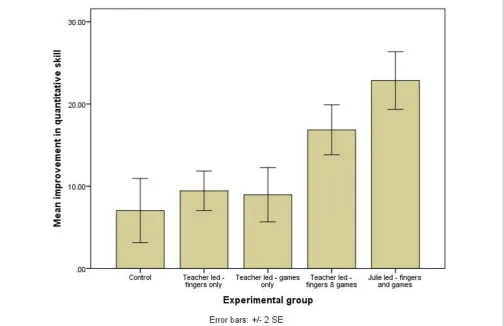
FigUre 1 | improvement in numeracy score by experimental group.
for group work. his would reduce distraction from noises within the classroom and yet to be in a space which was familiar to the students and therefore aid conidence. All tests were repeated ater the intervention sessions had been completed in March 2014.
resUlTs
analysis of Pretest Data
he set of ive tests used to measure quantitative skills showed a high level of reliability (ive items; Cronbach’s α = 0.814).
herefore, subsequent analysis used a composite “quantitative skills” score generated by adding scores from the ive components.
here was a signiicant positive correlation between inger gno-sis and quantitative skills at pretest (r = 0.33, n = 133, p < 0.0005),
in line with previous research. here were also signiicant positive correlations between quantitative skills and magnitude comparison (r = 0.37, n = 133, p < 0.0005), and between inger
gnosis and magnitude comparison (r = 0.171, n = 133, p = 0.05).
However, the correlation between inger gnosis and magnitude comparison disappeared when quantitative skills were partialed out (r = 0.058, n = 133, p = 0.511).
analysis of Posttest Data
A one-way ANOVA was used to compare improvement in quan-titative skills between the ive experimental conditions. his
revealed a signiicant efect of condition (F4, 128 = 16.71, p < 0.0005).
Post hoc tests showed that both versions of the combined intervention (teacher-led and researcher-led) led to greater improvements in quantitative skills than the other three condi-tions, which did not difer from one another (see Figure 1). he two versions of the combined intervention did not difer signiicantly from one another in terms of improvement in quantitative skills.
In order to calculate an efect size for improvement in quantita-tive skills, the two combined intervention groups were combined, and compared with the three other groups combined; Hedges’
g = 1.32, a very large efect. See Table 2 for descriptive statistics
for the combined groups.
In order to determine whether the inger training aspect of the intervention had been efective in improving inger gnosis scores, groups that received inger training were combined and compared with those that did not. Descriptive statistics can be seen in Table 3, and an independent t-test revealed a signiicant diference in improvement in inger gnosis scores (t = 2.53,
df = 131, p = 0.013).
TaBle 4 | improvement in magnitude comparison score—those that received the number games intervention compared with other groups.
condition N Mean sD se
Groups that received number games 83 3.08 4.30 0.47 Other groups combined (control, inger training only) 50 1.3 4.03 0.57
TaBle 3 | improvement in inger gnosis score—those that received inger training compared with other groups.
condition N Mean sD se
Groups that received inger training 82 1.90 4.26 0.47 Other groups combined (control, number
games only)
51 0.16 3.13 0.44
TaBle 2 | improvement in quantitative skills—combined intervention compared with other groups.
condition N Mean sD se
Combined intervention (researcher-led and teacher-led)
55 19.80 9.02 1.22
Other groups combined (control, inger training only, number games only)
78 8.56 8.11 0.92
6
Jay and Betenson Mathematics at Your Fingertips
Frontiers in Education | www.frontiersin.org June 2017 | Volume 2 | Article 22
signiicant diference in improvement in magnitude comparison scores (t = 2.38, df = 131, p = 0.019).
summary
he results show that the inger training aspect of the intervention was efective in improving participants’ inger gnosis scores, but on its own was not efective in improving scores on the quantitative skills test. Similarly, the number games aspect of the intervention was efective in improving non-symbolic magnitude comparison scores, but on its own was not suicient to improve quantitative skills. he two versions of the intervention that combined both the inger training and number games aspects were successful in improving participants’ quantitative skills relative to controls, and with a large efect size.
DiscUssiOn anD cOnclUsiOn
he indings show that the combined intervention, incorporating both inger training and symbolic number games, gave rise to signiicant improvements in participants’ numeration scores. Neither intervention alone had an efect on numeration scores. his is an important and original contribution to knowledge in this ield, as this combination of interventions has not been tested before, to our knowledge. his inding suggests that children’s developing number sense is best supported by experience of a combination of representations of number—in this case includ-ing includ-ingers plus verbal, symbolic and non-symbolic representa-tions—rather than by a particular set in isolation. Conidence in the inding is added by the fact that the intervention led by a class’s usual teacher showed a similar increase in number sense as did the group led by the researcher.
Prior to the intervention taking place, the pretest data showed a correlation between inger gnosis and number sense. his sup-ports previous indings from the study by Fayol et al. (1998) and
Andres et al. (2012). he indings do not fully corroborate the indings of Gracia-Bafalluy and Noël (2008), who found that an 8-week inger training intervention alone improved quantiica-tion skills in a sample of 6–7-year-old children (approximately the same duration and age-range as in the current study). A possible explanation for this diference is that Gracia-Bafalluy and Noël selected participants who had poor inger gnosis at the outset of their study, while the present study included participants with a full range of initial levels of inger gnosis. However, the indings presented here do agree with the main indings of Gracia-Bafalluy and Noël, in that a inger training intervention—when combined with the number gains intervention—did lead to gain in inger gnosis, and that these gains were accompanied by gains in quan-titative skills.
he indings of the present study do not fully align with those of the study by Siegler and Ramani (2008), Skwarchuk et al. (2014), and others who have found that playing games involving symbolic representations of numbers can improve children’s numerical knowledge. However, Siegler and Ramani (2008) worked with a sample of low-income children with low levels of numerical knowledge at the outset of their experiment, which again difered from the range of participants included in the present study. Again, though, in combination with the inger training, the number games intervention did lead to gains in quantitative skills.
he indings presented here suggest that for an interven-tion to be successful in increasing children’s quantitative skills—when the children are starting within the normal range of ability—then the intervention should involve a combination of number representations, rather than one particular set of representations.
Conidence in the above interpretation is added by the fact that the inger training intervention (but not the number games intervention) was shown to improve participants’ inger gnosis scores, and the number games intervention (but not the inger training intervention) was shown to improve non-symbolic magnitude comparison scores. his supports the argument that while both aspects of the intervention have a potential role to play in supporting children’s learning, it is only in combination that they can be shown to improve children’s quantitative skills. We argue that this provides evidence for the functional hypothesis, regarding the relationship between inger gnosis and quantitative skills (Butterworth, 1999), whereby ingers act as a bridge, or mediator, between other representations of number.
Multiple components of numerical
Understanding
One possibility is that the efects were additive, and only reached signiicance in combination. his is somewhat unlikely as each intervention in isolation led to levels of quantitative skills that were very close to those of the control group (Figure 1). However, although diferences were not signiicant, the mean scores of the inger training-only group and the number games-only group were higher than that of the control group, and so it is not possible to discount this possibility without replication of the current study.
A second possibility is that the combined intervention led to better results as it was more likely to match children’s particular needs. Dowker (2005, 2008) has shown that there are several components involved in children’s developing understanding of number and arithmetic and that intervention is most efec-tive when it addresses the particular component that child is experiencing diiculty with. In the case of the current study, it is possible that some children may have needed more intervention in inger gnosis and others in symbolic number manipulation or magnitude comparison.
A third possibility is that the combined intervention helped children to make connections between representations of number. his possibility follows from the functional hypothesis regarding the relationship between inger gnosis and quantitative skills. Children generally need explicit exposure to relationships between numerical phenomena or relationships in order to internalize them (Fuson, 1986). It may be that the combination of activities in the intervention helped make relationships between diferent representations of number for participating children. his hypothesis would place the current study within a growing body of work showing that children oten ind it diicult to make connections between diferent aspects of number. Goin and Ansari (2016), for example, show that children’s judgments of cardinality and ordinality of number independently predict indi-vidual diferences in arithmetic luency, and that there is a lack of relationship between them. Similarly, De Smedt et al. (2013)
noted a lack of relationship between skills in processing symbolic and non-symbolic representations of number. Further work is needed in order to determine which relationships are necessary for the development of expertise with number, and how children experience barriers and enablers for these in their learning.
limitations
Each of the ive experimental groups comprised children who normally worked together as a class. his means that there may have been unobserved intra-cluster factors that afected learning and performance. For example, children in one class could con-ceivably respond more positively or more lexibly to an interven-tion than those in another class, with another teacher. A future fully randomized study could address this issue and provide more convincing evidence for the efectiveness of the intervention.
A second limitation relates to the fact that posttests were carried out soon ater the last session of the intervention. It is
therefore not possible to know whether the gains in quantitative skills demonstrated by the two groups participating in the com-bined intervention would have persisted long enough to show an efect on a delayed test. If an intervention such as this is to be useful in a school context then it will be important to show both that gains persist and that they contribute to a more lexible foundation for further learning.
Despite the limitations of the study, we argue that it has pro-vided promising evidence that a combined inger training and number games intervention can contribute to young children’s quantitative skills and their developing mathematical under-standing. We understand that further research will be needed in order to fully determine the underlying mechanisms by which the interventions leads to gains in skill, and to add conidence in the efectiveness of the intervention, but argue that suicient evidence has been gained from this study to warrant such further work.
conclusion
his study has shown that an intervention that combines inger training with number games can improve quantitative skills among 6–7-year-old children. It supports the indings of previous research arguing for a functional relationship between inger gno-sis and numeracy. We argue that this study provides evidence that ingers represent a means for children to bridge between other (verbal, symbolic, and non-symbolic) representations of number and that this contributes to children’s developing understanding. he large efect size suggests that with further reinement and replication, the combined inger training and number games intervention could be a useful tool for teachers to use to support children’s developing understanding of number.
eThics sTaTeMenT
he study was approved by the ethics committee of the Graduate School of Education, University of Bristol. Opt-out consent was gained from all parents of children who participated. Informed consent was gained from head teachers and classroom teachers of all children who participated.
aUThOr cOnTriBUTiOns
he study reported in this article was carried out as part of Dr. Betenson’s doctoral studies at the University of Bristol, supervised by Dr. Jay. Dr. Jay adapted the article from Dr. Betenson’s thesis, carrying out a reanalysis of data and additional literature review.
FUnDing
he research reported in this article was carried out as part of the second author’s doctoral study, funded by the UK Economic and Social Research Council at the University of Bristol.
reFerences
Alibali, M., and DiRusso, A. (1999). he function of gesture in learning to count: more than keeping track. Cogn. Dev. 14, 37–56. doi:10.1016/S0885- 2014(99)80017-3
Andres, M., Michaux, N., and Pesenti, M. (2012). Common substrate for mental arithmetic and inger representation in the parietal cortex. Neuroimage 62, 1520–1528. doi:10.1016/j.neuroimage.2012.05.047
8
Jay and Betenson Mathematics at Your Fingertips
Frontiers in Education | www.frontiersin.org June 2017 | Volume 2 | Article 22
Butterworth, B., Varma, S., and Laurillard, D. (2011). Dyscalculia: from brain to education. Science 332, 1049–1053. doi:10.1126/science.1201536
De Smedt, B., Noël, M. P., Gilmore, C., and Ansari, D. (2013). he relationship between symbolic and non-symbolic numerical magnitude processing and the typical and atypical development of mathematics: a review of evidence from brain and behavior. Trends Neurosci. Educ. 2, 48–55. doi:10.1016/j. tine.2013.06.001
Dehaene, S., Piazza, M., Pinel, P., and Cohen, L. (2003). hree parietal circuits
for number processing. Cogn. Neuropsychol. 20, 487–586. doi:10.1080/
02643290244000239
Dowker, A. (2005). Individual Diferences in Arithmetic: Implications for Psychology, Neuroscience and Education. Hove: Psychology Press.
Dowker, A. (2008). Individual diferences in numerical abilities in preschoolers. Dev. Sci. 11, 650–654. doi:10.1111/j.1467-7687.2008.00713.x
Fayol, M., Barrouillet, P., and Marinthe, C. (1998). Predicting arithmetical achieve-ment from neuropsychological performance: a longitudinal study. Cognition 68, 63–70. doi:10.1016/S0010-0277(98)00046-8
Fuson, K. (1986). Roles of representation and verbalization in the teaching of multi-digit addition and subtraction. Eur. J. Psychol. Educ. 1, 35–56. doi:10.1007/ BF03172568
Gallistel, C., and Gelman, R. (1992). Preverbal and verbal counting and computa-tion. Cognition 44, 43–74. doi:10.1016/0010-0277(92)90050-R
Gelman, R., and Gallistel, C. (1978). Young Children’s Understanding of Numbers. Cambridge, MA: Harvard University Press.
Gerstmann, J. (1940). Syndrome of inger agnosia, disorientation for right and let, agraphia and acalculia: local diagnostic value. Arch. Neurol. Psychiatry 44, 398–408. doi:10.1001/archneurpsyc.1940.02280080158009
Goin, C., and Ansari, D. (2016). Beyond magnitude: judging ordinality of sym-bolic number is unrelated to magnitude comparison and independently relates to individual diferences in arithmetic. Cognition 150, 68–76. doi:10.1016/j. cognition.2016.01.018
Gracia-Bafalluy, M., and Noël, M. P. (2008). Does inger training increase young children’s numerical performance? Cortex 44, 368–375. doi:10.1016/j. cortex.2007.08.020
Jordan, N., Hanich, L., and Kaplan, D. (2003). A longitudinal study of mathematical competencies in children with speciic mathematics diiculties versus children with comorbid mathematics and reading diiculties. Child Dev. 74, 834–850. doi:10.1111/1467-8624.00571
LeFevre, J. A., Fast, L., Skwarchuk, S. L., Smith-Chant, B. L., Bisanz, J., Kamawar, D., et al. (2010). Pathways to mathematics: longitudinal predictors of performance. Child Dev. 81, 1753–1767. doi:10.1111/j.1467-8624.2010.01508.x
Marinthe, C., Fayol, M., and Barrouillet, P. (2001). “Gnosies digitales et développement des performances arithmétiques,” in Troubles du Calcul et Dyscalculies chez l’Enfant, eds A. Van Hout, C. Meljac, and J. Fischer (Paris: Masson), 239–254.
Moeller, K., Martignon, L., Wessolowski, S., Engel, J., and Nuerk, H. C. (2011). Efects of inger counting on numerical development – the opposing views of neurocognition and mathematics education. Front. Psychol. 2:328. doi:10.3389/ fpsyg.2011.00328
Mundy, E., and Gilmore, C. K. (2009). Children’s mapping between symbolic and nonsymbolic representations of number. J. Exp. Child Psychol. 103, 490–502. doi:10.1016/j.jecp.2009.02.003
Noël, M. (2005). Finger gnosia: a predictor of numerical abilities in children? Child
Neuropsychol. 11, 413–430. doi:10.1080/09297040590951550
Nosworthy, N., Bugden, S., Archibald, L., Evans, B., and Ansari, D. (2013). A two-minute paper-and-pencil test of symbolic and nonsymbolic numerical magnitude processing explains variability in primary school children’s arith-metic competence. PLoS ONE 8:e67918. doi:10.1371/journal.pone.0067918 Sato, M., and Lalain, M. (2008). On the relationship between handedness and
hand-digit mapping in inger counting. Cortex 44, 393–399. doi:10.1016/j. cortex.2007.08.005
Siegler, R. S., and Ramani, G. B. (2008). Playing linear numerical board games promotes low-income children’s numerical development. Dev. Sci. 11, 655–661. doi:10.1111/j.1467-7687.2008.00714.x
Simon, O., Mangin, J.-F., Cohen, L., Le Bihan, D., and Dehaene, S. (2002). Topographical layout of hand, eye, calculation and language related areas in the human parietal lobe. Neuron 33, 475–487. doi:10.1016/S0896-6273(02)00575-5 Skwarchuk, S. L., Sowinski, C., and LeFevre, J. A. (2014). Formal and informal home learning activities in relation to children’s early numeracy and literacy skills: the development of a home numeracy model. J. Exp. Child Psychol. 121, 63–84. doi:10.1016/j.jecp.2013.11.006
Conlict of Interest Statement: he authors declare that the research was con-ducted in the absence of any commercial or inancial relationships that could be construed as a potential conlict of interest.