Analysis of relations between spatiotemporal movement
regulation and performance of discrete actions reveals
functionality in skilled climbing
ORTH, Dominic, KERR, Graham, DAVIDS, Keith <http://orcid.org/0000-0003-1398-6123> and SEIFERT, Ludovic
Available from Sheffield Hallam University Research Archive (SHURA) at:
http://shura.shu.ac.uk/16937/
This document is the author deposited version. You are advised to consult the publisher's version if you wish to cite from it.
Published version
ORTH, Dominic, KERR, Graham, DAVIDS, Keith and SEIFERT, Ludovic (2017). Analysis of relations between spatiotemporal movement regulation and performance of discrete actions reveals functionality in skilled climbing. Frontiers in Psychology, 8 (OCT).
Copyright and re-use policy
See http://shura.shu.ac.uk/information.html
Sheffield Hallam University Research Archive
1 A review of relationships between spatiotemporal movement regulation and discrete actions for 1
revealing functionality of skilled climbing 2
Activity states and performance during climbing 3
Type: Review 4
Author List: Dominic Orth1,2, Graham Kerr2,3, Keith Davids4, Ludovic Seifert1 5
Affiliations: 6
1
CETAPS - EA 3832, Faculty of Sport Sciences, University of Rouen, France.
7 2
School of Exercise and Nutrition Science, Queensland University of Technology, Brisbane, Australia.
8
3
Movement Neuroscience Program, Institute of Health and Biomedical Innovation, Queensland
9
University of Technology, Brisbane, Australia.
10
4
Centre for Sports Engineering Research, Sheffield Hallam University, Sheffield, United Kingdom.
11
Corresponding author: 12
Ludovic SEIFERT CETAPS EA3832 Faculty of Sports Sciences, University of Rouen Normandy Boulevard Siegfried 13
76821 Mont Saint Aignan cedex, France E-mail: [email protected] Tel: (+33) 235 146 784 Fax: (+33) 14
235 147 793 15
Funding 16
This project received the support of the CPER/GRR1880 Logistic, Mobility and Numeric and funding from the 17
French National Agency of Research (reference: ANR-13-JSH2-0004 DynaMov). 18
Conflicts of Interest 19
Dominic Orth, Graham Kerr, Keith Davids and Ludovic Seifert declare that they have no conflict of interest with the 20
content of this review. Neither in terms of payment or services from a third party, influence from any funding bodies 21
or other possible relationships. No patents or copyrights are related to this work. 22
2 Abstract
24
In this review of research on climbing expertise, we focus on different measures of climbing 25
performance, including spatiotemporal measures related to fluency and activity states (i.e., 26
discrete actions), performed by climbers toward achieving the overall goal of getting to the end of 27
a route efficiently and safely. Currently a broad range of variables have been reported, however, 28
many of these fail to capture how climbers adapt to a route whilst climbing. We argue that 29
spatiotemporal measures should be considered concurrent with evaluation of activity states (such 30
as reaching or exploring) in order gain a more comprehensive picture of how climbers 31
successfully adapt to a route. Spatial and temporal movement measures taken at the hip are a 32
traditional means of assessing efficiency of climbing behaviors. More recently, performatory and 33
exploratory actions of the limbs have been used in combination with spatiotemporal indicators, 34
highlighting the influence of limb states on climbing efficiency and skill transfer. However, only 35
a few studies have attempted to combine spatiotemporal and activity state measures taken during 36
route climbing. This review brings together existing approaches for observing climbing skill at 37
outcome (i.e., spatiotemporal assessments) and limb (i.e., activity states) levels of analysis. Skill 38
level is associated with a spatially efficient route progression and lower levels of immobility. 39
However, more difficult hold architecture requires significantly greater mobility and more 40
complex movement patterning to maintain performance. Different forms of functional, or goal-41
supportive, movement variability including active recovery and hold exploration, have been 42
implicated as important adaptations to physiological and environmental dynamics that emerge 43
during the act of climbing. Indeed, recently it has also been shown that when climbing on new 44
routes, efficient exploration can improve the transfer of skill. Ultimately, this review provides 45
insight into how climbing performance and related actions can be quantified to better capture the 46
functional role of movement variability. 47
Key words: affordances, exploration, functional movement variability, rock climbing, motor 48
skill, skill transfer 49
3 1. Introduction
51
Traditionally, skilled climbing is characterized by the efficiency of spatial and temporal 52
patterns that emerge at the centre of mass (COM) during the act of climbing (Billat, Palleja, 53
Charlaix, Rizzardo, & Janel, 1995; Cordier, Dietrich, & Pailhous, 1996). Temporal assessment 54
quantifies the number and nature of stoppages relative to continuous climbing, indicating the 55
amount of time spent in isometric contraction (Billat et al., 1995; White & Olsen, 2010). Spatial 56
indicators highlight the efficiency of a climber's trajectory across the surface, estimating the 57
ability to perceive an efficient ‘pathway’ through the route (Boschker & Bakker, 2002; Cordier, 58
Mendès-France, Bolon, & Pailhous, 1993). Finally, combined spatiotemporal measures, such as 59
the minimization of jerk, globally indicate how smoothly climbing movements are linked 60
together (Seifert, Orth, et al., 2014). Importantly, evaluating performance along spatial and 61
temporal variables can address different mechanisms underpinning skilled climbing (Cordier et 62
al., 1996). For example, initial and rapid improvement in performance is believed to be primarily 63
influenced by the rapidly adapting visual-motor system (Pezzulo, Barca, Bocconi, & Borghi, 64
2010). Alternatively, a climber may improve performance by linking movements in a more 65
periodic fashion. These sorts of improvement occur over longer time-scales, such as the months 66
and years required for musculoskeletal system adaptation (Vigouroux & Quaine, 2006). 67
More recently, activity states such as reaching and grasping have been distinguished as 68
having explorative (information gathering) or performatory (body progressing) qualities, 69
providing an estimate of the intentions underpinning an individual’s actions during climbing 70
(Pijpers, Oudejans, Bakker, & Beek, 2006). For example, changing constraints, such as height 71
from the ground during climbing practice (Pijpers et al., 2006), does not physically modify 72
climbing affordances. Where climbing affordances are defined as opportunities for qualitatively 73
distinct actions that support climbing such as hold reachability, grasp-ability, stand on-ability and 74
specific climbing movements (Boschker, Bakker, & Michaels, 2002). However, increasing 75
climbing height can interact with an individual’s state. This can alter the discrete actions used 76
during climbing, but, in a transient fashion on the basis of altered intentions brought about by an 77
increased state of anxiety. In this case, an increased state of anxiety, influences intentions toward 78
information pick-up for remaining fixed to the wall, as opposed to achieving progression. Such 79
inferences of climbers intentions are generally based on behavioral data. For example, when an 80
individual reduces the distance they are willing to reach for grasping holds, or they increase their 81
use of exploratory actions, this suggests the climber is primarily concerned with stability as 82
opposed to efficient progression (Pijpers et al., 2006; Seifert, Wattebled, et al., 2014). 83
A limitation in the extant literature is that how an individual’s specific activity state can 84
influence climbing efficiency is poorly understood, and, being able to combine these measures 85
can be tremendously informative (Orth, Davids, & Seifert, 2016). Indeed, approaches that have 86
considered these variables in combination have uncovered important insights into the functional 87
or goal-supportive characteristics of movement variability (Fryer et al., 2012; Seifert, Boulanger, 88
Orth, & Davids, 2015). For instance, Pijpers et al. (2006) implied that exploratory behavior 89
reflects poor performance. Whereas, more recent studies have combined the analysis of 90
exploratory actions with spatiotemporal performance outcomes, revealing that exploratory 91
actions can be related to an improvement in performance through practice (Seifert et al., 2015). 92
Thus, this review draws together studies that have reported on performance and discrete limb 93
actions in climbing tasks to evaluate how, in combination, these can explain successful and 94
4 of the art on how spatial and temporal outcomes are used to quantify skilled climbing. Next, data 96
pertaining to activity states are considered with respect to their functionality for the individual. 97
Finally, hypotheses are presented for how activity states combined with spatial-temporal 98
outcomes can indicate specific intentions of climbers during the act of climbing. 99
2. Search methodology 100
Medline and SPORTDiscus databases were searched for published primary sources. 101
Keywords related to climbing (rock climbing, ice climbing, mountain climbing, boulder 102
climbing, artificial climbing, top-rope climbing, lead-rope climbing, mixed climbing, indoor 103
climbing, outdoor climbing, route climbing, slope climbing) were pooled (via Boolean operation 104
‘OR’) and combined (via Boolean operation ‘AND’) with keywords related to skilled behavior 105
(skill, transfer, perform, ability, expert, novice, beginner, intermediate, advanced, elite, dynamic, 106
force, kinematics, kinetics, perception, action, cognition, behavior, centre of mass, trajectory, 107
movement, movement pattern, recall, gaze, vision, coordination, motor, feet, hand, foot, grasp, 108
reach, pattern, intervention, pedagogy, feedback, constraint, coach, learn, practice, applied, train, 109
fluency, fluidity, smoothness, jerk, activity state, classification, intention, exploration, strategy) 110
and also pooled via Boolean operation ‘OR’. Results were limited to human participants, written 111
in the English language, and, Medline and SPORTDiscuss databases searched from their earliest 112
available record up to November 2016. Google Scholar was then used to scrutinize the related 113
articles and referencing studies. Reference lists were of all eligible studies were then inspected by 114
hand. 115
Articles were restricted to those written in English. Restrictions were also made on the 116
participant sample, study design and outcomes measures. Specifically, for inclusion, studies were 117
required to report sample characteristics so that ability level could be estimated such as either as, 118
beginner, intermediate, advanced, elite or upper elite (Draper, Canalejo, et al., 2011). Study 119
designs were limited to experimental or technical reports that involved climbing a surface graded 120
for difficulty (Draper, Canalejo, et al., 2011). Furthermore studies where the task goal did not, 121
implicitly or otherwise, require getting to the end of the route were excluded. For example if the 122
task required participants adopt a static posture or perform isolated reach and grasp actions, it 123
was excluded since such task constraints do not impose a route finding problem. Outcomes were 124
restricted to at least one measure to quantify spatial, temporal patterns of the COM or limbs, or, 125
activity state during actual climbing. Appraisal of article quality, was evaluated in terms of 126
potential contribution to understanding how activity states influence performance efficiency 127
along spatial-temporal measures. Eligible experiments were then identified to a standardised form 128
which was then used to extract relevant study data (see Table 1). These included, experimental 129
design, sample characteristics, interventions (including detailed characteristics of route design 130
properties), task characteristics, independent variables and levels, outcome measures, and 131
comparisons and interaction effects. 132
3. Results 133
Using the search methodology, the Medline database yielded 1099 titles and abstracts. These 134
were screened yielding 35 relevant articles, which were identified and their full texts retrieved. 135
Relevant studies were then screened using the standardized inclusion criteria and 13 eligible 136
studies identified. Using the same search methodology, the SPORTDiscsuss database was 137
searched. This yielded 2201 results, these titles and abstracts were screened, from which 59 138
5 was assessed using the standardized inclusion criteria, identifying 15 studies this way. The related 140
articles, citing articles and reference lists of 7400 eligible studies were searched using Google 141
Scholar. 94 relevant studies were subsequently identified for eligibility screening. After 142
duplicates were removed, an additional 13 eligible studies were identified this way. The article 143
search was stopped at this point. From this pool of 41 studies, 22 fulfilled the eligibility criteria. 144
These are summarised to Table 1 and discussed below. 145
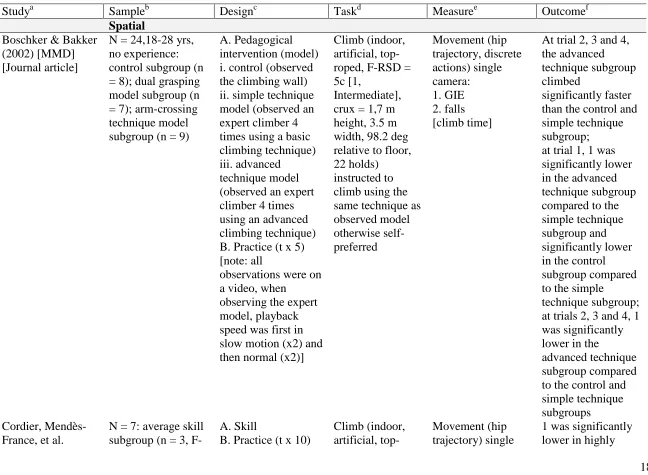
>>>Table 1 here<<< 146
4. Spatial and temporal measures of skilled adaptation to route properties in climbing 147
Data on skilled climbing behavior can reflect coordination of actions to route properties, 148
providing insights on the quality of movement adaptations. A number of studies have 149
incorporated spatial and temporal measures into a single outcome to quantify climbing fluency. 150
These have generally involved the analyses of the climbers' COM projection, to estimate velocity 151
(Cordier et al., 1996; Sibella, Frosio, Schena, & Borghese, 2007), acceleration (Cordier et al., 152
1996; Sibella et al., 2007), jerk (Seifert, Orth, et al., 2014), and phase portrait patterning (Cordier 153
et al., 1996). Among these, being very much linked to the number sub-movements used in 154
carrying out an action (Elliott et al., 2010), jerk cofficients on hip movements provides the most 155
straightforward indication of capacity to co-adapt spatial-temporal demands of performance 156
(Seifert, Orth, et al., 2014). For example, Seifert et al. (2014) calculated jerk coefficients on three 157
dimensional hip translation and rotation accelerations. Here, jerk coefficients improved with 158
practice on a route that involved use of different types of grasping techniques (overhand grasping 159
and pinch grips), compared to no significant change on a route that required use of a single type 160
of action (overhand grasping) (Seifert, Orth, et al., 2014). 161
Whilst expertise in climbing involves highly adaptive and proficient performance along 162
both spatial and temporal dimensions in combination, current understanding of skill and practice 163
effects has been primarily approached by considering each dimension separately (Cordier et al., 164
1996; Sibella et al., 2007). 165
4.1 Spatial indicators of climbing fluency 166
Spatial indicators relate to analyses of displacement on a surface. Existing approaches 167
include computation of the geometric index of entropy (GIE, see equation 1 below) (Boschker & 168
Bakker, 2002; Cordier et al., 1993; Cordier, Mendès-France, Bolon, & Pailhous, 1994; Cordier, 169
Mendès-France, Pailhous, & Bolon, 1994; Orth, Button, Davids, & Seifert, 2017; Pijpers, 170
Oudejans, Holsheimer, & Bakker, 2003; Sanchez, Boschker, & Llewellyn, 2010; Seifert et al., 171
2015; Sibella et al., 2007; Watts, Drum, Kilgas, & Phillips, 2016), climb distance (Green, Draper, 172
& Helton, 2014; Green & Helton, 2011; Seifert, Wattebled, et al., 2014; Seifert, Wattebled, et al., 173
2013), average movement distance (Nieuwenhuys, Pijpers, Oudejans, & Bakker, 2008), COM-to-174
wall distance (Zampagni, Brigadoi, Schena, Tosi, & Ivanenko, 2011), and planar displacement of 175
the COM (Zampagni et al., 2011). Interpreting the quality of displacement with respect to a route 176
is the main reason GIE has enjoyed widespread application (Boschker & Bakker, 2002; Cordier 177
et al., 1993; Cordier, Mendès-France, Bolon, et al., 1994; Cordier, Mendès-France, Pailhous, et 178
al., 1994; Pijpers et al., 2003; Sanchez et al., 2010; Seifert, Orth, Button, Brymer, & Davids, 179
2017; Sibella et al., 2007). 180
Specifically, GIE is given for a given trajectory � ∶ ⌊�,�⌋ → �3, letting ∆� be the 181
6 ∆� =� ���2+��2
�
�=1
Equation 1 183
���� =log(2∗ ∆�
)−log(∆�(�)) log(2)
Equation 2 184
According to Cordier et al. (1994) the GIE can assess the amount of fluency of a curve. 185
The higher the entropy value, the higher the irregularity of the climbing trajectory, whereas the 186
lower the entropy value, the more regular is the climbed trajectory. GIE has a number of 187
advantages over reported spatial variables, such as the average movement distance (Nieuwenhuys 188
et al., 2008), in that it is based on theoretically generalizable principles (Cordier, Mendès-France, 189
Pailhous, et al., 1994), readily interpreted with respect to climbing activity, and, is effective for 190
detecting skill (Cordier et al., 1993), practice (Cordier et al., 1993), route (Seifert et al., 2017) and 191
technique effects (Boschker & Bakker, 2002; Sibella et al., 2007). Furthermore, data collection to 192
perform an entropy calculation is highly feasible involving use of a single camera (Sanchez et al., 193
2010). Figure 1 shows how entropy is calculated (Panel A) and with respect to how changing the 194
length of an analysed trajectory with the convex hull affects outcomes. 195
In climbing tasks, entropy outcomes are particularly increased when route difficulty is 196
hard relative to the ability level of the climber, sometimes referred to as functional task difficulty 197
(Guadagnoli & Lee, 2004), and, the route has not yet been physically practiced (Cordier, 198
Mendès-France, Pailhous, et al., 1994). For example, when the functional difficulty of a route is 199
increased, by modifying the number of choices embedded into it, entropy increases even in 200
experienced climbers (Seifert et al., 2015). Practice effects have also been reported, with 201
performance after repeated practice generally converging to an asymptote level at a rate 202
dependent on the initial skill level of the climbers. Typically, the higher the initial skill level, the 203
more rapid an asymptote is reached (Cordier et al., 1993; Cordier, Mendès-France, Bolon, et al., 204
1994; Cordier, Mendès-France, Pailhous, et al., 1994). Intriguingly, Boschker and Bakker (2002) 205
found that prior knowledge about advanced inter-limb coordination patterns can improve entropy 206
in beginners, allowing them to improve performance faster through practice, see also (Seifert, 207
Coeurjolly, Hérault, Wattebled, & Davids, 2013). 208
Notably in Boschker and Bakker (2002), practice of less advanced techniques also 209
resulted in entropy values similar to those when advanced actions were used, suggesting that the 210
route designs may not have required more advanced technique for improved performance. 211
Sanchez et al. (2010) also raised the concern, that, when elite climbers were compared on routes 212
close to the limits of their ability level, no relationship between the climbers' performance GIE 213
was shown. This may have been because the climbers had not practised physically on the wall 214
before testing began, and, the difficulty was close to the climbers' ability limit (Sanchez et al., 215
2010, p. 360). Implications of these studies suggest that, through observing repeated practice, 216
larger learning effects can be expected when route difficulty is closer to a climber’s ability level 217
(Cordier et al., 1993). It is worth emphasizing, however, that these findings also indicate that in 218
7 >>Figure 1 about here<<
220
Aside from cases where task and skill interaction effects make entropy difficult to 221
interpret, the variable is limited in other ways. Currently the application of GIE is limited to a 222
single plane of analysis and important anterior-posterior plane translations (Robert, Rouard, & 223
Seifert, 2013; Russell, Zirker, & Blemker, 2012; Sibella et al., 2007; Zampagni et al., 2011) or 224
rotations around any given axis are missed (Seifert et al., 2015; Seifert, Orth, et al., 2014). Of 225
additional concern, is that if a climber is ‘blocked’ at certain points in the climb, the GIE 226
magnitude will only be influenced if there is an increase in the length of the trajectory during this 227
time. For example this can occur when postural readjustments are made. If no movement at the 228
hip occurs during a stoppage, however, GIE magnitude will not be affected (Watts et al., 2016). 229
Thus, changes in constraints, such as the use of a top-rope (a rope is secured to the top of the 230
route prior to performance) verse lead roping (where the climber needs to secure the rope to 231
multiple fixed points during climbing for safety), may not lead to significant differences in 232
entropy because they do not require a significant reorganisation of the pathway taken through the 233
route (cf. Hardy & Hutchinson, 2007). None-the-less, GIE is a highly usable method, where 234
limitations are made up for in ease of acquisition and interpretation. 235
4.2 Temporal indicators of fluency 236
Temporal measures interpreted with respect to continuity of climbing performance 237
include the: (i) relationship between static and dynamic movements at the hips (Billat et al., 1995; 238
Cordier, Mendès-France, Bolon, et al., 1994; Nieuwenhuys et al., 2008; Seifert, Wattebled, et al., 239
2014; Seifert, Wattebled, et al., 2013; White & Olsen, 2010); (ii) relationship between hold 240
grasping and moving between holds (Nieuwenhuys et al., 2008; Pijpers, Oudejans, & Bakker, 241
2005; Pijpers et al., 2006; White & Olsen, 2010); (iii) plateau duration at the hips (Seifert, 242
Wattebled, et al., 2014; Seifert, Wattebled, et al., 2013); (iv) within-route climb time (Draper, 243
Dickson, Fryer, & Blackwell, 2011; Sanchez et al., 2010; Seifert, Wattebled, et al., 2013); (v) 244
time spent in three-hold support (Sibella et al., 2007) and; (vi) movement frequency (Cordier et 245
al., 1996). 246
Quantifying the amount of time spent in different climbing-specific activity states 247
provides one of the better time based indications of the climbers adaptation to route properties. 248
For example, the degree of mobility is sensitive to local changes in the routes difficulty, including 249
crux and rest points (Sanchez et al., 2010), and can detect differences between individuals who 250
fall or complete the route (Draper, Dickson, et al., 2011). The most predominant approach to 251
estimate performance in the temporal dimension is the computation immobility to mobility ratio, 252
calculated by determining how long, with respect to the total climb time, an individual’s COM or 253
limbs remain in a stationary state relative to its moving state. 254
According to Billat et al. (1995) time spent immobile reflects time under isometric 255
contraction, subsequently incurring an energy cost. However, since depending on the nature of 256
the hand holds, this time can either increase fatigue in the finger muscles (Vigouroux & Quaine, 257
2006) or provide an opportunity to allow these muscles to recover (Sanchez, Lambert, Jones, & 258
Llewellyn, 2012a), the characteristics of the route design needs to be addressed (for an innovative 259
modelling approach see, Tosi, Ricci, Rosponi, & Schena, 2011). Indeed, it has been shown that 260
periods of immobility can reflect strategic actions with respect to demands on the physiological 261
system imposed by route design (Billat et al., 1995; White & Olsen, 2010). For example, 262
8 more or less rest while grasping a hold and immobile (Amca, Vigouroux, Aritan, & Berton, 264
2012). This is also true in terms of the overall posture that climbers can adopt. For example, 265
when sitting away from the wall with arms extended, passive forces can be exploited for 266
remaining on the wall at a reduced energy cost (Russell et al., 2012; Zampagni et al., 2011). 267
Alternatively, White and Olson (2010) also speculated that a high immobility at the hip, 268
in the case of bouldering, reflects an inability to perceive how to move through a route 269
continuously, reducing performance in the activity. Sanchez et al. (2012a) provided some 270
evidence for this argument, showing that more experienced climbers spent longer at rest locations 271
within routes when not given an opportunity to view the route from the ground. This suggesting 272
that immobility can indicate visual exploration of upcoming holds. Thus, individuals might 273
benefit from periods of immobility at the hips and longer periods of reaching because exploratory 274
actions might help to determine more effective pathways through the route (Nieuwenhuys et al., 275
2008; Sanchez et al., 2010; Seifert et al., 2015). Indeed, typically beginners show high levels of 276
immobility, suggesting a lack of effective pick-up of information for perceiving climbing 277
opportunities for route progression (Pijpers et al., 2005; Pijpers et al., 2006). 278
A key disadvantage of immobility is that classifying an individual as immobile is 279
commonly undertaken by frame-by-frame analysis of an operator. For example, criteria for 280
mobility have included statements like: “progress of the hips was observed” (Billat et al., 1995) 281
whereas, criteria for static climbing have included: “no discernible movement in pelvic girdle” 282
(White & Olsen, 2010). In an ice-climbing study, an automatic approach was taken by Seifert et 283
al. (2014) using a definition based on a movement threshold. In this case, immobility was 284
considered when, along the vertical axis, pelvis displacement was less than 0.15 m for durations 285
longer than 30 s. This approach, however, required manual digitisation of the hips and was 286
limited to analysis of vertical displacement actions of ice-climbers. Similar problems arise when 287
manually coding limb states, where a limb is determined as moving between holds (mobile) or is 288
in contact with a support surface (immobile) (Pijpers et al., 2006; White & Olsen, 2010). Thus, 289
since immobility is generally determined as the lack of displacement over time, directly using 290
velocity is a possible solution we suggest here. Specifically, for a trajectory � ∶ ⌊�,�⌋ → �3, we 291
find the thresh-hold based immobility to mobility ratio as: 292
���� =∑ �� � �=1
� 293
Equation 3 294
�� = �1,0, ������� <�ℎ���ℎ � ≥ �ℎ���ℎ
Equation 4 295
�� = ����2+��2
296
9 Of additional concern when using immobility is that the (ir)regularity in the temporal 298
dynamics of movements are not considered (Seifert, Coeurjolly, et al., 2013). For example, a 299
climber could remain immobile at single location on the wall, with the remaining climb time 300
measured as mobile. Cordier et al. (1996), addressed this concern using a spectral dimension 301
analysis of the last five practice trials (of ten) and showed that temporal movement dynamics of 302
experts were periodic, since they displayed vertical displacement of the hips at regular intervals 303
of 3 seconds. Furthermore, phase portrait analyses of each group revealed that advanced 304
individuals displayed more regular movement characteristics (stable dynamics), whereas, 305
intermediate climbers exhibited less predictable dynamics. These findings suggesting advanced 306
climbers achieved a stable ‘coupling’ between their coordination repertoire and the 307
environmental features. The temporal analyses used with reference to their GIE analysis (Cordier 308
et al., 1996; Cordier et al., 1993), showed that whilst the intermediate climbers, achieved similar 309
levels of GIE efficiency, relative to the advanced group, they still required more training to 310
improve efficient temporal dynamics. Indeed, the major limitation of spatial and temporal 311
measures is that, although they provide important information in isolation, interpreting the nature 312
of movement adaptions during climbing can be enhanced by considering these outcomes in 313
combination (Draper, Canalejo, et al., 2011; Laffaye, Collin, Levernier, & Padulo, 2014; Magiera 314
et al., 2013; Seifert, Wattebled, et al., 2013). 315
4.3 Multi-variate approaches to understanding climbing fluency 316
Thus, we now consider in more detail how combined measures of spatial-temporal 317
indicators of performance can improve interpretation of climbing behavior using exemplary data 318
(Orth, Davids, & Seifert, 2014). In Figure 2, Panel A, both immobility (using equations 3, 4 and 319
5) and GIE (equations 1 and 2) are calculated on a climbed trajectory at three sections of a 320
beginner level route (French rating scale of difficulty = 5a). It is shown that, depending on which 321
section of the route the climber is in, the relationship between GIE and immobility can be 322
inversed. Indeed, spatial and temporal properties of behavior are probably co-adapted depending 323
on the constraints on performance (Billat et al., 1995). For example, when required to use 324
complex movements, such as when using dynamic moves, a high degree of mobility is probably 325
also important. Conversely, when using less dynamic movements, a low level of mobility may 326
help maintain a degree of stability, particularly when needing to keep the COM close to the wall 327
(Fuss, Weizman, Burr, & Niegl, 2013). If co-adaptation between GIE and IMR do support 328
efficient climbing, a clear hypothesis is that immobility and movement complexity are co-adapted 329
to maintain performance in terms of smoothness or jerk (Seifert et al., 2015; Seifert, Orth, et al., 330
2014). 331
>>Figure 2 about here<< 332
An important limitation in understanding the results related to performance fluency such 333
as, Jerk, GIE and IMR, is that, without a consideration of the climbers intentions during periods 334
of immobility or increased entropy, these data may be mistakenly concluded as dysfunctional 335
(Seifert, Orth, et al., 2014). The study by Fryer and colleagues (2012) illustrates this point nicely. 336
In this study more experienced climbers exhibited a greater percentage of time spent immobile, 337
compared to less experienced individuals. After carrying out an activity analysis into the types of 338
actions undertaken during rest, it was found that the more experienced climbers were actively 339
resting during immobility, either applying chalk to their hands or shaking their hands. In this 340
example, without additional data from the activity analysis, it may have been erroneously 341
10 by the route. In actual fact, the data highlighted the climbers’ self-management of their internal 343
states, relative to their exploitation of opportunities for rest in the climbing route, an important 344
skill-dependent performance behavior (Fryer et al., 2012). This case exemplifies how interpreting 345
activity states of climbers can provide mechanistic insights of fluency measures (Seifert et al., 346
2015; Seifert, Coeurjolly, et al., 2013). 347
5. The role of activity states in climbing for understanding performance 348
It is generally assumed that the task goal corresponds to the intentions of the individual 349
where in climbing, the goals of the task are to: a) not fall; b) get to the end of a route, and; c) use 350
an efficient pathway and movement patterning that reduces prolonged pauses (Orth et al., 2016). 351
However, importantly, intentions can be influenced by skill (Rietveld & Kiverstein, 2014), which 352
are reflected in adaptations that emerge with respect to dynamic constraints (Balagué, Hristovski, 353
& Aragonés, 2012; Davids, Araújo, Seifert, & Orth, 2015). Thus, estimates of the intentions of 354
individuals during performance can help place performance outcomes more accurately in line 355
with what an individual was trying to achieve. 356
Seifert et al. (2014), for example, showed that expert ice-climbers went about achieving 357
their intentions to maintain energy and economy by focusing perception and action toward 358
specific intentions. Actions were related to the perception of information for the usability of 359
existing holes in the ice fall in so far that they tended to seek holds that did not require them to 360
swing their ice tool. In contrast, the intentions of inexperienced climbers pertained to stability, 361
where perceptions were focused on information related to the size of holes in the ice surface. In 362
this case actions were motivated for achieving deep, secure, anchorages during ascent. Indeed, 363
inexperienced climbers displayed significantly longer periods of immobility at the hips, higher 364
amounts of swinging actions prior to making a definitive anchorage with their ice-tools, and 365
tended to adopt a 'X-like' body position with the arms and legs spread out for stability. Whilst the 366
inexperienced climbers showed poor performance in terms of temporal fluency, their exploratory 367
actions were in correspondence to the intention to avoid falling. Thus, the distinction between 368
exploratory and performatory actions is fundamental to understanding climber intentions and the 369
functionality of their actions during performance and learning. 370
5.1 Performatory actions 371
According to Pijpers and colleagues (2006), performatory actions are meant to reach a 372
specific goal and include: moving a hand or foot from one hold to the next to use it as support for 373
further climbing actions (Nieuwenhuys et al., 2008; Pijpers et al., 2006; White & Olsen, 2010); 374
using a hold to move the entire body vertically or ascend the route (Sanchez et al., 2012a; Seifert, 375
Wattebled, et al., 2014; Seifert, Wattebled, et al., 2013); using a hold to support recovery actions 376
(Fryer et al., 2012; Sanchez et al., 2012a); and, making visual fixations during movement at the 377
hips (Nieuwenhuys et al., 2008). Theoretically, performatory actions correspond to actions that 378
are intended for progression. If performatory actions are effective they should improve fluency, 379
by reducing the amount of time spent immobile and contributing to ongoing progression through 380
the route. For example, a climber might skip holds, use a more difficult movement (Sibella et al., 381
2007) or use less advanced actions (Boschker & Bakker, 2002) which might result in more or less 382
fluid climbing performance. 383
5.2 Exploratory actions 384
Exploratory actions, on the other hand, are primarily information gathering movements 385
11 opportunities (i.e., affordances) can pertain to modalities such as haptic, auditory, visual and 387
kinesthetic (Seifert, Wattebled, et al., 2014; Smyth & Waller, 1998). Exploratory actions have 388
included: when climbers explore whether a hold is within reach (Pijpers et al., 2006); when a 389
hold is touched without being used as a support (Nieuwenhuys et al., 2008; Pijpers et al., 2006; 390
Sanchez et al., 2012a; Seifert, Orth, et al., 2014; Seifert, Wattebled, et al., 2014; Seifert, 391
Wattebled, et al., 2013); when an anchorage is weighted to test its fallibility (Seifert, Wattebled, 392
et al., 2014); when tools are used to swing without a definite anchorage (Seifert, Wattebled, et al., 393
2014; Seifert, Wattebled, L'Hermette, & Herault, 2011; Seifert, Wattebled, et al., 2013); and 394
when a visual fixation occur whilst an individual is immobile (Nieuwenhuys et al., 2008). When 395
exploratory indices increase, this is generally associated with poorer performance on measures of 396
fluency (Orth et al., 2016). For example, if a climber stops because they cannot perceive an 397
effective path through the route (Cordier et al., 1993; Sanchez et al., 2012a), this would be 398
associated with a higher frequency of hold exploration (Pijpers et al., 2006) and possibly an 399
increased GIE (Cordier, Mendès-France, Pailhous, et al., 1994). Furthermore, as exploration 400
reduces, fluency can improve (Seifert, Orth, et al., 2014; Seifert, Orth, Herault, & Davids, 2013), 401
suggesting an important relationship between exploration and performance improvement through 402
practice. For example Seifert et al. (2015) recently showed how exploration remained elevated 403
under transfer conditions after a period of variable practice (i.e., where each training session 404
involved practice on one of three different routes). In this study, implications were that potential 405
mechanisms underpinning the positive transfer in climbing were related to the efficient use of 406
exploration. 407
6. Variability in activity states and their functionality 408
In this final section, we explore some of the implications of linking different activity 409
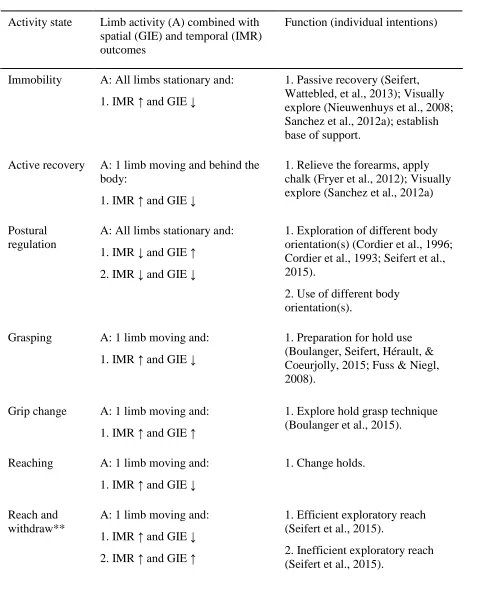
states with performance outcomes (summarized in Table 2) with predictions for future work. 410
Specifically, we attempt to explain the goals or intentions underpinning behavioral variability 411
related to both activity state and spatial-temporal measures. Indeed, a key result of this review has 412
been the identification of a broad range of activity states that have been reported in the literature 413
that appear to be important for performance during climbing. As clarified in Table 2, key activity 414
states include: immobility; postural regulation; grasping; grip change; active recovery; reaching; 415
reaching and withdrawing; traction; and, chaining movements in succession. 416
Typically, total immobility is a sign of poor performance (e.g., being ‘blocked’), however, 417
functional movement variability can be identified in efforts to visually explore (such as indicated 418
though head movements or gaze tracking tools). Postural exploration is probably particularly 419
relevant for beginners, as this may allow an individual to determine more efficient positions and 420
new body-wall orientations that may be important for more advanced movements (Seifert et al., 421
2015). Another possibility discussed, has been that the individual may benefit from immobility 422
by visually exploring upcoming holds, perhaps indicated by the amount of fixations made and 423
their relative distance to the individual during immobility (Sanchez et al., 2012a). 424
Exploration can also include reaching to touch a hold but not grasping it or using it to 425
support the body weight (Seifert et al., 2015). This is probably important for perceiving accurate 426
body-scaled actions (Pijpers, Oudejans, & Bakker, 2007). Perhaps, as different techniques, such 427
as dynamic moves (Fuss et al., 2013), become part of an individual’s action capabilities this 428
boundary of reachability may distinguish individuals of different skill levels. Making adjustments 429
in how a hold is grasped prior to using it, is also a form of exploration in terms of its ‘grasp-430
12 adjustments to how they position their hand on a hold. Such exploratory actions may be
432
important to improve the amount of friction that can be applied to the hold (Fuss et al., 2013), or, 433
enable a qualitatively different way of using the hold such as in cases where multiple edge 434
orientations are available (Seifert, Orth, et al., 2014). 435
*** Table 1 about here *** 436
Finally, It has been argued that exploration can support perception of affordances or 437
opportunities for new climbing moves (Seifert, Orth, et al., 2013). This may be observed by 438
examining how climbing actions differ through practice. For example, over repeated attempts, 439
different route pathways, body orientations or grasping patterns might be used, reflecting 440
exploration emerging during learning. Thus, during intervention the nature of learning behavior 441
in so far that it can be related to the progression toward higher levels of performance (or fluency) 442
may be better understood by evaluating the level at which exploration emerges. 443
A substantial challenge, in future research is in measuring exploration at different levels 444
of analysis with respect to performance, both, in technically manageable and theoretically 445
consistent ways (Orth et al., 2016; Schmidt, Orth, & Seifert, 2016). For instance, whilst, 446
performatory and exploratory actions are predominantly assessed by considering overt action at 447
the limbs, such characteristics are distinguishable across other levels, such as overall organization 448
of the body (Russell et al., 2012; Seifert, Dovgalecs, et al., 2014), postural regulation (Boulanger, 449
Seifert, Hérault, & Coeurjolly, 2016), visual search (Nieuwenhuys et al., 2008) and at more 450
refined levels of control at hand-hold interaction (Fuss & Niegl, 2008) and are a clear research 451
challenge for future work. 452
In particular the role of exploration for improving transfer is worth more attention. 453
Indeed, any on-sight climb (where a climber attempts to climb a route they have never physically 454
practiced) might be conceptualized as a skill transfer problem, requiring adaptations during 455
performance with unfamiliar surface properties and in contexts with dynamic environments (such 456
as outdoors). Assuming positive transfer (Carroll, Riek, & Carson, 2001; Issurin, 2013) is 457
supported by the ability to skillfully search out efficient route pathways and climbing 458
opportunities, interventions aiming to improve performance on new routes should consider the 459
functional role of exploration during practice. 460
7. Conclusion 461
This review has demonstrated the importance of relating fluency and activity measures for 462
understanding climbing actions and performance outcomes. Whilst numerous variables have been 463
reported across the extant literature, many of these fail to capture how climbers adapt to a route 464
whilst climbing. We have argued that there should be an emphasis on considering spatiotemporal 465
measures concurrent with the evaluation of climbing specific activity states. Depending on the 466
level of detail, such states can include: immobility; postural regulation; grasping; grip change; 467
active recovery; reaching; reaching and withdrawing; traction; and, chaining movements in 468
succession. In doing so, a more comprehensive picture of how climbers successfully adapt to a 469
given route can be taken. In particular, the climbers intentions should be easier to estimate. For 470
example, by combining these data, it is possible to more accurately determine if an individual is 471
stopping in order to recover or because they cannot perceive opportunities for how to progress. 472
We have also highlighted limitations in traditional performance measures (i.e., entropy and 473
13 immobility should be concurrently assessed with respect to jerk. In doing so, the efficiency with 475
which a climber is able to co-adapt movement complexity with required mobility can be 476
addressed. 477
For future research, there is a major lack of understanding for how climbers transfer their 478
skill to new routes and warrants more innovative approaches. Skill transfer is an essential part of 479
climbing and indeed physical activity and sports in general. We anticipate that more successful 480
climbers are more effective in how they explore new routes. Thus, characterizing how 481
exploration is functional to climbers, and how they learn to explore effectively, such as based on 482
practice constraints that require exploration, is a key problematic for future work. 483
14 8. References
485
Amca, A. M., Vigouroux, L., Aritan, S., & Berton, E. (2012). Effect of hold depth and grip technique on
486
maximal finger forces in rock climbing. Journal of Sports Sciences, 30(7), 669-677.
487
Balagué, N., Hristovski, R., & Aragonés, D. (2012). Nonlinear model of attention focus during
488
accumulated effort. Psychology of Sport and Exercise, 13(5), 591-597.
489
Billat, V., Palleja, P., Charlaix, T., Rizzardo, P., & Janel, N. (1995). Energy specificity of rock climbing and
490
aerobic capacity in competitive sport rock climbers. Journal of Sports Medicine and Physical
491
Fitness, 35(1), 20-24.
492
Boschker, M. S., & Bakker, F. C. (2002). Inexperienced sport climbers might perceive and utilize new
493
opportunities for action by merely observing a model. Perceptual and Motor Skills, 95(1), 3-9.
494
Boschker, M. S., Bakker, F. C., & Michaels, C. F. (2002). Memory for the functional characteristics of
495
climbing walls: Perceiving affordances. Journal of Motor Behavior, 34(1), 25-36.
496
Boulanger, J., Seifert, L., Dovgalecs, V., Herault, R., Orth, D., & Davids, K. (2014). Automatic detection of
497
climbing affordances. Paper presented at the 4th International Conference on Complex Systems
498
and Applications, France, Le Havre.
499
Boulanger, J., Seifert, L., Hérault, R., & Coeurjolly, J. F. (2015). Automatic sensor-based detection and
500
classification of climbing activities. Sensors Journal, IEEE.
501
Boulanger, J., Seifert, L., Hérault, R., & Coeurjolly, J. F. (2016). Automatic sensor-based detection and
502
classification of climbing activities. Sensors Journal, IEEE, 16(3), 742-749.
503
Carroll, T. J., Riek, S., & Carson, R. G. (2001). Neural adaptations to resistance training. Sports Medicine,
504
31(12), 829-840.
505
Cordier, P., Dietrich, G., & Pailhous, J. (1996). Harmonic analysis of a complex motor behavior. Human
506
Movement Science, 15(6), 789-807.
507
Cordier, P., Mendès-France, M., Bolon, P., & Pailhous, J. (1993). Entropy, degrees of freedom, and free
508
climbing: A thermodynamic study of a complex behavior based on trajectory analysis.
509
International Journal of Sport Psychology, 24, 370-378.
510
Cordier, P., Mendès-France, M., Bolon, P., & Pailhous, J. (1994). Thermodynamic study of motor
511
behaviour optimization. Acta Biotheoretica, 42(2-3), 187-201.
512
Cordier, P., Mendès-France, M., Pailhous, J., & Bolon, P. (1994). Entropy as a global variable of the
513
learning process. Human Movement Science, 13(6), 745-763.
514
Davids, K., Araújo, D., Seifert, L., & Orth, D. (2015). Expert performance in sport: An ecological dynamics
515
perspective In J. Baker & D. Farrow (Eds.), Routledge Handbook of Sport Expertise (pp. 130-144):
516
Routledge.
517
Davids, K., Hristovski, R., Araújo, D., Serre, N. B., Button, C., & Passos, P. (Eds.). (2014). Complex Systems
518
in Sport. London: Routledge.
519
Draper, N., Canalejo, J. C., Fryer, S., Dickson, T., Winter, D., Ellis, G., . . . North, C. (2011). Reporting
520
climbing grades and grouping categories for rock climbing. Isokinetics and Exercise Science, 19(4),
521
273-280.
522
Draper, N., Dickson, T., Fryer, S., & Blackwell, G. (2011). Performance differences for intermediate rock
523
climbers who successfully and unsuccessfully attempted an indoor sport climbing route.
524
International Journal of Performance Analysis in Sport, 11(3), 450-463.
525
Elliott, D., Hansen, S., Grierson, L. E., Lyons, J., Bennett, S. J., & Hayes, S. J. (2010). Goal-directed aiming:
526
Two components but multiple processes. Psychological bulletin, 136(6), 1023.
527
Fryer, S., Dickson, T., Draper, N., Eltom, M., Stoner, L., & Blackwell, G. (2012). The effect of technique and
528
ability on the VO2–heart rate relationship in rock climbing. Sports Technology, 5(3-4), 143-150.
529
Fuss, F. K., & Niegl, G. (2008). Instrumented climbing holds and performance analysis in sport climbing.
530
Sports Technology, 1(6), 301-313.
15
Fuss, F. K., Weizman, Y., Burr, L., & Niegl, G. (2013). Assessment of grip difficulty of a smart climbing hold
532
with increasing slope and decreasing depth. Sports Technology, 6(3), 122-129.
533
Green, A. L., Draper, N., & Helton, W. S. (2014). The impact of fear words in a secondary task on complex
534
motor performance: A dual-task climbing study. Psychological Research, 78(4), 557-565.
535
Green, A. L., & Helton, W. S. (2011). Dual-task performance during a climbing traverse. Experimental
536
Brain Research, 215, 307-313.
537
Guadagnoli, M. A., & Lee, T. D. (2004). Challenge point: a framework for conceptualizing the effects of
538
various practice conditions in motor learning. Journal of Motor Behavior, 36(2), 212-224.
539
Hardy, L., & Hutchinson, A. (2007). Effects of performance anxiety on effort and performance in rock
540
climbing: A test of processing efficiency theory. Anxiety, Stress, and Coping, 20(2), 147-161.
541
Issurin, V. B. (2013). Training transfer: Scientific background and insights for practical application. Sports
542
Medicine, 43(8), 675-694.
543
Laffaye, G., Collin, J. M., Levernier, G., & Padulo, J. (2014). Upper-limb power test in rock-climbing.
544
International Journal of Sports Medicine, 35(8), 670-675.
545
Magiera, A., Roczniok, R., Maszczyk, A., Czuba, M., Kantyka, J., & Kurek, P. (2013). The structure of
546
performance of a sport rock climber. Journal of Human Kinetics, 36(1), 107-117.
547
Nieuwenhuys, A., Pijpers, J. R., Oudejans, R. R., & Bakker, F. C. (2008). The influence of anxiety on visual
548
attention in climbing. Journal of Sport & Exercise Psychology, 30(2), 171-185.
549
Orth, D., Button, C., Davids, K., & Seifert, L. (2017). What current research tells us about skill acquisition
550
in climbing. In L. Seifert, P. Wolf, & A. Schweizer (Eds.), The Science of Climbing and
551
Mountaineering: Routledge.
552
Orth, D., Davids, K., & Seifert, L. (2014). Hold design supports learning and transfer of climbing fluency.
553
Sports Technology, 7(3-4), 159-165.
554
Orth, D., Davids, K., & Seifert, L. (2016). Coordination in climbing: effect of skill, practice and constraints
555
manipulation. Sports Medicine, 46(2), 255-268.
556
Pezzulo, G., Barca, L., Bocconi, A. L., & Borghi, A. M. (2010). When affordances climb into your mind:
557
Advantages of motor simulation in a memory task performed by novice and expert rock climbers.
558
Brain and Cognition, 73(1), 68-73.
559
Pijpers, J. R., Oudejans, R. R., & Bakker, F. C. (2005). Anxiety-induced changes in movement behaviour
560
during the execution of a complex whole-body task. The Quarterly Journal of Experimental
561
Psychology Section A, 58(3), 421-445.
562
Pijpers, J. R., Oudejans, R. R., & Bakker, F. C. (2007). Changes in the perception of action possibilities
563
while climbing to fatigue on a climbing wall. Journal of Sports Sciences, 25(1), 97-110.
564
Pijpers, J. R., Oudejans, R. R., Bakker, F. C., & Beek, P. J. (2006). The role of anxiety in perceiving and
565
realizing affordances. Ecological Psychology, 18(3), 131-161.
566
Pijpers, J. R., Oudejans, R. R., Holsheimer, F., & Bakker, F. C. (2003). Anxiety–performance relationships in
567
climbing: a process-oriented approach. Psychology of Sport and Exercise, 4(3), 283-304.
568
Rietveld, E., & Kiverstein, J. (2014). A rich landscape of affordances. Ecological Psychology, 26(4),
325-569
352.
570
Robert, T., Rouard, A., & Seifert, L. (2013). Biomechanical analysis of the strike motion in ice-climbing
571
activity. Computer methods in biomechanics and biomedical engineering, 16(sup1), 90-92.
572
Russell, S. D., Zirker, C. A., & Blemker, S. S. (2012). Computer models offer new insights into the
573
mechanics of rock climbing. Sports Technology, 5(3-4), 120-131.
574
Sanchez, X., Boschker, M. S. J., & Llewellyn, D. J. (2010). Pre-performance psychological states and
575
performance in an elite climbing competition. Scandinavian Journal of Medicine and Science in
576
Sports, 20(2), 356-363.
16
Sanchez, X., Lambert, P., Jones, G., & Llewellyn, D. J. (2012a). Efficacy of pre-ascent climbing route visual
578
inspection in indoor sport climbing. Scandinavian Journal of Medicine and Science in Sports,
579
22(1), 67-72.
580
Sanchez, X., Lambert, P., Jones, G., & Llewellyn, D. J. (2012b). Efficacy of pre-ascent climbing route visual
581
inspection in indoor sport climbing. Scandinavian Journal of Medicine and Science in Sports, 22,
582
67-72.
583
Schmidt, A., Orth, D., & Seifert, L. (2016). Collection of visual data in climbing experiments for addressing
584
the role of multi-modal exploration in motor learning efficiency. Paper presented at the In
585
International Conference on Advanced Concepts for Intelligent Vision Systems.
586
Seifert, L., Boulanger, J., Orth, D., & Davids, K. (2015). Environmental design shapes perceptual-motor
587
exploration, learning, and transfer in climbing. Frontiers in Psychology, 6, 1819.
588
Seifert, L., Coeurjolly, J. F., Hérault, R., Wattebled, L., & Davids, K. (2013). Temporal dynamics of
inter-589
limb coordination in ice climbing revealed through change-point analysis of the geodesic mean of
590
circular data. Journal of Applied Statistics, 40(11), 2317-2331.
591
Seifert, L., Dovgalecs, V., Boulanger, J., Orth, D., Hérault, R., & Davids, K. (2014). Full-body movement
592
pattern recognition in climbing. Sports Technology, 7(3-4), 166-173.
593
Seifert, L., Orth, D., Boulanger, J., Dovgalecs, V., Hérault, R., & Davids, K. (2014). Climbing skill and
594
complexity of climbing wall design: Assessment of jerk as a novel indicator of performance
595
fluency. Journal of Applied Biomechanics, 30(5), 619-625.
596
Seifert, L., Orth, D., Button, C., Brymer, E., & Davids, K. (2017). An ecological dynamics framework for the
597
acquisition of perceptual–motor skills in climbing. In F. Feletti (Ed.), Extreme Sports Medicine (pp.
598
365-382): Springer International Publishing.
599
Seifert, L., Orth, D., Herault, R., & Davids, K. (2013). Affordances and grasping action variability during
600
rock climbing In T. J. Davis, P. Passos, M. Dicks, & J. A. Weast-Knapp (Eds.), Studies in Perception
601
and Action: Seventeenth International Conference on Perception and Action (pp. 114-118). New
602
York: Psychology Press.
603
Seifert, L., Wattebled, L., Herault, R., Poizat, G., Adé, D., Gal-Petitfaux, N., & Davids, K. (2014).
604
Neurobiological degeneracy and affordance perception support functional intra-individual
605
variability of inter-limb coordination during ice climbing. PloS one, 9(2), e89865.
606
Seifert, L., Wattebled, L., L'Hermette, M., & Herault, R. (2011). Inter-limb coordination variability in ice
607
climbers of different skill level. Education, Physical Training and Sport, 1(80), 63-68.
608
Seifert, L., Wattebled, L., L’Hermette, M., Bideault, G., Herault, R., & Davids, K. (2013). Skill transfer,
609
affordances and dexterity in different climbing environments. Human Movement Science, 32(6),
610
1339-1352.
611
Sibella, F., Frosio, I., Schena, F., & Borghese, N. A. (2007). 3D analysis of the body center of mass in rock
612
climbing. Human Movement Science, 26(6), 841-852.
613
Smyth, M. M., & Waller, A. (1998). Movement imagery in rock climbing: Patterns of interference from
614
visual, spatial and kinaesthetic secondary tasks. Applied Cognitive Psychology, 12(2), 145-157.
615
Tosi, P., Ricci, L., Rosponi, A., & Schena, F. (2011). A theory of energy cost and speed of climbing. AIP
616
Advances, 1(3), 032169.
617
Vigouroux, L., & Quaine, F. (2006). Fingertip force and electromyography of finger flexor muscles during
618
a prolonged intermittent exercise in elite climbers and sedentary individuals. Journal of Sports
619
Sciences, 24(2), 181-186.
620
Watts, P. B., Drum, S. N., Kilgas, M. A., & Phillips, K. C. (2016). Geometric entropy for lead vs top-rope
621
rock climbing. International Journal of Exercise Science, 9(2), 168-174.
622
White, D. J., & Olsen, P. D. (2010). A time motion analysis of bouldering style competitive rock climbing.
623
The Journal of Strength & Conditioning Research, 24(5), 1356-1360.
17
Zampagni, M. L., Brigadoi, S., Schena, F., Tosi, P., & Ivanenko, Y. P. (2011). Idiosyncratic control of the
625
center of mass in expert climbers. Scandinavian Journal of Medicine and Science in Sports, 21(5),
626
688-699.
627
628
629
630
Figure Captions 631
Figure 1. Panel A: Exemplified is the shorter the path length within a given convex hull, the 632
lower the geometric index of entropy (GIE). Panel B: The advanced climber (blue line) shows a 633
more straight forward trajectory (and thus lower GIE) compared to the beginner (red line). Panel 634
C: By the 42nd trial (blue line), the same individual does not show blocked periods, reducing the 635
GIE. Panel D: An individual was asked to climb the same route either with the front of the body 636
remained facing the wall (red line) or with the side of the body facing the wall (blue line). The 637
more advanced technique required an increase in movement complexity. NB: All exemplary data 638
are on the same route designed with French rating scale of difficulty = 5a. m = metres. 639
640
Figure 2. The relationship between entropy and immobility as a function of wall position. Note 641
that radius of each point was scaled to increase in proportion to the duration spent in a given state 642
(thus the larger the dot, the longer the individual was in the given state of mobility (i.e., blue line) 643
or immobility (redline). c = convex hull. GIE = geometric index of entropy. IMR = immobility to 644
mobility. m = metres. 645
18 Table 1. Studies fulfilling inclusion criteria.
647
Studya Sampleb Designc Taskd Measuree Outcomef
Spatial Boschker & Bakker
(2002) [MMD] [Journal article]
N = 24,18-28 yrs, no experience: control subgroup (n = 8); dual grasping model subgroup (n = 7); arm-crossing technique model subgroup (n = 9)
A. Pedagogical intervention (model) i. control (observed the climbing wall) ii. simple technique model (observed an expert climber 4 times using a basic climbing technique) iii. advanced
technique model (observed an expert climber 4 times using an advanced climbing technique) B. Practice (t x 5) [note: all
observations were on a video, when
observing the expert model, playback speed was first in slow motion (x2) and then normal (x2)]
Climb (indoor, artificial, top-roped, F-RSD = 5c [1,
Intermediate], crux = 1,7 m height, 3.5 m width, 98.2 deg relative to floor, 22 holds) instructed to climb using the same technique as observed model otherwise self-preferred
Movement (hip trajectory, discrete actions) single camera: 1. GIE 2. falls [climb time]
At trial 2, 3 and 4, the advanced technique subgroup climbed
significantly faster than the control and simple technique subgroup; at trial 1, 1 was significantly lower in the advanced technique subgroup compared to the simple technique subgroup and significantly lower in the control subgroup compared to the simple
technique subgroup; at trials 2, 3 and 4, 1 was significantly lower in the
advanced technique subgroup compared to the control and simple technique subgroups Cordier,
Mendès-France, et al.
N = 7: average skill subgroup (n = 3,
F-A. Skill
B. Practice (t x 10)
Climb (indoor, artificial,
top-Movement (hip trajectory) single
19 (1993) [MMD]
[Journal article]
RSD = 6b-6c [1.75-2.25, Intermediate]); highly skilled subgroup (n = 4, F-RSD = 7a-7b [2.5-3, Intermediate-, Advanced])
roped, F-RSD = 6a [1.25,
Intermediate], ~10 m high) self-preferred
camera: 1. GIE 2. fractal dimensions [climb time]
skilled subgroup; 1 significantly decreased with practice in both groups;
[note: a significant interaction effect between skill and practice showed that 1 reduced faster in the higher skilled subgroup compared to the lesser skilled subgroup; a clear correlation was shown between climb time and entropy with higher climb times being associated with higher entropy] Cordier,
Mendès-France, et al. (1994) [MMD] [Journal article]
Average skill subgroup (F-RSD = 6b [1.75,
Intermediate]); highly skilled subgroup (F-RSD = 7b [3, Advanced]) [note: the exact number of
individuals making up each sub-group not reported]
A. Skill
B. Practice (t x 10)
See above, Cordier, Mendès-France, et al. (1993)
Movement (hip trajectory) single camera:
1. GIE [climb time]
Highly skilled subgroup showed less 1 compared to the average skilled subgroup;
20 [note: highly skilled subgroup reduced entropy to
asymptote by trial three whereas the average skill subgroup did not reach a clear asymptote after 10 trials of practice] Cordier,
Mendès-France, Pailhous, et al. (1994) [MMD] [Journal article]
N = 10: non-expert subgroup (n = 5, F-RSD = 6b [1.75, Intermediate]); expert subgroup (n = 5, F-RSD = 7b [3, Advanced])
A. Skill
B. Practice (t x 10)
See above, Cordier, Mendès-France, et al. (1993)
Movement (hip trajectory) single camera:
1. GIE [climb time]
Highly skilled subgroups showed overall less entropy compared to the average skilled subgroup; With practice entropy significantly reduced; Highly skilled group reduced entropy faster with practice than the average skilled group; Highly skilled group reduced entropy to
21 et al. (2003) [RM]
[Journal article] – Experiment 2
yrs, little to no experience in climbing
(height)
i. mean height of foot holds 0.3 m from the ground ii. foot holds 3.7 m from the ground
artificial, top-rope, flush vertical, 6 hand- and 5 foot-holds, 7 m height, 3.5 m width) nr
[note: difficulty assumed as easily achievable; participants practiced on route before testing; each trial required 20 sec continuous climbing]
trajectory) single camera:
1. GIE
[climb time, HR and state anxiety]
significantly increased when climbing in the high condition.
Sanchez, Boschker, et al. (2010) [IG] [Journal article]
N = 19, 24.6 yrs±4.0SD, elite climbers, F-RSD = 7b+ to 8b [3.25-4.5, Advanced-Elite]: successful subgroup (n = 9);
unsuccessful subgroup (n = 7) [note: successful subgroup
membership criteria required that the climbers get to at least the 39th hold (out of 50). Those who did not were assigned to the unsuccessful
A. Skill Climb (artificial, F-RSD = 7c+ [3.75,
Advanced]], crux = 2, rest points = 2, on-sight, 16 m high, 50
handholds) competition [preview = 5 mins]
Movement (hip trajectory) single camera:
1. GIE (section 1 crux, section 1, section 2) 2. climb time (section 1 crux, section 1, section 2) [precompetitive state anxiety] [note: 16/19 of the climbers were analyzed; for analysis the route was broken into 2 sections and 2 crux points]
2 was significantly longer in the
successful subgroup compared to the unsuccessful
22 subgroup.]
Zampagni, Brigadoi, et al. (2011) [IG] [Journal article]
N = 18 M: elite subgroup (n = 9, 32.1 yrs±7.6SD, F-RSD = 7b-8b [3-4.5, Advanced-Elite], climbing age = 13.9 yrs); no experience subgroup (n = 9, 31.9 yrs±8.5SD)
A. Skill Climbing
(artificial, top-rope, 20 holds, uniform holds = 13 cm high, 16 cm wide, 12 cm deep) under instruction [note: instructed on the sequence of which limb to reposition and to which hold, this pattern was repeated until climbers reached the top; climbers were required to complete each cycle within 4 seconds]
Movement, applied force (COM, hands and feet) mulit-camera,
instrumented holds: 1. COM
anterior/posterior and lateral motion (min, mean, max) 2. force (vertical component)
The expert
subgroup climbed with 1 significantly further from the wall and with larger lateral
displacements compared to the no experience
subgroup; 2 showed
significantly larger oscillations in the expert subgroup compared to the no experience
subgroup.
Temporal Billat, Palleja, et al.
(1995) [RM] [journal article]
N = 4, 22.2
yrs±2.3SD, F-RSD = 7b [3, Advanced], climbing age = 3 yrs
A. Hold (size) & Wall (slope) i. smaller more complex hold design ii. steeper slope [note: difficulty matched]
Climb (indoor, artificial, F-RSD = 7b [3,
Advanced], red-point, 15 m high, ~10 deg
overhang) self-preferred [note: 5 hrs
Movement (discrete actions) single camera:
1. Dynamic time (discernable motion at the hips)
2. Static time (no discernable motion at the hips)
23 practice on each
route prior to testing]
[note: additional variables of interest related to oxygen consumption]
Cordier, Mendès-France, et al. (1996) [MMD] [Journal article]
N = 10: non-expert subgroup (n = 5, F-RSD = <7a [<2.5, Intermediate]); expert subgroup (n = 5, F-RSD > 7a [>2.5, Advanced])
A. Skill
B. Practice (t x 10)
See above, Cordier, Mendès-France, et al. (1993)
Movement (hip trajectory) single camera:
1. Frequency of movement (Hz) 2. Harmonic analysis
Expert subgroup generated
approximately one movement every three seconds and were closer to the harmonic model by a factor of about two compared to the non-expert
subgroup. Draper, Dickson, et
al. (2011) [MMD] [Journal article]
N = 18, 12 M, 25.6±4.5
intermediate level, onsight lead F-RSD = 5+ [1,
Intermediate], red-point F-RSD = 6a [1.25, Intermediate] climbing age
3.6yrs±3.1
A. Route Type i. tope-rope ii. lead rope
B. Route completion i. yes (n = 11) ii. no (n = 7)
[note: group formed post hoc based on those who did or did not fall]
Climb (indoor, artificial, F-RSD = 6a, 12.5 m height, 7 quick-draws) self-preferred
Movement (climb time)
single-camera [yrs experience, NASA-TLX, CSAI-2D, oxygen
consumption, blood lactate, HR]
1. Climb time (between successive quick-draws)
Experience was the best predictor of climbing success and was also correlated with confidence and faster climbing within challenging parts of an ascent. Climbers that fell were slower through the route
White & Olsen (2010) [Journal article] [RM]
N = 6, elite, age = 28yrs±5SD, climbing age = 16yrs±5SD
Observational Climb (indoor, artificial, bouldering) competition
Movement (discrete actions)
two-cameras:
1. hand contact time