A mapping from conceptual graphs to formal concept
analysis
ANDREWS, Simon <http://orcid.org/0000-0003-2094-7456> and POLOVINA,
Simon <http://orcid.org/0000-0003-2961-6207>
Available from Sheffield Hallam University Research Archive (SHURA) at:
http://shura.shu.ac.uk/3804/
This document is the author deposited version. You are advised to consult the
publisher's version if you wish to cite from it.
Published version
ANDREWS, Simon and POLOVINA, Simon (2011). A mapping from conceptual
graphs to formal concept analysis. In: ANDREWS, Simon, POLOVINA, Simon, HILL,
Richard and AKHGAR, Babak, (eds.) Conceptual Structures for Discovering
Knowledge (The 19th International Conference on Conceptual Structures, ICCS
2011, Derby, UK. Lecture Notes in Computer Science (Subseries: Lecture Notes in
Artificial Intelligence), (6828). Berlin and Heidelberg, Springer, 63-76.
Copyright and re-use policy
See
http://shura.shu.ac.uk/information.html
Sheffield Hallam University Research Archive
A Mapping from Conceptual Graphs to Formal
Concept Analysis
Simon Andrews and Simon Polovina
Conceptual Structures Research Group Communication and Computing Research Centre Faculty of Arts, Computing, Engineering and Sciences
Sheffield Hallam University, Sheffield, UK
[email protected], [email protected]
Abstract. A straightforward mapping from Conceptual Graphs (CGs) to Formal Concept Analysis (FCA) is presented. It is shown that the benefits of FCA can be added to those of CGs, in, for example, formally reasoning about a system design. In the mapping, a formal attribute in FCA is formed by combining a CG source concept with its relation. The corresponding formal object in FCA is the corresponding CG tar-get concept. It is described how a CG, represented by triples of the form source-concept, relation, target-concept, can be transformed into a set of binary relations of the form (target-concept, source-concepta relation) creating a formal context in FCA. An algorithm for the trans-formation is presented and for which there is a software implementation. The approach is compared to that of Wille. An example is given of a simple University Transaction Model (TM) scenario that demonstrates how FCA can be applied to CGs, combining the power of each in an integrated and intuitive way.
1
Introduction
2
Motivation
At Sheffield Hallam University we have established a Conceptual Structures Research Group. One of us (Polovina) has had a long-standing interest in CGs whilst the other (Andrews) has developed an active interest in FCA. Our group has applied CGs through the Transaction Model (TM) [6]. For FCA there is our contribution to the CUBIST project (www.cubist-project.eu). One of our core interests is how we can at a practical level bring CGs and FCA together. For this purpose we took a simple TM example, namely ‘P-H University’ to illustrate the discussion that we now present [6].
3
Conceptual Graphs (CGs)
A Conceptual Graph (CG) is a bipartite graph as shown by the general form in Figure 1 and may be read as: “The relation of a Concept 1 is a Concept 2”.
Concept_2 relation
Concept_1
Fig. 1.General Form of a CG
3.1 Concepts and Relations
The direction of the arcs between a concept and a relation assist the direction of the reading. It distinguishes the source concept from the target concept. Here therefore Concept 1 is the source concept and Concept 2 the target concept. Alternatively to this ‘display’ form (produced using theCharGer CGs software, charger.sourceforge.net/), a CG may be written in the following ‘linear’ text-based form:
[Concept_1] -> (relation) -> [Concept_2]
Consider the following example:
[Transaction] -> (part) -> [Cash_Payment]
[Educational_Institution: P-H_University]
This reads as “The educational institution known as P-H University”, where P-H University is the referent of the type label Educational Institution in this concept. A concept that appears without an explicit referent has a ‘generic’ ref-erent, thereby referring to an individual that is implicit. Thus for example the concept [Transaction] simply means “A transaction” or “There is a trans-action”. It could be that the transaction has a distinct reference number e.g.
#tx1 as its referent, resulting in [Transaction: #tx1], if it conforms to that particular transaction.
4
Mapping CGs to FCA
4.1 A CG to FCA Algorithm
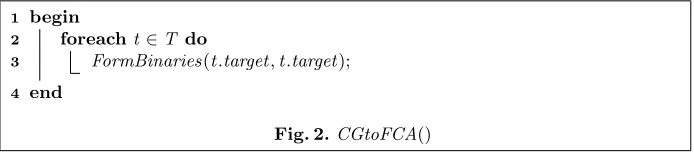
The following algorithm takes a Conceptual Graph (CG) in the form of a set of (SourceConcept,Relation,TargetConcept) triples and creates a corresponding set of binary relations of the form (TargetConcept,SourceConceptaRelation) and thereby makes an FCA formal context whose attributes are theSourceConcepta Relation parts and whose objects are the correspondingTargetConcept parts of each binary relation.
The SourceConcept, Relation and TargetConcept parts of a CG triple, t, are denoted by t.source, t.relation and t.target, respectively. I is the set of (Object,Attribute) pairs making the FCA formal context, where
t∈T ⇒(t.target,t.sourceat.relation)∈I
The mapping is transitive in that the target CG concept of one relation can become the source CG concept of another relation. This transitivity gives rise to the inference of implicit mappings:
∀t1,t2∈T •t1.target=t2.source⇒(t2.target,t1.sourceat1.relation)∈I
begin
1
foreacht∈T do
2
FormBinaries(t.target,t.target);
3
end
[image:4.612.135.482.517.594.2]4
Fig. 2.CGtoFCA()
begin
1
foreacht∈T do
2
if t.target=MovingTarget then
3
Attribute←t.sourceat.relation;
4
Object←FixedTarget;
5
I ←I∪ {(Object,Attribute)};
6
FormBinaries(FixedTarget,t.source);
7
end
[image:5.612.132.483.113.239.2]8
Fig. 3.FormBinaries(FixedTarget,MovingTarget)
MovingTarget. FixedTarget is used as a stem target concept so that inferred, transitive, binaries can be formed by backward chaining. This is achieved by setting MovingTarget to a source concept that is searched for as a target con-cept in an inferred relation.
The algorithm works by initially setting the target concept of each triple as both MovingTarget and FixedTarget and then calling FormBinaries to iterate through all triples, forming a corresponding FCA (Object,Attribute) pair each timeMovingTargetmatches the target concept of a triple. The transitive binaries are formed by recursively calling FormBinaries, setting MovingTarget to the current source concept and leavingFixedTarget unchanged.
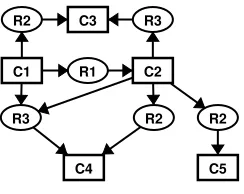
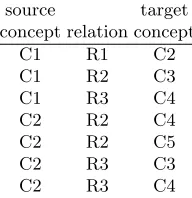
To demonstrate the algorithm (and provide a partial proof) it is applied to the simple CG example shown in Figure 4. The corresponding set of triples is given in Table 1.
R3
R3 R1
R2 C1
R2
C5 C3
C4
C2 R2
Fig. 4.A Simple Conceptual Graph
Rather than go through all of the triples in the main algorithm, for brevity it is sufficient to show the features of the algorithm by listing a sequence of steps from the call toFormBinaries fromCGtoFCAwhent ←(C2,R2,C4).
[image:5.612.248.370.446.543.2]C26=C4 t←(C1,R2,C3)
C36=C4 t←(C1,R3,C4)
C4 =C4//the target of the triple matches the moving target I ←I ∪ {(C4,C1aR3)}//add FCA (Object,Attribute)
FormBinaries(C4,C1)//the fixed target is C4, moving target is C1 t←(C1,R1,C2)
C26=C1 t←(C1,R2,C3)
C36=C1 t←(C1,R3,C4)
C46=C1 t←(C2,R2,C4)
C46=C1 t←(C2,R2,C5)
C56=C1 t←(C2,R3,C3)
C36=C1 t←(C2,R3,C4)
C46=C1
//no targets of triples match C1 //so back up one level to moving target being C4 t←(C2,R2,C4)
C4 =C4//the target of the triple matches the moving target I ←I ∪ {(C4,C2aR2)}
FormBinaries(C4,C2)//moving target is now C2 t←(C1,R1,C2)
C2 =C2//the target of the triple matches the moving target I ←I∪ {(C4,C1aR1)}
//thus adding an implied FCA binary by backward chaining FormBinaries(C4,C1)//already completed above
source target
concept relation concept
C1 R1 C2
C1 R2 C3
C1 R3 C4
C2 R2 C4
C2 R2 C5
C2 R3 C3
[image:6.612.259.355.535.634.2]C2 R3 C4
Simple CG
C1-R1 C1-R2 C1-R3 C2-R2 C2-R3 C1
C2 ×
C3 × × ×
C4 × × × ×
[image:7.612.258.359.113.210.2]C5 × ×
Fig. 5.The Corresponding Formal Context of the Simple Conceptual Graph
A small deficiency of the algorithm is that binaries associated with a tar-get concept may be generated multiple times. Each call to FormBinaries from CGtoFCA generates all binaries associated with FixedTarget, so multiple in-stances of a target concept means this will happen multiple times. An imple-mentation of the algorithm may need to take this into account (by removing repeated binaries after generation, for example). However, in practical terms, multiple instances of a binary only means that a ‘cross’ is entered into a table cell multiple times.
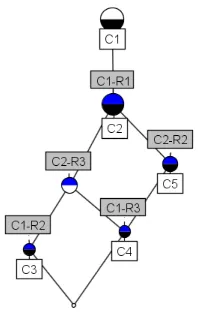
Fig. 6.The Corresponding Concept Lattice for the Simple Conceptual Graph
[image:7.612.262.361.385.543.2]CG) and reporting them to the user. It may then be useful for the author of the CG to consider how desirable the cycles are in their design.
The resulting binaries generated from the simple CG triples are shown as a cross-table (FCA context) in Figure 5 and hence as an FCA concept lattice in Figure 6. Using well known notions from FCA, a number of observations can be made:
– C1 is not a target CG concept of any relation.
– C1−R1 is the relation with the most results (four):C2,C5,C4 andC3. – C4 results from the most relations (four):C1−R1,C2−R3,C2−R2 and
C1−R3.
5
A Simple University Scenario Example
We now specify the example. It is a simple case study that is discussed exten-sively elsewhere to demonstrate the Transaction Model (TM) [6]. Essentially the case study is about P-H University, which is a fictional higher education insti-tution. The University is not primarily a profit-making institution; rather it has to remain financially sound whilst recognising its community objectives. Key to these objectives are its research activities. P-H University thereby needs to ex-plicate the relationship between its research and its community objectives. 40% of its staff are emerging researchers that receive time off for research instead of revenue-generating activities (e.g. teaching), added to which there is a diversion of revenue to give the established researchers’ time to support their emerging colleagues. In financial terms these items represent a ‘cost’ to the University for which there is no corresponding revenue. Yet the financial cost saving from not investing in the emerging research staff’s psychical stimulation would un-dermine the very purpose of the university in meeting its community objectives. To achieve the correct balance, P-H University turns to the TM. The TM shows that psychical stimulation and motivated staff are balanced with its financial obligations to sustain the University’s existence.
5.1 The CG for the example
P-H University’s TM is given by Figure 7. From the TM modelled in CG for P-H University we can observe the following:
1. The University’s TM reveals its validity through the costs being balanced by the benefits to the university achieving its community objectives. As Community Objective refers to communitites, in CG it is shown as the plural referent{*cmtobj}.
Transaction Psychical_Stimulation source part Cash_Payment Established_Researcher’s_Time Community Emerging_Researcher’s_Time Revenue_Diversion event_subject Motivated_Staff event_subject part Community_Objective: {*cmtobj} event_subject Educational_Institution: P-H_University realise Staff: {*stf}@40% destination destination source part source
Fig. 7.CG of P-H University Scenario
P-H University’s TM
T ransaction part Established Researc her’s Time source Psyc hical Stim ulation ev en t sub ject Rev en ue Div ersion ev en t sub ject Cash P a ymen t ev en t sub ject Motiv ated Staff realise Emerging Researc her’s Time destination Established Researc her’s Time destination Comm unit y Ob jectiv e: { *cm tob j } destination Comm unit y Ob jectiv e: { *cm tob j } source Emerging R esearc her’s Time source
Staff:{*stf}@40% × × × × ×
Educational Institution: P-H University × × × × × × × ×
Community Objective:{*} × × ×
Motivated Staff × ×
Revenue Diversion ×
Emerging Researcher’s Time × ×
Community × × × ×
Established Researcher’s Time × ×
Cash Payment ×
Psychical Stimulation ×
Transaction
[image:9.612.155.458.294.631.2]3. The TM shows that Cash Payment and Revenue Diversion versus Psychical Stimulation are the two complementary sets of economic events that trigger the transaction.
4. The event subject relations (i.e. the states altered by the economic events) point to the relevant economic resources that in this case are the researchers’ time and staff motivation.
5. The source and destination relations (i.e. providers and recipients) of the economic resources are the agents in the transaction. These are the educa-tional institution P-H University and the agents it transacts with, namely its staff and the community it serves.
6. The{*stf}@40%describes a plural of staff, specialised by the@40% thereby denoting the 40% of staff that are supported by emerging researchers time. 7. Motivated Staff is an economic resource of the University in that they add
value to the assets of the University by being motivated.
5.2 CGtoFCA
Using a software implementation of the CGtoFCAalgorithm (CGFCA, source-forge.net /projects/cgfca/), and displaying the result using the Concept Explorer software (sourceforge.net/projects/conexp/), Figure 9 shows the FCA lattice for P-H University’s TM in CG as shown by Figure 7. The formal context table is given by Figure 8.
As described earlier the CG source concept concatenated with its relation be-come formal attributes in FCA and the CG target concept bebe-comes a formal ob-ject. Thus for example [Emerging_Researcher’s_Time]a(destination) be-comes the formal attribute Emerging_Researcher’s_Time destination and
[Educational_Institution: P-H_University]becomes the formal object
Educational_Institution: P-H_University.
From the lattice for P-H University we can observe the following:
1. A node’s own attribute(s) and its own objects follow the triple structure of CGs i.e. source concept→relation→target concept. For example:
TheCash Payment event subjectis Emerging Researcher’s Timeand
Motivated Staff realise Community Objective: {*cmtobj}
2. The formal attributes and objects of a concept automatically ‘collect’ the the dependencies in the CG. For example:
Communityis dependent onCommunity Objective: {*cmtobj} source,
Motivated Staff realise, Psychical Stimulation event subject and
Transaction part.
3. The dependencies culminate in Transaction.
5.3 An Integrated, Interoperable Conceptual Structure
Fig. 9.Concept Lattice of P-H University Scenario
which is the epitome of the TM. In simple termsallthe objects further down from
Transaction part describe the extent of the transaction; without which the transaction cannot exist and the lattice shows the hierarchical interdependencies of the CG concepts and their relations. The direction of the arcs of the CGs model are preserved in the FCA lattice. As for each concept’s referent, they too are preserved in exactly the same way as they appear in the CG.
As the inherent nature of CGs are preserved inCGtoFCA, CGs operations such as conformity, projection and maximal join can still be performed and iterated with those of FCA (e.g. attribute exploration). Thus to give one simple scenario, P-H University could model its TM in CGs, exploring the dimensions of its model through such CG operations. UsingCGtoFCAit could simultaneously translate that TM into an FCA lattice and bring the power of FCA to bear on its TM too. Any enhancements that FCA identified could be translated back into CGs. Models could then be round-tripped between FCA and CGs. Put simply, throughCGtoFCAwe have merged CGs and FCA into asingleandinteroperable conceptual structure that provides a superset of operations by combining those of CGs with FCA.
5.4 An Enhanced TM
contract_party
contract_party
Transaction Psychical_Stimulation
source part
Cash_Payment
Established_Researcher’s_Time
Community Emerging_Researcher’s_Time
Revenue_Diversion
event_subject
Motivated_Staff event_subject
part
Community_Objective: {*cmtobj} event_subject
Educational_Institution: P-H_University
realise
Staff: {*stf}@40% destination
destination contract_party
source part
[image:12.612.136.483.127.289.2]source
Fig. 10.CG of P-H University Scenario v2
[image:12.612.135.481.356.610.2]to it via its arcs and relations in that TM, there are none pointing from[Staff:
{*stf}@40%] or [Community]. There should be some explicit relationship that points from these ‘outside’ agents in this transaction to P-H University, which is the ‘inside’ agent given it is P-H University’s TM. Each of these outside agents is a contract party to P-H University. It therefore joins the following CG to its TM:
[Educational_Institution: P-H_University]-(contract_party)<-[Staff: {*stf}@40%] (contract_party)<-[Community]
The result is the CG TM Figure 10 and the lattice Figure 11. In comparison with Figure 9 we can now observe that the extent of the bottommost concept in Figure 11 is P-H University with the contract party relations duly added in the description of its attributes. Additionally, all the concepts contain own objects. This reveals that all the key concepts have been identified in both the CGs TM and the lattice TM; it transpires that there should not be a formal concept without at least one own attribute and at least one own object. Though such a simple change, it was not obvious in the previous work on the TM using CGs alone [6].
5.5 Wille’s CG to FCA Approach
To evaluate the comparative value ofCGtoFCA, the P-H University’s TM in CG as originally depicted by Figure 9 was also converted into an FCA formal context and concept lattice based on the translation given by Wille [7]. Wille remarks that CGs capture knowledge at the logical level and FCA adds mathematical rigour, terming it as the ‘mathematization’ of conceptual structures. We have seen an illustration of the enhancement that FCA brings through the P-H Uni-versity scenario. It is therefore particularly interesting to peruse Wille’s own translation between CGs and FCA. The results according to Wille’s translation are shown by Figures 12 and 13 respectively.
As described in the introduction and shown by these figures, Wille’s transla-tion essentially takes the referents of CG concepts, as aggregated by the relatransla-tion that links the concepts. The resulting aggregated referents are then presented as formal objects with their formal attributes as the given relation. This is followed by the source and target concept’s type label. As we have seen, the source type label is given the index ‘1’ and the target is indexed as ‘2’. In line with Wille’s translation for each object we have had also to give the referents an explicit identifier e.g.(#tx1,#cp1)to support the attributespart,Transaction 1and
Cash Payment 2.
P-H University’s TM part ev en t sub ject
source destination realise Transaction
1 Cash P a ymen t 1 Cash P a ymen t 2 Emerging Researc hers Time 1 Emerging Researc hers Time 2 Educational Institution 2 Rev en ue Div ersion 1 Rev en ue Div ersion 2 Established Researc hers Time 1 Established Researc hers Time 2 Staff 2 Psyc hical Stim ulation 1 Psyc hical Stim ulation 2 Motiv ated Staff 1 Motiv ated Staff 2 Comm unit y Ob jectiv e 1 Comm unit y Ob jectiv e 2 Comm unit y 2
(#tx1,#cp1) × × ×
(#tx1,#ps1) × × ×
(#tx1,#rd1) × × ×
(#cp1,#emrt1) × × ×
(#rd1,#esrt1) × × ×
(#ps1,#ms1) × × ×
(#emrt1,P-H University) × × ×
(#esrt1,P-H University) × × ×
(#ms1,{*cmtyobj}) × × ×
({*cmtyobj},#cmty1) × × ×
(#emrt1,#esrt1,{*stf}@40%) × × × ×
[image:14.612.134.482.138.421.2]({*ctmyobj},P-H University) × × ×
Fig. 12.Formal Context of P-H University Scenario after Wille
[image:14.612.137.483.496.603.2]into the underlying CGs, it can be argued that this approach leads on the one hand to lists of object pairs that share the same relation but on the other hand lead to rather more complex lattices that show a hierarchy of separated out CG source and target concepts and relations. This is evidenced by the outcomes demonstrated by Figures 12 and 13 for P-H University. The elegant interdepen-dence and simpler lattices as shown in Figure 9 is not as easily discerned and the insight that lead to Figure 11 is not evident. Notably, Transaction as the key concept in the TM is not at the head of the lattice. For the TM it is the relationship of other concepts to the Transaction concept that is the nub of the TM as we have seen.
6
Conclusions
We have demonstratedCGtoFCAas a straightforward mapping from Conceptual Graphs (CGs) to Formal Concept Analysis (FCA). CGs and FCA can thus interoperate in a practical way, combining their power in an integrated and intuitive conceptual structure. The simple case study (P-H University) has shown an enhancement to the Transaction Model (TM) modelled in CGs alone. It thus illustrates the benefits of CGtoFCA, which will spur the wider development of conceptual structures’ and their practical applications.
References
1. Dau, F., Klinger, J. (2005). “From Formal Concept Analysis to Contextual Logic” Lecture Notes in Computer Science 3626, Berlin: Springer. pp. 81-100.
2. Delugach, H., Lampkin, B. (2000). “Troika: Using Grids, Lattices and Graphs in Knowledge Acquisition”. In:Working with Conceptual Structures: Contributions to ICCS 2000, G. Stumme, Ed. Aachen, Germany: Shaker Verlag, pp. 201-214. 3. Ganter, B., Rudolph, S (2001). “Formal Concept Analysis Methods for Dynamic
Conceptual Graphs”. In: H. Delugach and G. Stumme (Eds.): ICCS 2001, LNAI 2120. Springer-Verlag Berlin Heidelberg. pp. 143-156.
4. Kuznetsov, S. O. (1999). “Learning of Simple Conceptual Graphs from Positive and Negative Examples”, Lecture Notes in Computer Science 1704, Berlin: Springer. pp. 384-391.
5. Mineau, G., Stumme, G., Wille, R. (1999) “Conceptual Structures Represented by Conceptual Graphs and Formal Concept Analysis”, inConceptual Structures: Stan-dards and Practices, Tepfenhart, W., Cyre, W. (Eds.), Lecture Notes in Computer Science 1640, Springer Berlin / Heidelberg. pp. 423-441.
6. Polovina, S., Hill, R. (2009) “A Transactions Pattern for Structuring Unstructured Corporate Information in Enterprise Applications”,International Journal of Intel-ligent Information Technologies, April-June 2009, Vol. 5, No. 2, IGI Publishing, 34-47.