Department of Computer Science, University of Canterbury,
Honours Project, Paul J. Commons, October 1983.
A
DATABASE DESIGN
FOR THE
INDEX
Report Outline.
[1] Introduction.
[2] Description of Project Objectives and Design steps.
[3] Definition of MED Power Supply Network. [3.1] Substations.
[3.1.1] Substation Types. [3.2] Underground Cables.
[3.3] Overhead Lines. [3.4] Transformers.
[3.5] High Voltage Switchgear. [3.5.1] Circuit Breakers. [3.5.2]
[3.5.3] [3.5.4]
Switching Mechanism.
High Voltage Switchgear Function. All Insulated Units.
Page
1 3
5 5 6 6
7
8 9 10
11 11 12
[3.6] Miscellaneous Equipment. 13
[3.6.1] Pilot Cables. 13
[3.6.2] Voltage and Auxiliary Transformers. 13
[3.6.3] Relays. 14
[3.7] MED System Diagram. 14
[4] Analysis of Existing Information Systems. [4.1] Domain of Information Systems.
15 15 [4.1.1] Substation Division Transformer Cards. 16
[4.1.3] Planning Division Substation-Transformers
File. 18
[4.2] The Formation of a Data Dictionary. [4.2.1] Data Dictionary Definition. [4.2.2] Data Dictionary Construction
[5] Design of a Model representing Physical Equipment relationships.
[5.1] Elements. [5.2] Nodes. [5.3] Branches.
[5.4] Relationships.
[5.4.1] Node Identification. [5.4.2] Branch Identification. [5.4.3] Element·Identification.
[6] Data Analysis.
[6.1] Identification of Information Entities. [6.2] Identification of Primary Keys.
20 20 21
23 24 24 25 26 27
28 29
30 30 31 [6.3] Determination of Inter-Entity relationships. 32 [6.4] Normalisation of Derived Relations. 33
[6.4.1] First Normal Form. [6.4.2] Second Normal Form. . [6.4.3] Third Normal Form.
[6.4.4] Derived Relations. [6.5] The Conceptual Model.
[7] Database Implementation.
[7.1] Purpose of Implementation.
33 34 34 35 35
[8]
(9]
[7.2] Implementation Method.
[7.2.1] Data Model Chosen.
[7.2.2] Database Management System Chosen. [7.2.3] Relations Mapped.
[7.2.4] Network Area Implemented. [7.2.5] Query Program.
[7.3] Design Strengths and Weaknesses. [7.3.1] MED Appraisal.
[7.3.2] Strengths.
[7.3.3] Criticisms.
The future of the Database. [8.1] Design Appraisal. [ 8 . 2] Size of Database.
[8.3] Future Hardware/Software Requirements.
List of References.
37 37 38 38 39 39
40 40 40
41
44
44 45 45
Appendices.
(i) Examples of present system documentation.
(ii) Data Dictionary.
(iii) Data analysis document.
(iv) The Conceptual Model.
(v) MIMER table definitions and listings.
[1] INTRODUCTION
During the 1981-82 summer vacation, I worked for the Christchurch Municipal Electricity Department (MED) developing and implementing a vehicle information system. During this period, Chris Axford, MED Staff Planning Engineer, first presented me with the problems involved in the design of a future MED Engineering Database.
The MED operates a complex electricity supply network about which it is necessary to maintain a vast quantity of technical information for operational, maintenance and planning purposes. Many small manual information systems in the forms of cards,maps, books etc. presently exist within the engineering divisions. These systems are often inaccessible and they lack co-ordination,
flexibility and accuracy.
A well designed centralised computer database would not suffer from these limitations. Such a system would provide for any user a common pool of accurate and up to date information accessible on a straightforward and systematic basis. Engineering studies, statistical surveys and reports that are at present very hard to obtain could be produced with relative ease.
configuration. The complexity and vastness inherent in the design of the proposed database makes this design an ideal problem for an Honours Project.
[2] OUTLINE OF PROJECT OBJECTIVES AND DESIGN STEPS.
Overall objective: The formulation and testing of a database design upon which a future database
implementation could be based.
This project is the first formal study of the described problem. It is intended to provide an initial design foundation from which further database development can proceed. Eventually efforts following this 'watershed' study will lead to a working database system.
Much early effort concentrated in the obtaining a complete understanding of the MED problem - its scope and terminology. This involved an informal study of MED operations and interviews with approximately 10 staff members.
Once this initial knowledge had been obtained a set of logical design steps was formulated:
(1) An analysis of existing information systems.
(2) The development of a model to represent physical equipment relationships.
(3a) Data analysis.
(3b) The construction of a 'conceptual' database model.
Each of these steps is a clearly defined design task. These design 'building blocks' are sequenced in a logical practical order ,the successful completion of each step allowed work to proceed to the next design phase. The completion of each design step also meant the satisfying of a project objective~ The four outlined design steps are documented in Chapters [4] to [7] of this project report.
Other project objectives which were not design steps:
(5) A suggested outline of steps towards future database implementation (Chapter 8).
[3] DEFINITION OF THE MED POWER SUPPLY NETWORK.
Before any discussion of database design details can begin, a brief description of the MED power supply network is necessary.
The Christchurch MED distributes electricity to its consumers via a complex supply network comprising some 2000 substations, 2000 km of underground cable and 1200 km of overhead line. A description of each of these three main network components is useful.
[3.1] Substations.
Concentrations of supply equipment are housed in substations situated throughout Christchurch. Installed equipment includes busbars, circuit breakers, isolating switches and transformers together with associated devices for operation, maintenance and protection.
Substations are the central focus Information concerning equipment substation location as a primary
[3.1.1] Substation types.
There are various types of substations ranging from buildings (district and network substations) to small sheet steel kiosks and simple pole mounted transformers. A kiosk substation usually contains a few units of magnefix switchgear and a small transformer. District substations contain large 55-tonne transformers and approximately 30 circuit breakers plus a whole range of
equipment. installed
auxiliary, control, protection and Often a concentration of supply within an independent building such
communication equipment is as a bank or school. This equipment concentration is also referred to as a substation.
Cables and lines ~unning between substations link together the equipment they contain.
[3.2] Underground Cables.
IGSo
SUBSTATION
I BOO
APPRO..:.
l
1
1375
- '2.\% ~\
~o\.1~'01>.1\0'"
Pictori'ally:
Substation: o
Individual Cable length: Cable Joint:
Substation 'A'
Substation 'B'
® -~®·--~~~~ o Substation 'C'
,~,,
~~~~-®
~
,~~
'Thru' Jointt
~'Tee'
Joint
Thus an underground cable leaving a substation may, via a series of lengths and joints, provide an electrical connection to equipment housed in many other substations. There is a clear functional difference between the two types of cable joint, this distinction is important and is discussed further later.
The MED drawing office maintains detailed records concerning the lengths, sizes and types of cables laid as well as the position of 'tee' and 'thru' joints.
[3.3] Overhead Lines
complicated webs of linked lines are a feature of the supply network.
To enable portions of the network to be isolated for operational and maintenance reasons high voltage overhead lines are equipped with isolators, reclosers and sectionalisers. Isolators are operated manually and reclosers open automatically upon the detection of fault current and then attempt a set number of reclosures to deal with transient faults. Sectionalisers usually operate in conjunction with and 'downstream' of reclosers to isolate progressive segments of the network during a fault. These items of equipment are physically installed between two lengths of line.
Line:
Substation
[3.4] Transformers.
Recloser (or isolator, sectionaliser)
The network which the proposed database will represent includes the routing of power from the incoming 66 kV feeders to the final transformation of power to 400V within local substations.
Transformers convert power initially from 66 kV to 11 kV. These large transformers are typically housed at district substations. llkV power is routed to 'network' substations, which are usually only supplied power from one district substation. Provision is made for an alternative supp~ing district substation in emergency situations.
Network substations, inturn, route power to secondary, smaller substations ,usually kiosk or pole mounted substations. These low-level substations contain only a transformer which converts power from the incoming 11 kV to 400 volts, which is the voltage suitable for street supply. Physically linked to each transformer is a 'low voltage panel'. These panels divert power to different street destinations (low voltage circuits). The low voltage panel represents the outermost supply point at which the database inclusion of network equipment finishes.
[3.5] High Voltage Switchgear.
providing switching on a single circuit.
Single switching units may be installed together on busbars to provide switching for a number of outgoing circuits. This configuration is used
to copper incoming and in district substations where rows of circuit breakers are commonly connected via a busbar.
[3.5.1] Circuit Breakers.
A circuit breaker is often connected to an underground cable and via a series of cable lengths and joins an electricial connection exists to another substation(s) from the circuit breaker.
Expressing this by
a
diagram:Circuit breaker 0
Cable Length: Cable Joint: Busbar:
~
11
~
2~
2
tr
I!3
~---·
-[
3 4
Circuit breaker 2 of substation A is connected to circuit breaker 3 of substation B. This electricial connection comprises four lengths of underground cable and three cable 'thru' joints. The above diagram represents a typical connection between a district substation and a network substation. Circuit breakers are also connected to overhead lines, transformers, all insulated units (description later) and other busbars.
[3.5.2] Switching Mechanism.
An incoming cable linked to a circuit breaker supplies power to a busbar. This power is diverted to different network destinations via bus bar circuit breakers linked to outgoing circuits. Each circuit breaker provides a link to a concentration of network equipment. In turn, a row of these devices are linked together via a common busbar. Thus this configuration provides a mechanism for the routing of power
throughout the network.
[3.5.3] High Voltage Switchgear Functions.
A circuit breaker will open, breaking an electricial circuit upon overload current or a fault. The most expensive switching device, it can be remotely operated.
-Fuse switches, as the name suggests, are an electricial switch which contain a powder fuse. When a circuit overload or fault occurs the fuse blows, averting considerable damage to network equipment.
An oil switch does not have this tripping feature. It is simply an electricial switch enclosed in oil. The isolation of the switch in oil enables safer operation of the switch.
Circuit breakers, oil switches functionally different devices but are the network.
[3.5.4] All Insulated Units.
and fuse configured
switches are similarly in
[3.6] Miscellaneous Equipment.
[3.6.1] Pilot Cables.
To provide communication links between different points on the network, 'pilot' cables have been laid. These pilot cables are used for communication purposes only, they are very different to the power cables described earlier. Wherever a reference to cables is made in this report the reference concerns power cables; all references to pilot cables are stated explicitly.
Pilot cables consist of several paired wires, and pilot cables are connected to pilot boxes within substations. Pilot cable circuits are installed for purposes such as telephone communication ,network monitoring and remote control, etc.
[3.6.2] Voltage and Auxiliary Transformers.
[3.6.3] Relays.
Relays are devices which perform network protection, monitoring and control functions. At district substations each circuit breaker has a relay associated with it.
[3.7] MED System Diagram.
Included as figure(l) is one page of the MED system diagram. This is prepared monthly by the MED drawing office. This page shows the network configuration for the Dallington area of Christchurch. More than twenty of such pages represent the entire network.
FIGURE(l) THE SYSTEM DIAGRAM.
KEY
Underground Cable:
Overhead Line:
Transformer:
Tee Joint:
Isolator:
Recloser:
Kiosk (Transformer and Switchgear): ~
Kiosk (Switchgear only): ~)
Pole Mounted Substation: (~
Building:
Building (Transformer and Switchgear): ~
Building (Switchgear only) :
0
Busbar with CBs(or FSs, OSs):
;
M'INTYRE SJ.,. ·I~Al.
~
~ AKAROA
~ ST
.----+--,
OLIVINE
~
TROON
PL.@--!'} SHIRLEY
~I*
t--<Xi--1-S[""""l~~ROCK · . . _ ~ ~'I,_;V ONAWE
r-
-1-ISALI
'2."(' 0 PL @ I
t - - C < H - . . AMOS
PL ALMA\~
~
IHEWLIN~S PL O• Sf SABINA
Ill 5J....
WHITEHALL
ST "3·15 . JS
KINGSfOII.D
sr@...
GOLF LINKS RD •104
ORCADE~ ...,
ST
MAR5HlAIID RD •zo
==1=..1
L
HOR~ESHOE
LAK£ll
I...( 9 RD KING:OLEA L...---. C 9~~~~Lt... ~- -1---e-·;;z~s ... =:::=:\<d~L-111 ~ ~~E~H;>i ~~~~~
ACHESON GOLF LINKS r;. L-...{S)-
-. r-:::-.
RD SOUTH (X}.-...::!:_-4---t---- CRESSWELL >.DE BLO(;'E '0'-PL ~
LAKE rftRIICE
R0*30
flHTE I'""
~ .
~~-~
.
c ~ ... :zI"-" ..., ____ I ~j;Cc"y AV • ~
~>,HILLS
0 n.,_ - - - - -~9Zi~==
Ill"
orR\lDCKSI_EY'< >'1tD•282. ORONTES ~ - ~ AV• 257
c
~ I
:1: I I I I
~~ I I
EMMETI ST NEW &RIGI!lllN HOPE ~
ST N O ~D WOOLWORTHS C ~ "sr _.f'.?!
L . a - -.c
SHIRLEY NEW BRIGKTON
IIJTfRM~IATf t ~ HERSTCUL;: W.
.,, I "'" I w., 1-z
'<Y I;::;:AWA~ ";;
-®--- ST
DALLINGTON
WESTCOTTI
~~ I
""'
I... ~
EMMETI r..t\
~ s. r---o ~ - --::x..>o--~
>-::li
1-w
I
~
.,
I
"' ,._
~t I
~t; I
·15 % w
I
<I)~
- o I
0 AILSA ST
____ ,
1 __ """"j....:. 2;,;;;5_....!.___r-;-.;..,....j I REH.EAl
v <.,_,..f-- ~}
<.,;~ ~ CABLES
_ , ______ ....;;z.,>~ 3 ~N~~o
. . . , _ ---""""2:;,;;5~~ GOlF LIPW.S
- f - - P-0 s IJ>jJT ll
- 1 - NEWBRIGHTO' S •Z.S
~D >~'Ill f - - -o
SP~GHT
©
1 - 6:::~i
I
WAR.DEN (~ 7X
A-B BS.~
i
HILL~ ,_ 5T Ill!'- NORTH • ZS" - 8 AVERILLI .., ~ •217 ~ F""' PAR~D£ ST UNIT IG
0 I - F""' STAPLETON' MARIAN GA~HURST f----q- . 25"
~ I RD N. ~ ~ AD if-15"2 ~
W ~ sr• ~-44 ~ ~~ TEPJ\I'LE II ·;<~
VJ 0 R~~ u
STRAT HFltl D AV
GAVHUI\\iT RD * 172.
1-
---~: UI'.J!AOOES WOOLOVILLE J/AA~ST~~":cTON 0 . . . . _ - ·25" ~ ~gl~ ~N-~~~·-533
~ \ r- . . _ . - AVERILL 5T -~ 12 [.,l~Lts
w:
Eft-
N <....__~ LOCAl_/,. GAYHURST:r I (;:,~~~~grE ~, ME~r' ©-I- ~~r RIPPLAY RD N2152
~: r-,. - I • 14~~LB-C B.S
~ : r.\X'EWflRI
H-
NOPJH p~e1r.. I" 15 .._ ~• .J I rD • 2.43. ,__ ~~ SHIRLEY BOIS~ 9"""'- ,, " I~ ~ f - - n.c.
Z 1 . - -~-~ •r• ,.._, IG CABLt:S
:::> r'>. .___ , >.sTAPLETON_s 1 (>..- I"' ~
::=
1-.-... 1 ~ HILLS RD ~ ~ Ro ~ 96
v:><
11 GAYHuRsr. .
~ : GRE~fDRD NQ 130. ~ F""" r - - -I•
t-""
-I- ~ ~WILNGTDN RD. 62. ....ns
VJ : OLIDLEY ·!>AL ~
19
MAR?HlAIID Q .J,..._!--~ I ;; t> I ""' ST :g
ti
IIJl 0/H .,c..L-.. ___ ,.W I ~ ~ ll.itl.s O '25 ?J.J c- D B S [
!z I fill' • 66 ·Ob .r.. 9 ·5 AI. - f-AVERII L _jD
~I
r
.b
Y~
0
RJ.o't
~
51 UNIT2\1-
~-~
VJ : _ ~ M1~ALL ~ 2.2. -
-i:; I rr.~CT ~
~ I ~TAPLETONS ..,..I:~~YSHL 9 TZ o ~~ M'BRATNEYS
cr
I
Ro. s1
lp. sr•7 cABLEs ~r--> Ro ,.79~
i
01~_~_
c ...1-<
L~
I
BANKS L...r:."'' CHEAM~LANDY
;:: II HILLS • ~- ~ NORRTDH AVON ZS [7" D-A ~5 AV ~ -::- ST
~ ;;{ I I I "'
())
L.i RO - 8 sl~N~~& xr}:-~~==-~~:---~
"-"
...J I WOODCHE"STER HOME.
©>--II
-"'="' :J.1D I
1
GAYHURST BIRCHFIELD1
!':'5 : RD !1. ,n AV Ill ~ i
j I SNELL PL HALBEI. ST I
-« L __ --- - - - --~- _j
[4] ANALYSIS OF EXISTING SYSTEMS.
Numerous scattered information systems presently exist within the MED engineering divisions. Mostly manual in operation, the majority were developed many years ago and today rely on the knowledge of long-serving staff ·members. The initial design phase involved detailed examination of the existing systems. This analysis involved the collection of system documents, interviews with staff members and the observation of working systems. It was aimed at determining the function and information content of these systems.
The future database must replace the majority of the functions performed by the existing systems. It appears that some present system functions are only performed because of historical reasons. The examination of current systems for inclusion in the centralised database has exposed some archaic features which are no longer required. While some old system functions will not be continued ,some new functions will be included in the proposed database.
[4.1] Domain of Information Systems.
Information systems analysed came from the following MED areas: Planning Division,
Substations Division, Drawing Office.
Mains Division.
The Planning Division has information systems centered on network transformers (computer), work instruction sheets (folders) and land sites (book). Initial interest for a future database has come from the Planning Division.
The majority of information in the future database will directly concern the Substations Division. This division maintains many card based systems recording information on network equipment: circuit breakers, oil switches, fuse switches, transformers, all
insulated units, auxiliary transformers, low voltage panels and voltage transformers.
Further card based systems and also maps developed by the Drawing Office record cable,
information. Using books and information and pilot cable data.
line, cards
substation and isolator the Test Room keeps relay
Rather than give exhaustive descriptions of all the systems analysed three typical systems have been chosen for a brief definition of their function and content.
[4.1.1] Substation Division Transformer Cards.
Each transformer owned by the MED, whether installed in the network
with it.
cabinet and they are sequenced by transformer make and serial number. Each transformer card has details such as make, serial number, price, purchase date, impedance, etc. This information
is used for maintenance and accounting purposes.
Much information is duplicated. Transformers are usually purchased in groups, with all having similiar specifications. The design of this card system does not take advantage of this feature and common specifications are recorded for each individual transformer. The specifications are not recorded only once for the entire group but many times instead.
The problems with illegible hand writing
this ·and other card-based systems are loss of cards, difficulty in data maintenance, retention of redundant information (for example, a sold transformer may still have a card), and inflexibility. Card-based systems are inflexible in the sense that card formats are usually rigid and a data retrieval operation on a non-key item (such as transformer purchase date) is very tedious.
[4.1.2] Test Room Relays
The Test Room uses two card systems and a book system to record relay information. Each system stores relay data under a different primary key.
The book system has brief relay details sorted by (a) relay type/function,
(b) make and
(c) purchase date.
For access the correct type is found followed by make and then finally purchase date. Sold ·and replaced relays have their entry crossed out. As more relays are purchased the book entries grow.
One card system is sequenced by the substation location of relays. The other card system, which uses colour coding, is sorted by relay make and relay type.
All three systems have been developed to enable efficient retrieval of relay information on several different keys.
[4.1.3] Planning Division Substations-Transformers file.
Each existing network transformer has an associated record on the disk file, the file is accessed by substation name. Record fields contain data items such as system diagram grid references, substation type, transformer KVA and load statistics. Much of the stored information is also recorded by Substation Division card systems.
The Planning Division records transformer and substation information relevant for its function, data which it uses extensively in its activities. Only a subset of total transformer data is included in this system, the majority of the remaining transformer information is recorded by the Substations Division. Reports such as the winter load summary and listings such as substation 'rounds' are produced by the FORTRAN programs which access the data file.
All substations are visited at regular intervals for checking and the gathering of load statistics. A substation 'round' is a group of substations situated in a common area which are visited together sequentially.
The system file is updated monthly and then copies of the whole file are distributed to many staff members. A simple dump of the data file acts as a useful substation index for many activities revolving around substations.
to data file formats lead to extensive changes to the set of accessing FORTRAN programs. The system has more flexibility than card systems but an exceptional query on a non-key item requires the writing of a FORTRAN program just for this special task.
[4.2] The formation of a Data Dictionary.
This first step in the database design was aimed at collecting as much information as possible about the MED systems, that is about the usage, relationships and meaning of stored data.
Gathered examples of present system documentation are listed in Appendix(I). Particularly relevant for close examination are the early documents(i ... vii) ,those which belong to the systems discussed in this chapter. For the most part, the content of these documents is self-explanatory, however some of the engineering terminology is a little specialised. Before detailed design could formally begin definitions of all unknown data items and entities were obtained. This usually involved interviews with staff members. All data items names and definitions were gathered together to form a data dictionary.
[4.2.1] Data Dictionary Definition.
[4.2.2] Data Dictionary Construction.
Data items in each report were identified and named, as were all items on cards, in books, on maps and in other filing schemes. Some of the items were discarded as a future requirement as they were deemed only a past requirement and no longer relevant. Conversely, new data items considered necessary in the future were added to the data dictionary.
To aid item identification and to group data items/elements in a logical manner, a naming convention was adopted. Items found on the same card or report, or belonging to the same equipment component were named with common leading characters. For example 'T MAKE' (manufacturer} and 'T_OILVOL' (oil volume} are two items which belong to the aggregate of items concerning transformers. Names were limited to eight characters for reasons of brevity and compatibility with database management systems.
Most data items or elements appeared solely on one system document, but some items usually keys, appeared on various reports,cards etc. The leading example of this is 'L MEDNAM'
(MED name for a land site}, this item is the key for land site information, information belonging to the substation on that site, and some information concerning the equipment within the substation.
clear definition of a data item.
[5] DESIGN OF A MODEL REPRESENTING EQUIPMENT RELATIONSHIPS.
The design of the proposed database must represent the two inherent types of relationships that exist within the supply network.
(1) Inter-Entity Relationships.
The network contains numerous inter-related information entities. For example, a MED land site is usually associated with a substation and a substation is always associated with the equipment it houses.
(2) Physical Relationships.
The network contains complex physical relationships that exist between the individual pieces of supply equipment. These individual relationships are often simple instances of entity relationships, for example a low voltage panel is always physically connected to a transformer. However an underground cable can connect together a great variety of equipment components. The physical relationships involved in cable connections are not simple instances of a general relationship between entities.
relationships is constructed.
The two distinct classes of equipment entities are:
(1) those which are installed in series, linking only two components, and
(2) those which provide network branching, linking together more than two components of equipment.
[5.1] Elements.
The term 'circuit element' is devised for equipment varieties which link together two supply points. Examples of circuit elements are lengths of cable, thru joints, lines, and circuit breakers. Each one of these 'entities is connected to two other entities, they have an incoming and outgoing connection.
Pictor;ally:
-~~-·-~o---Thru Joint Cable Length Thru Joint
The length of cable is a circuit element as it connects only two items of equipment, the two thru joints.
[5.2] Nodes.
tee joints, AIUs and low voltage panels. A tee joint links together three cable lengths, (three circuit elements). A node is a point of branching, it is where three or more elements are electrically linked. Via a series of circuit elements a node can have an electrical connection to other nodes.
Breaker Substation
_l__o~
BreakerTee Joint
The tee joint node is connected to the busbar node via 2 cable thru joints, 3 lengths of cable and a circuit breaker.
[5.3] Branches.
[5.4] Relationships.
A branch consists of many circuit elements.
A node has one or more branches linking it to other nodes. A branch links together two nodes.
Thus:
1 : n
branch <--->> elements
1 : n
node <--->> branches
1 : 2
branch <--->> nodes
A substation can house several busbars, AIUs and low voltage panels. Thus it can contain many nodes, another relationship:
1 : n
substation <---->> nodes
This relationship of course does not hold for tee joints, they are usually situated outside substations.
restricted 1 : 1
line
--->
elementsSimilarly each AIU, low voltage panel, etc. is a network node, for example:
restricted 1 : 1
AIU
--->
nodes[5.4.1] Node Identification.
Each node is uniquely identified through
(1) substation location (substation name), and ( 2) its name.
This is nec~essary as names devised for network nodes are not unique between substations. The obvious name for a busbar node is the switchgear room in which it is installed. Many substations contain switchgear rooms known as 'Switchgear Room A'; this and other node names are not unique.
Stored for each node is its type (busbar, tee joint, etc.) and its voltage.
[5.4.2] Branch Identification.
In order to record the sequence in which elements are configured between two linked nodes, each element is associated with a sequence number. One node is termed the top node and has an assumed sequence number of O, and the other node is termed the bottom node, and has an assumed sequence number of infinity. Each element between the two nodes has a sequence number ranging from 1 to infinity. An element with sequence number 1 is linked to the top node and to the element with sequence number 2. The element with sequence number 3 is physically connected to elements with sequence numbers 2 and 4.
Deciding on which node is top or bottom does not really matter. A suggested convention is that the power supplying node be the top node and the power receiving node be the bottom node. For example, a branch between a district substation busbar and a network substation busbar has the district substation busbar as the top node.
Branch key:
(1} top substation name, (2} top node name,
(3} bottom substation name, (4} bottom node name.
[5.4.3] Element Identification.
Each circuit element is identified by the branch it belongs to and its sequence within that branch.
Element key:
(1} top substation name, (2} top node name,
(3} bottom substation name, (4} bottom node name,
(5} element sequence number.
Stored for each element is the element type (cable, line, etc.}.
[6] DATA ANALYSIS
The final database design is expressed as a conceptual model. A conceptual model is an inherent model of information entities with the data items representing them, together with the
relationships interconnecting the entities. It is based on the data processing needs of the database environment (in this case
the MED}.
By expressing the database design in such a way, the design is independent of the actual database management system chosen on which to implement the database. A conceptual model can be mapped to any data model, the three major data models being relational, network and hierarchical. Furthermore, a conceptual model is also independent of ~he hardware configuration chosen for the data model adopted.
To determine all entities and their inter-relationships all data elements contained within the data dictionary are analysed. This involves looking for which objects or concepts the elements belong to and which entity relationships the data elements are part of. Data analysis consists of the following steps.
[6.1] Identification of Information Entities.
contains information about one or more entities. In the design each different type of equipment is an information entity. Equipment entities include all the items described in chapter 3, components such as circuit breakers, transformers and relays etc. Other entities include work instruction sheets, land sites, substation rounds and the elements, nodes and branches outlined in the previous chapter. Usually the presence of a report or card containing information based on a common object (or concept) means this object is an information entity.
[6.2] Identification of Primary Keys.
Primary keys, or entity identifiers, are data elements which uniquely identify an inform~tion entity. For some entities the specification of a primary key is a relatively straightforward exercise, for example 'WIS_NO', work instruction sheet number is the obvious key for the WIS entity. However, most entities are uniquely identified through primary keys which consist of the combination of several data elements. For instance, the circuit breaker entity has a primary key which consists of land/substation name, node name and circuit breaker panel number - three elements form the primary key.
there are two major data retrieval operations based on different primary keys. The solution to this problem is to create an 'index' relation between the two primary key candidates, with one key used as a unique identifier for the relation containing entity data.
[6.3] Determination of Inter-Entity relationships.
Through the examination of source documents, the observation of working systems and using accumulated knowledge of the database entities, the relationships between information entities are formally specified. This specification involves the determination of how equipment entities physically interface and how data items are grouped in reports.
[6.4] Normalisation of Derived Relations.
The expression of a database design through the specification of all information entities and their inter-relationships allows useful concepts from the relational data model to be applied in the design process. The relational model uses a 'normalisation' concept to group data elements into tables which represent information entities and their inter-relationships. The normalisation theory is based on the observation that a certain set of relations (or tables) has better properties in an inserting, deleting and updating environment than do other sets of relations containing the same data. When the clearly defined set of normalisation steps are followed, developed relations are sure to work correctly in the data processing environment and will be fundamentally sound in structure.
The use of relational model concepts in this data analysis does not mean the relational approach must be followed in actual database implementation~ relational model concepts or tools are only 'borrowed' to build a set of sound, correct relations.
[6.4.1] First Normal Form.
many. A many to many relation is not in first normal form, a unique primary key needs to be defined. The data analysis document included as Appendix (III) has many examples of derived relations involving one to one, one to many and many to many mappings. This first normalisation step is similiar to the data analysis step outlined in section [6.3].
[6.4.2] Second Normal Form.
The second normalisation step redefines relations in which non-key data items or attributes have only partial dependence on the primary key for their unique identification. Partial dependence causes serious updating problems.
[6.4.3] Third Normal Form.
[6.4.4] Derived Relations.
All derived relations are in third normal form. Most initially observed relations are already in third normal form, but in some cases relations have to be transformed to the third normal form standard.
The data analysis details involved in the specification of all information entities and relations is formally documented in Appendix(III). This document includes many examples of the normalisation of relations to third normal form. Over fifty relations are initially devised, but after the removal of duplicate relations and the combination of relations with identical primary keys the number is finally reduced to 38.
The database design includes 38 relations and over 200 individual data items, these two statistics reflect the size of this database problem.
[6.5] The Conceptual Model.
A graphical. representation is used to present the final conceptual model. Relations are shown as boxes and the relationships between the primary keys of entities are shown as arrows. Unfortunately the model is to big fit on one sheet of paper and is spread on to eight pages (Appendix IV).
Relations with only one key data element are placed at level one, which is generally at the top of the graphical diagrams. Relations with primary keys consisting of the combination of two data items are placed at level two, lower on the diagrams and relations with keys consisting of three keys lower still, etc. Artificial level one relations are created where the data items which compose keys of level two, level three .•. relations do not exist as level one entities. This is to show the participation of these data items in the composite keys of the higher level relations.
[7] DATABASE IMPLEMENTATION
[7.1] Purpose of the Implementation.
Perhaps the best test of any database design is actual database implementation and extensive use. A full scale implementation of the database was outside the bounds of this project. However a limited implementation was made. The implementation was intended to
(1) stand as a demonstration of the design in practice, and (2) enable the testing of the various design features.
[7.2] Implementation Method.
[7.2.1] Data Model Chosen.
[7.2.2] Database Management System Chosen.
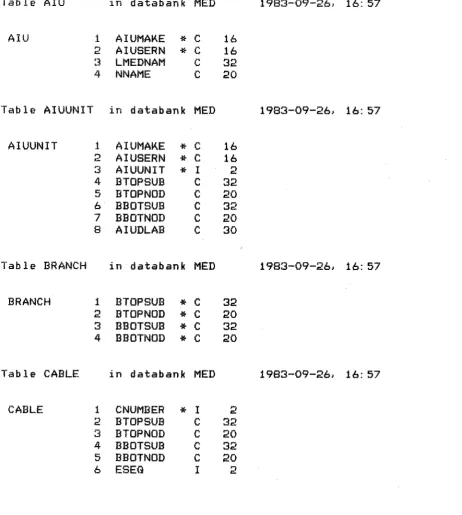
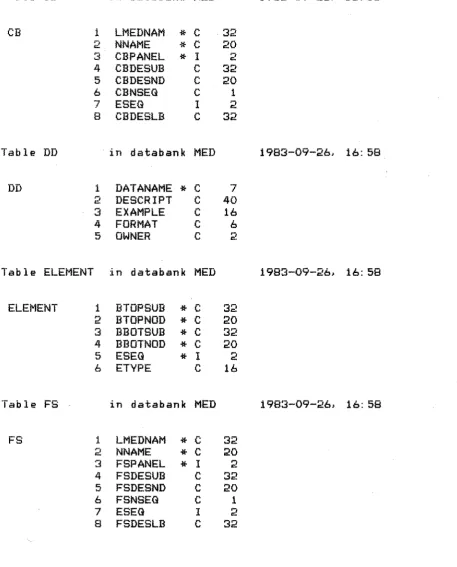
The system was implemented on the MIMER database management system, installed on the Burroughs 6900. MIMER is a relational database system with a very powerful query command language facility. This MIMER-QL facility was extensively used in the development of the physical database and it provided a easy medium for testing the design. MIMER is a very 'user friendly' piece of software, and this together with its relational basis, makes it a system suitable for use by a wide range of people in many database environments, with database expertise not being an essential user requirement.
[7.2.3] Relations Mapped.
approximately 120 entity attributes.
[7.2.4] Network Area Implemented.
A small subset of the total supply network was selected to provide data for the relational tables. The chosen area centered on the Dallington District Substation, a description of which is included as figure (3). The area includes examples of all information entities. Not all items of equipment were included in the database. Only single examples of oil and fuse switches were included as they are configured similarly to circuit breakers and over 30 circuit breakers were described in the database. For simplicity, tee joints were numbered for unique identification, and only several cable thru joints were represented. The majority of the entered data was factually correct, although for some trivial items of information fictitious but realistic entries were made. Despite being only a small subset of the entire network this area represented about 300 table rows.The size of the 'MED' MIMER databank was approximately 100 000 characters.
[7.2.5] Query Program.
/l,\JI'(<•t..co;-r
"lof\(TocT'Pc rJ.
1.} .,.
ofPJCf<:>IJ ~C> '1'\1 b . '.·. ~~o-1
. - .;_)
1-I"IB>u/\"\ 5.T . . . i I
.-;'.( I rf»JCf'.LL.S-r --- {()· • 17 I
1 fiR·•:'/11.. S1~1 12. ~I(,-+ i ________ ·,_1
tl~f-roifrrf\?~ ~)01'1" ~~<>' p~ I
C,.ou:: L"l 'I: s
K\:) _s OtJIH
Rri1 R£f'"T
-~~-7A's-r t:?
f_l
_t-Il u.S IZD 1'1<:1 , so
Pd~rt.t {h1 vl">"
F'>xY>;;~\e ~ $ 0
WCOO'-hLLE
s-r
·1 --1o
•4-..
·-i-~
j
.. ., I . '""'"" :.
.-.--- Il r'IW(<Cll!g
Tee 1.. ;,._ (_Q -- S14.J r<oR.r
('?() ~140
Tf?ISlPL -;.JfPt..~ ... r
[:_
). 3
----~
tlr>-~ S~<6>R-.•fn .J:tl\1
~e1<eot RD. E·
-q .fi <..A!.-Lt.S
1-\1\.U. f._t;, ,;:r 130
Got.r G,..,"'t fD::; o...at-r,3
1\-f!. tS
ulli"l t(:,
GRiwoC>I fc o\\1~'<-[q _
r----'---1---~!_o..[ (,ocf Ll~~<" /Zo!u•'"' l'.l
-·1'--r- :
lOIII 1~l
clEW f.f'IHI-to<-.1
fl.\) t-\'l II I
<;~c.-1<'11 Ave
r==+·---;~ Lf\l(£ -re:P14VE" fl) ~Q. S
~
eit'Jt. 1WI'<Holl;:'l_~_ 1---J----_J
G.AI.IK\les:-r !'.<> !1~ 6'2
I
~~ ;Q0c",
).
r---1----
I •I
I(
!
I!
II
i
---,-I
I
i 12 I' ·;o,i. Cl'l!><-f'
2_-~-L:i}_ .Lol~<-lf'.••P·."'-'-' ~~
l_t
I
~-( £5: 15
I
1G-j T2.<:. c.I\GcE.r r ,1I
[,.
, , - - - ; 1'1 [11'-f'';l-\1.1'"0 p~ 0/H'.
2o
l
:;!< ( .. b e s··l
:;!1 p,•lt.f/',LI ~r UtH-1~1!n
[
,_~-,·).1:> cAP,LC('
l 24
~-~i
'}<;
-'IJ-? e ~
"'
----.
" I) i
-·--r----;-r-, -
:
Yi'":
I I I II
B/l"~Ci A·~f.
llAI'CL/1~
PL.
Mtllpp,,,U;V\.1 g\)~79
t:l1\t.<.itH·10'r-l 1e.l:. 1\ \-1 0
c
;"'() [TI r.... w JA r'Dj'l:l.lt A iJI) l<;vA>J
I I_\ fl\
z
(\\ -\ [ 0 7'\) !\ t/l c t7Q l!j {') -\ 1-5
-u r-Ci\ ::?-(1\ 2..-\
ftj C7procedures. It served as an interface between an inquiring user and the database. It answered over 30 queries on different entity keys. Use of this program effectively tested the designed data retrieval/insertion pathways and without a sound database design some queries could not have been implemented.
[7.3] Design Strengths and Weaknesses.
[7.3.1] MED Appraisal.
The design was informally examined by MED staff members but a formal appraisal from all interested parties has yet to be made. This coupled with the implementation not being extensively tested by MED users means the design has not been fully evaluated by the future database users. However, design features studied closely by MED staff were considered satisfactory.
[7.3.2] Strengths.
understand. This is not a problem, as all present information systems upon which function the design was based, were used by people with knowledge of the network configuration.
Despite the initial intention that the implementation should be small, the relational tables infact contained a considerable amount of data. This confirms impressions held right through this design project the proposed database will be large. Estimated database size, using the implementation size as a guide, will be the order of around 100 megabytes. This estimate is based on the fact that one thirtieth of the network was implemented, one third of all entities in the chosen subset were included ,one half of all relations were mapped and one fifth of all relation attributes were mapped. This is only a very approximate estimate, a more exact calculation is a future requirement.
[7.3.3] Criticisms.
Furthermore the creation of data item just for indexing purposes introduces redundancy and some retrieval/insertion operations would then involve two relations instead of one.
It is important in designs of this nature to avoid adding unnecessary new concepts foreign to the database environment. New concepts can confuse existing system users. The nodes-branches-elements model was introduced to represent physical relationships. It is a concept unfamiliar to MED staff. An equivalent model did not exist in the systems analysed, and with data on different equipment items becoming centralised and
integrated such a model was necessary.
Database management systems maintain internal indices for the access of data sets. The more data items that compose an entity key, the greater the index overhead. Most relations had keys composed of several data items, thus much index overhead. But the keys derived were the keys necessary, they could not be redefined just for the reason of efficiency.
desirable design feature.
The final implementation result was pleasing, it showed the design at work and gave it some practical credibility. Testing of the design was carried out by its designer. The implementation was not given extensive use by different MED staff members, this would have been the best design test.
[8) THE FUTURE OF THE DATABASE.
[8.1] Design Appraisal
This design foundation from
project which
was intended to further database
provide an development
initial could continue. The next step towards a future working system must the evaluation of the design by the different users of present MED systems. While staff members have informally appraised aspects of the design, what is needed is a thorough examination of this document by all concerned people and a formal evaluation. Coupled with this must be further demonstration of the implementation to a wider circle of MED users. Likely to require minor detail changes is the data dictiona~y, where some formats might need alteration and new items added.
[8.2] Size of the Database.
A useful statistic to have when looking ahead to full database implementation is an estimate of the size of the proposed system. Such a calculation is now possible, however it does not simply involve the addition of relation data attribute lengths (in bytes) and multiplication by the estimated number of rows. Consideration has to be made for future network growth , the data involved in the maintenance of internal indices and also the possibility of data coding where data items have only a limited set of possible values. Nevertheless, an estimate of database size is something that can be achieved in the near future, along with design evaluation.
[8.3] Future Hardware/Software Requirements.
Decision steps will need to be taken to devise what software and hardware configuration the new database will involve. A database management package such as MIMER provides database flexibility, has data and machine independence and offers many powerful facilities to database users and managers. Two clear database software alternatives exist: a system based on a package like MIMER or IMAGE (Hewlett-Packard), or a suite of application programs tailormade for the different data processing functions. Both alternatives have strong advantages and disadvantages.
[9] LIST OF REFERENCES
Of considerable value for this project was:
'DATABASE - structured techniques for design performance and management.'
S. Atre, Wiley 1980.
Useful additional texts were:
'An Introduction to Database Systems.' (3rd edition)
c.
Date, Addison-Wesley 1981. and'Fundamentals of Database Systems.'
s.
Deen, Macmillan 1977.APPENDIX (I)
Examples of present system documentation. ( i)
(ii) (iii) ( i v)
(v)
(vi) (vii)
Substation division transformer card.
Testroom substation card containing relay information. Testroom relay card.
Page of testroom relay book.
Planning division substation master file(transformers). Planning division winter loaa summary.
Planning division substation round.
(viii) Planning division work instruction sheet. (ix)
(x)
(xi) (xi i)
Drawing office substation card.
Drawing office cable lengths, joints cards(2) Substation division kiosk card.
Substation division auxiliary/ voltage transformer cards. (xiii) Substation division fuse switch card.
(xi v) '''S'I:l'b's·ta tion division magnef ix card.
\i( >'iC JJ·.\L ELEI... rJ\k JTY DI:.J>AI\TJ\1E!\T. CHJ~JSTCHC:RCH. I\.Z. 2 7 . . - · . ··- . - . - - - ' - - - . - - ---~--~~
,---Tlc\;-..;SFOR~1ER CARDA·
--- -~ \L~ h EE : -:::
D:>t, of l'uJ.::.I;-;1se : /
SIZE K\'A :/ _-,:::::
Price: 2~7
T\'JX' : t> \: ,.. ;_
- "
O-il Gals: ; ...
.
r 'Date Where Installed Remarks
j
f
Date ..
J . ·.
Where Installed · . . Re~rks · .·l
• 2o-/l·-6'9
~ddt/ 2~~
?IIi
.fW.
lfJf6,U,J1/54o
;l?t:" . .:Si!d(v/1 ...'j·8~72' ~~4«. ~~
I
. E. D.
UBSTATI
N
H
ATHCc)TE
,,., , I
Ji
I. .
12.00M
A
/of-J; .
SWITCHGEAR MAKE TYPE UNITS kV RATING DRAWING Nos.
'5.
w
s
CBII+
If
3-.r-o. MVA CT-s:... ... ··· (; -~ I
7·::::...
.c.
"
I~ If ~Souf.JIT Nq. TYPE FEEDER CABLE CT-s RELAY 0/C E/L NOTE
{ ••.•
~
••~
••••• L~ ~T~f rq.~ ~·~, ~~ ;~~~~ ~0~;;41 ~I%1t ~~. :~ ~~~
=
·!;;
Jl
;~'!,~
} :
JI!~f;)~
zy-
J~'f!l~£
..
(P§,?t
J/)
~L
••••••••••••••••••••••••••••••••.•••••••••
i.~~;~
.'I .·.; _:-:··~ · ·, ~ -~-: ll .ttoo-8ooft
S/P
. . . • . . . • . . . • . • . . . . • . . • • • . . • • . • • • . • • • • • • ;.../. . . t . . . { . . . . • • • . • • • • • . • . . • • . . . . • ~.f···.t ... ~-··· ···
-c7U .. ~t=
vs·
~p·zr··· ..
···~··· ···(··;···:··>··.~=:··· ··· ··· ···-· ....i?oc/s.... ··· -·· ··· ··· ··· · ··· ··· ··· ·· · ··· ···
··· ··· ···· ··· ··· ··· ··· ··· ··· ··· ··· ··· ··· ···· ···· ···· ···· ···· ···· ··· ···;:f'c;.o· ]. ..
f:ioo!i. ··· ··· ··· ···· ···· ···· ···· ··· ···· ... ··· ··· ··· ··· ···· ···· ···· ···
::tt.:::::::.:
·::::::~:::::::::
·::Jf>.:q;;:;;;rt::t.i0:/;;::!!..?./f/iL:
:·::::::~.:::::: :::::::::?.9..~./.i..::::: ?.P..~j:X::: Xi£:::::~:?..:.:::::::::::::::::.:::::::::::::.::::::·::
i::::::: .. :
... ··· ... ··· ··· ··· G.T.P..../1... .. ... .' ... ··· ..
?.:.~
...
~.:~
... .
.. ... ... .... ... ... ... ··· .1.
.~.:-::.~
?.!:_(1___ ··· ... ··· .... . ... .:~:::::::::.·
::::·::·::·::::::: ::·:·:...
. ... :.!.. ... ...
Bf??!~
....
?...~.9.}./..
.. ?:E .... .
~f!.E
.. ...
t.o..., ... .
4{X)- 800(1 ;::t..:::::::::
:::::~::::::::::8::~::~:;;:·:::::::::::·::::::::·.::::
··:::·::··: ::.::::: ·:: ..
/ii?PZ£:::· :::·::··:::···:::::·:: :·:::·:::·: ::·::.::::. :::::::::.::::::::· ::::::::·::.: ·::::·:· ·:::::::::·:::.
tE.D. SUBSTATION
HEA-i
HCOl-E
iII< V
SWITCHGEAR MAKE TYPE UNITS kV RATING ! DRAWING Nos.
MVA CT-s:
JIT No. TYPE
I
FEEDER CABLE CT-s RELAY 0/C E/L NOTE: •••••••••••• ;;.
··~·~~:~¥~~ ):~
••••••••••••.
0~:~1~ ·:~fi ·]~~
••
:3··· •••••.••••••••••.•••••••••••••••••• ··•••••·•
i~V:···
'··;·9:·::·::::
··:~~·:::::
·::::x;{x:::::rLi·::::::::.::::::::·:·::
·::::::x·:.:::::::
·::~;;~:~::~-9.~a~ -~::;~
1
-~_::: :~~:~: ::;.~::::· ;;;>;~ ~:·:···:::::::
::::::--;·_:_ .. ··:.:.·:
... , ... ··· >J?. .
f··§'····~·ftl··;_
..
···)9 ... ···:·;···
····'2:2·-~
..
4.CJ;J.~
..
~.D~-~-~ ~~~-
...~.13
...
·--~-~-
... :··· .... .
... ... ... ... ... :... ... ... . ... : .... <:,T .. i,J. . .'.!... ... . ... : .. ~ ... i.:.5 .. ... .
M.
E. D.
RELAY
MAKE ... .f15Efl ... TYPE . ..
R
I ... RATING . £A ... SER. No. 83fJSl- I()RANGES .... ./ -:-. 6. sEc.... .2.. :S'. .. -:-:-:..10. Rm?..5 ... M.E.D. No. S:~.7 ..
DOOD
Bulliv•'lf 333'
DATE SUBSTATION FEEDER PHASE
hl.
REMARKS
1----~---'G ...
J5.s..o ...H ..
r?..r?..N .. H.B.Y. ... SP.BR. ~ 5 ....R.9. ....
o ..
.H. ...R.r;.o.. ....
0:1..7.~... .
... :-... !.'fA .. :-.. J .. O ... V.f'l.)!_\.~ ... G.f; .. i,.f\T.IN.r;, ... .
. / ,_·) I • ' / , ' I , ' 1/1-:·r,'/ / I ... J / / ; ) /
-I '5 7D ____ ": ____________
"'---/ 5' :·)"S' I• II
- - - ' - - · - -- - - - ·
-~
.i [
lf • 6 · 1:.9
/i-A ,,y'll{ C' (~ r J r;. e..f-JI :S"!-7 1 ' 1
'
-( :)·II . , ( - f - (, y.
1_>-;r:;_
IS. c. t:~
--
---"
483
~
I I . 7 I IEST7:; .P
-,-,
__ _
TL __
-rz
IZ...
RELAYS
/· . I ( I . I ,· .
=---~~~
--=-__ -_--_---_-
....!..7....:::~-~~.:....\-.:....i
_ __, __ _·~
:Hp_-o_t_L H0_'/ ____ · __=--=J~---=-
--
--=-=-~:=--~-~--~--=
;S-1-(;:; ~ .
- - - -
£31_\._:....~::..;·~--'--=.:=-+-1-5'---:---7-;-t--- t>AL~L=,:'---';;-~_,_~'-"~--~=--=~======:~---
---~---~
- - - '2-7/G _ _ q--:,.-70 &. Rot-( Lt.:=i
~---;---2719 't
--1
I<__j
---1 .0.6.__ ~ ~ ..
fr _
_?-'j . 7:.?I
.N ., F A.l>D E tJs
-r
p I. "'b2fJ I•
t ,,
---ITP~
!
-
~-
!7~::-;
---;-_--;:.;-;
;-1~~~
--;::;-·
---i-1
---+,_-'-~-~:..:.;,__,-
-_
~]> -~:_:--:_:.;~_::_
.~ ~~~'o'" ~ 'r~N -~=----
-5
,_F+=--__ . __ _
---
---~~
-- ---- 1---_---.· ---
-·-=J
--3c~J;"-
t.-7~
M r_E-4b.l>eN~
---~=
_jlli=.
I
30--., ~-·2-7-... DXFOR..b-"Ti.JA.I-1 I I
---1---~ -
---+--- ---+--- ---+--- ---+--- ---+--- ---+--- 1 ---+--- _ _ _ _ 7
"""-:>C_ :':. 6--4--7'5 PAPANI.I.. I
3i~.
---~---1---~---1./ -12-73 T2
3 "3i f1 .f. I
---f---.:L....<.!.-..-f---f---t
..
-~----j~·---1---... · .... .---f---=3'--''3=-=2+-'-fl_·_,_ 4-....:7_'S-=----t-P'-A...:...:f>A""IJ:..::.._Lt::..:.l ________ ~---+---l+1----'---i---_ _ _ __ ____ _ ____ __ _
---f---~J·:...·':. <-'1.!... -1....:'-='2~---'1_.,2~-_,_?_,~"'--t~---'-',A,~b::....;!:>"'-'--'1 N-"-=C.-''"TD-"-'-'-. •=-J ---+---+---· _____ t - - - _ __ ____________ _
c,
;-~;£::==='====~j+-'-_-_-_-
__ ..
~:~~~~~~~~~~~~~~~~:~~~-~~~~--= ~~---~ ~----
__
-_~
___ .
:ZH-3
~
fSJf '7o3l :Z~'f-75 f.k.LS~rE:t:..L 1'?>2
---~---1-''"--"'-_;__---'~_;J-2 -9 · 7 .; H.\ L S 0 t.:;. L L I '1 2
. _____ __ '11 o 12.3.-...2...:.. 7{. _ _j D.t.!..f.Jli..QtJ _I_I ________________ ·· _ _
--
~~~ ~~:-1i~J:
:_:t.
~- ~ =--~
-.
-~
! : ..• ---
=-·-·· ---
-=:-- --
---~~---__l!l__~fJJQ:.!J~ .. 'J' E_fl.SE~ ·_I_!E.F!:._~;-~y::, ________ - · - - - · - · _________
---====
---~--~:~~
__ -_ ..
----=
---~~-;~S-_-7_-()_-f.l---l--~---·~t----~---1~--'--'P.~I-P::P.,J.._Jl)'__A
___P_L_~-N~,
__--_--_-_-_-~
--- ---
-~_,z.:___ _ --- ---- ;'---- ---
---.
~-
_( __ _j{)1)80.3 _j''t:-2- 'OQ _ ___f-IILIOt.l _ _ ]-<ff-7Y
3B3_v~!>czTI~ _cA~t:
P//.1\!.:J OLe. -r cArt:
SUBSTATION MASTER FILE
31 MARCH 1983
[O=O'LOAD CATEGORYJ
SUBSTATION :SUB : TRAHSFORMER : ROUHD: GRID: DRWG : MXTAP: SYSTEM NAME (OTHER LOCAL NAME>:POSN: KYA TYPE 0 NO :REFS1 NO
A.B.CONSOLIDATED ABBERLEY CR
ABBEY Pl
ABERDEEN ST
*
30 ACACIA AVACHESOt~ AV
ACTOt~ ST 'I 1 0 ADAMS PL
ADMIRALS WAY AIKMANS RD AILSA ST
AKAROA ST <NO 1 STREET) <NO 2 W.W.) AKELA ST
ALBANY ST ALCESTER ST
ALDERSHOT ST # 72 . ALDWINS RD # 45 ALDWINS RD # 54 ALDIJINS RD ~108
ALDW I t~S RD ~ 179 ALDWINS RD EDMONDS ALFRED ST
ALLOWAY ST ALMA PL
AMBLESIDE DR i 23 AMBLESIDE DR # 61 AMOS PL
AMURI.MOTORS
At~DREWS CR
ANGLESEA AV i 1
ANNEX RD ANDREWS
&
BEAVEN ANNEX RD N·ANTHONY RD
ANTIGUA ST 1122 ANTIGUA ·ST #134 ANTIGUA ST #191 ANTIGUA ST #194 AORANGI.RD # 78 AORANGI .RD -#11 0 AORANGI RD:#125 AORANGI :RD # 177 AOTEA TR #.50 APOLLO PL APPLEBY CR APPLEufOOD PL
ARANUI HIGH SCHOOL
1BLDG1 :HI 1<: 300 :LO K: 200 :LO
K:
300 :LOK:
200 1HI K: 300 :LOK:
300 IHI K: 200 :LO K: 200 1HI K: 300 :LO 1<: 300 :BLDG: 500I 200
:HI K: 300 :LO 1<: 300 :BLDG: 750 :HI 1<: 300 :LO 1<: 200 :LO
K:
300 :LOK:
200 1LO K: 200 :LOK:
300 :BLDG: 750 :LOK:.200 :HI 1<: 300 1HI 1<: 300 :LO K: 200 :HI K: 200 :BLDG: 500 :HI K: 200 :LO K: 200 :BLDG: 500 :HI K: .200 :POLE: 30:LO
1<:
300:LO K: 200 :LO K: 300 :OUTD: 500 :LO 1<: 300 :LO K: 200 :HI K: 300
:HI
1<:
200:LO K: 200
:LO
1<:
300:HI K: .300 :LO K: 200 :LO K: 300
HVC
I 1 112 113D4tP35 3 66 : 6G2:E35 5 69 1 881 :AY32 4 42 :12E6tJ33
5 30 :11G2lP44 3 70 : 7D2:A31 4 112 :13E5:P35 4 9 :20D2:W27 5 91 : 9F6:F18
3 47 t12B3:F37 4 70 :8E2 :C31 2 70 I 8C2:AZ31
5 70 : 8C2rAZ31
3 47 :12B3:E37 4 66 : 6H2:E35 I 2 110 113E5:2451551 3 95 :9G2 :E23 5 1 :20A1:133079: 4 1 1 I 15G3: 133 078:
5 1 1 02 : 15G3: 134 078:
5 101 :15G3: 0134771 4 1 :20A2:133079: 2 103 115G2:P31 5 84 t16A3:B25 3 71 803:829 3 53 : 4F2:A45 5 53 : 4H3:103068: 4 71 : 8D2:A29 1
2 108 :13A4:243150: 4 22 :18B4:T37 5 87 : 9A 1 : AP23 2 30 :11H1:R44 4 30 :11H2:Q44 6 93 :9G3 :A3037 4 21 :13H4:R35 5 21 : 13H4: R35 4 24 :f3G2:P35 2 24 :13G2:Q35 4 50 :11A2:841 5 1 55 :11A2:B42 3 55 :11A2:C42 4 54 :11B2:D43 5 10 :19H4:8830 4 1 64 5C6: 11 6 064: