P.
J.
Bryant
No. 18
November 1981
r
' i
Mathematics Department, University of Canterbury, Christchurch, New Zeal.and.
Waves on the water surface propagate typically in wave groups, each group consisting of a small number of waves. The envelopes of the wave groups change, in general, as the groups propagate. Particular envelope shapes remain constant for certain ranges of the group height to wavelength ratio E and the group length to wavelength ratio ko. Envelopes for groups containing a large number of waves (ko »1) of small amplitude (€ <<1) are modelled by the cubic Schrodinger equation. Short periodic groups of permanent envelope exist only for larger values of €. A numerical method is described for obtaining solutions of the nonlinear water wave equations representing periodic wave groups of
permanent envelope without smalls or large ko assumptions. The method, which is based on the fast Fourier transform technique, has applications elsewhere in-nonlinear wave problems.
permanent envelope are presented.
Examples of short wave groups of
1. Introduction
The action of wind on the water surface is to generate wave groups whose group lengths are a small multipie of the lengths of the waves in the groups. The envelopes of such groups change, in general, as the groups propagate, whether or not the wind is present. This investigation is concerned with calculating those freely propagating periodic wave
groups whose envelopes have permanent. shape. It is possible that the envelopes of permanent shape may be the asymptotic forms of the envelopes
Zakharov (1968) derived equations for nonlinear periodic waves
on deep water in the small amplitude approximation. He showed further
that if all wavenumbers lie in a narrow waveband, the envelope of the
wave train satisfies the cubic Schrodinger equation. This equation
has solutions describing envelopes of permanent shape, which because
of the narrow waveband assumption, enclose groups whose length is
large compared with the lengths of the waves inside them. Yuen
& Lake (1980) reviewed many of the interesting properties that have
been found for the wave group solutions of the cubic Schrodinger
equation, and for their relation to the long-time evolution of narrow
waveband small amplitude wave trains. One such property, described
originally by Zakharov & Shabat (1971), is that a small amplitude narrow
waveband wave group evolves asymptotically into a wave group of permanent
envelope.
In an earlier investigation (Bryant, 1979), wave group solutions
were derived from the nonlinear wave equations without making the narrow
waveband approximation, but with the small amplitude approximation still
retained. The wave group solutions tended towards uniform wave train
solutions as the group length to wavelength ratio was decreased~without
short wave groups being found. It was clear that the small amplitude
approximation was the limiting factor, so a new approach to the nonlinear
wave equations has been devised which makes neither the narrow waveband
nor the small amplitude approximations.
An important part of the new approach is the use of the fast Fourier
transform technique, following the successful application of this technique
to nonlinear wave phenomena by Fornberg & Whitham (1978), where more
information about it may be found. The calculations were made on the
Prime 750 at the University of Canterbury using Fortran 77, with the fast
2. Governing equations
The nondimensional equations for the irrotational motion associated
with a wave train propagating in the x-direction on deep water are
<Pxx + <Pyy = O Y < i::n ' (2. la)
(2.lb)
nt - <P y
+
i::n x x <P=
o
Y
=
i::n (2. le)<Pt + n + ~ i::<P 2 + ~ i::<JJ 2 =
o '
x y (2 .ld)
The nondimensional water surface displacement is n(x,t), and <j)(x,y,t)
is the nondimensional velocity potential. Periodic wave group
solutions of permanent envelope are sought for which 2Tit is the
wave-length of a typical wave in the group, 2TIL is the group wave-length, and a is
the maximum group height above the mean horizontal surface y
=
0. Thelength scale t i s used in the derivation of equations (2.1), and the wave
slope parameter is E: = a/i. All nondimensional wavenumbers k are integers, corresponding to dimensional wavenumbers k/L, but the ratio
ko
=
L/t need not be an integer.Periodic·wave group solutions of the cubic Schrodinger equation
have the form
{ kx
cos -
-ko
sin{x - (1
+
ai::2) t} ,describing a group propagating with the group velocity~ whose
(2.2a)
( 2. 2b)
amplitudes ak are symmetric about ko, It should be noted that the
wave frequency is
w(k) w(k.o) + (k-ko) (:) +
~
(k-ko)2(~~1]
+ ...ko ko
The narrow waveband assumption is equivalent to stating ·that the
wavenurobers k satisfy
k - ko ,...., E:
«
1 .ko
The frequency correction as2 is such that a tends to 0.25 as ko becomes
large at smalls. The velocity potential associated with the surface
displacement, equation (2.2a), is
¢ = z;b expky sin{kx -
·(1
+ k-ko + as2)t},k k ko ko 2ko (2.2c)
The generalisation of equations (2.2) that satisfies equations
(2.i) with the full nonlinear boundary conditions is
n
=
z:z;a, cos{~(x-~t) - j(~+as2)t},j k Jk ko
(2. 3a)
¢
=
Z:
Lb . exp ky sin{~ ( x -~
t) - j (~
+ a.E: 2 ) t \.J .· j k Jk ko ko
(2.3b)
The index j = 0 describes the surface displacement and water motion
which is steady relative to the group structure. The index j
=
1refers to the amplitudes contained in equations (2.2) lying in a
waveband about ko. Each higher value of j describes a set of
amplitudes in a waveband lying about jk0 , the maximum surface
displacement amplitude in each of these wavebands being estimated
by the ratio E:j-l of the maximum amplitude in the waveband for j 1.
When equations (2.3a,b) are substituted into equations (2.lc,d), with
the function. exp (ksn/ko) expanded as a power series, the latter
equa-tions may be written respectively
F = Z:~F sin{kn (x-~t) - m(~+as2)t}
m n mn o Q I ( 2 .4a)
G = LLG cos{~(x-~t) - m(~+as2)t} = 0,
m n mn ko ( 2. 4b)
where p· , G are functions of all amplitudes a . k, b . . and a.
Equations (2.4a,b) are valid for all x and t, implying that
F
=
G=
O, all m,n.mn mn (2. 5)
It is possible in principle to calculate F ,G as functions of mn mn
ajk'bjk' and a, and then to solve equations (2.5) for ajk'bjk' and a.
A likely strategy for the algebraic calculation would be that of
successive approximations to F ,G , followed by successive
approxima-mn mn
tions to ajk'bjk' and a. A numerical method has been devised instead
which uses the fast Fourier transform technique to calculate F ,G , mn mn
and Newton's method of solving nonlinear algebraic equations to find
3. Numerical method of solution
The surface displacement n and velocity potential¢ in equations
(2.3a,b) are substituted now into the nonlinear boundary conditions
(2.lc,d) in order to obtain explicit relations for F,G in equations
(2.4a,b). The abbreviations
cjk cos{(k/ko)(x-~t) - j(~+as2)t}
s jk
=
sin { (k/ko) (x-~ t) - j (~+as2) t}are used in the expansions.
F kl; {kj ( 2ko) + j (~ +oc2) }a .ks 'k - kl; (k/ko) exp (ksn/ko) b .ks 'k
jk J J jk J J
- s [k L (k/ko) a .ks .k] x [L L (k/ko) exp (ksn/ko) b .k-c 'k]
=
O , ( 3. la)jk J J jk J J
G
- jf
{k/2k0 ) + j (~ +as2) }exp(ksn/ko)bjkcjk +ff
ajkcjk+ ~ s [L L (k/ko)exp (ksn/ko) b .kc .k] 2
j k J J
+ ~s[Lk (k/ko)exp(ksn/ko)b.ks.k] 2 = O.
j k J J
Also, from the definition of s,
H
=
k ka
'k - l = 0 .j k J
(3.lb)
The partial derivatives needed for Newton's method are now listed.
clF/claJ.k ::: {k/(2ko) + j (~ + as2) }sJ.k - sc 'k LL (q/ko) 2exp(qsn/ko)b s
J p q pq pq
- s(k/ko)s.kLL (q/ko)exp(qsn/ko)b c
J p q pq pq
- s2c.k[LL(q/k0)a s i'x [LL(q/ko) 2exp(qsn/k0)b c
J p q pq pq p q pq pq (3.2a)
clF/clbjk::: - (k/ko)exp(ksn/ko)sjk
- s (k/ko) exp (ksn/ko) c 'k LL (q/ko) a s ,
J p q pq pq (3. 2b)
clF/cla ::: s2 LL pa s ,
p q pq pq (3.2c)
- sc.kLL{q/(2ko) + p(~+as2)}(q/ko)exp(qsn/ko)b c + cJ.k
J p q . pq pq
+ s2c 'k [L 2: (q/ko) exp (qsn/ko) b c J
J pq
MM
x [:l: L (q/ko) 2exp (qsn/ko) b c
J
p q pq pq
+ s2c.k[LL(q/k0)exp(qsn/ko)b s l
J pq
MM
x [LL (q/ko)2exp(qsn/ko)b s l ,
p q pq pq ( 3. 2d)
clG/clbjk
= -
{k/(2ko) + j(~+as2)}exp(ksn/ka)cjk+ s(k/ko)exp(ksn/ko)c.kLL (q/ka)exp(qsn/ko)b c
J p q pq pq
+
s (k/ko) exp (ksn/ko) s 'k L 2: (q/ko) exp (qsn/k o) b s ,J pq pqpq (3. 2e)
clG/ila
=
s2 LL exp (qsn/ko) pb cp q . pq pq (3.2f)
1 I clH/clbjk = 0 , clH/cla 0 . ( 3. 3)
Suppose that i t is required to calculate all surface displacement
amplitudes ajk having magnitudes greater than some ~mall quantity such
_3
as 10 , and that the total number of such amplitudes is N. The
correspondi~g wavenumber ranges, found by trial and error, are
where k1(0) = 1, k1(j);;;,, l , and
J
l
(k2 (j) - k1 (j)+
1) = N (3.4)A given wavenumber k may occur in the ranges defined by more than one
value of j. The 2N + l unknown quantities to be calculated are ajk'bjk
for the values of j and k above, and a. An initial estimate is made
of the 2N+l unknowns and this is substituted into all of equations
(3.1, 3.2). Next, a double Fourier transform over x and t i s made of
each of these equations to calculate F ,G , (8F/8a.k) , ... , (8G/8a)
mnmn J mn mn
for k1(m) <n < k2 (m) ,m
=
0,1, ... ,J.Newton's method applied to Fas a function of the 2N+l variables
ajk'bjk' and a, is described by
1::~(8F/8a.k)(a.k-a1.k) + ~~(8F/8b.k)(b.k-b1.k) + (8F/8a)(a-a1 ) = F,
jk J J J jk J J J
(3.5)
where I denotes the new value of each variable, and F and its derivatives
are calculated at the old values of the' variables. The double Fourier
transform of equation (3.5) is
for k1 (m) < n<k2 (m), m
=
0,1, ... ,J. Similarly~ ~ ( 8G/8a .k) (a .k-a' .. ) + 1:: ~ ( 8G/8b .k) (b .k-b1,k) + ( 8G/8a) (a-a' ) = G ,
j k J mn J Jk'. j k J mn J J mn mn (3.6b)
over the same N values as equation ( 3. 6a) , and .,·
1:; ~ <'\ <'\ I
(oH/oa.k) (a,k-a.k) = H. (3.6c)
j k J J J
Since all coefficients of the set of 2N+l linear equations (3.6) are
known, the set may be solved to obtain the new values of each of the
2N+l variables ajk'bjk' and a.
Calculations were begun with the solution of the cubic Schrodinger
equation at wave slope E
=
0.05 and group length to wavelength ratioko, and ko was decreased step by step at constants, with each
solution being used as the initial estimate for the next solution.
The number of wavenumbers N was also increased step by step for each
value of sand ko, the criterion being that the first and last
amplitude ajk for each waveband should have a magnitude less than
_3
10 , unless the lower limit k1(j) was already 1. Newton's method
converged well in most examples calculated, the main exception being
examples near to uniform wave train solutions where care had to be
taken to keep the two types of solution apart. The accuracy of the
solutions could be tested by determining F and G in equations (2.4)
mn mn
not only for the N wavenumbers included in the calculation but for
other wavenumbers also.
4. Short wave groups
The parts of the surface displacement and horizontal velocity at
the water surface which are steady relative to the group structure are
given, from equations (2.3), by
k2 (0)
no (x,t)
=
I
a0k cos (k/ko) (x-~ t) ,
k=l
k2 (0)
uo(x,t) =
l
(k/ko)b0kcos(k/ko)(x-~t)
k=l
(4 .la)
Both have negative minima below the group maxima, representing a
set-down and counter-current below each group maximum. Although cause
and effect cannot be separated, the growth and decay of the amplitude
of a wave train as 'it moves through a group maximum is influenced
directly by the convergence and divergence regions respectively of
the horizontal velocity uo(x,t). This nonlinear velocity field
contributes to the balance betweeo linear dispersion and the Stokes
permanent shape.
Three examples of groups of permanent envelope are presented
with E = 0.25 and ko 5, 2. 5, and 1. 25 . The envelope and one
position of the wave train is sketched for each example, as well
as the horizontal velocity field u0(x,t). The 2N+l variables ajk'
bjk' and a for each example are tabulated at the end of the section.
The first example, with E = 0.25,ko = 5, is sketched in fi~ure 1.
As in all three examples, the height of the envelope above the mean
level exceeds the depth of the envelope below the mean level at the
centre point (with no(x,t) included), the ratio of height to depth in
this case being 1.28. The ·horizontal velocity field uo(x,t), which
is confined here to about one wavelength at the centre of the group,
contributes to the balance with the linear dispersion which keeps the
envelope of the group constant with an effective length of about three
wavelengths.
The second example, with E = 0.25,ko = 2.5, is sketched in figure
2, two group lengths being shown. An interesting feature is that, as
in the previous example, three wavelengths occur in each group, and the
effective part of the horizontal velocity field uo(x,t) is almost the
same as before. Although calculation of this example uses a group
length to wavelength ratio ko = 2.5, the amplitude of the surface
harmonic at k = 3 far exceeds that at k = 2. The ratio ko, at givens,
determines the wave group, but i t may be interpreted as a central
wave-number in the dominant waveband only in the linear limit as E tends to
zero.
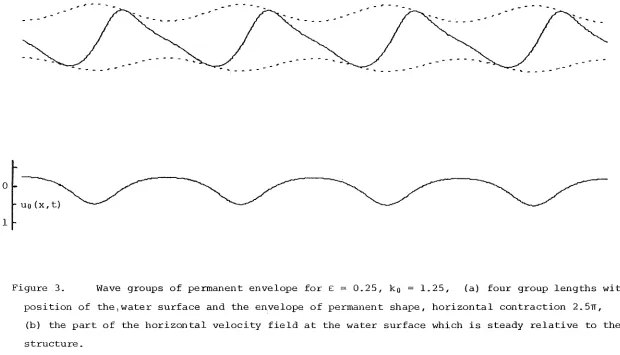
The third example, withs= 0.25,ko = 1.25, is sketched in figure 3,
four group lengths being shown. The central part of the horizontal
velocity field uo(x,t) in each group length is almost identical in
shape with that in the previous two examples. This example falls
··~.-in the transition range between two and one wavelengths ··~.-in each group
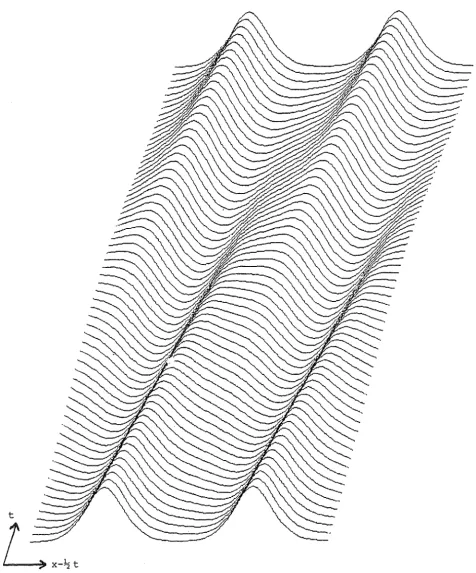
The evolution of the wave train as it moves through the group
is made clearer in figure 4, which is a perspective sketch of the
water surface over two group lengths in a frame of reference moving
with the group structure, with time increasing over one group period
up the figure. Figure 3 is a cross-section of this sketch one quarter
of the group period from the initial time. The crest of the wave does
not move through the group with a uniform velocity, but is moved forward
in phase as it passes through the group minimum. Sketches of a
number of examples with€= 0.25 have shown that the lower limit in
ko for two wavelengths in each group, both waves moving uniformly
through the group structure, is at about ko = 1.35, and the upper limit
in ko for one. wavelength in each group, the wave moving uniformly through
the group structure, is at about ko = 1.15. The group structure at the
smaller values of ko consists of a small periodic rise and fall together
of the wave crests, and corresponding oscillation of the wave shapes, as
the wave train propagates across the water surface.
The method of solution· includes a spectral analysis of the water
surface displacement and of the complete water velocity field, enabling
properties such as momentum or energy integrals to be calculated
immediately. It includes also a spectral analysis of the nonlinear
water surface boundary conditions, from which it may be deduced which
harmonics should be added if higher precision is required. The fast
Fourier transform technique, combined either with time-stepping (Fornberg
& Whitham, 1978), or with Newton's method as above, offers many possibilities
rable of harmonics
The harmonics for the three examples are listed, stating only
_3
those harmonics whose surface displacement amplitudes exceed 10
in magnitude.
E 0.25, ko
a
1k,k=2, ... ,15
blk'k=2, ... ,15
a
2k,k=8, ... ,21
b2k'k=8, ... ,21
a
3k,k=l5, ... , 25
b3k'k=l5, ... ,25
5, a= 0.207.
E 0.25, ko 2.5, ct = 0.213.
a0k ,k=l, ... , 5 -0.009 -0.007 -0.004 -0.002 -0.001 bOk ,k=l, ... ,5 -0.048 -0.020 -0.008 -0.003 -0.001
a1k,k=l, ... ,8 0.005 0.163 0.442 0.162 0.053 0.018 0.006 0.002
blk'k=l, ... ,8 0.008 0.181 0.402 0.127 0.037 0.012 0.004 0.001
a2k,k=4, ... ,ll 0.004 0.020 0.040 0.031 0.018 0.009 0.004 0.002
b2k, k=4, ... , 11 0.0 0.001 0.002 0.001 0.0 0.0 0.0 0. 0
a3k,k=7, ... ,14 0.001 0.004 0.007 0.007 0.005 0.003 0.002 0.001
b3k'k=7, ... ,14 0.0 0.0 0.0 0.0 0.0 0.0 0.0 0.0
a4k,k=l2, ... ,15 0.001 0.002 0.002 0.001 b4k'k=l2, ... ,15 0.0 0.0 0.0 0.0
E = 0.25, ko 1. 25, ct 0.080.
a0k,k=l,2 -0.015 -0.003 bOk'k=l,2 -0.043 -0.005
a1k,k=l, ... ,4 0.682 0.189 0.015 0.001 blk, k=l, ... , 4 0.760 0.149 O.Oll 0.001 a2k ,k=2, ... ,5 0.049 0.041 0.012 0.002 b2k'k=2, ... ,5 0.002 0.001
o.o
o.o
a3k ,k=3, ... ,6 0.005 0.008 0.005 0.002 b3k ,k=3, ... ,6o.o
0.0 0.0o.o
a4k,k=5,6 0.002 0.001References
.Bryant, P.J. 1979 Nonlinear wave groups in deep water.
Stud. Appl.
Math.
61, 1-30.Fornberg, B., & Whitham, G.B. 1978 A numerical and theoretical study
of certain nonlinear wave phenomena.
Phil. Trans. Roy. Soc. Lond. A
289, 373-404.
Yuen, Henry C., & Lake, Bruce M. 1980 Instabilities of waves on deep
water.
Ann. Rev. Fluid Mech.
12,
303-34.Zakharov, V.E. 1968 Stability of periodic waves of finite amplitude
on the surface of a deep fluid.
Zh. Prikl. Mekh. Tekh. Fiz.
9,
86-94
(J. Appl. Mech. Tech. Phys.
2, 190-4).Zakharov, V.E., & Shabat, A.B. 1971 Exact theory of two-dimensional
self-focusing and one-dimensional self-modulating waves in nonlinear
1.
(November 1976) BRYANT, P.J.
(Reprinted March 1978)
Permanent wave structures on an open two layer fluid.
2.
(December 1976) WEIR, G.J.
Conformal Killing tensors in reducible spaces.
3.
(January 1977) WEIR, G.J.
&
K3RR, R.P.
Diverging type-D metrics.
4.
(February 1 977) KERR, R, P,
&WILSON, W
.B.
Singularities in the Kerr-Schild metrics.
5.
(May 1977) PETSRSEN, G. M.
Algebras for matrix limitation.
6.
(August 1977) GRAY, A.G.
Topological methods in second order arithmetic.
7.
(September 1 977) WAYLEN, P. C.
Green functions in the early universe.
8.
(November 1977) BEATSON, R.K.
The asymptotic cost of Lagrange interpolatory side
conditions in the space C(T).
9.
(November 1977) BEATSON, R.K.
The degree of monotone approximation.
1 O.
(November 1977) BR2ACH, D.R.
On the non-existence of 5-(24,12,6) and 4-(23,11 ,6) designs.
11.
(February 1978) BRYANT, P.J.
&LAING, A.K.
Permanent wave structures and resonant triads
in a layered fluid.
12.
(August 1978) BALL, R.P.
Norse theor,,; with applications and extensions.
13.
(September 1978) BRYANT, P.J.
Nonlinear wave groups in deep water.
14.
(September 1978) BREACH, D.R.
Some 2-(2n+1 ,n,n-1) designs with multiple extensions.
1
5.
(October 1 980) CHOW, SHUE-SUM
Singular value decomposition and its applications.
16.
(January 1981) BREACH, D.R.
Some Remarks on a Family oft-designs.
17.
(August 1981) BREACH, -D.R.
Star Gazing in Affine Planes.
• • - :I - - - - ~ , - - - -
- - ~
- . : : - ---0.0~
uo (x,t)
-0.1
Figure 1. The wave group of permanent envelope for E
=
0.25, ko=
5, (a) one group length with one positionof the water surface and the envelope of permanent shape, horizontal contraction 2.5TI, (b) the part of the
horizontal velocity field' at the water surface which is steady relative to the group structure.
[image:16.852.95.673.105.173.2]---..
-
-a.of ·
uo (x,t)
-0.1
Figure?· Wave groups of permanent envelope. for£= 0.25, ko = 2.5, (a) two group lengths with one
position of the water surface and the envelope of permanent shape, horizontal contraction 2.5TI,
(b) the part of the horizontal velocity field at the water surface which is steady relative to the group
0.0
-0.1
-~---
-
~-
-uo(x,t)
Figure 3. Wave groups of permanent envelope for E
=
0.25, ko=
1.25, (a) four group lengths with oneposition of the)water surface and the envelope of permanent shape, horizontal contraction 2.5TI,
(b) the part of the horizontal velocity field at the water surface which is steady relative to the group
[image:18.842.58.678.99.454.2]