SUBSTITUTION
A thesis
presented for the degree of
Doctor of Philosophy in Chemistry in the
University of Canterbury by
R.J. MARTYN
THESIS
CHAPTER
1
2
TABLE OF CONTENTS
Page
ABSTRACT i
GENERAL INTRODUCTION 1
1.1 Electrophilic Aromatic Halogenation. . . 1 1.2 Consequences of Ipso-Attack
.
. .
". .
.
1.31.4
Reactions of Wheland Intermediates The Chlorination of Polysubstituted Phenols with Chlorine . . . .
CHLORINATION OF PHENOLS AND ANI LINES IN ACETIC ACID AND HYDROCHLORIC ACID: A STRUCTURAL STUDY . . . .
2.1 Chlorination of 3-Chloro-6-methylaniline
2 4
10
19
and 2,5-dimethylaniline . . . . . 19 2.2 Chlorination of
2,4-Dichloro-6-methyl-phenol, 2,3-Dimethylaniline and 3-Chloro-2-methylphenol . . . . . 23 2.3 Chlorination of 2,3,6-Trimethylphenol,
Dimethylaniline and
2,6-Dimethylphenol . . . 26 2.4 Chlorination of 2,5-Dimethylphenol,
3,5-Dimethylphenol, 2,3,4,6-Tetrachloro-5-methylphenol, 2,3-Dimethylphenol and
2,3,4,5-Tetrachloro-6-methylphenol . . . 30 2.5 Chlorination of 3-Methylphenol 42
3 FORMATION OF
6-CHLORO-6-METHYLCYCLOHEXA-2,4-DIENONES FROM POLYSUBSTITUTED PHENOLS . . . . 43
3.1 Introduction 43
3.2 Reaction of Polysubstituted Phenols with Chlorine in Carbon Tetrachloride and
4
5
REACTIONS OF 6-CHLORO-6-METHYLCYCLOHEXA-2,4-DIENONES WITH CHLORINE IN ACETIC ACID
4.1 Introduction . . . .
4.2 Chlorine addition to
6-Chloro-6-methyl-62 62
cyclohexa-2,4-dienones in Acetic Acid 63 4.3 Discussion: Chlorine addition to
6-Chloro-6-methylcyclohexa-2,4-dienones 76
EXPERIMENTAL METHODS
· ·
·
· ·
·
· ·
84 5.1 Apparatus, Materials and Instrumentation 84 5.2 Experimental section Relating toChapter 2
· ·
·
· ·
.
. · · · ·
·
·
· ·
86 5.3 Experimental Section Relating toChapter 3
·
· ·
·
· .
.
· · ·
·
· ·
·
·
100 5.4 Experimental section Relating toChapter 4
· ·
·
·
·
·
·
·
·
· ·
·
112 5.5 Selected Preparations of Chlorophenols·
127APPENDIX 1
Single-Crystal X-ray Structure Analyses . . . 131
APPENDIX 2
Chlorination of 2-Nitrophenols; Formation of
(E)-(2RS-5RS)-2,4,5,6,6-Pentachloro~2-methyl-6-nitrohex-3-enoic Acid. . • . . . . . 174
REFERENCES 181
Page Page
Scheme 1 17 Block A 16
Scheme 2 196 Block B 18
Scheme 3 197 Block C 186
Scheme 4 198 Block D 187
Scheme 5a 200 Block E 188
Scheme 5b 200 Block F 189
Scheme 6 208 Block G 190
Scheme 7 212 Block H 191
Scheme 8 214 Block I 192
Block J 193
Block K 194
Block L 195
Block M 199
Block N 201
Block 0 202
Block P 203
Block Q 204
Block R 205
Block S 206
Block T 207
Block U 209
Block V 210
Block W 211
Page Page
Table 2.1 36 Figure 1 166
Table 3.1 61 Figure 2 166
Table 4.1 82 Figure 3 167
Table 1 150 Figure 4 167
Table 2 151 Figure 5 168
Table 3 152 Figure 6 169
Table 4 153 Figure 7 169
Table 5 154 Figure 8 170
Table 6 155 Figure 9a 171
Table 7 156 Figure 9b 171
Table 8 157 Figure 10 172
Table 9 158 Figure 11 172
Table 10 159 Figure 12 173
Table 11 160 Figure 13 180
ABSTRACT
In the first part of this thesis the conformation and stereochemistry of a number of polychlorocyclohex-3-enones, formed by the reaction of chlorine in acetic acid and
hydrochloric acid with polysubstituted phenols (or anilines), are discussed. Those polychlorocyclohex-3-enones with the H(Cl)CS or the Me(Cl)CS structural features were shown to exist in a twist-boat conformation with the CS-Cl bond in
the flagpole orientation. In contrast, two polychlorocyclohex-3-enones with gem-dichloro substituents at CS, were shown to be conformationally mobile in solution. The alicyclic
ring of two 4,4,S-trichlorocyclohex-2-enones were also shown to exist in twist-boat conformations, but with the CS-Cl bond in the equatorial orientation. A satisfactory correlation between the lH n.m.r. and infrared spectroscopic data and the known structures in the solid state indicates that these 3-enones and polychlorocyclohex-2-enones adopt conformations in solution close to those
observed in the solid state.
Extensive use of single-crystal X-ray structure analysis was made in the above structural studies; some thirteen
structure analyses are reported in this thesis.
attack ipso to a chlorine atom. Where both ortho positions of the phenolic substrate are methyl substituted, the site of ipso chlorine attack is affected by the meta substituents.
In the third part of this thesis the additions of
chlorine to 6-chloro-6-methylcyclohexa-2,4-dienones to give polychlorocyclohex-3-enones and polychlorocyclohex-2-enones are discussed. These addition reactions proceed by three distinct reaction mechanisms, 2,3-, 4,5- and 2,5-chlorine addition. The 2,3-chlorine addition reaction was shown to be powerfully acid-catalysed. In contrast, the 4,5- and 2,5-chlorine additions were shown to be only mildly acid-catalysed. Reaction mechanisms which accommodate these observations are discussed.
CHAPTER 1
GENERAL INTRODUCTION
1.1 Electrophilic Aromatic Halogenation
Conventional electrophilic substitution reactions of aromatic compounds involving the halogens F, Cl, Br, I are now generally well understood and a ntimber of good reviews have been written on this topic. l ,2,3,4 Less well understood are reactions, often observed alongside electrophilic
substitution reactions, in which the product is unexpected in terms of conventional substitution. Many such reactions, previously termed anomalous or non-conventional, have been reported. For instance, the bromination of t-butylbenzene yields bromobenzene in addition to the expected productsr
ortho-, meta- and para- bromo-t-butylbenzene. 5
tBu
Br2/H2°.,
dioxane
Br tBu
38%
tBu tBu
Br
7%
Bf
It is probable that the bromobenzene is formed by electrophilic attack of bromine on the carbon bearing the t-butyl group,
followed by loss of the comparatively stable t-butyl carbocation. Other non-conventional reactions, such as side-chain
modification have been reported. For instance, the
Cl
(l2 .. A(OH
The initial step in this reaction is attributable to electrophilic attack of chlorine at a carbon bearing a methyl group.
The term ipso was introduced by Perrin and Skinner 7 to denote attack by a reagent at a substituted nuclear position. Subsequently many of the previously observed, anomalous or non-conventional reactions could be described in terms of the consequences of ipso aromatic attack.
1.2 Consequences of Ipso-Attack
The Wheland intermediates (w's) from a mono-substituted benzene are of two kinds, those (Wo '
w
P' Wm) in which the
electrophileis attached to an unsubstituted position, and that
rlf
in which i t is attached to the. position at which the substituent X is attached.x
x
x
x
x
EE
Observation of the intermediates WOI
w
mlwp
is rare since generally the chemistry associated with these forms is simple, rapid proton loss. However, direct observation of ~ hasproved possible under exceptional circumstances. For
instance, the reaction between hexamethylbenzene and N02+, under conditions in which bases and nucleophiles are absent, has been shown to give the ~e below, by l3C n.m.r. 8
x
Other stable wi 's are obtained when a stabilising group is situated para to the position of ipso attack. For instance the reaction of N,N-dimethyltoluidine with N02+ gives the
Me 9
stabilised wi below.
Me
+ NO Z
)
N (MelZ
The
wf
can undergo a variety of reactions, for example, return to reactants, migration of the ipso group, side-chain1.3 Reactions of the Wheland Intermediates
x
(al Nucleophilic Capture of ~
The Wheland intermediate, with its cationic character, is susceptible to nucleophilic attack. Many examples have been reported in the field of electrophilic nitration of aromatic compounds. One in particular, the nitration of o-xylene in acetic anhydride, was important in attracting attention to ipso attack in nitration. 10
Me
Me
Me
Me
Me
Me
16% OAe 51%
The major product was found to be the acetoxy-o-xylene (51%) along with the expected nitro-o-xylenes. Further studies carried out on a number of methyl benzenes showed that the ratio of nitration to acetoxylation was dependent upon the nature of the substrate but independent of its
concentration.lO,ll It was suggested that the mechanism involved capture of the
wfe
by acetate followed byelimination of nitrous acid to give the aryl acetate product.
Me
Me
N02Me
Me
Me
Me
Me
Me
NO·
AeO-)
-4
)- HN02
This mechanism was confirmed by the isolation of the stereoisomeric adducts,
Me Me
H OAc
formed during the nitration ofo-xylene,lO,ll Similar products were obtained for a large number of aromatic substrates,
mainly by Fischer and co-workers. 12
Another example, the chlorination of phenanthrene by chlorine acetate in acetic acid, while not involving ipso attack as such, does illustrate the nucleophilic capture of the Wheland intermediate formed from electrophilic halogen attack. 13
AcOO ) AcOH
H
H H
The reaction of phenanthrene with chlorine acetate gave the cis- 9-chloro-10-acetoxyphenanthrene (30%), trans-9-chloro-10-acetoxyphenanthrene (30%) and the substitution product,
9-chlorophenanthrene (40%). The product ratios are unaffected by added sodium acetate,
nucleophile, i t seems reasonable to suggest that the
carbocationic Wheland intermediate is formed directly from Cl+ attack and subsequently reacts indiscriminately with so 1 vent to give cis or trans products.
(b) Migration of an Ipso Group
The Wheland intermediate
wi
can formally rearrange in two ways, by migration of the substituent X or by migration of the electrophile. Examples of the former, where anydistinction can be made, are rarely observed. One example, the nitration of 6-chlorothymol, was shown to give the product arising from the formation of the
wfl
followed by 1,3 migration of the chlorine atom.[I [I
Me 11e Me
NO+
2 ) )
ipr i p r ipr Cl
OH OH OH
Bromination of 6-chlorothymol gave a 46% yield of the product arising from 1,3 chlorine migration from the
wfl.14
[I [I Br Br CI
Me Me Me
Br2
~ - H+ ~ +
Ipr i p r ipr [I ipr
OH OH OH OH
46% 54%
Me
Br
It is unlikely that the 2-bromo-6-chlorothymol (54%) is formed totally from migration of bromine from the
wfl
(since. of bromine migration from the
w~r,14)
and is probablymainly formed by direct bromination at the activated position ortho to the OH function.
Migration of the electrophile is more commonly reported, especially in nitration studies. Examples in halogenation are
less common but have been reported for the rearrangement of dienones formed by ipso attack on phenol derivatives. For instance, the rearrangement of the bromo dienone below in sulphuric acid has been shown to give the tribromo phenol in nearly quantitative yield. lS
0
OH
OH
Br
Br
BrBr
Br
Sr
H2 SO 4
)
-H+
)Sr
Me
Sr
Br
Me
The reaction is strongly acid-catalysed and is thought to proceed through the ~e intermediate.
There are three distinct mechanisms for migration, (i) intramolecular, (ii) extramolecular and (iii) inter-molecular. Intramolecular migration .is characterised in
that the migrating group never becomes sufficiently free of the carbon structure to do other than move to a position adjacent to the ipso position i.e. a(1,2 migration).
Extramolecular migration differs from intramolecular migration in that the migrating group becomes free enough to be able to distinguish and select amongst the positions in the carbon structure, but does not leave the "encounter-pair" .
carbon-structure and diffuses into the solvent, i t may then react with carbon structures other than the one i t left.
The mode of migration depends largely upon the rate of formation of the
wI
which, if i t proceeds at the encounter rate favours extramolecular migration or, if i t proceeds slower than the encounter rate, intermolecular migration is dominant.(c) Substituent Modification
The driving force behind the reaction of a
wI
is often the collapse back to aromaticity. Modification of thesubstituent by the ipso attacking species is one way of
achieving this. For example, the reaction of hexamethylbenzene with chlorine in acetic acid gives predominantly the
chloromethylpentamethylbenzene as product. 6
Illuminati and co-workers have shown that the reaction
CH2Cl
exhibits first-order kinetics in boJch substrate and molecular chlorine and is electrophilic in character. While i t is
reasonable to suggest that the ~e is the intermediate initially formed the precise mechanism of the formation of the chloromethyl compound is not known. It is possible that the rearrangement proceeds by loss of H+ from a methyl
An alternative mechanism suggested was the formation of a cyclic transition state, from the wfe involving the ipso
chlorine atom and a neighbouring methyl carbon atom, followed by loss of H+ and rearrangement to the chloromethyl compound.
(d) Ipso Substitution
Bromination and chlorination of t-butylbenzene have both been shown to give products arising from ipso sUbstitution along with the expected ortho, meta and para electrophilic substitution products. 5 ,17 A partial rate factor of 1 has
tBu
x
X
Br (2%)
) (I (0-13'1"0)
been derived for the chloro-de-t-butylation of t-butylbenzene in 99% aqueous acetic acid, and for the bromination of
t-butylbenzene with hydrobromous acid in 50% aqueous dioxane a partial rate factor of 1.4 can be deduced for the bromo-de-t-butylation reaction. The replacement of t-butyl occurs therefore at approximately the same rate as the replacement of a hydrogen in benzene. Ipso-substitution can become the predominant reaction under favourable conditions. For example, the bromination of 1,3,5-tri-t~butylbenzene gives 71% of the
product of ipso substitutions - 3,5-dibromo-l-t-butylbenzene. In this case i t was proposed that the t-butyl groups provided steric hindrance to the ring positions bearing hydrogen.
There are many other examples of ipso halogen substitution where the ipso substituent is B(OH)2, SiR3' CHO, COOH, or
Of more importance, at least to this present work, is the consideration of the consequences of ipso attack when the substrate is a substituted phenol. It has long been known that one of the direct consequences of ipso attack is the loss of the phenolic proton to give a cyclic ketone.
OH
OH
a
)
x
X Ex
EMany of these dienones arising from ipso halogen attack have been prepared and a few stable examples isolated. This substitution reaction has been designated a SE21 reaction mechanism since i t exhibits bimolecular kinetics and is electrophilic in character. The prime indicates that some rearrangement of the double bonds has occurred.
Substituted aromatics bearing OAc, OR or NH2 sUbstituents have also been shown to undergo ipso-substitution reactions to give cyclohexadienones.
1.4 The Chlorination of Polysubstituted Phenols with Chlorine The chlorination of pentachlorophenol has been shown to give, as products of ipso chlorine attack, the 2,4-dienone (1) and the 2,S-dienone. (2)19 (refer Block A)*. Formation of the 2,4-dienone (1) is favoured in non-polar solvents and good yields are obtained if pyridine or some other compound is
present, which is able to remove hydrogen chloride. Formation
of the thermodynamically more stable 2,5-dienone (2) occurs when the 2,4-dienone (1) is treated with iodine, or when the chlorination is carried out in the presence of iodine or some catalyst such as aluminium trichloride.
In acetic acid, and with excess chlorine, the reaction proceeds through to the octachlorocyclohex-3-enone (3) and the octachlorocyclohex-2-enone (4). It was proposed that the cyclohex-3-enone (3) was formed by capture of the 2,4-dienone (1) by further 2,5-addition of chlorine and that the cyclohex-2-enone (4) was formed by 1,2-addition to the
2,5-dienone (2).19 However, i t should be noted that the
cyclohex-2-enone (4) could also be formed by 4,5 addition to the 2,4-dienone ( l ) .
As the 2,4-dienone (1) is formed more rapidly than the thermodynamically stable 2,5-dienone and since pentachloro-phenol is almost as strong an acid as acetic acid, i t has
been suggested that the substrate attacked by the electrophile is the phenoxide ion; such a phenoxide ion is more strongly artha directing than the corresponding phenol. 20 However,
no kine~tic investigations are reported which resolve this question.
In 1969, Morita and Dietrich reported the chlorination of a number of artha and meta cresols (and toluidines) to give polychlorocylohexenones. 21 Also prepared were a number of
For example, the chlorination of 3-chloro-6-methylaniline (6) (refer Block A) was reported to give the two
hexachloro-cyclohex-3-enones (7) and (8). The reaction was proposed to proceed first, by electrophilic substitution at the ortho and para vacant ring positions (Scheme 1), then chlorination ipso to the C6-methyl group to give the 2,4-dienone (9). Subsequent 2,5-addition of C12 would then give the observed
hexachlorocyclohex-3-enones (7) and (8). The 2,4-dienone (9) was prepared in admixture with another compound (c. 3:1), but was not isolated in a pure state. No attempt to prepare the
hexachlorocyclohex-3-enones (7) and (8) by further chlorine addition to the dienone was reported.
The structures of these polychlorocyclohex-3-enones were assigned on the basis of u.v., infrared and IH n.m.r.
spectroscopic data. It was assumed that the conformation of the cyclohex-3-enone ring structure was a modified half-chair.
(I
( 71 (I
It was also assumed that the C5-hydrogen was in the
pseudoaxial position and that the C5-Cl bond was therefore pseudoequatorial. Compound (7) was then assigned the cis stereochemistry and compound (8) the trans stereochemistry.
While, on first inspection, these stereochemical assignments appeared reasonable, consideration of the
formed by the exhaustive chlorination of 2,4-dichloro-6-methylphenol (10), 2,3-dimethylaniline (13)22 and 3-chloro-2-methylaniline (16)21 showed a number of inconsistencies between the stereochemical assignments and spectroscopic data (refer Block B). For example, the observed IH n.m.r. chemical shifts for the C2-methyl protons in (14) (61.89) and (15) (0 2.06) are apparently reversed from the observed methyl shifts for (11) (0 2.07) and (12) (0 1.89) and for
(17) (6 2.17) and (18) (0 2.01), for the same variation in
stereochemistry. Oh the assumed basis that the cyclohex-3-enone ring structure is in the same conformation in each case, i t might be expected that a consistent pattern of IH n.m.r. methyl shifts would be found.
Also of concern was the apparent reversal in trend for the infrared carbonyl stretching frequencies observed for the compound pairs (14) (v 1752) and (15) (v 1770) and compounds (17) (v 1758) and (18) (v 1768) for the
stereo-chemical reassignment for (14) and (15) on the basis of the IH n.m.r. methyl proton chemical shifts. This disparity could not be resolved by comparison with (11) and (12) since the infrared data recorded was for a (c.l:l) mixture of the two isomers.
Finally, the assumption made in the stereochemical
assignments by Morita and Dietrich that the cyclohex-3-enone ring structure was in a modified half-chair conformation with the C5-H bond pseudoaxial also seemed questionable.
This concern rested upon firstly, the known ring conformation of the 5-nitrocyclohex-3-enone (19) (skew-boat) with the
Me
119)
It was appreciated from the outset that the analogy
between the polychlorocyclohex-3-enones and the 5-nitrocyclohex-3-enone (19) was somewhat distant, particularly because
intramolecular hydroxy-carbonyl hydrogen bonding was probably present in the nitro ketone (19). Nonetheless, i t remained conceivable that the C5-Cl bond in the polychlorocyclohex-3-enones adopted the pseudoaxial position also.
The cyclohex-3-enone ring is in a twist-boat conformation as shown by the appropriate torsion angles C(6)-C(5)-C(4)-C(3)
(-26.2°)* and C(4)-C(3)-C(2)-C(I) (6.9°).* That the bulky pentachlorophenoxy group is pseudoaxial is shown by the torsion angle C(3)-C(4)-C(5)-O(5) (88.4°).
In all these structures 1,3-diaxial non-bonded interactions between pseudoaxial C5-substituents and substituents at C3 and CI (both sp2 carbons) are absent.
Since elucidation of the mechanism of the formation of these polychlorocyclohex-3-enones was the prime objective of this present work, the stereochemistry of the compounds was of considerable importance because the stereochemistry of these and related compounds might yield information about the chlorination process. Because we were not convinced of the total accuracy of the available data, i t was considered that a reinvestigation of these polychlorocyclohex-3-enones, with full characterisation and determination of their
stereochemistr~was warranted. In particular, we sought a clear relationship between the observed spectroscopic
properties and the stereochemistry of any polychlorocyclohex-3-enone.
The method adopted was one of preparation, isolation of the compounds (by a variety of chromatographic techniques), spectroscopic characterisation, identification and use of single crystal X-ray analysis as an a priori method of
determining the stereochemistry of selected key compounds.
BLOCK A
0 0
Cl Cl Cl
Cl 2/CCl4 ) Cl
( 1 ) py
Cl Cl Cl
Cl Cl
Cl [l
( 2 )
Cl [I
Cl Cl
0 0
Cl
Cl Cl Cl
Cl Cl
Cl
Cl Cl Cl
(3 ) ( 4)
Cl Cl Cl
[ I C I
Cl C I
>
+
NH2
Me Me C I
SCHEME 1
[[ [[
[[ [[2
) + HCl
NH2 NH2
Me 'l'1e
( 6)
[[ [[
[l Cl
P
[l+ [l ( [[2
+HCl
NH2 NH2
[L Cl [l
Cl Cl
[l
)
[ l Me Cl Me
BLOCK B
Cl c\ Cl Cl Cl
CHAPTER TWO
Chlorination of Phenols and Anilines in Acetic Acid and Hydrochloric Acid: A Structural Study
Introduction
The chlorination of all the phenols and anilines were carried out under the same reaction conditions. The phenol
(or aniline) was dissolved as a 10% solution in glacial acetic acid and concentrated hydrochloric acid 5% v/v.
Chlorine gas was then bubbled slowly through the stirred solution until the reaction was complete. Reactions were carried out at 20°, the reaction mixture being cooled when necessary to maintain this reaction temperature. All
reactions were carried out in the dark to eliminate free-radical side-chain chlorination. For detailed reaction conditions refer to the experimental section relating to Chapter 2.
The following chlorination reactions are discussed in sections. Each section contains a group of
polychlorocyclohex-3-enones, which have some structural feature(s) in common.
2.1 Chlorination of 3-Chloro-6-methylaniline and 2,5-Dimethylaniline
2.1.1 Chlorination of 3-Chloro-6-methylaniline (21) Chlorination of (21), as above, followed by
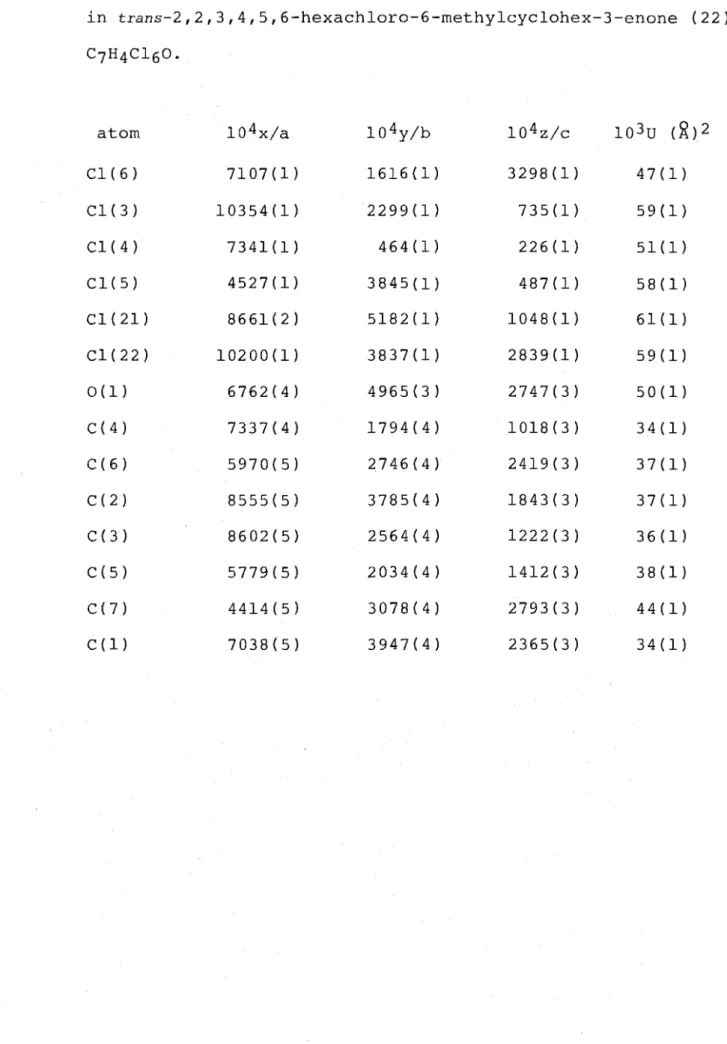
Chromatotron* equipped with a silica gel plate. First eluted was the trans isomer (22), C7H4C160, m.p. 109.S-ll0.So, the structure of which was established by single-crystal X-ray analysis. A perspective drawing of this structure (22) is presented in Figure 1 and the corresponding atomic
co-ordinates are given in Table 1#.
In the crystalline state, structure (22) exists with its cyclohex-3-enone ring structure in a twist-boat conformation as shown by the relevant torsion angles C(3)-C(4)-C(S)-C(6) -29.0(S)0 and C(1)-C(2)-C(3)-C(4) 9.6(S)0. Previously, i t had been assumed that the ring conformation was a
modified half-chair. 22 The CS-Cl bond is in the flagpole orientation, C(3)-C(4)-C(S)-Cl(S) 90.S(4)0, notably different from the previously assumed orientation. 22 The C6-Cl and C6-Me bond orientations, with respect to the carbonyl
function, are closely similar to the a-axial and a-equatorial bond orientations in a cyclohexanone in the chair conformation, as shown by the torsion angles
M~
[ I
O(1)-C(1)-C(6)-Cl(6) -107.S(4)0 and O(1)-C(1)-C(6)-C(7)
l2.2(S)0 respectively. This structural feature is reflected in the infrared carbonyl stretching frequencies of these compounds. It is known that an equatorial chlorine atom of an a-chlorocyclohexanone will shift the infrared carbonyl stretching frequency by approximately 20 cm- l to higher wave
* (Refer to experimental section; Apparatus, Materials and Instrumentation)
number,25,26 due to increased dipole-dipole interaction of the equatorial chlorine with the carbonyl function. An axial chlorine atom however, has little or no effect upon the carbonyl stretching frequency.
In contrast, and as a consequence of the cyclohex-3-enone ring conformation, the magnitude of the torsion angles between the C2-substituents and the carbonyl
functional group are much more similar, O(1)-C(1)-C(2)-Cl(2l) -47.0(4)° and O(1)-C(1)-C(2)-Cl(22) 68.6(4)°,
Eluted subsequent to (22) was an isomeric compound (23) C7H4C160, m.p. 122.5-123°. With the structure of ketone (22) determined as above, the structure of the C6-epimeric compound (23) is defined by exclusion. The
infrared carbonyl stretching frequencies of (22) (v 1760 cm- l ) and (23) (v 1778 cm- l ) (Nujol mulls) are markedly different. Assuming that the ring conformations of (22) and (23) are similar in the solid state, this difference (18 cm- l ) is consistent with the known effects of axial and equatorial
chlorine atoms on the infrared carbonyl stretching frequencies of a-chlorocyclohexanones,25,26 The assumption that the
ring conformations of (22) and (23) are similar seems
reasonable since the X-ray crystal structures of cyclohex-3-enones (22),(28),(38),(46),(48),(49),(57),(58) and (59) all exhibit similar ring conformations (refer Table 16: Selected Torsion Angles for Polychlorocyclohex-3-enones). Furthermore, if the assumption is made that the conformations of (22) and
the angular (H19)3 methyl protons are deshielded by (6 0.32) by a 1,3-syn-axial 6-B-chloro substituent. 27
Me
In compound (23), the geometry of the molecule is such that the C(7)-Cl(2) syn distance is greater than in the steroid model. The observed differences in the C6-methyl IH n.m.r. chemical shifts between ketones (22) and (23) is
correspondingly reduced (6 0.13). Similar effects were observed in other C2 and C6 epimeric ketones, considered
later in this chapter.
On the above grounds, the second isomer (23) was assigned the cis stereochemistry, i.e. simply epimeric at C6 with ketone (22~
Morita and Dietrich reported the inverted stereochemistry at C6 for ketones (22) and (23)?2
2.1.2 Chlorination of 2,5-Dimethylaniline (24)
Chlorination of (24), as above, gave a mixture (c. 2:1)
of the pentachlorocyclohex-3-enones (25) and (26) (refer Block C). Crystallization of the crude material from pentane gave a mixture of the two isomers, which were separated on a Chromatotron silica gel plate. The major
component (25), CSH7C150, m.p. 129-130° was assigned the trans stereochemistry and the minor component, CSH7Cl:P, m.p.
their spectroscopic properties, by analogy to ketones (22) and (23).
The C2-methyl lH n.m.r. chemical shifts (25) (6 1.94) and (26) (6 2.08), follow closely those observed for ketones
(22) (61.97) and (23) (6 2.10). The infrared carbonyl stretching frequencies for isomers (25) (v 1758 cm- l ) and
(26) (v 1772 cm- l ) show a difference of (14 cm- l ), comparable
to that observed between ketones (22) and (23) (18 cm- l ), consistent with the isomers (25) and (26) being epimeric at C6.
Morita and Dietrich reported the inverted stereochemistry at C6 for ketones (25) and (26).21
2.2 Chlorination of 2,~-Dichloro-6-methylphenol, 2,3-Dimethylaniline and 3-Chloro-2-methylaniline
2.2.1 Chlorination of 2,4-Dichloro-6-methylphenol (27)
Chlorination of (27), as above, gave a mixture (c. 3:1) of the pentachlorocyclohex-3-enones (28) and (29) (refer
Block D). Crystallization of the crude material from pentane gave a mixture of the two isomers, which were separated on a Chromatotron silica gel plate. Compound (29), eluted first, was obtained in admixture with an impurity (c. 20%)
ketone (22),.as shown by the torsion angles C(3)-C(4)-C(5)-C(6) -27.9(8)° and C(1)-C(2)-C(3)-C(4) 6.7(8)°. The C5-Cl bond
is in the flagpole orientation C(3)-C(4)-C(5)-Cl(5) 92.2(6)°, a feature also observed in the structure of ketone (22).
The C6-gem-dichloro substituents assume the axial and equatorial positions, as shown by their torsion angles relative to the carbonyl functional group, O(1)-C(1)-C(6)-Cl(61) -104.4(5)° and O(1)-C(1)-C(6)-Cl(62) 12.3(7)°. These torsion angles are, again, close to those expected for the axial and equatorial bonds of an a-substituted cyclohexanone. The C2-substituents however, exhibit much more similar
torsion angles relative to the carbonyl functional group,
O(1)-C(1)-C(2)-C(7) 65.2(7)° and O(1)-C(1)-C(2)-Cl(2) -50.5(6)°. The consequence of this similarity in torsion angles is that the C2-C12/Cl=01 dipole interaction would not be dramatically different for C2-epimers, for example, (28) and (29).
Consequently differences in the infrared carbonyl stretching frequencies would be less marked than for C6-epimers, for example, ketones (22) and (23). In fact, compound (29)
(v 1761 cm- l ) has an infrared carbonyl stretching frequency
very close to that observed for its isomer (28) (v 1766 cm- l ),
Morita and Dietrich reported the correct stereochemistry for ketones (28) and (29), but their argument was based on incorrect conformations for the two compounds. 22
2.2.2 Chlorination of 2,3-Dimethylaniline (30)
Chlorination of (30) as above, gave a mixture (c. 1:3) of the pentachlorocyclohex-3-enones (31) and (32), (refer Block D),
gel plate.
which were separated on a Chromatotron silica Eluted first was the major component (32), C8H7C150, m.p. 84-85°, assigned the trans stereochemistry. Eluted subsequently was compound (31), C8H7C150, m.p. 128.5-129.5°, assigned the cis stereochemistry.
The structures were assigned to (31) and (32) by
analogy with ketones (28) and (29) on the basis of the lH n.m.r. and infrared spectroscopic data.
The C2-methyl lH n.m.r. resonances of (31) (0 2.06) and (32) (0 1.89), follow closely those observed for cyclohex-3-enones (28) (02.07) and (29) (0 1.89). The infrared carbonyl stretching frequencies of ketones (31) (v 1770 cm- l ) and (32)
(v 1767 cm- l ) are similar in frequency and in magnitude
of difference to those observed for ketones (28) (v 1766 cm- l ) and (29) (v 1761 cm- l ). On the above basis the two isomers
(31) and (32) are simply epimeric at C2.
Morita and Dietrich reported the inverted stereochemistry at C2 for the ketones (31) and (32).21
2.2.3 Chlorination of 3-Chloro-2-methylaniline (33)
Chlorination of (33) as above, gave a mixture (c. 2:3)
Eluted first was compound (35), C7H4C160, m.p. 60-61°, assigned the trans stereochemistry. Eluted subsequently was the isomeric compound (34), m.p. 111.5-112°, assigned the cis stereochemistry. The structures were assigned by analogy to ketones (31) and (32) and to ketones (28) and
(29), on the basis of the spectroscopic data. The C2-methyl IH n.m.r. resonances of ketones (31) (6 2.17) and (32)
(6 1.99) follow the trend observed for ketone pairs (28) (6 2. 07) and (29) (6 1.89) and for (31) (6 2. 06) and (32) (6 1.89), The larger difference in chemical shift between ketones (34) and (35) is most probably attributable to the C3-chlorine substituent.
The infrared carbonyl stretching frequencies of
ketones (34) (v 1770 cm- l ) and (35) (v 1765 cm- l ) parallel those observed for ketone pairs (28) and (29) and for (31) and (32). The small difference in the infrared carbonyl
stretching frequencies between ketones (34) and (35) (5 cm- l ) indicates that these ketones are C2-epimers.
Morita and Dietrich reported the inverted stereochemistry at C2 for the ketones (34) and (35).
2.3 Chlorination of 2,3,6-Trimethylphenol, 2,6-Dimethylaniline and 2,6-Dimethylphenol
2.3.1 Chlorination of 2,3,6-Trimethylphenol (36) Chlorination of (36), as above, followed by
crystallization of the crude product from pentane, gave a mixture (c. 3:1) of the tetrachlorocyclohex-3-enones (37) and (38) (refer Block E), the components of which were
The structure of the first eluted compound (38),
C9HIOC140, m.p. 106-107°, was determined by single-crystal X-ray analysis. A perspective drawing is presented in Figure 3, with the corresponding atomic co-ordinates given in Table 3. The ring structure of the cyclohex-3-enone (38), in the solid state, (twist-boat), is almost identical to that observed for the cyclohex-3-enone (22) above, and
similar to other cyclohex-3-enones, as shown by the relevant torsion angles C(3)-C(4)-C(5)-C(6) -31(1)° and C(1)-C(2)-C(3)-C(4) 11(1)° (refer Table 16).
The C5-Cl bond is in a flagpole orientation as shown by the torsion angle C(3)-C(4)-C(5)-Cl(5) 89(1)°, similar
to cyclohex-3-enones (22) and (28) above. The C6-substituents adopt the axial and equatorial bond orientations, as shown by the torsion angles relative to the carbonyl function, O(1)-C(1)-C(6)-Cl(6) -108.5(9)° and O(1)-C(1)-C(6)-C(9) 9(1)°. In contrast, the C2-substituents exhibit torsion angles, relative to the carbonyl function, much more similar in magnitude, Cl(2) 73(1)° and O(1)-C(1)-C(2)-C(7) -44(1)°.
Comparison of the spectroscopic data for ketone (38) with that of the isomer (37), allows assignment of the stereochemistry to the latter compound. The close
similarity of the infrared carbonyl stretching frequencies for (37) (v 1742 cm- l ) and (38) (v 1740 cm- l ) indicates a common C6-Cl bond orientation for the two isomers. The lH n.m.r. spectrum of ketone (37) (8 2.02) shows the C2-methyl-protons to be deshielded (8 0.20) relative to the
ketone (37). On the above basis the compounds (37) and (38) are simply C2-epimers.
Morita and Dietrich reported the inverted stereochemistry at C2 for the ketones (37) and (32).22
2.3.2 Chlorination of 2,6-Dimethylaniline (39)
Chlorination of (39), as above, gave a mixture (c. 2:3)
of the tetrachlorocyclohex-3-enones (40) and (41) (refer Block E), which were separated on a Chromatotron lica gel plate. The structures of the isomers (40) and (41) were assigned by analogy with the trimethyl ketones (37) and (38) on the basis of their spectroscopic data, which parallel closely those observed for the ketones (37) and (38). The C2-methyl lH n.m.r. resonances for ketones (40) (8 2.02) and (4l) (8 1.82) are ident 1 to those observed for ketones (37) and (38) respectively, indicating a 1,3-syn-axial relationship in compound (40). The infrared carbonyl stretching frequencies for ketones(40) (v 1748 cm- l ) and (41)
(v 1745 cm- l ) differ by only 3 cm-- l , indicating a common C6-Cl bond orientation for the two isomers. On the above
basis the isomeric ketones (40) and (41) are simply C2-epimers. Morita and Dietrich reported the inverted stereochemistry at C2 for the ketones (40) and (4l)?2
2.3.3 Chlorination of 2,6-Dimethylphenol (42)
Chlorination of (42), as above, gave a mixture (c.3:2) the pentachlorocyclohex-3-enones (43) and (44) (refer
Block E). Crystallization of the crude material from pentane gave the isomer (43). The second isomer (44) was separated from the crude mixture on a Chromatotron silica gel
Chlorination of 2,6-dimethylphenol (42) has been reported by Vollbracht et.al.28 to yield only one
pentachlorocyclohex-3-enone. On the basis of its infrared spectrum and III n.m.r. spectrum and a consideration of
Dreiding and Stuart-Courtauld models, these authors suggested that the cyclohex-3-enone ring existed in a conformation
intermediate between a half-chair form and one of two
extremeboat-forms. 28 In this conformation i t was proposed that the C6-Cl bond was axial, the C5-ll bond was close to planar with the alkene system, and the C5-Cl bond was close to perpendicular to that plane. This conformation described, corresponds closely to that expected for compound (43) on the basis of the crystal structures for cyclohex-3-enones
(22) (28) and (38), considered above.
Taking into account the downfield chemical shift of the C2-methyl III n.m.r. signal, due to the proximal C3-Cl
atom (an effect also observed in ketones (34) and (35) above), the structures of ketones (43) and (44) can be assigned by analogy to ketones (37) and (38) and to ketones (40) and (41) above. The difference in the C2-methyl III n.m.r. resonances between ketones (43) (0 2.11) and (44) (0 1.88) indicates that a s~-axial C2-methyl/C6-Cl relationship is present in ketone (43). The similarity of the infrared carbonyl stretching frequencies for ketones (43) (v 1750 cm- l ) and
(44) (v 1750 cm- l ) indicate a common C6-Cl bond orientation for the two isomers. On the above grounds the pentachloro-cyclohex-3-enones are simply C2-epimers.
Morita and Dietrich 22 also reported only one isomer
but assumed the incorrect conformation for that compound. 22
2.4 Chlorination of 2,5-Dimethylphenol, 3,5-Dimethylphenol, 2,3,4,6-Tetrachloro-5-methylphenol, 2,3-Dimethylphenol and 2,3,4,5-Tetrachloro-6-methylphenol
2.4.1 Chlorination of 2,5-Dimethylphenol (45)
Chlorination of (45), as above, gave a mixture
(c. 5:17:13:9:24:11) of the compounds (46), (47), (48), (49), (25) and (26), which were separated on a Chromatotron silica gel plate. Compounds (25) and (26) were shown to be
identical to those formed from the chlorination of 2,5-dimethylaniline (24) (Section 2.1.2).
The structure of ketone (46), CSH6C160, m.p. 94.5-95°, eluted subsequent to ketones (25) and (26), was determined by single-crystal X-ray analysis. A perspective drawing is presented in Figure 4 and the corresponding atomic
co-ordinates are given in Table 4. The cyclohex-3-enone ring structure of (46) is in a twist-boat conformation as shown by the relevant torsion angles C(3}-C(4}-C(5)-C(6) -28.9(3)° and C(1)-C(2}-C(3)-C(4) 8(1}0. This conformation is similar to that observed for the cyclohex-3-enones (22), (28) and (38) above (refer Table 16). In contrast to those structures, the C5-ring carbon of ketone (46) is fully substituted, bearing a methyl group and a chlorine atom. Despite this difference the C5-Cl bond still adopts the flagpole
O(1)-C(1)-C(6)-Cl(61) -104.5(8)° and O(1)-C(1)-C(6)-Cl(62) 12(1)°. The C2-substituents however, exhibit torsion
angles, relative to the carbonyl function, much more similar in magnitude, O(1)-C(1)-C(2)-Cl(2) -51.2(9)° and O(1)-C(1)-C(2)-C(7) 65.5(9)°. These structural features are also similar to those observed for the structures of ketones (22), (28) and (38) above.
Eluted subsequent to ketone (46) was the 2,5-dienone (47), which crystallized from pentane as pale yellow needles, m.p. 55-56°. The structure assigned to dienone (47) by
Morita and Dietrich 22 is in accord with the observed spectroscopic properties.
Eluted subsequent to dienone (47) were two polysubstituted cyclohex-2-enones (48) and (49).
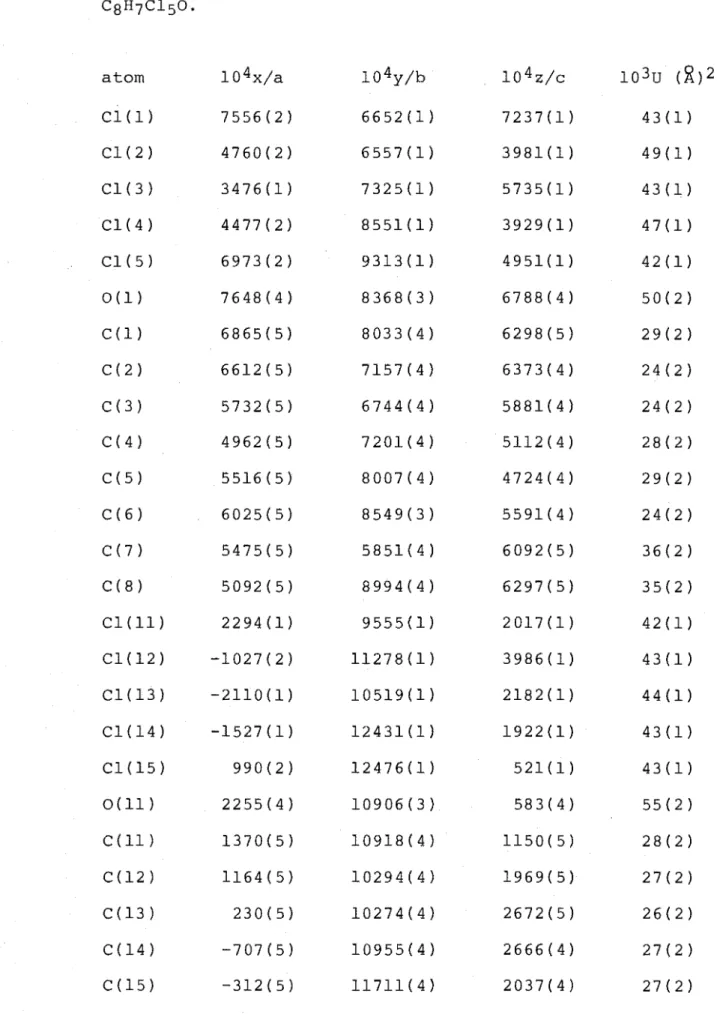
The structures of cyclohex-2-enones (48) and (49) were determined by single-crystal X-ray analysis. A perspective drawing of cyclohex-2-enone (48), C8H9C150, m.p. 92.5-93°, is presented in Figure 5 and the corresponding atomic
co-ordinates given in Table 5 . . The cyclohex-2-enone ring structure of ketone (48) is in a twist-boat conformation, as shown by the relevant torsion angles C(2)-C(3)-C(4)-C(5) 18.7(8)° and C(3)-C(4)-C(5)-C(6) -47.8(7)°.
In contrast to the cyclohex-3-enones (22), (28) and (38) the C5-Cl bond of cyclohex-2-enone (48) adopts the
O(l)-C(l)-C(2)-Cl(1) 0.0(8)°. The structure determined contains two independent molecules in the asymmetric unit. Least-squares best-fit calculations using the programme XFIT29 show the
two molecules to be essentially non-crystallographic mirror images of each other, with only minor conformational differences.
A perspective drawing of the isomeric compound (49), C8H9C150, m.p. 84-85°, is presented in Figure 6 and the
corresponding atomic co-ordinates are given in Table 6. The cyclohex-2-enone ring structure of ketone (49) is in a
twist-boat conformation, as shown by the relevant torsion angles C(2)-C(3)-C(4)-C(5) 14.0(5)° and C(3)-C(4)-C(5)-C(6) -42.3(4)°. These angles are comparable to those observed for cyclohex-2-enone (48).
The C5-Cl bond adopts the equatorial position and the C5-H5 the axial position. The C6-substituents adopt the axial and equatorial positions, as shown by their torsion
angles relative to the carbonyl function, O(1)-C(1)-C(6)-Cl(6) -90.3(4)°* and O(1)-C(1)-C(6)-C(8) 26.1(5)°.*
The infrared carbonyl stretching frequencies (Nujol mulls) for compounds (48) and (49) reflect the differences
between the two structures. Ketone (49) (v 1708 cm- l ), has the C6-Cl bond in the axial orientation while ketone (48)
(v 1718 cm- l ) has the C6-Cl bond in orientation close to that
for an equatorial position. Consequently the infrared carbonyl stretching frequency for ketone (48) is observed at a higher frequency. The difference is not as great in magnitude as that observed for the cyclohex-3~enones (22) and
(23), because the C6-C15 and C6-C8 bonds are more equally bisected by the carbonyl function in ketone (48) than in the cyclohex-3-enone examples, above.
Vollbracht et.al. reported the formation of (25) from the chlorination of 2,5-dimethylphenol. 28 Morita and Dietrich, in contrast, reported the formation of ketones (25) and (26) together with ketone (46), to which they assigned the
correct stereochemistry but assumed the incorrect conformation. Cyclohex-2-enone (48) was reported in
admixture with 2,5-dienone (47) by Morita and Dietrich, 22 but no attempt was made to assign the stereochemistry.
2.4.2 Chlorination of 3,5-Dimethylphenol (50)
Chlorination of (50),as above, gave a mixture (c. 1:9)
of the compounds (51) and (52) (refer Block G).
Crystallization of the crude product gave the 2,5-dienone (52). Separation of the components of the remaining
mixture on a Chromatotron silica gel plate gave the
hexachlorocyclohex-3-enone (51). The structure of ketone (51) was determined by consideration of the spectroscopic data and by analogy with other cyclohex-3-enones above, on the assumption that the C5-Cl bond was in the flagpole
orientation. This assumption seems reasonable, since the X-ray structure of the cyclohex-3-enone (46) with the C5-Me/C5-Cl structural feature, and the ketones (22), (28) and (38) with the C5-H/C5-Cl structural feature, all have the C5-Cl bond in that orientation. On the above basis, the C5-methyl IH n.m.r. resonance for ketone (51) (0 2.20)
deshielding ef of the C3-Cl atom. The chemical shift of the C3-methyl IH n.m.r. resonance of the ketone (51)
(6 2.30) suggests that the methyl group is attached to an olefinic carbon atom. ~e ketones (25) and (26) exhibit
similar C3-methyl resonances for the methyl groups in similar environments to ketone (51).
Morita and Dietrich assigned the same gross structure to ketone (51), but assumed that the C5-methyl bond was pseudoaxial and thus proposed the incorrect conformation for ketone (51).22
Vollbracht et.al. 28 reported the 2,5-dienone (52) as being the only product from the chlorination of 3,5-dimethylphenol (50). The structure of this 2,5-dienone
(52) was assigned on the basis of its spectroscopic data, and was the structure proposed earlier by Auwers et.al.,30 Muller and Linde 31 and Fort. 32
2.4.3 Chlorination of 2,3,4,6-Tetrachloro-5-methylphenol (53) Chlorination of (53), as above, gave a mixture (c. 3:2)
of the compounds (54) and (55), which were separated on a Chromatotron silica gel plate.
The issue in question in this case was the position
of the methyl group. It was possible that the methyl group was located at the olefinic C3-ring carbon atom, since the
observed IH n.m.r. resonance for ketone (54) (0 2.27) is close to that expected for such a methyl group, cf. ketone
(51) (6 2.30). Alternatively the methyl group could be
located at the sp3 C5 site. The IH n.m.r. resonance for the C5-methyl in ketone (46) (6 2.25) is also close to that
resolved by examination of the infrared C=C stretching
frequency of ketone (54) in comparison with other cyclohex-3-enones (refer Table 2.1). It was observed that a difference of approximately 22 cm- l in the infrared C=C stretching
frequency occurred betweeen polychlorocyclohex-3-enones
differing only in the substituent at C3 (i.e. Cl or methyl). Comparison of the infrared olefinic stretching frequencies
for the cyclohex-3-enones in Sections 2.1, 2.2 and 2.3, all having ... Cl
the common C5 structural feature, shows that the infrared ... H
olefinic stretching frequency is largely independent of the nature of the C2- and C6-substituents and of the stereo-chemistry at these sites. Therefore the dominant factor
fecting the infrared olefinic stretching frequency is the nature of the SUbstituent at C3 (since C4 always bears a Cl atom in these structures). Replacement of the C5-H atom by a methyl group (or a chlorine atom as shown in Section 2.4, later) results in a shift in the infrared olefinic stretching frequency by approximately 20 cm- l to lower frequency. This shift is observed for both Cl and C3-methyl as shown by ketones (46) and (51). On the above basis, ketone (54) (v 1597 cm- l ) (C=C) must have a chlorine
atom as the C3-substituent, the methyl group is therefore at C5. Assuming that the heptachlorocyclohex-3-enone (54) is in a similar conformation to those cyclohex-3-enone structures discussed above, then the IH n.m.r. methyl resonance of (54) (6 2.27) is consistent with the methyl group being in a similar orientation to that found for ketone (46) (6 2. 25 ) .
2.1
2.2
2.3
2.4
Cl Cl
""'C:::::C/ (22) (23) (34) (35) ( 43) (44)
( 46 )
1622 1612 1623 1620 1625 1627 1607 *(54) 1597 (57) 1603 (58) 1596
( 61) 1598
(25) (26) (31) (32) (37 ) ( 38) (51)
( 59 )
1645 1640 1646 1640 1643 1648 1627 1620 23 28 23 20 18 21 20 22
the C5-methyl group pseudoaxial. 2l
The structure of the 2,5-dienone (55) was proposed by Crowther and McCombie in 1913 (m.p. 92°)33 and subsequently by Morita and Dietrich 2l and is in accord with its
spectroscopic data.
2.4.4 Chlorination of 2,3-Dimethylphenol (56)
Chlorination of (56), as above, gave a mixture (c. 8:2:1)
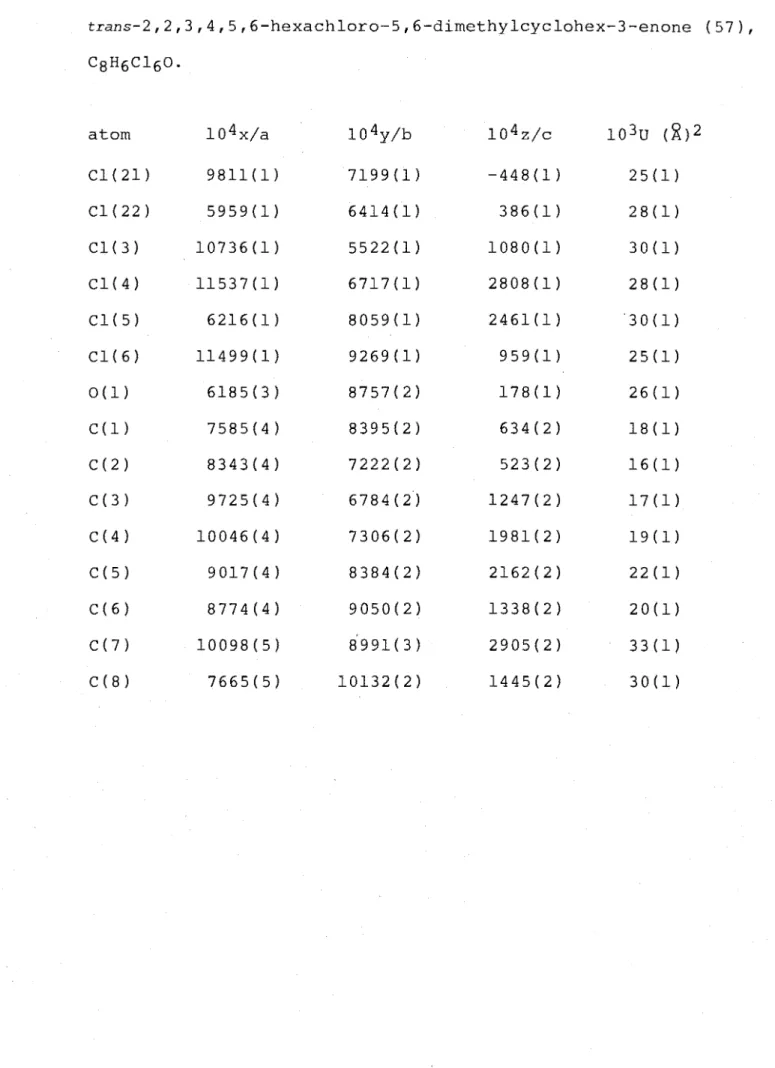
of the compounds (57) (58) and (59) (refer Block H), which were separated on a Chromatotron silica gel plate. Eluted first was the hexachlorocyclohex-3-enone (57), C8H6C160,
m.p. 87-88°, the structure of which was determined by single-crystal X-ray analysis. A perspective drawing is presented in Figure 7 and corresponding atomic co-ordinates are given in Table 7.
The cyclohex-3-enone ring structure is in a twist-boat conformation, as shown by the torsion angles C(3)-C(4)-C(5)-C(6) -32.8(3)° and C(1)-C(2)-C(3)-C(4) 8.5(4)°. These
angles, and hence the conformation, are similar to those observed for other cyclohex-3-enones (refer Table 16). The C5-Cl bond adopts the flagpole orientation, as shown by the torsion angle C(3)-C(4)-C(5)-Cl(5) 80.2(3)°. The
C6-substituents Cl(6) and C(8) adopt the axial and equatorial positions respectively, as shown by their torsion angles
relative to the carbonyl function, O(1)-C(1)-C(6)-Cl(6)
-108.6(2)° and O(1)-C(1)-C(6)-C(8) 8.8(3)°. The C2-substituents adopt positions with torsion angles, relative to the
polychlorocyclohex-3-enone structures (refer Table 16).
The structure of the C6-epimer (58), C8H6C160, m.p. 142-143°, eluted subsequent to compounds (57) and (59), was
determined by single-crystal X-ray analysis. A perspective drawing of ketone (58) is presented in Figure 8 and
corresponding atomic co-ordinates are given in Table 8. The cyclohex-3-enone ring structure of ketone (58) (twist-boat) is almost identical to that of ketone (57) above, as shown by the relevant torsion angles C(3)-C(4)-C(5)-C(6) -32.6(3)° and C(1)-C(2)-C(3)-C(4) 9.5(3)°. The C5-Cl atom is again in the flagpole orientation as shown by the torsion angle C(3)-C(4)-C(5)-Cl(5) 82.9(2)°. The C6-substituents C(8) and
(C16) adopt the axial and equatorial positions
respectively, as shown by their torsion angles, relative to the carbonyl function, O(1)-C(1)-C(6)-C(8) -106.8(3)° and O(1)-C(1)-C(6)-Cl(6) 10.7(3)°. The C2-substituents Cl(2l) and Cl(22) adopt positions with torsion angles, relative to the carbonyl function, more similar in
magnitude, O(1)-C(1)-C(2)-Cl(2l) 75.7(2)° and O(l)-C(l)-C(2)-Cl(22) -40.4(2)°.
The difference between the two structures (57) and (58) is reflected in the infrared carbonyl stretching frequencies. Ketone (58) (v 1765 cm- l ) has the C6-equatorial chlorine atom, and consequently the infrared carbonyl stretching
band occurs at higher frequency than for ketone (57) (v 1760 cm- l ) with the C6-axial chlorine atom. This effect was
observed for other C6-epimeric cyclohex-3-enones above, but is of smaller magnitude (5 cm- l ) than the examples previously discussed
0£
20 cm- l ).C5-ring carbon has gern-dichloro substituents. The issue in this structure was whether the C2-substituents (Cl and methyl) would dictate the conformation of the cyclohex-3-enone ring structure.
At room temperature the lH n.m.r. spectrum of ketone (59) showed one sharp resonance (0 2.19) due to the C3-methyl
group and one very broad resonance (0 1.98, 10Hz at half height), assigned to the C2-methyl group. Repeating this experiment at lower temperature (-12°), the lH n.m.r.
spectrum of (59) resolved into 3 sharp peaks (0 2.20) (0 2.13) (0 1.89) in an approximate ratio 2:1:1. On the above basis i t appeared reasonable to suggest, at least in the solution state, that the ketone (59) exists as an equilibrium
mixture of the two conformers (59a) and (59b). The observed lH n.m.r. methyl resonances (at -12°) are as expected for such conformational isomers, being similar to the chemical shifts for methyl groups in the isomeric pairs (31) ~ 2.07) and (32) (0 1.89), and (34) (0 2.17) and (35) (0 1.99).
In the soli? state, the infrared carbonyl stretching frequency for compound (59) (Nujol mull) shows a single peak (~ 1761 cm- l ).
While this may suggest that the ketone (59) exists as only one conformer in the solid state, the possibility that both conformers (59a) and (59b) exist in the solid state cannot be excluded, since i t has been observed that the
orientation of C2-substituents (when Cl and methyl) on other cyclohex-3-enones has little or no effect on the infrared carbonyl stretching frequency.
A single-crystal X-ray analysis was performed upon a
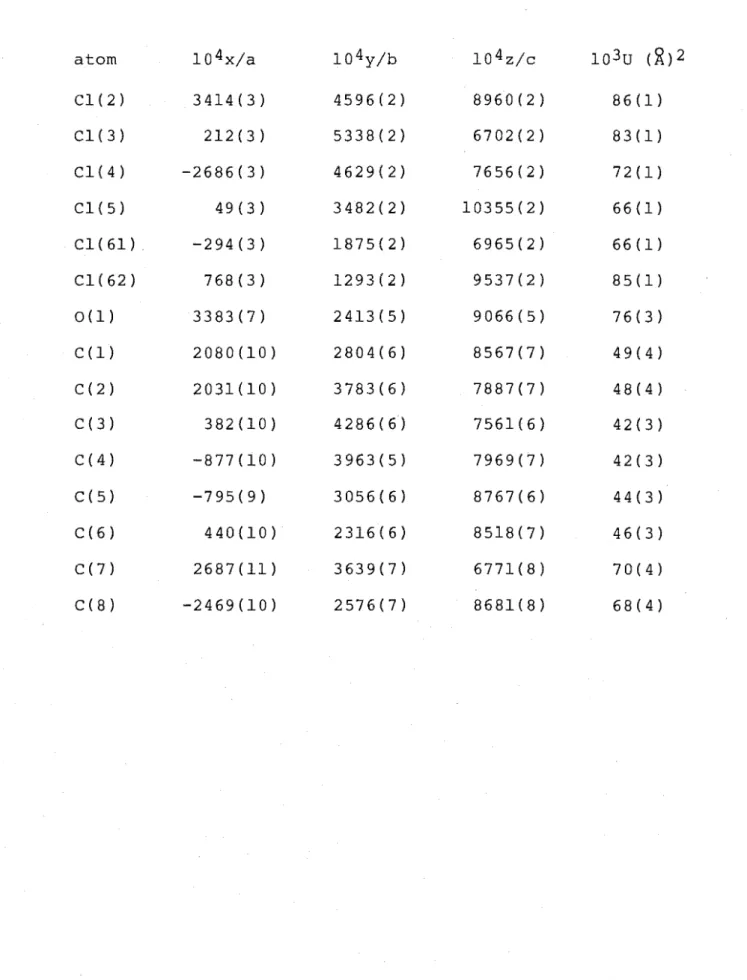
from pentane, CSH6C160, m.p. 92-92.5°. A perspective drawing of the structure is presented in Figure 9 and the corresponding atomic co-ordinates are given in Table 9. The cyclohex-3-enone ring structure of ketone (59) is in a twist-boat conformation, as shown by the torsion angles C(3)-C(4)-C(5)-C(6) -26.9(5)° and C(1)-C(2)-C(3)-C(4) 6.6(5)°. The C6-substituents Cl(61) and Cl(62) adopt the equatorial and axial orientations respectively, as shown by their torsion angles relative to the carbonyl function, O(1)-C(1)-C(6)-Cl(61) 7.0(4)° and O(1)-C(1)-C(6)-Cl(62) -111.1(2)°. The C2-substituents Cl(2) and C(7) were found to be
non-stoichiometrically disordered about the C2-ring carbon atom. The C2-chlorine atom was found to have a
site-occupancy-factor of 0.S5 in the position Cl(2), Figure ga, and 0.15 in the position Cl(2)', Figure 9b, as shown by the torsion angles
O(1)-C(1)-C(2)-Cl(2) -44.1(4)° and O(1)-C(1)-C(2)-Cl(2)' 77.3(5)°, respectively. Correspondingly the C2-methyl group was found to have a site-occupany-factor of 0.85 in the
position C(7), Figure 9a and 0.15 in the position C(7) I ,
Figure 9b, as shown by the torsion angles, O(1)-C(1)-C(2)-C(7) 70.5(5)° and O(1)-C(1)-C(2)-C(7)' -39.3(9)°, respectively.
Morita and Dietrich 22 reported ketones (57) and (58) as being the products of chlorination of 2,3-dimethylphenol
(56). The structures they proposed for these compounds were 5,6-trans-dimethyl conformers, i.e. for the compound (57), the C5-methyl group equatorial and the C6-methyl group
equatorial, and for compound (58), the C5-methyl group axial and the C6-methyl group axial, for the cyclohex-3-enone
ring in a half-chair conformation. On this basis the
(58) incorrect. In both cases the incorrect ring conformation was assumed.
The hexachlorocyclohex-3-enone (59) was not reported as a product in the above reaction.
2.4.5 Chlorination of 2,3,4,5-Tetrachloro-6-methylphenol (60) Chlorination of (60), as above, gave a mixture (c. 3:2)
of the compounds (61) and (73) (refer Block I), which were separated on a Chromatotron silica gel plate. rhe molecular uncertainties for compound (61) were, (i) whether the methyl group was located at C2 or C6 and (ii) whether the C2 (or C6) methyl substituent dictated the ring conformation.
The IH n.m.r. spectrum of compound (61) at room
temperature shows a single very broad resonance (0 2.10, 7Hz
at half height). Repeating the experiment at -10°, the IH n.m.r. spectrum resolves into two sharp peaks (0 2.22) and (0 2.00).
On this basis i t seems reasonable to suggest that the ketone (61) exists as a mixture of the C2-conformers, at least in solution. The IH n.m.r. methyl chemical shifts,
observed at. -10°, are as expected by analogy with the C2-epimers (34) (0 2.17) and (35) (0 1.99).
The infrared spectrum ~ujol mull) of the ketone (61) shows two carbonyl stretching frequencies (v 1778 cm- l ) and
(v 1768 cm- l ) of equal intensity. It therefore seems likely that both C2-conformers of ketone (61) exist in the solid state. The small difference between the infrared carbonyl stretching frequencies (10 cm- l ) is consistent with the methyl group being at C2.
any conformational mobility for this compound. The structure proposed by Morita and Dietrich for ketone (61) was based on the incorrectly assumed half-chair conformation with the methyl group at C2 in the axial orientation. 2l
The 2,4-dienone (73) formed in this reaction, was assigned the structure on the basis of its spectroscopic properties by Morita and Dietrich. 2l The formation of these 2,4-dienones are discussed in detail in a later chapter.
2.5 Chlorination of 3-Methylphenol (63)
Chlorination of (63), as above, gave )75% of the
hexachlorocyclohex-3-enone (64) (refer Block I), which was crystallized from the crude material from pentane/diethyl-ether.
Morita and Dietrich had reported ketone (64) as being the major product of the chlorination of 3-methylphenol (63)Jl
CHAPTER 3
FORMATION OF 6-CHLOROCYCLOHEXA-2,4-DIENONES FROM POLYSUBSTITUTED PHENOLS
3.1 Introduction
Denivelle and Fort 19 reported the formation of 6-chlorocyclohexa-2,4-dienones from the chlorination of
phenols in the presence of pyridine in carbon tetrachloride. Morita and Dietrich 21 subsequently used a similar method to prepare a number of 6-chlorocyclohexa-2,4-dienones, in the course of their identification of some minor products formed by the reaction of ortho and meta cresols with chlorine in acetic acid. Our interest was in preparing a number of these 6-chlorocyclohexa-2,4-dienones so that the addition of chlorine in acetic acid to the 2,4-dienone system could be studied.
The reaction conditions employed differed slightly from those used by the above workers. In general, the phenol was dissolved as a 10% solution in carbon
tetrachloride and an equimolar amount of pyridine. Chlorine, as a chlorine/carbon tetrachloride solution, was added
dropwise, in slight excess, (1.1 mole equivalent) to the rapidly stirred phenolic solution at 0°. The reaction was rapid, as judged by the immediate formation of a pyridine hydrochloride precipitate. A neutral aqueous
3.2 Reaction of Polysubstituted Phenols with Chlorine in Carbon Tetrachloride and Pyridine
3.2.1 Reaction of 2,4-Dichloro-6-methylphenol (65)
Chlorination of phenol (65), as above, gave the 2,4-dienone (66) (refer Block J), as a pale yellow oil. This
oil was shown (IH n.m.r.) to be essentially pure dienone (66). Attempts to chromatograph the oil on silica resulted in
decomposition and crystallization from a variety of solvents failed to yield any solid material. The structure was
assigned on the basis of its spectroscopic properties.
The infrared spectrum (v 1698 cm-l,C;Q and 1625, 1560
cm- l , C=C) confirms the presence of a conjugated dienone system. The lH n.m.r. chemical shift of the C6-methyl group
(0 1.83) (refer Table 3.1)* is downfield relative to that expected for a vinylic methyl group adjacent to a
carbonyl function (c. 2.0-2.1 ppm). This indicates that the ring carbon bears a chlorine atom in addition to the C6-methyl group. This downfield chemical shift of the C6-methyl proton resonance, is observed consistently for all the
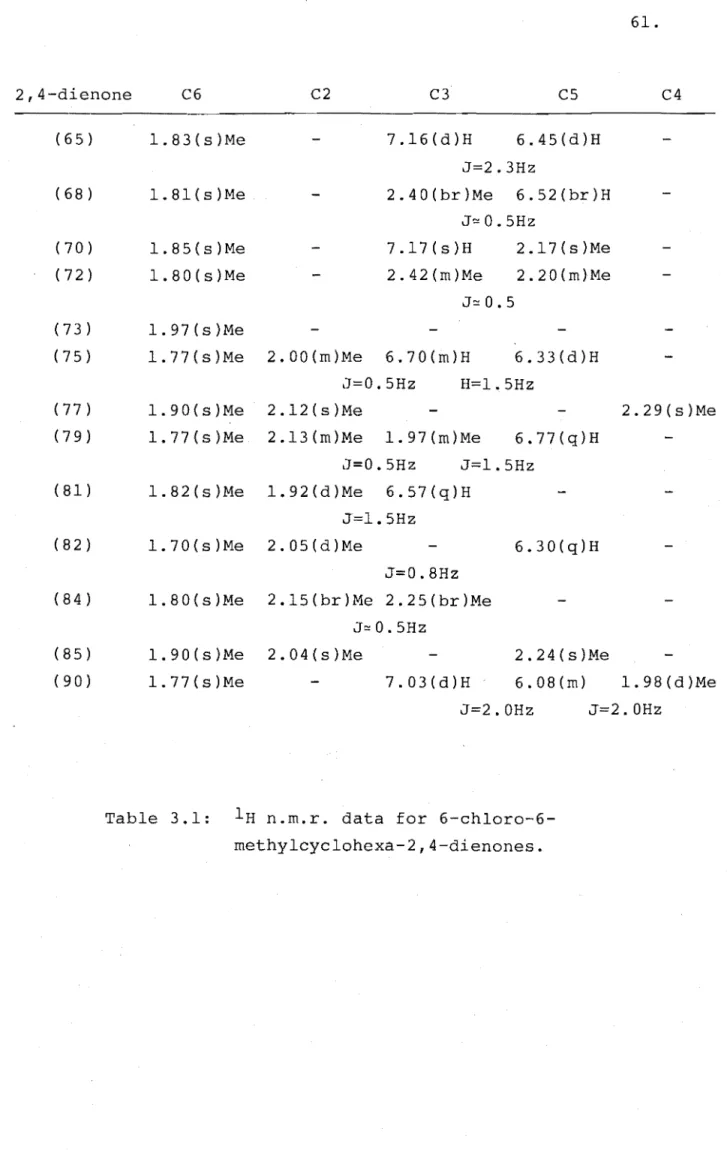
6-chloro-6-methylcyclohexa-2,4-dienones prepared (refer Table 3.1).
The C3-H and C5-H proton resonances appear as doublets (J 2.3 Hz), this is consistent with allylic coupling as part of the linear 2,4-dienone w-system. Furthermore, the
C6-methyl proton resonance appears as a sharp singlet, coupling between these protons and the adjacent C5-H proton does not occur, again consistent with the proposed structure. The
structure of 2,4-dienone (66) is in agreement with that proposed by Morita and Dietrich,21 the 2,4-dienone (66) being formed by selective ipso chlorine attack at the ortho position bearing the methyl group.
3.2.2 Reaction of 2,4-Dichloro-3,6-dimethylphenol (67) Chlorination of phenol (67), as above, gave the 2,4-dienone (68) (refer Block J), which crystallized from
dichloromethane/pentane as pale yellow crystals, m.p. 57-58°. The structure of this compound (68) was assigned on the
basis of its spectroscopic data. The infrared spectrum
(v 1695 em-I,
c=o
and 1630, 1554 em-I, C=C) confirms the presence of a conjugated dienone system.The IH n.m.r. spectrum, (refer Table 3.1) exhibited a C6-methyl proton resonance (8 1.81) consistent with that observed for other 6-chloro-6-methylcyclohexa-2,4-dienones. The C3-methyl resonance (8 2.40) is consistent with that expected for a vinylic methyl group. The C3-methyl protons and the C5-H proton are coupled (J=0.5 Hz), in accord with homoallylic coupling in the linear 2,4-dienone n-system. Coupling between the C6-methyl group protons and the C5-H proton is absent, the C6-methyl peak appearing as a sharp singlet. This structure (68) is in agreement with that proposed by Morita and Dietrich,22 and the 2,4-dienone (68) is formed by selective ipso chlorine attack at the ortho position bearing the methyl group.
3.2.3 Reaction of 2,4-Dichloro-5,6-dimethylphenol (69)
shown (IH n.m.r.) to be essentially pure dienone (70). The structure was determined from its spectroscopic properties. The infrared spectrum (v 1700 cm- l , c=o and 1625, 1575 cm- l , C=C) confirms the presence of a conjugated dienone system. The IH n.m.r. spectrum (refer Table 3.1) includes a C6-methyl proton resonance (6 1.85) similar to that observed for other 6-chloro-6-methylcyclohexa-2,4-dienones. The structure
therefore, is that of 2,4-dienone (70) and is in agreement with that proposed by Morita and Dietrich. 22
The 2,4-dienone (70) is formed by selective ipso chlorine attack at the oItho position bearing the methyl group.
3.2.4 Reaction of 2,4-Dichloro-3,5,6-trimethylphenol (71) Chlorination of phenol (71), as above, gave the 2,4-dienone (72) (refer Block J), as a pale yellow oil. This
oil was shown (IH n.m.r.) to be essentially pure dienone (72). The structure was determined from the spectroscopic data.
The infrared spectrum (v 1690 cm- l , c=o and 1620, 1560 cm- l , C=C) confirms the presence of a conjugated dienone system. The IH n.m.r. spectrum (refer Table 3.1) shows that the C6-methyl proton resonance (6 1.80) is similar to that
2,4-dienone (72) is formed by selective ipso chlorine attack at the ortho position 'bearing the methyl group.
3.2.5 Reaction of 2,3,4,5-Tetrachloro-6-methylphenol (60)
Chlorination of phenol (60), as above, gave the 2,4-dienone (73) (refer Block J), as a pale yellow oil, which crystallized from pentane as pale yellow crystals, m.p. 57-58°. The
structure was determined from its spe