1
Bachelor Thesis
“A narrative analysis of possible selves- An explorative study of letters from the future.”
Bianca Friederike Gräbel (s0194948) Bachelor Student Psychology
University of Twente
Supervisors University of Twente: Dr. Anneke Sools
Dr. Gerben Westerhof
2
List of contents Page
Summary 3
1. Introduction 4
1.1 Future imagining and wellbeing 4 1.2 Possible selves 6
1.2.1 Traditional definitions of possible selves 6
1.3 Narrative plots 8
1.4 Narrative psychology 9 1.4.1 The (possible) self in narrative psychology 10
1.5 Narrative futuring 10
1.6 Research questions 12
2. Method 12
2.1 Participants recruitment and selection 12
2.2 Procedure 13
2.3 Data analysis 14
2.3.1 Storyline analysis 15
2.3.2 Categorization of prototype plots 16 3. Results 16
3.1 Overview 16
3.2 Plots 18
3.2.1 Plot 1: Generative family plot 18
3.2.2 Plot 2: Interpersonal conflict plot 21 3.2.3 Plot 3: Redemptive self plot 24
3.2.4 Plot 4: Think positive plot 26 3.2.5 Plot 5: Better world plot 29 3.2.6 Plot 6: Perfect life plot 32 3.3 Comparison of different prototype plots and possible selves 34 4. Conclusions and Discussion 37
3 Summary
The relation of future imagining and wellbeing has been topic of interest in many studies. One form of future imagining is the construction of possible selves, e.g. “…future oriented
conceptions of how humans want to be or not want to be. “ (Markus & Nurius, 1986, 1987). Studies have already indicated that the imagination of future oriented best possible selves influences wellbeing. Another form of future imagining is the construction of future scenarios via narrations. The field of narrative psychology researches, in what way narrative futuring (imagining the future through stories) can influence actual wellbeing and promotes mental health in the present. Narrative futuring is a new branch in the field of narrative psychology. Studies examining the main elements involved in the process of narrative futuring lack. The actual research project “Letters from the future” of the Life Story Lab at the University of Twente is designed to examine, in what way narrative futuring works. The new aspect of the study is the analysis of the narrative construction of possible selves in the process of narrative
futuring to promote mental health and wellbeing in the present. Via the webpage of the Life Story Lab of the University of Twente, respondents were invited
to write a letter from the future to their actual self or anybody else in the present. The letter needs to have a positive character and should transport hope out of a better future.
In the present explorative study, 30 future letters were selected out of a pool of 491 letters. These letters were analyzed, using the method of storyline analysis. This method is based on Burkes (1949) conception of “Dramatism”. According to Burkes (1949), life can be
understood as a drama, consisting of „Act“, “Scene“, “Agent“, “Agency“ and “Purpose“, characterized by human motives. The storylines of the future letters were analyzed in terms of these elements. In the process of purposive sampling the different main story lines in the future letters, were explored and categorized into prototype plots. Each prototype plot is characterized by specific key topic, which can be recognized in a couple of future letters. Based on this categorization, it was further possible to define the different constructions of
possible selves embedded in these plots. The storyline analysis resulted in the categorization of 6 different prototypes of narrative
4
“Trouble” is here identified as a kind of imbalance between the elements of the narration, developed by Burke (1949).
The research results confirm the definitions of possible selves already available in
corresponding scientific literature. The results support the thesis of Markus & Nurius (1986, 1987) that “Possible selves” can be defined as future oriented conceptions of how humans want to be…..” (Markus & Nurius, 1986, 1987). Whereas in other studies it is mainly focused on best possible selves this study also provides new insights in terms of the exploration of other, new types of possible selves and their characteristic structure.
These findings indicate that the narrative construction of future oriented possible selves and narrative futuring in general, are new branches of the field of psychology, which need to be researched further.
The future letters represent an effective research tool to collect a great variety of data for the further narrative analysis of possible selves. The storyline analysis is a useful method, to make the different types of possible selves visible. The main new aspect of this study is that by analyzing the construction of possible selves in a narrative way, the dynamic process of developing a certain type of possible self has been made visible.
The study also provides limitations. By categorizing the letter’s individual content into prototype plots, specific, individual elements of each respondent’s possible self are lost. Furthermore the results need to be checked in terms of their interrater-reliability and needs to be repeated within different samples
This explorative study is a first attempt to define different types of possible selves and
5 1. Introduction
1.1 Future imagining and wellbeing
The study of future imagination is important to various branches in the field of psychology. According to Atance & O’Neil (2001), the ability to create an imagination of oneself in a certain future situation distinguishes humans from other species. Thinking about the future can be further seen as the driving force of the cultural evolution of human beings (Atance & O’Neil, 2001). Future imagining is thus a central element of the human existence, what underlines the
necessity to examine, in what way future imagining influences psychological functioning. The main question in this context is: “How does narrative future imagining work?” To be able to answer this question, it is necessary to analyze the main elements involved in the process of narrative futuring.
Various studies have examined the influence of future oriented thinking on psychological functions. The study of Meevissen, Peter and Albers (2011) indicates that future thinking promotes positive emotions and optimism. Projecting the self in a future situation, can also serve as a coping strategy (Averill& Sundararajan, 2004).
A positive view of the future is also an important element of psychological wellbeing (Mac Leod& Conway, 2007). In their study MacLeod & Conway (2007) underline the importance of positive future imagining on wellbeing. Their study indicates that people, who experience less wellbeing (in this case depressed people), have difficulties in imagining a positive future for themselves. These results show that there exists a relation between future imagining and wellbeing. One form of future imagining is the creation of possible selves
One possibility of positive future imagining is the creation of (best) possible selves.
Oyserman, Bybee, Terry & Hart-Johnson (2004) state that possible selves about future events can promote positive feelings. Possible selves, as well as goals, support the impression that the self is able to assimilate to future circumstances, what in turn promotes optimism and trust in the ability to make changes (Markus & Wurf, 1987). Self-enhancing possible selves evoke positive feelings, as well as hope and trust in the future. They make us feel good about
ourselves (Gonzalez, Burgess & Mobilio, 2001). Various studies have examined relation between best possible selves (BPS) and wellbeing. A
6
research has shown that the imagination of best possible selves, as well as writing about it, can increase optimism and mood (Meevissen, Peter & Alberts, 2010).
In their study Meevissen et. al (2010) look at the effect, daily imagining of a best possible self over a period of two weeks, has on optimism. Optimism is here defined as a personality trait that correlates with and predicts psychological and physical wellbeing (Schleier & Carver, 1986, 1992). The results of the study of Meevissen et. al. (2010) indicate that daily
imagination of a best possible self over two weeks can lead to increases in optimism. This effect appears by people already high in optimism, as well as by those, who are not. Peters, Flink, Boersma and Linton (2011) find out that writing about and imagining a BPS increases positives future expectancies. Imagining a positive future scenario has furthermore the same effect as behavior and does also lead to increased levels of confidence and success. To gain a deeper insight in the different imagined types of best possible selves, further research is needed (Meevissen, et. al., 2011).
The above mentioned studies indicate that there exists a relation between the imagination of (best) possible selves and wellbeing. Focusing on processes that promote wellbeing and mental health is the result of a recent paradigm shift in the field of psychology. This paradigm shift ends up in a redefinition of the term mental health. Instead of defining mental health by focusing on the appearance of psychopathological symptoms, also the grade of wellbeing is taken into account (Lamers, Westerhof, Bohlmeijer, Klooster, Keyes, 2011). This can be best understood as a shift from an illness-focused approach to wellbeing focused approach to
mental health. The promotion of wellbeing by telling stories is central to the field of narrative psychology.
This branch of psychology is introduced in paragraph 1.4 The following paragraph leaves the reader with a detailed definition of the construct of
possible selves as a form of future imagining. The narrative structure of possible will be underlined and the related key terms are introduced.
1.2 Possible selves
1.2.1 Traditional definitions of possible selves
7
imagination of how it would feel like to be in this certain future state. A possible self is consequently a more subjective emotional colored experience and less a neutral imagination of a certain future state. The construction of a possible self is a „…compelling vision or conception of the self in a future state. “(Wurf & Markus, 1991 p. 99).
Markus & Ruvolo (1989) pointed out that possible selves influence motivation. They can serve as goals that motivate us to achieve certain desired end-states. Undesired possible selves motivate us, to engage in behaviors, aimed at avoiding negative end- states (Markus &
Ruvolo, 1989). Summarized “possible selves” can be defined as future oriented conceptions of how humans want to be or not want to be.” (Markus & Nurius, 1986, 1987) and give “personalized meaning to global motives.”(Cantor, Markus, Niedenthal, & Nurius, 1986, p.99). .
According to Martin G. Erikson (2007) the theory of possible selves needs to be worked out further, to come to a clarified concept. He states that the definition of Markus and Nurius (1986, 1987) simplifies the conception of “Possible selves” and consequently main defining features of the conception of “Possible selves” are lost in their argumentation. In his
argumentation Erikson (2007) underlines the function of possible selves as agents of the future and focuses on their narrative structure.
Possible selves as agents of the future
The notion of agency implies that the conception of possible selves includes an impression of engaging in active behavior.
Agency can be understood as a kind of autonomy or flexibility in the process of creating and specifying possible selves. The creation of undesirable possible selves, without having any future oriented behavioral strategy to avoid these negative states, marks the absence of agency
(Markus & Nurius, 1986). In terms of Erikson (2007), the conception of “Agency” is not only involved in the process of
creating possible selves, but also influences the experience of those possible selves. It is a characteristic quality. According to Erikson (2007) possible selves are future oriented constructions, which include an experience of being an agent in this future situation. This agent acts by certain means .Therefore, examining the role of “Agency” in the construction of possible selves is crucial, to be able to define main types of possible selves.
8
Possible selves as narratives Erikson (2007) mentioned that possible selves have a narrative structure. That underlines the
necessity of a study that examines the narrative construction of different types of possible selves, as a form of narrative futuring.
Erikson states that „The possible self consists of a story we tell about ourselves in a
hypothetical future situation.”(Erikson, 2007, p. 355). He further points out that the narrative structure of possible selves is essential to the new definition of this concept and comes to the conclusion. that the narrative nature of possible selves needs to be researched further. Erikson gives specific directions regarding the kind of instrument necessary to measure the narrative nature of possible selves. An instrumentation to measure possible selves in narrated stories needs to focus on the „Experienced meaning of possible selves in a personal
context.”(Erikson, 2007, p.356).
Furthermore it is useful, to include the conception of agency in the instrumentation to get a deeper insight in the influence, possible selves have on motivation and action (Erikson, 2007).
1.3 Narrative plots So, if possible selves are events, consisting of causes of actions, consequences of actions and
a result represented in narrative form, we need a definition of this narrative form. For this wee
turn to the work of the philosopher Paul Ricoer. Ricoer (1984) states that there is no other way than the narrative one, to describe life stories.
We always relate happenings to our current situation and give so meaning to them. A
narrative story, mirrors the narrator’s individual perspective. Each story has a setting in time and place, with a beginning, middle, and ending (Bruner, 1995). The plot, as the key-element of a narrative story, is constructed by ordering actions and events to give meaning to them.
This process reflects the individual intention of the narrator (Sarbin, 1986; Ricoer, 1984). The narrative plot can be understood as a process and a product at the same time: “Perhaps the
most essential ingredient of a narrative accounting (or storytelling) is its capability to structure events in such a way that they demonstrate, first, a connectedness or coherence and second, a sense of movement or direction through time.” (Gergen & Gergen, 1986, p. 25). So a
narrative plot mirrors on the one hand a process of becoming a certain person and is also a
9
The narrative structure of a possible self makes it possible to look at different parts of the narrated story and to relate them to the current situation (Bruner, 1995).
1.4 Narrative psychology
The promotion of wellbeing is central to narrative psychology. Narrative psychology aims to develop strategies that can help people to become active in promoting their own wellbeing (Lindström & Eriksson, 2005).
Narrative psychology states that humans are able to reflect consciously on their life and to give meaning to it. According to the narrative approach, language is a crucial element in the construction and experience of our self and reality. Narrative psychology focuses on these individual experiences people make in their life. Humans are seen as being active, in that they give their live direction through a narration (Crossley, 2000).
Narrative psychology argues that people shape and construct their own identity, by describing and imagining their lifes in a narrative way. In this narration, the own individual life is a kind of well structured story that combines events of past, present and future to a meaningful whole (Crossley, 2000). Narrative imagination can be understood as “The ability to be an intelligent reader of another person’s story“(Nussbaum, 1997, p.11). In this context. Randall & Mc Kim (2004) develop the term “Narrative competence”. Essential for the development of this competence is our ability to formulate and to follow a story, in this case the story of our own lives. In other words: Humans shape their identity by storytelling. The narrative
competence makes it furthermore possible for us, to deal with an unstable and ambivalent future.
Mainly in times of trouble, wherein continuity and structure are needed, the process of constructing and telling a story can create coherence and meaning ( Polkinghorne,1988;
Bohlmeijer, 2007).
10
who demonstrate that certain forms of diary writing can serve as a coping strategy that can be used to deal with stressful live events and in turn affects mental health positively.
1.4.1 The (possible) self in narrative psychology
The self in narrative psychology is defined in terms of becoming. It is a temporal process instead of a static construct. In this process events are integrated into a meaningful unity (Allport, 1955; May, 1983 pp. 133-142).
According to this definition, the self can change and assimilate over time and space and is continuous in development. As well as a narration, the human self is represented by an ever developing process, in dependence of aspects out of the own past, present and future
(Polkinghorne, 1988). Scheibe (1986) defines narrative human identities as not stable, but as continually elaborating.
The human self can be defined as a narrative, in which humans give meaning to happenings and actions. Possible selves are also a part of the self concept (Markus & Ruvolo, 1989; Wurf & Markus, 1991). Human identity is not only related to actual self and past self, but also influenced by the future oriented possible self. (Polkinghorne, 1988).This research is grounded in the dynamic definition of the human self as a narrative.
Summarized the main point of interest in narrative psychology is, to examine, in what way narrative (future) imagining promotes individual mental wellbeing. The narrative psychology defines the importance of life stories on mental wellbeing in a functionalistic way, by
underlining that they help to deal with problems and help to support as well as to keep wellbeing and mental health.
1.5 Narrative Futuring
The main question of the present research project is: “How does narrative future imagining work?” To be able to answer this question, it is necessary to make a linkage between future imagination and narrative psychology. Narrative futuring can be understood as a combination of these above outlined concepts. It is the construction of future scenarios via narrations. One topic of interest in the field of narrative psychology is, in what way narrative futuring can influence actual wellbeing and can promote mental health in the present. Narrative futuring is a new branch in the field of narrative psychology. Consequently sufficient scientific
11
relation of its two key elements (future imagining and narrative psychology) and wellbeing instead, already has been topic of interest in several studies.
The concept of narrative futuring provides a more future oriented approach to the promotion of actual wellbeing. A definition of the term narrative futuring can be found in the previous masterthesis of Wahle (2012): Narrative futuring is “The creative process, in which one uses imagination and draws upon the knowledge and experience from past and present, in order to construct a narrative about how the future could possibility be like.” (Wahle, 2012 pp. 9). Narrative futuring consequently can be seen as a dynamic process of integrating past and present experiences and knowledge to a meaningful and coherent future oriented scenario
As already pointed out, one form of future imagining is the creation of possible selves. Instead of focusing on the narration of past and present events, the research project of the Life
Story Lab at the University of Twente works with future oriented narrated stories with a positive character. It is already known that positive future imagination is related to wellbeing, the narrative aspect in this process has been researched less
The new aspect of the present study is the analysis of possible selves and its relation with wellbeing in the process of narrative futuring. The future is here imagined in a narrative way, in the form of a written coherent future focused story (Sools & Mooren, 2012). It is intended to examine the relation of narrative futuring and actual mental wellbeing to promote mental health in the present. The lack of information about narrative futuring underlines the necessity to develop a deeper understanding narrative futuring and to examine its relation with actual mental health
The narrative structure of possible selves offers the opportunity to get access to their construction. The future letters, as a new developed narrative instrumentation, represent a research tool, with which the narrative structure of different types of possible selves can be examined in the way Erikson (2007) mentioned it.
12
1.6 Research questions
In reference to the theoretical introduction the following research question has been worked out:
“Which types of possible selves characterize the process of narrative futuring?” Furthermore the following sub-questions have been worked out:
1. “Which different types of prototype plots characterize the letters from the future?” 2. “Which different types of possible selves characterize the letters from the future?”
2. Method
2.1 Participants, recruitment and selection Altogether 592 respondents have participated in the “Letters from the future research project”.
It can be mentioned most of the respondents were Dutch (70 %) or German (27 %). In the study more women than man participated. The educational background is mostly middle or high. Most of the participants are students. This can be explained by the two chosen
recruitment methods “Convenience sampling” and “Snowball sampling”: People of the researcher’s direct environment have been invited to participate (convenience sampling). Furthermore students of the course “Narrative Psychology” at the University of Twente have been invited to participate and were further ask to recruit other respondents (snowball
sampling).
13 Scheme 1: Selection procedure of the future letters
Purposive selection. Criterion of “Plot diversity
Form criterion of length (≥ 150 words)
Content criterion of narrative richness
The process of selection started with a pool of 491 future letters. First all letters were scanned in terms of new, interesting plots. Letters containing a new, already not recognized interesting plot were selected with the intention to get a great diversity of narrative plots. This process resulted in a purposive selection of 100 future letters. According to the form criterion of length, letters consisting of less than 150 words were excluded. That results in a selection of 60 future letters.
In the further selection procedure, the content criterion of narrative richness has been used. In this iterative and explorative process, the content of the remaining 60 letters was scanned, to examine interesting and new storylines. This process ended after 30 future letters had been selected. This selection procedure offers the possibility to get a variety of different storylines
and possible selves. 2.2. Procedure
Respondents participated in the online research via the webpage of the Life Story Lab of the University of Twente. The research procedure was divided into 4 steps
: 1. Writing the letter
The respondents, analyzed in this project, had to upload a self written letter from the future addressed to themselves or to other people in the present. The content of the letter needs to have a positive character and should transport hope out of a better future to the respondent self and other people in the present. These letters made it possible, to create a positive image
of the future in a narrative way. Pool of491 future letters
100 future letters
60 future letters
14
2. Answering Questions about the letter Respondents needed to answer several questions regarding their experience of writing the
future letter and their intention to participate and actions necessary to achieve their created future scenarios.
3. Questionnaire wellbeing (MHC-SF) The Mental Health Continuum-Short Form questionnaire had been executed, to determine the respondent’s subjective wellbeing as a symptom of mental health. This questionnaire is not used in this study.
4. Biographical information Participants were asked to fill in some biographical data as age, gender, nationality and education.
2.3 Data analysis
In this section the different steps of the analysis procedure are outlined. The method of storyline analysis and its theoretical background are introduced. Finally the process of categorizing the future letter’s content into prototype plots is described.
A narrative storyline analysis was executed to categorize the individual content of the future letters into characteristic prototype plots and to explore and to operationalize the different types of possible selves, embedded in these plots. All data is processed anonymously. The analysis procedure is summarized in the following scheme: Scheme 2: Analysis procedure in the present study
Storyline analysis
Categorization into prototype plots
Definition of different types of possible selves embedded in
15 2.3.1 Storyline analysis
The storyline analysis is based on the conception of “Dramatism” developed by Kenneth Burke (1945). According to him, life can be understood as a drama consisting of “Act“, “Scene“, “Agent“, “Agency“ and “Purpose“ characterized by human motives. The main point in this conception is the individual motivation represented by the reasons why people do the things they do. Burke (1945) believed that it is possible to discover the motives of people (actors) by looking at their motivation. The storyline analysis was based on the above mentioned elements. Furthermore the time horizon is taken into account to characterize the different types of narrative plots.
The following scheme explains what is exactly meant by each of them: Scheme3: Elements of “Dramatism” (Burke, 1945)
Act Scene Agent Agency Purpose What
happened? What is the action? What is going on? Where is the act happening? What is the back- ground
situation? Who is
involved in the action? What are their roles?
How do the What is the agents act? actions
goal goal? By what means do the agents act?
Furthermore it was paid attention to moments of "Trouble" in the narration. Any change in life is according to Jerome Bruner and Joan Lucariello (1989), who refer to Burke (1945), caused by a kind of imbalance between set goals and chosen methods to achieve these goals. The so called developed “Trouble“ can be understood as a kind of conflict, between the above mentioned elements and can be defined as the driving force of changes in life.(Bruner,
Lucariello, 1989, p.77). By using this instrumentation, it is possible to label and to categorize the given information. Each future letter was analyzed apart.
In the process of purposive sampling the different main story lines, those future letters consist of, were explored and categorized into prototype plots. Each prototype plot is characterized by specific key topic, which can be recognized in a couple of future letters. Based on this
16
appearing in the letters. These, in the plots embedded possible selves can be understood as
concretization of the narrative plots in terms of identity. 2.3.2 Categorization of prototype plots
To categorize the future letters, a comparative analysis procedure has been executed. In this iterative process new types of prototype plots are defined.
The narrative analysis of the 30 chosen future letters resulted in the categorization of different types of narrative plots. This categorization was based on the characteristic relation of the above mentioned elements act, scene, agent, agency, purpose and trouble in the narration. Also the time horizon has been taken into account.
The categorization into a specific type of prototype plot has been made in reference to the main story line of a future letter. This main story line is characterized by a certain content that consists of specific elements/topics. This characterizing content appeared several times in a couple of letters. In case the narration showed for example all main elements of prototype plot1, but also one that belongs to another type of plot, the narration can be categorized as prototype plot1. If a narration consists of more elements of different types of prototype plots, it can be defined as a combination of these certain types of plots. Did this combination appear several times, a new type of prototype plot needs to be defined .
3. Results
3.1 Overview
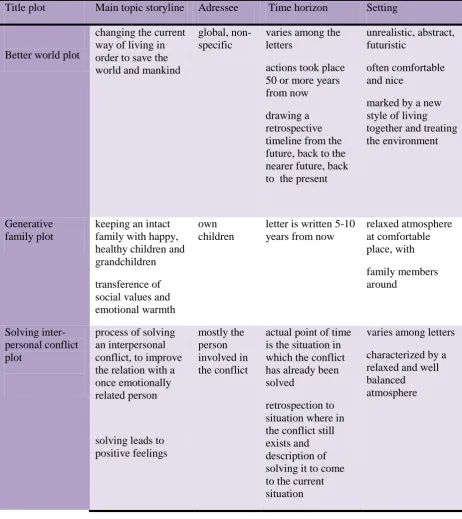
The narrative analysis of the 30 chosen future letters results in the categorization of 6 different types of narrative plots. Table 1 summarizes the main categorization criteria, which have lead to the definition of the different prototypes of narrative plots in the future letters.
To get an impression of the global content of the defined plots, a summary, with a characteristic title of each prototype plot has been worked out. This summary gives a description of the storyline’s main topic, but is still close to the respondent’s own formulations.
17
By adding an example of a storyline analysis of one future letter, the process of categorizing an individual narration into a prototype plot has been made transparent. So it is also possible to follow the conclusions that have been drawn out of the narrative analysis.
[image:17.595.66.529.247.767.2]Finally the frequencies of the categorized plots and main differences and similarities are outlined.
Table 1: Categorization scheme of the 6 found different types of narrative plots out of the
N=30 future letters:
Title plot Main topic storyline Adressee Time horizon Setting
Better world plot
changing the current way of living in order to save the world and mankind
global,
non-specific
varies among the letters
actions took place 50 or more years from now
drawing a retrospective timeline from the future, back to the nearer future, back to the present
unrealistic, abstract, futuristic
often comfortable and nice
marked by a new style of living together and treating the environment
Generative family plot
keeping an intact family with happy, healthy children and grandchildren
transference of social values and emotional warmth
own children
letter is written 5-10 years from now
relaxed atmosphere at comfortable place, with family members around Solving inter-personal conflict plot
process of solving an interpersonal conflict, to improve the relation with a once emotionally related person
solving leads to positive feelings
mostly the person involved in
the conflict
actual point of time is the situation in which the conflict has already been solved
retrospection to situation where in the conflict still exists and description of solving it to come to the current situation
varies among letters
18
Perfect life plot fulfillment of the narrator`s dreams
the narrator
self narration is situated
+/-10 years from now
Place, where the narrator feels comfortable and save, for example the own house
Think positive plot
advice to focus on the positive sides of live and not to be afraid of the future
the narrator self
variable: Ranges from present to 13 years from now
situation, where in the narrator feels well balanced and relaxed
Redemptive self plot
process of becoming more self-confident by overcoming obstacles, fears and own problems
the narrator
self
letter is written 15-30 years from now
main act took place at an point of time between now and the current situation
current situation is perfect and comfortable
3.2. Plots 3.2.1 Plot 1: Generative family plot
Summary
Having an intact family as well as a good relation with my lucky, healthy, adult children and
grandchildren I hope one day I can look at my adult children and grandchildren and can say to myself, that I
did everything right. I hope to have a close relationship to all of them and that I was able to give them the help they needed to become as lucky and successful as they are today. It would be really beautiful, if we would feel emotional related as a family even in future times and I was able to carry over certain values that are important to me.
Setting
19 Characters
The narrator, as the main character, defines herself in terms of familiar bonds and related typical behaviors: “One day I hope to be a grandmother.” The narrator is characterized by a positive view of life. She is an open minded and reflective person. Her own family is the most important thing in her life: “I am a real family person.” The protagonist underlines that she has been positively influenced by the way, her parents have raise her. Furthermore her children and grandchildren and the narrator’s parents are mentioned in the plot. These characters get their meaning by the importance, the protagonist gives to them. The constellation of actors in the story, stresses the generative character of this plot. Actions
In the example the narrator underlines the importance of giving love and attention to her grandchildren and mentioned the intention to transfer her own positive way of looking at life to them. Furthermore she wants to influence their development in a positive way. The good intrafamiliar relation and the process of carrying over certain personal values are the central topics of the storyline. The protagonist’s actions are marked by self-effective behavior. This self- efficacy is underlined by mentioning concrete strategies to achieve the wished outcomes. Important in this context is that the narrator believes, to be able to be effective in acting out the mentioned strategies. Her behavior are marked by trust in own strengths and abilities to achieve wished outcomes, in this case the transmission of personal values and the fulfillment
of the role of a “Good” grandmother. Agency
20
Purpose The purpose of the narrator is to create and to keep an intact family, as well as to carry over certain values to his descendants. She wants to be actively involved in this process and furthermore would like to influence the development of her children and grandchildren in a positive way. She wishes her family to be lucky and healthy. The intact family represents the centre of life for the narrator.
Trouble In the example no real explicit kinds of imbalance between the characterizing elements of the
storyline can be recognized. Time horizon
The letters are written 5-10 years from now. The actions took place in this future situation. The narrations contain retrospective aspects, in that the narrator refers to principles and values, transmitted by own parents and grandparents that should be transmitted further to the own descendants.
Type of possible self The type of possible self, which is created in this plot got the name „Generative family possible self“. It can be characterized as an individual self that gets its meaning in relation to other family members, especially the own descendants and in relation to the emotional bonds that hold them together as a family. These intrapersonal bonds are a key element of this possible self. The possible self, embedded in this plot, has a dynamic structure. The narrator places herself in a future family situation wherein the different members have developed further and/or new family members have been born. Consequently the intrafamiliar situation differs from the one in the present. The narrator creates thus a new understanding of her own self, with new behavioral rules that fit to her new or re-arranged role within her family. Example TB1_536
Title: Becoming a caring grandmother and proud mother that supports the development of her grandchildren in an intact family
21
them and would like to give them the love I have given to my own children. I would like to do the same things with them, I self have done with my parents and also have done with my own children. I am a real family person. My children have become perfect adults and my intention is to influence my grandchildren in the same way I did with my
children, so that they also develop as good as their parents. I hope that my whole family will stay as healthy and happy as now.
3.2.2 Plot 2: Interpersonal conflict plot Summary
Solving an interpersonal conflict
After long time thinking about you and our conflict, I have realized that I could not become lucky, as long as something stands between us. Although I was afraid of your reaction, I have found the strength to talk to you and let you see, what you meant to me. So it was possible to talk about the things that have turned us apart.
Setting
The letter has been written, while the narrator sits together with her mother and drinks a cup of tea. At this point of time, the interpersonal conflict already has been solved and everything has come to a good end. The atmosphere that has been created is balanced and relaxed. In the narration another setting is mentioned, while the narrator starts to describe, in what way the interpersonal conflict has been solved. While this description, the narrator switches back to the situation, wherein the conflict still exists. This situation is, in contrast to the current one, characterized by negative feelings: “I have negative feelings about it since 2 years.”
Characters
Main characters in the story line are the protagonist (I-narrator), a close friend of the
protagonist and the protagonist’s mother. The I-narrator is the main actor in the plot. She ones had a close relationship to the above mentioned close friend, which has broken
22
mother. She has an advisory function and encourages the protagonist to become active in solving the conflict.
Actions
Main topic of this plot is the interpersonal conflict between the protagonist and a close friend. It is a conflict with a person, emotionally related to the protagonist. The narrator suffers enormously from the argument and misses the other person in her life or wants him to change his behavior. In the example the main topic of the conflict is forgiveness: “You let me see, that people are good and embrace you again even though you have not been honest in the past”. At the beginning, the protagonist feels very uncomfortable with the current situation, the conflict with another person makes the narrator feel said and uncomfortable. She is helpless. The engagement in active, effective behavior results in solving this interpersonal conflict and leads further to the reconstruction of the emotional bond of the two involved
people. Agency
To deal with the problem, the protagonist first started to talk to her mother. This conversation is the starting point in becoming active to solve the conflict. The advisory function of the narrator’s mother can be seen as a helper that supports the protagonists to move forward to the desired end-state. Based on this conversation, the protagonist started to become active in changing the current situation. Main aspect in this process is it, to overcome doubts and fears in order to honestly mentioning own feelings and to ask for forgiveness even though it makes one emotionally vulnerable “ I have missed you Stefan. I’m sorry for what has happened.” Purpose
The purpose of the narrator is to become active in dealing with an interpersonal conflict to overcome its negative influence on the narrator’s life. Here the re-establishment of the emotional bond with and the positive reaction of the person, important to the narrator, are essential.
Trouble
23
rejection. This break between these elements makes it necessary, to change behavior and to develop certain means to change the current situation.
Time horizon
The letter has been written more or less 10 years from now. At this point of time the
characterizing conflict already has been solved. The narrator draws a retrospective timeline back to conflict situation to describe the process of solving it.
Type of possible self
The type of possible self, which is created in this plot got the name “Social-emotional
possible self“. It can be characterized as a possible self with an individual character. This type of possible self gets its meaning through the process of solving an interpersonal conflict and the re-arrangement of the relationship with this person. The protagonist ones feels emotionally related to the person involved in the conflict. The process of solving the conflict and the re-establishment of the intrapersonal bonds are key elements of this possible self.
Example TB1_255
Title: Finally talking to you again and solve our conflict
Summary: Today I have seen you again and I have finally found the strength to talk to you after our argument 2 years ago. Every time I have thought of you, I got the impression that I need to do something to stop the
silence between us, because we once were so close related. It makes me feel said. My mother has encouraged me, to start talking to you. I
went to you and have told you that I have missed you and you were lucky to see me and have forgiven me my mistakes. That fact, that it is always possible to find the way back to people you feel close to, even though you have made mistakes and you have hurt them, has given me a feeling of warmth and hope.
24 3.2.3 Plot 3: Redemptive self plot
Summary
Believe in yourself to overcome obstacles and become lucky in life
First I was not self confident and not able to focus on my strengths to overcome certain obstacles. By concentrating on my abilities and desires, I have become a self confident, independent person, who has made the right decisions, has overcome his doubts and has been
successful in realizing his dreams. Setting
The protagonist is at her house and started to look back at the difficult period of live, she has mastered. The house represents a kind of secure base. The term “My house” furthermore indicates, success in live, in terms of independence and possession. This setting can be seen as a contrast to the setting, wherein the narrator operates at times of the personal crisis. The second setting is dominated by the crisis and its negative influences. Independence or possession were completely unrealistic at this point of time.
Characters
The I-narrator is the person of interest in the story. Furthermore a partner and friends are mentioned. They play an important role in the narrator’s life, but are not of great importance for the main storyline of this narration. It is only referred to them in two sentences:”In social terms, there will not be many changes. You will still enjoy it, having the nice friends you already have today and they will stay important for you. Also your relationship stays stable and lovely.” In the story, the protagonist has changed his personality in terms of how to see herself and the world.
Actions
It is an intrapersonal conflict, a crisis in life, marked by the isolation and behavioral
stagnation, as a result of own weakness and deficits. These negative personal characteristics of the protagonist hinder her to reach her goals and to become the person she wants to be. The narrator makes herself and her disability to act effectively responsible for the negative
situation in his life. “I know that you struggle with your eetingdisorder at the moment and that this often restrains you in your daily life.” The protagonist’s actions first are mainly
25
The protagonist is passive and dominated by feelings of guilt. In the further progress of the story, the protagonist’s actions are marked by more self-confidence and independence: “Very important is, that I am more self confident. I allow myself to enjoy and often I am able to take life as it is. The in this process developed new self-confidence is underlined by the
formulation of advices and behavioral strategies, the narrator gives to her actual self, to encourage herself to overcome her doubts and fears.
Agency
The protagonist achieves her goals, by starting to focus on personal strengths and the development of self confidence. Stopping always controlling herself has made her independent.
Purpose
The main purpose of the narration is the development of self-confidence to overcome fears, doubts and obstacles that influence the protagonist’s life in a negative way and hinder her to live her life the way she wants to. Finally she reached her goals by focusing on her own strengths.
Trouble
The trouble in this story is rooted in the process of overcoming the personal life crisis of the protagonist. In terms of Burke (1945), it can be seen as an imbalance between the narrator’s actions and her purpose. The protagonist’s actions are characterized by feelings of guilt and the need for control, in contrast to this action the protagonist wishes to become independent and to overcome her crisis, the eating disorder. This conflict makes it necessary, to change the actual behavior to reach the desired end-state.
Time horizon
26
Type of possible self The type possible self that is represented in the “Redemptive self plot“, can be best understood as an, on achievement and personal growth focused, representation of a best possible self. The narrator defines it as the realization of her dreams. It is an concrete formulated and individual possible self that gets its meaning by looking at the process of overcoming obstacles in order to develop own strength and abilities to reach certain goals. The process of changing an unrealistic best possible self into a more realistic and finally reached best possible self by overcoming obstacles and developing own strengths, underlines the dynamic structure of this type of possible self. In dependence of the abilities of the narrator, it can be adapted and modified.
Example TB1_141
Title: The process of becoming more self confident and the development of trust in my own abilities has make my life more positive
Summary: After looking back at my life until now, I can say that I am very lucky at the moment, but also have experienced very difficult periods of time. But summarized these difficulties have made me stronger and have shaped my personality. My problems have initiated a process of change, referring to the way I look at myself and how I deal with my life. I have learned, to look at things more relaxed and to trust in my own abilities. Even if something goes wrong, I can manage it, because I have become more selfconfident. By realizing, that I self have controle over my life, I have been able to match with my eatingdisorder and have become more independant.
3.2.4 Plot 4: Think positive plot Summary
Enjoy your life and think positive
27
Focusing on possible negative outcomes is a waste of time. You can trust in yourself and the quality of your decisions. Everything will come to a good outcome.
Setting
The advice to think positive has been formulated by the narrator from out a secure, happy and balanced situation. In the example the protagonist lives at a nice house, outside the town in the Netherlands. The environment is characterized as free of any stressors or threatening elements. It is a secure place, wherein the actor can find relaxation.
Characters
In the narration two characters were described. The protagonist, the I-narrator, is a self reflective person, who has started to focus consciously on the positive sides of life and the things that bring joy to her. Furthermore the sentence “Talk to the people around you, share your thoughts and emotions and help each other through difficult times.” underlines the social and empathic character of this person. The second character that is mentioned in the plot, is the narrator’s husband, who does not play an active role in the narration. He also represents an element of the well-balanced life the protagonist lives at the moment. The protagonist has a more communal character and defines herself in terms of interpersonal relationships. Actions
The actor’s behavior is marked by a kind of fear of the future, what influences and hinders the narrator`s behaviors and provokes negative feelings. The narrator does not act independently to fulfill her dreams. These feelings of being isolated by own doubts and fears of the future, marks the starting point in the process of becoming active. Similar to the “Redemptive self plot“, the narrator formulates advices and behavioral strategies, to her actual self, to motivate
herself to change her way of thinking. The protagonist’s way of acting is marked by a process of development more self-effective
behavior. This process is mainly influenced by the development of more trust in good future oriented outcomes. A positive view of the future should stimulate the protagonist, to become active and to become more satisfied in life.
Agency
28
plot. The protagonist has started to focus consciously on herself and the positive sides of her life. “Everyday I am sitting in the bathroom for half an hour and think of all the positive things of the day and how good my live is in principle.” Furthermore the I-narrator has started to control negative thoughts.
Purpose
The narrator in the present should start to believe and to focus on the positive sides of live. She should trust in good outcomes, to become more satisfied and relaxed in life. The future letter’s intention, to transport hope out of a better future is obviously recognizable.
Trouble
The moment of trouble in this storyline can be understood as a kind of imbalance between the intention to be an optimistic person, who is satisfied with life (purpose) and the lack of means to develop such a positive perspective of looking at the own life, without fears and negative feelings. Similar to the “Redemptive self plot“, a bad situation changes into a good one. The narrator develops certain means, which she presents to her actual self, to motivate herself to change his way of thinking. The conflict between goals and lack of means to achieve this desired end-state, forms the intention to make a change in behavior.
Time horizon
The point of time, at which the letters has been formulated ranges from present to 13 years from now. It also contains retrospective aspects, in that the narrator encourages her
actual/former self, to change its view of life to become more satisfied. Type of possible self
29 Example: TB1_663
Title: Achievement of an optimistic view of live, by focusing on the positive side of life
Summary: I know that it is not always easy to enjoy life and to stop thinking too much on possible, negative outcomes. But it is crucial, to focus on the positive side of life. Now I am living a happy and well balanced life. That I have achieved, by taking the time, to be consciously optimistic and by avoiding thoughts about negative outcomes. I advice you, not to worry about your future, because there is no reason to do so. There is a solution to every problem. The best thing in life is to enjoy life. 3.2.5 Plot 5: Better world plot
Summary
Creation of a new model of society that leads to a better world
Today we are living in a world, which values and conditions are very different to those we know today. Human beings have realized that they need to change their style of living
together in order to save the earth and the human existence. By creating new technologies and by turning back to values like freedom, tolerance, equality and the intention to include weaker people as well as to help each other, humans have been successful in creating a new model of society in order to save the world.
Setting
30 Characters
Here no single I-narrator as main acting character is mentioned. Instead mankind in general can here be seen as the social and reflective protagonist in the storyline.
Act
The story starts with a look at the situation on earth 50 years ago. Humans nearly have
destroyed the earth and living on earth was marked by social and intercultural problems. Then the narration switches to the actual improved situation, which is characterized by new way of living together in technical as well as social terms. The main aspect in the storyline is the development of a behavioral change of mankind in reference to the social cultural and technical aspects that is essentially needed, in order to save the world and the human existence on earth.
The new way of acting is marked by a social and technically innovative structure. “It has been learned to take care of the earth and many creative solutions have been created, as cars that drive with sun energy. Religions have been disappeared, what leads to a more peaceful way of living together. Everybody is accepted the way he is.”
Agency
The goal to save the human existence has been achieved by creating a new form of society, which is based on social values as tolerance and empathy. People have started to live together in a peaceful way. They have developed new technologies, which make it possible to save the environment.
Purpose
The main purpose in this narration is the realization of the development of the ability to deal with the great essential problems, humans will have to face with, as a consequence of their present style of living. It can be best understood as the behavioral change of mankind, in order to save and improve human existence on earth.
Trouble
31
Human’s social network also has broken down. Human existence on earth was really at risk to fail. At this point of time, instead of developing certain means to keep human existence on earth, humans continue to destroy their base of living. This fundamental incongruence between means and purpose marks the necessity for a behavioral change in the form of the development of strategies, to improve the situation and to move forward to the desired end state.
Time horizon
The time horizon varies among the letters. The actions took place 50 or more years from now. The time horizon is generally marked by retrospective timeline. The narrator draws a timeline starting at the actual future situation, than refers to the nearer future and finally ends at the actual present.
Type of possible self
In contrast to the other different defined types of possible selves, who have an individual character, the possible self that can be recognized in the “Better world plots“ is a “Communal shared possible self“. By this is meant that it is the creation of a possible self, shared or represented by a whole society. It can be understood as commonly shared understanding of a new way to live, in order to keep the human existence. This possible self has a dynamic structure. It has been developed out of an egocentric, individual type of possible self and is characterized by tolerant, social and reflective qualities.
Example TB1_315
Title.: The world 50 years ago-An antimaterialistic society with new
technologies and new general ethnical principles, in terms of tolerance and individualism.
Summary: The world we live in today is very different to the one 50 years ago. The situation firstly was really difficult, the existing forms of society broke down, because everybody only cares for himself. Furthermore there has been no motivation to take care of the earth, in order to save the human existence. But luckily humans have changed their view of the world and they have been able to develop new strategies of using
32
focus. People take care of each other and accept individual values and norms.
3.2.6 Plot 6: Perfect life plot
During my life, all my wishes and desires have been come true
Summary When I look back at my life, I can say that all my dreams come true. I have reached all my goals referring to my career, my private life and my social status, without experiencing any great mentionable failures. At present, I am completely happy.
Setting
The story takes place at the location, where the protagonist also lives today. He really likes it, to live at this place: “I still happily live in the Nassaustraat, because we really enjoy it to do so.” The setting can be characterized as a place, to which the narrator has a positive personal relation and where he feels comfortable and save. “The Nassaustraat is and will be our nice palace as usual.”
Characters
The main character in this story is the protagonist (I-narrator). Characteristic for this story is that the narrator uses of the term “We”, while talking about the achievements of his future self. By using this formulation the narrator directly makes a linkage between actual self and his future self. “Here some of “our“ great experience in life.” The protagonist can be characterized as a person, who has a clear impression of what he wants to achieve in life. Because of his lucky life, the protagonist feels very self confident and free of fears. The plot consists of further characters, which do not play a crucial role in the narration. The
protagonist mentioned that he has married and has kids. Actions
33 Agency
Because no imbalance makes it necessary to change behavior, according to the achievement of certain goals in the storyline, no explicit means are mentioned. Agency is marked by the way of how to manage the own life. The protagonist should keep and trust in his goals and dreams. The underlying mean to achieve certain goals in this story, is thus the focus on own life dreams and the trust in the own ability to realize them.
Purpose
The purpose of the narration is the realization of one’s own individual life goals. The process of living the own dreams. The letters should underline the narrator’s belief in a positive future. It is indented to support the protagonist, to engage in the behaviors, which will lead to the wished outcomes. The narration can be summarized as an appeal to the protagonist to trust and to follow his intentions.
Trouble
The „Perfect life plot“ is characterized by no recognizable moments of trouble, in terms of certain imbalances or breaks between setting, characters, actions, means and purpose that would made a change in behavior necessary.
Time horizon
The plot is situated at a point of time more or less than 10 years from now. The retrospective aspect in the narration is represented by an appeal of the protagonist’s future self to the protagonist’s actual self, to follow his present intentions.
Type of possible self
34 Example: TB1_474
Title: Successful achievement of all main goals of life
Summary: All expectancies, goals and dreams you have now, you will realize in your future. You are married, have children and a little own firm. Everything has become great and that’s why you think that nothing could happen that is able to destroy your realized dreams and your good looking future.
3.3 Comparison of different prototype plots and possible selves
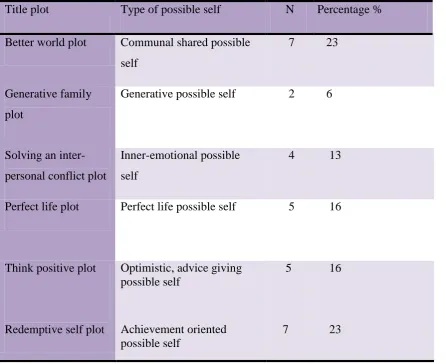
[image:34.595.66.513.400.764.2]The following table gives an overview of the frequencies of the different defined prototypes of narrative plots and the different types of possible selves they contain. The plots and related possible selves have been ordered according their degree of individualism. Furthermore they are differentiated in term of implicit or explicit moments of “Trouble”
Table 2: Comparison of different prototype plots and possible selves (N=30)
Title plot Type of possible self N Percentage % Better world plot Communal shared possible
self
7 23
Generative family plot
Generative possible self 2 6
Solving an inter-personal conflict plot
Inner-emotional possible self
4 13
Perfect life plot Perfect life possible self 5 16
Think positive plot
Redemptive self plot
Optimistic, advice giving possible self
Achievement oriented possible self
5
7 16
35
The “Better world plot” and the “Redemptive self plot” are the narrative plots with the highest frequencies, followed by the “Perfect life plot” and the “Think positive plot” each with 16 %. The “Generative family plot” is the one with the lowest frequency in the sample. The plots can be best differentiated by looking at their grade of individuality and the function of the embedded possible self.
The first mentioned plot, the “Better world plot” is the less individualistic one. This plot contains a communal shared possible self that has been developed by a whole society. Typical for the related possible self is the commonly shared goal, to create a form of society in order to save the world. Its main function is to highlight, that a behavioral change is needed to save human existence on earth and to highlight the possibilities humans have, when they start to act as a community.
In the “Generative family plot”, the closest family members are the persons of interest. The embedded “Generative possible self”, similar to the “Better world plot”, gets its meaning in relation to other people. This plot and the related possible self also have a more collectivistic character. Compared to the “Better world plot” the grade of individuality is rated as slightly higher. The narrator, with his own individual intentions and values, plays a more central role compared to the “Better world plot”. The “Generative possible self” is defined by the
emotional bonds that relate the closest family members. This plot thus also constructed in collectivistic terms. The main function of the “Generative possible self” is the transmission of personal values and perspectives in order to keep traditional values as well as a good relation with the own ancestor and closest family members.
The “Solving inter-personal conflict plot” contains the “Inner-emotional possible self”. It is a more individual type of possible self in that the relationship of two people is central to it. Main topic of the “Solving inter-personal conflict plot” is the process of managing a conflict with a once emotionally related person. By solving the conflict, the once close relationship to the person of interest, can be re-established. This “Inner-emotional possible self” underlines the positive effect of trusting in people’s ability to forgive mistakes and their ability to change their behavior. It functions as a kind of encouragement to become active in solving an
interpersonal conflict.
The in the “Generative family plot” and in the “Solving an interpersonal conflict plot“ embedded possible selves are the ones with the most social character. The relation to
36
of the two embedded possible selves is their function. The transmission of certain values and perspectives to keep intra-familiar bonds is the central function of the “Generative possible self”.
Main function of the “Social-emotional possible self”, is the encouragement to become active in solving interpersonal problems. Another main function is the development of trust in other people’s ability to forgive.
The “Perfect life possible self” is a person’s individual representation of the best possible imagined future outcomes in his life. Main elements of the related “Perfect life plot” are the narrator’s individual dreams and life goals. Other characters are also mentioned in the plot, but only play a subordinated role, in that they only serve as a representation of the narrator’s dreams. For this reason, the grade of individuality has been rated as higher, compared to above already mentioned plots. The “Perfect life possible self” underlines the realizability of once own dreams and goals. It functions as kind of motivator to go straight forward and to believe in the own abilities to live the life somebody wants to. It is a type of best possible self. Here the perfect realization of once own dreams is central. This possible self is the only one that is mainly formulated as a desired end state. The process character can here be recognized less.
The in the “Think positive plot” embedded “Optimistic, advice giving possible self” has a very individual character, because other people are not the topic of interest. It has an advisory function. The advice of how to achieve a well-balanced and satisfied life is the main
characterizing element. The advice contains the appeal to consciously focus on the positive sides of life and to behave according to once own, individual needs. The related possible self gets its meaning by looking at this advice/message a person’s future self addresses at his actual self
The “Think positive plot” and the “Perfect life plot” are the two plots with the most positive character. Compared to the other categorized plots, they transport the most hope out of a better future.
37
motivator to trust in the own abilities to change life in a positive way by focusing on own competencies.
Interesting to mention is that the “Redemptive self plot” and the “Better world plot” represent two opposite strivings. Namely on the one hand a tendency for individualism and on the other hand a striving for collectivism. The main topic of both plots is achievement and the
realization, that it is possible to make remarkable changes life by focusing on own abilities and strengths. This happens in the “Better world plot” on a collectivistic level and in the “Redemptive self plot” on an individual level.
The “Achievement oriented possible self” and the “Perfect live possible self” both have a motivational function. In the “Perfect life plot” this function can be more seen as an appeal to focus on the own goals and to keep focusing behavior on their realization. In the “Redemptive self plot” the embedded possible self functions as a motivator in that it encourages the
protagonist to become active in changing his behavior to overcome a personal crisis by focusing on own strengths and abilities.
4. Conclusions and Discussion
The present study was based on the two research questions “Which different types of
prototype plots characterize the letters from the future? and “Which different types of possible selves characterize the letters from the future?”
The future letter’s content has been categorized into 6 different types of narrative plots (Better world plot, Generative family plot, Solving inter-personal conflict plot, Perfect life plot, Think positive plot, Redemptive self plot). In all of these plots a characterizing possible self (Communal shared possible self, Generative possible self, Inner-emotional possible self, Perfect life possible self, Optimistic, advice giving possible self, Achievement oriented possible self) is embedded. These different types of possible selves vary in their content, their grade of individuality, their dynamic, their function, and their time horizon.
The different functions of the explored possible selves are in line with the assumption of Markus & Nurius (1986, 1987) that the constructions of possible selves represent future
oriented conceptions of how humans want to be or not want to be. In the present study the defined types of possible selves mainly are constructed in terms of a
38
process. The innovating aspect in this study is that the narrative analysis of possible selves in the future letters makes this process of the creation of possible selves visible.
These results underline the key assumption of this research that the self is a dynamic construction that can change and assimilate over time and space and which is continuous in development. Except the “Perfect life possible self”, all found different types of possible selves are characterized by an individual, dynamic structure, marked by a process of change. This process reflects the individual intention of the narrator (Sarbin, 1986; Ricoer, 1984). Not all categorized plots show explicit moments of “Trouble”. The lack of explicit “Trouble” in the “Perfect life plot” for example can be explained by the specific function of the
embedded possible self. It functions as kind of appeal to follow the own intentions. The protagonist should keep on, behaving according to realize his dreams because he will be successful in doing so. The possible self indicates that no changes in behavior are necessary. In the “Generative family plot also no explicit moments of trouble are recognizable.
On the surface in these plots no incongruities, that indicate a need for behavioral changes have been recognized. Even though, it is likely that there always exist at least some implicit moments of trouble. These moments can, for example be represented by implicit fears of the protagonist not to be able to reach the formulated goals. Thus an implicit lack of trust in the own abilities and developed means. In this context it would be interesting, to execute follow-up studies, to examine the relationship between prototype plots with no explicit moments of trouble and actual wellbeing. Furthermore in could be interesting to develop methods to make implicit moments of trouble visible. So it can be examined in what way different types of trouble in the narration can be related to wellbeing.
Because “Trouble” has been identified as a motivational driving force for behavioral changes (Bruner, Lucariello, 1989, p.77)., I would expect that the possible selves embedded in plots with explicit moments of trouble can be related to greater experienced wellbeing. At the point of time the “Trouble” has been recognized and has been explicitly mentioned in the narration, a process of striving to a more desirable end-state is initiated. I could imagine that this process of becoming active and consequently more independent can have a positive effect on wellbeing.