TYPES AND POLYMORPHISM IN PERSISTENT
PROGRAMMING SYSTEMS
Richard C. H. Connor
A Thesis Submitted for the Degree of PhD
at the
University of St Andrews
1991
Full metadata for this item is available in
St Andrews Research Repository
at:
http://research-repository.st-andrews.ac.uk/
Please use this identifier to cite or link to this item:
http://hdl.handle.net/10023/13487
Types and Polymorphism in
Persistent Programming Systems
Richard C. H. Connor
Department of Mathematical and Computational Sciences
University of St Andrews
ProQuest Number: 10167262
All rights reserved
INFORMATION TO ALL USERS
The quality of this reproduction is dependent upon the quality of the copy submitted.
In the unlikely event that the author did not send a com plete manuscript and there are missing pages, these will be noted. Also, if material had to be removed,
a note will indicate the deletion.
uest
ProQuest 10167262
Published by ProQuest LLO (2017). Copyright of the Dissertation is held by the Author.
All rights reserved.
This work is protected against unauthorized copying under Title 17, United States C ode Microform Edition © ProQuest LLO.
ProQuest LLO.
789 East Eisenhower Parkway P.Q. Box 1346
In submitting this thesis to the University of St Andrews I understand that I am giving permission for it to be made available for use in accordance with the regulations of the University Library for the time being in force, subject to any copyright vested in the work not being affected thereby. I also understand that the title and abstract will be published, and tliat a copy of the work may be made and supplied to any bona fide library or research worker.
%
Declarations
■i
I, Richard Charles Henry Connor, hereby certify that this thesis has been f composed by myself, that it is a record of my own work, and that it has not been if accepted in partial or complete fulfilment of any other degree or professional
qualification.
Date ^
I was admitted to the Faculty of Science of the University of St Andrews under Ordinance General No. 12 on 1st October 1985 and as a candidate for the degree of Ph.D. on 1st October 1985
Signed Date
Z K ,
I hereby certify that the candidate has fulfilled the conditions of the Resolution and Regulations appropriate to the Degree of Ph.D.
I
I
Acknowledgements
Many people have contributed to the research presented in this thesis, and it is impossible to acknowledge them all. Working in a group, ideas are passed around and developed as a communal effort, and it is impossible to know from where, if anywhere, they have originated.
Fred Brown, Quintin Cutts, A1 Dearie, Graham Kirby and Ron Morrison, in the PISA group at St Andrews, have all been involved with all of the research. From outside the group, discussions with Malcolm Atkinson, Mike Livesey, Dave McNally, Atsushi Ohori and John Rosenberg have all directly resulted in ideas presented here. To this I would like to add thanks to all other participants in PISA
and FIDE project meetings, and anyone else I have discussed these topics with. | Finally Ron Morrison, my supervisor, must be thanked again for the very major
pait he has played not only in the construction of this thesis, but also in the
1 Introduction... ...1
1.1 Type systems... ...4
1.1.1 Modelling and protection... 4
1.1.2 Safety and flexibility...5
1.1.3 Time of checking... 5
1.2 Persistence...6
1.2.1 Motivation... 6
1.2.2 Definition of persistence... ..7
1.2.3 Orthogonal persistence... 8
1.2.3.1 Removing complexity... 8
1.2.4 Persistent languages... .'...9
1.2.4.1 PS-algol and Napier88... 10
1.2.5 Relation to database programming languages...11
1.3 Polymorphism... ...11
1.4 Persistent type systems... 14
1.5 Thesis structure...17
1.5.1 Software reuse in persistent systems... 17
1.5.2 Models of protection... 18
1.5.2.1 Protection... 18
1.5.2.2 Viewing mechanisms... 19
1.5.3 Typechecking across separately compiled modules... 19
1.5.4 Implementation of polymorphism... 20
2 Software reuse...23
2.1 Introduction...23
2.1.1 Program sharing and binding ... 23
2.2 Binding mechanisms... 27
2.2.1 Environments and binding...27
2.2.1.1 Static and dynamic environments...27
2.2.1.2 L-value and R-value binding... 29
2.3 Napier88 environments... 32
2.3.1 Creation and use of Napier88 environments...32
2.3.2 L-value binding... 34
2.3.3 Constancy... 35
2.3.4 Persistence... 36
2.3.5 Programming system construction... 37
2.4 Incremental construction and release... 44
2.4.2 The example in PS-algol... 48
2.4.2.1 The data type pntr...48
2.4.2.2 Persistence...48
2.4.2.3 System construction... 50
2.4.3 Conclusions ... 52
2.5 Type abstraction...52
2.5.1 Universal quantification - specialised reuse...54
2.5.2 Existential quantification... 57
2.6 Conclusions... 64
3 Protection and viewing...66
3.1 Introduction ... 66
3.2 Protection of integrity... ... ...68
3.2.1 Integrity of data...68
3.2.2 Protection in persistent systems...70
3.3 Information hiding ... 72
3.3.1 Subtype Inheritance... 73
3.3.2 Ist-order information hiding... ... 75
3.3.3 2nd-order information hiding...80
3.3.4 Conclusions... 84
3.4 Viewing mechanisms... ...84
3.4.1 Database viewing mechanisms... 85
3.4.2 View construction in Napier88...87
3.4.2.1 Creating a concrete representation...87
3.4.2.2 Placing concrete representations in the store...89
3.4.2.3 Creating abstract view types...90
3.4.2.4 Creating instances of views... 92
3.4.2.5 Using views... ...93
3.4.2.6 Operations over more than one account... 94
3.4.3 Privileged data access...95
3.5 Conclusions ...99
4 Type equivalence in persistent systems... 101
4.1 Introduction... 101
4.2 Type equivalence models... 102
4.2.1 Structural and Name Equivalence... 102
4.2.1.1 Definitions... 102
4.2.1.2 Example... 103
4.2.2 Equivalence models within a program... 104
-i
4.2.3.1 Sharing a type between modules...108
4.2.3.2 Sharing a type between independent sub system s... ...109
4.2.3.3 Abstracting over complex type definitions...110
4.2.3.4 Efficient execution... I l l 4.2.4 A Universal Equivalence Model... 112
4.3 Implementation of stmctural type checking 113 | 4.3.1 Type Equivalence Checking... 113
4.3.2 Representing Types...114
4.3.3 Efficient Structural Checking... 115
4.3.4 Normalisation... 116
4.3.5 Representing types by graphs... 118
4.3.6 Representing Types by Strings...121
4.3.6.1 Normalising Graphs ... 122
4.3.6.2 Mapping to Strings...124
4.3.7 Comparison of Graphs and Strings... 126
4.3.7.1 Speed... 126
4.3.7.2 Space... 126
4.3.7.3 Sharing...127
4.3.8 Measurements...128
4.3.8.1 Space... 129
4.4 Constructing type representations... 130
4.4.1 The Napier88 type system and algebra... 130
4.4.2 Constructing type representations...133
4.4.2.1 Base types... 134
4.4.2.2 Vectors 135 %« 4.4.2.3 Structures 135 | 4.4.2.4 Variants... 137
4.4.2.5 Procedures... 138 J 4.4.3 Quantified types...139
4.4.4 Parameterised types...143
4.4.5 Specialisation...144
4.4.6 Recursive types... 147
4.4.7 Parameterised recursive types... 150
4.4.8 Recursive existentially quantified types...160
4.4.9 Free quantifiers... ... ... ... 162
4.4.9.1 Static checking... 162
4.4.9.2 Dynamic checking...165
4.4.10 Conclusions... 168
4.5 Conclusions... 169
5 On the implementation of polymorphism... 171
5.1 Introduction ... 171
5.1.1 Compilation, architectures, and polymorphism ...172
5.2 Parametric polymorphism... 174
5.2.1 Machine-level type systems...174
5.2.2 Textual implementation ...177
5.2.2.1 Multiple parameters... 177 |
5.2.2.2 Calls within calls... .178
5.2.2.3 First class procedures...179 S 5.2.2.4 Persistence... 179
5.2.2.5 Conclusions ..180 |
5.2.3 Uniform implementation...180
5.2.3.1 Fixed size value representations...181
5.2.3.2 Finding pointers... 181
5.2.3.3 Conclusions... 182
5.2.4 Semi-uniform, partly tagged implementation... 183
5.2.4.1 Semi-uniform implementation...184 |
5.2.4.2 Conversion by procedural encapsulation... 187
5.2.4.3 Cost of procedural encapsulation ... 193
5.2.4.4 Reverse encapsulation ...194
5.2.4.5 Cost comparison of encapsulation and reverse encapsulation...196
5.2.4.6 Lazy conversion using tagging... 197
5.2.4.7 Conclusions... ...201
5.2.5 Conclusions ... 201
5.3 Inclusion polymorphism... 202
5.3.1 Subtype inheritance... 203
5.3.2 Value representations and partial type abstraction... 205
5.3.2.1 General formats...206
5.3.2.2 Specific formats... 207
5.3.2.3 Bounded universal quantification...208
5.3.2.4 Implementations...209
5.3.3 Uniform field addressing... 210
5.3.4 Tagged field addressing...212
5.3.4.1 Variants of string address maps...213
5.3.5 Paitly tagged field addressing... 215
5.3.5.1 Bounded universal quantification...216
5.3.5.2 Inclusion polymorphism... 220
S
5.3.6 Comparisons...226
5.3.7 Generalisation of implementation techniques... 228
5.3.7.1 Variants and subtyping...229
5.3.7.2 Uniform implementation... 230
5.3.7.3 Tagged implementation ... 231
5.3.7.4 Partly tagged implementation... 233
5.3.8 Conclusions... 234
5.4 Other forms of polymorphism... 235
5.4.1 Ad hoc polymorphism... 236
5.4.1.1 Fully tagged ad hoc implementation...238
5.4.1.2 Partly tagged ad hoc implementation... 239
5.4.1.3 Textual ad hoc implementation...240
5.4.2 Existential quantification...241
5.5 Conclusions... 242
6 Conclusions... 246
6.1 Related work... 247
6.1.1 Past...247
6.1.2 Future... 248
6.2 Applications building systems... 249
6.2.1 Software reuse ... 249
6.2.1.1 Dynamic L-value binding...249
6.2.1.2 Quantification over dynamic bindings... 250
6.2.2 Protection and viewing...251
6.2.2.1 Using types to hide information...251
6.2.2.2 Viewing with existentially quantified types...251
6.3 Programming system implementation... 252
6.3.1 Typechecking across persistent systems... 252
6.3.1.1 Type models... 252
6.3.1.2 Structural checking across store... 253
6.3.2 Implementation of polymorphism...253
6.3.2.1 General problems and classification of solutions...253
6.3.2.2 Parametric implementation ... 254
6.3.2.3 Inclusion implementation...254
6.4 Some final words... 254
Appendix I... 256
Napier88 Context Free Syntax...256
Session:...256
Type descriptors:... 256
Object declarations: ... .257
Clauses:...257
Expressions:... 257
Value constructors:... 258
L iterals:... 259
Miscellaneous and microsyntax:... 259
Appendix II ... 261
Napier88 Type Rules...261
M eta-rules...i... ... 261
Session : ... 261
Object Declarations :... 261
Clauses : ... 261
Expressions : ... 262 ,263 ,264 ,265 .265 .266 Value constructors:
Literals :... Appendix HI
1 Introduction
I
Information systems frequently have to deal with longevity and scale in the data | that they support. Data is required with lifetimes which match the real-world | processes which they represent, which can range from microseconds to years. | 'I'-Data is also commonly required to support the work of large organisations, with # time scales of up to hundreds of years.
-A* One of the difficulties of dealing with such data is that it may not be possible to
predict which data will be useful in the future, nor when data will be useful. For example, in a computer aided design system all of the design data must be available to the designers for as long as the design is in progress. However the whole design, including its history, calculations, tests and decisions may be required for a later investigation if the evolved design turns out to be flawed. The solution to such problems in non-computerised systems is traditionally to save as much data as possible - information is never deliberately tlirown away.
The longevity of data in a computer system has a number of consequences. If data keeps on being collected, the size of the total body may become very large. As new uses are found for data, the number of programs within a system may also become large, and more people may become dependent upon the data. All these factors increase the potential complexity of a system.
The size of a body of data is always a relative problem to the storage technology available. Thus "large-scale” is interpreted as a volume large enough to challenge the current technology. The complexity of large systems, however, is technology
I
A further problem in large systems is that of change. Users of a system should be I
given at least the appearance of stability, so a system does not change as they are using it. This may be achieved by the specification of constraints, which may
themselves be subject to change. The critical changes to a system are those with ' global effect, which are changes in organisation, changes in representation and
changes in meta-data. This last class is the most difficult to manage.
Many users may wish to invoke changes to a system, and many users may also have to modify their use of data as a consequence of other changes. One of the difficulties is for users to understand the semantics of changes, so that a change may be explained to them. It is important to limit the propagation of change, so that the system may appear to be stable to most users.
An ideal model for building applications in an integrated data-intensive system has been described by the FIDE project [FID90], and may be likened to the diagram in Figure 1.1.1. In such a model as much as possible is factored out of the application programs into a central repository. Using such a model it should be possible to accelerate software production, improve system reliability and gain economies from code re-use.
Currently, however, information systems are usually constructed within a set of loosely connected support systems, such as database systems, programming languages, programming environments and operating systems. Each of these
components is often designed independently and built using a separate technology. $ The resulting inconsistencies between these technologies make programming of
Applications Software
Building Tools
Growing Population of Applications Programs
Central Repository of Data, Model, Constraints
and Operations
Figure 1.1.1 The FIDE model of applications building
The programming of systems which deal with large amounts of long-lived data is intrinsically difficult. However, the major failure of current technology as outlined above is that the lack of integration leads to avoidable complexity.
[image:16.616.81.446.64.405.2]:ï
system must be sufficiently flexible to allow the modelling of activities normally 3 provided by untyped support systems.
"à
1.1 Type systems
1.1.1 Modelling and protection
Cardelli and Wegner [CW85] give an account of how type systems arise naturally # in programming languages, and indeed in human nature. "As soon as we start
working in an untyped universe, we begin to organise it in different ways for
different purposes." Thus, for example, the same bit pattern in a computer | memory may be viewed in a number of different ways according to some
properties of the entity it is intended to represent. The same bit patterns may be
used to represent the character "a" and the number 97, but a programmer would | normally wish to abstract over this fact.
This gives rise to the notion of a type system as an aid to modelling, by the provision of a set of regular interpretations of bit patterns. A programmer may think in terms of values modelled by a type system rather than in terms of a computer's memory state.
This modelling, however, may potentially be violated by the application of | inappropriate operations. All values must be modelled by abstraction over bit
1.1.2 Safety and flexibility
As always, however, the extra safety provided by the prevention of operations in certain contexts causes a loss of flexibility. For example, it is reasonable to prohibit an operation such as bitwise or on two values which represent integers. On the other hand, it may be convenient for a program to model an integer as a bit pattern, or vice versa, in which case the prevention of this operation is not desirable.
The level at which a type system's protection is specified varies widely between programming languages. Languages such as C [KR78] provide only a modelling role, and if desired any operation may be applied to values of any type. Such languages are very flexible, but at the cost of some safety. Many languages allow at least some operations which violate the type system, for example it is not uncommon to be able to index past the bounds of an array. Again, this allows extra flexibility, but at the cost of safety.
A language whose type system prevents any operations which violate its modelling facilities is referred to as a strongly typed language. Before strong typing is enforced in a programming language, the designers must be confident that the modelling provided by the type system is adequate for the language's purpose. If type system modelling is inadequate, then programmers are forced to use inappropriate type models. In this case strong typing may be over-restrictive.
1.1.3 Time of checking
An operation which violates a model provided by a type system may be detected at any time before the operation is executed. In general, it is desirable to detect such errors as early as possible. There are two reasons for this:
• program efficiency
If an error is detected before a program starts to execute tiien the semantics of
failure need not be dealt with. It may not be acceptable to terminate the execution # when a type error occurs. If the absence of type errors can be guaranteed before
execution begins, then no dynamic resource is required to check for possible type errors, with a consequent increase in efficiency.
Languages where all type errors may be detected by static analysis of a program are known as statically typed languages. They have the desirable property that no operation which violates type system modelling can ever occur during execution.
Once more, however, such systems must forfeit some flexibility to achieve this. i
For example, such a system can only allow manifest values to be used as array bounds and subscripts, as otherwise a dynamic error could occur. Most programming languages do rely upon at least some dynamic type checking.
Programming systems which deal with large amounts of heterogeneous data require some dynamic typechecking to allow necessary abstraction over the type of this data. A program which binds dynamically to its data should only have to describe the type of that subset of the data upon which it operates. To allow such partial specification in an evolving universe, an infinite union type is required [ABC83]. Before a value of such a type may be usefully manipulated, a dynamic type check is necessary.
1.2 Persistence
1.2.1 Motivation
structures and database systems. These mappings were observed to have a number of costs:
• they were entirely extraneous to the required computation on the data, thus obscuring code and confusing programmers
• they were not subject to type checking, and consequently were a common source of error
• it was difficult to translate incrementally in either direction, and a consequent tendency was to load more data than necessary during a program's execution
• there were large computational overheads in performing the translation
The construction and maintenance of these mappings is a serious problem in a system which must deal with large amounts of long-lived data.
-S
Persistent programming languages were designed initially to solve these problems. They eliminate discontinuities in the computational model, and economise on
design and implementation effort by using the same concepts and constructs j throughout the entire computational system.
1.2.2 Definition of persistence
Persistence is defined as the length of time for which data exists and is usable [ABC83]. A spectrum of persistence exists and is characterised by:
transient results during expression evaluation local variables in procedure activations
own variables, global variables and heap items data that exists between program executions
data that exists between various versions of a program data that outlives a program
Traditionally, the first tliree categories are managed by a programming language and the others by a file system or database management system. A persistent system is one where all categories of longevity are catered for by a single
1.2.3 Orthogonal persistence
The following principles of persistent programming systems have been identified in LABC83J:
Programming language ^ R e a l world conceptual
data model model
Figure 1.2.1 Conceptual mappings in a traditional system
'1
I
I
I
• Persistence Independence
The manipulation of data in a program is independent of the | persistence of that data. That has the consequence that a '| programmer can not specify the physical movement of data
between long term and short term storage devices.
• Persistent Data Type Orthogonality <
All data values are allowed the full range of persistence irrespective of their type.
• Persistence Identification
The identification of values which are to be made persistent is not related to the type system, computational model or control structures of a language
Programming languages which obey all three of these principles are classified as persistent programming languages, and are said to display orthogonal persistence.
1.2.3.1 Removing complexity
The understandability of a language is its most important property. The main difficulty with data intensive programming is understanding the mapping between the real world and the computational models. A non-persistent system may be represented by the diagram in Figure 1.2.1.
Database (File System) data model
Figure 1.2.2 Conceptual mappings in a persistent system
The single mapping means not only that a system should be easier to understand, but also that no code needs to be written to maintain the mappings. In a data intensive application, maintaining the extra mappings is estimated to cost around 30% of the total code [AMP86].
1.2.4 Persistent languages
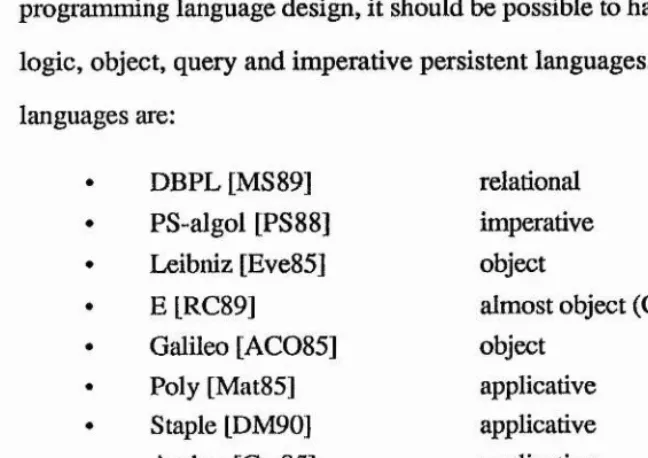
As the provision of persistence should be orthogonal to all other aspects of programming language design, it should be possible to have applicative, relational, logic, object, query and imperative persistent languages. Some known persistent languages are:
DBPL [MS89] relational PS-algol [PS88] imperative Leibniz [Eve85] object
E LRC89] almost object (C++) Galileo [AC085] object
Poly [Mat85] applicative Staple LDM90] applicative Amber [Car85] applicative Persistent Prolog [GMD85] logic
% [HS89] capability
Napier88 [MBC89] imperative
This diagram shows three mappings between different models of the data. A programmer must understand all of these mappings, as well as the different models, to be confident about data manipulation. In a persistent system, as illustrated in Figure 1.2.2, only one such mapping exists between the two data models. Thus the task of modelling data within a system is greatly simplified.
Persistent language ^ ---► Real world conceptual
data model model
[image:22.614.72.396.527.756.2]1
1.2.4.t PS-algol and Napier88
Two examples of orthogonally persistent languages are PS-algol [PS88] and Napier88 [MBC89]. In both languages, persistence is identified by reachability from distinguished roots in a persistent store. For a value to persist after the invocation of a program, it must be placed within the transitive closure of one of these distinguished roots. This model of persistence is highly suitable for imperative languages, but other models are required for different language
paradigms. |
'I Persistence in PS-algol is modelled by a set of standard procedures. A
distinguished persistent root may be created by the standard procedure
createDatabase^ which takes a database name and password as parameters and returns a value which represents the new root. The same root may be accessed by another program invocation by use of the openDatabase procedure.
The root returned when creating or opening a database is a pointer to an instance of i an associative lookup table, of type Table, Further standard procedures are
defined to manipulate these values. sEnter takes as parameters a string key, a
Tabley and a value of an infinite union type. sLookup also takes a string key and a
Tabley and returns the most recent value which has been stored using sEnter with the same key and Table. Thus these tables may be used to store a value of arbitrary complexity in a manner which is orthogonal to any of its attributes.
arbitrary store structure to be built from this root. The Napier88 system consists of a language and a populated persistent store, which contains amongst other things the standard functions and procedures.
1.2.5 Relation to database programming languages
A database programming language is one which is designed to deal with large amounts of long-term data, and a persistent language is one in which the longevity of data is orthogonal to its use. Although the motivation for these different kinds of language may be different, they converge rapidly to the same set of problems. A database programming language may start from a data model and endeavour to provide a general-purpose programming algebra over it, while a persistent language may start with a general-purpose programming algebra within which it must also provide a data model. Recent research and collaboration, particularly in the FIDE (Esprit II Basic Research Action 3070) project has shown that the two communities are on the point of merging, to tackle the outstanding problems caused by scale and longevity of data.
1.3 Polymorphism
Polymorphism was probably first identified by Strachey [Str67]. Although his discussion is mainly restricted to operators which may have several forms according to the type of their arguments, he also points out another more regular form of polymorphism, introduced by example of the function map. He introduces the terms "ad hoc" and "parametric" to describe these two forms of polymorphism, and mentions that both forms present a considerable challenge to the programming language designer.
defined in a more recent survey paper 1CW85J as an attribute of a programming language which allows "some values and variables to have more than one type". This definition allows subtype inheritance, coercion and some models of abstract data types all to be classified as polymorphism. The term inclusion polymorphism has been added to those defined by Strachey to describe a general form of subtype inheritance. The following are working definitions of the different kinds of polymorphism:
• ad hoc: An operation is defined over a number of different types, and its semantics may depend upon the type of its operands. An example is the operator "+", which may be defined over integers and reals, and has a different interpretation for each type.
• parametric: Instances of the same type within a type description may be abstracted over by an implicit or explicit type parameter. An example is an identity function, where although the parameter and result may be of any type, they are statically known to be the same type.
• inclusion: The type of a value may be partially abstracted over, so that unnecessary type information need not be stated. An example is a function which is defined over any record value which has an age field of type integer.
All of these language concepts have evolved independently from each other. Languages such as early assemblers contained no polymorphism whatsoever. Ad hoc polymorphism was the first to appear, in languages such as Fortran [ANS78], which defined overloaded operators, such as "+", along with the ability to coerce values from integer to real according to the use of such operators. Parametric polymorphism appeared in ML [Mil83], and inclusion polymorphism in Simula [BDM73J. Existentially quantified types as described by Mitchell and Plotkin [MP88] is a model of abstract data types which introduces abstraction over a type description, and such types are included in the definition of parametric polymorphism given above.
Î
I
■■I
.%-The motivation for all of these diverse language models is the same: the need to abstract over type. As type systems include more static contraints, then flexibility is lost as well as safety gained. Some of this flexibility, however, may be regained without the loss of safety by the introduction of type abstraction. Polymorphism is viewed here not as some theoretical attribute of type systems but as a solution to a class of practical problems which require type abstraction.
Ad hoc polymorphism allows the meaning of an operation to depend upon the types of its operands. In early languages such as Fortran the motivation for this was to abstract over the different representations used for types such as single and double length floating point numbers, so that the same arithmetic operators could be applied to them. However, the use of an operator could still be statically determined from program analysis, and so no true type abstraction occurred. However, Keas [Kea88] and Wadler and Blott [WB89] have more recently shown how such polymorphism may be extended to allow abstraction over related sets of types.
derived by incremental enhancement of others. Then any operations which are
defined over a type may also be applied to derived types. This allows, in | retrospect, partial abstraction over data types. Once again, the need for this style # of programming was apparent some time before its formal treatment, and even its
classification as a form of polymoiphism [Car84].
Existential data types were formally introduced by Mitchell and Plotkin as a general
I
i
model for abstract data types. These types allow the hiding of information by | Ï abstracting over types, but maintain complete static type safety. The model
described is not usually considered as a form of polymorphism, but involves abstraction over a given type signature in the manner of parametric polymorphism.
1.4 Persistent type systems
Type systems are historically viewed as mechanisms which impose static safety constraints upon a program. Within a persistent environment, however, the type system takes on a wider role.
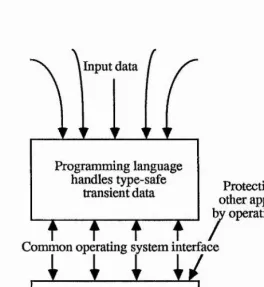
Input data
Programming language handles type-safe
transient data
f t
f
"T
Common operating system interface
w I 1/
Access by other applications through
operating system interface
Permanent data beyond jurisdiction
of programming language
Figure 1.4.1 Traditional strategy for permanent and shared data
Mechanisms which govern long term data, such as protection and module binding, must be dealt with at the level of this interface. Historically this has the consequence that the type system may not be enforced, and knowledge of the typed structure of data may not be taken advantage of. This is shown diagramaticaliy in Figure 1.4,1.
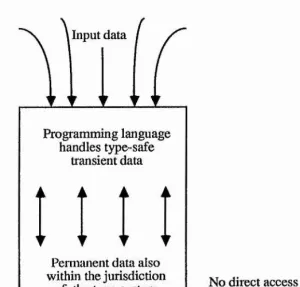
In a persistent system, the storage of data beyond a single program invocation is handled by programming language mechanisms, and no common operating system interface is necessary. The only route by which data may be accessed is through the programming language, and so the type system of a single language may be used to enforce protection upon both transient and permanent data. High-level modelling may be relied upon for the entire lifetime of the data, as it never passes outside the language system. Figure 1.4.2 gives a diagrammatic view of such a system.
[image:28.614.138.399.58.342.2]Input data
Programming language handles type-safe
transient data
Permanent data also within the jurisdiction
of the type system No direct access is possible to permanent data
Figure 1.4.2 The persistent strategy
The universality of the persistent type system has consequences in terms of both the modelling and protection provided by the type system itself, and also presents some new challenges in terms of implementation.
With respect to modelling, the persistent type system must be sufficiently flexible to allow the modelling of activities normally provided by untyped support systems. Such activities include, for example, the linking of separately prepared program units, and file system access protection. Methods of achieving such flexibility whilst maximising safety include the controlled use of infinite unions, parametric and inclusion polymorphism.
With respect to protection, the increased role of a type system means that any protection mechanisms programmed at a high level may be fully relied upon to protect the data for its lifetime, as access from outside the constraints of the type
[image:29.614.117.417.56.343.2]15
system is not possible. In particular, various high level information hiding techniques may be used to restrict data access, instead of relying upon the normally coarse grain and typeless control provided by outside technologies.
The implementation of such a system presents the challenges of combining the following features:
• a fine-grained type system to maximise safety, resulting in large and complex type descriptions
• infinite unions, parametric and inclusion polymorphism, to allow sufficient flexibility
• the efficient implementation of the above features in a persistent system
Efficiency is considered important as programmers are well known to sacrifice safety and long-term efficiency for short-term performance. Efficiency considerations within a persistent system are notably different from those in a non- persistent system.
1.5 Thesis structure
This thesis is divided into four main chapters. Two of these concentrate upon the issues of modelling and protection when a single type system is used to govern all data, and the other two on how such a system may be implemented. An outline of each of these chapters is given in the sections 1.5.1 to 1.5.4.
I
1.5.1 Software reuse in persistent systems
Persistent programming systems with first class procedure values [AM85] may be used to solve some of the problems associated with the incremental construction of large programming systems. In particular, software componentry may be shared, rather than copied, whilst maintaining the benefits of a strongly typed programming language. Apart from orthogonal persistence, two other language facilities are required to allow this.
A flexible, incremental binding mechanism is required to model a number of
different methodologies for the binding of program components [Dea89J. In # particular, carefully controlled dynamic and L-value binding in such a mechanism
may allow the incremental construction of a complex software system.
Type abstraction is also necessary to maximise the sharing of software componentry, as it allows the specification of program segments that do not
As all data within a persistent system are subject to type system constraints, no unlawful access to the data may occur except in the event of system failure. This gives the property of type safety to permanent data, which can not be achieved in a non-persistent system.
A further effect of the type safety of all data is that any protection which is programmed may not be revoked by a lower level of technology. This means that access protection and software constraints may be programmed as suitable for the individual data. A number of different language mechanisms may be used to
I
depend upon a full type description of the data over which tliey operate. Universal i
'ft
quantification allows abstraction over the type of a program segment, and | existential quantification allows abstraction over the implementation of the data it
uses [CW85, MBC87].
■ r;
1.5.2 Models of protection
#
i
1,5.2.1 Protection
Large bodies of data are inherently valuable, and must be protected against
accidental or deliberate misuse. This is true in both persistent and non-persistent '$
protect permanent and shared data, including subtype inheritance, procedural encapsulation, and abstract data types [MBC90].
1.5.2.2 Viewing mechanisms
The protection of data in database systems is normally achieved by integrity constiaints and viewing mechanisms. In a persistent system, however, such mechanisms do not need to be specially provided as they may be programmed within a persistent programming language. Integrity constraints may be programmed within procedural encapsulation, and viewing mechanisms may be programmed with a combination of encapsulation and existentiaUy quantified data types. The added advantage of existentiaUy quantified types over traditional viewing mechanisms is that they are statically type checkable. The referential integrity provided by a persistent store ensures that views occur over the same instance of data, and the copying of data, with its associated integrity problems, is not necessary [CDM90J.
1.5.3 Typecliecking across separately compiled modules
Type equivalence checking is well understood within a program, but presents some extra problems in a persistent system which allows the independent compilation of co-operating modules [CBC90]. In a persistent system, data which is shared between modules does not move outside the language's type system, and so the type system must address the new issues. Commonly, languages which are not persistent can allow such co-operation only by using a store interface which is not type secure, such as a file system.
provision of the facilities traditionally found in DBMS for schema editing, use and evolution.
Two models of type equivalence are in common use: name equivalence and structural equivalence. While name equivalence schemes are easier to implement and are genarally more efficient they still have to use structural checks to provide important facilities such as schema merging. On the other hand structural equivalence, generally more flexible and less efficient, can often achieve the same performance as name equivalence [CBC90].
One important topic of research is how to improve the performance of structural equivalence checking. How such checking may be performed is fully investigated. The balance between constructing efficient representations of types in terms of store and the speed of the equivalence algorithm in comparing two representations is described.
Two main candidates for type representations are strings and graphs. The differences in practice of these representations highlight the difficulties in their construction and use. Some preliminary measurements are available and the main conclusion is tliat where tlie type schema is large and involves the sharing of types, the graph representation is much more efficient in terms of space. It may however be slower in terms of speed of checking depending on its use within a persistent store.
1.5.4 Implementation of polymorphism
The other proposal is for a mechanism which allows type-specific operations to be performed on a value whose type is partially abstracted over, and may tlierefore be used to implement inclusion polymorphism. This mechanism may also be useful
21
Values of different types frequently have different machine-level representations, for reasons of efficiency. The difficulty of implementing polymorphic systems
stems from the fact that, as the type may be abstracted over, the representation of a f value is not always known statically. This causes problems with all kinds of
polymorphism. With parametric polymorphism, operations which may manipulate a value of any type are defined over values whose type, and therefore representation, is not known. With inclusion polymorphism operations such as
record dereference may be defined over values whose type is partially abstracted | over. Representation dependent information, such as record offsets, may not
always be calculated statically. With ad-hoc polymorphism there is a requirement I for operations with different semantic meanings to be executed according to the
type of the operands, which may be abstracted over in some systems. I A number of solutions to these problems have been proposed and successfully i implemented [Mil83, Lis81, DD79, Mat85, BMS80, Fai82, Tur87, WB89]. All
of these implementations however have been in non-persistent languages, and for 4
various reasons are not well suited to the implementation of polymorphism in a persistent programming system.
% Two new mechanisms for the implementation of polymorphism are described here.
One of these solves the problems encountered when operations are to be performed 4
on a value about which no type information is available. This is suitable for the implementation of parametric polymorphism and existential data types. This
mechanism has been successfully used in the implementation of the persistent ‘I language Napier88 [MDC90].
i
in object-oriented languages as a solution to object addressing with multiple inheritance [CDM89],
22
I
1
2 Software reuse
2.1 Introduction
J
Persistent programming systems may be used to solve some of the problems # associated with the construction of large and complex programming systems. In
particular, software componentry may be shared, rather than copied, whilst maintaining the benefits of a strongly typed programming language. Apart from orthogonal persistence, two other language facilities are required to allow this.
3
A flexible, incremental binding mechanism should be able to model a number of
different methodologies for the binding of program components. In particular, | Î such a mechanism should allow the incremental construction and evolution of a
'
complex software system. So that a system constructed incrementally may be released, it should also be possible to bind the components together tightly at a later stage.
Type abstraction is also necessary to maximise the sharing of software componentry, as it allows the specification of program segments that do not depend upon a full type description of the data over which they operate. Universal quantification allows abstraction over the type of a program segment, and existential quantification allows abstraction over the implementation of the data it uses [CW85, MBC87].
2.1.1 Program sharing and binding
Type systems provide support for modelling and protection within programming languages. Traditionally, this support exists only within the confines of a single
■‘I
I
different programs. A consequence of this is that a programmer need not bedistracted by the writing of conversion routines to flatten and rebuild permanent Ê
data, nor the possibility that permanent data may be compromised by access from I outside the control of the language’s type system [ABC83].
A further ability of persistent languages is the type-safe storage of data of any type. t| This is not possible in a non-persistent language. For example^ many languages
include type systems which are able to model first-class procedures and abstract
data types. Unless the internal form of such values is part of a language's f"' semantic domain it is not possible for a programmer to specify flattening and
restructuring of arbitrary data.
Within a persistent programming system, the ability to store procedures has been shown to be extremely powerful [AM85]. In particular, it allows sub-programs as well as data to be placed in the persistent store and flexibly bound as they are required during the execution of another program. This ability potentially allows all programming activity to be expressed within a single system, and goes some way to provide a technology suitable for the construction of an integrated project support environment [MBD85].
Programming languages normally define only a single mechanism for the exporting of data from beyond tlie scope of a single program, and this interface is used both for data which is to outlive a program and also for data which is to be shared by a number of programs. This is true of both persistent and non-persistent languages. In a persistent system, however, where procedures may be passed through this interface, a more flexible model of reusing software is made possible.
I
written to perform sub-tasks, but these must always be bound together from outside a language system. Usually they must be bound before a program starts to execute, using a mechanism such as a linker. In tins case software reuse is limited to the provision of program libraries, which are linked into a program before its execution.
version of the code is required, and programs have no obligation to bind to code t that they never execute.
Some operating systems, such as Multics [Org72], have provided similar solutions to the problem of code and data sharing. Although such systems work well, they do not provide support at a level which allows type-safe sharing within the domain of a programming language.
There are further requirements for a persistent system to maximise its software reuse potential. It must have a flexible binding mechanism which makes it easy for a component builder to place procedures in the store, and for an application builder to bind to them. To allow for different kinds of change in systems, a number of different kinds of bindings are desirable, from fully static to fully dynamic [MAB90].
To minimise the number of components which are necessary, a persistent system should have the ability to abstract over type. Many general-purpose components only require partial knowledge of the type of the data they operate over, and if type abstraction mechanisms are not present tlien multiple copies of code, witli different type descriptions, will appear even in a persistent system.
i The language Napier88 [MBC89] includes an environment mechanism which $ allows for very flexible binding, and two kinds of type abstraction, namely
2.2 Binding mechanisms
2.2.1 Environments and binding
2.2.1.1 Static and dynamic environments
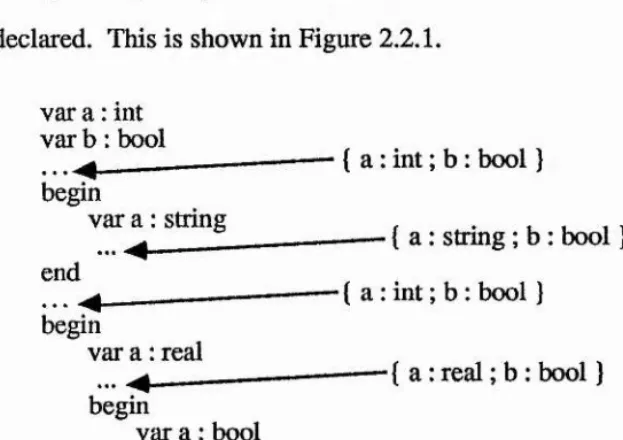
Environment in its general sense is defined as the set of identifiers which are in scope in a block-structured programming language. [Str67] Scope levels may be used to provide a contextual naming scheme within a single program. The rules for constructing an environment in block-structured languages are that an identifier is lexically in scope only between its declaration and the end of the block in which it is declared. This is shown in Figure 2.2.1.
var a : int var b : bool
•-4- { a : int ; b : bool ) begin
var a : string { a : string ; b : bool ) end
begin
var a : real ... ^
begin
• { a : int ; b : bool} { a : real ; b : bool} var a : bool
var c : int ( a : bool ; b : bool ; c : in t} end
...
end { a : real ; b : bool )
Figure 2.2,1 Static environments
[image:40.614.108.420.316.536.2]Most of the work in the design and implementation of environments in Napier88 was carried out by Alan Dearie, and is reported in [Dea88, Dea89J.
.1 In contrast, languages such as Lisp [McC62] use a dynamic binding scheme. An
identifier binds to its most recent declaration during the evaluation of a program. Thus the declaration of an identifier enhances some dynamic environment with a
new instance, and the use of an identifier causes a dynamic lookup to obtain the -f current binding. In general with this scheme binding may not be determined by
static program analysis, as it depends on evaluation order. This binding mechanism is more flexible than that of block structure, and in a persistent system would potentially allow identifiers in separately prepared programs to refer to the same declaration. Its relative drawbacks are that it is less efficient, and fewer programming errors may be detected by static analysis.
In Napier88, the data type env is a dynamic model of static block-structured environments, with individual values of type env corresponding to lexical levels. Using values of this type, collections of bindings may be dynamically introduced at the start of a new scope level. The difference between Napier88's model of dynamic binding and that of a language such as Lisp is that Napier88’s binding is mostly static, and dynamic binding is restricted to specified points of block entry. At these points, the static environment is enriched with those identifiers which will be bound from the dynamic environment during program execution. Thus each identifier used from a dynamic environment need only be bound dynamically once during the execution of a program. This model gives maximum safety and efficiency while still allowing the flexibility of sharing declarations between contexts.
2.2.1.2 L-value and R value binding
In a programming language with update, identifiers may bind to locations which contain values [Str67j. The identifier may be required, in different contexts, to be used to access either the location itself or its contained value.
In some languages, such as ML, the consistent use of an explicit dereference operator allows any expression regardless of context to denote either a location or a value. A new binding of an identifier to a location may be introduced, for example, by
val a = ref 7
The identifier a always denotes the location, and tlie contents of this location may only be accessed by an explicit dereference. For example, to increment the value within this location the identifier a on the left hand side denotes the location itself, and the expression \a on the right hand side denotes the value contained therein:
a := !a + 1
Another identifier may be bound to the same location, for example val b ” a
after which an update to b will also affect the value stored in a. This is quite different from
val b = ref !a
which declares a new location initialised to the value contained in a.
Locations normally have a very restricted algebra defined over them: assignment
operator, and whether an identifier denotes a location or its contained value is determined by its use. In Pascal, for example, in the statement
a := a + 1
the different instances of a bind to different entities: on the right hand side of the assignment operator to the value, and on the left hand side to the location. This may be thought of as an automatic insertion of the dereference operator in appropriate contexts. Most block-structured programming languages use the convention that an expression to the left of an assignment evaluates to a location, and anywhere else to the contained value. For this reason, bindings to a location are usually referred to as L-value bindings, and to a contained value as R-value bindings.
This convention makes it impossible for an identifier to bind to a location which exists before its declaration. For example, in the statement
a := b
an implicit dereference occurs when b is accessed. The effect is therefore to update
the location bound to a with the value in the location bound to 6, rather than ?| updating the binding between a and its location with a binding between a and 6’s
location. Every declaration therefore introduces a new location to which the identifier always remains bound.
If it is wished to share a location between contexts, this may only be achieved by using a data type which itself contains locations, for example a record in a language with store semantics. If a and b are both record values, the statement
updates tlie location bound to a with the same instance of the record referred to in the location bound to b. If the record has a field jc, then after this assignment the expressions
a(x) and
b(x)
both specify the same L-value.
The programming language CPL [BBH63] introduces a new operator to allow binding of an identifier to a location which already exists. One of the operators in the language is a location assignment operator, which causes the right hand side of the assignment statement to evaluate to a location rather than its contained value. The statement
a = b
causes b to evaluate to the location bound to 6, rather than the value stored in it. The effect of the statement is therefore to update the binding between a and the location it refers to. The purpose of this feature is to allow the manipulation of commonly accessed locations within data structures, so that, for example
l e t a s b [ 2 , 2 j a := <expression> would have the same effect as
b[ 2 , 2 ] := <expression>
32
In Napier88 evaluation to L-value occurs in two places, according to convention. The first is on the left hand side of an assignment operator. The second occurs on binding to a dynamic environment. At the point where an identifier is bound to a dynamic environment, the binding occurs to the L-value. This introduces the property of allowing identifiers within independently prepared programs to dynamically refer to the same L value.
2.3 NapierSS environments
J
■i? Dynamic binding may be modelled in Napier88 by the data type env [Dea89]. A
value of this type represents a collection of bindings, each of which consists of an !
À
identifier, a type, and a value. The Napier88 model of mutability requires also a
constancy indicator in association with each binding. |
I
2.3.1 Creation and use of NapierSS environments
A new dynamic environment may be created in Napier88 with a procedure found | in the standard environment, itself called environment. This is of type 5
proc( env )
and returns an environment with no bindings. A new environment may be created and bound to an identifier by
let e := environment()
A binding may be added to an environment in the same way that a binding is normally added to the static environment, using a let declaration. This must now
specify a destination environment, as well as an identifier, for the initialising | expression. An integer value may be added to the new environment:
in e let a := 7
I
' ' " ' ... ' ''M
4.
I
Notice that this does not enhance the static environment, only the environment # denoted by e. Declarations enhance the static environment only if no dynamic 5
environment value is stated. Thus c%
let a := 7 print( a )
will cause the the print procedure to be called with the value 7, but in e let a :== 7
print( a ) |
will fail during the static analysis of the program, as the identifier a is not available |
for use in the call of the print procedure. i
Due to the dynamic nature of these environment values, one further operation is
required which is not normally available in a static environment. This is to drop a : j binding from an environment, which may be written, for example, as
drop a from e
An important attribute of the drop operation is that it does not affect any program which has already formed a binding to the identifier which is dropped. It removes only the identifier from the environment, and not the location which is denoted by the identifier.
The final requirement is a method for a binding from a dynamic environment to be brought into a static one. In NapierSS this may be achieved by the use clause, for example:
use e with a : int in begin
print( a ) end
The use clause specifies the bmding between the static and dynamic environments, performed once upon the block entry, and within the use clause the identifier a is
in the static environment. Notice that the type must be specified at the point of binding. All typechecking may therefore be performed statically, except for a single check at the time of binding to the dynamic environment.
The use ... in part of the use clause specifies a new lexical level, in which all of the bindings specified from the dynamic environment are introduced and bound to
locations within the static environment. For example, using a language with the i location assignment operator of CPL, the NapierSS code •Ï
use e with a , b : int ; c : string in |
begin *
end
could be expressed as |
begin
let a : int = e( "a” ) let b : int = e( "b" ) let c : string = e( "c" ) begin
end end
where the dynamic environment e is represented as a lookup procedure with
varying result type. |
1
One further point about the use clause is that it may specify a subset of the
identifiers actually present within the environment. This partial specification % means that a programmer need specify only the type of data which is of interest in j
4
each particular context. :|
2.3.2 L-value binding
this is that, should an update be performed to a location bound from a dynamic environment, the effects of this update are apparent to any other context where the same binding is in scope. Thus side-effects are not restricted to the local scope.
For example, the program in Figure 2.3.1 declares an identifier a within a new | environment. Two dynamic bindings to this identifier will occur during the
program’s execution. The first of these, in the procedure change^ is evaluated as the L-value associated with a, and the second as the R-value.
let new = environment() in new let a := 7
1
let change = proc( e : env ; new Value : int ) | use e with a : int in a := new Value
change( new , 3 )
use new with a : int in piint( a )
Figure 2.3.1 Binding to an L value
The L-value binding in the procedure means that the update will show through, and the procedure print will be called with the value 3, rather than 7.
2.3.3 Constancy
In NapierSS, constancy is an attribute of an L-value rather than of type [GM79]. This means that each L-value must have a specification of its constancy. With the names which denote locations in static environments, this is always statically determinable. In NapierSS constancy is specified by a single equality symbol in a declaration, for example
let a = 7
specifies a to be constant, whereas let a := 7
allows a to be updated at some future time.
The same syntax is used to specify a constant L-value within a dynamic environment. The only difference is that violation of constancy may no longer always be detected statically, and so a dynamic constancy test is required. For example, tlie program in Figure 2.3.2 is the same as in Figure 2.3.1 except that the declaration of the identifier a is as a constant. This program will therefore fail diaing the execution of the procedure change.
let new = environmentQ ill new let a = 7
let change = proc( e : env ; new Value : int ) use e with a : int in a := new Value change( new , 3 )
use new with a : int in print( a )
Figure 2.3.2 Binding to a constant L-value
This failure could occur at different times. To catch the error as soon as possible, it would occur at the time of binding the updated identifier to the constant location. Alternatively, the failure may not be detected until the update is performed. This allows the successful completion of a program in which the update is present statically but is not executed. NapierSS chooses the latter of these options.
2.3.4 Persistence
The NapierSS system has a single predefined identifier, PS. This is a procedure which returns a value of type env. The environment returned is the root of the persistent store, and any value which is reachable from this root wül persist. Any data value may be made to persist by arranging for it to be within this transitive closure.
5::|
could be used to create a new binding within such a scheme. Notice that this is an over-restrictive example of how environments may be used: no restrictions of either topology or type within a naming scheme are imposed by the language mechanism.
use PS() with user : env in use user with staff : env in use staff with richard : env in begin
let new = environment() in new let a := 7
in richard let integers = new end
Figure 2.3.3 Binding to an example naming scheme
The program in Figure 2.3.3 causes a dynamic bind to an environment called
richard which should already be in the persistent store. This environment becomes usable within the static environment of the main block. Another environment is created, and the binding of a to a location initialised with the value 7 is placed in it. The new environment is then placed in the environment richard. The new environment and its contained value are now within the transitive closure of the persistent store, and so will be made to persist after the program has finished executing.
2.3.5 Programming system construction
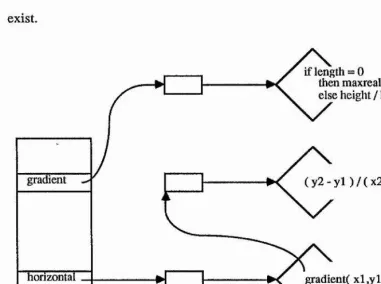
Figure 2.3.4 shows how a procedure which is to be used as a component may be declared and stored. This program contains the declaration of a procedure value which calculates the gradient of a line. When the program is executed, it places the new procedure within the persistent store. Above the program in Figure 2.3.4 is a diagrammatic representation of the persistent store after the execution of the program.
(y2- yl ) / ( x 2 - x l gradient
in PS() let gradient := proc( xl,yl,x2,y2 : real real ) ( y 2 - y l ) / ( x 2 - x l )
Figure 2,3.4 Adding gradient to the persistent store
Figure 2.3.5 shows the declaration of a procedure which uses the gradient
component, and is itself placed in the persistent store. This program first looks up the grflii/cnt procedure from the persistent store. The binding here is to the L-value declared in the previous program. Another procedure is then declared which uses the binding to gradient^ and this procedure is then itself placed in the persistent store. Notice that the new procedure is statically bound to the procedure gradient:
no dynamic binding or typechecking is required for the execution of horizontal.
"
:
J
-Ï
gradient (y2-yl )/(x2-xl )
horizontal gradient( xl,yl,x2,y2 ) = 0.0
use PS() with gradient : proc( real,real,real,real -> real ) in begin
let new = proc( xl,yl,x2,y2 : real -> bool ) gradient( xl,yl,x2,y2 ) = 0.0
end in PS() let horizontal = new
Figure 2.3.5 Static binding within the persistent store
A component writer however is unlikely to provide a perfect definition at the first attempt, and so there may be a need to later update it. For example, after the procedure horizontal has been installed in a system, it may be noticed that gradient
will fail if the two x-values happen to be the same. Figure 2.3.6 shows how a program which replaces the existing version of gradient with a new one may be written.
As both this program and horizontal are bound to the L-value denoted by gradient
within the persistent store, the effect of this update is that future calls to horizontal
if xl = x2 then maxreal
else(y2-yl )/(x2~xl )
gradient ( y 2 - y l ) / ( x 2 - x l )
horizontal gradient( xl,yl,x2,y2 ) = 0.0
use PS() with gradient : proc( real,real,real,real -> real ) in gradient := proc( xl,yl,x2,y2 : real -> real )
if xl = x2 then maxreal else ( y 2 - y l ) / ( x 2 - x l ) Figure 2.3.6 Updating the L-value binding
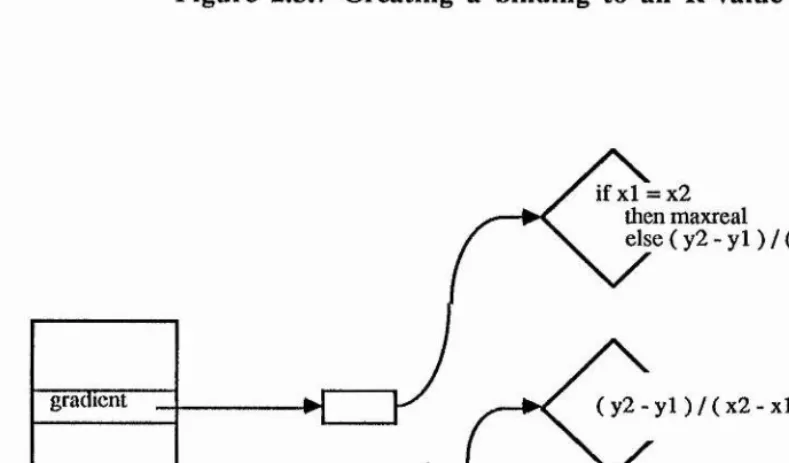
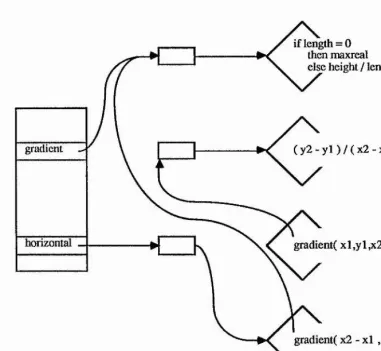
The above method of binding is unsuitable for some applications. For example, the writer of the horizontal procedure may know that it will work with the version of gradient in the store at the time, and therefore requires to bind to this version and remain unaffected if it is replaced. This may be achieved by binding to the R- value associated with gradient, as demonstrated in Figure 2.3.7.
1 %
Here, a new location gradient_yalue is declared and initialised with the R-value of the binding gradient. This location is declared as constant, and may never be updated. Therefore the new procedure is bound statically to the value of the procedure body of gradient which is in the store at the time this program is executed. The diagram in Figure 2.3,7 shows the state of the store after this program has been executed but before gradient is updated by the program in Figure
[image:53.612.81.473.51.320.2]2.3.6, and Figure 2.3.8 shows the state of the store after gradient is updated by the program in Figure 2.3.6.
( y2 - yl ) / ( x2 - xl )
gradient_value( xl,yl,x2,y2 ) = 0.0
gradient
horizontal
use PSQ with gradient : proc( real,real,real,real -> real ) in begin
let gradient„value = gradient
let new = proc( xl,yl,x2,y2 ; real -> bool ) gradient_value( xl,yl,x2,y2 ) = 0.0 end in PSQ let horizontal := new
Figure 2.3.7 Creating a binding to an R value
if xl = x2 then maxreal
else ( y2 - yl ) / ( x2 - xl )
(y2 - yl ) / ( x 2 - xl )
gradient„value( xl,yl,x2,y2 ) = 0.0 horizontal
gradient
[image:54.614.78.473.462.693.2]