1
Computational Evaluation of the Impact of
Incorporated Nitrogen and Oxygen Heteroatoms
on the Affinity of Polyaromatic Ligands for
Carbon Dioxide and Methane in Metal-Organic
Frameworks
Alice Henley†, Matthew J. Lennox†, Timothy L. Easun§, Florian Moreau‡, Martin Schröder‡ and Elena Besley*†
†School of Chemistry, University of Nottingham, Nottingham, UK, NG7 2RD
‡School of Chemistry, University of Manchester, Oxford Road, Manchester, M13 9PL
§School of Chemistry, Cardiff University, Main Building, Park Place, Cardiff, UK, CF10
2 ABSTRACT
Density functional theory is employed to explore the binding of carbon dioxide and methane in a series of isoreticular metal-organic frameworks, with particular emphasis on understanding the impact of directly incorporated nitrogen and oxygen heteroatoms on the affinity of the ligand for CO2 and CH4. While the strongest binding sites for both CO2 and CH4 were found
to be directly above the aromatic rings of the core of the ligand, the introduction of heteroatoms to the core systems were shown to significantly alter both the binding strength and preferred binding locations of CH4 and CO2.The presence of pyrazine rings within the ligand was
observed to create new binding sites for both CO2 and CH4 and, in the case of CO2, severely
3 INTRODUCTION
Metal-organic frameworks (MOFs) are a relatively new class of materials, which have emerged from coordination polymer chemistry over the past few decades.1 MOFs are constructed from
inorganic secondary building units connected together using organic ligands, often creating a highly porous structure in which features such as the pore size, surface area, topology or functionality may be controlled via judicious choice of metal and ligand.2-5 The tuneable nature of
MOFs and wide variety of accessible functionalities has resulted in their receiving a great deal of attention as high-performance adsorbents in carbon capture6-9 and methane storage10-13 technology.
Computational methods play an increasingly important role in the design and evaluation of MOFs for these applications, allowing for the high-throughput screening of a vast array of candidate MOF structures.14-19 Computational approaches are also used in detailed exploration of particular
problems such as, relevant to this study, the role of coordinatively unsaturated metal sites on CO2 20-21 and CH
422-23 adsorption or the interaction of CH4 and CO2 with various organic ligands.24-27 In
the present work, the binding of CO2 and CH4 with a number of real and hypothetical organic
ligands inspired by the recently synthesized experimental series of metal-organic frameworks, MFM-18X,28 is explored in vacuo using dispersion-corrected density functional theory in order to
shed light on the influence of directly incorporated heteroatomic species on ligand-guest interactions.
The MFM-18X series of frameworks(where X = 0, 1, 3 or 5) employs octacarboxylate ligands with central polycyclic cores of increasing length (Figure 1) and have been shown experimentally to exhibit promise for both CO2 and CH4 adsorption applications. The structures all contain three
4 large (diameter > 12.4 Å) for the adsorption mechanism at low loading to be dominated by interactions between the gas and the ligand cores which form the pore walls.
5
Figure 1. The MFM-18X ligands as previously described(top) and the resulting three-dimensional structure, demonstrated for MFM-183 (bottom). The three different types of cavity present in the MOF are indicated by colored spheres.
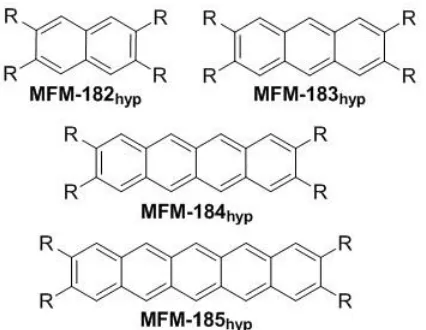
The pure hydrocarbon aromatic analogues of MFM-183 and MFM-185 have proven to be synthetically unobtainable, as have both heterocyclic and carbocyclic versions of MFM-182 and MFM-184. The simulation-based approach taken in this work enables the binding mechanisms of CH4 and CO2 to be systematically investigated not only for the synthesized linkers used in the
MFM-18X series, but also for the hypothetical members of the series shown in Figure 2. This provides significant insight into the influence of linker length and, in particular, composition on the interaction between CH4/CO2 and the pore walls of the framework, as well as valuable
[image:5.612.201.414.412.577.2]information for further experimental efforts.
Figure 2. The hypothetical linker fragments explored in this work.
RESULTS AND DISCUSSION
The interaction of single molecules of CO2 and CH4 with a series of organic linker fragments,
6 functional theory with Grimme 3 dispersion correction (DFT-D3)29 implemented in the Q-Chem
software package.30 In addition to the experimentally synthesized ligand systems,the hypothetical
naphthalene, anthracene-, tetracene- and pentacene-based ligands were also investigated.
In order to reduce the computational cost of the calculations, the isophthalic acid portions of the linkers were omitted and replaced with single hydrogen atoms (i.e. the R groups shown in Figures 1 and 2 were replaced with C6H5 in all simulations). The presence of electron-withdrawing
functional groups (or, in the case of MOFs, the presence of a coordinated metal oxide cluster) has been shown previously to have a stabilizing effect on the guest-ligand complex.25, 31-32 As the
aromatic core of the ligand – the focus of the present study – is at least two aromatic units removed from the COOH group, however, the influence of the electron-withdrawing group on guest binding in the systems studied herein is likely to be minimal. In referring to the linker fragments studied in this work, we adopt the form Lnc and Lnh, in which n indicates the length of the central aromatic
core (n = 0 to 5), c indicates a carbocyclic molecule and h indicates a heterocyclic molecule. The interaction of the guest molecule with the linker was evaluated in two steps, both using the B3LYP functional.33 An initial geometry optimization of the guest-linker dimer was undertaken
using the 6-31+G* basis set, followed by single-point energy calculations using the larger 6-311+G* basis set, from which the binding energy of the guest molecule was calculated following the counterpoise method for the correction of the basis set superposition error.34 Partial charges
were determined using the CHELPG method.35 For each guest-linker system, several initial
7 In order to validate the adopted computational methodology, a range of benchmarking calculations were performed for a simple weakly interacting system – the CO2 – C6H6 dimer. These
results are compared with the literature values for the binding energy and equilibrium separation obtained by coupled-cluster theory with iterative singles-and-doubles excitations and a perturbative treatment of triplet excitations, CCSDT(T), in the limit of the complete basis set (CBS)36 as well as other available data. Table 1 summarizes a comparison between the
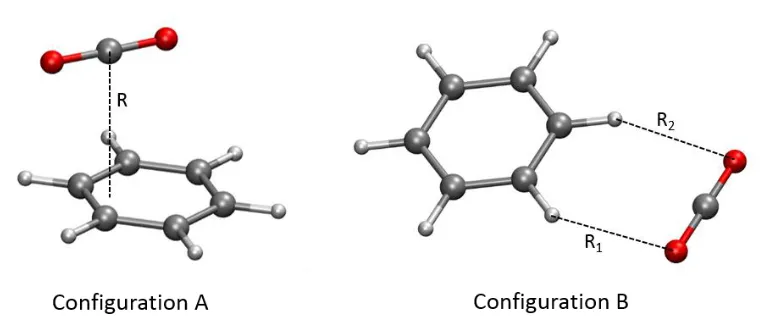
performance of B3LYP-D3 method, used in this study, with CCSD(T) method and less accurate Moller-Plesset Perturbation theory, MP2. For both configurations of CO2 – C6H6 dimer, ‘stacked’
(configuration A in Figure 3) and ‘end on’ (configuration B in Figure 3), B3LYP-D3 results perform consistently better than MP2 and, in the case of configuration A, are in excellent agreement with the ‘golden standard’ CCSD(T)/CBS results.
A very good agreement for the binding energies calculated using CCSD(T) and DFT-D3 methods has been previously reported37 for non-covalent interactions of CO
2 molecule with a large
set of organic linker molecules including nitrogen-containing heterocycles. The authors37
concluded that both methods are suitable tools to study such weakly bound systems. The performance of B3LYP-D3 hybrid functional augmented with a dispersion term has been also shown to be reliable for description of the interaction between small molecular adsorbates (CH4,
H2, N2, CO2, CO, H2O and NH3) with Cu- and Fe-containing coordinatively unsaturated sites
8
Figure 3. Two configurations of CO2 – C6H6 dimer used in benchmarking calculations presented
in Table 1.
Table 1. Benchmarking results for the binding energy and equilibrium distance in CO2 – C6H6
dimer comparing the performance of B3LYP-D3, MP2 and CCSD(T) methods.
Method Basis set R, Å Binding Energy, kJ/mol Configuration A
MP239 def2-QZVPD 3.35§ -11.90 def2-TZVPD 3.35§ -9.90 B3LYP-D3 def2-QZVPD 3.28 -10.41
def2-TZVPD 3.28 -10.29 B3LYP-D3 6-31+G* 3.28 -10.24 CCSD(T)36 CBS 3.25 -10.20±0.40 CCSD(T)39 CBS 3.35§ -10.70
CCSD(T)39 aug-cc-pVTZ 3.35§ -9.70
Configuration B
9
B3LYP-D3 6-31+G* 2.71 2.71 -4.96
§ geometry optimized at the MP2/def2-TZVPP level of theory
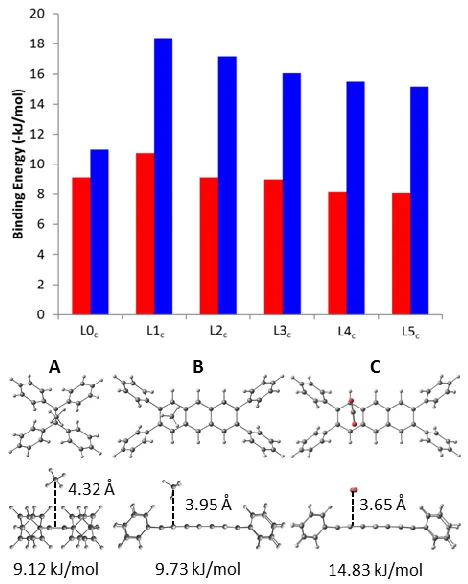
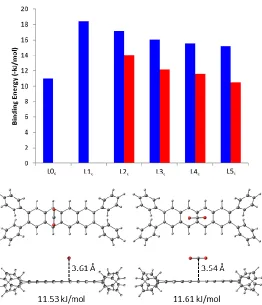
In the case of the non-heterocyclic linkers (L0c, L1c, L2c, L3c, L4c and L5c), a steady increase in
binding strength is observed as the linker length is decreased, reaching a maximum for L1c (Figure
4; top). For both CH4 and CO2, the highest strength binding locations on the carbocyclic linkers
were found to be adjacent to the phenyl rings on each end of the linker, either directly over or near the first aromatic ring of the carbocycle (Figure 4; bottom). The primary interaction in this location is between either a positively charged hydrogen (in the case of CH4) or carbon atom (for CO2) with
the electron-rich centre of the aromatic ring. Additional, weaker interactions exist between the guest molecule and the edges of nearby terminal phenyl groups. As the separation between the terminal phenyl groups is reduced by removing aromatic units from the centre of the linker, guest molecules are able to interact not only with the nearest pair of phenyl rings but also with those on the opposite end of the linker, resulting in the observed increase in binding strength. Further reduction in linker length from L1c to L0c eliminates the central aromatic component of the linker
entirely and results in increased steric hindrance due to the short separation between terminal phenyl groups, forcing the guest molecule further away from the linker (Figure 4; bottom). As a result of these two factors, both CH4 and, in particular, CO2 were found to be much more weakly
10
Figure 4. Calculated binding energy (top) of CH4 (red) and CO2 (blue) in the non-heterocyclic
linkers and representative preferred binding sites (bottom) viewed from above and the side of the linker fragment: A) CH4 on L0c; B) CH4 on L3c; C) CO2 on L3c.
While guest binding on the preferred binding site within the carbocyclic linker series – the aromatic ring nearest the phenyl groups – is weakened as the linker is extended, the introduction of additional aromatic rings results in an increase in the total number of viable binding sites. In the case of CH4, additional binding sites were found both directly above any additional aromatic rings
11 more than one CH4 molecule on each face of the ligand may be sterically impossible. Given the
similarity in binding energies observed along the core of the ligand, it is unlikely that CH4 will
[image:11.612.157.456.208.348.2]remain localized on one particular site under ambient conditions and the interaction energy in the real system is therefore likely to be an average of both primary and secondary sites.
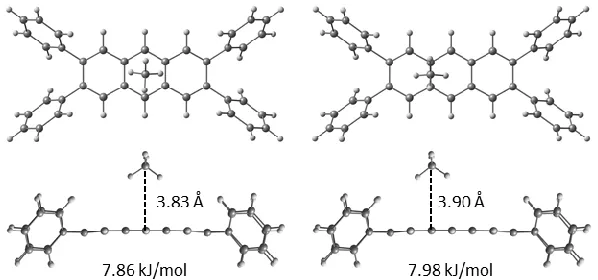
Figure 5. Representative secondary CH4 binding sites on L3c viewed from above and the side of
the linker fragment. Similar binding modes were observed on L4c and L5c (see SI).
Little difference was observed in methane binding energy with the secondary binding sites on extension of the linker system from L3c to L4c and L5c, indicating that while an increase in linker
length results in a more weakly bound methane molecule at the primary adsorption site, it is not detrimental to the adsorption of methane on secondary sites. The inclusion of a longer ligand is therefore likely to be advantageous, allowing more than one methane molecule to bind with the same ligand without the steric clashes between primary and secondary sites that exist in L0c-L2c,
although a full exploration of the many-molecule system would require a classical statistical mechanics approach.
In the case of CO2, secondary binding sites were also observed either directly over any additional
12 align itself with the O-C-O axis parallel to the plane of the aromatic core of the linker, and generally adopted a position with the O-C-O axis either aligned with or perpendicular to the long axis of the aromatic core (Figure 6). Unlike methane, however, CO2 binds much more weakly to the
secondary sites when compared to the primary binding locations and a steady decrease in binding strength is observed for secondary sites as the linker is extended (Figure 6), a result of the more significant electrostatic interactions between CO2 and the phenyl rings at the end of the linkers,
which remains non-negligible at a longer separation distance than the primarily dispersive CH4
-linker interactions.
Figure 6. Dependence of CO2 - linker binding energy on linker length for primary (blue) and
[image:12.612.176.438.319.624.2]13 (bottom). Similar binding modes were observed for L3c and L5c (see SI). L0c and L1c do not
contain enough aromatic rings to allow for secondary biding sites.
While both CH4 and CO2 behave similarly in the non-heterocyclic linkers with respect to the
available binding sites and dependence of binding energy on linker length, the same is not true upon introduction of N- and O-heteroatoms to the system, such as those present in L3h and L5h.
[image:13.612.82.533.355.518.2]The presence of nitrogen and oxygen within the aromatic core of the linker alters the distribution of charge in the system, introducing regions of significant positive charge (Figure 7). This has the effect of both creating new viable binding sites and significantly altering – and even eliminating – previously identified sites.
Figure 7. Comparison of CHELPG partial charge maps of the carbocyclic (top) and heterocyclic (bottom) forms of L5. A similar change in charge distribution was observed for L3 (see SI).
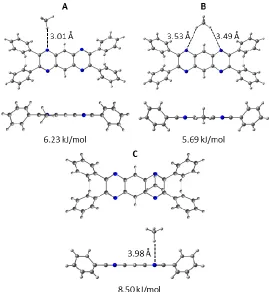
In the case of the heterocyclic L3h linker, the preferred methane binding site was found to be
14 bond-like interactions via directed C-H···N interactions (Figure 8). While the interaction between methane and the side of the linker (binding energies between 5.69 kJ/mol and 6.23 kJ/mol) are 2-3 kJ/mol weaker than the interactions observed between methane and the π system of the rings, they still exceed kT at room temperature, suggesting that they do represent viable methane adsorption sites. Methane was not observed to bind along the edge of the linker in the carbocyclic analogue, L3c. While the introduction of N-heteroatoms to the L3 system causes methane to be
15
Figure 8. Binding sites identified for the CH4 - L3h dimer: A, B) secondary binding sites created
via C-H···N interactions; C) preferred binding site above a pyrazine ring.
While the location of the strongest methane binding sites on the carbocyclic L3c and heterocyclic
L3h linkers remained very similar, the introduction of additional O-heteroatoms in the longer L5h
linker significantly alters the preferred CH4 binding locations. For the CH4 - L5h system, the
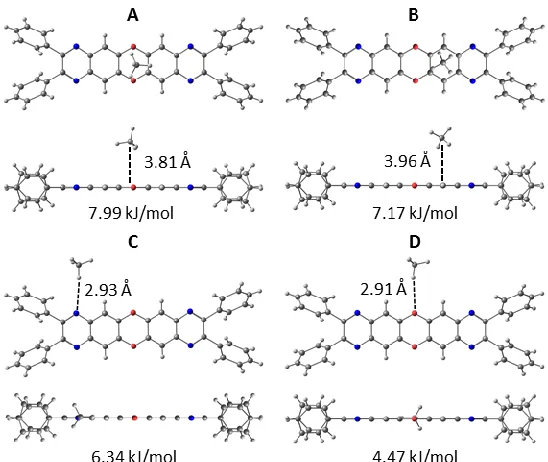
strongest interactions were observed when methane was located directly above the oxygen-containing, electron-rich central ring of the linker (Figure 9). Although a similar configuration was observed in the carbocyclic L5c, methane exhibits a noticeably stronger interaction with the
heterocycle (by between 0.5 to 0.9 kJ/mol). In contrast to the L3h system, no dimers were observed
in which methane is bound above the plane of the pyrazine rings of L5h (cf. Fig. 8C for L3h),
16 L3h ligand. As in L3h, the interaction between H of CH4 and the heteroatoms of the linker creates
a number of new methane binding sites in comparison to the carbocyclic analogue, L5c (Figure 9).
The strongest of these new sites are located near the N-heteroatoms (BE = 6.34 kJ/mol; Fig. 9C), a result of the interaction between C—H and the nitrogen lone pair. Further sites are located near the O-heteroatoms, either via a direct C—H⋯O interaction (BE = 4.47 kJ/mol; Fig. 9D) or a
bridging mode, in which methane is seen to interact weakly with both nitrogen and oxygen (BE = 4.76 kJ/mol; SI). As in L3h, the binding energies for these newly created sites exceed kT at room
[image:16.612.169.443.324.555.2]temperature, indicating that they can be expected to play a non-negligible role in methane adsorption at low pressure.
Figure 9. Binding sites identified for the CH4-L5h dimer: A, B) preferred binding sites above or
next to the oxygen-containing ring; C, D) secondary binding sites along the side of the linker.
The introduction of heteroatoms was found to have an even greater impact on the binding of CO2 with the L3 and L5 systems. The change in charge distribution induced by the introduction of
17 Whereas the strongest interactions in the carbocyclic L3c and L5c were found to be directly over
the ring systems (BE = 16.06 kJ/mol and 15.17 kJ/mol, respectively), only comparatively weak interactions (about 7-12 kJ/mol) were found for similar conformations in the heterocyclic systems. As was the case for methane, several new strong CO2 binding sites were identified near the
N-heteroatoms (Figure 10), exhibiting binding energies of around 17.5 kJ/mol (L3h) and 16.7 kJ/mol
(L5c), approximately 1-2 kJ/mol stronger than any sites observed in their carbocyclic analogues.
The CO2 molecule is able to bind strongly with the linker via a combination of the interaction of
the positively charged C of CO2 with the negatively charged N-heteroatoms and interactions
between the negative O of CO2 and the regions of slight positive charge above and below the ring.
The overall effect of heteroatoms on the adsorption of CO2 in these systems is likely to be minimal,
18
Figure 10. Representative binding sites for CO2 on the heterocyclic L3h and L5h linkers: A)
comparatively weak interaction with the pyrazine rings of L3h (4 kJ/mol weaker than equivalent
sites in L3c); strongest binding site B) on L3h; C) on L5h, created via CCO2···N and OCO2···π
interactions.
From the point of view of the selective adsorption of CO2 over CH4 at low loading – in which
the selectivity is dominated by the interaction of the two species with the framework – the ratio of the binding energies of the two components (BECO2/BECH4) is of greater interest than the binding
energies themselves. In the case of primary adsorption sites on non-heterocyclic linkers, CO2
always binds more strongly with the linker than CH4 and the ratio from the calculations was found
to vary from 1.21 (in L0c) to a maximum of 1.91 (in L4h). Little dependence of the ratios of binding
energies of the five carbocyclic linkers on linker length was observed, with the lowest ratios being observed in L1c and L3c (1.71 and 1.79, respectively), while the ratios in the remaining three
linkers ranged from 1.88 to 1.91. When both primary and secondary binding sites are considered, the selectivity of linkers L1c through L5c was found to be almost identical, with binding energy
ratios ranging from 1.63 (L5c) to 1.72 (L4c). The presence of heteroatoms in the linkers appears to
be beneficial to CO2 selectivity when sites along the sides of the linkers are considered
(BECO2/BECH4 = 2.67-2.91). Although CO2 is expected to be selectively bound over CH4 along the
edges of the heterocyclic linkers, the re-distribution of charge above and below the aromatic core of the linker is detrimental to CO2 and methane is preferred in sites above the ring system of L3h
as a result (BECO2/BECH4 = 0.82).
19 In this work, we have presented an extensive computational study of the binding of CH4 and
CO2 with a series of real and hypothetical MOF ligands, exploring the effect of linker length and
the presence of N- and O-heteroatoms on the affinity of the linker for the two species. It has been shown that the strongest binding sites for both CH4 and CO2 in the carbocylic linkers are found
directly above the aromatic rings of the linker core, primarily the ring nearest to the outer phenyl rings of the system. The strongest binding on the carbocyclic linkers were observed for the benzene and naphthalene-based systems, in which strong interactions with the π system of the aromatic rings are combined with additional interactions with the nearby outer phenyl rings. The shortest linker, L0c, was found to introduce significant steric restrictions on the binding locations of CH4
and CO2, and both species were only weakly bound as a result.
Although the introduction of heteroatoms to the linkers was found to be beneficial in the case of CH4, the case was not as clear for CO2. In the heterocyclic linkers, CH4 was able to bind in the
regions above and below the heterocyclic core of the linker with only a small reduction in binding strength compared to the carbocyclic analogues. The presence of heteroatoms introduced additional adsorption sites along the sides of the heterocycle, a result of hydrogen bond-like interactions between methane and the heteroatoms, presenting an attractive route to increased CH4
adsorption affinity in MOFs with polyaromatic ligand systems, particularly when combined with proposed methods towards frameworks containing linkers with increased aromatic surface area.18, 41-42
The presence of heteroatoms in the L3h and L5h linkers was found to significantly enhance CO2
binding compared to the carbocyclic L3c and L5c. The strongest binding sites, however, were found
to be along the sides of the heterocycle and CO2 was no longer able to bind strongly with sites
20 adsorption is therefore likely to be highly system dependent, with the largest benefit being in systems where the edges of the heterocycles are accessible to CO2, for example, MFM-18X,28
NOTT-12243 and the quinoxaline-based MOFs of Zhu and co-workers.44 It is notable that while
three quinoxaline MOFs were reported, considerably enhanced CO2 uptake was observed in the
only MOF in which the edges of the pyrazine system were accessible.
Comparison of the relative binding strengths of CH4 and CO2 indicates that any of the
carbocyclic linkers studied in this work are suitable for selective adsorption of CO2 over CH4 at
low pressure but that the presence of at least one central aromatic ring improves selectivity considerably over the single unsaturated C-C bond present in L0c. Comparison of the heterocyclic
and carbocyclic linkers suggests that while the presence of heteroatoms can greatly enhance the selectivity towards CO2 for systems in which the edges of the heterocyclic rings are accessible, the
presence of heteroatoms tends to favour methane in regions directly above and below the heterocyclic rings and the incorporation of heteroatoms into ligands in which the heteroatom is not able to interact directly with CO2 may, in fact, reduce the selectivity of the MOF for carbon dioxide
over methane at low pressure.
ASSOCIATED CONTENT
Supporting Information.
Calculation of pore size distribution; additional CH4 binding sites on L4c, L5c and L5h; additional
CO2 binding sites on L3c and L5c; CHELPG charges for L3h and L3c.
AUTHOR INFORMATION
21 *email: [email protected]; tel. +44 (115) 846 8465
Author Contributions
The manuscript was written through contributions of all authors. All authors have given approval to the final version of the manuscript.
Notes
The authors declare no competing financial interest.
ACKNOWLEDGMENT
The authors wish to acknowledge funding from EPSRC and the University of Nottingham High Performance Computing facility for computational time; EB acknowledges an ERC Consolidator Grant for financial support. We are grateful to Dr. Alexander Markevich for providing benchmarking calculations for CO2 – benzene dimer.
REFERENCES
1. Batten, S. R.; Champness, N. R.; Chen, X. M.; Garcia-Martinez, J.; Kitagawa, S.; Ohrstrom, L.; O'Keeffe, M.; Suh, M. P.; Reedijk, J., Terminology of Metal-Organic Frameworks and Coordination Polymers (Iupac Recommendations 2013). Pure and Applied Chemistry 2013, 85, 1715-1724.
2. Rowsell, J. L. C.; Yaghi, O. M., Metal-Organic Frameworks: A New Class of Porous Materials. Microporous and Mesoporous Materials 2004, 73, 3-14.
3. Yaghi, O. M.; O'Keeffe, M.; Ockwig, N. W.; Chae, H. K.; Eddaoudi, M.; Kim, J., Reticular Synthesis and the Design of New Materials. Nature 2003, 423, 705-714.
4. Lu, W. G., Wei, Z.; Gu, Z.-Y.; Liu, T.-F.; Park, J.; Park, J.; Tian, J.; Zhang, M.; Zhang, Q.; Gentle T. et al., Tuning the Structure and Function of Metal-Organic Frameworks Via Linker Design. Chem. Soc. Rev. 2014, 43, 5561-5593.
22 6. Bae, Y. S.; Snurr, R. Q., Development and Evaluation of Porous Materials for Carbon Dioxide Separation and Capture. Angew. Chem.-Int. Edit. 2011, 50, 11586-11596.
7. Li, J. R.; Kuppler, R. J.; Zhou, H. C., Selective Gas Adsorption and Separation in Metal-Organic Frameworks. Chem. Soc. Rev. 2009, 38, 1477-1504.
8. Chen, S. Q.; Zhai, Q. G.; Li, S. N.; Jiang, Y. C.; Hu, M. C., Channel Partition into Nanoscale Polyhedral Cages of a Triple-Self-Interpenetrated Metal-Organic Framework with High CO2 Uptake. Inorg. Chem. 2015, 54, 10-12.
9. Yazaydin, A. O., Snurr, R. Q.; Park, T.-H.; Koh, K.; Liu, J.; LeVan, M. D.; Benin, A. I.; Jakubczak, P.; Lanuza, M., Galloway, D. B. et al., Screening of Metal-Organic Frameworks for Carbon Dioxide Capture from Flue Gas Using a Combined Experimental and Modeling Approach. J. Am. Chem. Soc. 2009, 131, 18198-18199.
10. Eddaoudi, M.; Kim, J.; Rosi, N.; Vodak, D.; Wachter, J.; O'Keeffe, M.; Yaghi, O. M., Systematic Design of Pore Size and Functionality in Isoreticular Mofs and Their Application in Methane Storage. Science 2002, 295, 469-472.
11. Peng, Y.; Krungleviciute, V.; Eryazici, I.; Hupp, J. T.; Farha, O. K.; Yildirim, T., Methane Storage in Metal-Organic Frameworks: Current Records, Surprise Findings, and Challenges. J. Am. Chem. Soc. 2013, 135, 11887-11894.
12. Gandara, F.; Furukawa, H.; Lee, S.; Yaghi, O. M., High Methane Storage Capacity in Aluminum Metal-Organic Frameworks. J. Am. Chem. Soc. 2014, 136, 5271-5274.
13. Rana, M. K.; Koh, H. S.; Zuberi, H.; Siegel, D. J., Methane Storage in Metal-Substituted Metal-Organic Frameworks: Thermodynamics, Usable Capacity, and the Impact of Enhanced Binding Sites. J. Phys. Chem. C 2014, 118, 2929-2942.
14. Colon, Y. J.; Snurr, R. Q., High-Throughput Computational Screening of Metal-Organic Frameworks. Chem. Soc. Rev. 2014, 43, 5735-5749.
15. Duren, T.; Bae, Y. S.; Snurr, R. Q., Using Molecular Simulation to Characterise Metal-Organic Frameworks for Adsorption Applications. Chem. Soc. Rev. 2009, 38, 1237-1247.
16. Gomez-Gualdron, D. A.; Gutov, O. V.; Krungleviciute, V.; Borah, B.; Mondloch, J. E.; Hupp, J. T.; Yildirim, T.; Farha, O. K.; Snurr, R. Q., Computational Design of Metal-Organic Frameworks Based on Stable Zirconium Building Units for Storage and Delivery of Methane. Chem. Mat. 2014, 26, 5632-5639.
17. Wilmer, C. E.; Leaf, M.; Lee, C. Y.; Farha, O. K.; Hauser, B. G.; Hupp, J. T.; Snurr, R. Q., Large-Scale Screening of Hypothetical Metal-Organic Frameworks. Nature Chemistry 2012, 4, 83-89.
18. Bichoutskaia, E.; Suyetin, M.; Bound, M.; Yan, Y.; Schroeder, M., Methane Adsorption in Metal-Organic Frameworks Containing Nanographene Linkers: A Computational Study. J. Phys. Chem. C 2014, 118, 15573-15580.
19. Fernandez, M.; Woo, T. K.; Wilmer, C. E.; Snurr, R. Q., Large-Scale Quantitative Structure-Property Relationship (QSPR) Analysis of Methane Storage in Metal-Organic Frameworks. J. Phys. Chem. C 2013, 117, 7681-7689.
20. Grajciar, L.; Nachtigall, P.; Bludsky, O.; Rubes, M., Accurate Ab Initio Description of Adsorption on Coordinatively Unsaturated Cu2+ and Fe3+ Sites in MOFs. Journal of Chemical
Theory and Computation 2015, 11, 230-238.
21. Haldoupis, E.; Borycz, J.; Shi, H. L.; Vogiatzis, K. D.; Bai, P.; Queen, W. L.; Gagliardi, L.; Siepmann, J. I., Ab Initio Derived Force Fields for Predicting CO2 Adsorption and Accessibility
23 22. Koh, H. S.; Rana, M. K.; Wong-Foy, A. G.; Siegel, D. J., Predicting Methane Storage in Open-Metal-Site Metal-Organic Frameworks. J. Phys. Chem. C 2015, 119, 13451-13458.
23. Chen, L. J.; Grajciar, L.; Nachtigall, P.; Duren, T., Accurate Prediction of Methane Adsorption in a Metal-Organic Framework with Unsaturated Metal Sites by Direct Implementation of an Ab Initio Derived Potential Energy Surface in GCMC Simulation. J. Phys. Chem. C 2011, 115, 23074-23080.
24. Torrisi, A.; Bell, R. G.; Mellot-Draznieks, C., Predicting the Impact of Functionalized Ligands on CO2 Adsorption in MOFs: A Combined DFT and Grand Canonical Monte Carlo Study.
Microporous and Mesoporous Materials 2013, 168, 225-238.
25. Torrisi, A.; Mellot-Draznieks, C.; Bell, R. G., Impact of Ligands on CO2 Adsorption in
Metal-Organic Frameworks: First Principles Study of the Interaction of Co2 with Functionalized Benzenes. Ii. Effect of Polar and Acidic Substituents. Journal of Chemical Physics 2010, 132. 26. Alsmail, N. H.; Suyetin, M.; Yan, Y.; Cabot, R.; Krap, C. P.; Lu, J.; Easun, T. L.; Bichoutskaia, E.; Lewis, W.; Blake, A. J. et al., Analysis of High and Selective Uptake of Co2 in an Oxamide-Containing {Cu-2(OOCR)(4)}-Based Metal-Organic Framework. Chem.-Eur. J.
2014, 20, 7317-7324.
27. Yu, D.; Matteucci, S.; Stangland, E.; Calverley, E.; Wegener, H.; Anaya, D., Quantum Chemistry Calculation and Experimental Study of CO2/CH4 and Functional Group Interactions for
the Design of Solubility Selective Membrane Materials. J. Membr. Sci. 2013, 441, 137-147. 28. Moreau, F., Kolokolov, D. I., Stepanov, A. G.; Easun, T. L.; Dailly, A.; Lewis, W.; Blake, A. J.; Nowell, H.; Lennox, M. J.; Besley, E. et al., Engineering Porosity and Rotational Dynamics in a Series of Octacarboxylate Metal-Organic Frameworks. submitted 2016.
29. Goerigk, L.; Grimme, S., A Thorough Benchmark of Density Functional Methods for General Main Group Thermochemistry, Kinetics, and Noncovalent Interactions. Phys. Chem. Chem. Phys. 2011, 13, 6670-6688.
30. Shao, Y. H.; Gan, Z.; Epifanovsky, E.; Gilbert, A. T. B.; Wormit, M.; Kussmann, J.; Lange, A. W.; Behn, A.; Deng, J.; Feng, X. et al., Advances in Molecular Quantum Chemistry Contained in the Q-Chem 4 Program Package. Mol. Phys. 2015, 113, 184-215.
31. Fischer, M.; Gomes, J. R. B.; Froba, M.; Jorge, M., Modeling Adsorption in Metal-Organic Frameworks with Open Metal Sites: Propane/Propylene Separations. Langmuir 2012, 28, 8537-8549.
32. Fischer, M.; Hoffmann, F.; Froba, M., Molecular Simulation of Hydrogen Adsorption in Metal-Organic Frameworks. Colloids and Surfaces a-Physicochemical and Engineering Aspects
2010, 357, 35-42.
33. Becke, A. D., Density-Functional Thermochemistry 3. The Role of Exact Exchange. Journal of Chemical Physics 1993, 98, 5648-5652.
34. Boys, S. F.; Bernardi, F., Calculation of Small Molecular Interactions by Differences of Separate Total Energies - Some Procedures with Reduced Errors. Mol. Phys. 1970, 19, 553-&. 35. Breneman, C. M.; Wiberg, K. B., Determining Atom-Centered Monopoles from Molecular Electrostatic Potentials - the Need for High Sampling Density in Formamide Conformational-Analysis. Journal of Computational Chemistry 1990, 11, 361-373.
36. Witte, J.; Neaton, J. B.; Head-Gordon, M., Assessing Electronic Structure Approaches for Gas-Ligand Interactions in Metal-Organic Frameworks: The CO2-Benzene Complex. The Journal
24 37. Vogiatzis, K. D.; Klopper, W.; Friedrich, J., Non-Covalent Interactions of Co2 with Functional Groups of Metal–Organic Frameworks from a CCSD(T) Scheme Applicable to Large Systems. Journal of Chemical Theory and Computation 2015, 11, 1574-1584.
38. Supronowicz, B.; Mavrandonakis, A.; Heine, T., Interaction of Small Gases with the Unsaturated Metal Centers of the HKUST-1 Metal Organic Framework. The Journal of Physical Chemistry C 2013, 117, 14570-14578.
39. Chen, L.; Cao, F.; Sun, H., Ab Initio Study of the – Interactions between CO2 and
Benzene, Pyridine, and Pyrrole. International Journal of Quantum Chemistry 2013, 113, 2261-2266.
40. Henley, A.; Bound, M.; Besley, E., Effective Binding of Methane Using a Weak Hydrogen Bond. Journal of Physical Chemistry A 2016, 120, 3701-3709.
41. Wang, T. C., Bury, W.; Gomez-Gualdron, D. A.; Vermeulen, N. A.; Mondloch, J. E.; Deria, P.; Zhang, K.; Moghadam, P. Z.; Sarjeant, A. A.; Snurr, R. Q. et al., Ultrahigh Surface Area Zirconium MOFs and Insights into the Applicability of the BET Theory. J. Am. Chem. Soc. 2015, 137, 3585-3591.
42. Farha, O. K.; Eryazici, I.; Jeong, N. C.; Hauser, B. G.; Wilmer, C. E.; Sarjeant, A. A.; Snurr, R. Q.; Nguyen, S. T.; Yazaydın, A. Ö.; Hupp, J. T., Metal–Organic Framework Materials with Ultrahigh Surface Areas: Is the Sky the Limit? J. Am. Chem. Soc. 2012, 134, 15016-15021. 43. Yan, Y.; Suyetin, M.; Bichoutskaia, E.; Blake, A. J.; Allan, D. R.; Barnett, S. A.; Schroder, M., Modulating the Packing of Cu-24(Isophthalate)(24) Cuboctahedra in a Triazole-Containing Metal-Organic Polyhedral Framework. Chem. Sci. 2013, 4, 1731-1736.
44. Zhu, Y.; Wang, Y. M.; Zhao, S. Y.; Liu, P.; Wei, C.; Wu, Y. L.; Xia, C. K.; Xie, J. M., Three N-H Functionalized Metal-Organic Frameworks with Selective CO2 Uptake, Dye Capture,
and Catalysis. Inorg. Chem. 2014, 53, 7692-7699.