Endogenous choice of price or quantity contract and
the implications of two-part-tariff in a vertical structure
†Debasmita Basak
Swansea University, UK
and
Leonard F.S. Wang
Wenlan School of Business, Zhongnan University of Economics and Law, Wuhan, China
November 2015
Abstract: We re-investigate the endogenous choice of price (Bertrand) and quantity (Cournot) contract in the presence of a vertically related upstream market for input. We find that choosing price contract is the dominant strategy for downstream firms when the two-part-tariff pricing contract is determined through centralised Nash bargaining. We further show that the level of social welfare is the same regardless of the mode of product market competition (i.e., Bertrand or Cournot).
Key Words: Bargaining; Bertrand; Cournot; Two-part tariffs; Vertical pricing; Welfare
JEL Classification: D43; L13; L14
Correspondence to: Debasmita Basak, Section of Accounting, Finance & Economics, School of Management, Swansea University, Fabian Way, Swansea SA1 8EN, UK
Email: [email protected] ______________________ †
1. Introduction
There is a well-established line of research analysing the effects of Bertrand and Cournot competition on profit and social welfare. In a seminal paper, Singh and Vives (1984) show that choosing quantity (price) contract is the dominant strategy for both firms when the goods are substitutes (complements). Furthermore, firms' profits are higher under Cournot competition whereas Bertrand competition yields higher social welfare when the input markets are competitive1. However, it is often found that input suppliers and the final goods producers are involved in two-part tariff vertical pricing contracts (Berto Villa-Boas, 2007 and Bonnet and Dubois, 2010). Alipranti et al. (2014) show that when a monopoly input supplier and two final goods producers determine the two-part tariff vertical pricing contracts through a decentralised generalised Nash bargaining process, the equilibrium profits of the final goods producers and social welfare are higher under Cournot competition.
We, on the other hand, aim to revisit the classic question of price and quantity contract where the downstream firms involve in centralised bargaining2 with an upstream input supplier to determine the two-part tariff vertical pricing contracts. We show that choosing price contract is the dominant strategy for the downstream firms and both Bertrand and Cournot entail equal welfare level. López and Naylor (2004), López (2007), Mukherjee et al. (2012) also consider the implications of Bertrand and Cournot competition in isolation, under strategic input-price determination. Their results mostly confirm Singh and Vives' (1984) findings and hence, our results are in stark contrast with the existing literature.
2. The model
We consider an economy with two downstream firms, denoted by Diproducing differentiated
products where , = 1, 2 and ≠ . The downstream firms require a critical input for production that they purchase from a monopoly input supplier, U, through two-part tariff contracts involving an up-front fixed-fee and a per-unit price. U produces the inputs at a constant marginal cost of production, c which we assume to be zero. We assume that one unit of input is required to produce one unit of the output, and and can convert the inputs to the final goods without incurring any further cost.
1
See Delbono and Denicolò (1990), Qiu (1997) and Häckner (2000) for some works on Bertrand and Cournot competition under competitive input markets.
2
We develop a model of three stage game. At stage 1, each downstream firm simultaneously chooses whether to adopt quantity contract or price contract. At stage 2, U is involved in a centralised bargaining with a representative of D1 and D2 to determine the terms of the two-part tariff contracts involving an up-front fixed-fee, Fi, and a per-unit price,
i
w, i=1, 2. At stage 3, firms compete contingent to the decisions made in stage 1. We solve the game through backward induction.
Hence, we start our discussion at stage 3. To this extent we consider four possible constellations, = , , , ; that attribute to the following properties:
• = : where both firms adopt quantity contracts
• = : where both firms adopt price contracts
• = : where D1 chooses price contract and D2 chooses quantity contract
• = : where D1 chooses quantity contract and D2 chooses price contract.
We work out the equilibrium outcomes under each of these strategy combinations.
At stage 2 U, the monopoly input supplier and a representative of D1 and D2
determine the terms of the two-part tariff contract by maximising the following generalised Nash bargaining expression
Max
,
+ !" #
$%
&
'
(− !"
#
$%
&
%*'
1
where and (− !" denote the output and net profit of the downstream firms and β (resp. (1−β)) shows the bargaining power of the input supplier (resp. final goods producers). We restrict our analysis to + ∈ 0,1.
Maximising the above with respect to ! gives the following3
! =12 + (− 1 − +
#
$% #
$%
& 2
Substituting (2) in (1), we get the maximisation problem as
Max
+ (
+ " #
$%
&
'
1 − + (+ "
#
$%
&
%*'
3
Eq. (3) shows that the per-unit input price is determined to maximise the industry profit (i.e., the total profits of U, D1 and D2), since
3
( + "
#
$%
= 01− "+ 2
#
$%
1
#
$%
which is the profit of a monopoly final goods producer, producing both the products at zero marginal cost of production. Hence, it is intuitive that the centralised bargaining entails same level of output, consumer surplus and social welfare irrespective of the mode of the contract (i.e., Bertrand or Cournot) chosen by the final goods producers.
Corollary 1: If the final goods producers and a monopoly input supplier involve in
centralised generalised Nash bargaining to determine the two-part tariff vertical pricing
contract, the outcomes yield equal level of output, consumer surplus and social welfare
irrespective of the type of the product market competition.
3. Equilibrium outcomes
We now find out the equilibrium outcomes under a specific (inverse) demand function: 1 1 ) ) 3, similar to Alipranti et al. (2014) with an exception that we normalise the demand intercept to unity for simplicity. 3 ∈ 0,1 measures the degree of product differentiation. If 3 1, the goods are perfect substitutes, and if 3 0, the goods are isolated.
3.1 (q-q) contract
Downstream firm's profit motive yields
Max4
(
44 (44 ) !
1 ) ) 3) " ) ! 4
Solving the first order conditions we obtain the equilibrium output of the ith firm
44 2 ) 3 ) 24 ) 3# 3 5
Given (5), the profit equation in (4) reduces to
(44 #) ! 6
Maximising (3) subject to (5) and (6) gives the equilibrium per-unit input price and upfront fixed fee as
Given the per-unit input price, the equilibrium fixed-fees gives !44 + ) 3 +341 3#
The equilibrium downstream profit is
(44 14 81 ) +1 39 7
Next, we work out the consumer surplus and social welfare, are respectively as ;<44 1
4 81 39 and <?1 44 34 81 39 81
3.2 (p-p) contract
In order to solve the Bertrand game we derive the direct demand function %*A*BCABD
%*AE . Accordingly, the representative downstream firm maximises the following
MaxB
(
FF (FF) !
1 ) G%*A*BCABD
%*AE H ) ! 9 The equilibrium price and output of the ith firm can be found as
1FF 1 ) 32 3 24 ) 3# 3
FF 1 ) 32 3 ) 2 ) 34 ) 3#1 ) 3## 3 10
Given the above, downstream's profit maximisation problem in (9) reads as
(FF 1 ) 3##) ! 11
Maximising (3) subject to (9) and (10) gives the equilibrium per-unit input price and fixed fees
FF 32 and !FF 14 8+ ) 31 39
The net equilibrium profits of D1 and D2 are
(FF 14 81 ) +1 39 12
We find the consumer surplus and social welfare as below ;<FF 1
3.3 (p-q) contract
Next consider the situation where % chooses the price contract and # chooses the quantity contract. The maximisation problem of the downstream firms yield
MaxB
J (%
F4 (
%F4) !%
1%) %1 ) 1%) 3# ) !% 14. K) and,
Max4
E (#
F4 (
#F4) !#
1 ) # ) 31 ) 1%) 3# ) ##) !# 14. L
Maximising (14.a) and (14.b) determines the equilibrium price charged by % and the corresponding output level of # respectively.
1%F4 1 ) 32 3 21 ) 34 ) 33# #% 3#
#F4 2 ) 3 34 ) 33%#) 2# 15
Hence, the profit equations in (14) and (15) reduce to
(%F4 %#) !% 16. K
(#F4 1 ) 3###) !# 16. L
We derive the per-unit input price and upfront fixed fees by generalised Nash bargaining %F4 12 81 39 and 3 #F4 32
and
!%F4 !#F4 2+ ) 23 2+3 ) 381 3# #
The net equilibrium profits of D1 and D2 are
(%F4 2 ) 2+ 23 ) 2+3 381 3# # and (#F4 2 ) 2+ 23 ) 2+3 ) 381 3# # 17
The equilibrium consumer surplus and social welfare are respectively ;<F4 1
4 81 39 and <?1 F4 34 81 39 181
3.4 (q-p) contract
Max4
J (%
4F= (
%4F− !%
= 1 − %− 31 − 1# − 3% − %%− !% 19. K)
and,
MaxB
E (#
4F = (
#4F− !#
= 1# − #1 − 1# − 3% − !# 19. L
Maximising (19.a) and (19.b) and solving the first order conditions give the equilibrium price and quantity of % and # respectively.
%4F= 2 − 3 − 24 − 33%#+ 3#
1#4F =1 − 32 + 3 + 34 − 33%#+ 21 − 3## 20
Hence, the profit equations in (19) give
(%4F= 1 − 3#%#− !% 21. K
(#4F = ##− !# 21. L
and the following outcomes
%4F= 32 and #4F = 12 81 + 39 3
!%4F= !#4F= 2+ − 23 + 2+3 − 381 + 3# #
The net equilibrium profits of D1 and D2 are
(%4F =2 − 2+ + 23 − 2+3 − 381 + 3# # and (#4F =2 − 2+ + 23 − 2+3 + 381 + 3# # 22
The equilibrium consumer surplus and social welfare are respectively ;<4F =1
4 81 + 39 and <?1 4F= 34 81 + 39 231
4. Results
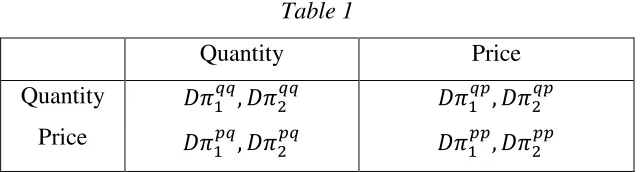
Table 1
The closed form solutions of firms' pay-offs under , , , are reported in equations (7), (12), (17) and (22) respectively. Straightforward calculations give the following.
(%44 − (%F4 = (%4F− (%FF = (#44 − (#4F = (#F4− (#FF = −18 81 + 393 # < 0
The proposition below is immediate from the above.
Proposition 1: Assume that 3 ∈ 0,1, choosing price contract is the dominant strategy for
both firms.
The intuition goes as follows. Each final goods producer's profit motive is driven by the amount of input price and upfront fixed fee payable to the upstream agent. First, assume that firm 2(firm 1) chooses the quantity contract. When + is significantly high, meaning that the input supplier's opportunistic behaviour is more pronounced; firm 1's (firm 2's) output loss following an increase in its own input price is larger under quantity contract than under price contract. Furthermore, the fixed fee being higher under quantity contract 4; !%44 > !%F4 !#44 > !#4F", firm 1 (firm 2) finds it profitable to choose price contract. Next, if firm 2 (firm 1) chooses a price contract firm 1 (firm 2) again prefers a price contract over a quantity contract as the latter generates a greater loss in its own output level and it involves a higher fixed fee; !%4F > !%FF !#F4> !#FF". Hence, choosing price contract becomes the dominant strategy for both downstream firms. However, when + is significantly small, the input suppliers offer a lump-sum subsidy to the downstream firms (see footnote 3). The opportunistic behaviour being less significant, in this case, the downstream firms only combat the output reducing effect by choosing price contract (as alluded above).
5. Conclusion
Allowing a centralised generalised Nash bargaining between the input supplier and the final goods producers, we show the social welfare are the same under Bertrand and Cournot
4
Check that !%44) !%F4 !%4F) !%FF !#44) !#4F !#F4) !#FFO%G%CAA H#>0.
Quantity Price
Quantity Price
(%44, (#44 (%F4, (#F4
competition. Our result that adopting price contract is the dominant strategy for downstream duopoly irrespective of the type of the product attracts renewed interest in the bargaining literature.
References
Alipranti, M., C. Milliou and E. Petrakis, 2014, ‘Price vs. quantity competition in a vertically related market’, Economics Letters, 124: 122-126.
Berto Villa-Boas, S., 2007, ‘Vertical relationships between manufacturers and retailers: inference with limited data’, Review of Economic Studies, 74: 625-652.
Boeri, T. and Burda, M.C., 2009, ‘Preferences for collective versus individualised wage setting’, Economic Journal, 119: 144063.
Bonnet, C. and P. Dubois, 2010, ‘Inference on vertical contracts between manufacturers and retailers allowing for nonlinear pricing and resale price maintenance’, Rand Journal of Economics, 41: 139-164.
Calmfors, L. and Driffill, J. (1988), ‘Bargaining structure, corporatism and macroeconomic performance’, Economic Policy, 3: 13-61.
Danthine, J. and J. Hunt, 1994, ‘Wage bargaining structure, employment and economic integration’, Economic Journal, 104: 528-41.
Delbono, F. and V. Denicolò, 1990, ‘R&D investment in a symmetric and homogeneous oligopoly’, International Journal of Industrial Organization, 8: 297-313.
Flanagan, R.J., 2003, ‘Collective bargaining and macroeconomic performance,' in J.T. Addison and C. Schnabel (eds.), ‘International Handbook of Trade Unions’, pp. 172-96, Cheltenham: Edward Elgar.
Häckner, J., 2000, ‘A note on price and quantity competition in differentiated oligopolies’,
Hirsch, B., C. Merkl, S. Müller and C. Schnabel, 2014, ‘Centralized vs. decentralized wage formation: The role of firms' production technoloy’, IZA Discussion Paper no. 8242. López, M.C., 2007, ‘Price and quantity competition in a differentiated duopoly with upstream
suppliers’, Journal of Economics and Management Strategy, 16: 469-505.
López, M.C. and R.A. Naylor, 2004, ‘The Cournot–Bertrand profit differential: a reversal result in a differentiated duopoly with wage bargaining’, European Economic Review, 48: 681-696.
Mukherjee, A., U. Broll and S. Mukherjee, 2012, ‘Bertrand versus Cournot competition in a vertical structure: a note’, Manchester School, 80: 545-559.
Qiu, L. D., 1997, ‘On the dynamic efficiency of Bertrand and Cournot equilibria’, Journal of Economic Theory, 75: 213-229.
Singh, N. and X. Vives, 1984, ‘Price and quantity competition in a differentiated duopoly’,