1 Terrorist Learning: A New Analytical Framework
Terrorists learn every day to gain further knowledge on how to achieve their
violent objectives. Consequently, understanding terrorist learning forms a crucial
part of the fight to counter terrorism. However, whilst existing literature within
terrorism studies has examined a number of different parts of the learning
process there currently fails to exist a comprehensive framework to encompass
the learning process as a whole. This article will rectify this oversight by drawing
upon wider learning literature to develop a new analytical framework for terrorist
learning that provides a definition, considers the actors involved and identifiies
processes and outcomes. Consequently, the full landscape of current and
potential research in this important area is revealed.
Just as states, government departments and national armed forces learn so do violent non-state actors. For all of these actors learning is an ongoing process to improve ability and performance, and also a discontinuous process as part of a problem-solving agenda.1 The aim of learning is to build on successes, avoid past pitfalls and stay ahead of the learning curve of competitors and enemies in terms of approaches, tactics, technology and skills. It is about increasing
accuracy and efficiency and, therefore, in this sense learning can act as both a form of intelligence and a force enabler and multiplier.
2 cells or networks within their organisations,3 from other terrorist organisations,4 experts,5 states, the private sector6, media7 and counter-terrorist actors.
Recent developments involving high profile terrorist groups underline the role of learning in the production of tactical innovation and strategic adaptation.
Dissident republican actors in Northern Ireland continue to reveal a learned understanding of past IRA tactics. Islamic State (commonly known as ISIS) is learning to embrace regional franchises. So-called ‘lone actor’ terrorists, like the Boston marathon bombers Dzhokhar and Tamerlan Tsarnaev, auto-didactically learn bomb-making techniques over the internet. Hamas is learning to exist in different operational environments and changing Israeli tactics.8 Al Qaeda’s central hierarchy has fragmented into regional hubs that are learning how to localise activities. The Taliban are currently closely observing and learning from the actions and successes of ISIS, as are Jemmah Islamiah in South East Asia – who previously learned from Al Qaeda, whilst the New IRA and Continuity IRA are learning from the Taliban in regards to their use of explosively formed projectiles (EFPs) – horizontally fired homemade rockets.9 Hezbollah connect with outside experts to obtain required learning whilst many terrorist actors study state security forces in order to learn from them. As Forest adequately noted, “successful terrorist attacks are rarely accomplished by idiots”.10
3 force enabler but it also disturbs the mechanisms in place for the dissemination of learning to large numbers, that improves terrorist organisation resilience. Furthermore, reducing terrorist learning capabilities allows counter-terrorist groups the time and space to catch up, overtake or extend their lead on the learning curve.
In order to comprehensively investigate how terrorist actors learn a new framework of analysis is required. Whilst academic literature has examined learning by and within state actors, and some has explored learning in terms of state responses to violent non-state actors,11 scholars have largely overlooked the vitally important work of specifically researching terrorist learning.12 This paper aims to rectify such an oversight by drawing upon the wider learning literature in general, and state-based learning in particular,13 to forge a new framework for the analysis of terrorist learning. This framework will define what is meant by learning, who are the agents of learning (the learners), and
establish the processes and outcomes of terrorist learning for future analysis. As a result the framework reveals a landscape of research in this area that can be utilised by academics and practitioners to aid understanding and the
investigation of learning by violent non-state actors in the future.
Existing approaches to learning Defining terrorist learning
There is a vast literature on learning, with its study traceable back to the
4 not been rigorously or consistently applied by terrorism studies scholars. Part of the challenge for the study of terrorist learning is that learning remains
notoriously difficult conceptually and methodologically for research; a challenge that is compounded by access and ethical difficulties in the study of terrorists. In the analysis of state-based learning Levy has claimed learning to be a
“minefield” whilst Tetlock has described learning as conceptually “elusive”.15 Consequently, scholars studying state learning have utilised a range of
definitions and approaches and this research will draw upon a number of these to provide a comprehensive definition that is applicable at the sub-state level. In particular, such a definition will consider and endeavour to bring together ideas from cognitive psychology (but extend the definition beyond simply the
appropriation of new knowledge)16 , behaviourist based learning theories (that emphasise reinforcement and practice),17 organisational theorists (that include changes in institutional procedures as part of their definition of learning),18 and constructivist approaches (that argue that learning has an effect upon beliefs, as well as behaviour). In particular, in terrorist organisations heavily influenced by ideology the impact of learning upon beliefs as well as behaviour can be crucial.
This paper also rejects definitions that suggest a teleological condition of
5 indicators of success. Such a definition may be possible to some extent in the study of terrorist learning by groups that codify their ideas in manuals,
handbooks and trade press, such as periodicals like Al-Qaeda’s In the Shadow Of
the Lances or Islamic State’s Dabiq, but it is not universally applicable. In
addition, this definition assumes that learning only occurs when an improvement is made. Whilst this may be the aim of learning it is not possible that this can always be the outcome, but learning has still occurred.
Finally, a number of learning theorists have defined learning by differentiating the concept from that of change. Levy, for example, rejects the approach of Bayesian economics that associates learning with a consistent change, and is clear to distinguish learning from policy change. He explains that change can occur for a number of reasons other than learning whilst learning can result in an outcome other than change, including the reinforcement of existing policies.20 Organisational theorists also stress this difference and explain that change can occur due to shifts in personnel, changes in legislation or as the result of
unintended consequences. Instead, for this paper, change must be understood as one possible outcome of learning. In the past, using the two concepts as synonyms has only sought to encourage the study of a particular outcome rather than the wider learning process. For example, in several important recent
6 The most comprehensive study of terrorism learning thus far has been produced by researchers at the RAND Corporation, who have also posited the most explicit definition of terrorist learning within the limited field of literature.22 They have defined terrorist learning as: “sustained changes that involve intentional action by or within a group at some point...Furthermore, we categorise as learning only changes that are beneficial to the terrorist group.”23 As such their definition relies upon change as an indicator of learning, as rejected by organisational theorists, and applies an accuracy and efficiency criterion, thus ignoring the possibility that learning incorrect lessons can also be regarded as learning. To overcome these contrasting approaches a new definition must be established.
Understanding the agent of terrorist learning
Having developed an understanding of what learning is it is also important to distinguish who is the agent of analysis in terrorist learning – the learner. We identify four principle agents of learning in the broader learning literature that have a significant impact on terrorism: the individual, the group, generations and organizations.
7 inmates whilst he was incarcerated alongside them in a London prison in the 1950s.27 Kitfield also stresses the importance of Osama Bin Laden’s learning for al Qaeda,28 whilst Forest emphasises that individual learning is significant
beyond the leadership of terrorist organisations by citing examples of those motivated by, but not connected to, extremist ideology; the 7/7 London bombers, Oklahoma City bomber Timothy McVeigh, and white supremacist Buford Furrow.29 Most recently the attacks in Paris against Charlie Hebdo reemphasised the threat of “lone actor” attacks by those individuals who have learned terrorism without formal affiliation to a terrorist organisation.30
8 Thirdly, other groups of individual terrorists may also be considered learners in their own right. Groups can be bound outside of social interactions by a shared identity. Learning in demographic groups, for example, is particularly used by electoral and domestic political analysts.33 One cohort, which is bound together by a temporal identity, is generations; individuals who are within an age range at a particular point in time. Generational learning has been studied within education studies, economics and political science but has predominantly been ignored by researchers of state-based and terrorist learning.34 Yet generations are significant learners and interaction between two generations can often result in mutual learning. In terrorism these interactions regularly occur through
conversations in person and online and through the exchanging of war stories during training.
The final learner is that of the organisation. In fact, the majority of existing terrorist learning literature, including the seminal RAND study, has drawn upon organizational theory35 to consider terrorist organisations as the key learner.36 Similarly, much of the literature that examines state responses to terrorism has also used organisational theory to examine learning37 and the result is an
9 Establishing the processes of terrorist learning
The literature on processes of learning is dominated by the fields of psychology, education studies and organization theory. Whilst behavioural psychologists such as Pavlov, Thorndike and Skinner pioneered three different understandings of the process of learning – classical conditioning, operant learning and
instrumental learning respectively39 – cognitive psychologists, such as Piaget,40 have rejected these ideas to follow a rationalist epistemological approach that likens learning to an information processing model of inputs, memory and recall.41 The organisational theorists Levitt and March have also utilised the cognitivists’ approach to memory to develop and analogous process of organisational learning. They equally distinguish learning as a three stage
process; recording an experience, conserving the experience and retrieval of the experience.42
In education studies, particularly within the education of adults, there is also a constructivist approach to the learning process, whereby learners create
knowledge through the seeking of meaning of their own experiences.
Consequently, learning is an experiential, active and constructive process but constructivists ignore the possibility of passive learning through culture, language, history and ideology.43 For Siemens, the constructivist approach to learning has developed further in the digital age to focus more upon the
10 specialized information sets, and the connections that enable us to learn more are more important than our current state of knowing.”44 Such an understanding of the learning process would be particularly interesting for those studying the exchange of terrorist knowledge through the internet, or terrorist organisations that seek outside expertise.
Organizational theory approaches to learning have been influenced by
cognitivism, behaviourism, constructivism and connectivism, and have more clearly identified learning as a process with different stages. Huber, for example, argues that learning occurs in a four stage process; knowledge is acquired, knowledge is shared through information distribution, the information is
interpreted in order to become understood and is stored for future use in some form of organisational memory.45 This definition is useful because, as it draws upon a number of influences, it can be applied to all four of the identified learners within terrorist learning. It is also this definition that appears to have influenced the RAND study on terrorist learning, as it uses the same component stages within its analysis.46 However, the interpretation of knowledge is
immutable and immeasurable, and forms part of knowledge acquisition; it is not a separate stage. In addition, the distribution of knowledge needs to be
devolved into two stages of the process; distribution and implementation of the lesson. Consequently, a new analytical framework is required that builds upon the work of Huber but considers whether each stage of his learning process is necessary or whether additional stages are required when applied to terrorism.
11 The outcome of terrorist learning is lessons; lessons that have different
characters and impacts. In the wider learning literature both the character and the impact of lessons is examined. In examining the character of lessons three considerations are made. Firstly, a normative approach distinguishes the lesson as positive or negative. Positive lessons are those that result from learning where events have gone well, often leading to the impact of repeating behaviour or reinforcing existing beliefs. Negative lessons result from learning where
events have not gone as anticipated. Consequently the impact usually involves different beliefs and behaviours emerging in similar situations. Many academics who focus on the learning mechanisms within state institutions argue that the learning process occurs more often in response to failure than success, thus leading to the majority of lessons being negative in character.47
The second consideration to the character of a lesson is whether it is tacit or explicit. Explicit lessons are able to be codified whilst tacit lessons cannot. In terrorist learning literature Kenney uses this distinction to apply to types of knowledge, “techne” and “metis”, whereby techne are skills that can be taught through traditional study and metis are skills gained through engagement in activity and practice.48 In terrorist learning an explicit lesson may be one relating to the technical knowledge of bomb making, whilst a tacit lesson would focus upon the instinct involved in surveillance operations. Linked to this is the
differentiation between formal and informal modes of learning. Formal learning takes place on a group-wide basis with the aim of institutionalising lessons. Take for example the IRA Green Book as a formal effort to distil best practice (“don’t be seen in the company of known republicans”), tactical tips (“our chief
12 our people”), lifestyle recommendations (“drink-induced loose talk is the most potential danger facing any organisation”), and historical indoctrination (“control of our affairs in all of Ireland lies more than ever since 1921 outside the hands of the Irish people”).49
Informal learning, conversely, takes places among individuals within groups and relies on social interaction or lessons gleaned from an informal arena, such as popular culture. One striking example of the informal lesson-learning legacy of popular culture on terrorist groups is the Tamil Tigers. Seasoned travel writer William Dalrymple spent time with the group in Sri Lanka in the 1980s. He recalled how when he was interviewing a senior Tiger commander in a jungle camp he was struck by similarities between the group’s tactics and scenes from Hollywood action movies. The Tiger leader replied with a smile: “Our camps are all equipped with videos. War films are shown three times a week and are compulsory. We often consult Predator and Rambo before planning ambushes. None of us are trained soldiers. We’ve learned all we know from these films.” Dalrymple perused their video collection to find it stocked with “complete sets of
Rambo, Rocky and James Bond; all the Schwarzeneggers; most of the Vietnam
films; and no less than three versions of The Magnificent Seven. It was wonderful: real freedom fighters earnestly studying Sylvester Stallone to see how it’s done.”50 Similarly, jihadists may learn from martyrdom biographies, religious stories and songs making these forms of learning worth further exploration.
13 terms these are defined as battle and engagement, campaign plans and national security strategy and policy respectively. These are also applicable to terrorist learning. In an air hijacking for example, tactical lessons would relate to those committing the hijacking and may involve means to circumnavigate security on the ground. Operational lessons would relate to the leadership of the terrorist cell involved and the planning of the attack, such as studying airport blueprints or plane design to decide upon the specifics of the hijack. The strategic lessons would relate to the national or international leaders of the terrorist organisation and may be about the benefits of air hijacking, deciding upon the target and the actions to be taken after the operation is complete. Consequently, the different character of lessons can also directly relate to who is learning and vice versa.
There are also several approaches in the literature to exploring the impact of lessons. Educational theorists, for example, distinguish between “deep” and “surface” lessons,51 whereby deep lessons critically challenge underlying assumptions and surface lessons examine events in isolation.52 Psychologists explore a similar idea in terms of “simple” and “complex” lessons. As such simple lessons are understood as impacting on a method but not a goal, therefore behaviour changes but not beliefs. Complex lessons, on the other hand, involve reconsidering both the method and the goal.53
14 the learner, one for the action and one for the strategy or value behind such action, and therefore aligns closely to the idea of “complex” lessons in
psychology. Consequently, although there are different terms and slight changes in approach to the analysis of lesson impacts it is clear that there is also much overlap between these three approaches.
The majority of literature associated with terrorist learning has focused upon the outcomes of learning but have not explicitly considered characters of lessons. Instead research has often focused upon different impacts of lessons without drawing upon the mentioned theoretical approaches. They have focused upon tracing empirical observations of impact; change, adaption and innovation.55 Dolnik, for example, creates a definition of innovation specific to the terrorism context: “an act of introduction of a new method or technology or the
improvement of an already existing capability”, 56 but does not establish the concept as an outcome of a larger process of learning. To the 11 factors he cites as relevant to terrorist innovation, including group dynamics, resources and ideology, we would posit that the missing component of learning culture is a vitally important additional consideration.57
A proposed analytical framework for terrorist learning
What is terrorist learning?
A definition of terrorist learning must reject the approach to defining learning by cognitive psychologists, as it incorrectly synonymises the appropriation of
15 and a causal mechanism that requires an impact, upon beliefs and/or behaviour, immediately or over time. A new definition must ensure a distinction between learning and change (such as innovation or adaptation). It is clear that change is an outcome of learning but also that learning can often reinforce existing ideas and actions thus negating the necessity for change as an outcome. In addition, an accuracy or efficiency criterion must be rejected as learning that does not improve efficacy is still learning nonetheless. Finally, academic definitions of learning have previously been criticised for being developed for the convenience of research. In 1966 the educational psychologist Stones noted that the
definition of learning had quickly become wrapped up in the research of learning.58The organisational theorists, Argyris and Schön, were equally
concerned that the political science approach to defining learning was detached from practiced reality.59 Consequently, to be usable by both scholars and
practitioners the new definition must be universally workable in research and in practice.
It is proposed that terrorist learning be defined as:
The acquisition of knowledge to inform terrorist related activities in the future.
In this definition the “who” is intentionally learner neutral, as different learners will be examined, but focuses upon those with terrorist intent rather than
examining terrorist recruiting tools. It is also unspecific about “what is learned”, defined only as “knowledge”. However, it would not be sufficient to define
16 “acquisition of knowledge” allowing research to consider different processes of learning.
The outcome within the definition is defined as “to inform terrorist related
activities in the future”. The use of the term “activities” does not predispose that learning only impacts behaviour but that terrorists must engage, or plan to engage, in terrorist activities to be so defined as terrorists. Therefore the word “inform” is also important to stress the impact of learning upon beliefs.
Nonetheless, both “inform” and “activities” reveal that learning has an impact. Thus this definition extends the ideas of cognitive psychologists to clearly establish learning as a process.
The definition does not include an accuracy or efficiency criterion as learning the “wrong” lesson remains learning nonetheless. In addition, no outcome is
required immediately, only “in the future”, offering potential and allowing
learning to be a long-term process if required. There is also no defined outcome for either the character or impact of learning; learning does not have to result in change, innovation or adaption, it may result in a number of different outcomes. Consequently, it is hoped that this definition provides sufficient rigidity for
operationalising research, but flexibility for investigation. For the same reasons the endeavour for this definition is that is can be applied by both academics and practitioners in the study of terrorist learning.
17 It is clear from the literature that learning has involved research of a number of learners but always focused upon one exclusively at the expense of others. Research on terrorist learning must extend this work by drawing upon multi-disciplinary approaches from psychology, organisation theory and sociology and endeavour to examine all four relevant learners; terrorist individuals, terrorist organisations, groups of terrorists, and generations of terrorists.
In addition, learners interact with each other and are part of each other. For example, terrorist individuals form terrorist groups, organisations and
generations, whilst within terrorist organisations there are terrorist groups, generations and individuals. No learner exists in a vacuum or is mutually exclusive from the others. Consequently research into terrorist learning would benefit from considering learners as spheres of learning that overlap and interact (as illustrated in figure 1).
18 These spheres each represent a terrorist learner. In this case individual terrorist learners are represented by the “individual” sphere, terrorist organisations by the “organisational” sphere, groups of terrorists by the “social” sphere and generations of terrorist by the “generational” sphere.
19 moving from the centre out into other areas of overlap between two or three spheres and finally the remaining isolated spheres.
What are the processes of terrorist learning?
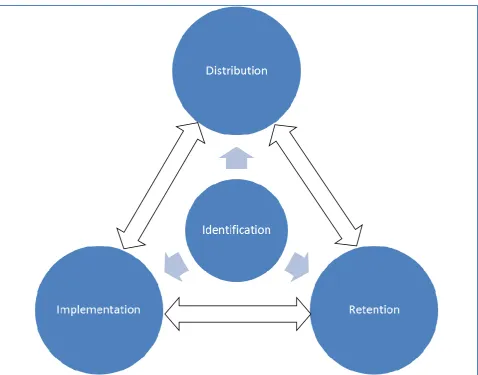
Learning is a process, not one action, that occurs over several stages. Drawing upon, but extending, the work of Huber, we understand the terrorist learning process as comprising four stages; identification, distribution, implementation and retention (as illustrated in figure 2). The identification of a lesson is always the first stage in the learning process as it is at this stage that, in line with our definition of terrorist learning, the “acquisition of knowledge” occurs and such knowledge is interpreted into a lesson relevant for “informing terrorist activities in the future”. Consequently, this singular stage unites two of the stages
distinguished by Huber as “acquisition” and “interpretation” as they are
20
Figure 2: Illustration of the process of learning
21 Understanding from where the knowledge for terrorism is acquired and
interpreted is a fertile area of research, and has already resulted in a formidable volume edited by Forest.60 However, more can be achieved. The study of lesson identification can examine lessons from internal and external sources,61 methods of lesson identification, such as self-reflection or trial and error testing, and consider whether these methods are formal, ongoing and routine – and thereby more easily subject to disruption – or informal or only occur in extraordinary circumstances and therefore may prove more challenging to counter. Patterns of lesson identification can be reflected upon, as some terrorist learners may seek to only identify lessons from internal sources rather than risk infiltration, whilst others may routinely be using external sources that may provide a weak link for counter-terrorist operations.
22 organisational, social or generational sphere of terrorist learning distribution can be internal and external – with other terrorist organisations, terrorists groups of individuals and generations of terrorists whereby the learner becomes the
teacher. When the learner is in the individual sphere learning can only be distributed externally. Lesson distribution from one learner becomes the acquisition of knowledge for another and hence can significantly improve the resilience of a terrorist organisation. This is why understanding this process is so important for counter-terrorism. A number of researchers within terrorism
studies have examined this process through the concepts of “contagion”62 or “diffusion”.63 In addition, some work has been conducted into the methods of lesson distribution, such as internet videos or apprenticeships, but more is needed.64
The stage of retention is where a lesson is recorded for the future. In some cases lessons are not ready for implementation, they are “to inform terrorist related activities in the future”. In other cases lessons are implemented but need to be retained for future learners, as suggested by literature on connectivism. In organisational theory the formal retention of lessons becomes known as
“organisational memory”, whereas in social theory less formal retention can occur though tradition, symbols or language. Retention is significant as if lessons are not retained they may become unlearned over time and research into
23 In the implementation stage of the learning process the lesson is used for
terrorist activities, hence this also becomes an outcome of terrorist learning. At this stage the potential for the lesson becomes a reality and can be claimed to have been “learned”. The implementation stage is a crucial opportunity for counter-terrorism operations to disturb terrorist activities. It is therefore also important that this is a defined stage within the learning process, thus rejecting the uniting of “implementation” with “distribution” in the framework produced by Huber.
What are the outcomes of terrorist learning?
Terrorist learning results in terrorist lessons with different characters and
impacts, and the two are often interlinked. How these lessons are implemented forms part of the “implementation” stage of the learning process. Lessons can be positive or negative, explicit or tacit, tactical, operational or strategic. These lessons have different impacts upon beliefs, behaviour or both. Positive lessons usually have the impact of reinforcing existing beliefs or behaviour, whilst
negative lessons often create change, through adaption, evolution or innovation. Explicit or tacit lessons can each lead to a variety of impacts, that are not as predetermined by the lesson character as positive or negative lessons, but often explicit lessons will impact upon the technical and tacit lessons upon the
practical. Tactical, operational and strategic lessons are equally not
predetermined but tactical lessons are more likely to impact behaviour and strategic lessons to impact beliefs.
24 which are found within the learning literature. In this case surface, simple and single loop lessons impact behaviour only whilst deep, complex and double loop lessons impact beliefs and/or behaviour (in his study of learning in the British Army, Catignani categorises these respectively as “lower level” and “higher level” learning66). Consequently, the inclusion of the labelling of such lessons becomes unnecessary and the focus of research on terrorist outcomes can
simply consider learning in relation to whether beliefs or behaviour (or both) are impacted by the lesson and whether this impact is reinforcement or change. An examination of both the characters and impacts, as the outcomes of terrorist learning, will enable the identification of patterns of learning and consideration of what types of lessons are being learned in an endeavour to predict, and prevent, future terrorist learning outcomes.
Conclusion
Terrorist learning is happening now. Every day terrorists are seeking to learn in order to improve their chances of achieving their objectives. To thwart terrorist success terrorist learning must be tackled and addressed. In order for this to be possible it is crucial for counter-terrorist practitioners to understand how
terrorists learn; what learning is, who is learning and what are the processes and outcomes of terrorist learning. However, in order to ascertain how terrorist learning occurs a full understanding of the learning process is required; the current literature on terrorist learning generally focuses on one particular learner or only one stage of the learning process.
25 develop a new framework for use by academics and practitioners. This
framework reveals the full process of terrorist learning,demonstrating crucial and fertile areas for future research and points of weakness for exploitation in
counter-terrorist operations. In addition to areas already discussed, research is required into and between different learners as each terrorist agent is different, just as no two state actors learn in the same way. There is also worthwhile large-N research to be conducted using this framework to examine wider patterns of terrorist learning and to consider whether the learning process can be anticipated. For example, can patterns be traced between the source of knowledge that is acquired and the outcome of learning; if, for example, knowledge is acquired from experts are the outcomes likely to be explicit and tactical lessons? Equally, can patterns be derived between the learner and the outcome, such as the social sphere resulting in the outcome of operational lessons with an impact upon the practical by adaptation? In addition, barriers that prevent or halt the learning process can be identified, in order that these barriers can be replicated by counterterrorist operatives.
26
1 For more on learning for problem solving see Maria J. Rasmussen and Mohammed M. Hafez, ‘Terrorist Innovations in Weapons of Mass Effect: Preconditions, Causes and Predictive Indicators’, Defense Threat Reduction Agency workshop report (August 2010), 2.
2 Andrew Selth, ‘Ireland and Insurgency: The Lessons of History’, Small Wars and Insurgencies, Vol.2 No.2 (1991), p.299; Kumar Ramakrishna ‘The Making of the Jemmah Islamiyah Terrorist’ in Teaching Terror: Strategic and Tactical
Learning in the Terrorist World ed. James J.F. Forest (Maryland: Rowman and
Littlefield, 2006), 223-260.
3 James Forest provides a good overview of activities to implement learning within terrorist groups, ‘Training Camps and Other Centres of Learning’, in
Teaching Terror: Strategic and Tactical Learning in the Terrorist World James
J.F. Forest (ed.) (Maryland: Rowman and Littlefield, 2006), 69-109.
4 Brian J. Phillips, ‘Terrorist Group Cooperation and Longevity’, International
Studies Quarterly, Vol.58 (2014), 337; Andrew Selth, ‘Ireland and Insurgency:
The Lessons of History’, Small Wars and Insurgencies, Vol.2 No.2 (1991), 303; Roman D. Ortiz ‘Renew to Last: Innovation and Strategy of the Revolutionary Armed Forces of Columbia (FARC)’ in Teaching Terror: Strategic and Tactical
Learning in the Terrorist World James J.F. Forest (ed.) (Maryland: Rowman and
Littlefield), 205-222.
5 Often experts are found for terrorist organizations by state sponsors. For example, Hizballah have used contacts provided by Syria and Iran.
6 Brian A. Jackson, ‘Technology Acquisition by Terrorist Groups: Threat Assessment Informed by Lessons from Private Sector Technology Adoption’,
27 7 William Dalrymple, ‘What Arnie did in the Sri Lankan war’, The Observer (New Review section), 8 March 2015; Cindy Combs “The Media as a showcase for Terrorism”, in Teaching Terror: Strategic and Tactical Learning in the Terrorist
World James J.F. Forest (ed.) (Maryland: Rowman and Littlefield, 2006),
133-154.
8 R. Kim Cragin ‘Learning to Survive: The Case of the Islamic Resistance Movement (Hamas)’ in Teaching Terror: Strategic and Tactical Learning in the
Terrorist World James J.F. Forest (ed.) (Maryland: Rowman and Littlefield,
2006), 189-204.
9 Henry McDonald, ‘Irish dissident groups learning from Taliban and Isis, police officer warns’, The Guardian, 19 January 2015.
10 James J.F. Forest ‘Introduction’, in Teaching Terror: Strategic and Tactical
Learning in the Terrorist World James J.F. Forest (ed.) (Maryland: Rowman and
Littlefield, 2006), 1.
11 Michael Kenney ‘The Challenge of Eradicating Transnational Criminal
Networks: Lessons form the War on Drugs’, paper presented at the 2002 Annual Meeting of the American Political Science Association, Boston, MA, August 29-September 1 2002.
12Three notable exceptions here are Michael Kenney From Pablo to Osama: Trafficking and Terrorist Networks, Government Bureaucracies, and Competitive
Adaption (University Park: Pennsylvania State University Press, 2007); Brian A.
Jackson et al, Aptitude for Destruction (Santa Monica: RAND Corporation, 2005); James J.F. Forest (ed.) Teaching Terror: Strategic and Tactical Learning in the
Terrorist World (Maryland: Rowman and Littlefield, 2006).
28 14 See for example on economic learning, Drew Fudenberg and David K Levine (1998) The Theory of Learning in Games (Massachusetts: MIT Press); on cybernetic learning, John D Steinbruner(1976) The Cybernetic Theory of
Decision, (Princeton: Princeton University Press); on learning in evolutionary
biology, Richard Dawkins (1976) The Selfish Gene (Oxford: Oxford University Press); on education studies for students, John Dewey (1897) ‘My Pedagogic Creed’, School Journal, 54: 77-80; for adults, Malcolm S Knowles (1980) The
Modern Practice of Adult Education (New York: The Adult Education Company);
for learning for oneself, Chris Kenyon and Stewart Hase (2001) ‘Moving from andragogy to heutagogy in vocational education’,
http://www.avetra.org.au/abstracts_and_papers_2001/Hase-Kenyon_full.pdf,
date accessed 18/10/2012.
15 Jack S Levy (1994) ‘Learning and Foreign Policy: Sweeping a Conceptual Minefield’, International Organization, 48/2: 279-312; P E Tetlock ‘Learning in U.S. and Soviet Foreign Policy: In Search of an Elusive Concept’, in G. Breslauer & P. E. Tetlock (eds.) Learning in US and Soviet Foreign Policy (Boulder, CO: Westview, 1991).
16 Robert P Abelson, Elliot Aronson, William J McGuire, Theodore M Newcomb, Milton J Rosenberg and Percy H Tannenbaum (eds.) Theories of Cognitive
Consistency (Chicago: Rand McNally, 1968); J A Rosati ‘A cognitive approach to
the study of foreign policy’ in Foreign policy analysis: Continuity and change in
its second generation, Laura Neack, Jeanne Hay and Patrick Haney (eds.) (New
Jersey: Prentice Hall, 1995), 50.
17 George Siemens (2005) ‘Connectivism: A Learning Theory for the Digital Age’,
29 18 Pertti H Lounamaa and James G March (1987) ‘Adaptive Coordination of a Learning Team’, Management Science, 33/1: 107-108.
19 P E Tetlock ‘Learning in U.S. and Soviet Foreign Policy: In Search of an Elusive Concept’, in G. Breslauer & P. E. Tetlock (eds.) Learning in US and Soviet
Foreign Policy (Boulder, CO: Westview, 1991), 22.
20 Jack S Levy (1994) ‘Learning and Foreign Policy: Sweeping a Conceptual Minefield’, International Organization, 48/2: 289-290.
21 See for example on innovation Martha Crenshaw, “Innovation: Decision Points in the Trajectory of Terrorism”, Conference on Trajectories of Terrorist Violence in Europe, Miinda de Gunzburg Centre for European Studies, Harvard University, Cambridge, MA, March 9-11, 2001; on change see Kim Cragin and Sara A. Daly
The Dynamic Terrorist Threat: An Assessment of Group Motivations and
Capabilities in a Changing World (Santa Monica:CA,: RAND Corporation, 2003);
on adaption see Michael Kenney From Pablo to Osama: Trafficking and Terrorist
Networks, Government Bureaucracies, and Competitive Adaption (University
Park: Pennsylvania State University Press, 2007).
22 Brian A. Jackson et al, Aptitude for Destruction (Santa Monica: RAND Corporation, 2005).
23 Ibid, p.2, footnote 7.
24 Jean Piaget Psychology of the Child (New York: Basic Books, 1972). 25 Edwards, Ward, Harold Lindman and Leonard Savage (1963) ‘Bayesian Statistical Inference for Psychological Research’, Psychological Review, 70/3: 193-242.
26 See for example Ernest R May ‘Lessons’ of the Past: The Use and Misuse of
History in American Foreign Policy (Oxford: Oxford University Press, 1973);
30
Decision-Makers (London: Collier Macmillan, 1986); Robert Jervis Perception and
Misperception in International Politics (Chichester: Princeton University Press,
1976); Yuen Foong Khong Analogies at War (Princeton: Princeton University Press, 1992).
27 Andrew Selth (1991), ‘Ireland and Insurgency: The Lessons of History’, Small Wars and Insurgencies, 2/2: 311.
28 James Kitfield (2001) ‘Osama’s Learning Curve’, National Journal, 33/45: 3506-3511.
29 James J.F. Forest ‘Introduction’, in Teaching Terror: Strategic and Tactical
Learning in the Terrorist World James J.F. Forest (ed.) (Maryland: Rowman and
Littlefield, 2006), 1-32.
30 Martin Pengelly (2015) “Eric Holder says US ‘at war’ with ‘lone wolf’ terrorists after Paris attacks”, The Guardian, 11th January 2015.
31 Mark Hamm Terrorism as Crime: From Oklahoma City to Al-Qaeda and Beyond (New York: New York University Press, 2007).
32 L S Vygotsky, Mind In Society: The Development of Higher Psychological
Processes (Cambridge, MA: Harvard University Press, 1978).
33 M E Turner (ed.) Groups at work: Advances in theory and research (New York: Lawrence Erlbaum, 2001)
34 See for example Eve Gregory and Ann Williams City Literacies: Learning to
Read Across Generations and Cultures (London: Routledge, 2000); T Parker
Ballinger, Michael G Palumbo and Nathaniel T Wilcox (2003) ‘Precautionary Saving and Social Learning Across Generations: An Experiment’, The Economic
Journal, 113/490: 920-947; M Kent Jennings, Laura Stoker and Jake Bowers
31
Journal of Politics, 71/3: 782-799; Robert Jervis, Perception and Misperception in
International Politics (Chichester: Princeton University Press, 1976), 549-250.
35 For a summary of organisational learning theory see Chris Argyris and Donald A Schön Organizational Learning: A Theory of Action Perspective, (Reading, MA: Addison-Wesley, 1978).
36 Brian A. Jackson et al, Aptitude for Destruction (Santa Monica: RAND
Corporation, 2005). See also for example Chuck Lutes, ‘Al-Qaida in Action and Learning: A Systems Approach’, (2001), accessed May 19, 2015,
http://www.au.af.mil/au/awc/awcgate/readings/al_qaida2.htm; Horacio R. Trujillo and Brian A. Jackson, ‘Organisational Learning and Terrorist Groups’, in
Teaching Terror: Knowledge Transfer in the Terrorist World, James J. F. Forest
(ed.) (Maryland: Rowman and Littlefield, 2006), 52-68; Michael Kenney
Organisational Learning and Islamic Militancy, (2009) available at
https://www.ncjrs.gov/pdffiles1/nij/grants/226808.pdf, date accessed 19 May 2015. Martha Crenshaw (2014) argues that there is a wider trend of the
application of organisational theories to Terrorist Studies in general, ‘Terrorism Research: The Record’, International Interactions, 40/4: 563.
37 Sergio Catignani (2014) ‘Coping with Knowledge: Organisational Learning in the British Army?’, Journal of Strategic Studies, 37/1:30-64.
38 Bo Hedberg, ‘How Organizations Learn and Unlearn?’ in Paul C. Nyström and William H. Starbuck (eds.), Handbook of Organizational Design (Oxford: Oxford University Press, 1981), 3–27.
39 I P Pavlov, Conditioned Reflexes (New York: Dover Publications, 1960); Edward L Thorndike, Education Psychology: Briefer Course (Florence: Routledge, 1999), 69-83.
32 41 George Siemens(2005) ‘Connectivism: A Learning Theory for the Digital Age’,
International Journal of Instructional Technology and Distance Learning, 2/1.
42 Barbara Levitt and James March (1988) ‘Organizational Learning’, Annual
Review of Sociology, 14: 327-328.
43 D Jonassen (1991) ‘Evaluating Constructivist Learning’, Educational
Technology, 36/9: 28-33.
44 George Siemens (2005) ‘Connectivism: A Learning Theory for the Digital Age’,
International Journal of Instructional Technology and Distance Learning, 2/1.
45 George P Huber (1991) ‘Organizational Learning: The Contributing Processes and the Literatures’, Organization Science, 2/1: 88-90.
46 Brian A. Jackson et al, Aptitude for Destruction (Santa Monica: RAND Corporation, 2005), Volume 1, xi.
47 Robert Jervis, Perception and Misperception in International Politics (Chichester: Princeton University Press, 1976) 235.
48 ‘How Terrorists Learn’ Chapter in Michael Kenney From Pablo to Osama (Pennsylvania: Pennsylvania University Press, 2007), 135-166.
49 IRA ‘Green Book’
(available from www.cain.ulst.ac.uk/otherem/organ/ira/ira_green_book.htm ). 50 William Dalrymple, ‘What Arnie did in the Sri Lankan war’, The Observer (New Review section), 8 March 2015.
51 F Marton and R Saljo(1976) ‘On qualitative differences in learning - 1:outcome and process’, British Journal of Educational Psychology, 46: 4-11.
52 J Biggs, Teaching for quality learning at university (Buckingham: Society for Research into Higher Education and Open University Press, 1999); Noel J
Entwistle, Styles of Learning and Teaching: An Integrated Outline of Educational
33 Publishers, 1989); Paul Ramsden Learning to Teach in Higher Education
(Abingdon: Routledge, 1991).
53 Joseph Nye (1987) ‘Nuclear learning and US-Soviet security regimes’,
International Organization 41/3: 380.
54 Chris Argyris and Donald A Schön Organizational Learning (Wokingham: Addison-Wesley, 1996).
55 See for example Kim Cragin and Sara A. Daly The Dynamic Terrorist Threat:
An Assessment of Group Motivations and Capabilities in a Changing World (Santa
Monica, CA: RAND Corporation, 2004); Scott Gerwehr and Russell W Glenn, The
Art of Darkness: Deception and Urban Operations (Santa Monica, CA: RAND
Corporation, 2000); Bruce Hoffman (2001) ‘Change and Continuity in Terrorism’,
Studies in Conflict and Terrorism, 24: 417–428; Jessica Stern (2003) ‘The
Protean Enemy’, Foreign Affairs, 82/4: 27–40.
56 Adam Dolnik, Understanding Terrorist Innovation: Technology, Tactics and
Global Trends (Abingdon: Routledge, 2007), 10.
57 Ibid., 13.
58 Edgar Stones, An Introduction to Educational Psychology (London: Methuen & Co Ltd., 1966), 51.
59 Chris Argyris and Donald A. Schön, Organizational Learning (Wokingham: Addison-Wesley, 1996), xix.
60 James J.F. Forest (ed.) Teaching Terror: Strategic and Tactical Learning in the
Terrorist World (Maryland: Rowman and Littlefield, 2006).
61 A number of these are mentioned in the introduction of this paper. The RAND report identifies external knowledge sources of vicarious experience, cooperating with other organisations, outside human resources and acquisition of knowledge sources or technologies, and internal knowledge sources as congenital
34 development. Brian A. Jackson et al, Aptitude for Destruction (Santa Monica: RAND Corporation, 2005), Volume 2, 183-4.
62 Mia Bloom, Dying to kill: The allure of suicide terror (New York: Columbia University Press, 2005); M I Midlarsky, M Crenshaw and F Yoshida (1980) ‘Why violence spreads: The contagion of international terrorism’ International Studies
Quarterly, 24: 262–298.
63 A Braithwaite and Q Li (2007) ‘Transnational terrorism hot spots:
Identification and impact evaluation’ Conflict Management and Peace Science, 24, 281–296; M Horowitz (2010) ‘Nonstate actors and the diffusion of
innovations: The case of suicide terrorism’ International Organization, 64: 33– 64.
64 See Akil Awan’s contribution to this volume for detailed discussion of jihadi’s use of the internet.
65 John Mueller explored whether war could be unlearned in Retreat from
Doomsday (New York: Basic Books, Harper Collins, 1989).
66 Catignani, ‘Coping with Knowledge’, 31.