Research Article
Shrimp Feed Formulation via Evolutionary
Algorithm with Power Heuristics for Handling Constraints
Rosshairy Abd. Rahman,
1Graham Kendall,
2,3Razamin Ramli,
1Zainoddin Jamari,
4and Ku Ruhana Ku-Mahamud
51Department of Decision Science, School of Quantitative Sciences, Universiti Utara Malaysia, 06010 Sintok, Kedah, Malaysia 2University of Nottingham Malaysia Campus, Semenyih, Malaysia
3University of Nottingham, Nottingham, UK
4Mariculture Research Centre, Bukit Malut, 07000 Langkawi, Malaysia
5School of Computing, Universiti Utara Malaysia, 06010 Sintok, Kedah, Malaysia
Correspondence should be addressed to Rosshairy Abd. Rahman; [email protected]
Received 30 May 2017; Revised 26 August 2017; Accepted 2 November 2017; Published 26 November 2017
Academic Editor: Michele Scarpiniti
Copyright © 2017 Rosshairy Abd. Rahman et al. This is an open access article distributed under the Creative Commons Attribution License, which permits unrestricted use, distribution, and reproduction in any medium, provided the original work is properly cited.
Formulating feed for shrimps represents a challenge to farmers and industry partners. Most previous studies selected from only a small number of ingredients due to cost pressures, even though hundreds of potential ingredients could be used in the shrimp feed mix. Even with a limited number of ingredients, the best combination of the most appropriate ingredients is still difficult to obtain due to various constraint requirements, such as nutrition value and cost. This paper proposes a new operator which we call Power Heuristics, as part of an Evolutionary Algorithm (EA), which acts as a constraint handling technique for the shrimp feed or diet formulation. The operator is able to choose and discard certain ingredients by utilising a specialized search mechanism. The aim is to achieve the most appropriate combination of ingredients. Power Heuristics are embedded in the EA at the early stage of a semirandom initialization procedure. The resulting combination of ingredients, after fulfilling all the necessary constraints, shows that this operator is useful in discarding inappropriate ingredients when a crucial constraint is violated.
1. Introduction
Shrimps are crustaceans and are among the main aquatic organisms being farmed. It contributes to the fast growing aquaculture industry in the food-production sector [1]. Feed has been identified as the most expensive component of the total cost when farming shrimps [2–5]. Providing a better shrimp feed, with minimum cost, could help farmers reduce costs and increase profits.
Shrimps require several nutrients for healthy growth. Shrimp nutrients are a complex subject because the nutri-tional requirements change at each stage of its life cycle (i.e., larval, nursery, juvenile, and adult). Thus, shrimp feed must be specifically formulated for different stages of its life [6]. Juvenile shrimps require higher nutritional values, especially protein, than shrimps in other life stages. For this reason,
most previous studies have focused on juvenile shrimps [7– 13]. This study also focusses on formulating feed for juvenile shrimps.
The quality of shrimp feed depends on two factors: nutrients and ingredients. Shrimps require specific nutri-tional requirements such as protein, lipid, ash, and fibre [14]. Protein is the most expensive nutrient source, comprising two different types (crude protein and amino acid). There are 22 amino acids that are commonly found in proteins [15], but shrimps require only ten essential amino acids (EAA), in a specific ratio, to achieve its optimal growth [15]. Only a small number of studies have taken into account the value of amino acids [16] due to a lack of information on the requirement of total amino acids for optimal growth of juvenile shrimp. The crude protein level, while maintaining ideal ratios of EAA, will increase growth [17]. In this paper, we take into account Volume 2017, Article ID 7053710, 12 pages
the requirement of amino acid in formulating shrimp feed. However, since the real amino acid requirement for shrimps is unknown, we estimate the amino acid requirement based on expert opinion, the scientific literature, and commercial feed data.
It is important to take into account ingredients, to ensure that a shrimp’s diet contains appropriate nutrients and has an attractive physical appearance to entice shrimps [18]. Fish meal is one of the most expensive ingredients and is also a primary source of protein [19]. For this reason, it is important for fish meal to be included in the shrimp diet.
This paper presents a feed formulation problem for juvenile shrimps, which is motivated by real world require-ments, as experienced by the Department of Fisheries (DOF), Malaysia. The problem dataset has several new constraints in addition to those currently experienced by the DOF. Previous studies [20, 21] have obtained a ratio of ingredients based on a set of preselected ingredients. However, the combination of some ingredients is sometimes unable to return a feasible solution as each ingredient has a minimum quantity require-ment. Therefore, in order to choose only the appropriate ingredients, a semirandom initialization operation [21] acts as a way of precontrolling the nutrient requirement. Our work utilises this semirandom initialization, improving upon it with a new alternative initialization operator based on the work in [22]. Our improvement differs from [22] in the computation of obtaining new ingredient values within the Evolutionary Algorithm (EA).
The organization of the rest of the paper is as follows. In Section 2, we describe the feed or diet formulation problem and present related work. In Section 3, the EA method-ology for addressing the DOF feed formulation problem is described. In Section 4, we present the mathematical formulation of the problem, while in Section 5 we propose an EA with Power Heuristics as a strategy to improve the solution methodology for the feed formulation problem. In Section 6, comparisons between the variations of the EA are presented, which demonstrates the effectiveness of the proposed method. The final section concludes the paper and provides suggested future work directions.
2. Feed Formulation Problem
A feed formulation problem can be categorized in two forms which address humans and farmed animals. The term“menu planning problem” normally relates to methods used for planning menus for the human diet [23], and it can also be defined as the scheduling of meals associated with a person’s needs during a given time horizon [24]. In agricultural applications, the diet formulation problem is commonly known as the feed mix problem [25] or feed formulation [26, 27]. It involves a combination of several feed ingredients in specific quantities in order to satisfy nutritional requirements at a minimum cost [25] for the diet of farmed animals. Many studies [28–31] have attempted to formulate animal diets using approaches to improve the quality of the feed. In this section we highlight past studies that have discussed the feed formulation problem involving animals. The approaches can be categorized into four classes:
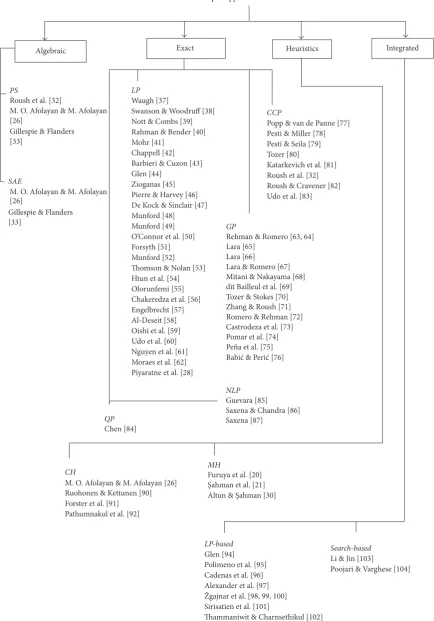
algebraic, optimization, heuristics, and integrated approaches [18]. The range of methodologies which have been used to address the feed formulation problem is presented in Figure 1. The abbreviations used are as follows: PS = Pearson’s Square, SAE = Simultaneous Algebraic Equation, LP = Linear Programming, GP = Goal Programming, CCP = Chance Constrained Programming, QP = Quadratic Programming, NLP = Nonlinear Programming, CH = Constructive Heuris-tics, and MH = Metaheuristics.
2.1. Algebraic Approaches. An algebraic approach is a method which involves mathematical calculations and is normally too computationally expensive. There are only two approaches that can be classified as algebraic approaches which have been applied to the feed formulation problem. These approaches are Pearson’s Square (PS) [26, 32, 33] and Simultaneous Algebraic Equations (SAE) [26, 33]. The limitation of PS is it can only balance one nutrient at a time, while SAE is computationally expensive when solving many nutrients and ingredients [34]. Therefore, these methods are not suitable for handling ingredient constraints.
2.2. Exact Approaches. Optimization involves maximizing or minimizing a function by systematically choosing the best value in a feasible region [35]. It is also defined as the process of attempting to find the best possible solution among all those available [36]. Optimization approaches, with regard to animal feed formulation, have included Lin-ear Programming [28, 37–62], Goal Programming [63–76], Chance Constrained Programming [32, 77–83], Quadratic Programming [84], and Nonlinear Programming [85–87]. These methodologies were frequently used in various feed formulation problems, with LP dominating the studies. LP requires that all the constraints for the problem be exactly formulated, which can be problematic for some problems.
2.3. Heuristic and Metaheuristic Approaches. Heuristics are based on the concept of rule of thumb [88]. When applying a heuristic technique, the expectation is to achieve the best-so-far solution in a feasible region. In the case of feed formulation, the heuristic and metaheuristic approaches are discussed together in this section due to the limited number of studies being carried out using these approaches.
All techniques applied in diet formulation
PS
Roush et al. [32]
M. O. Afolayan & M. Afolayan
M. O. Afolayan & M. Afolayan
M. O. Afolayan & M. Afolayan [26] [26]
[26]
Gillespie & Flanders [33]
CH
Ruohonen & Kettunen [90] Forster et al. [91] Pathumnakul et al. [92]
LP
Waugh [37]
Swanson & Woodruff [38] Nott & Combs [39] Rahman & Bender [40] Mohr [41]
Chappell [42] Barbieri & Cuzon [43] Glen [44]
Zioganas [45] Pierre & Harvey [46] De Kock & Sinclair [47] Munford [48]
Munford [49] O’Connor et al. [50] Forsyth [51] Munford [52] Thomson & Nolan [53] Htun et al. [54] Olorunfemi [55] Chakeredza et al. [56] Engelbrecht [57] Al-Deseit [58] Oishi et al. [59] Udo et al. [60] Nguyen et al. [61] Moraes et al. [62] Piyaratne et al. [28]
CCP
Popp & van de Panne [77] Pesti & Miller [78] Pesti & Seila [79] Tozer [80]
Katarkevich et al. [81] Roush et al. [32] Roush & Cravener [82] Udo et al. [83]
QP
Chen [84]
NLP
Guevara [85] Saxena & Chandra [86] Saxena [87]
GP
Rehman & Romero [63, 64] Lara [65]
Lara [66]
Lara & Romero [67] Mitani & Nakayama [68] dit Bailleul et al. [69] Tozer & Stokes [70] Zhang & Roush [71] Romero & Rehman [72] Castrodeza et al. [73] Pomar et al. [74] Peña et al. [75] Babić & Perić [76]
MH
Furuya et al. [20] Şahman et al. [21] Altun & Şahman [30]
Search-based
Li & Jin [103]
Poojari & Varghese [104]
LP-based
Glen [94]
Polimeno et al. [95] Cadenas et al. [96] Alexander et al. [97] Žgajnar et al. [98, 99, 100] Sirisatien et al. [101]
Thammaniwit & Charnsethikul [102]
Exact Heuristics Integrated Algebraic
SAE
[image:3.600.82.517.87.709.2]Gillespie & Flanders [33]
search-based heuristic algorithm to solve several small-scale problems involving four to ten ingredients for swine feed formulation. However, to gain the optimal solution using this approach requires high computational time especially when there was a lot of ingredients and nutrients that need to be considered.
A metaheuristic is a high level algorithm that provides a set of strategies or procedures, which seek an optimal solution [93]. In relation to animal feed formulation, [20, 92] conducted studies using an Evolutionary Algorithm (EA), while [30] utilised Particle Swarm Optimization. Furuya et al. [20] solved nonlinear constraints involving ratios of ingre-dients for livestock feed. Their study showed that an EA is a promising methodology for the diet formulation problem as a feasible solution could be obtained even for a problem that had no apparent solution. They considered minimum and maximum ratios of ingredients, with many of the ingredients being free from any requirement or constraint.
S¸ahman et al. [21] produced a good solution for a cattle feed problem with a few constraints, which aimed to obtain a zero value for their EA penalty function. S¸ahman et al. [21] also worked on the feed formulation problem for poultry, which had many nutrient constraints. Altun and S¸ahman [30] explored a PSO (Particle Swarm Optimization) approach to solve nonlinear constraints of nutrients. In comparison to a Genetic Algorithm, the PSO solution is superior, with respect to achieving lower penalty values. However, both [21, 30] did not consider a ratio constraint in their animal feed formulation problems.
2.4. Integrated Approaches. Integrated approaches are the combination of two or more methodologies. In a feed formu-lation problem, most of the integrated techniques are based on LP [94–102], with a few being search-based [103, 104].
2.5. Discussion. Considering the four approaches discussed above, an algebraic approach is not applicable since it is not able to cater for more than one nutrient. Optimization approaches are the favoured methodology in a diet formu-lation problem. However in determining the minimum cost feed, the linear or nonlinear constraints are increasingly complex and thus difficult to handle. In these situations, applications of standard linear or nonlinear programming techniques are both time consuming and inefficient [21]. Therefore, the EA as a metaheuristic has the potential of returning quality solutions which is the reason why it has been used by previous researchers. We hypothesize that an EA with enhanced search operators, such as in the initialization stage, will provide superior solutions even when new constraints are introduced.
3. Evolutionary Algorithm for the Feed
Formulation Problem
An EA is a multistage algorithm, comprising initialization, selection of parents, crossover, and mutation. These operators are normally tuned in order to improve their performance.
For example, new initialization procedures have been pro-posed by [105], selection by [106], crossover by [107], and mutation by [22].
A new mutation operator known as Power Mutation was introduced by [22] to cater for constrained problems with real number representation. It is an enhancement of uniform mutation and makes use of both lower and upper bounds of a constraint. The advantage of using each constraint’s boundaries is that we might get a number of possible solutions within that constraint’s range. Deep and Thakur [22] introduced Power Mutation with the aim of using an EA without any assistance from other constraint handling techniques. The idea of Power Mutation can be further extended for other operations such as the initialization.
In an animal feed formulation, [20] has pioneered the utilisation an EA, aiming to solve the nonlinear constraints which involve a ratio of ingredients. The study showed that an EA is able to produce a near optimal solution even for a problem that has no apparent solution. [20] considered the minimum and maximum values of each ingredient. However, almost all of the minimum values were considered as free values. Reference [21] then continued the work of [20] utilising a GA to achieve the least cost diet for livestock. Their experiments produced good quality solutions for this problem. However, [21] did not consider a ratio constraint in their study. Only these two studies utilise an EA for the animal feed formulation. Hence, this paper addresses both limitations in those two studies. We investigate an EA for the minimum and maximum values for nutrients and ingredients and take into account ratio constraints between nutrients.
Previous research for animal feed formulation using metaheuristics has attempted to get the appropriate mix of ingredients. For example, eight ingredients can be used in the formulation, and then a specific percentage of all ingredients are selected to be included in the formulation. Based on expert opinion, at most ten ingredients could be included in the formulation in order to obtain a low cost diet. However, it is very difficult to find the best ten ingredients with the optimal quantities to fulfill all specified nutrients with minimum cost. This paper investigates the use of an EA, to address the feed formulation problem. Table 1 summarizes the number of ingredients included in previous studies that have used heuristic approaches. Reference [26] did not mention the number of ingredients.
Table 1: Number of ingredients used in heuristic approach.
Author Type of animal Technique Number of ingredients
(1)M. O. Afolayan and M. Afolayan [26] Poultry TE —
(2)Pathumnakul et al. [92] Swine Search Dataset 1: 6; dataset 2: 5
(3)Furuya et al. [20] Livestock EA 20
(4)S¸ahman et al. [21] Poultry and cattle GA Poultry: 11; cattle: 7
(5)Altun and S¸ahman [30] Poultry, cattle, sheep, rabbit PSO 9
data obtained from manufacturers and the Department of Fisheries, Malaysia.
4. Shrimp Feed Formulation Model
In the shrimp feed formulation problem, the aim is to satisfy all the nutritional needs of farmed shrimps at a minimum cost. The minimization problem considers 14 ingredients and 18 nutrients. The main aim of this shrimp feed formulation is to minimize the overall cost of the shrimp feed. In order to obtain the minimum cost, a penalty system is used. A penalty value is given if the ingredients and nutrients selected are unable to fulfill the constraints or requirements as discussed in the following subsection.
4.1. Objective Function and Constraints. As part of modelling the shrimp feed formulation problem, objective function and constraints are defined as follows:
𝑓 (𝑠) =min
14
∑
𝑖=1
(𝑋𝑖× 𝐶𝑖) , (1)
where𝐶𝑖is the cost of ingredient𝑖,𝑋𝑖equals the weight of the𝑖th ingredient, and𝑓(𝑠)is the total cost of the feed,
subject to
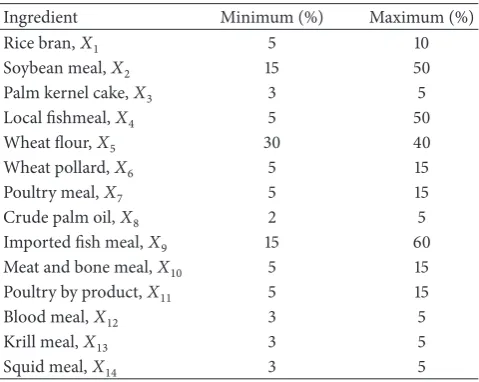
(i) ingredients’ range based on maximum and minimum value as shown in Table 2:
𝑋𝑖= 0
or𝐿𝑋𝑖 ≤ 𝑋𝑖≤ 𝑈𝑋𝑖
∀𝑋𝑖,
(2)
where𝐿𝑋𝑖is lower bound of ingredienti,𝑈𝑋𝑖is upper bound of ingredient𝑖, and𝑋𝑖equals the weight of the
𝑖th ingredient;
(ii) total ingredients weight is
𝑛
∑
𝑖=1
𝑋𝑖= 𝑌, (3)
where𝑌is a total ingredients weight as predefined by the user in the user interface,
the specific amount is fixed at 100 kg;
(iii) single nutrients’ range based on maximum and mini-mum values as shown in Table 3:
𝐿𝑁𝑘 ≤∑𝑛
𝑖=1
𝑁𝑘𝑖𝑋𝑖≤ 𝑈𝑁𝑘, (4)
where𝐿𝑁𝑘 is lower bound of total value of nutrient k, 𝑈𝑁𝑘 is upper bound of total value of nutrient k, and 𝑁𝑘𝑖 is total value of nutrientk in ingredient 𝑖,
𝑘 = 1, 2, . . . , 16;
(iv) combination of nutrients’ range based on maximum and minimum value as shown in Table 3:
𝐿𝑁𝑘(𝑖𝑗) ≤
𝑛
∑
𝑖=1𝑁𝑘(𝑖𝑗)𝑋𝑖≤ 𝑈𝑁𝑘(𝑖𝑗), (5)
where𝐿𝑁𝑘(𝑖𝑗)is lower bound of combination nutrients
i and j and 𝑈𝑁𝑘(𝑖𝑗) is upper bound of combination
nutrientsiandj;
(v) ratio of nutrients’ range based on maximum and minimum value as shown in Table 3:
𝐿ratio≤ ∑
𝑛 𝑖=1𝑁𝑘𝑖
∑𝑛𝑖=1𝑁𝑘𝑗 ≤ 𝑈ratio, (6)
where𝐿ratiois lower bound of ratio between nutrients
i and j and 𝑈ratio is upper bound of ratio between
nutrientsiandj.
4.2. Ingredients and Nutrients. In this study, 14 ingredients and 18 nutrients are considered. The ingredients have min-imum and maxmin-imum percentages that can be used. These values are shown in Table 2. The nutrient constraints are categorized into three types which are single, combination, and ratio. There are 16 nutrients that are classified as a single type, that is, crude protein, lipid, fibre, ash, calcium, phos-phorus, and ten essential amino acids (EAAs). These EAAs are arginine, histidine, isoleucine, leucine, lysine, methion-ine, phenylalanmethion-ine, threonmethion-ine, tryptophan, and valine. These nutrients are shown in Table 3. For the combination types, there are two, which are combinations of methionine and cystine and also phenylalanine and tyrosine. A ratio of calcium and phosphorus is also taken into consideration. The minimum and maximum percentages and values given represent the lower and upper bounds for each of the ingredient and nutrients, respectively.
Table 2: A list of ingredients and its specific range.
Ingredient Minimum (%) Maximum (%)
Rice bran,𝑋1 5 10
Soybean meal,𝑋2 15 50
Palm kernel cake,𝑋3 3 5
Local fishmeal,𝑋4 5 50
Wheat flour,𝑋5 30 40
Wheat pollard,𝑋6 5 15
Poultry meal,𝑋7 5 15
Crude palm oil,𝑋8 2 5
Imported fish meal,𝑋9 15 60
Meat and bone meal,𝑋10 5 15
Poultry by product,𝑋11 5 15
Blood meal,𝑋12 3 5
Krill meal,𝑋13 3 5
Squid meal,𝑋14 3 5
Table 3: A list of nutrients and its specific range.
Nutrients Minimum Maximum
Single nutrient
Crude protein, % 38.00 45.00
Lipid, % 0.08 0.18
Fibre, % — 4.00
Ash, % — 15.00
Calcium, % — 2.30
Phosphorus, % 0.30 0.70
Arginine, % 1.60 2.32
Histidine, % 0.60 0.84
Isoleucine, % 1.00 1.33
Leucine, % 1.70 2.16
Lysine, % 1.55 1.65
Methionine, % 0.70 0.96
Phenylalanine, % 1.40 1.60
Threonine, % 1.30 1.44
Tryptophan, % 0.20 0.32
Valine, % 1.20 1.60
Nutrients combination
Methionine + cystine, % 1.00 1.44
Phenylalanine + tyrosine, % 2.70 7.10
Nutrients ratio
Calcium: phosphorus, % 1 : 1.3 1 : 1.3
4.3. The Evolutionary Algorithm Model. The constraints func-tion is embedded as part of the fitness funcfunc-tion in our EA as shown in Algorithm 1.
The EA draws from other established operators, such as the Roulette Wheel Selection [109, 110], one-point crossover [110], and Power Mutation (excerpted from [22]). However, in this study we highlight the use of a Power Heuristic, which is incorporated in the initialization stage of the EA to help obtain a good quality feasible solution for formulating shrimp feed mix with many ingredients.
5. Power Heuristics Algorithm
for EA Initialization
The original idea of Power Heuristics came from a mutation operator known as Power Mutation, introduced by [22]. Power Heuristics is capable of deleting inappropriate ingre-dients and, thus, searches for the most suitable combination of ingredients. When too many preferred ingredients are candidates, nutrient constraints might be violated as each ingredient has its own restrictions. Hence, Power Heuristics are embedded in the early stage of the EA, to act as a filter against a poor combination of ingredients and search for better alternatives with minimal penalty values.
Power Heuristics uses a local search concept that searches around the neighbourhood of a solution. It begins by check-ing the feasibility of a potential solution. If the solution is infeasible, a new ingredient will be located that is within the range of one unit (kilogram) from the current ingredient. This mechanism is able to remove a few ingredients. Finally, the penalty value for the new solution is calculated. This mechanism is useful when inappropriate ingredients need to be removed in the case of an important constraint being violated; that is, the total ingredient weight exceeds the required amount. The incorporation of this operator can at least reduce the initial penalty value, thus increasing the possibility of locating a feasible solution. The algorithms for Power Heuristics and Power Mutation are presented in Algorithms 2 and 3, respectively.
Power Heuristics is adapted from the Power Mutation operator as originally introduced by [22]. As the purpose of Power Mutation is to obtain a feasible solution, introducing a new weight for each ingredient in the mutation stage (𝑋𝑖𝑚) is designed to include a lower and upper bound as in equations
(∗∗∗∗)and(∗∗∗∗∗).
Power Heuristics aims to reject some ingredients and then repair the solution to achieve a lower penalty value. The formula for getting an adjusted weight for each ingredient is designed so that the adjusted weight for the particular ingredient (𝑋𝑖𝑓) can be either zero or slightly different from the original weight as shown in equation (∗∗) (refer to Algorithm 2). Most previous studies (e.g., [111–115]), espe-cially those that used experimental design approach, used less than ten ingredients for aquaculture feeds including shrimps. The reason was to cut down the operation costs such as ordering and storage [18].
In order to test the practicality of Power Heuristics, two initialization procedures were tested to obtain some insights and suggest the best initialization operator. The first procedure is a semirandom initialization operation which employed a formula using lower and upper bound values of the weight of each ingredient, as shown in (7). The second procedure also employed the same formula, but with the inclusion of Power Heuristics, as indicated in Algorithm 2, for filtering purposes.
For𝑖 = 1, 2, 3, . . . , 14
(i) Initialize solution in semi random procedure
Incorporate Power Heuristics
(ii) Evaluate each individual penalty value
(iii) Select pair to mate using eitherRoulette Wheel Selection operator
(iv) Do Crossover usingOne-Point Crossover operator
(v) DoPower Mutation
(vi) Repair operator usingPower Heuristics
(vii) Apply elitism operator
(viii) Repeat step (iii) until step (vii) until a number of generations is reached
Algorithm 1: The EA algorithm.
(i) Generate uniform random number,𝑟between[0, 1]
(ii) Gettusing formula:
𝑡 = 𝑋𝑖− 𝐿𝑋𝑖 𝑈𝑋𝑖− 𝑋𝑖
(∗)
where𝑋𝑖: ingredient𝑖value from initial solution,𝐿𝑋𝑖: lower bound of ingredient𝑖,
𝑈𝑋𝑖: upper bound of ingredient𝑖
(iii) Compare valuetwithrand determine which one is greater
(iv) Find new value of𝑋𝑖𝑓by comparingrwitht
If𝑟 > 𝑡,
Then new value of𝑋𝑖𝑓= 0
If𝑡 ≥ 𝑟,
Then generate new value of𝑋𝑖𝑓by the formula:
(𝑋𝑖− 1 < 𝑋𝑖< 𝑋𝑖+ 1) (∗∗)
(v) Repeat step (ii) to (iv) for other allele and also for other infeasible individuals (vi) Calculate new fitness value for the solution
Algorithm 2: Power Heuristics algorithm.
where 𝐿𝑋𝑖 is ingredients’ lower bound, 𝑈𝑋𝑖 is ingredients’ upper bound, and𝑗is the number of populations.
6. Results and Discussions
Semirandom initialization operation, adapted from [21], was implemented to find solutions at the initial stage so as to ensure that the weight of ingredients lies within the ingredients’ limitations. The experimentations between these two initialization operations were carried out and the results are shown in Table 4. The generation of the proposed EA model with a Power Heuristic operator (EA-PH) was carried out with certain established operators, which are Roulette Wheel Selection, One-Point Crossover, and Power Mutation.
The evolutionary model with semirandom initialization operation (EA-SR) was used as a benchmark. Since this work is the first attempt of filtering some ingredients from the list, the only appropriate algorithm to be compared is by using EA-SR. Each model was run 30 times using the algorithm from Algorithm 1. Experimentations of EA with two initialization operators, that is, EA-PH and EA-SR, were conducted. These initialization operators were tested, while other EA operators remain the same. As in Table 4, the EA-SR provided an infeasible solution in every run, whereas
the EA-PH model showed that no solution was infeasible. This experimentation shows that Power Heuristics allows unnecessary ingredients to be filtered out of the system. As a result, the total selected ingredients in the system might be less than fourteen. Indirectly, the requirements of ingredient’s weight and nutrient’s range can be fulfilled.
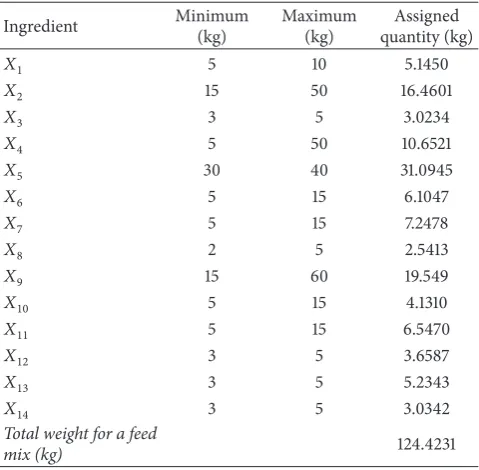
A sample solution for the shrimp feed formulation is shown each in Tables 5 and 6 as obtained from EA-SR and EA-PH, respectively. In comparison, the EA-SR solutions in Table 5 include all ingredients with a total weight of 124.4231 kg, while EA-PH solution in Table 6 shows that only eight ingredients were selected for the solution with a total weight of 100.0514 kg. The total price for this feed combination using EA-SR was MYR 297.34, and MYR 217.08 was the price for EA-PH. The results from this experiment conclude that Power Heuristics in the EA model is able to remove some inappropriate ingredients in searching for a feasible solution when many possible ingredients are under consideration.
In addition, the performance of the EA-PH model was statistically evaluated with𝜇EA-PH = 547.67,𝜇EA-SR= 100422,
𝜎EA-PH = 139.778, and𝜎EA-SR= 114.816. As confidence level
(i) Generate uniform random numbers,𝑠1and𝑟between[0, 1]
(ii) Getsusing formula:𝑠 = 𝑝(𝑠1)𝑝−1
where𝑠1is the random number andpis the index of Power distribution
(iii) Gettusing formula:
𝑡 =𝑋𝑈𝑖𝑐− 𝐿𝑋𝑖
𝑋𝑖− 𝑋𝑖𝑐 (∗ ∗ ∗)
where𝑋𝑖𝑐: ingredient𝑖value from crossover stage,𝐿𝑋𝑖: lower bound of ingredient𝑖,
𝑈𝑋𝑖: upper bound of ingredient𝑖
If(𝑡 < 𝑟),
Then generate a new value of𝑋𝑖𝑚by the formula
𝑋𝑖𝑚= 𝑋𝑖𝑐− 𝑠 (𝑋𝑖𝑐− 𝐿𝑋𝑖) (∗ ∗ ∗ ∗)
Else if(𝑡 ≥ 𝑟)
Then find a new value of𝑋𝑖𝑚by the formula
𝑋𝑖𝑚= 𝑋𝑖𝑐+ 𝑠(𝑈𝑋𝑖− 𝑋𝑖𝑐) (∗ ∗ ∗ ∗ ∗)
(iv) Repeat step (iii) to (iv) until all alleles in chromosomeiare mutated.
(v) Calculate new fitness value for the solution
[image:8.600.50.544.319.380.2]Algorithm 3: Power Mutation algorithm [22].
Table 4: Performance of both models based on penalty value with different initialization procedures.
Model Minimum penalty value Mean penalty value Mean run time
(minutes) Number of infeasible solutions
EA-SR 100000
(infeasible)
100422
(infeasible) 165.71 30/30
[image:8.600.51.291.416.651.2]EA-PH 300 547.67 201.52 0/30
Table 5: A sample solution obtained from the EA-SR model.
Ingredient Minimum
(kg)
Maximum (kg)
Assigned quantity (kg)
𝑋1 5 10 5.1450
𝑋2 15 50 16.4601
𝑋3 3 5 3.0234
𝑋4 5 50 10.6521
𝑋5 30 40 31.0945
𝑋6 5 15 6.1047
𝑋7 5 15 7.2478
𝑋8 2 5 2.5413
𝑋9 15 60 19.549
𝑋10 5 15 4.1310
𝑋11 5 15 6.5470
𝑋12 3 5 3.6587
𝑋13 3 5 5.2343
𝑋14 3 5 3.0342
Total weight for a feed
mix (kg) 124.4231
of EA-PH is better than EA-SR due to the significantly less penalty value obtained.
Regarding the ingredients, selecting them is based on the nutritional values obtained in the shrimp feed mix, whether fish meal is included or not. The underlying rationale for this selection is that the price of fish meal is relatively high. This
Table 6: A sample solution obtained from the EA-PH model.
Ingredient Minimum
(kg)
Maximum (kg)
Assigned quantity (kg)
𝑋2 15 50 42.5860
𝑋3 3 5 4.0431
𝑋6 5 15 14.3030
𝑋7 5 15 13.1132
𝑋8 2 5 4.0231
𝑋11 5 15 12.1350
𝑋13 3 5 4.6120
𝑋14 3 5 5.2360
Total weight for
a feed mix (kg) 100.0514
𝑋1= 𝑋4= 𝑋5= 𝑋9= 𝑋10= 𝑋12= 0.
is not a surprise since fish meal is high in demand and thus, many researchers [116, 117] have tried to substitute fish meal with alternative ingredients in their studies. The alternatives that could maintain the palatability of the shrimp feed such as krill meal [118, 119] and poultry by product meal [120] have been tested.
[image:8.600.309.550.417.570.2]otherwise have to be carried out considering a large number of combinations of ingredients. A potential extension to this research could be to use the solution from this research as input to an ED approach to confirm how the shrimp will perform. These approaches could complement each other to obtain the best shrimp feed.
7. Conclusions and Future Work
A shrimp feed formulation problem was explored in this study using an EA strategy. A heuristic procedure known as Power Heuristics was incorporated at the initialization stage in an EA model to explore the neighbourhood area when the initial solution was infeasible. The function of this Power Heuristic is to filter unsuitable ingredients and remove it from the EA computation. The heuristic operator is capable of filtering some combinations of ingredients from a selected database of choices, which could lead to potentially poor solutions. It works well if many options exist in the search space, which is suitable for a large problem like an animal diet formulation with many possible ingredients being considered. In future, many new avenues can be explored, such as improving the integration of Power Heuristics with the EA or new integration with other population based techniques with various ingredients, as hundreds of possible ingredients have been tested in the literature.
Conflicts of Interest
The authors declare that they have no conflicts of interest.
Acknowledgments
Research on the work reported in this paper was supported by Universiti Utara Malaysia and the Ministry of Higher Education Malaysia under the Fundamental Research Grant Scheme (FRGS) number 12817. The authors are grateful and would like to thank the parties for the financial support received during the research period and able to produce this piece of work.
References
[1] FAO, “Fisheries and Aquaculture Department,” 2014, http:// www.fao.org/docrep/016/i2727e/i2727e.pdf.Last.
[2] K. Chin, “The feedmilling industry, the assessment of product quality and the economics of shrimp feeds. Report of the workshop on shrimp and finfish feed development. Johore
Bahru,”Malaysia, pp. 25–29, 1988.
[3] C. Lim and D. M. Akiyama, “Chapter 6: Nutrient requirement
of penaeid shrimp,” inNutrition and utilization technology in
aquaculture, pp. 60–73, AOCS Press, 1995.
[4] Y. C. Shang, P. Leung, and B.-H. Ling, “Comparative economics
of shrimp farming in Asia,”Aquaculture, vol. 164, no. 1-4, pp.
183–200, 1998.
[5] J. W. Hertrampf, P. K. Biswal, and S. K. Mishra, “A revolutionary concept for shrimp feeding,” http://www.allaboutfeed.net/Proc- ess-Management/Management/2005/6/A-revolutionary-con-cept-for-shrimp-feeding-AAF010209W/.
[6] J. M. Fox, G. D. Treece, and D. R. Sanchez, “Shrimp nutrition
and feed management,” inMethods for improving shrimp
farm-ing in Central America, M. C. Haws and C. E. Boyd, Eds., pp. 65– 90, of Central America Press, Managua, Nicaragua:University, 2001.
[7] J. M. Fox, A. L. Lawrence, and E. Li-Chan, “Dietary requirement for lysine by juvenile penaeusvannamei using intact and free
amino acid sources,”Aquaculture, vol. 131, pp. 279–290, 1995.
[8] A. G. J. Tacon, J. J. Cody, L. D. Conquest, S. Divakaran, I. P. Forster, and O. E. Decamp, “Effect of culture system on the nutrition and growth performance of Pacific white shrimp
Litopenaeus vannamei (Boone) fed different diets,”Aquaculture
Nutrition, vol. 8, no. 2, pp. 121–137, 2002.
[9] C. Pascual, E. Zenteno, G. Cuzon et al., “Litopenaeus vannamei juveniles energetic balance and immunological response to
dietary proteins,”Aquaculture, vol. 239, no. 1-4, pp. 375–395,
2004.
[10] S. Arnold, R. Smullen, M. Briggs, M. West, and B. Glencross, “The combined effect of feed frequency and ration size of diets with and without microbial biomass on the growth and
feed conversion of juvenile Penaeus monodon,”Aquaculture
Nutrition, vol. 22, no. 6, pp. 1340–1347, 2016.
[11] S. L. Zeng, W. Q. Long, L. X. Tian et al., “Effects of dietary aflatoxin B1 on growth performance, body composition, haema-tological parameters and histopathology of juvenile Pacific
white shrimp (Litopenaeus vannamei),”Aquaculture Nutrition,
vol. 22, no. 5, pp. 1152–1159, 2016.
[12] Y.-Y. Yu, W.-D. Chen, Y.-J. Liu, J. Niu, M. Chen, and L.-X. Tian, “Effect of different dietary levels of Gracilaria lemaneiformis dry power on growth performance, hematological parameters and intestinal structure of juvenile Pacific white shrimp
(Litope-naeus vannamei),”Aquaculture, vol. 450, pp. 356–362, 2016.
[13] J. A. Venero, D. A. Davis, and D. B. Rouse, “Variable feed allowance with constant protein input for the pacific white shrimp Litopenaeus vannamei reared under semi-intensive
conditions in tanks and ponds,”Aquaculture, vol. 269, no. 1-4,
pp. 490–503, 2007.
[14] M. Jobling, “National Research Council (NRC): Nutrient
re-quirements of fish and shrimp,”Aquaculture International, vol.
20, no. 3, pp. 601-602, 2012.
[15] J. P. Lazo and D. A. Davis, “Ingredient and feed evaluation,” in
Encyclopedia of Aquaculture, R. R. Stickney, Ed., pp. 453–463, Wiley-terscience Publication, Texas, Tx, USA, 2000.
[16] J. M. Fox, D. A. Davis, M. Wilson, and A. L. Lawrence, “Current status of amino acid requirement research with marine penaeid
shrimp,” inAvances en Nutrici´on Acu´ıcola VIII. VIII Simposium
Internacional de Nutrici´on Acu´ıcola, pp. 182–196, Nuevo Le´on, 2006.
[17] G. M. Pesti, “Impact of dietary amino acid and crude protein
levels in broiler feeds on biological performance,”Journal of
Applied Poultry Research, vol. 18, no. 3, pp. 477–486, 2009.
[18] A. R. Rahman,Evolutionary algorithms with average crossover
and power heuristics for aquaculture diet formulation [Ph.D. thesis], Universiti Utara Malaysia, 2014.
[19] L. E. Cruz-Su´arez, M. Nieto-L´opez, C. Guajardo-Barbosa, M. Tapia-Salazar, U. Scholz, and D. Ricque-Marie, “Replacement of fish meal with poultry by-product meal in practical diets for Litopenaeus vannamei, and digestibility of the tested
ingredi-ents and diets,”Aquaculture, vol. 272, no. 1-4, pp. 466–476, 2007.
[20] T. Furuya, T. Satake, and Y. Minami, “Evolutionary
program-ming for mix design,”Computers and Electronics in Agriculture,
[21] M. A. S¸ahman, M. C¸ unkas¸, S¸. ˙Inal, F. ˙Inal, B. Cos¸kun, and U. Tas¸kiran, “Cost optimization of feed mixes by genetic
algo-rithms,”Advances in Engineering Software, vol. 40, no. 10, pp.
965–974, 2009.
[22] K. Deep and M. Thakur, “A new mutation operator for real
coded genetic algorithms,”Applied Mathematics and
Computa-tion, vol. 193, no. 1, pp. 211–230, 2007.
[23] E. Eckstein, “Communication to the Editor—Is the “Diet
Prob-lem” Identical to the “Menu Planning ProbProb-lem”?”Management
Science, vol. 16, no. 9, pp. 527-528, 1970.
[24] J. L. Balintfy, G. T. Ross, P. Sinha, and A. A. Zoltners, “A math-ematical programming system for preference and compatibility
maximized menu planning and scheduling,” Mathematical
Programming, vol. 15, no. 1, pp. 63–76, 1978.
[25] B. Render, J. Stair, M. E. Hanna, and R. M. Hanna,Quantitative
analysis for management (, , ). Upper Saddle River, Pearson Education, Inc, New Jersey, NJ, USA, 9th edition, 2006. [26] M. O. Afolayan and M. Afolayan, “Nigeria oriented poultry feed
formulation software requirements,”Journal of Applied Sciences
Research, vol. 4, no. 11, pp. 1596–1602, 2008.
[27] M. J. Villamide, R. Caroba˜no, I. Hern´andez et al., “Evolution of a feed formulation practice in amandatory course on animal
production,”Procedia Social and Behavioral Sciences, vol. 1, pp.
1797–1801, 2009.
[28] M. K. D. K. Piyaratne, N. G. J. Dias, and N. S. B. M. Attapattu, “Linear model based software approach with ideal amino acid
profiles for least-cost poultry ration formulation,”Information
Technology Journal, vol. 11, no. 7, pp. 788–793, 2012.
[29] S. Thammaniwit and P. Charnsethikul, “Benders decomposition method for a large two-stage linear programming model,”
International Transaction Journal of Engineering, vol. 4, pp. 253– 268, 2013.
[30] A. A. Altun and M. A. S¸ahman, “Cost optimization of mixed
feeds with the particle swarm optimization method,”Neural
Computing and Applications, vol. 22, no. 2, pp. 383–390, 2013. [31] A. R. Rahman and R. Ramli, “Average Concept of Crossover
Operator,” in Proceedings of the International Conference on
Management and Artificial Intelligent, 2013.
[32] W. B. Roush, T. Cravener, and F. Zhang, “Computer formulation
observations and caveats,”Journal of Applied Poultry Research,
vol. 5, no. 2, pp. 116–125, 1996.
[33] J. R. Gillespie and F. B. Flanders,Modern livestock and poultry
production, Cengage Learning, Clifton Park, New York, USA, 8th edition, 2009.
[34] S. Ghosh, J. Ghosh, D. T. Pal, and R. Gupta, “Current concepts of feed formulation for livestock using mathematical modeling,”
Animal Nutrition and Feed Technology, vol. 14, no. 1, pp. 205– 223, 2014.
[35] G. Zhang, J. Lu, and Y. Gao,Multi-level decision making models,
methods and applications, Springer, methods and applications, 2015.
[36] E. K. Burke and G. Kendall, “Introduction,” inSearch
Method-ologies: Introductory Tutorials in Optimization and Decision Support Techniques, E. K. Burke and G. Kendall, Eds., p. 18, Springer, New York, NY, USA, 2005.
[37] F. V. Waugh, “The minimum-cost dairy feed,”Journal of Farm
Economics, vol. 33, no. 3, pp. 299–310, 1951.
[38] L. W. Swanson and J. G. Woodruff, “A sequential approach to the feed-mix problem a sequential approach to the feed-mix
problem,”Operations Research, vol. 12, no. 1, pp. 89–109, 1964.
[39] H. Nott and J. F. Combs, “Data processing feed ingredient
composition data,”Feed Stuffs, vol. 39, no. 41, pp. 21-22, 1967.
[40] S. A. Rahman and F. E. Bender, “Linear programming approx-imation of least-cost feed mixes with probability restrictions,”
American Journal of Agricultural Economics, vol. 53, no. 4, pp. 612–618, 1971.
[41] G. M. Mohr, “The bulk constraint and computer formulations
of least-cost feed mixes,”Review of Marketing and Agricultural
Economics, vol. 40, no. 1, pp. 15–28, 1972.
[42] A. E. Chappell, “Linear programming cuts costs in production
of animal feeds,”Operational Research Quarterly, vol. 25, no. 1,
pp. 19–26, 1974.
[43] M. A. Barbieri and G. Cuzon, “Improved nutrient specification
for linear programming of penaeid rations,”Aquaculture, vol.
19, no. 4, pp. 313–323, 1980.
[44] J. J. Glen, “A Mathematical Programming Approach to Beef
Feedlot Optimization,”Management Science, vol. 26, no. 5, pp.
524–535, 1980.
[45] C. Zioganas,The determination of viable, parity and optimum
sizes of family-type sheep farms in the Epirus Region of Greece. Unpublished doctoral thesis [Ph.d. thesis], 1981.
[46] N. R. S. Pierre and W. R. Harvey, “Incorporation of uncertainty
in composition of feeds into least-cost ration models,”Journal
of Dairy Science, vol. 69, pp. 3051–3062, 1986.
[47] H. C. De Kock and M. Sinclair, “Multi-mix feedstock problems
on microcomputers,”Journal of the Operational Research
Soci-ety, vol. 38, no. 7, pp. 585–590, 1987.
[48] A. G. Munford, “A microcomputer system for formulating
animal diets which may involve liquid raw materials,”European
Journal of Operational Research, vol. 41, no. 3, pp. 270–276, 1989. [49] A. G. Munford, “Evaluating marginal costs associated with ratio
and other constraints in linear programmes,”Journal of the
Operational Research Society, vol. 40, no. 10, pp. 933–935, 1989. [50] J. D. O’Connor, C. J. Sniffen, D. G. Fox, and R. A. Miligan,
“Least cost dairy cattle ration formulation model based on the
degradable protein system,”Journal of Dairy Science, vol. 72, pp.
2733–2745, 1989.
[51] D. M. Forsyth, “Chapter 5: Computer programming of beef
cattle diet. In,” inBeef cattle feeding and nutrition, T. W. Perry
and M. J. Cecava, Eds., p. 68, Academic Press, Inc, California, Ca, USA, 2nd edition, 1995.
[52] A. G. Munford, “The use of iterative linear programming in
practical applications of animal diet formulation,”Mathematics
and Computers in Simulation, vol. 42, no. 2-3, pp. 255–261, 1996. [53] E. Thomson and J. Nolan, “UNEform: A powerful feed formula-tion spreadsheet suitable for teaching or on-farm formulaformula-tion,”
Animal Feed Science and Technology, vol. 91, no. 3-4, pp. 233– 240, 2001.
[54] M. S. Htun, T. T. Thein, and P. Tin, Linear programming
approach to diet problem for black tiger shrimp in shrimp aquaculture. Paper presented at the Information and Telecommu-nication Technologies, Yangon, Myanmar, Burma, 2005. [55] T. O. S. Olorunfemi, “Linear programming approach to
least-cost ration formulation for poults,” Information Technology
Journal, vol. 6, no. 2, pp. 294–299, 2007.
[56] S. Chakeredza, F. K. Akinnifesi, O. C. Ajayi, G. Sileshi, S. Mngomba, and F. M. T. Gondwe, “A simple method of formu-lating least-cost diets for smallholder dairy production in
sub-Saharan Africa,”African Journal of Biotechnology, vol. 7, no. 16,
[57] E. Engelbrecht,Optimising animal diets at the Johannesburg zoo [Bachelor degree thesis], University of Pretoria, 2008.
[58] B. Al-Deseit, “Least-cost broiler ration formulation using linear
programming technique,” Journal of Animal and Veterinary
Advances, vol. 8, no. 7, pp. 1274–1278, 2009.
[59] K. Oishi, H. Kumagai, and H. Hirooka, “Application of the mod-ified feed formulation to optimize economic and environmental criteria in beef cattle fattening systems with food by-products,”
Animal Feed Science and Technology, vol. 165, no. 1-2, pp. 38–50, 2011.
[60] I. U. Udo, C. B. Ndome, S. B. Ekanem, and P. E. Asuquo, “Application of linear programming technique in least-cost ration formulation for African catfish (Clarias gariepinus) in
semi-intensive culture system in Nigeria,”Journal of Fisheries
and Aquatic Sciences, vol. 6, no. 4, pp. 429–437, 2011.
[61] T. T. H. Nguyen, I. Bouvarel, P. Ponchant, and H. M. G. Van Der Werf, “Using environmental constraints to formulate
low-impact poultry feeds,”Journal of Cleaner Production, vol. 28, pp.
215–224, 2012.
[62] L. E. Moraes, J. E. Wilen, P. H. Robinson, and J. G. Fadel, “A linear programming model to optimize diets in environmental
policy scenarios,”Journal of Dairy Science, vol. 95, no. 3, pp.
1267–1282, 2012.
[63] T. Rehman and C. Romero, “Multiple-criteria decision-making techniques and their role in livestock ration formulation,”
Agricultural Systems, vol. 15, no. 1, pp. 23–49, 1984.
[64] T. Rehman and C. Romero, “Goal programming with penalty
functions and livestock ration formulation,”Agricultural
Sys-tems, vol. 23, no. 2, pp. 117–132, 1987.
[65] P. Lara, “An interactive multigoal programming model for determining livestock rations: An application to dairy cows in
Andalusia, spain,”Journal of the Operational Research Society,
vol. 43, no. 10, pp. 945–953, 1992.
[66] P. Lara, “Multiple objective fractional programming and live-stock ration formulation: a case study for dairy cow diets in
Spain,”Agricultural Systems, vol. 41, no. 3, pp. 321–334, 1993.
[67] P. Lara and C. Romero, “Relaxation of nutrient requirements on livestock rations through interactive multigoal programming,”
Agricultural Systems, vol. 45, no. 4, pp. 443–453, 1994.
[68] K. Mitani and H. Nakayama, “A multiobjective diet planning
support system using the satisficing trade-off method,”Journal
of Multi-Criteria Decision Analysis, vol. 6, pp. 131–139, 1997. [69] P. J. dit Bailleul, J. Rivest, F. Dubeau, and C. Pomar, “Reducing
nitrogen excretion in pigs by modifying the traditional
least-cost formulation algorithm,”Livestock Production Science, vol.
72, no. 3, pp. 199–211, 2001.
[70] P. R. Tozer and J. R. Stokes, “A multi-objective programming approach to feed ration balancing and nutrient management,”
Agricultural Systems, vol. 67, no. 3, pp. 201–215, 2001.
[71] F. Zhang and W. B. Roush, “Multiple-objective (goal) program-ming model for feed formulation: an example for reducing
nutrient variation,”Poultry Science, vol. 81, no. 2, pp. 182–192,
2002.
[72] C. Romero and T. Rehman, “Livestock ration formulation via
goal programming with penalty functions,” inIn Romero, vol.
11, pp. 149–161, In, 2003.
[73] C. Castrodeza, P. Lara, and T. Pe˜na, “Multicriteria fractional model for feed formulation: Economic, nutritional and
environ-mental criteria,”Agricultural Systems, vol. 86, no. 1, pp. 76–96,
2005.
[74] C. Pomar, F. Dubeau, M.-P. L´etourneau-Montminy, C. Boucher, and P.-O. Julien, “Reducing phosphorus concentration in pig diets by adding an environmental objective to the traditional
feed formulation algorithm,”Livestock Science, vol. 111, no. 1-2,
pp. 16–27, 2007.
[75] T. Pe˜na, P. Lara, and C. Castrodeza, “Multiobjective stochastic
programming for feed formulation,”Journal of the Operational
Research Society, vol. 60, no. 12, pp. 1738–1748, 2009.
[76] Z. Babi´c and T. Peri´c, “Optimization of livestock feed blend by
use of goal programming,”International Journal of Production
Economics, vol. 130, no. 2, pp. 218–223, 2011.
[77] W. Popp and C. V. D. van de Panne, “Minimum-cost cattle feed
under probabilistic protein constraints,”Management Science,
vol. 9, no. 3, pp. 405–430, 1963.
[78] G. M. Pesti and B. R. Miller,Animal feed formulation: Economics
and computer applications, Chapman Hall, New York, 1993. [79] G. M. Pesti and A. F. Seila, “The Use of an Electronic Spreadsheet
to Solve Linear and Non-Linear “Stochastic” Feed Formulation
Problems,”Journal of Applied Poultry Research, vol. 8, no. 1, pp.
110–121, 1999.
[80] P. R. Tozer, “Least-cost ration formulations for holstein dairy
heifers by using linear and stochastic programming,”Journal of
Dairy Science, vol. 83, no. 3, pp. 443–451, 2000.
[81] V. M. Katarkevich, A. N. Rubinov, S. A. Ryzhechkin, and T. Sh. Efendiev, “Compact holographic solid-state
distributed-feedback laser,”Quantum Electronics A, vol. 24, no. 10, pp. 871–
873, 1994.
[82] W. B. Roush and T. L. Cravener, “Stochastic true digestible
amino acid values,”Animal Feed Science and Technology, vol.
102, no. 1–4, pp. 225–239, 2002.
[83] I. U. Udo, C. B. Ndome, and P. E. Asuquo, “Use of stochastic programming in least-cost feed formulation for african catfish (Clarias gariepinus) in semi-intensive culture system in
Nige-ria,”Journal of Fisheries and Aquatic Science, vol. 6, no. 4, pp.
447–455, 2011.
[84] J. T. Chen, “Quadratic programming for least-cost feed
formula-tions under probabilistic protein constraints,”American Journal
of Agricultural Economics, vol. 55, no. 2, pp. 175–183, 1973. [85] V. R. Guevara, “Use of nonlinear programming to optimize
performance response to energy density in broiler feed
formu-lation,”Poultry Science, vol. 83, no. 2, pp. 147–151, 2004.
[86] P. Saxena and M. Chandra, “Animal diet formulation models: A
review (1950-2010),”CAB Reviews: Perspectives in Agriculture,
Veterinary Science, Nutrition and Natural Resources, vol. 6, article no. 57, pp. 1–9, 2011.
[87] P. Saxena, Animal diet formulation using nonlinear
program-ming: an innovative approach, Germany:Lambert Academic Publishing, 2011.
[88] J. M. C. Hutchinson and G. Gigerenzer, “Simple heuristics and rules of thumb: Where psychologists and behavioural biologists
might meet,”Behavioural Processes, vol. 69, no. 2, pp. 97–124,
2005.
[89] J. F. Oliveira and M. A. Carravilla, “Heuristics and Local Search,” Technical Report, 2009.
[90] K. Ruohonen and J. Kettunen, “Effective experimental designs
for optimizing fish feeds,”Aquaculture Nutrition, vol. 10, no. 3,
pp. 145–151, 2004.
[91] I. P. Forster, W. G. Dominy, A. L. Lawrence, F. L. Castille, and S. Patnaik, “Optimization of a research diet for the Pacific white shrimp, Litopenaeus vannamei, using mixture model
[92] S. Pathumnakul, M. Ittiphalin, K. Piewthongngam, and S. Rujikietkumjorn, “Should feed mills go beyond traditional least
cost formulation?”Computers and Electronics in Agriculture,
vol. 75, no. 2, pp. 243–249, 2011.
[93] K. S¨orensen and F. Glover,Encyclopedia of Operations Research
and Management Science, K. S¨orensen, F. Glover, and F. Meta-heuristics, Eds., New York, 2013.
[94] J. J. Glen, “A linear programming model for an integrated
crop and intensive beef production enterprise,”Journal of the
Operational Research Society, vol. 37, no. 5, pp. 487–494, 1986. [95] F. Polimeno, T. Rehman, H. Neal, and C. M. Yates, “Integrating
the use of linear and dynamic programming methods for
dairy cow diet formulation,”Journal of the Operational Research
Society, vol. 50, no. 9, pp. 931–942, 1999.
[96] J. M. Cadenas, D. A. Pelta, H. R. Pelta, and J. L. Verdegay, “Appli-cation of fuzzy optimization to diet problems in Argentinean
farms,”European Journal of Operational Research, vol. 158, no. 1,
pp. 218–228, 2004.
[97] D. L. J. Alexander, P. C. H. Morel, and G. R. Wood, “Feeding strategies for maximising gross margin in pig production,” in
Global Optimization: Scientific And Engineering Case Studies, pp. 33–43, Springer, New York, 2006.
[98] J. ˇZgajnar, L. Juvancic, S. Kavcic, J. ˇZgajnar, L. Juvanˇciˇc, and S.
Kavˇciˇc, “Spreadsheet tool for least-cost and nutrition balanced
beef ration formulation,” inProceedings of the Paper presented
at the 16th Int. Symp. Animal Science Days, Strunjan, Slovenia, 2008.
[99] J. ˇZgajnar, L. Juvanˇciˇc, and S. Kavˇciˇc, “Combination of linear
and weighted goal programming with penalty function in
opti-misation of a daily dairy cow ration,”Agricultural Economics,
vol. 55, no. 10, pp. 492–500, 2009.
[100] J. ˇZgajnar, L. Juvancic, S. Kavcic, J. ˇZgajnar, L. Juvanˇciˇc, and
S. Kavˇciˇc, “Multi-goal pig ration formulation; mathematical
optimization approach,”Agronomy Research, vol. 7, no. 2, pp.
775–782, 2009.
[101] D. Sirisatien, G. R. Wood, M. Dong, and P. C. H. Morel, “Two aspects of optimal diet determination for pig production: efficiency of solution and incorporation of cost variation,”
Journal of Global Optimization, vol. 43, no. 2-3, pp. 249–261, 2009.
[102] S. Thammaniwit and P. Charnsethikul, “Benders decomposition method for a large two-stage linear programming model,”
International Transaction Journal of Engineering, Management and Applied Sciences and Technologies, vol. 4, pp. 253–268. [103] F.-C. Li and C.-X. Jin, “Study on fuzzy optimization methods
based on principal operation and inequity degree,”Computers
and Mathematics with Applications, vol. 56, no. 6, pp. 1545–1555, 2008.
[104] C. A. Poojari and B. Varghese, “Genetic algorithm based
technique for solving chance constrained problems,”European
Journal of Operational Research, vol. 185, no. 3, pp. 1128–1154, 2008.
[105] S. Rahnamayan, H. R. Tizhoosh, and M. M. A. Salama, “A novel population initialization method for accelerating evolutionary
algorithms,”Computers & Mathematics with Applications, vol.
53, no. 10, pp. 1605–1614, 2007.
[106] R. Kumar and Jyotishree, “Blending Roulette Wheel Selection
Rank Selection in Genetic Algorithms,”International Journal of
Machine Learning and Computing, vol. 2, pp. 365–370. [107] A. Shrestha and A. Mahmood, “Improving Genetic Algorithm
with Fine-tuned Crossover and Scaled Architecture,”Journal of
Mathematics, v.2016, Article ID, vol. 10, Article ID 4015845, 2016, http://dx.doi.org/10.1155/2016/pages.
[108] D. A. Davis, “Nutrient requirements of penaeid shrimp,”Global
Aquaculture Advocate, pp. 72–74, 2005.
[109] K. Sastry, D. Goldberg, and G. Kendall, “Chapter 4: Genetic
Algorithms,” inIntroductory tutorials in optimization and
deci-sion support techniques, E. K. Burke and G. Kendall, Eds., pp. 93–117, Springer, New York, NY, USA, 2014.
[110] D. E. Goldberg, “Genetic algorithms in search, optimization,
and machine learning,”Choice Reviews Online, vol. 27, no. 02,
pp. 27-0936–27-0936, 1989.
[111] C. Seenivasan, S. Radhakrishnan, T. Muralisankar, and P. Sara-vana Bhavan, “Bacillus subtilis on survival, growth, biochemical constituents and energy utilization of the freshwater prawn
Macrobrachium rosenbergii post larvae,”Egyptian Journal of
Aquatic Research, vol. 38, no. 3, pp. 195–203, 2012.
[112] S. Lin, X. Lin, Y. Yang, F. Li, and L. Luo, “Comparison of chelated zinc and zinc sulfate as zinc sources for growth and immune
response of shrimp (Litopenaeus vannamei),”Aquaculture, vol.
406-407, pp. 79–84, 2013.
[113] T. Muralisankar, P. S. Bhavan, S. Radhakrishnan, C. Seenivasan, N. Manickam, and R. Shanthi, “Effects of dietary supplementa-tion of fish and vegetable oils on the growth performance and muscle compositions of the freshwater prawn Macrobrachium
rosenbergii,”The Journal of Basic & Applied Zoology, vol. 67, pp.
34–39, 2014.
[114] A. J. P. Nunes, M. V. C. S´a, C. L. Browdy, and M. Vazquez-Anon, “Practical supplementation of shrimp and fish feeds with
crystalline amino acids,”Aquaculture, vol. 431, pp. 20–27, 2014.
[115] B. T. N. Kumar, H. S. Murthy, P. Patil, P. L. Doddamani, and R. Patil, “Enhanced immune response and resistance to white tail disease in chitin-diet fed freshwater prawn, Macrobrachium
rosenbergii,”Aquaculture Reports, vol. 2, pp. 34–38, 2015.
[116] C. Hern´andez, M. A. Olvera-Novoa, K. Aguilar-Vejar, B. Gonz´alez-Rodr´ıguez, and I. Abdo de la Parra, “Partial replace-ment of fish meal by porcine meat meal in practical diets for
Pacific white shrimp (Litopenaeus vannamei),” Aquaculture,
vol. 277, no. 3-4, pp. 244–250, 2008.
[117] D. M. Smith, G. L. Allan, K. C. Williams, and C. Barlow,
Avances en Nutrici´on Acu´ıcola V. Memorias del V Simposium Internacional de Nutrici´on Acu´ıcola, Cruz-Sußrez., L. E. Ricque-Marie, D. Tapia-Salazar, M. Olvera-Novoa, and M. A. y Civera-Cerecedo, Eds., M´erida, Yucat´an, M´exico, 2000.
[118] L. Burri and J. P. Nunes, “Benefits of including krill meal into
shrimp diets,”World Aquaculture, 2016.
[119] A. V. Suresh, K. P. Kumaraguru vasagam, and S. Nates, “Attractability and palatability of protein ingredients of aquatic and terrestrial animal origin, and their practical value for blue shrimp, Litopenaeus stylirostris fed diets formulated with high
levels of poultry byproduct meal,”Aquaculture, vol. 319, no. 1-2,
pp. 132–140, 2011.
[120] T. M. Samocha, D. A. Davis, I. P. Saoud, and K. DeBault, “Substitution of fish meal by co-extruded soybean poultry by-product meal in practical diets for the Pacific white shrimp,
Litopenaeus vannamei,”Aquaculture, vol. 231, no. 1-4, pp. 197–
Submit your manuscripts at
https://www.hindawi.com
Hindawi Publishing Corporation
http://www.hindawi.com Volume 2014
Mathematics
Journal ofHindawi Publishing Corporation
http://www.hindawi.com Volume 2014 Mathematical Problems in Engineering
Hindawi Publishing Corporation http://www.hindawi.com
Differential Equations International Journal of
Volume 2014
Hindawi Publishing Corporation
http://www.hindawi.com Volume 2014 Hindawi Publishing Corporationhttp://www.hindawi.com Volume 2014
Hindawi Publishing Corporation
http://www.hindawi.com Volume 2014
Mathematical PhysicsAdvances in
Complex Analysis
Journal ofHindawi Publishing Corporation
http://www.hindawi.com Volume 2014
Optimization
Journal of Hindawi Publishing Corporationhttp://www.hindawi.com Volume 2014
Combinatorics
Hindawi Publishing Corporation
http://www.hindawi.com Volume 2014
International Journal of
Hindawi Publishing Corporation
http://www.hindawi.com Volume 2014
Journal of
Hindawi Publishing Corporation
http://www.hindawi.com Volume 2014
Function Spaces
Abstract and Applied Analysis
Hindawi Publishing Corporation
http://www.hindawi.com Volume 2014
International Journal of Mathematics and Mathematical Sciences
Hindawi Publishing Corporation http://www.hindawi.com Volume 201
The Scientific
World Journal
Hindawi Publishing Corporationhttp://www.hindawi.com Volume 2014
Hindawi Publishing Corporation
http://www.hindawi.com Volume 2014
Discrete Dynamics in Nature and Society
Hindawi Publishing Corporation
http://www.hindawi.com Volume 2014
Hindawi Publishing Corporation
http://www.hindawi.com Volume 2014
#HRBQDSDĮ,@SGDL@SHBR
Journal ofHindawi Publishing Corporation
http://www.hindawi.com Volume 2014 Hindawi Publishing Corporationhttp://www.hindawi.com Volume 2014