(will be inserted by the editor)
Comparison of Algorithms that Detect Drug Side Effects using
Electronic Healthcare Databases
Jenna Reps1 · Jonathan M. Garibaldi1 · Uwe Aickelin1 · Daniele Soria1 · Jack Gibson2 · Richard Hubbard2
Received: date / Accepted: date
Abstract The electronic healthcare databases are start-ing to become more readily available and are thought to have excellent potential for generating adverse drug re-action signals. The Health Improvement Network (THIN) database is an electronic healthcare database contain-ing medical information on over 11 million patients that has excellent potential for detecting ADRs. In this pa-per we apply four existing electronic healthcare data-base signal detecting algorithms (MUTARA, HUNT, Temporal Pattern Discovery and modified ROR) on the THIN database for a selection of drugs from six chosen drug families. This is the first comparison of ADR sig-nalling algorithms that includes MUTARA and HUNT and enabled us to set a benchmark for the adverse drug reaction signalling ability of the THIN database. The drugs were selectively chosen to enable a comparison with previous work and for variety. It was found that no algorithm was generally superior and the algorithms’ natural thresholds act at variable stringencies. Further-more, none of the algorithms perform well at detecting rare ADRs.
Keywords Adverse drug event·Electronic healthcare database · Longitudinal observational database · MUTARA · HUNT · Observed Expected Ratio · disproportionality methods
1
Intelligent Modelling & Analysis, NG8 1BB Tel.: ++44 (0) 115 95 14299
E-mail: [email protected]
2
Clinical Sciences Building, Nottingham City Hospital, NG5 1PB
1 Introduction
It is an unavoidable consequence that prescription drugs frequently cause unwanted side effects due to the un-predictability of how a drug will interact with all the body functions [23]. When a negative side effect has been associated with a drug, it is referred to as an ad-verse drug reaction (ADR). Clinical trials are used as a means to identify common ADRs, but are not suit-able at detecting all the possible ADRs. The reason clinical trials cannot find all the ADRs is due to the trials being limited by time constraints, sample popu-lation size, sample popupopu-lation bias and unrealistic con-ditions [16]. For example, outside of a clinical trial it is common practice for a patient to be taking multi-ple prescription drugs but not all co-prescriptions can be monitored during clinical trials. It is also common for certain subpopulations such as children or pregnant women to be underrepresented in trials due to ethical reasons. As a consequence, post marketing surveillance is constantly required to identify any previously undis-covered ADR throughout the time a drug is actively prescribed. Pharmacovigilance signal detection is the process of identifying potential adverse reactions to a drug that were previously unknown. Once a tentative signal is generated, it is further evaluated to confirm causation between the drug and adverse drug reaction, if causation is shown, we refer to the signal as a true signal, if causation is not shown, it is a false signal.
database. The existing SRS algorithms include calculat-ing measures frequently used in epidemiology such as the reporting odds ratio [17] and proportional report-ing ratio [9], a Bayesian approach [3] and an Empiri-cal Bayes approach [8]. Due to the voluntary nature of these databases information is often missing, incorrect or duplicated [1]. It is also believed that some ADRs may not be detectable by mining SRS databases due to under-reporting [2], for example people may not be bothered to report less severe side effects or may not notice a very rare ADR. The existing algorithms ap-plied to SRS databases have previously been described as filters rather than definitive ADR detectors as the tentative signals they generate still require further in-vestigation to determine if they are true or false.
Recently a new type of medical database, the Elec-tronic Healthcare Database (EHD), has started to at-tract attention for scientific research and is expected to become a fundamental component in future pharma-covigilance [25]. It is common for this type of database to contain a wealth of information such as complete medical and drug prescription histories for a patient. These databases offer a different perspective for detect-ing ADRs than the SRS databases and current research includes developing methods to mine EHDs or integrat-ing EHDs and other healthcare databases together and mining the combination [6] [4].
There has been a recent focus on developing al-gorithms that can mine EHDs and a variety of algo-rithms exist. A range of different methodologies have been incorporated into signalling ADRs including case control approaches [18], cohort approaches [20], modi-fying older algorithms developed for SRS databases [7] [28], developing sequential pattern mining based algo-rithms aiming to find dependencies between drugs and medical events by using a control group [11] [12], inves-tigating temporal changes [15] or by calculating the log likelihood over time [5]. One previous study applied and compared a range of ADR signalling algorithms includ-ing the SRS adapted disproportionality algorithms and the Temporal Pattern Discovery (TPD) algorithm to multiple EHDs [19]. They showed that the algorithms investigated tended to return many false positive as-sociations and that there was no clear optimal algo-rithm, as the most suitable algorithm depends on the desired trade off between the sensitivity and specificity. Another study concluded that there were little differ-ence between the signalling ability of the SRS adapted disproportionality algorithms and a selection of cohort and case control algorithms [21]. To date there has been no comparison that includes the ADR signalling algo-rithms known as Mining Unexpected Temporal Asso-ciation Rules given the Antecedent (MUTARA) [11]
and Highlighting UTARs Negating TARs (HUNT) [12]. Both MUTARA and HUNT offer a unique perspective for signalling ADRs for a specific drug of interest as they are case control methods that incorporate a pa-tient level filter. It is of interest to investigate how MU-TARA and HUNT compare with the SRS adapted dis-proportionality algorithms and the TPD algorithm as these have been extensively investigated.
An EHD known as The Health Improvement Net-work (THIN) is a UK database that contains time stamped medical data on over 11 million patients and has excel-lent potential for ADR signal detection. Recent work has investigated the suitability of ADR signalling us-ing the THIN database in it’s raw form compared to a mapped form that enables it to be integrated with other EHDs [27]. The study showed that many THIN records were unable to be mapped but this did not ap-pear to limit the signalling ability of the mapped THIN database. In this paper, we applied a selection of ADR signalling algorithms to the raw THIN database. This enabled a benchmark to be determined that can be used to aid the development of future ADR signalling algo-rithms that are specific to the THIN database and can utilise all the information contained within. This is im-portant as we do not know all the possible ADRs for any drug so there is no ‘golden standard’ to compare ADRs signalling algorithms against. Furthermore, this comparison enables us to determine the rare ADR sig-nalling potential of each algorithm investigated as this has not been previously studied. This is important as algorithms mining the THIN database may be more likely to signal rare ADRs (occurring in less than 1 in 1000 patients) compared to algorithms mining the SRS databases due to the THIN database not relying on voluntary reporting. Although rare ADRs do not occur often, if they are severe (such as liver failure or death), it is important to identify them and algorithms capa-ble of signalling rare but severe ADRs would greatly improve current healthcare.
In this paper we compare four existing algorithms (HUNT, MUTARA, TPD and modified ROR) by ap-plying them to the THIN database (www.thin-uk.com) consisting of general practice records for patients regis-tered at participating practices within the UK. In previ-ous comparisons applied to other EHDs the algorithm’s general ability of ranking ADR as well as it’s ability of signalling ADRs at the natural threshold have been investigated. For consistency, these measures are also determined in this study on the THIN database.
list of potential ADRs but MUTARA has a natural threshold for signalling ADRs when the unexpected-leverage is greater than 0. Unfortunately, HUNT does not have a natural threshold so in this paper, for the natural threshold comparison, we implement a thresh-old of signalling the top 10% of the ranked events. The general ability of identifying ADRs, independent of their natural signalling thresholds, can be observed by using rank based measures such as the area under the Receiver Operator Characteristic (ROC) and the average precision. The rank based measures are calcu-lated by considering the top n ranked events by each algorithm to be the tentative signals generated by each algorithm. Although technically a signal corresponds to an unknown potential ADR, for evaluation purposes in this paper we generate signals by considering that there are no known ADRs (so signals corresponding to a drug and adverse reaction are generated even if the drug is currently known to cause the adverse reaction) and use the known ADR knowledge to determine the number of true signals by finding how many of the known ADRs are signalled by each algorithm. So, we use the number of known ADRs occurring in the top n ranked events by each algorithm to calculate the number of true sig-nals generated by each algorithm where n determines the signalling threshold. The sensitivity and specificity can then be evaluated.
The continuation of this paper is as follows, sec-tion 2 gives a background on the existing algorithms describing the databases they were previously applied to and previous results. Section 3 contains information about the THIN database, the drugs investigated and the method applied in this paper to compare the algo-rithms. Section 4 presents the results of the comparison method and is followed by a discussion in section 5. This paper finishes with the conclusion in section 6.
2 Algorithms
The EHDs do not contain direct links between drugs and medical events that are potential ADRs but these links can be inferred by using the temporal informa-tion in the database and finding all the medical events that occur within a set time period after the drug is pre-scribed. In this paper we are investigating the ability to detect immediately occurring ADRs so we consider all medical events that occur within 30 days of the drug prescription as possible drug and ADR pairs. Justifi-cation for investigating the 30 day time period after a drug prescription is that this is a trade off between having a long enough time period that under-reporting will be minimised (as patients have time to report any side effects) while reducing the amount of noise caused
Table 1 Contingency table used in existing SRS methods. Event j =Yes Event j =No Drug i=Yes w00 w01
Drug i=No w10 w11
by a long time period. After finding all the medical events that occur within 30 days of the drug prescrip-tion, the pharmacovigilance algorithms developed for EHDs then calculate a dependency measure between the drug and each medical event and return a list of all medical events that occurred within 30 days of the prescription for any patient ranked by the dependency measure. The medical event ranked 1 is the medical event that appears to have the greatest dependency on the drug of interest having been previously prescribed. The existing EHD algorithms calculate the dependency measure differently and the majority implement a fil-ter. We described the existing algorithms and the de-pendency measures used in the sections below.
2.1 SRS Algorithms
2.1.1 SRS Algorithms & Background
The SRS algorithms were originally developed for gen-eral SRS databases where the actual rate that a drug is prescribed and the rate that a medical event occurs is unknown, as SRS databases only contain data on the drug prescriptions that may have resulted in an ADR. Consequently, the SRS algorithms estimate the background rate that a medical event occurs by find-ing out how often the medical event is reported with any drug in the database. Medical events that are re-ported disproportionally more often with the drug of interest compared to all the other drugs in the data-base are then ranked highly as suspected ADRs. These algorithms make use of a contingency table, see Table 1, summarising the number of reports that contain (or do not contain) the drug and event of interest.
One example of an SRS algorithm is the reporting odds ratio (ROR),
ROR=w00/w10 w01/w11
(1)
where a measure of how often the medical event occurs after the drug being investigated relative to how often it occurs after any other drug (w00
w10) is divided by how often any other medical event occurs after the drug be-ing investigated relative to how often they occur after any other drug (w01
2.1.2 SRS algorithms Previous Results
Existing work by Zorych et al. applied the ‘modified SRS algorithms’ to a simulated EHD database and a real EHD database [28]. They first transformed the EHD databases into an SRS style database contain-ing reports of potential drug and ADR pairs by uscontain-ing temporal relations, in a similar way as described at the beginning of this section, see Fig. 1. After transform-ing the EHD data into SRS data they then applied the existing SRS disproportionality algorithms.
2.1.3 Implementation of the modified SRS algorithms in this study
In this paper we use the ‘Spontaneous reporting system’ style transformation [28], where SRS style reports con-sisting of a patient, drug prescription and possible ADR are inferred from the EHD by discovering all the medi-cal events that occur within 30 days of a drug prescrip-tion. Fig. 1 illustrates an example of the transformaprescrip-tion. After the THIN database is transformed, as described in Fig. 1, the ROR is applied. The left bound of the 90% confidence interval of the ROR (ROR05) is calculated for every event that occurs in at least three reports for the drug of interest (w00 ≥3) and the medical events are ranked based on the ROR05, see Eq. 2 [17] [28]. We chose to use the left bound of the 90% confidence interval of the ROR as previous work showed that the ROR05 was better at ranking medical events in terms of how likely they are to be ADRs than the ROR [28]. So the measure of dependency used to rank the medical events when applying the modified SRS algorithms to the THIN database is the chosen SRS algorithm value (in this case the ROR05) calculated on the SRS style transformed database.
ROR05=exp(ln(
w00/w10
w01/w11 )
−1.645∗ r
1 w00
+ 1
w01
+ 1
w10
+ 1
w11 )
(2)
2.2 MUTARA/HUNT
2.2.1 MUTARA/HUNT Background
The algorithms Mining Unexpected Temporary Asso-ciation Rules given the Antecedent (MUTARA) [11] and Highlighting UTARs, Negating TARs (HUNT) [12] were developed to be implemented on the Queensland
Linked Data Set (QLDS) comprising of the Common-wealth Medicare Benefits Scheme (MBS), Pharmaceu-tical Benefits Scheme (PBS) and Queensland Hospi-tal morbidity data. The QLDS contained hospiHospi-tal data from the 1 July 1995 to 30 June 1999 and MBS/PBS records from 1 January 1995 to 31 December 1999. Medical events from the hospital data were recorded by the International Statistical Classification of Dis-eases and Related Health Problems (ICD) 9 system and there were a total of 2020 different diagnoses. The drug prescriptions were coded with the World Health Or-ganization (WHO) Anatomical Therapeutic Chemical (ATC) system [24] and the database contained a to-tal of 758 distinct drug codes. The QLDS did not have complete records for each patient and only contained hospital records.
2.2.2 MUTARA/HUNT algorithms
Both MUTARA and HUNT make use of a dependency measure known as the leverage that is frequently used when mining sequential patterns. In the context of this paper the leverage calculates the temporal dependency of medical eventCon drugAby finding the number of patients that have drugAfollowed by medical eventC within a time period ofT days (denotedA→T C) minus the number of patients you would expected to have the medical event after the drug if the drugAand medical eventC occurred independently of each other.
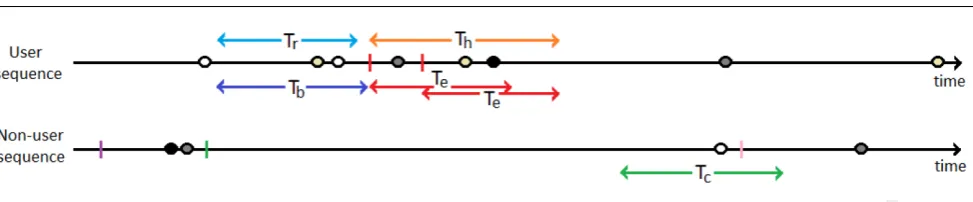
The algorithms apply a case control approach where patients prescribed the drug are referred to as users and patients that have never been prescribed the drug are referred to as non-users. The non-users are used to estimate the background rate that a medical event occurs. When implementing the algorithms the values Te, Tc, Tr, Tb∈Nare input.
Fig. 1 The line represents the THIN data for patient Pat1 with the arrow showing the direction of time and each circle is a day, with red circles representing a prescription of a drug and green circles representing an occurrence of a medical event. To transform this into SRS style data, the drugs are paired with all the medical events that occur within 30 days, so the THIN data represented in this Figure is transformed into seven SRS reports for the Pat1. The SRS style reports consist of four SRS data entries for drug A (Pat1-drug A -medical events 1,Pat1-drug A-medical event 2,Pat1-drug A- medical event 3 and Pat1-drug A-medical event 4) and three SRS data entries for Drug B (Pat1-Drug B-medical event 2, Pat1-Drug B-medical event 3 and Pat1-drug B-medical event 4).
C) is defined as the number of userThconstrained sub-sequences containing the medical event C divided by tot, the supp(A →) is the number of users divided byT totandsupp(→T C) is the number of userThconstrained subsequences that contain the medical eventC divided bytotplus the number of non-userTcconstrained sub-sequences that contain the medical eventC divided by tot. The leverage is calculated as,
Leverage=supp(A→T C)−supp(A→)T ×supp(→T C) (3)
In addition to calculating the standard leverage, a new measure called unexpected-leverage is also calcu-lated. The unexpected-leverage (unexlev) makes use of a user’s history to filter repeated medical events from the users’s Th constrained subsequence as these are ‘predictable’ and unlikely to be ADRs. This is done by investigating a reference period of lengthTrdays start-ing from Tb days prior to the first prescription within the user’s sequence and filtering medical events from the user’s Th subsequence if they occurred during the Trdays in the period prior to the first prescription. An example of determining if an item is ‘predictable’ can be seen in Fig. 3 where three medical eventsC2,C3 andC4 all occur within the Th days after the prescription but the medical eventC2 also occurred within theTrdays prior to the prescription so it is considered to be ‘pre-dictable’ and is filtered, whereas the medical eventsC3 and C4 do not occur within theTr days prior so they are not filtered. Defining supp(A ,→T C) as the num-ber of users who’sThconstrained subsequence contains medical event C but who do not have medical event C within the Trdays prior to the first prescription di-vided by totand supp(,→T C) as the total of the
num-ber of users who’sThconstrained subsequence contains medical eventC but who do not have medical eventC within the Tr days prior to the first prescription plus the number of non-user Tc constrained subsequences that contain the medical eventCall divided bytot, the unexpected leverage is calculated as,
unexlev=supp(A,→T C)−supp(A→)T .supp(,→T C) (4)
MUTARA was designed to calculate the unexpected-leverages for a drug and set of specified medical events. MUTARA then ranks the medical events in descending order of the unexpected-leverage, so the dependency measure used by MUTARA for signalling ADRs is the unexpected-leverage value.
The authors state that MUTARA is prone to thera-peutic failures so HUNT was developed as an improve-ment [12]. HUNT returns medical events in descending order of the ratio between the leverage rank and the unexpected-leverage rank,
RankRatio= event rank based on leverage event rank based on unexpected-leverage
(5)
Fig. 2 Example of a user sequence and a non-user sequence with the time periods illustrated. The red vertical lines in the user sequence corresponds to the point in time that the user is prescribed the drug being investigated, non red vertical lines correspond to prescriptions of other drugs and the circles correspond to medical events, with different colours representing different medical events.
Fig. 3 Example of determining if an event is ‘predictable’ or not within the sequence. If the event occurs in the hazard periodTh and referenceTr period it is ‘predictable’, if it occurs in the hazard period and not the reference period it is not ‘predictable’.
filtered from the Th constrained subsequences, result-ing in the unexpected-leverage beresult-ing lesser than the leverage. Therefore, the rank number of ADRs based on unexpected-leverage will be less than or equal to the rank number based on leverage (as medical events linked to the cause of taking the drug will have moved down the rankings), so the rank ratio will be greater than or equal to 1, whereas medical events linked to the cause of the drug will have an unexpected-leverage rank number greater than or equal to the leverage rank number, so the rank ratio will be less than or equal to 1. It is clear that ADRs will have a higher RankRatio than therapeutic failure medical events.
2.2.3 MUTARA/HUNT Previous Results
MUTARA was applied on the QLDS for older females given alendronate and within the top ten events re-turned by the algorithm was reflux esophagitis, a known ADR. The top two events returned by MUTARA were linked to osteoporosis, the cause of taking the drug and the other events were not listed and assumed to be unlikely to be adverse drug events. This suggests the precision of the top ten events (P(10)) is 0.1 for the algorithm applied to QLDS with a specific strata.
HUNT was applied on the QLDS for the drug al-endronate and the stratum consisting of older females. The results show HUNT returned three known ADRs within the top ten events returned. This corresponds to anP(10) = 0.3. When alendronate was investigated for older males, one known ADR was returned, corre-sponding to anP(10) = 0.1.
2.2.4 Implementation of MUTARA/HUNT in this study
In this study the set of medical events input in MU-TARA and HUNT is the collection of any medical event that occurred within 30 days of a first prescription of the drug being investigated for any patient. The rea-son behind choosing 30 days is for consistency with the other algorithms in this study, enabling a fairer comparison. We did not implement any stratification and the chosen study period was all the records from 1900−2010. The algorithms MUTARA60and HUNT60 referred to in the continuation of this paper were MU-TARA and HUNT implemented with Tc = Te = 30, Tr = Tb = 60 and the algorithms MUTARA180 and HUNT180 referred to in the continuation of this paper were MUTARA and HUNT implemented with Tc = Te = 30, Tr =Tb = 180. We chose not to have a gap between the reference period and date of first prescrip-tion of the drug (Tr=Tb) as preliminary tests indicated this gave better results due to many indicator events occurring a few days prior to prescription.
2.3 TPD Ratio
2.3.1 TPD Ratio Background
Norenet al.developed the Temporal Pattern Discovery (TPD) algorithm based on a measure of disproportion-ality [15]. This method is very similar to the dispropor-tionality methods applied to SRS databases.
[image:6.595.47.534.77.178.2] [image:6.595.53.539.240.277.2]patients and 120 million prescriptions. Similar to the THIN database, the UK IMS Disease Analyzer extracts data directly from general practitioners computers. The OE ratio was implemented on patient records up to 31 December 2005. The database contained 3445 drugs and 5753 medical events encoded by the ICD-10 [26].
2.3.2 TPD algorithms
The TPD algorithm compares the number of patients that have the first prescription of drug x in thirteen months followed by eventy within a set timetrelative to the expected number of patients if drugxand event y were independent. Lettingnt
xy denote the number of patients that have drugxfor the first time (in thirteen months) and event y occurs within time period t, nt.y denote the number of patients that are prescribed any drug for the first time (in thirteen months) and have eventy within time periodt.ntx. denote the number of patients that have drugxfor the first time (in thirteen months) with an active follow up in time periodt and nt..denote the number of patients that have any drug for the first time (in thirteen months) with an active follow up in time period t. The expected number of patients that have drugxand then eventyin a time periodtis then,
Exyt =ntx. nt
.y nt
..
(6)
If for a given drug, the event occurs more than ex-pected, the ratio between the observed and expected will be greater than one. By taking thelog2 of the ra-tio, a positive values suggests an interesting association between a drug and event. Modifying the equation to prevent the problem of rare events or drugs resulting in a small expectation that can cause volatility, a statisti-cal shrinkage method is applied.
IC =log2
nt xy+ 1/2 Et
xy+ 1/2
(7)
The shrinkage adds a bias for theICtowards zero when an event or drug is rare. The credibility intervals for theIC are the logarithm of the solution to Eq. 8 with q= 0.025 andq= 0.975.
Z µq
0 (Et
xy+ 1/2) nt
xy+1/2 Γ(nt
xy+ 1/2)
u(ntxy+1/2)−1e−(n t
xy+1/2)du=q
(8)
The above can find possible drug and event associa-tions of interest for a givent, however, the authors sug-gest that general temporal patterns can be found by comparing the IC of two different time periods. The
follow-up period of primary interest is denoted by u and the control time period by v. This removes event and drug relationships that just happen to occur more in certain sub-populations. The difference between the IC for both time periods is,
log2
nu xy Eu
xy −log2
nv xy Ev
xy
(9)
re-arranging and adding a shrinkage term gives,
IC∆=log2
nu xy+ 1/2 Eu∗
xy+ 1/2
(10)
where
Exyu∗= n v xy Ev
xy
.Exyu (11)
In previous work, Norenet al.setuandvsuch that 30 days after the prescription is contrasted with a time period of 27 to 21 months prior to prescription, this centers the v period around the same time of the year that theuperiod occurs preventing seasonal bias. The TPD calculates theIC∆for each medical event that oc-curs within a month of the drug being investigated for any patient and returns the list of the medical events in descending order of the IC∆ value. In addition to calculating theIC∆, a filter is applied to remove med-ical events with an IC on the day of prescription or the month prior higher than theIC for the time period investigated after the prescription.
2.3.3 TPD Previous Results
The algorithm was applied to the UK IMS Disease An-alyzer database for the drug nifedipine and found seven known ADRs within the top ten non administrative events returned. This corresponds to anP(10) = 0.7.
2.3.4 Implementation of TPD in this study
In this study we implemented the TPD as described in [15], with 30 days after the first prescription in 13 months contrasted with 27 to 21 months prior to pre-scription, but investigated two different filters:
– We apply the TPD and filter medical events with an IC value the month prior to prescription or anIC value on the prescription day greater than the IC value during the month after the prescription (TPD 1).
The justification for choosing two filters is due to the possibility that ADRs can occur and be reported to doctors on the same day as the prescription, so filter-ing events with anIC value on the day of prescription greater than the IC value during the month after the prescription may prevent detection of some ADRs. We can investigate this by implementing both filters and comparing the results.
3 Materials & Methods 3.1 THIN Database
The THIN database contains medical records from par-ticipating general practices within the UK. The data are anonymously extracted directly from the general prac-tice Vision clinical system [10]. THIN then implements validation steps; these are added as extra fields within the tables. The database contains patient information including the year of birth, gender, date of registra-tion and family history of each patient registered at the practice since participation. Any illness, symptom, pro-cedure, laboratory test, diagnosis or other relevant in-formation that a doctor learns about a patient (referred to as a medical event) is recorded along with the cor-responding date. Information regarding any medication prescribed as well as the date of the prescription and the dosage are also included in the database. For this com-parison a database containing records from 495 general practices was used. This subset of the THIN database contained approximately four million patients, over 358 million prescription entries and over 233 million medi-cal event entries.
Each medical event is recorded in the database by a reference code known as a Read code. The Read codes used in the THIN database are an independent system designed specifically for primary care but every ICD-9-CM (International Classification of Diseases, Ninth Edi-tion, Clinical Modification) code (or analogues) have a corresponding Read code [22]. The UK general prac-tice database has a hierarchal event Read code struc-ture. The longer the Read code the greater the detail. For example ‘H32..00’ may represent the event ‘Depres-sion’ whereas ‘H321.00’ may represent ‘Depression due to medication’. The last two elements of the Read code represent events of the same type but described differ-ently for example ‘G1...00’ and ‘G1...01’ may represent ‘had a chat with patient’ and ’had a chin wag with pa-tient’ respectively. Only the first five elements of the Read codes were used in this study and Read codes corresponding to administrative events were ignored as they did not offer any information about ADRs. There
were a total of 90 122 different five element Read codes used in this study.
3.2 Preprocessing the THIN Database
Data miners applying algorithms to EHDs obtained from general practice records need to be careful with newly register patients. As patients can change gen-eral practices at any age, when they register they may have a history of events that a doctor needs to record. The term ‘registration event dropping’ is used when his-toric or previously diagnosed events of newly registered patients are entered into the database. For example, when a new patient first visits their doctor they may inform the doctor of a previously diagnosed chronic ill-ness such as ‘diabetes’. This medical event will then be input into the database with a date corresponding to the visit, rather than the actual date the patient was diagnosed with diabetes. As the dates recored for the ‘registration event drops’ are frequently incorrect, including them in a research study will bias results. Research suggests that ’registration event dropping’ is significantly reduced after a patient is registered for a year. To prevent ’registration event dropping’ biasing the results in this study, the first 12 months of medical history after registration are ignored for each patient as justified in [14].
As patients can move to a different practice at any time (or die), in this study we only include prescrip-tions into the study where the corresponding patient is still active for a minimum of 30 days after. This pre-vents the bias due to ‘under-reporting’ of adverse drug events that may occur if a patient no longer attends the practice. The last date a patient is active is considered to be the maximum date of any record for the patient or the patient’s date of death.
3.3 Drugs
the effect that the attributes (average age, male propor-tion, total number of patients) of the group of patients prescribed each drug have on the algorithm.
The drugs Ibuprofen, Ketoprofen, Fenoprofen and Celecoxib used in this study are all from the same drug family known as non-steroidal anti-inflammatory drugs (NSAIDs). These drugs are typically prescribed for con-tinuous pain associated with inflammation and have a variety of common side effects including gastrointesti-nal disturbances, hypersensitivity reactions and depres-sion. Rarer side effects include congestive heart failure, renal failure and hepatic failure. Elderly patients are more prone to side effects associated with NSAIDs. In this study the the drugs tended to be prescribed sightly more to females with the male proportion ranging from 0.335−0.405 and to older patients, although Ibupro-fen was prescribed to younger patients more than the other NSAID drugs. The NSAID drug prescribed the most was Ibuprofen with over a million first in 13 month prescriptions, whereas Fenoprofen was only prescribed 1225 times for the first time in 13 months, see Table 2. The quinolones are a class of drugs used to treat bac-terial infections such as respiratory track infections and urinary-track infections. Ciprofloxacin, levofloxacin, mox-ifloxacin, nalidixic acid and norfloxacin are drugs from the quinolone family that are investigated in this pa-per. The quinolones have many side effects, including tendon rupture. The average age of the patients pre-scribed the quinolones for the first time in 13 months was similar between all the drugs, around the late fifties. The male proportion shows that females are prescribed quinolones more than males, but this was more obvi-ous for norfloxacin and nalidixic acid. Ciprofloxacin was the most prescribed quinolone and moxifloxacin was the least common, with only 1465 prescriptions. Table 3 shows the information on the drugs from the THIN database.
Tricyclic antidepressant drugs are a family of drugs used to treat depression and are known to cause, among others, cardiovascular and central nervous system side effects. The three drugs, doxepin, lofepramine and nor-triptyline where selected in this paper. The tricyclic antidepressants investigated are prescribed to patients with similar ages and genders and tend to be prescribed more often to older females. The main difference be-tween the drugs is that doxepin is only prescribed to 6752 patients whereas the other two drugs are pre-scribed to more than 10000 patients, see Table 4.
The drugs nifedipine, nicardipine, amlodipine, felodip-ine and verapamil are all calcium channel blocker that are used to treat high blood pressure and raynaud’s phenomenon. It is common for the calcium channel blockers to be prescribed with other drugs and
apply-ing the existapply-ing algorithms to detect side effects on the calcium channel blockers will investigate the effect of confounding due to multiple prescriptions. The drug nifidipine was previously used to investigate the TPD applied to the UK IMA Disease Analyzer, so investigat-ing the calcium channel blockers will also give insight into how robust the TPD is when applied to different electronic healthcare databases. The calcium channel blockers are generally prescribed for the first time in 13 months to patients around 65 years old. Amlodip-ine and nicardipAmlodip-ine are prescribed only slightly more to females than males, whereas the other calcium chan-nel blockers investigated are prescribed even more often to females. Amlodipine and nifedipine have been pre-scribed over 100000 times for the first time in 13 months in the THIN database, but nicardipine has only been prescribed 2796 times, see Table 5.
The sulphonylurea drug family includes tolbutamide, glibenclamide, gliclazide, glimepiride and glipizide. They are a class of antidiabetic drugs used for the manage-ment of type 2 diabetes mellitus. The sulphonylureas are prescribed for the first time in 13 months to older patients will an average age around 65 years old and all the sulphoylureas investigated except tolbutamide are prescribed more often to males, with approximately equal male proportions. Glipizide and tolbutamide are the less frequently prescribed sulphonylurea drugs. The general information about each of the sulphonylurea drugs can be seen in Table 6.
The last drug family is the Penicillin drugs amoxi-cillin, ampiamoxi-cillin, flucloxaamoxi-cillin, benzylpenicillin and phe-noxymethlypenicillin. These drugs are used to treat bac-terial infections. The number of times the drugs are recorded as being prescribed in the THIN database varies between 2000 to over two million. There is also a divergence between the average age of the patients prescribed each of the drugs, with the penicillins gener-ally being prescribed to younger patients than many of the other drugs families investigated in this paper. The male proportion is fairly similar between the different penicillin drugs, with females being prescribed the drug more often than males, see Table 7.
3.4 Comparison Method
Table 2 Information about the NSAID drugs investigated in this paper. Total is the number of times the drug is prescribed for the first time in 13 months, age is the average age of the patients who are prescribed the drug for the first time in 13 months and male proportion is the number of patients that are male divided by the total number of patients who are prescribed the drug for the first time in 13 months.
[image:10.595.117.457.248.311.2]Drug Total TPD MUTARA ROR Age male proportion celecoxib 68036 62946 62100 63416 62.49 0.335 ibuprofen 1178163 1012555 858819 903415 45.56 0.405 ketoprofen 72946 65718 61710 63536 58.17 0.375 fenoprofen 1255 1008 975 1036 56.29 0.404
Table 3 Information about the Quinolone drugs investigated in this paper. Total is the number of times the drug is prescribed for the first time in 13 months, age is the average age of the patients who are prescribed the drug for the first time in 13 months and male proportion is the number of patients that are male divided by the total number of patients who are prescribed the drug for the first time in 13 months.
Drug Total TPD MUTARA ROR Age male proportion ciprofloxacin 280011 250158 227739 235420 55.64 0.440
levofloxacin 7662 7028 6775 6928 60.55 0.43 norfloxacin 14876 13224 12220 12625 56.83 0.262 moxifloxacin 1465 1347 1343 1371 62.09 0.419 nalidixic acid 4273 3646 3620 3787 55.63 0.127
Table 4 Information about the tricyclic drugs investigated in this paper. Total is the number of times the drug is prescribed for the first time in 13 months, age is the average age of the patients who are prescribed the drug for the first time in 13 months and male proportion is the number of patients that are male divided by the total number of patients who are prescribed the drug for the first time in 13 months.
Drug Total TPD MUTARA ROR Age male proportion doxepin 6752 6029 5908 6104 56.69 0.316 lofepramine 45532 38565 37642 39517 51.39 0.285 nortriptyline 11775 10519 10307 10650 54.43 0.286
Table 8 Table illustrating a TP, FP, FN and TN. Listed event means the medical event is listed on the British Na-tional Formulary as a known side effect and non-listed event means it is not listed as a known side effect.
Listed event Non-listed event Signalled True Positive (TP) False Positive (FP) Not Signalled False Negative (FN) True Negative (TN)
health (such as administration events or occupation in-formation). Without this filter the performance of each algorithm was reduced.
3.4.1 Natural threshold based measures
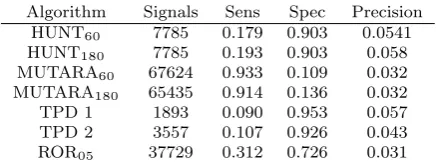
The signalling ability of each algorithm using the natu-ral threshold was investigated by calculating the sensi-tivity and specificity at their natural thresholds (0 for MUTARA/TPD and 1 for ROR) using the values de-scribed in Table 8.
Sensitivity = T P
T P +F N (12)
Specificity = T N
T N+F P (13)
3.4.2 Rank based measures
Each data mining algorithm, as described in section 2, is applied to the THIN database and a ranked list of medical events is returned for each drug investigated. The non filtered medical events are ranked in descend-ing order of the association between the drug of interest and medical event, so medical events the algorithm has deemed more likely to be ADR are ranked higher, an example of this can be seen in Table 9. Each algorithm is then analysed by investigating how well it has ranked each of the known ADRs that have occurred in the re-turned ranked list. The known ADRs are those that are listed in the British National Formulary (BNF) [13] for the specific drug, or medical events described as ‘adverse reaction to drug x’ or containing information about the continuation of the drug prescription.
Table 5 Information about the calcium channel blocker drugs investigated in this paper. Total is the number of times the drug is prescribed for the first time in 13 months, age is the average age of the patients who are prescribed the drug for the first time in 13 months and male proportion is the number of patients that are male divided by the total number of patients who are prescribed the drug for the first time in 13 months.
[image:11.595.124.450.257.320.2]Drug Total TPD MUTARA ROR Age male proportion nifedipine 125491 112715 112499 115823 65.29 0.453 verapamil 24334 22000 21896 22513 65.01 0.405 felodipine 69534 65093 64036 65202 67.46 0.454 amlodipine 270918 251316 249972 254876 66.68 0.494 nicardipine 2796 2510 2511 2593 65.91 0.481
Table 6 Information about the sulphonylurea drugs investigated in this paper. Total is the number of times the drug is prescribed for the first time in 13 months, age is the average age of the patients who are prescribed the drug for the first time in 13 months and male proportion is the number of patients that are male divided by the total number of patients who are prescribed the drug for the first time in 13 months.
Drug Total TPD MUTARA ROR Age male proportion glibenclamide 11874 10356 10377 10768 65.12 0.540
gliclazide 45824 41626 40537 41612 65.02 0.546 glimepiride 10957 10156 9882 10081 64.20 0.534 glipizide 5315 4856 4614 4731 66.50 0.535 tolbutamide 3113 2758 2793 2894 69.40 0.487
Table 7 Information about the penicillin drugs investigated in this paper. Total is the number of times the drug is prescribed for the first time in 13 months, age is the average age of the patients who are prescribed the drug for the first time in 13 months and male proportion is the number of patients that are male divided by the total number of patients who are prescribed the drug for the first time in 13 months.
Drug Total TPD MUTARA ROR Age male proportion amoxicillin 2795759 2321098 1593874 1718875 38.84 0.427 benzylpenicillin 2071 1610 1840 1972 31.79 0.471 flucloxacillin 971174 834017 729967 765428 41.42 0.456 phenoxymethly 55397 45941 45679 48142 29.67 0.396 ampicillin 80655 63458 64827 69381 39.18 0.423
The precision of each method at cutoffK, denoted P(K), is defined as the fraction of known ADRs that occur in the top K events of the list returned by each algorithm for a specific drug, see Eq. (14).
P(K) = PK
i=1y(i)
K (14)
The average precision (AP) is a measure that can be used to determine how well an algorithm generally ranks the medical events associated to a drug. This measure has previously been applied to compare algo-rithms implemented on a different EHD [19].
The AP is calculated by finding the averageP(K) for eachKcorresponding to a known ADR,
AP = P
K:y(K)=1P(K) P
iy(i)
(15)
Using Table 9 as an example, as there are two known ADRs returned (P
iy(i) = 2) and the known ADRs in the table are ranked second and third we have {K : y(K)= 1}={2,3}, so the AP score is,
AP = P(2) +P(3)
2 =
1/2 + 2/3
2 =
7
12 (16)
It was also possible to investigate how well each algorithm ranks the known adverse drug events for a specific drug depending on how common they are. As the BNF states the risk of each known ADR by sepa-rately listing frequently, less frequently and rarely oc-curring known ADRs we also calculated the AP score of each algorithm when only considering rarely occur-ring known ADRs (as unknown ADRs are likely to be rare). So, we calculate the AP scores for two different situations; considering all known ADRs and considering only rarely occurring known ADRs. When considering only the rare ADRs, the known common and less com-mon ADRs are filtered from the list of medical events returned by each algorithm. The reason for filtering the common and less common known ADRs is to prevent their presence causing a low AP score when only con-sidering rare ADRs, as if an algorithm did not filter the common and less common known ADRs and correctly ranks these highly (above the rare ADRs) then the rare ADRs would have a lower rank, which would result in a lower AP score when only considering rare ADRs.
[image:11.595.108.468.377.441.2]Table 9 An example of the medical event list associated to a specific drug and ordered by one of the algorithms. Medical Event Rank Score Known ADR y(i)
Event 1 2.34 No y(1)= 0
Event 5 2.12 Yes y(2)= 1 precision2= 1/2
Event 4 1.75 Yes y(3)= 1 precision3= 2/3
Event 2 1.74 No y(4)= 0
[image:12.595.130.433.197.261.2]Event 3 0.68 No y(5)= 0
Table 10 An example of the medical event list for all the drugs and ordered by one of the algorithms. Drug Medical Event Rank Score Known ADR y(i)
Drug 10 Event 7 2.34 No y(1)= 0
Drug 10 Event 5 2.12 Yes y(2)= 1
Drug 2 Event 56 1.75 Yes y(3)= 1
Drug 9 Event 7 1.74 No y(4)= 0
[image:12.595.52.273.305.389.2]Drug 2 Event 16 0.68 No y(5)= 0
Table 11 The specificity and sensitivity at the natural thresholds for the different algorithms (3dp).
Algorithm Signals Sens Spec Precision HUNT60 7785 0.179 0.903 0.0541
HUNT180 7785 0.193 0.903 0.058
MUTARA60 67624 0.933 0.109 0.032
MUTARA180 65435 0.914 0.136 0.032
TPD 1 1893 0.090 0.953 0.057 TPD 2 3557 0.107 0.926 0.043 ROR05 37729 0.312 0.726 0.031
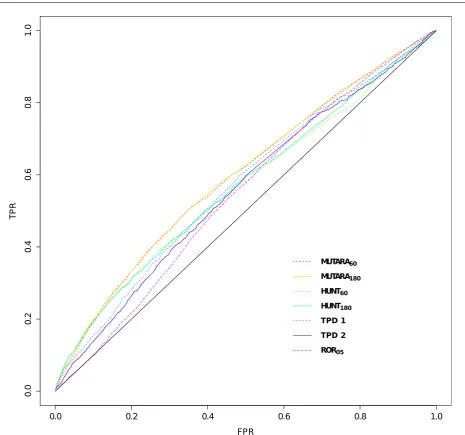
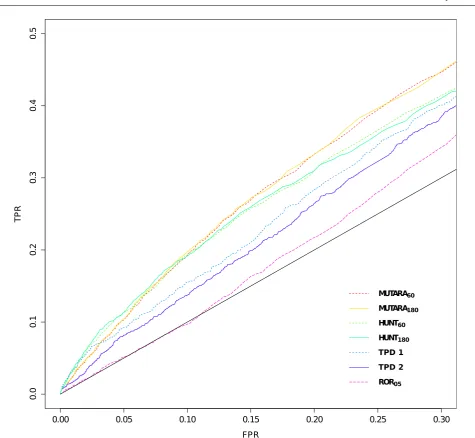
than calculating ranking measures per drug) we also compute ROC plots. The ROC plots were generated by combining all the drug results for each algorithm, as il-lustrated in Table 10 and calculating the sensitivity and specificity for signals generated at a range of signalling thresholds. The ROC curves are formed by plotting the true positive rate (TPR=sensitivity) against the false positive rate (FPR=(1-specificity)). The Area Under the Curve (AUC) was approximated using the trape-zoidal rule for FPR ranging between 0-1, 0-0.3 and 0-0.1 (AU C[0,1],AU C[0,0.3] andAU C[0,0.1] respectively).
4 Results
4.1 Natural Thresholds
Table 11 shows the specificity and sensitivity for the different algorithms at their natural threshold and the number of signals generated. The natural threshold for the ROR and TPD are that their lower confidence in-terval value is greater than 1 and 0 respectively. MU-TARA does not have a lower confidence interval calcu-lation, so the natural threshold implemented is that the unexpected-leverage is greater than 0 and for HUNT the top 10% of medical events were signalled.
Table 12 The AUC results for the different algorithms (3dp).
Algorithm AU C[0,1] AU C[0,0.3] AU C[0,0.1]
HUNT60 0.566 0.072 0.011
HUNT180 0.570 0.071 0.011
MUTARA60 0.596 0.076 0.010
MUTARA180 0.597 0.069 0.010
TPD 1 0.570 0.065 0.009 TPD 2 0.557 0.060 0.007 ROR05 0.546 0.048 0.005
4.2 ROC Analysis
THE AUC[0,1]for the algorithms ranged between 0.546 (ROR05) to 0.597 (MUTARA180), the AUC[0,0.3] for the algorithms ranged between 0.048 (ROR05) to 0.076 (MUTARA60) and AUC[0,0.1]for the algorithms ranged between 0.005 (ROR05) to 0.011 (HUNT180and HUNT60). Fig. 4 and Fig. 5 show the ROC plots for the different algorithms.
4.3 AP
[image:12.595.307.524.306.390.2]0.0 0.2 0.4 0.6 0.8 1.0
0.
0
0.
2
0.
4
0.
6
0.
8
1.
0
FPR
TP
R
MUTARA60
MUTARA180
HUNT60
HUNT180
TPD 1
TPD 2
ROR05
Fig. 4 The ROC plots for the different algorithms over the whole FPR (1-specificity) range. The black line is the line x=y.
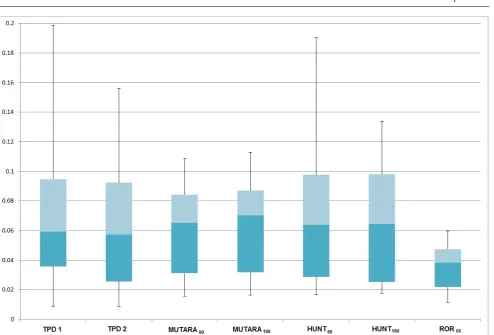
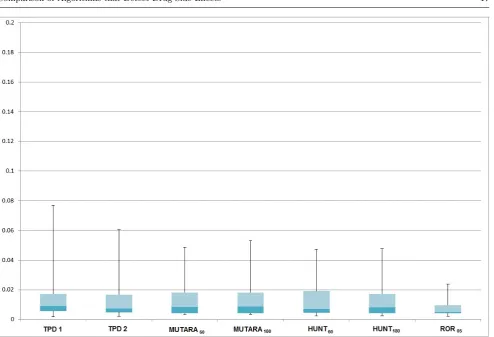
The box plots of the AP scores for the different al-gorithms seen in Fig. 7 show overall the TPDs, MU-TARAs and HUNTs perform equally and outperform the ROR05. The MUTARA algorithm has the highest median AP score over all the drugs and is more consis-tent, whereas the performance of the TPD and HUNT varies more between the drugs. The box plots for the algorithm AP scores when only considering rare known ADRs, see Fig. 8, shows that the algorithms AP scores are lower when ranking rare ADRs, as the maximum AP score for all the algorithms when only considering rare known ADRs was less than 0.08, whereas the max-imum AP scores for all the algorithms when considering all known ADRs was approximately 0.2.
5 Discussion
5.1 Natural Thresholds
[image:13.595.58.524.78.513.2]0.00 0.05 0.10 0.15 0.20 0.25 0.30
0.
0
0.
1
0.
2
0.
3
0.
4
0.
5
FPR
TP
R
MUTARA60
MUTARA180
HUNT60
HUNT180
TPD 1
TPD 2
ROR05
Fig. 5 The ROC plots for the different algorithms over the section of FPR (1-specificity) less than 0.3. The black line is the line x=y.
able to signal the known ADRs without being swamped by false positives.
5.2 ROC Analysis
The existing EHD algorithms can be implemented to return a list of medical events in order of how likely the algorithm has deemed each medical event to be a potential ADR. In effect, the algorithms act as filters where lowly ranked medical events are filtered out and tentative signals are generated for the top n ranked medical events. These tentative signals are investigated further with more stringent statistical analysis required to confirm if they are true signals or not. Therefore, to discover ADRs, the algorithms need to rank medical
events corresponding to ADRs highly and the higher they are ranked the more likely they are to be discov-ered. This shows that AUC[0,0.1] and AUC[0,0.3] give a direct indication into how likely the algorithms will detect ADRs. As the natural threshold’s of the algo-rithms act at different stringencies, the AUC[0,0.1] and AUC[0,0.3] measures offer a fairer comparison between the algorithms.
[image:14.595.53.529.75.513.2]Fig. 6 Bar chart showing the AP scores for all the drugs, with a dashed line separating the different drug families.
5.3 AP
Overall no algorithm consistently outperformed the oth-ers over all the drugs investigated in this study, how-ever, either the TPD 1 or HUNT had the highest AP score for the majority of the drugs studied. The ROR05 generally performed the worse, but still had a higher AP score than the other algorithms for the drug phe-noxymethylpenicillin. As we know the number of times each drug was prescribed, the average age of the pa-tients prescribed each drug and the male proportion of the patients prescribed the drug, we discuss how these factors impacted on the different algorithms below.
5.3.1 Age
The drugs prescribed to the youngest patients were the penicillins. The TPD 1 returned the highest AP score for flucloxacillin, amoxicillin and phenoxymethylpeni-cillin and HUNT60 returned the highest AP score for benzylpenicillin sodium and ampicillin. This is consis-tent with the general results as the TPD 1 and HUNT60 generally had the highest AP score over all the drugs. Although, compared to the other drugs in the study
all the algorithms performed fairly poorly for the peni-cillins suggesting drugs that on average are prescribed to younger patients may require the algorithms to ap-ply stratification techniques rather than apap-plying the algorithms to all ages. This is unfortunate as stratifi-cation is likely to result in an increase in the time it takes to identify an ADR, as the population of patients being prescribed a drug needs to be partitioned by age but there is a lower limit to the patient size required for the algorithms to work accurately.
[image:15.595.44.537.74.411.2]Fig. 7 Box plot showing the median, quartiles and minimum/maximum AP scores for each algorithm applied to all the drugs.
ranking a known ADR highly, whereas the other algo-rithms apply less stringent filters.
5.3.2 Gender Bias
The drugs with the greatest gender bias towards fe-males (prescribed more often to fefe-males) were the drugs norfloxacin, lofepramine , nortriptyline and doxepin with male proportions of 0.26,0.28, 0.29 and 0.32 respec-tively. Apart from lofepramine, MUTARA and HUNT perform much better for the drugs prescribed more to females than males. This may highlight the need for MUTARA and HUNT to be applied to a subset of the patients such as old females or young males as was im-plemented originally for MUTATA and HUNT.
The drugs gliclazide, glibenclamide, glipizide and glimepiride are prescribed more often to males than fe-males with a male proportion of 0.55, 0.54, 0.53 and 0.53 respectively. These drugs had the lowest AP scores compared to all the other drugs investigated and pos-sibly suggests that the algorithms have difficulties de-tecting ADRs for drugs prescribed more often to males. This result is not unexpected as patients taking part in clinical trails are predominately male, so the known ADRs for drugs frequently prescribed to males are more
likely to be rare (otherwise they would be discovered during the clinical trials).
5.3.3 Low Prescription Rates
[image:16.595.45.540.74.409.2]Fig. 8 Box plot showing the median, quartiles and minimum/maximum AP scores for each algorithm when only considering rare known ADRs for all the drugs.
5.4 Detecting rare ADRs
The results show that none of the existing algorithms is able to rank rare ADRs highly and currently the ex-isting algorithms tend to focus on detecting more com-mon ADRs. A possible reason for this with the TPD is because it is more stringent as the calculation is bi-ased to reduce the IC∆ when a medical event is rare, this means that we can be more confident about signals generated by the TPD, but at the cost that rarer ADRs may take longer to be signalled. The reason MUTARA and HUNT struggle to rank rare ADRs highly is likely due to non ADR medical events that are linked to the cause of the drug incorrectly having a high rank and pushing the rare ADRs down the ranked list.
This is an important result as the currently un-known ADRs are either likely to be rare or correspond to medical events with a high background rate, as more obvious ADRs will be discovered during clinical trails or by mining SRS databases.
5.5 Discussion of Existing Algorithms
[image:17.595.45.540.73.410.2]We investigated the two different filters for the TPD and interestingly including the day of prescription into the filter improved the AP scores for the majority of drugs, this suggests that most ADRs are not recorded on the same day as the drug is prescribed. However, for some drugs the TPD 2 outperformed the TPD 1, so using the day of prescription in the filter does occasion-ally prevent the detection of known ADRs. In summary, including the day of prescription into the filter for the TPD generally increases the algorithms precision but at a cost as it can prevent the detection of some ADRs.
5.6 Previous Work and Limitations
The results obtained in this study were consistent with previous results as theP(10) for MUTARA and HUNT averaged 0.065 and 0.122 respectively in this study and were 0.1 and 0.1−0.3 respectively in previous work [11][12]. The P(10) for the TPD method applied to Nifedipine in this study was 0.7, the same as on the UK IMS Disease Analyzer database [15]. However, there was deviation between the AP score of the ROR05 in this study (0.01−0.06) and in the study by Zorychet al.[28] (0.1-0.15), this is probably due to this study us-ing real data with redundant Read codes and Zorychet al.using simulated data.
One limitation with this study is that there is no ‘gold standard’ for ADR detection and it is impossi-ble to calculate the true sensitivity, specificity and AP scores of the algorithms as the complete set of ADRs for each drug is unknown and the algorithms may cor-rectly rank an unknown ADR highly but this would lower the sensitivity, specificity and AP values in this study due to the event not being listed by the BNF as a known ADR. However, the algorithms should be able to correctly rank the known ADRs and these are likely to be more common and obvious, so if the algorithm is unable to correctly rank these above noise events then it is unlikely to identify the unknown ADRs, so the AP scores determined in this study still give insight into the algorithms abilities to detect ADRs. The redundancy in the Read Codes may also result in biased results as similar medical events with different Read Codes may get ranked closely and push down the ranks of known ADR, so the algorithms may have higher AP scores if there was a way to group Read Codes corresponding to the same medical event.
6 Conclusions
In this paper we compared four existing ADR detect-ing algorithms by applydetect-ing them to the THIN
data-base for a range of drugs and measured how well they ranked the known ADRs or signal known ADRs at their natural thresholds. We have determine that the bench-mark AP score for ADRs signalling algorithms applied to the THIN database is 0.2, the benchmark AUC[0,0.1] is 0.011 (3dp) and AUC[0,0.3] is 0.076 (3dp). Future al-gorithms should aim for higher scores. The results show that no algorithm was superior for all the drugs consid-ered, although the results do indicate that HUNT may be the optimal algorithm to apply when the number of patients prescribed the drug is low or the TPD may be optimal when the patients are old, however further research needs to be conducted to confirm these hy-potheses. However, in many situations at present, the tentative ADR signals should be generated based on how the medical events are ranked by all the different algorithms rather than relying on one algorithm alone. The results also clearly show that the existing algo-rithms are not capable of detecting rare ADRs, but one of the potential advantages of mining the THIN data-base compared with mining the SRS datadata-bases it the ability to detect rare ADRs that are under-reported in SRS databases. For example, some rare but fatal ADRs might never be noticed and reported into an SRS data-base and would therefore be undetectable by mining SRS databases.
Future work could focus on developing new filters that are able to remove the medical events that are re-lated to the cause of taking the drug but do not occur before the drug is prescribed, such as illness progression events. This would then reduce the number of false pos-itive associations that are returned by the algorithms. Future work should also address the limitations of this study by developing a way to cluster the Read codes and reduce their redundancy.
References
1. Almenoff, J., Tonning, J.M., Gould, A.L., et al: Perspec-tives on the use of data mining in pharmacovigilance. Drug Saf 28(11), 981–1007 (2005)
2. Alvarez-Requejo, A., Carvajal, A., Begaud, B., et al: Under-reporting of adverse drug reactions- estimate based on a spontaneous reporting scheme and a sentinel system. Eur J Clin Pharmacol 54(6), 483–488 (1998) 3. Bate, A., Lindquist, M., Edwards, I.R., et al: A bayesian
neural network method for adverse drug reaction signal generation. Eur J Clin Pharmacol 54, 315–321 (1998) 4. Behrman, R.E., Benner, J.S., Brown, J.S., et al:
Develop-ing the sentinel system - a national resource for evidence development. N Engl J Med 364, 498–499 (2011) 5. Brown, J.S., Kulldorff, M., Chan, A., et al: Early
for large-scale drug safety monitoring: the eu-adr project. Pharmacoepidemiol Drug Saf 20, 1–11 (2011)
7. Curtis, J.R., Cheng, H., Delzell, E., et al: Adaptation of bayesian data mining algorithms to longitudinal claims data: coxib safety as an example.Med Care 46, 969–975 (2008)
8. DuMouchel, W.: Bayesian data mining in large frequency tables, with an application to the FDA spontaneous reporting systemt. Amer Statistician 53(3), 177–190 (1999)
9. Evans, S.J.W., Waller, P.C., Davis, S.: Use of propor-tional reporting ratios (PRRs) for signal generation from spontaneous adverse drug reaction reports. Pharma-coepidemiol and Drug Saf10(6), 483–486 (2001) 10. INPS, A Cegedim Company: Welcome to inps,
http://www.inps4.co.uk/ (2011, accessed 25 jan 2012) 11. Jin, H., Chen, J., Kelman, C., et al: Mining unexpected
associations for signalling potential adverse drug reac-tions from administrative health databases.PAKDDpp. 867–876 (2006)
12. Jin, H.W., Chen, J., He, H., et al: Signaling poten-tial adverse drug reactions from administrative health databases. IEEE Trans Knowl Data Eng 22(6), 839– 853 (2010)
13. Joint Formulary Committee . British National Formu-lary: 62 ed. London: BMJ Group and Pharmaceutical Press (2011)
14. Lewis, J.D., Bilker, W.B., Weinstein, R.B., Strom, B.L.: The relationship between time since registration and measured incidence rates in the general practice research database. Pharmacoepidemiol Drug Saf14(7), 443–451 (2005)
15. Noren, G.N., Hopstadius, J., Bate, A., et al: Temp-oral pattern discovery in longitudinal electronic patients records. Data Min Knowl Disc20, 361–387 (2010) 16. Piromohamed, M., James, S., Meakin, S., et al: Adverse
drug reactions as cause of admission to hospital: prospec-tive analysis of 18820 patients. Br Med J 329, 15–19 (2004)
17. van Puijenbroek, E.P., Bate, A., Leufkens, H.G.M., et al: A comparison of measures of disproportionality for signal detection in spontaneous reporting systems for adverse drug reactions. Pharmacoepidemiol Drug Saf 11(1), 3– 10 (2002)
18. Rosenberg, L., Coogan, P., Palmer, J.: Case-Control Sur-veillance, in Pharmacoepidemiology, fourth edition (ed b. l. strom) edn. John Wiley & Sons, Chichester, UK (2007) 19. Ryan, P.B., Madigan, D., Stang, P.E., Overhage, J.M., Racoosin, J.A., G.Hartzema, A.: Empirical assessment of methods for risk identification in healthcare data: Results from the experiments of the observational medical out-comes partnership. Statist. Med.31, 4401–4415 (2012) 20. Ryan, P.B., Powell, G., Pattishall, E., Beach, K.:
Perfor-mance of screening multiple observational databases for active drug safety surveillance. International Society of Pharmacoepidermiology:Providence,RI,USA, (2009) 21. Schuemie, M.J., Coloma, P.M., Straatman, H., Herings,
R.M.C., Trifir, G., Matthews, J.N., Prieto-Merino, D., Molokhia, M., Gini, L.P.R., Innocent, F., Mazzaglia, G., Picelli, G., Scotti, L., van der Lei, J., Sturkenboom, M.C.J.M.: Using electronic health care records for drug safety signal detection: A comparative evaluation of sta-tistical methods. Medical Care.50(10, 890–897 (2012) 22. Shephard, E., Stapley, S., Hamilton, W.: The use of
elec-tronic databases in primary care research. Fam Pract
28(4), 352–354 (2011). DOI 10.1093/fampra/cmr039
23. Story, N.L.: Sexual dysfunction resulting from drug side effects. J Sex Res10(2), 132–149 (1974)
24. WHO Collaborating Centre for Drug Statistics Method-ology: ATC classification index with DDDs, 2013. Oslo (2012)
25. Wilke, R.A., Xu, H., Denny, J.C., et al: The emerging role of electronic medical records in pharmacogenomics. Int J Clin Pharmacol Ther89(3), 379–386 (2001) 26. World Health Organization: International Statistical
Classification of Diseases and Related Health Problems (The) ICD-10. 2010 Edition. Nonserial Publications (2011)
27. Zhou, X., Murugesan, S., Bhullar, H., Liu, Q., Cai, B., Wentworth, C., Bate, A.: An evaluation of the thin data-base in the omop common data model for active drug safety surveillance. Drug Saf36, 119–134 (2013) 28. Zorych, I., Madigan, D., Ryan, P., et al: