1
The Evolution of Self-Control 2
Evan L. MacLean, Brian Hare, Charles L. Nunn, Elsa Addessi, Federica Amici, Rindy C. 3
Anderson, Filippo Aureli, Joseph M. Baker, Amanda E. Bania, Allison M. Barnard, Neeltje J. 4
Boogert, Elizabeth M. Brannon, Emily E. Bray, Joel Bray, Lauren J. N. Brent, Judith M. Burkart, 5
Josep Call, Jessica F. Cantlon, Lucy G. Cheke, Nicola S. Clayton, Mikel M. Delgado, Louis J. 6
DiVincenti, Kazuo Fujita, Esther Herrmann, Chihiro Hiramatsu, Lucia F. Jacobs, Kerry E. Jordan, 7
Jennifer R. Laude, Kristin L. Leimgruber, Emily J. E. Messer, Antonio C. de A. Moura, Ljerka 8
Ostojić, Alejandra Picard, Michael L. Platt, Joshua M. Plotnik, Friederike Range, Simon M. 9
Reader, Rachna B. Reddy, Aaron A. Sandel, Laurie R. Santos, Katrin Schumann, Amanda M. 1 0
Seed, Kendra B. Sewall, Rachael C. Shaw, Katie E Slocombe, Yanjie Su, Ayaka Takimoto, 1 1
Jingzhi Tan, Ruoting Tao, Carel P. van Schaik, Zsófia Virányi, Elisabetta Visalberghi, Jordan C. 1 2
Wade, Arii Watanabe, Jane Widness, Julie Young, Thomas R. Zentall, Yini Zhao 1 3
1 4
Classification: Biological Sciences – Psychological and Cognitive Sciences 1 5
Short title: The Evolution of Self-Control 1 6
1 7
Address for Correspondence: 1 8
Evan MacLean 1 9
Duke University 20
Evolutionary Anthropology, Box 90383 Biological Sciences 21
Durham, NC 27708, United States 22
E-mail:[email protected] 23
Phone: 919-660-7290 24
Abstract 26
Cognition presents evolutionary research with one of its greatest challenges. Cognitive 27
evolution has been explained at the proximate level by shifts in absolute and relative 28
brain volume and at the ultimate level by differences in social and dietary complexity. 29
However, no study has integrated the experimental and phylogenetic approach at the 3 0
scale required to rigorously test these explanations. Instead, previous research has largely 3 1
relied on various measures of brain size as proxies for cognitive abilities. We 3 2
experimentally evaluated these major evolutionary explanations by quantitatively 3 3
comparing the cognitive performance of 567 individuals representing 36 species on two 3 4
problem-solving tasks measuring self-control. Phylogenetic analysis revealed that 3 5
absolutebrain volume best predicted performance across species and accounted for 3 6
considerably more variance than brain volume controlling for body mass. This result 3 7
corroborates recent advances in evolutionary neurobiology and illustrates the cognitive 3 8
consequences of cortical reorganization through increases in brain volume. Within 3 9
primates, dietary breadth but not social group size was a strong predictor of species 4 0
differences in self-control. Our results implicate robust evolutionary relationships 4 1
between dietary breadth, absolute brain volume, and self-control. These findings provide 4 2
a significant first step toward quantifying the primate cognitive phenome and explaining 4 3
Significance Statement 4 5
Although scientists have identified surprising cognitive flexibility in animals and 4 6
potentially unique features of human psychology, we know less about the selective forces 4 7
that favor cognitive evolution, or the proximate biological mechanisms underlying this 4 8
process. We tested 36 species in two problem solving tasks measuring self-control and 4 9
evaluated the leading hypotheses regarding how and why cognition evolves. Across 50
species, differences in absolute (not relative) brain volume best-predicted performance on 51
these tasks. Within primates, dietary breadth also predicted cognitive performance, 52
whereas social group size did not. These results suggest that increases in absolute brain 53
size provided the biological foundation for evolutionary increases in self-control, and 54
implicate species differences in feeding ecology as a potential selective pressure favoring 55
these skills. 56
57
58
59
60
Introduction 62
Since Darwin, understanding the evolution of cognition has been widely regarded as one 63
of the greatest challenges for evolutionary research (1). Although researchers have 64
identified surprising cognitive flexibility in a range of species (2-40) and potentially 65
derived features of human psychology (41-61), we know much less about the major 66
forces shaping cognitive evolution (62-71). With the notable exception of Bitterman’s 67
landmark studies conducted several decades ago (63, 72-74), most research comparing 68
cognition across species has been limited to small taxonomic samples (70, 75). With 69
limited comparable experimental data on how cognition varies across species, previous 7 0
research has largely relied on proxies for cognition (e.g. brain size) or meta-analyses 7 1
when testing hypotheses about cognitive evolution (76-92). The lack of cognitive data 7 2
collected with similar methods across large samples of species precludes meaningful 7 3
species comparisons that can reveal the major forces shaping cognitive evolution across 7 4
species, including humans (48, 70, 89, 93-98). 7 5
To address these challenges we measured cognitive skills for self-control in 36 7 6
species of mammals and birds (Fig 1) tested using the same experimental procedures, and 7 7
evaluated the leading hypotheses for the neuroanatomical underpinnings and ecological 7 8
drivers of variance in animal cognition. At the proximate level, both absolute (77, 99-7 9
107) and relative brain size (108-112) have been proposed as mechanisms supporting 8 0
cognitive evolution. Evolutionary increases in brain size (both absolute and relative) and 8 1
cortical reorganization are hallmarks of the human lineage and are believed to index 8 2
commensurate changes in cognitive abilities (52, 105, 113-115). Further, given the high 8 3
species (108, 122), it is expected that the energetic costs of large brains are offset by the 8 5
advantages of improved cognition. Thecortical reorganization hypothesis suggests that 8 6
selection for absolutely larger brains – and concomitant cortical reorganization – was the 8 7
predominant mechanism supporting cognitive evolution (77, 91, 100-106, 120). In 8 8
contrast, the encephalization hypothesis argues that an increase in brain volume relative 8 9
to body size was of primary importance (108, 110, 111, 123). Both of these hypotheses 90
have received support through analyses aggregating data from published studies of 91
primate cognition and reports of ‘intelligent’ behavior in nature – both of which correlate 92
with measures of brain size (76, 77, 84, 92, 110, 124). 93
With respect to selective pressures, both social and dietary complexity have been 94
proposed as ultimate causes of cognitive evolution. The social intelligence hypothesis 95
proposes that increased social complexity (frequently indexed by social group size) was 96
the major selective pressure in primate cognitive evolution (6, 44, 48, 50, 87, 115, 120, 97
125-141). This hypothesis is supported by studies showing a positive correlation 98
between a species’ typical group size and neocortex ratio (80, 81, 85-87, 129, 142-146), 99
cognitive differences between closely related species with different group sizes (130, 137, 1 00
147, 148), and evidence for cognitive convergence between highly social species (26, 31, 1 01
149-151). The foraging hypothesis posits that dietary complexity, indexed by field 1 02
reports of dietary breadth and reliance on fruit – a spatiotemporally distributed resource – 1 03
was the primary driver of primate cognitive evolution (152-155). This hypothesis is 1 04
supported by studies linking diet quality and brain size in primates (79, 81, 86, 142, 156), 1 05
and experimental studies documenting species differences in cognition that relate to 1 06
While each of these hypotheses has received empirical support, a comparison of 1 08
the relative contributions of the different proximate and ultimate explanations requires: 1 09
(i) a cognitive dataset covering a large number of species tested using comparable 1 1 0
experimental procedures; (ii) cognitive tasks that allow valid measurement across a range 1 1 1
of species with differing morphology, perception and temperament; (iii) a representative 1 1 2
sample within each species to obtain accurate estimates of species-typical cognition; (iv) 1 1 3
phylogenetic comparative methods appropriate for testing evolutionary hypotheses; and 1 1 4
(v) unprecedented collaboration to collect these data from populations of animals around 1 1 5
the world (70). 1 1 6
Here, we present the first large-scale collaborative dataset and comparative 1 1 7
analysis of this kind, focusing on the evolution of control. We chose to measure self-1 self-1 8
control – the ability to inhibit a prepotent but ultimately counterproductive behavior – 1 1 9
because it is a crucial and well-studied component of executive function and is involved 1 20
in diverse decision-making processes (168-170).For example, animals require self-1 2self-1
control when avoiding feeding or mating in view of a higher-ranking individual, sharing 1 22
food with kin, or searching for food in a new area rather than a previously rewarding 1 23
foraging site. In humans, self-control has been linked to health, economic, social, and 1 24
academic achievement, and is known to be heritable (171-173). In song sparrows, a 1 25
study using one of the tasks reported here found a correlation between self-control and 1 26
song repertoire size, a predictor of fitness in this species (174). In primates, performance 1 27
on a series of nonsocial self-control control tasks was related to variability in social 1 28
tasks that quantify self-control are ideal for comparison across taxa given these robust 1 3 0
behavioral correlates, heritable basis, and potential impact on reproductive success. 1 3 1
In this study we tested subjects on two previously implemented self-control tasks. 1 3 2
In the A not B task (27 species, N = 344), subjects were first familiarized with finding 1 3 3
food in one location (container A) for three consecutive trials. In the test trial, subjects 1 3 4
initially saw the food hidden in the same location (container A), but then moved to a new 1 3 5
location (container B) before they were allowed to search (Movie S1). In the cylinder 1 3 6
task (32 species, N = 439), subjects were first familiarized with finding a piece of food 1 3 7
hidden inside an opaque cylinder. In the following ten test trials, a transparent cylinder 1 3 8
was substituted for the opaque cylinder. To successfully retrieve the food, subjects 1 3 9
needed to inhibit the impulse to reach for the food directly (bumping into the cylinder) in 1 4 0
favor of the detour response they had used during the familiarization phase (Movie S2). 1 4 1
Thus, the test trials in both tasks required subjects to inhibit a prepotent motor 1 4 2
response (searching in the previously rewarded location or reaching directly for the 1 4 3
visible food), but the nature of the correct response varied between tasks. Specifically, in 1 4 4
the A not B task subjects were required to inhibit the response that was previously 1 4 5
successful (searching in location A) whereas in the cylinder task subjects were required 1 4 6
to perform the same response as in familiarization trials (detour response), but in the 1 4 7
context of novel task demands (visible food directly in front of the subject). 1 4 8
Results 1 4 9
Across species and accounting for phylogeny, performance on the two tasks was strongly 1 50
correlated (R = 0.53, N = 23, p < 0.01). Thus, species (n = 23) that participated in both 1 51
Because the two tasks assessed complementary but not identical abilities, the composite 1 53
score serves as a general index of self-control across tasks. Phylogenetic analyses 1 54
revealed that scores were more similar among closely related species, with the maximum 1 55
likelihood estimate of – a measure of phylogenetic signal – significantly greater than 1 56
zero in most cases (Table 1). For both tasks, scores from multiple populations of the same 1 57
species (collected by different researchers at different sites) were highly correlated 1 58
(cylinder task: r = 0.95, n = 5, p = 0.01; A not B task: r = 0.87, n = 6, p = 0.03; see SI). 1 59
To control for the non-independence of species level data, we used phylogenetic 1 60
generalized least squares (PGLS) to test the association between performance on the 1 61
cognitive tasks and the explanatory variables associated with each hypothesis. Our 1 62
neuroanatomical predictors included measures of absolute brain volume (endocranial 1 63
volume [ECV]), residual brain volume (residuals from a phylogenetic regression of ECV 1 64
predicted by body mass [ECV residuals]) and Jerrison’s (108) encephalization quotient 1 65
(EQ; see Methods). 1 66
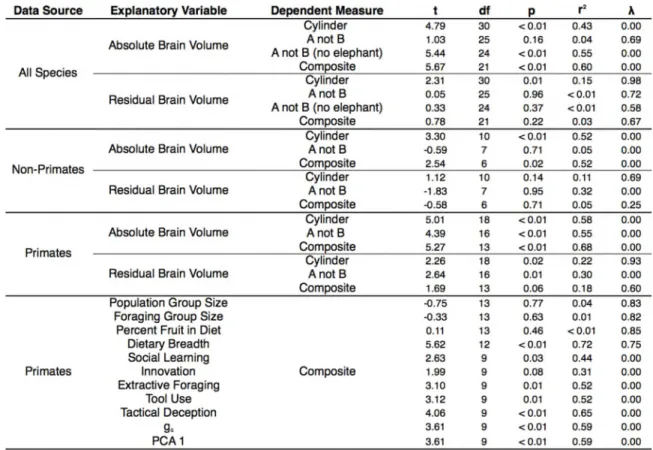
Across species, absolute brain volume (measured as ECV) was a robust predictor 1 67
of performance (Fig 2; Table 2) supporting the predictions of the cortical reorganization 1 68
hypothesis. ECV covaried positively with performance on the cylinder task and the 1 69
composite score and explained substantial variance in performance (r2= 0.43-0.60; Table 1 7 0
2). This association was much weaker for the A not B task, reflecting that the largest-1 7 largest-1
brained species (Asian elephant) had the lowest score on this measure (Fig 2; Table 2). 1 7 2
The same analysis excluding the elephant yielded a strong and significant positive 1 7 3
association between ECV and scores on the A not B task (Fig 2; Table 2). Across the 1 7 4
explained only 3% of variance in composite scores, and was a significant predictor of 1 7 6
performance in only one of the tasks (Table 2; SI; Fig 2). EQ was positively related to 1 7 7
composite scores across species (β = 0.28, t21 = 3.23, p < 0.01, λ = 0, r2= 0.33) but again 1 7 8
explained far less variance than absolute brain volume. 1 7 9
We conducted the same analyses using only primates (23 species, 309 subjects), 1 8 0
the best-represented taxonomic group in our dataset. Within primates, absolute brain 1 8 1
volume was the best predictor of performance across tasks and explained substantial 1 8 2
variation across species (r2= 0.55-0.68; Fig 3; Table 2). In contrast to the analysis across 1 8 3
all species, residual brain volume was predictive of performance on both tasks within 1 8 4
primates, although it explained much less variance than absolute brain volume (r2= 0.18-1 8 5
0.30; Fig 3; Table 2). Within primates the analysis using EQ as a predictor of composite 1 8 6
scores was similar to that using ECV residuals (β = 0.24, t13 = 1.65, p = 0.06, λ = 0.66, r2 1 8 7
= 0.17). 1 8 8
We also restricted the analyses to only the non-primate species in our sample (13 1 8 9
species, 258 subjects). Within the non-primate species, ECV was again the best predictor 1 90
of self-control, and was significantly and positively associated with composite scores and 1 91
scores on the cylinder task, but not the A not B task (Table 2). Removing the Asian 1 92
elephant from the analysis of the A not B task did not change this result (β = 0.09, t6 = 1 93
1.37, p = 0.11, λ = 0, r2= 0.24). Residual brain volume was not a significant predictor of 1 94
any of these measures (Table 2), and EQ was unrelated to composite scores (β = -.01, t6= 1 95
-0.08, p = 0.53, λ = 0.28, r2< 0.01). 1 96
We used the experimentally derived measures of self-control to investigate the 1 97
cognitive evolution. We focused on primates because these species are best represented 1 99
in our dataset, and the ecological data have been systematically compiled and related to 200
neuroanatomical proxies for cognition in these species. As a measure of social 201
complexity, we tested the hypothesis that social group size, which covaries with 202
neocortex ratio in anthropoid primates (129), would predict performance in the self-203
control tasks. To explore multiple variants of this hypothesis, we investigated both 204
species-typical population group size and foraging group size as predictor variables. 205
Neither measure of group size was associated with task performance (Fig 3; Table 2; 206
Table S7), echoing findings using observational data on behavioral flexibility (92). We 207
tested the foraging hypotheses by examining whether the degree of frugivory (% fruit in 208
diet) or dietary breadth (number of dietary categories reported to have been consumed by 209
each species (92)) predicts performance. The percent of fruit in a species’ diet was not a 21 0
significant predictor of any of the cognitive measures (Fig 3; Table 2; Table S7). 21 1
However, dietary breadth covaried strongly with our measures of self-control (Fig 3; 21 2
Table 2; Table S7). Supplemental analyses involving home range size, day journey length, 21 3
the defensibility index, and substrate use revealed no significant associations (SI). 21 4
To provide an integrated test of variance explained by absolute brain volume and 21 5
dietary breadth, we fit a multiple regression including both terms as predictors of 21 6
primates’ composite cognitive scores. This model explained 80% of variance in 21 7
performance between species with significant and positive coefficients for both absolute 21 8
ECV and diet breadth, controlling for the effects of one another (ECV: t11 = 2.10, p = 21 9
0.03; diet breadth: t11 = 4.05, p < 0.01; λ = 0.56, r2= 0.80). Thus, while correlated with 220
complexity account for unique components of variance in primate cognition, together 222
explaining the majority of interspecific variation on these tasks. Interestingly, in this 223
model the independent effect for dietary breadth (r2=0.59) was considerably larger than 224
that for brain volume (r2= 0.28). 225
We also assessed the extent to which our experimental data corroborate species-226
specific reports of intelligent behavior in nature (92). Controlling for observational 227
research effort, our experimental measures covaried positively with reports of innovation, 228
extractive foraging, tool use, social learning, and tactical deception in primates (Table 2; 229
Table S7; SI). Our experimental measure also covaried with a ‘general intelligence’ 23 0
factor ‘gs’ (92) derived from these observational measures (Table 2; Table S7; SI). 23 1
Lastly, we used data from the extant species in our dataset to reconstruct 23 2
estimated ancestral states in the primate phylogeny. Maximum likelihood reconstruction 23 3
of ancestral states implies gradual cognitive evolution in the lineage leading to apes, with 23 4
a convergence between apes and capuchin monkeys (Fig 4; SI). Thus, in addition to 23 5
statistical inferences about ancestral species, this model reveals branches in the 23 6
phylogeny associated with rapid evolutionary change, convergence and divergence, and 23 7
the historical contexts in which these events occurred. 23 8
Discussion 23 9
Our phylogenetic comparison of three-dozen species supports the hypothesis that 24 0
the major proximate mechanism underlying the evolution of self-control is increases in 24 1
absolute brain volume. Our findings also implicate dietary breadth as an important 24 2
ecological correlate, and potential selective pressure for the evolution of these skills. In 24 3
unrelated – to variance in self-control. The weaker relationship with residual brain 24 5
volume and lack of relationship with social group size is particularly surprising given the 24 6
common use of relative brain volume as a proxy for cognition and historical emphasis on 24 7
increases in social group size as a likely driver of primate cognitive evolution (85). 24 8
Why might absolutely larger brains confer greater cognitive advantages than 24 9
relatively larger brains? One possibility is that as brains get absolutely larger, the total 250
number of neurons increases, and brains tend to become more modularized, perhaps 251
facilitating the evolution of new cognitive networks (91, 101, 102). Indeed, recent data 252
suggest that human brains are notable mainly for their absolute volume, and otherwise 253
conform to the (re)organizational expectations for a primate brain of their volume (100, 254
104-107, 176, 177). Due to limited comparative data on more detailed aspects of 255
neuroanatomy (e.g. neuron counts, regional volumes, functional connectivity) our 256
analyses were restricted to measures derived from whole brain volumes. However, an 257
important question for future research will be whether finer measures of the 258
neuroanatomical substrates involved in regulating self-control (e.g. prefrontal cortex) 259
explain additional variation in cognition across species. For example, the best performing 260
species in our sample were predominantly anthropoid primates, species that have evolved 261
unique prefrontal areas that are thought to provide a cognitive advantage in foraging 262
decisions that rely on executive function (178-180). Nonetheless, other species without 263
these neuroanatomical specializations also performed well, raising the possibility that the 264
cognitive skills required for success in these tasks may be subserved by diverse but 265
functionally similar neural mechanisms across species (e.g., 181). Thus, while 266
cognitive networks, more detailed data from the fields of comparative and behavioral 268
neuroscience will be essential for understanding the biological basis of species 269
differences in cognition (e.g., (182-185)). 27 0
Within primates we also discovered that dietary breadth is strongly related to 27 1
levels of self-control. One plausible ultimate explanation is that individuals with the most 27 2
cognitive flexibility may be most likely to explore and exploit new dietary resources or 27 3
methods of food acquisition, which would be especially important in times of scarcity. If 27 4
these behaviors conferred fitness benefits, selection for these traits in particular lineages 27 5
may have been an important factor in the evolution of species differences in self-control. 27 6
A second possibility is that dietary breadth represents an ecological constraint on brain 27 7
evolution, rather than a selective pressure per se (116, 156, 186, 187). Accordingly, 27 8
species with broad diets may be most capable of meeting the metabolic demands of 27 9
growing and maintaining larger brains, with brain enlargement favored through a range 28 0
of ecological selective pressures (86). Nonetheless, after accounting for shared variance 28 1
between dietary breadth and brain volume, dietary breadth was still strongly associated 28 2
with performance on self-control tasks. Thus, it is likely that dietary breadth acts both as 28 3
a selective pressure and a metabolic facilitator of cognitive evolution. Given that foraging 28 4
strategies have also been linked to species differences in cognition in non-primate taxa 28 5
(94, 157-160, 162, 163, 167), it remains an important question whether dietary breadth 28 6
will have similar explanatory power in other orders of animals. 28 7
The data reported here likely represent relatively accurate estimates of species-28 8
typical cognition because we collected data from large samples within each species 28 9
populations of the same species were highly correlated, and performance was not 291
associated with previous experience in cognitive tasks (SI). Thus, while populations may 292
vary to some extent (e.g. due to differences in rearing history or experimental experience), 293
these differences are small relative to the interspecific variation we observed. The 294
relationship between our experimental measures of self-control and observational 295
measures of behavioral flexibility also suggest that our measures have high ecological 296
validity, and underscore the complementary roles of observational and experimental 297
approaches for the study of comparative cognition. 298
Our tasks could be flexibly applied with a range of species because all species we 299
tested exhibited the perceptual, motivational, and motoric requirements for participation. 3 00
Thus, despite the fact that these species may vary in their reliance on vision, visual acuity, 3 01
or motivation for food rewards, all species met the same pretest criteria, assuring similar 3 02
proficiency with basic task demands before being tested. Nonetheless, in any comparative 3 03
cognitive test it is possible that features of individual tasks are more appropriate for some 3 04
species than others. One mechanism to overcome this challenge is through the approach 3 05
implemented here, in which (i) multiple tasks designed to measure the same underlying 3 06
construct are used, (ii) the correlation between tasks is assessed across species, and (iii) a 3 07
composite score averaging performance across tasks is used as the primary dependent 3 08
measure. In cases where data are limited to a single measure from a species, the results 3 09
must be interpreted extremely cautiously (e.g. performance of the Asian elephant on the 3 1 0
A not B task). 3 1 1
The relationship between self-control and absolute brain volume is unlikely to be 3 1 2
a comparison of models using only body mass or ECV as the predictor of composite 3 1 4
scores yielded stronger support for the ECV model both in an analysis across all species 3 1 5
(∆AIC = 0.77), and within primates (∆AIC= 3.12). However, it is only within primates that 3 1 6
the change in AIC between the body mass and ECV models exceeded the 2-unit 3 1 7
convention for meaningful difference (188). Second, the number of neurons in primate 3 1 8
brains scales isometrically with brain size, indicating selection for constant neural density 3 1 9
and neuron size, a scaling relationship that contrasts with other orders of animals (100). 3 20
Thus, the relationship between absolute brain volume and self-control may be most 3 21
pronounced in the primate species in our sample, and may not generalize to all other 3 22
large-brained animals (e.g. whales, elephants), or taxa whose brains are organized 3 23
differently than primates (e.g. birds). Nonetheless, even when removing primate species 3 24
from the analysis, absolute brain volume remained the strongest predictor of species 3 25
differences in self-control. Third, ancestral state reconstructions indicate that both 3 26
absolute and relative brain volume have increased over time in primates, while body mass 3 27
has not (189). Lastly, although not as predictive as absolute brain volume, residual brain 3 28
volume was a significant predictor of self-control in several of our analyses. Thus, 3 29
multiple lines of evidence implicate selection for brain volume (and organization) 3 3 0
independent of selection for body size, and our data illustrate the cognitive consequences 3 3 1
of these evolutionary trends. 3 3 2
With the exception of dietary breadth we found no significant relationships 3 3 3
between several socioecological variables and measures of self-control. These findings 3 3 4
are especially surprising given that both the percentage of fruit in the diet and social 3 3 5
findings suggest that the effect of social and ecological complexity may be limited to 3 3 7
influencing more specialized, and potentially domain-specific forms of cognition (190-3 (190-3 8
198). For example, among lemurs, sensitivity to cues of visual attention used to 3 3 9
outcompete others for food covaries positively with social group size, while a nonsocial 3 4 0
measure of self-control does not (147). Therefore, our ability to evaluate the predicted 3 4 1
relationships between socioecology and cognition will depend on measures designed to 3 4 2
assess skills in specific cognitive domains (e.g. visual perspective-taking or spatial 3 4 3
memory). In addition, more nuanced measures of social and ecological complexity (e.g. 3 4 4
coalitions or social networks) may be necessary to detect these relationships (199). 3 4 5
Overall, our results present a critical step toward understanding the cognitive 3 4 6
implications of evolutionary shifts in brain volume and dietary complexity. They also 3 4 7
underscore the need for future cognitive studies investigating how ecological factors 3 4 8
drive cognitive evolution in different psychological domains. These experimental 3 4 9
measures will be particularly important given that even the most predictive 3 50
neuroanatomical measures failed to account for more than 30% of cognitive variance 3 51
across species in this study. With a growing comparative database on the cognitive skills 3 52
of animals, we will gain significant insights into the nature of intelligence itself, and the 3 53
extent to which changes in specific cognitive abilities have evolved together, or 3 54
mosaically, across species. This increased knowledge of cognitive variation among living 3 55
species will also set the stage for stronger reconstructions of cognitive evolutionary 3 56
history. These approaches will be especially important given that cognition leaves so few 3 57
research provides a critical first step toward mapping the primate cognitive phenome and 3 59
unraveling the evolutionary processes that gave rise to the human mind. 3 60
Methods 3 61
In the A not B task, subjects were required to resist searching for food in a 3 62
previous hiding place when the food reward was visibly moved to a novel location. 3 63
Subjects watched as food was hidden in one of three containers positioned at the exterior 3 64
of a three-container array and were required to correctly locate the food in this container 3 65
on three consecutive familiarization trials before advancing to the test. In the test trial, 3 66
subjects initially saw the food hidden in the same container (container A), but then 3 67
watched as the food was moved to another container at the other end of the array 3 68
(container B; Movie S1). Subjects were then allowed to search for the hidden food, and 3 69
the accuracy of the first search location was recorded. This procedure differs slightly 3 7 0
from the original task used by Piaget (200) in which test trials involved the immediate 3 7 1
hiding of the reward in location B, without first hiding the reward in location A. Our 3 7 2
method followed the procedure of Amici et al. (175), and similarly we conducted one test 3 7 3
trial per subject. For the A not B task, our dependent measure was the percentage of 3 7 4
individuals that responded correctly on the test trial within each species. 3 7 5
In the cylinder task, subjects were first familiarized with finding a piece of food 3 7 6
hidden inside an opaque cylinder. Subjects were required to successfully find the food by 3 7 7
detouring to the side of the cylinder on 4/5 consecutive trials before advancing to the test. 3 7 8
In the following ten test trials, a transparent cylinder was substituted for the opaque 3 7 9
cylinder. To successfully retrieve the food, subjects needed to inhibit the impulse to reach 3 8 0
for the food directly (bumping into the cylinder) in favor of the detour response they had 3 8 1
to perceive the transparent barrier on the first test trial, they had ample opportunity to 3 8 3
adjust their behavior through visual, auditory and tactile feedback across the ten test trials. 3 8 4
For the cylinder task our dependent measure was the percentage of test trials that a 3 8 5
subject performed the correct detour response, which was averaged across individuals 3 8 6
within species to obtain species means. 3 8 7
In both tasks, all species were required to meet the same pretest criteria, 3 8 8
demonstrating a basic understanding of the task, and allowing meaningful comparison of 3 8 9
test data across species. Although the number of trials required to meet these criteria 3 90
varied between species, we found no significant relationship between the number of 3 91
pretest trials and test performance on either task (A not B: t25 = -1.83, λ = 0.52, p = 0.08; 3 92
Cylinder Task: t30= -1.14, λ = 0.69, p = 0.26).For analyses involving brain volume, log 3 93
endocranial volume (ECV) was used as the measure of absolute brain volume and we 3 94
extracted residuals from a PGLS model of log ECV predicted by log body mass as our 3 95
primary measure of relative brain volume (ECV residuals; SI). As an additional measure 3 96
of relative brain size we incorporated Jerrison’s (108) encephalization quotient (EQ), 3 97
calculated as: EQ = brain mass/0.12 * body mass0.67. Although EQ and a residuals 3 98
approach both measure deviation from an expected brain to body scaling relationship, 3 99
they differ in that EQ measures deviation from a previously estimated allometric 4 00
exponent using a larger dataset of species, whereas ECV residuals are derived from the 4 01
actual scaling relationship within our sample, while accounting for phylogeny. 4 02
To control for the non-independence of species level data, we used PGLS to test 4 03
the association between performance on the cognitive tasks and the explanatory variables 4 04
measures of dietary complexity would covary positively with cognitive performance. 4 06
Thus, each of these predictions was evaluated using directional tests following the 4 07
conventions (δ = 0.01, �= 0.04) recommended by Rice & Gaines (201), which allocates 4 08
proportionally more of the null distribution in the predicted direction, while retaining 4 09
statistical power to detect unexpected patterns in the opposite direction. We incorporated 4 1 0
the parameter λ in the PGLS models to estimate phylogenetic signal and regression 4 1 1
4 1 3
Acknowledgements 4 1 4
We thank Natalie Cooper and Sunil Suchindran for statistical advice. We thank Jeff 4 1 5
Stevens and two anonymous reviewers for comments on drafts of this manuscript. This 4 1 6
work was supported by the National Evolutionary Synthesis Center (NESCent) through 4 1 7
support of a working group lead by Charles Nunn and Brian Hare. NESCent is supported 4 1 8
by the NSF #EF-0905606. For training in phylogenetic comparative methods, we thank 4 1 9
the AnthroTree Workshop (supported by NSF BCS-0923791). Additional author support 4 20
and acknowledgments are listed in the SI. 4 21
4 22
4 23
4 24
4 25
4 26
References 4 28
1. Darwin C (1871)The descent of man, and selection in relation to sex(D. 4 29
Appleton and company, New York,) p 2 v. 4 3 0
2. Beran MJ & Beran MM (2004) Chimpanzees remember the results of one-by-one 4 3 1
addition of food items to sets over extended time periods.Psychological Science 4 3 2
15(2):94-99. 4 3 3
3. Bourjade M, Thierry B, Call J, & Dufour V (2012) Are monkeys able to plan for 4 3 4
future exchange?Animal Cognition15(5):783-795. 4 3 5
4. Bugnyar T & Heinrich B (2005) Ravens,corvus corax, differentiate between 4 3 6
knowledgeable and ignorant competitors.Proceedings of the Royal Society B-4 3 7
Biological Sciences272(1573):1641-1646. 4 3 8
5. Call J & Tomasello M (2008) Does the chimpanzee have a theory of mind? 30 4 3 9
years later.Trends in Cognitive Sciences12(5):187-192. 4 4 0
6. Cheney DL & Seyfarth RM (1990)How monkeys see the world: Inside the mind 4 4 1
of another species(University of Chicago Press, Chicago) p 377. 4 4 2
7. Cheney DL & Seyfarth RM (2007)Baboon metaphysics : The evolution of a 4 4 3
social mind(University of Chicago Press, Chicago) p 348. 4 4 4
8. Chittka L & Niven J (2009) Are bigger brains better?Current Biology 4 4 5
19(21):R995-R1008. 4 4 6
9. de Waal FB (2008) Putting the altruism back into altruism: The evolution of 4 4 7
empathy.Annual Review of Psychology59:279-300. 4 4 8
10. Fragaszy DM & Perry S (2003)The biology of traditions : Models and evidence 4 4 9
11. Gacsi M, Miklosi A, Varga O, Topal J, & Csanyi V (2004) Are readers of our 4 51
face readers of our minds? Dogs (Canis familiaris) show situation-dependent 4 52
recognition of human's attention.Animal Cognition7(3):144-153. 4 53
12. Galef BG & Laland KN (2005) Social learning in animals: Empirical studies and 4 54
theoretical models.Bioscience55(6):489-499. 4 55
13. Leavens DA & Hopkins WD (1998) Intentional communication by chimpanzees: 4 56
A cross-sectional study of the use of referential gestures.Developmental 4 57
psychology34(5):813. 4 58
14. Liedtke J, Werdenich D, Gajdon G, Huber L, & Wanker R (2011) Big brains are 4 59
not enough: Performance of three parrot species in the trap-tube paradigm.Animal 4 60
Cognition14(1):143-149. 4 61
15. Maestripieri D (2003)Primate psychology(Harvard University Press, Cambridge, 4 62
Mass. ; London) p 619. 4 63
16. Matsuzawa T (2001)Primate origins of human cognition and behavior(Springer, 4 64
Tokyo ; New York) p 587. 4 65
17. Miklósi Á (2008)Dog behaviour, evolution, and cognition(OUP Oxford). 4 66
18. Range F, Horn L, Bugnyar T, Gajdon GK, & Huber L (2009) Social attention in 4 67
keas, dogs, and human children.Animal Cognition12(1):181-192. 4 68
19. Schmitt V, Pankau B, & Fischer J (2012) Old world monkeys compare to apes in 4 69
the primate cognition test battery.PLoS One7(4):e32024. 4 7 0
20. Udell MaR, Dorey NR, & Wynne CDL (2010) What did domestication do to 4 7 1
dogs? A new account of dogs' sensitivity to human actions.Biological Reviews of 4 7 2
21. Wasserman E, Kiedinger R, & Bhatt R (1988) Conceptual behavior in pigeons: 4 7 4
Categories, subcategories, and pseudocategories.Journal of Experimental 4 7 5
Psychology: Animal Behavior Processes14(3):235. 4 7 6
22. Webb B (2012) Cognition in insects.Philosophical Transactions of the Royal 4 7 7
Society of London. Series B, Biological sciences367:2715-2722. 4 7 8
23. Weir AA, Chappell J, & Kacelnik A (2002) Shaping of hooks in new caledonian 4 7 9
crows.Science297(5583):981-981. 4 8 0
24. Wright AA, Santiago HC, Sands SF, Kendrick DF, & Cook RG (1985) Memory 4 8 1
processing of serial lists by pigeons, monkeys, and people.Science 4 8 2
229(4710):287-289. 4 8 3
25. Arnold K & Zuberbühler K (2006) Language evolution: Semantic combinations 4 8 4
in primate calls.Nature441(7091):303-303. 4 8 5
26. Benson-Amram S & Holekamp KE (2012) Innovative problem solving by wild 4 8 6
spotted hyenas.Proceedings of the Royal Society B: Biological Sciences 4 8 7
279(1744):4087-4095. 4 8 8
27. Cook RG, Brown MF, & Riley DA (1985) Flexible memory processing by rats: 4 8 9
Use of prospective and retrospective information in the radial maze.Journal of 4 90
Experimental Psychology: Animal Behavior Processes11(3):453. 4 91
28. Suddendorf T & Corballis MC (2010) Behavioural evidence for mental time 4 92
travel in nonhuman animals.Behavioural Brain Research215(2):292-298. 4 93
29. MacLean EL & Hare B (2012) Bonobos and chimpanzees infer the target of 4 94
30. Melis AP, Hare B, & Tomasello M (2006) Chimpanzees recruit the best 4 96
collaborators.Science311(5765):1297-1300. 4 97
31. Emery NJ & Clayton NS (2004) The mentality of crows: Convergent evolution of 4 98
intelligence in corvids and apes.Science306(5703):1903-1907. 4 99
32. Pepperberg IM & Pepperberg IM (2009)The alex studies: Cognitive and 500
communicative abilities of grey parrots(Harvard University Press). 501
33. Bekoff M, Allen C, & Burghardt GM eds (2002)The cognitive animal : 502
Empirical and theoretical perspectives on animal cognition(MIT Press, 503
Cambridge, Mass.), p 504. 504
34. Brannon EM & Terrace HS (1998) Ordering of the numerosities 1 to 9 by 505
monkeys.Science282(5389):746-749. 506
35. Hampton RR, Zivin A, & Murray EA (2004) Rhesus monkeys (macaca mulatta) 507
discriminate between knowing and not knowing and collect information as needed 508
before acting.Animal Cognition7(4):239-246. 509
36. Kaminski J, Call J, & Fischer J (2004) Word learning in a domestic dog: Evidence 51 0
for" fast mapping".Science304(5677):1682-1683. 51 1
37. Mendes N, Hanus D, & Call J (2007) Raising the level: Orangutans use water as a 51 2
tool.Biology Letters3(5):453-455. 51 3
38. Horner V & Whiten A (2005) Causal knowledge and imitation/emulation 51 4
switching in chimpanzees (Pan troglodytes) and children (homo sapiens).Animal 51 5
cognition8(3):164-181. 51 6
39. Inoue S & Matsuzawa T (2007) Working memory of numerals in chimpanzees. 51 7
40. Kaminski J, Call J, & Tomasello M (2008) Chimpanzees know what others know, 51 9
but not what they believe.Cognition109(2):224-234. 520
41. Hare B (2011) From hominoid to hominid mind: What changed and why?Annu. 521
Rev. Anthropol.40:293-309. 522
42. Penn DC, Holyoak KJ, & Povinelli DJ (2008) Darwin's mistake: Explaining the 523
discontinuity between human and nonhuman minds.Behavioral and Brain 524
Sciences31(2):109-130; discussion 130-178. 525
43. Tomasello M (1999)The cultural origins of human cognition(Harvard University 526
Press, Cambridge, Mass.) pp vi, 248 p. 527
44. Whiten A & Erdal D (2012) The human socio-cognitive niche and its 528
evolutionary origins.Philosophical Transactions of the Royal Society B: 529
Biological Sciences367(1599):2119-2129. 53 0
45. Shettleworth SJ (2012) Modularity, comparative cognition and human uniqueness. 53 1
Philosophical transactions of the Royal Society of London. Series B, Biological 53 2
sciences367(1603):2794-2802. 53 3
46. Boyd R & Richerson PJ (2009) Culture and the evolution of human cooperation. 53 4
Philos. Trans. R. Soc. B-Biol. Sci.364(1533):3281-3288. 53 5
47. Csibra G & Gergely G (2009) Natural pedagogy.Trends in Cognitive Sciences 53 6
13:148-153. 53 7
48. Fitch WT, Huber L, & Bugnyar T (2010) Social cognition and the evolution of 53 8
49. Haun D, Rapold C, Call J, Janzen G, & Levinson S (2006) Cognitive cladistics 54 0
and cultural override in hominid spatial cognition.Proceedings of the National 54 1
Academy of Sciences103(46):17568-17573. 54 2
50. Herrmann E, Call J, Hernandez-Lloreda MV, Hare B, & Tomasello M (2007) 54 3
Humans have evolved specialized skills of social cognition: The cultural 54 4
intelligence hypothesis.Science317(5843):1360-1366. 54 5
51. Hill K, Barton M, & Hurtado AM (2009) The emergence of human uniqueness: 54 6
Characters underlying behavioral modernity.Evolutionary Anthropology 54 7
18(5):187-200. 54 8
52. Hill K, Kaplan H, Lancaster J, & Hurtado A (2000) A theory of human life 54 9
history evolution: Diet, intelligence, and longevity.Evolutionary Anthropology 550
9(4):156-185. 551
53. Kagan J (2004) The uniquely human in human nature.Daedalus133(4):77-88. 552
54. Melis AP & Semmann D (2010) How is human cooperation different? 553
Philosophical Transactions of the Royal Society B: Biological Sciences 554
365(1553):2663. 555
55. Meltzoff AN (1999) Origins of theory of mind, cognition and communication. 556
Journal of communication disorders32(4):251-269. 557
56. Moll H & Tomasello M (2007) Cooperation and human cognition: The 558
vygotskian intelligence hypothesis.Philos. Trans. R. Soc. B-Biol. Sci. 559
57. Penn D & Povinelli D (2007) On the lack of evidence that non-human animals 561
possess anything remotely resembling a 'theory of mind'.Philos Trans R Soc Lond 562
B Biol Sci362(1480):731-744. 563
58. Penn DC & Povinelli DJ (2007) Causal cognition in human and nonhuman 564
animals: A comparative, critical review.Annu Rev Psychol58:97-118. 565
59. Dean LG, Kendal RL, Schapiro SJ, Thierry B, & Laland KN (2012) Identification 566
of the social and cognitive processes underlying human cumulative culture. 567
Science335(6072):1114-1118. 568
60. Jensen K, Call J, & Tomasello M (2007) Chimpanzees are rational maximizers in 569
an ultimatum game.Science318(5847):107-109. 57 0
61. Fehr E & Fischbacher U (2004) Third-party punishment and social norms. 57 1
Evolution and Human Behavior25(2):63-87. 57 2
62. Beach FA (1950) The snark was a boojum.American Psychologist5:115-124. 57 3
63. Bitterman ME (1965) Phyletic differences in learning.American Psychologist 57 4
20(6):396-410. 57 5
64. Griffin DR (1978) Prospects for a cognitive ethology.Behavioral and Brain 57 6
Sciences1(4):527-538. 57 7
65. Hodos W & Campbell CB (1969) Scala naturae - why there is no theory in 57 8
comparative psychology.Psychol. Rev.76(4):337-350. 57 9
66. Macphail EM (1987) The comparative psychology of intelligence.Behavioral and 58 0
67. Platt ML & Spelke ES (2009) What can developmental and comparative cognitive 58 2
neuroscience tell us about the adult human brain?Current Opinion in 58 3
Neurobiology19(1):1-5. 58 4
68. Shettleworth SJ (1993) Where is the comparison in comparative cognition?: 58 5
Alternative research programs.Psychological Science4(3):179-184. 58 6
69. Shettleworth SJ (2009) The evolution of comparative cognition: Is the snark still a 58 7
boojum?Behavioural Processes80(3):210-217. 58 8
70. MacLean EL, et al.(2012) How does cognition evolve? Phylogenetic comparative 58 9
psychology.Animal Cognition15(2):223-238. 590
71. Haun D, Jordan FM, Vallortigara G, & Clayton NS (2010) Origins of spatial, 591
temporal and numerical cognition: Insights from comparative psychology.Trends 592
in Cognitive Sciences14(12):552-560. 593
72. Bitterman ME (1965) Evolution of intelligence.Scientific American 212(1):92-594
100. 595
73. Bitterman ME (1975) The comparative analysis of learning.Science 596
188(4189):699-709. 597
74. Bitterman ME (1960) Toward a comparative psychology of learning.American 598
Psychologist15(11):704-712. 599
75. Reader SM (2014) Evolution of cognition.Oxford bibliographies in evolutionary 600
biology, ed Losos JB (Oxford University Press, New York). 601
76. Shultz S & Dunbar RIM (2010) Species differences in executive function 602
correlate with hippocampus volume and neocortex ratio across nonhuman 603
77. Deaner RO, Isler K, Burkart J, & van Schaik C (2007) Overall brain size, and not 605
encephalization quotient, best predicts cognitive ability across non-human 606
primates.Brain Behavior and Evolution70(2):115-124. 607
78. Roth G & Dicke U (2005) Evolution of the brain and intelligence.Trends in 608
Cognitive Sciences9(5):250-257. 609
79. Barton RA (1998) Visual specialization and brain evolution in primates. 61 0
Proceedings of the Royal Society of London Series B-Biological Sciences 61 1
265(1409):1933-1937. 61 2
80. Barton RA (1999) The evolutionary ecology of the primate brain.Comparative 61 3
primate socioecology, ed Lee PC (Cambridge University Press, Cambridge), pp 61 4
167-203. 61 5
81. Barton RA (2006) Primate brain evolution: Integrating comparative, 61 6
neurophysiological, and ethological data.Evolutionary Anthropology 15(6):224-61 7
236. 61 8
82. Beauchamp G & Fernandez-Juricic E (2004) Is there a relationship between 61 9
forebrain size and group size in birds?Evolutionary Ecology Research 6(6):833-620
842. 621
83. Deaner R, van Schaik C, & Johnson V (2006) Do some taxa have better domain-622
general cognition than others? A meta-analysis of nonhuman primate studies. 623
Evolutionary Psychology4:149-196. 624
84. Deaner RO, Nunn CL, & van Schaik CP (2000) Comparative tests of primate 625
cognition: Different scaling methods produce different results.Brain Behavior 626
85. Dunbar RI (1998) The social brain hypothesis.Evolutionary Anthropology 628
6(5):178-190. 629
86. Dunbar RI & Shultz S (2007) Understanding primate brain evolution.Philos. 63 0
Trans. R. Soc. B-Biol. Sci.362(1480):649-658. 63 1
87. Dunbar RIM (2003) The social brain: Mind, language, and society in evolutionary 63 2
perspective.Annu. Rev. Anthropol.32:163-181. 63 3
88. Gibson KR (2002) Evolution of human intelligence: The roles of brain size and 63 4
mental construction.Brain, Behavior and Evolution59(1-2):10-20. 63 5
89. Healy SD & Rowe C (2007) A critique of comparative studies of brain size. 63 6
Proceedings of the Royal Society B-Biological Sciences274(1609):453-464. 63 7
90. Shultz S & Dunbar R (2010) Encephalization is not a universal 63 8
macroevolutionary phenomenon in mammals but is associated with sociality. 63 9
Proceedings of the National Academy of Sciences107(50):21582-21586. 64 0
91. Smaers J & Soligo C (2013) Brain reorganization, not relative brain size, 64 1
primarily characterizes anthropoid brain evolution.Proceedings of the Royal 64 2
Society B: Biological Sciences280(1759). 64 3
92. Reader SM, Hager Y, & Laland KN (2011) The evolution of primate general and 64 4
cultural intelligence.Philos. Trans. R. Soc. B-Biol. Sci.366(1567):1017-1027. 64 5
93. Nunn CL (2011)The comparative method in evolutionary anthropology and 64 6
biology(University of Chicago Press). 64 7
94. Balda RP, Kamil AC, & Bednekoff PA (1996) Predicting cognitive capacities 64 8
from natural histories: Examples from four corvid species.Current Ornithology 64 9
95. Czeschlik T (1998) Animal cognition – the phylogeny and ontogeny of cognitive 651
abilities.Animal Cognition1(1):1-2. 652
96. Garland T & Adolph SC (1994) Why not to do 2species comparativestudies -653
limitations on inferring adaptation.Physiol. Zool.67(4):797-828. 654
97. Gomez JC (2005) Species comparative studies and cognitive development.Trends 655
in Cognitive Sciences9(3):118-125. 656
98. Papini MR (2002) Pattern and process in the evolution of learning.Psychol. Rev. 657
109(1):186-201. 658
99. Sherwood CC, et al.(2006) Evolution of increased glia–neuron ratios in the 659
human frontal cortex.Proceedings of the National Academy of Sciences 660
103(37):13606-13611. 661
100. Herculano-Houzel S, Collins CE, Wong P, & Kaas JH (2007) Cellular scaling 662
rules for primate brains.Proceedings of the National Academy of Sciences 663
104(9):3562-3567. 664
101. Finlay BL & Darlington RB (1995) Linked regularities in the development and 665
evolution of mammalian brains.Science268(5217):1578-1584. 666
102. Kaas JH (2000) Why is brain size so important: Design problems and solutions as 667
neocortex gets biggeror smaller.Brain and Mind1(1):7-23. 668
103. Holloway RL (1966) Cranial capacity and neuron number: A critique and 669
proposal.American Journal of Physical Anthropology25(3):305-314. 67 0
104. Herculano‐ Houzel S (2011) Brains matter, bodies maybe not: The case for 67 1
examining neuron numbers irrespective of body size.Annals of the New York 67 2
105. Herculano-Houzel S (2012) The remarkable, yet not extraordinary, human brain 67 4
as a scaled-up primate brain and its associated cost.Proceedings of the National 67 5
Academy of Sciences109(Supplement 1):10661-10668. 67 6
106. Herculano-Houzel S (2009) The human brain in numbers: A linearly scaled-up 67 7
primate brain.Frontiers in Human Neuroscience3. 67 8
107. Azevedo FAC, et al.(2009) Equal numbers of neuronal and nonneuronal cells 67 9
make the human brain an isometrically scaled-up primate brain.J. Comp. Neurol. 68 0
513(5):532-541. 68 1
108. Jerison HJ (1973)Evolution of the brain and intelligence(Academic Press, New 68 2
York,) p 482. 68 3
109. Kappelman J (1996) The evolution of body mass and relative brain size in fossil 68 4
hominids.Journal of Human Evolution30(3):243-276. 68 5
110. Lefebvre L, Reader SM, & Sol D (2004) Brains, innovations and evolution in 68 6
birds and primates.Brain Behavior and Evolution63(4):233-246. 68 7
111. Sol D, Bacher S, Reader SM, & Lefebvre L (2008) Brain size predicts the success 68 8
of mammal species introduced into novel environments.The American Naturalist 68 9
172(s1):S63-S71. 690
112. Sol D, Duncan RP, Blackburn TM, Cassey P, & Lefebvre L (2005) Big brains, 691
enhanced cognition, and response of birds to novel environments.Proc. Natl. 692
Acad. Sci. U. S. A.102(15):5460-5465. 693
113. Rightmire GP (2004) Brain size and encephalization in early to mid‐ pleistocene 694
homo.American Journal of Physical Anthropology124(2):109-123. 695
115. Seyfarth RM & Cheney DL (2002) What are big brains for?Proceedings of the 697
National Academy of Sciences99(7):4141-4142. 698
116. Aiello LC & Wheeler P (1995) The expensive-tissue hypothesis: The brain and 699
the digestive system in human and primate evolution.Current Anthropology 7 00
36(2):199-221. 7 01
117. Isler K & van Schaik CP (2006) Metabolic costs of brain size evolution.Biology 7 02
Letters2(4):557-560. 7 03
118. Barrickman NL, Bastian ML, Isler K, & van Schaik CP (2008) Life history costs 7 04
and benefits of encephalization: A comparative test using data from long-term 7 05
studies of primates in the wild.Journal of Human Evolution54(5):568-590. 7 06
119. Bennett PM & Harvey PH (1985) Brain size, development and metabolism in 7 07
birds and mammals.Journal of Zoology207:491-509. 7 08
120. Charvet CJ & Finlay BL (2012) Embracing covariation in brain evolution: Large 7 09
brains, extended development, and flexible primate social systems.Progress in 7 1 0
Brain Research195:71-87. 7 1 1
121. Isler K & van Schaik CP (2009) The expensive brain: A framework for explaining 7 1 2
evolutionary changes in brain size.Journal of Human Evolution57(4):392-400. 7 1 3
122. Martin RD (1981) Relative brain size and basal metabolic rate in terrestrial 7 1 4
vertebrates.Nature293(5827):57-60. 7 1 5
123. Jerison HJ & Barlow H (1985) Animal intelligence as encephalization. 7 1 6
Philosophical Transactions of the Royal Society of London. B, Biological 7 1 7
124. Byrne RW & Corp N (2004) Neocortex size predicts deception rate in primates. 7 1 9
Proceedings of the Royal Society of London Series B-Biological Sciences 7 20
271(1549):1693-1699. 7 21
125. Byrne RW & Whiten AW (1988)Machiavellian intelligence : Social expertise 7 22
and the evolution of intellect in monkeys, apes, and humans(Clarendon Press, 7 23
Oxford) pp xiv, 413. 7 24
126. Jolly A (1966) Lemur social behavior and primate intelligence.Science 153:501-7 25
506. 7 26
127. Humphrey NK (1976) The social function of intellect.Growing points in ethology, 7 27
eds Bateson P & Hinde R (Cambridge University Press, Cambridge), pp 303-317. 7 28
128. de Waal FBM & Tyack PL (2003)Animal social complexity : Intelligence, 7 29
culture, and individualized societies(Harvard University Press, Cambridge, 7 3 0
Mass.) pp xiv, 616. 7 3 1
129. Dunbar RI & Shultz S (2007) Evolution in the social brain.Science 7 3 2
317(5843):1344-1347. 7 3 3
130. Bond AB, Kamil AC, & Balda RP (2003) Social complexity and transitive 7 3 4
inference in corvids.Animal Behaviour65(3):479-487. 7 3 5
131. Byrne RW & Bates LA (2007) Sociality, evolution and cognition.Current 7 3 6
Biology17(16):R714-723. 7 3 7
132. Cunningham E & Janson C (2007) A socioecological perspective on primate 7 3 8
cognition, past and present.Animal Cognition10(3):273-281. 7 3 9
133. Dunbar RIM (1996)Grooming, gossip and the evolution of language(Faber and 7 4 0
134. Emery N (2005) The evolution of social cognition.The cognitive neuroscience of 7 4 2
social behaviour, eds Easton A & Emery N (Routledge), pp 115-156. 7 4 3
135. Holekamp KE (2007) Questioning the social intelligence hypothesis.Trends in 7 4 4
Cognitive Sciences11(2):65-69. 7 4 5
136. Kummer H, Daston L, Gigerenzer G, & Silk J (1997) The social intelligence 7 4 6
hypothesis.Human by nature: Between biology and the social sciences, eds 7 4 7
Weingart P, Mitchell SD, Richerson PJ, & Maasen S (Lawrence Erlbaum 7 4 8
Associates, Mahwah, NJ), pp 157-179. 7 4 9
137. MacLean EL, Merritt DJ, & Brannon EM (2008) Social organization predicts 7 50
transitive reasoning in prosimian primates.Animal Behaviour76(2):479-486. 7 51
138. Paz-y-Miño CG, Bond AB, Kamil AC, & Balda RP (2004) Pinyon jays use 7 52
transitive inference to predict social dominance.Nature430(7001):778-781. 7 53
139. Reader SM & Laland KN (2002) Social intelligence, innovation, and enhanced 7 54
brain size in primates.Proceedings of the National Academy of Sciences 7 55
99(7):4436-4441. 7 56
140. Barrett L, Henzi P, & Rendall D (2007) Social brains, simple minds: Does social 7 57
complexity really require cognitive complexity?Philos. Trans. R. Soc. B-Biol. Sci. 7 58
362(1480):561-575. 7 59
141. Seyfarth RM, Cheney DL, & Bergman TJ (2005) Primate social cognition and the 7 60
origins of language.Trends in Cognitive Sciences9(6):264-266. 7 61
142. Barton RA (1996) Neocortex size and behavioural ecology in primates. 7 62
Proceedings of the Royal Society of London. Series B, Biological sciences 7 63
143. Kudo H & Dunbar RIM (2001) Neocortex size and social network size in 7 65
primates.Animal Behaviour62(4):711-722. 7 66
144. Dunbar RIM & Shultz S (2007) Evolution in the social brain.Science 7 67
317(5843):1344-1347. 7 68
145. Pérez-Barbería FJ, Shultz S, & Dunbar RIM (2007) Evidence for coevolution of 7 69
sociality and relative brain size in three orders of mammals.Evolution 7 7 0
61(12):2811-2821. 7 7 1
146. Shultz S & Dunbar RIM (2007) The evolution of the social brain: Anthropoid 7 7 2
primates contrast with other vertebrates.Proceedings of the Royal Society of 7 7 3
London Series B-Biological Sciences274(1624):2429-2436. 7 7 4
147. MacLean EL, et al.(2013) Group size predicts social but not nonsocial cognition 7 7 5
in lemurs.PLoS One8(6):e66359. 7 7 6
148. Sandel AA, MacLean E, & Hare B (2011) Evidence from four lemur species that 7 7 7
ringtailed lemur social cognition converges with that of haplorhine primates. 7 7 8
Animal Behaviour81(5):925-931. 7 7 9
149. Bugnyar T, Stowe M, & Heinrich B (2004) Ravens,corvus corax, follow gaze 7 8 0
direction of humans around obstacles.Proceedings of the Royal Society of London 7 8 1
Series B-Biological Sciences271(1546):1331-1336. 7 8 2
150. Plotnik JM, De Waal FB, & Reiss D (2006) Self-recognition in an Asian elephant. 7 8 3
Proceedings of the National Academy of Sciences103(45):17053-17057. 7 8 4
151. Holekamp KE, Sakai ST, & Lundrigan BL (2007) Social intelligence in the 7 8 5
spotted hyena (crocuta crocuta).Philosophical Transactions of the Royal Society 7 8 6
152. Milton K (1981) Distribution patterns of tropical plant foods as an evolutionary 7 8 8
stimulus to primate mental development.American Anthropologist83(3):534-548. 7 8 9
153. Clutton-Brock TH & Harvey PH (1980) Primates, brains and ecology.Journal of 7 90
Zoology190(MAR):309-323. 7 91
154. Barton RA (2012) Embodied cognitive evolution and the cerebellum. 7 92
Philosophical Transactions of the Royal Society B: Biological Sciences 7 93
367(1599):2097-2107. 7 94
155. Zuberbühler K & Janmaat K (2010) Foraging cognition in non-human primates. 7 95
Primate Neuroethology:64-83. 7 96
156. Fish JL & Lockwood CA (2003) Dietary constraints on encephalization in 7 97
primates.American Journal of Physical Anthropology120(2):171-181. 7 98
157. Shettleworth SJ (2010)Cognition, evolution, and behavior(Oxford ; New York : 7 99
Oxford University Press, 2010.) 2nd Ed. 8 00
158. Balda RP & Kamil AC (1989) A comparative study of cache recovery by 3 corvid 8 01
species.Animal Behaviour38:486-495. 8 02
159. Barkley CL & Jacobs LF (2007) Sex and species differences in spatial memory in 8 03
food-storing kangaroo rats.Animal Behaviour73:321-329. 8 04
160. Bednekoff PA, Balda RP, Kamil AC, & Hile AG (1997) Long-term spatial 8 05
memory in four seed-caching corvid species.Animal Behaviour53(2):335-341. 8 06
161. Heilbronner SR, Rosati AG, Stevens JR, Hare B, & Hauser MD (2008) A fruit in 8 07
the hand or two in the bush? Divergent risk preferences in chimpanzees and 8 08
162. Krebs JR (1990) Food-storing birds - adaptive specialization in brain and 8 1 0
behavior.Philos. Trans. R. Soc. Lond. Ser. B-Biol. Sci.329(1253):153-160. 8 1 1
163. Krebs JR, Sherry DF, Healy SD, Perry VH, & Vaccarino AL (1989) Hippocampal 8 1 2
specialization of food-storing birds.Proceedings of the National Academy of 8 1 3
Sciences86(4):1388-1392. 8 1 4
164. Platt ML, Brannon EM, Briese TL, & French JA (1996) Differences in feeding 8 1 5
ecology predict differences in performance between golden lion tamarins 8 1 6
(leontopithecus rosalia) and wied's marmosets (callithrix kuhli) on spatial and 8 1 7
visual memory tasks.Animal Learning & Behavior24(4):384-393. 8 1 8
165. Rosati AG, Stevens JR, Hare B, & Hauser MD (2007) The evolutionary origins of 8 1 9
human patience: Temporal preferences in chimpanzees, bonobos, and human 8 20
adults.Current Biology17(19):1663-1668. 8 21
166. Rosati AG, Stevens JR, & Hauser MD (2006) The effect of handling time on 8 22
temporal discounting in two new world primates.Animal Behaviour 71(6):1379-8 23
1387. 8 24
167. Shettleworth SJ (1990) Spatial memory in food-storing birds.Philos. Trans. R. 8 25
Soc. B-Biol. Sci.329(1253):143-151. 8 26
168. Hare TA, Camerer CF, & Rangel A (2009) Self-control in decision-making 8 27
involves modulation of the vmpfc valuation system.Science324(5927):646-648. 8 28
169. Hauser MD (1999) Perseveration, inhibition and the prefrontal cortex: A new look. 8 29
170. Tangney JP, Baumeister RF, & Boone AL (2004) High self‐ control predicts 8 3 1
good adjustment, less pathology, better grades, and interpersonal success.Journal 8 3 2
of Personality72(2):271-324. 8 3 3
171. Moffitt TE, et al.(2011) A gradient of childhood self-control predicts health, 8 3 4
wealth, and public safety.Proceedings of the National Academy of Sciences 8 3 5
108(7):2693-2698. 8 3 6
172. Mischel W, Shoda Y, & Rodriguez ML (1989) Delay of gratification in children. 8 3 7
Science244(4907):933-938. 8 3 8
173. Bezdjian S, Baker LA, & Tuvblad C (2011) Genetic and environmental influences 8 3 9
on impulsivity: A meta-analysis of twin, family and adoption studies.Clin. 8 4 0
Psychol. Rev.31(7):1209-1223. 8 4 1
174. Boogert NJ, Anderson RC, Peters S, Searcy WA, & Nowicki S (2011) Song 8 4 2
repertoire size in male song sparrows correlates with detour reaching, but not with 8 4 3
other cognitive measures.Animal Behaviour81(6):1209-1216. 8 4 4
175. Amici F, Aureli F, & Call J (2008) Fission-fusion dynamics, behavioral flexibility, 8 4 5
and inhibitory control in primates.Current Biology18(18):1415-1419. 8 4 6
176. Sherwood CC, et al.(2006) Evolution of increased glia-neuron ratios in the 8 4 7
human frontal cortex.Proc. Natl. Acad. Sci. U. S. A.103(37):13606-13611. 8 4 8
177. Smaers J, et al.(2011) Primate prefrontal cortex evolution: Human brains are the 8 4 9
extreme of a lateralized ape trend.Brain, Behavior and Evolution77(2):67-78. 8 50
178. Genovesio A, Wise SP, & Passingham RE (2014) Prefrontal–parietal function: 8 51
179. Preuss TM (1995) Do rats have prefrontal cortex? The rose-woolsey-akert 8 53
program reconsidered.Journal of Cognitive Neuroscience7(1):1-24. 8 54
180. Passingham RE & Wise SP (2012)The neurobiology of the prefrontal cortex: 8 55
Anatomy, evolution, and the origin of insight(Oxford University Press). 8 56
181. De Kort SR & Clayton NS (2006) An evolutionary perspective on caching by 8 57
corvids.Proceedings of the Royal Society B: Biological Sciences 273(1585):417-8 5273(1585):417-8
423. 8 59
182. Rilling JK, Glasser MF, Jbabdi S, Andersson J, & Preuss TM (2011) Continuity, 8 60
divergence, and the evolution of brain language pathways.Frontiers in 8 61
Evolutionary Neuroscience3. 8 62
183. Mantini D, Corbetta M, Romani GL, Orban GA, & Vanduffel W (2013) 8 63
Evolutionarily novel functional networks in the human brain?The Journal of 8 64
Neuroscience33(8):3259-3275. 8 65
184. Rilling JK, et al.(2008) The evolution of the arcuate fasciculus revealed with 8 66
comparative dti.Nat. Neurosci.11(4). 8 67
185. Mars RB, Sallet J, Neubert F-X, & Rushworth MF (2013) Connectivity profiles 8 68
reveal the relationship between brain areas for social cognition in human and 8 69
monkey temporoparietal cortex.Proceedings of the National Academy of Sciences 8 7 0
110(26):10806-10811. 8 7 1
186. MacLean EL, Barrickman NL, Johnson EM, & Wall CE (2009) Sociality, ecology, 8 7 2
187. Allen KL & Kay RF (2012) Dietary quality and encephalization in platyrrhine 8 7 4
primates.Proceedings of the Royal Society B: Biological Sciences 279(1729):715-8 7 5
721. 8 7 6
188. Burnham KP & Anderson DR (2002)Model selection and multi-model inference: 8 7 7
A practical information-theoretic approach(Springer). 8 7 8
189. Montgomery SH, Capellini I, Barton RA, & Mundy NI (2010) Reconstructing the 8 7 9
ups and downs of primate brain evolution: Implications for adaptive hypotheses 8 8 0
and homo floresiensis.BMC Biology8(1):9. 8 8 1
190. Gigerenzer G (1997) The modularity of social intelligence.Machiavellian 8 8 2
intelligence ii: Extensions and evaluation, eds Whiten A & Byrne RA (Cambridge 8 8 3
University Press, Cambridge), pp 264-288. 8 8 4
191. Geary DC & Huffman KJ (2002) Brain and cognitive evolution: Forms of 8 8 5
modularity and functions of mind.Psychological bulletin128(5):667. 8 8 6
192. Cosmides L (1989) The logic of social-exchange - has natural-selection shaped 8 8 7
how humans reason - studies with the wason selection task.Cognition 31(3):187-8 31(3):187-8 31(3):187-8
276. 8 8 9
193. Fodor JA (1983)The modularity of mind : An essay on faculty psychology(MIT 8 90
Press, Cambridge, Mass.) p 145. 8 91
194. Hirschfeld LA & Gelman SA (1994)Mapping the mind: Domain specificity in 8 92
cognition and culture(Cambridge University Press). 8 93
195. Cosmides L & Tooby J (1994) Origins of domain specificity: The evolution of 8 94
functional organization.Mapping the mind: Domain specificity in cognition and 8 95
196. Leslie AM (1994) Tomm, toby, and agency: Core architecture and domain 8 97
specificity.Mapping the mind: Domain specificity in cognition and culture :119-8 9:119-8
148. 8 99
197. Gelman R & Williams EM (1998) Enabling constraints for cognitive development 900
and learning: Domain specificity and epigenesis.Handbook of child psychology, 901
ed Damon W (John Wiley & Sons In., Hoboken, NJ), Vol 2: Cognition, 902
perception and language, pp 575-630. 903
198. Amici F, Barney B, Johnson VE, Call J, & Aureli F (2012) A modular mind? A 904
test using individual data from seven primate species.PLoS One7(12):e51918. 905
199. Silk J, Cheney D, & Seyfarth R (2013) A practical guide to the study of social 906
relationships.Evolutionary Anthropology: Issues, News, and Reviews 22(5):213-907
225. 908
200. Piaget J (1954)The construction of reality in the child(Basic Books, New York). 909
201. Rice WR & Gaines SD (1994)‘ Heads i win, tails you lose’: Testing 91 0
directional alternative hypotheses in ecological and evolutionary research.Trends 91 1
Ecol. Evol.9(6):235-237. 91 2
202. Freckleton RP, Harvey PH, & Pagel M (2002) Phylogenetic analysis and 91 3
comparative data: A test and review of evidence.American Naturalist 91 4
160(6):712-726. 91 5
203. Pagel M (1999) Inferring the historical patterns of biological evolution.Nature 91 6
401(6756):877-884. 91 7
91 8