Philip Owen John
A Thesis Submitted for the Degree of PhD at the
University of St Andrews
2011
Full metadata for this item is available in Research@StAndrews:FullText
at:
http://research-repository.st-andrews.ac.uk/
Please use this identifier to cite or link to this item: http://hdl.handle.net/10023/1971
Philip Owen John
Thesis submitted for the degree of Ph.D. at the University of St Andrews,
Declaration
I, Philip Owen John, hereby certify that this thesis, which is approximately 80,000 words in length, has been written by me, that it is the record of work carried out by me and that it has not been submitted in any previous application for a higher degree.
I was admitted as a research student in September 2003 and as a candidate for the degree of Doctor of Philosophy in May 2004; the higher study for which this is a record was carried out in the University of St Andrews between 2004 and 2010.
date ………....… signature of candidate ………..…..……
I hereby certify that the candidate has fulfilled the conditions of the Resolution and Regulations appropriate for the degree of Doctor of Philosophy in the University of St Andrews and that the candidate is qualified to submit this thesis in application for that degree.
date ………....… signature of supervisor ………..…..……
In submitting this thesis to the University of St Andrews we understand that we are giving permission for it to be made available for use in accordance with the regulations of the University Library for the time being in force, subject to any copyright vested in the work not being affected thereby. We also understand that the title and the abstract will be published, and that a copy of the work may be made and supplied to any bona fide library or research worker, that my thesis will be electronically accessible for personal or research use unless exempt by award of an embargo as requested below, and that the library has the right to migrate my thesis into new electronic forms as required to ensure continued access to the thesis. We have obtained any third-party copyright permissions that may be required in order to allow such access and migration, or have requested the appropriate embargo below.
The following is an agreed request by candidate and supervisor regarding the electronic publication of this thesis: Access to all of printed copy but embargo of all of electronic publication of thesis for a period of three (3) years (maximum five) on the following ground(s):
publication would preclude future publication.
Abstract
This thesis is an examination of the printing industry in Paris between 1570 and 1590. These years represent a relatively under-researched period in the history of Parisian print. This period is of importance because of an event in 1572 – the St Bartholomew’s Day Massacre, and an event in 1588 – the Day of the Barricades and the subsequent exit from Paris of Henry III. This thesis concerns itself with the two years prior to 1572 and two years after 1588 in order to provide context, but the two supporting frames of this investigation are those important events. This thesis attempts to assess what effect those events had upon the printing industry in the foremost print centre of both France and Western Europe. With the religious situation in Paris quietened was there any concrete change in the 1570s and 1580s regarding the types of books printed in Paris? Was there any attempt to exploit this religious stability by pursuing the ‘retreating’ Protestant confession, or did the majority of printers turn away from confessional arguments and polemical literature? What were the markets for Paris books: were they predominantly local or international? The method by which these questions have been addressed is with a bibliometric analysis of the output of the Paris print shops. This statistical approach allows one to address the entire corpus of a city’s output and allows both broad surveys of the data in terms of categorisation of print, but also narrower studies of individual printers and their output. As such this approach allows the
Table of Contents
List of maps and illustrations iv
List of tables and graphs v
Acknowledgements viii
Abbreviations and editorial conventions ix
Introduction 1
Chapter I: The organisation of the industry 10
Chapter II: Paris as a centre of printing 47
Chapter III: Classification 79
§1: Religious print 80
§2: Learned print 100
§3: Literature 110
§4: Political print 118
Chapter IV: Printers, Libraires, & the division of labour 126
Chapter V: Paris and the international market 166
Conclusions 193
Appendix A1: Tables 197
Appendix A2: Graphs 220
Appendix B: Family Trees 246
List of maps and illustrations
0-0: Paris, c.1600 x
1-3: The Left Bank of Paris in the late sixteenth century 40
5-4: Frankfurt, c.1552 178
5-14: European centres of print 189
1-2: The church of the Mathurin fathers, c. 1612 (Harvard College Library) 21
3-2: The church of Saint-Eustache (Wikipedia Commons) 89
3-3: René Benoist, curé of Saint-Eustache, (Bibliothèque nationale de France) 90
3-3: Peter Canisius, SJ (Wikipedia Commons) 90
3-7: Jacques Peletier, De l'usage de géométrie, Paris: chez Gilles Gourbin,
1573 (Houghton Library, Harvard University) 105
3-8: Jacques Androuet du Cerceau, (British Museum) 109
3-9: Antoine Bertrand d'Airolles, Les Amours de Pierre de Ronsard. Superius,
Paris: Adrian le Roy & Robert Ballard, 1587 (Université de Mons-Hainaut) 112 3-10: Sixiesme livres de chansons. Contratenor, Paris: Adrian le Roy & Robert
Ballard, 1559 (Bibliothèque municipale, Rouen) 113
3-11: Pierre de Ronsard (Wikipedia Commons) 115
3-11: Philippe Desportes (Wikipedia Commons) 115
3-14: Le vray pourtraict de monsieur le duc de Guise et de monsieur le cardinal de Guise comme ils ont este tuez a Bloys 1588, Paris: s.n., 1589 (Bibliothèques Méjanes, Aix-en-Provence)
123
4-12: La harangue à l'ouverture de l'assemblée des trois estats generaux de son royaume en sa ville de Bloys, Paris: Fédéric Morel, 1588 (Médiathèque Louis Aragon, Le Mans);Declaration sur son edict de l'union de tous ses subjects catholiques, Paris: Fédéric Morel, 1588 (Bibliothèque municipale, Bordeaux)
151
4-14: Jacques Androuet du Cerceau, Le premier volume des plus excellents bastiments de France, Paris: pour Jacques Androuet du Cerceau, 1576. (Bibliothèques municipale, Angers)
153
4-15: Paolo Giovio, Histoires, Paris: Olivier de Harsy chez Thomas Belot, 1570
(private collection of Malcolm Walsby) 154
4-16: Entier discours de la victoire qu'il a pleu à Dieu donner aux chrestiens à l'encontre des Turcs, Paris : Fleury Prévost, 1571 (Bibliothèques Méjanes, Aix-en-Provence)
List of tables and graphs
0-1: Three classification schema for the library of the Abbaye Saint-Victor, Paris 8 1-1: Connections between members of theSocietas typographica librorum Officii
ecclesiastici ex decreto Concilii Tridentini. 19
2-1: Percentage share of French vernacular print by locus 49
2-2: French books in Paris, 1570-1590 with mean average ( χ̄ ). (Graph) 50 2-3: French books in Paris, 1570-1590 with mean average ( χ̄ ). (Table) 52 2-4: Latin books in Paris, 1570-1590 with mean average ( χ̄ ) 54 2-5: Latin books in Paris, 1570-1590 with median average ( χ̃ ) 54 2-6: French books in Paris, 1570-1590 with median average ( χ̃ ) 55
2-7: Number of sheets per copy / number of editions 58
2-8: Latin & French books, edition numbers and sheet usage 60
2-9: Average costs 62
2-10: Estimated expenditure on paper, wages, & ink by year 63
2-11: Sheet usage by category as percentage of total 64
2-12: Learned books and sheets, with total figures 65
2-13: Literature books and sheets, with total figures 66
2-14: Political books and sheets, with total figures 66
2-15: Religious books and sheets, with total figures 67
2-16: Sheets by editions for the four genres 67
2-17: Political books showing mode average of sheets per edition 69
2-18: Index of learned print 71
2-19: Index of literature 71
2-20: Index of political print 72
2-21: Index of religious print 72
2-22: Number of sheets per copy / number of editions (learned print) 74 2-23: Number of sheets per copy / number of editions (literature) 74 2-24: Number of sheets per copy / number of editions (political print) 75 2-25: Number of sheets per copy / number of editions (religious print) 75
2-26: Industry strength/confidence scale 76
2-27: Confidence index 77
3-6: Scientific books & natural history editions with trendline 104
3-12: Yearly printings of Ronsard and Desportes, 1570-1590 117
3-13: Cumulative numbers of printings of Ronsard and Desportes during the
period 1570-1590 117
4-1: Libraires/printers responsible for more than 200 editions 127
4-2: Nicolas Bonfons - French & Latin editions 131
4-3: Michel Sonnius - French & Latin editions 134
4-4: Jacques du Puys - French & Latin editions 136
4-5: Nicolas Chesneau - French & Latin editions 138
4-6: Abel L'Angelier - French & Latin editions 140
4-7: Gabriel Buon - French & Latin editions 142
4-8: Denis du Pré - French & Latin editions 144
4-9: Guillaume Chaudière - French & Latin editions 146
4-10: Adrian Le Roy & Robert Ballard - French & Latin editions 148
4-11: Fédéric Morel - French, Latin, & Greek editions 149
4-13: Percentage of printers/libraires with the number of bibliographical
distinct items to their name 152
4-17: Printers of more than 21 books classed as “Polemic, remonstrances &
complaints (inc. Newsbooks & Funeral orations)” 158
4-18: Printers of more than 15 League editions with the percentage of total
league editions printed 160
4-19: Printers of more than one League edition of which those editions
represent more than 50 per cent of their total editions 161
4-20: Printers of more than one League edition of which those editions represent more than 50 per cent of their total editions printed 1588-1590
162
5-1: Breakdown of language printing between centre and periphery prior to
1601 167
5-2: Proportion of Latin to vernacular print in seven centres of printing 171
5-3: Comparison of seven centres of printing 172
5-5: Number of editions from Paris at the Spring Fair, 1570-1590 179 5-6: Number of editions from Paris at the Autumn Fair, 1570-1590 180
5-7: Number of editions from Paris at the Fair, 1570-1590 181
5-8: Classification of books from Paris at the Frankfurt Fair (1570-1590) 182 5-9: Proportion of books from Paris at the Spring fair that date from the year of
that fair 183
5-10: Proportion of books from Paris at the Autumn fair that date from the year
5-11: Number of editions in each category by location of origin in the Willer’s
catalogue 185
5-12: Cities represented by more than 100 editions at the Frankfurt book fair,
1570-1590 (ordered by number of editions) 187
5-13: Cities represented by more than 100 editions at the Frankfurt book fair,
Acknowledgements
It is, of course, impossible that anyone can produce a significant piece of research work in isolation and I am indebted to a number of people who have contributed to the formation and completion of this research. I would like to thank all the librarians who have aided in the work of the St Andrew French Book Project and the Universal Short Title Catalogue Project, without which this study would have been impossible. I would like to thank Geneviève Guilleminot, of the Bibliothèque nationale de France, for
allowing me access to the papers of Philippe Renouard. I would also like to thank Daniel De Simone of the Library of Congress for his help in accessing the Rosenwald Collection housed at that library.
I would like to extend additional thanks to Sandy Wilkinson of University College, Dublin, and to Malcolm Walsby, of the University of St Andrews. Above all I would like to thank Professor Andrew Pettegree. His support, supervision, help, and faith in me are the sole reason this thesis exists in any form. I thank him for all that, and I thank both him and his family for their friendship and continued support.
I want to thank all the members of the School of History and members of the Reformation Studies Institute, past and present. Without the free environment of consultation this thesis might never have been born. They have provided an
environment of mutual support that has often led to lasting friendships. I would like to thank all my friends and family and in particular my wife, Jacqueline, for her support in the dark hours and for putting up with a rival. Finally I would like to dedicate this work to the memory of my father, Ian, whose support, encouragement and example made the continuation of my studies possible.
Abbreviations and Editorial conventions
Archives nationales ArchNat
Bibliothèque nationale de France BnF
French vernacular books: books published in the French language before 1601, Andrew Pettegree, Malcolm Walsby & Alexander Wilkinson (eds.), 2 vols., (Leiden, 2007)
FB
Universal Short Title Catalogue USTC
Edit 16. Le edizioni italiane del XVI secolo: censimento
nazionale, 5 vols., (Rome, 1989-) Edit 16
VD16. Verzeichnis de im deutschen Sprachbereich erschienenen Drucke des XVI. Jahrhunderts, 25
vols., (Stuttgart, 1983-2000) VD 16
Répertoire bibliographique des livres imprimés en France au seizième siècle, 32 vols., (Baden-Baden,
1968-1980) RepBib
Livre tournais lt.
Sols s.
Deniers d.
Florins fl.
Stuivers st.
ac. Active
Within the body of this work certain conventions have been adopted. Contractions and abbreviations have been restored to provide full comprehension of quotations;
otherwise the spelling, punctuation, and peculiarities of 16th century French printing have been quoted verbatim.
Introduction
During the late autumn of 1589 the King, Henry III, and his heir, Henry of Navarre, were laying siege to the city of Paris. Short of money and blamed by the Catholic League for the assassinations of Henry, duke of Guise and his brother the Cardinal, Henry III had been forced into making a truce with his Protestant cousin. On 26 April 1589 he met Henry of Navarre and, at Plessis-lez-Tours, they reached an accord. For Henry III the alliance was a necessity bourne out of financial difficulty and political isolation, for not only was he short of money but the League and their agents had driven him from all but three towns: only Blois, Tours, and Beaugency had stayed loyal to the king. Surrounding Paris, Henry III was encamped at Saint-Cloud, six miles west of the city, and Navarre at Meudon, just over five and a half miles to the south-west. The city itself was ablaze with anti-Valois feeling.
Distrust of Henry III had been mounting throughout the 1570s as the erstwhile hero of Catholic fidelity had become the king ofpolitiqueexpediency. In the wake of the death of Francis, Duke of Anjou and Alençon, the hope of a Catholic succession spurred the Catholic League, led by the Guises, into action as Henry refused to disinherit his heir presumptive, the Protestant Henry of Navarre. The growing disquiet over Henry III exploded into hatred with the deaths of the two Guise brothers in Blois in the winter of 1588. The convening of the Estates General in December 1588 had led to the
concession of three-quarters of the delegates to representatives of the Guise and League factions. Unable to obtain agreement Henry III, on the 23 December 1588, invited his namesake Henry, Duke of Guise to,
...discuss and settle with him matters of paramount importance. The latter goes to the King on that very day at eight o’clock in the morning. But as he enters the hall leading to the King’s chamber, there springs upon him two or three wounds in the back with a dagger. Thereupon several of the King’s halberdiers hasten to the scene to do him to death...Thereafter the King gave orders for the assassination of the Cardinal de Guise, the brother of the murdered Duke.1
With these assassinations, members of the League broke all pretence of fellowship with Henry III. To the government of Paris a revolutionary ‘Council of Forty’ was added. On 7 January 1589, members of the Faculty of Theology of the University of Paris, the Sorbonne, proclaimed that subjects of the French crown were released from their duty of obedience to their monarch; an action for which they also sought Papal approval. In the rhetoric of the preachers in Paris, Henry III was the new Herod. Three broadsheet editions and ten octavo editions were printed in 1589 bewailing the deaths and the ‘martyrdom’ of the brothers. The Pope, alarmed and dismayed by the murder of a Cardinal, summoned Henry to Rome under threat of excommunication. Parlement, stripped of Royalists and packed by the League, proclaimed Charles, Cardinal of Bourbon, as Charles X and Charles, Duke of Mayenne and brother of the assassinated brothers, as lieutenant-general of the kingdom.
Henry’s assassination of the Guise brothers would ultimately lead to his own murder. 1589 was a year of intense anti-Henrician preaching and publishing in Paris. The man who, as Duke of Anjou, had been celebrated by the Catholic factions of the kingdom had become a tyrant to be overthrown and on 1 August a Dominican took it upon himself to do just that. As Henry lay camped with his army in Saint-Cloud, Jacques Clément, carrying false papers from the Count de Brienne, who was imprisoned in Paris, arrived seeking an audience with the king. Under the pretext of delivering a secret message to the king:
[Henry] led [Clément] into his cabinet and read various scripts which the monk handed to him. When the King had perused the last, he asked the monk whether he had any more. The latter thereupon replied “Yes,” and, in place of the script, drew forth from his sleeve a short knife, the width of two fingers, which he thrust into the King’s abdomen below the navel.2
The wound was not believed to have been fatal but either in its initial thrust or its removal by Henry himself, it had damaged Henry’s bowels and by midnight on 2 August 1589 the last Valois king was dead. His last act was to declare Henry of Navarre his successor. With dwindling troops, Navarre broke off the siege and retreated into Normandy.
Henry’s departure from Paris in 1588 marks a natural end for a survey of the 1580s. His flight marks the last time a Valois king would ever step foot in Paris and it marked the beginning of the end of a period of relative calm in the city that had begun with the massacre of August 1572. By 1593 Henry of Navarre was a Catholic having abjured in July of that year; in 1594 he was crowned in Chartres, Rheims still being in the hands of his enemies, and by the end of March he was finally in possession of the capital itself.
The period of 1572 to 1588, therefore marks a unique period in French sixteenth-century history. It marks a period of relative confessional stability for the city. The Protestant question had been answered in the massacre of 1572 and the Catholic
ascendency had become so assured that supporters of the extremity of that position had the power to ultimately force the King from Paris. The years between the St
Bartholomew’s Day massacre and the ‘expulsion’ of Henry III from Paris are, therefore, of interest to scholars of book history. This thesis is a study of those years through the prism of Parisian printing via a bibliometric approach to the study of the output of the Paris printing shops. The point of this statistical approach is that, with a corpus of nearly 10,000 editions printed between 1570 and 1590, of which many are no longer extant, these questions cannot be answered with an investigation of individual texts. Only by taking a wider view of the corpus, through the use of bibliometrics, can such a large number of editions be analysed. It is for this same reason that the extent of the analysis begins in 1570 and ends in 1590. While the pertinent events in Parisian history happen in 1572 and in 1588, one cannot investigate the importance of those events without the sufficient context in which to set them.
Surprisingly, this period is one that has been relatively under-researched. While Annie Parent-Charron compiled a thorough and important study of the Paris printing industry, her study focused upon an earlier period, concentrating on the years 1535 to 1560. There is a relatively complete printed bibliography of Parisian editions by Brigette Moreau, but this only covers the years prior to 1541.3 The work that Moreau based her
bibliography upon was initially done by the French bibliographer Philippe Renouard. Renouard, who died in 1934, had undertaken a survey of the entire century of Paris
printing, and volumes containing the years after 1540 have started to appear in printed form. However, rather than appearing in volumes in chronological order the printed volumes of these later years have been assembled by printer orlibrairein alphabetical order. There are five volumes in this series, the latest of which, printed in 1991, deals with the printers from Bocard to Bonamy, inclusive. There have been supplementary tomes, the first in 1982 which covered Breyer; and the second in 1986 which covered Cavellat and the joint enterprise of Cavellat and Marnef.4 However, the gaps between
Bonamy and Breyer, Breyer to Cavellat, and Cavellat to the end of the alphabet have yet to appear in print.
For the period of the latter half of the 1580s and early half of the 1590s, Denis Pallier’s study of Paris print during the League years, 1585-1594, provides a useful starting point for these years.5 There are three strings to Pallier’s bow: the first is an analysis of the
printing industry in 1585; the second is a survey of the printers involved in the production of League polemic; and finally Pallier presents a bibliography and an examination of that polemic. However, outside of his examination of the printing industry, where Pallier discusses the structure of the industry in the run up to 1585, his survey of Paris printing is limited to the period of the League.
This thesis, therefore, is the only survey of this period in French and Parisian history. As such it is an attempt to investigate the experiences of the members of the industry and see what their reaction, and that of the industry, was to the events of the 1570s and 1580s. Because this is a bibliometric survey, the glass through which this will be
viewed is the output of that industry. Beyond categorisation requirements, little comment will be made about the content of the books that were being printed. Instead this thesis will focus on the book as an economic and physical item. An integral part of this thesis, therefore, is the focus on the industrial aspect of the book and the book trade. In attempting to map out a large industry during a twenty-one year period, we must look at the entirety of that industry’s output in that period. This would be
impossible to do were we to focus on individual editions. Instead by creating a database of editions and then analysing them from a bibliometric point of view: the size of the
book in terms of format, pages, sheets required and so on, we can create a map of the industry that is a map of the entirety of the industry and not just of one printer or print shop that may or may not be representative of the whole.
At the heart of this analysis is a database of all editions printed in Paris between the years 1570 and 1590. Like Denis Pallier, the core of this database comes from the manuscript records of Philippe Renouard. These are the same manuscript records that form the basis of the five volumes put together by Moreau for the pre-1541 period and for the seven volumes comprising the period post-1540 mentioned above.6 However,
the database at the centre of this thesis has benefited from additional sources. The first of these additional sources are the files of the St Andrews Book Project. The records of this project went into producing the two volume French Vernacular Books (FB) and have been integrated into the core Paris database.7 The second additional source are
the files of the Universal Short Title Catalogue (USTC) project. Currently the printed volumes of FB only provide data on French language editions and a limited number of non-French vernacular editions (where a significant proportion of the book is in French). However, one of the key components of the USTC project is the creation of companion volumes of FB containing non-French language editions printed in France. The files behind the creation of FB provide additional and supplementary information to the data provided by the Renouard manuscripts. There are good reasons for
supplementing Renouard with these two sources. Firstly, FB is an attempt to provide as thorough a survey of the French printing industry as possible. For this reason FB often includes editions for which no-surviving copy is now known, and possibly was not known in Renouard’s time. Furthermore, Renouard’s manuscripts do not consistently contain collation or pagination detail, something that is present in the files of FB, if not the printed volumes.
Because the core database of this project contains data gleaned from the files of the St Andrews Book Project and the USTC project, the core database contains information on
6MS, “Paris XVI. S. Tables Chronologiques”, BNF, Usuel Réserve Service, C58 (7)-(10).
books from a wide selection of printed and online bibliographies and catalogues.8 As
such, the core database represents the most complete catalogue of Paris books printed between 1570 and 1590 as there currently exists. Without the completeness of the database the kind of statistical analysis that this thesis represents would not be
possible. However, the database contains more than just physical information about the book as an object.
A significant step in the creation of the database and this thesis was the classification of items within it. Not only does each entry in the database represent a physical item of economic worth, but it also represents an intellectual contribution no matter how mean. While a thorough study of the content of the texts is outside the purview of this thesis, a general sense of content should be considered. This general sense can be conveyed through a classification scheme. For the purposes of this thesis the following classification scheme has been adopted.
The books were divided into one of four broad genres. The genres are learned,
literature, political, and religious. The criterion for division into these genres is that the content of the book must be predominantly of that category. For instance, League pamphlets from the latter part of the 1580s were classified as belonging into the
political genre. The basis of this decision is that, while many of these books contained a religious theme or argument, the main purpose of their creation was political rather than religious. Polemic and propaganda of this kind presents the greatest difficulty in classification since it requires a decision based upon ascertaining the motive beyond the authorship and publication of the edition.
Beyond the four main genres, each of which represented a type of book for which there was little overlap and each possessing an individual archetype, the database was categorised into a number of subcategories, twenty-three in total, unequally divided between the four top genres. The subcategories are obviously not as broad as the genre categories but, in order that the subcategories did not become overly specialised there is some degree of generalisation to them. The main aim of the subcategories is that they
should include within them books that share significant characteristics. For instance, the subcategory “Missals, Breviaries & Books of Hours”, which is a category containing three types of different religious books (one more different than the other two) but which share sufficient significant characteristics that they can be classed together. On the other hand, “Catechisms” is a separate and individual category despite having potential overlap with the previous category. The reason behind this separation is that catechisms represent a type of book that belongs to the post-Tridentine world, unlike the other three types of books.
A more complete discussion of the subcategories and of the form of the books within those subcategories takes place in Chapter III. However, it is worth iterating what the subcategories are here:
Religious
Bibles & psalters the Church Fathers
Biblical commentaries & interpretation Theology
Catechisms
Missals, Breviaries, & Books of Hours; Sermons & homilies
Spirituals & devotional texts Religious controversy & polemic
Sacred History & regulations of the Church
Learned
History & geography (including travel writing) Philosophy & morality
Scientific books & Natural History
Educational & school books, linguistics & dictionaries Medical texts, veterinary medicine, and agricultural texts Architecture, military handbooks, & heraldic works
Literature Music
Classical authors
Mediaeval & Contemporary authors
Political
Economics & monetary theory
Jurisprudence, edicts & ordinances (including 'Coustumes') Discourses on government & political theory
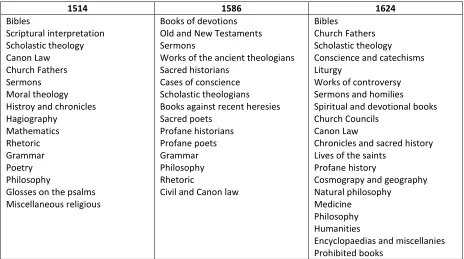
Much of this classification scheme is based upon contemporary schema such as the three used at the Abbaye Saint-Victor in Paris. The first, a reconstruction based on the 1514 catalogue of the Saint-Victor library; the second is designed for the personal use of the librarian Guillaume Cotin in the 1580s; and the third is from a 1624 manuscript.9
The three classification schemes are presented in Table 0-1.
1514 1586 1624
Bibles Scriptural interpretation Scholastic theology Canon Law Church Fathers Sermons Moral theology Histroy and chronicles Hagiography Mathematics Rhetoric Grammar Poetry Philosophy
Glosses on the psalms Miscellaneous religious
Books of devotions Old and New Testaments Sermons
Works of the ancient theologians Sacred historians
Cases of conscience Scholastic theologians Books against recent heresies Sacred poets Profane historians Profane poets Grammar Philosophy Rhetoric
Civil and Canon law
Bibles
Church Fathers Scholastic theology Conscience and catechisms Liturgy
Works of controversy Sermons and homilies
Spiritual and devotional books Church Councils
Canon Law
Chronicles and sacred history Lives of the saints
Profane history
Cosmograpy and geography Natural philosophy
Medicine Philosophy Humanities
[image:20.595.66.530.190.449.2]Encyclopaedias and miscellanies Prohibited books
Figure 0-1: Three classification schema for the library of the Abbaye Saint-Victor, Paris.10
There is quite a significant overlap between the classification scheme used in the Paris database and the schema used in the sixteenth and seventeenth century at Saint-Victor, particularly in the area of religious books. However, there are differences in
requirements between a classification scheme for books where one is able to study the text and for books where the only evidence of the content is a short title. Some of the categories used in classifying the Paris database contain more than one type of book to ensure that no category is so small as to make comment upon it pointless. Likewise the categories are general enough to ensure correct classification of editions about which sometimes only the minimal amount of information is known.
9Paul Nelles, “Three audiences for religious books in sixteenth-century France”, in Andrew Pettegree, Paul Nelles & Philip Conner (eds.), The Sixteenth-century French Religious Book, (Aldershot, 2001), p.258.
This thesis is an attempt to answer a series of general questions about the nature of the printing industry in Paris in the 1570s and 1580s. It arose out of a desire to examine the experience of the print trade in the wake of the St Bartholomew’s Day massacre and what effect such an event had upon a trade that had often been connected with
Protestantism. Natalie Zemon Davis’ 1965 study suggests that “printing supplied many supporters to the Protestant cause in Lyons as in other printing centres.”11 The
standard paradigm is that urban groups, like artisans, are considered to be the social matrix for radical Protestantism. The desire was to investigate whether the events of August 1572 settled the religious matter in such a way that the printers of Paris avoided a return to the provocative publishing that had been a mainstay in the 1560s. The extension of this thesis into years predating the St Bartholomew’s Day massacre was a natural result of a need to see the years post-1572 in context; likewise the extension of the study beyond 1588. That these twenty-one years would prove to be years of such abundance necessitated the method behind this study. The impossibility in examining in minute detail nearly ten thousand editions, many no longer extant, meant that the use of bibliometrics became a requirement rather than a luxury. That this thesis is a
bibliometric analysis, however, allows it to focus on the big picture and uncover details about the printing industry previously unknown. It also allows for the evaluation of notions about the printing industry which are held to be true by received wisdom but are notions that are not borne out by the statistical evidence.
Chapter I: The organisation of the industry
The central focus of printing in Paris was the area of the city known as the Latin
Quarter, the area surrounding the University, and it was here that the majority of Paris’ booksellers, printers, binders, and other associated and allied trades were based. In the colophons and title pages of the sixteenth-century book these names stand out: the Rue St-Jacques, the Rue St-Jean-de-Beauvais, the Rue St-Jean-de-Latran, the Clos Bruneau which leads to the Rue Mont-St-Hilaire, and, slightly further afield, the Pont St-Michel.
The presence of the trade in this area was no accident for the book trade had long been an established presence in Paris. Printing had been established as early as about 1470 and, even before then, the area surrounding the University, and in particular the Faculty of Theology – the Sorbonne – was already home to a great number of scribes,
illuminators, parchmenters, binders, and, not least,libraires, who provided services to the faculty and the students of the University. Perhaps the most ancient of the trades involved in the book trade, thelibrairesheld the most prominent position. Translatable as variously ‘bookseller’, ‘contractor’, ‘book producer’,12the contemporary English word
would be ‘stationer’13 Libraireswere the men responsible for the commission and
production of a manuscript; assimilated into the university’s body of scholars,
manuscriptlibraireswere more properly custodians rather than retailers of books.14
They controlled the authorised original texts (exemplars) from which copies were made; they therefore controlled the mechanism by which books were copied either in their entirety or in sections: thepeciasystem which allowed multiple customers to copy from one exemplar by dividing the text into portions. However, their role went further, acting as organisers of the trade. In the example of the manuscript Gui Bible thelibraire
Nicolas Lombard, was commissioned by Gui de Clermont or his agents with completing the task. Lombard assembled a team of craftsmen in the various requiredmetiersand
12Richard H. Rouse & Mary A. Rouse, Manuscripts and their makers: commercial book producers in Medieval Paris, 1200-1500, (London, 2000), vol. 1, p.24.
13“stationers, who are calledlibrairesin French.”, Rouse & Rouse, Manuscripts, vol. 1, p.25.
thus his role, the role of alibrairein this instance, was akin to a foreman of a building site – arranging the various different trades to create one unified work.15
In the age of print, as in manuscript era, thelibraireswere the lynchpin of the book world. However, it can be difficult to determine, unless explicitly stated, whether someone was alibraireor a printer; or whether alibraireprinted his own commissions or employed an independent printer to do so. With the gradual disappearance of the colophon, particularly in the late sixteenth century, this subcontracting of works is even more difficult to trace. What can, however, be done is to track interconnections
between the various members of the book trade. Sometimes this is visible in the book itself, when one book trade professional records printing for another. Another web of connections is established through family networks. In Paris, the establishment of long-lived printing dynasties and a dense network of connections between them gave the print world a stability lacking in many other centres of print. It was a characteristic of many parts of the European trade world, but seems particularly strongly developed in Paris.
These connections, usually solidified through marriage and remarriage, also help to explain how elements of the Parisian book world functioned in the period 1570-1590, a period when Paris had no formal Guild structure. Loyalties and relationships formed through these arrangements ensured a degree of co-operation reinforced by mutual benefit that could exceed any formal arrangements. A number of extended examples may be of benefit here. Elucidating these family networks helps draw the character of the Paris book world and explains its resilience in a time of political turbulence.
The Cavellat/Marnef family16
Guillaume Cavellat (libraire-juré, ac. 1546-1576) and Jérôme de Marnef (libraire-juré, ac. 1547-1595) were two of the most important printers in this period. Cavellat was
possibly the first syndic appointed in the wake of the Edict of Gaillon of 1571, and together they printed 195 editions between 1570 and 1590 (after 1583 Marnef was in partnership with Cavellat’s widow). Cavellat’s second wife, Denyse Girault was Jérôme’s niece.
The family connections between the Cavellat and Marnef families do not begin with Guillaume and Jérôme. Instead we begin with two sisters, Pierrette and Marie Alleaume. Pierrette married twice, firstly to Jean Loys (libraire, ac. 1535-1547) and then to
Thomas Richard (libraire/printer, ac. 1547-1568). With Loys she had one daughter, Madeleine, and with Richard she had two daughters, Charlotte and Louise. All three married printers orlibraires, Madeleine married Thomas Brumen (libraire-juré, ac. 1559-1588), a first generation member of the industry. Since Jean Loys was also a
libraire, it is quite possible that at one period Brumen worked for Loys. Brumen, like Loys before him, worked mainly with Latin works – 89 out the 140 editions Brumen produced in the period 1570-1590 were printed in Latin, a proportion of nearly two-thirds (63.57 per cent). Both of Brumen’s daughters, Pierrette and Marie Brumen marriedlibraires, Pierrette Brumen married Clovis Eve (libraire/relieur, ac. 1578-1634/5) and Marie Brumen married Jean II Corbon (libraire, ac. 1587-1618), the son of Jean I Corbon (libraire, ac. 1545-1585). Of the Richard sisters, Charlotte Richard
married Leonard Le Sueur (libraire, ac. 1571-1574) and Louise Richard married Antoine Gourdin (libraire, ac. 1565-1601).
Marie Brumen’s namesake and great aunt, Marie Alleaume, also married twice. Her first marriage was to Guillaume Richard (libraire, ac. 1540-1545), with whom she had three
16For full details on the printers andlibrairesmentioned in this and the following sections see Philippe Renouard, Répertoire des imprimeurs Parisiens, libraires, fondeurs de caractères et correcteurs
daughters, Catherine, Jeanne, and Gillette. Catherine married apâtissiernamed Robert Glannier, while Jeanne married, firstly Jean Caveiller (libraire/printer, ac. 1553-1561), and then Michel Julien (libraire-juré, ac. 1562-1583). Gillette also married within the printing trade, to Michel Clopejau (libraire/relieur, ac. 1567-1584). Marie Alleaume’s second marriage was to Guillaume Cavellat (libraire-juré, ac. 1546-1576). Cavellat inherited the address, the equipment and the stock of Guillaume Richard and he became stepfather to Richard’s daughters perhaps influencing the marriages of two of them. The Cavellat/Alleaume marriage would prove fruitful for both resulting in the only male children born to the Alleaume sisters. Three of the four children Marie had with
Cavellat were sons: Pierre (libraire-juré, ac. 1577-1628), Léon (libraire/printer, ac. 1577-1610), and Jean (libraire, ac. 1584-1587), and all of whom followed their father’s footsteps. Pierre Cavellat’s daughter, Marguerite, would later bind the Cavellat family to the important Chaudière family when she married the son of Guillaume Chaudière (libraire-juré, ac. 1564-1601), Regnault II Chaudière (libraire-juré, ac. c.1597-c.1633).
After Marie Alleaume’s death, Cavellat remarried to Denyse Girault and this is where the Marnefs become connected to the Cavellats. It was this marriage that helped Cavellat become elevated above the crowd. Cavellat and Girault had five children, none of whom will feature further in the study, so it is to Girault’s parentage that the focus now turns. Denyse Girault was the daughter of Ambroise Girault (libraire-juré, ac. 1520-1546) and Denise de Marnef. Her sister, Guillemotte Girault married Pierre Drouart (libraire-juré, ac. 1541-1586) and they had two sons, Jérôme (libraire, ac. c.1597-c.1636) and
Ambroise (libraire, 1582-1608). Denise de Marnef was the daughter of Geoffrey de Marnef (libraire-juré, ac. 1489-1518) and the niece of Jean I de Marnef (libraire-juré, ac. 1485-1510) and Enguilbert de Marnef (libraire-juré, ac. 1491-1533). The Marnefs were a fecund family, Denise de Marnef had a number of siblings, Jérôme, Jean II de Marnef (libraire-juré, ac. 1515-1522), Simon (who became Simon de Marnetz, a printer in Lyon in 1545), Claude, Philippe, Jeanne, and Simone. Jeanne de Marnef married Denis Janot (libraire-juré, ac. 1529-1545) and after his death, she married Étienne Groulleau (libraire-juré, ac. 1545-c.1564).
and French, including 22 editions of Ovid (exactly half in French and half in Latin). Jérôme de Marnef’s sister, Denise, the mother of Denyse Girault, married again after the death of Ambroise Girault, this time to Pierre Viart (libraire-juré/relieur, ac. 1512-1523), whose sister was connected to the greatest printing family of the sixteenth century, the Estiennes.
The Estienne/Chaudière family17
Pierre Viart, the second husband of Denyse Girault, had a sister, Guyunne, who also married more than once. Her first marriage brings a second connection between the Cavellats and Chaudières, and the second marriage brings a connection to the Estiennes.
The extensive careers of the members of the Estienne family, whose fortunes were intrinsically tied to the events of sixteenth-century France, are not very pertinent here for the influence of the Estienne family in the Paris of this period had dwindled due to the defection of Robert I Estienne (libraire/printer, ac. 1526-1550) to Calvinism and his subsequent move to Geneva. However, when Guyunne married Henri I Estienne
(libraire/printer, ac. 1502-1520), Robert I’s father, that marriage set the Estiennes on their way and is another example of a second marriage benefitting the second husband greatly. Before Guyunne married Estienne, she was married to Jean Higman (printer, ac. 1484-1500), a German émigré who moved to a house close to the Sorbonne where he ran a printing shop between 1484 and 1500. One of his journeymen was Henri I
Estienne, who inherited Higman’s stock and became stepfather to Damien (libraire-juré, ac. 1520-1525) and Geneviève Higman upon his marriage to Guyunne. Guyunne and Estienne had three more children, François I Estienne (libraire, ac. 1537-c.1552), Robert I, and Charles (libraire/printer, ac. 1551-1561). Henri I died circa 1520 and Guyunne, once again married one of her husband’s journeymen, Simon de Colines (libraire-juré, ac. 1520-1546). Colines adopted his step-children and two of these, Damien Higman, and François Estienne becamelibrairesin their own rights, both sending commissions to Colines. Robert I worked together with Colines, in the original shop first owned by Higman until 1526, when they separated. When Colines died, the children of both Jean Higman and Henri I Estienne inherited from Colines. Robert I moved to Geneva in 1551
after his conversion, and was followed there by his eldest son, Henri II (libraire/printer, ac. 1554-1555) in 1555, and by his youngest, François II, in 1562. His middle son and namesake, Robert II (libraire/printer, ac. 1555-1571), stayed in Paris where he married Denys Barbé. This Estienne spent most of his career working asimprimeur ordinaire du roi, printing edicts and ordinances. However, he also printed a number of educational works, in particular grammars and dictionaries, these later works continued to be printed, in his name, by his corrector and successor, Mamert Patisson (libraire/printer, ac. 1574-1602), who married his widow.
Leaving this branch of the family and returning to the children of Jean Higman, the interconnections between members of various printing families continue. Geneviève Higman made an advantageous marriage into the Chaudière family when she married Regnault I (libraire-juré, ac. 1509-1554). Their grandson, Guillaume, would become a large figure in the printing world and, during the period of this study, would be one of the most prolificlibraires. Guillaume, however, was not the first or onlylibrairein the family after Regnault I. Three of Guillaume’s aunts married members of the industry and it is their marriages that link us to the third family network that played a critical role in Paris during this period.
The Chaudière/Du Puys/Sonnius/L’Angelier family18
Regnault I Chaudière and Geneviève Higman had at least four children, one son, Claude (libraire/printer, ac. 1546-c.1564), and three daughters, Guyonne, Catherine, and
Hostelye. Guyonne married Andre Roffet (libraire/relieur, ac. 1533-1559), son of Pierre Roffet (libraire-juré/relieur, ac. 1511-1533), brother of Étienne Roffet (libraire/relieur, ac. 1534-1549), Ponce Roffet (libraire/relieur, ac. 1540-1555), and Jacques Roffet (libraire, ac. 1548-1551); and uncle of Nicolas Roffet (libraire/papetier, ac. 1560-1581), who succeeded him at the “enseigne le Faulcheur” on the Rue Neuve-Notre-Dame. One of Andre Roffet’s sisters, Girarde, was married first to Arnoul L’Angelier (libraire, ac. 1536-1557), then to Lucas I Breyer (libraire, ac. 1561-1581). She was the mother of Abel L’Angelier (libraire-juré, ac. 1572-1609) and Lucas II Breyer (libraire, ac.
c.1608). Another of his sisters, Guillemette, married Antoine Le Clerc (libraire, ac. 1545-1568).
Catherine Chaudière married Jean Macé (libraire-juré, ac. 1535-1588), who had
succeeded Pierre Gaudoul (libraire-juré, ac. 1508-1537). Upon Catherine’s death, Macé married Geneviève Roland, daughter of Guillaume Roland (libraire/papetier, ac. 1516-1546), and widow of Philippe de Brunel, “procureur au Châtelet”. Jean Macé had three sons, though it is not clear through which marriage. All three sons followed him into the industry; Jacques (libraire, ac. 1563-1570), Barthélemy (libraire-juré, ac. 1587-1616), and Charles (libraire, ac. 1571-1606). Barthélemy married Marie Buon, daughter of Gabriel Buon (libraire-juré, ac. 1558-1595) and sister of Nicolas Buon (libraire-juré, ac. 1598-1628). Nicolas Buon, in turn, was married to Blanche Chaudière, the sister of Regnault II Chaudière and daughter of Guillaume Chaudière. If Catherine Chaudière was Barthélemy’s mother, then she was the mother-in-law of Nicolas’ sister while
simultaneously being the great aunt of his wife. As already shown, Regnault II Chaudière married Marguerite Cavellat, the granddaughter of Guillaume Cavellat.
The Roigny/Chesneau/Morel family19
One of the lynchpins of the previous family was Jacques I du Puys, alibraireresponsible for 227 editions between 1570 and 1590. Du Puys married twice: it was his second marriage to Marguerite Vaillant that produced his son and heir, Jacques II, who would end up marrying Michel I Sonnius’ daughter from his second marriage. Jacques I’s first marriage, however, was probably quite important in helping him on his way to success for he married Catherine, daughter of Josse Badius (libraire/printer, ac. 1503-1533). Badius, né Van Asche, was a native of Ghent and a man of some learning. He was a tutor in Valence and then Lyon, where he worked as a corrector for Jean Trechsel. Badius had a number of children, Perrette, Catherine I, Conrad (libraire/printer, ac. 1545-1548), Jeanne, Marie I, Madeleine, Catherine II, and Marie II. Perrette married Robert I Estienne, Jeanne married Jean de Roigny (libraire-juré, ac. 1529-1566), Catherine I married Michel de Vascosan (libraire-juré/printer, ac. 1530-1577), and Catherine II married Jacques I du Puys. Du Puys, therefore, was the brother-in-law of Robert I Estienne and uncle of Robert II, Henri II, and François II. He was also the uncle of the children of Michel de Vascosan and Jean de Roigny. Of these it is the Vascosan children that provide the link to the most prolificlibraireof the period, Fédéric I Morel (libraire, ac. 1557-1583)
Morel’s high level of output can be attributed to his position as a Royal printer, a position that remained in the family until at least 1624. As Royal printer he was
responsible for 1,294 editions in the twenty-one years between 1570 and 1590, many of them short pamphlet versions of royal edicts. He was the son-in-law of Michel de
Vascosan and succeeded him at the “enseigne de la Fontaine” on the Rue St-Jacques. Vascosan’s daughter Jeanne, the wife of Morel, had a cousin on her mother’s side also named Jeanne. This Jeanne was the sister of Michel de Roigny (libraire-juré, ac. 1565-1591), the daughter of Jean de Roigny and the wife of Nicolas Chesneau (libraire-juré, ac. 1556-1584). Chesneau’s brother-in-laws, however, did not just include Michel de
Roigny, they also included Pierre L’Huillier (libraire-juré/ printer, ac. 1561-1602), the husband of Jeanne de Roigny’s younger sister, Marie.
The extraordinary network of marriage and family connections that established and bonded the principal printing families of Paris was one of the industry’s defining characteristics. Together these family groupings dominated the output of published books in one of Europe’s principal centres of print. Guillaume Chaudière, Gabriel Buon, Abel L’Angelier, Jacques du Puys, and Michel Sonnius were all, as we have seen,
members of one extended family. They were also five of the ten most prolificlibrairesin the period 1570-1590.20 Jacques I du Puys, Sébastien Nivelle (libraire-juré, ac.
1549-1603), Michel Sonnius, Jean-Baptiste du Puys, Abel L’Angelier, Barthélemy Macé, Ambroise Drouart, Michel Laurens, and Jean Sonnius were also all, at one time,
members of theCompagnie de la Grand’Navire, a syndicate formed to publish the works of the Church Fathers. Sébastien Nivelle was Ambroise Drouart’s father-in-law and the connections between many of the other members have already been emphasised as has Drouart’s connection to the Marnefs, and so on.
In fact, nothing demonstrates the importance of these connections better than the example of another collaborative syndicate, theSocietas typographica librorum Officii ecclesiastici ex decreto Concilii Tridentini. This was formed after the death of Jacques Kerver’s (libraire-juré/printer, ac. 1535-1583) to exploit his extensive privileges, including the privilege to print the liturgical works of the diocese of Paris and the privilege to print the reforms of the Council of Trent in France. TheSocietasincluded amongst its members Sébastien Nivelle, Michel Sonnius, Thomas Brumen, Guillaume de La Nouë (libraire-juré, ac. 1572-1601), Guillaume Chaudière, Claude Chappelet ( libraire-juré, ac. c.1586-c.1648), Jean Corbon (libraire, ac. 1545-1585), Jean (aka Jamet)
Mettayer (libraire/printer, ac. 1573-1605), Pierre L’Huillier, Laurens Sonnius, Pierre (aka Jamet) Mettayer (libraire/printer, ac. 1589/c.1591-c.1639), and Clovis Eve. Figure 1-1 indicates how all these men (with the lone exception of La Nouë) were connected, either by marriage, by family, or by associations that existed prior to Kerver’s demise (in the case of the relationship between L’Huillier and Jean Mettayer, father of Pierre Mettayer).21
Figure 1-1: Connections between members of theSocietas typographica librorum Officii ecclesiastici ex decreto Concilii Tridentini.22
It is important to iterate that under no circumstances is this a suggestion that these connections are the reason for the formation of theSocietasof theCompagnie.
However, it does demonstrate how strong the lines of relationship and connection were between some of the most important printing families in Paris. Not only was this an industry of relative geographical closeness but also of consanguinity. It was not a world of strangers.
Why did this matter? The ties that bound the Parisian printers had two tangible
consequences. Firstly it made it easier, through informal agreements and conversation, to establish an effective if never contractual division of work between the city’s
principal printing families. Paris printing, despite the difficulties of the times, was never characterised by cut-throat competition between the major printing firms. Secondly, the natural ties of family interest and, no doubt, mutual hospitality established a second, informal, organisational framework, to set alongside the formal organisational
22Solid lines indicate marriage or other family connection; dashed lines indicate prior association. Names in bold are members of theSocietas, names in italics indicate non-members acting as channels of
association. KERVER
Chappelet
Nivelle
Drouart
Girault Cavellat
Chaudière
Buon
Sonnius
Du Puys Roigny
L’Huillier Mettayer
Richard
Loys
Brumen
structures of the industry. The ties that bound the major Parisian printing families articulated a natural affinity and common interest that united the wealthier publishers against two other groups: newcomers attempting to break in to this relatively closed world, and the print shop journeyman. When employees and journeymen rebelled against harsh conditions of work, the Parislibraireshad many reasons to stand together.
The organisation of the industry
The organisation of the printing industry in Paris was unusual compared to the
organisations of other trades in the city. The printing industry was initially inseparable from the administration of the University of Paris: thelibrairesor booksellers and stationers of the city were brought into its body of scholars: likewise the University controlled the parchment sellers, the scribes and the illuminators.23 Under this system
these trades and arts received a number of privileges, including exemption from some taxation and from the duties of watch and ward. They also gained the right to be tried by University courts as befitted trades which were assimilated as a clerical branch of the University. However, as such a branch, they were forbidden to form a guild and the book trade in Paris was controlled wholly by the University via the trade’s constituent parts.24 While the book trade was purely manuscript and hand-written in nature, such
an organisation was sufficient for the administration of the industry but the development and growth of the movable-type press would lead to problems in an organisation of this format, not least because of the growth in the numbers working within that industry.
The closest thing to a guild that the Paris printing industry was allowed in this period was a confraternity: the Brotherhood of St John. Formed in 1401, this brotherhood, clearly predating the advent of movable-type, was originally formed by a charter of association given by Charles VI to certain scriveners, illuminators and binders. The object of this brotherhood was strictly religious: it celebrated three masses a year (one
23David T. Pottinger, The French book trade in the Ancien Regime, 1500-1791, (Cambridge, Mass., 1958), p.111.
for the King, his predecessors, and the University; one for the living members of the confraternity; and one for the deceased members).25 Based firstly at the church of St
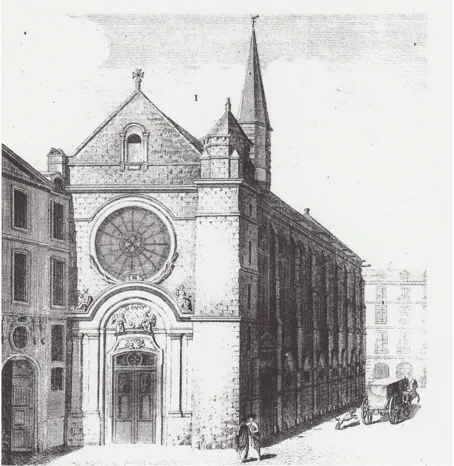
[image:33.595.71.525.171.637.2]André-des-Arts it moved, in 1582, to the church of the Mathurin fathers on the Rue St Jacques, heart of the printing quarter [Figure 1-2].
Figure 1-2: The church of the Mathurin fathers, c. 1612.
It was purely a religious and social organisation without any commercial or industrial agenda. It provided material support for its members and its members’ families in the
way that any confraternity would, but it made no attempt at regulating or exerting any influence on the business side of the industry.Records seem to indicate that the
Brotherhood was relatively wealthy, though most of these records date from the
seventeenth century. In 1601, the Brotherhood paid 6lt.2s.for a blue cloth robe for the beadle, decorated with a likeness of St John the Evangelist. The Brotherhood owned a painted image of the saint on which a crimson velvet corselet, fringed with red silk and gold thread, was placed. In 1620 they spent 548lt.1s.to renovate this corselet and add gold lilies.26 In both these cases subscriptions had been raised from amongst the
members. That such amounts could be found, even out of special contributions, is a testimony to the wealth of the Brotherhood’s members and to the importance to those members of the confraternity.
The Brotherhood celebrated two saints’ days: the 6th May (St John, Port Latin) and the 27thDecember (St John the Evangelist).27 Observance of the May holiday was
obligatory.28 The requirements of observance were simple: every member had to shut
his shop and attend high mass and vespers. These church observances were followed by the annual business meeting and then a banquet, though the banquet was on occasions suppressed due to the drunkenness that followed. This banquet, along with the other functions of the Brotherhood was funded primarily through subscriptions, mainly entrances fees and annual dues. From 1467 the annual dues were 16d. New members who wished to open a shop had to pay an entrance fee of 24s., apprentices and journeymen had to pay 1d.a week with additional levy when they entered service: 8s.for apprentices and 12d.for journeymen.29
The Brotherhood, however, was a confraternity: it was not a Guild, and so its influence over the industry is difficult to gauge, especially with the paucity of official records. Because of the legal restrictions placed upon members of the industry as members of the University, it is unlikely that the Brotherhood was officially anything more than a simple confraternity, providing the same services and opportunities for religious
26Pottinger, French book trade, p.108.
27According to Tertullian, the Emperor Domitian had St John thrown into a cauldron of boiling oil at the Porta Latina in Rome, a cauldron St John escaped from without injury. See Leopold Fonck,. “St John the Evangelist.” in The Catholic Encyclopedia, vol. 8. (New York, 1910); Chauvet, Les Ouvriers, p.8.
expression that other such confraternities did. It seems unlikely that the Brotherhood, like other fraternities in other industries, was anything more than a charitable and religious grouping. It is possible that because of the shared interests within the community, the Brotherhood could have exercised some control over admittance to membership and allowed for some shared awareness of appropriate industrial behaviour. This is certainly the conclusion of Pottinger: “Without doubt the law of 1618, which established the guild, crystallized a long standing demarcation between the charitable and the commercial interests of the members.”30
With no guild in existence prior to 1618 and only a charitable religious organisation and family connections binding the various members of the industry together, the trade could easily be considered a “free” one: that is, anyone who wished to do so could become a master so long as they possessed the necessary financial backing. The nominal controlling body in Paris, the University, was interested only in the orthodoxy of the books printed, not in business questions. Initially, all the University required was forlibrairesto take an oath of allegiance to the University. Failure to take this oath would result in the University ‘banning’ thoselibrairesthat had not done so: a step that was actually taken in 1316.31 Beyond this, internal administration was left in the hands
of the four ‘chief booksellers’ appointed by the University who supervised the other authorisedlibraires, binders, illuminators, and copyists.
Despite this relaxed approach to the industry by the authorities both temporal and spiritual, the trade seems to have attracted a great deal of Royal support. Charles VIII confirmed thelibrairesas officers of the University and declared that they and their successors would be free from all taxes and requirements for service in the city watch.32
Louis XII, on exempting the booksellers of Paris from contributing to his ‘great gift’ of 30,000livres, referred to them as privileged officers of the University and identified the
…great benefits which have resulted from the art and science of printing, the invention of which seems more divine than human, which has been invented in our time by the industry of said booksellers, and by which the
30Pottinger, French book trade, p.110.
31Eduoard Tromp, Étude sur l’organisation et l’histoire de la communauté des libraires et imprimeurs de Paris (1618-1791), (Nîmes, 1922), pp.9-11; Pottinger, French book trade, p.116.
Catholic faith has been greatly increased and strengthened, justice better administrated, and divine service more honourably and carefully
celebrated.33
One of his successors, Charles IX, would recognise this in 1571 when he said:
Kings, our predecessors, between all the arts which they estimated worthy to be maintained and advanced, held in great reputation and esteem this art of printing, which cultivates, polishes and raises the good spirits.34
However, while the trade could well be considered a “favoured infant industry”35of the
King, the language of the authorities failed to reflect the full extent of the changes in the post-Gutenberg book world. A remarkable instance of this is that the first use in a legal text of the wordimprimeur– printer – did not occur until 1571. For most of the printing industry’s infancy the Royal authorities seemed happy to leave the industry to its own devices, concerning itself with merely the content of the output, a concern that, while deepening with the spread of Lutheranism, did not bring about any industrial
intervention.
Despite, or perhaps because, of thislaissez-faireattitude, the industry would face grave questions within one-hundred years of the invention of the printing press. These problems came to a head in 1539 with the great strike in Lyon, a strike that spread within a few weeks to Paris. The grievances that sparked this protest were not fully resolved until 1571. In about 1530 the period of great prosperity and growth in Lyon had ended and the city faced a recession. Food had become scarce and its cost had risen while wages had stagnated.36 The printing industry, which had grown at a great rate
prior to the economic hardship, was particularly hit as the journeymen were traditionally fed by their masters and, as the price of food rose, the quality of that provided by the masters, fell. In April 1539 the journeyman printers of the town of Lyon, at the word ‘Tric’, simultaneously ceased their work and abandoned their jobs. The organising force behind this strike was called the ‘Company of the Griffarins’.
33Quoted in Pottinger, French book trade, p.118.
34Edict du Roy sur la Reformation de 1’Imprimerie, (Paris: Fédéric Morel, 1571), A2r. 35Pottinger, French book trade, p.117.
This Company was an attempt to organise the labour of the Lyon journeymen into a form of a trade union, an organisation that Royal officials considered to be a monopoly, as illegitimate in its efforts to raise wages as that of a merchant hoarding grain. What we know about this Company indicates that it was not unique and that similar secretive organisations existed in Paris. For the seventeenth century, our source for the existence of these organistions is a confessions given to the Sorbonne in 1655 by an
ex-journeyman.37 For the sixteenth century, however, our sources come from theProcés
criminal de Genèvewhich consists of testament from eighteen journeymen before the Consistory of Geneva. This latter source tells us of one journeyman, originally from Paris, who was accepted into the Company but spared the initiation ceremony because he had already been received at Paris “with his brothers”. Furthermore, connections between the Companies appear to have been strong: possession of a shared secret handshake and password, for instance, by which the Paris journeyman identified his membership to his Lyon brothers. This handshake is detailed thus:
Two right thumbs touch; the left little finger clasps the other’s left little finger; one right foot on the other’s right foot, one journeyman bites the other’s ear and whispers the password: ‘vivre les temps’.38
This possible connection between the Lyon Company and a Paris Company suggests that the strike that began in Paris was not unconnected to the trouble in Lyon. But whether or not there was a connection, the authorities seemed to have dealt with the two independently. The trouble in Lyon was set off mainly by the economic situation and the reaction of the masters to their increasing economic difficulties. As the masters increased the use of apprentices they also began to limit the amount of food and drink given to their journeymen with the ultimate goal of eliminating victuals for journeymen altogether. Although apprentices and journeymen often performed similar tasks, and both participated in the harsh manual labour of the shop, their positions were quite different. Many apprentices were young men with prospects. They might hope on completion of their apprenticeship to set up as an independent master. If lucky they might inherit their master’s shop, or marry his widow. Quite often they came from good
37E. Levasseur, Histoire des classes ouvrières et de l’industrie en France avant 1789 (Paris, 1900), pp.703-707
families, often the families of other master printers. Most journeymen were day
labourers. Although often highly skilled and experienced they had no long term career prospects. The potential for conflict was obvious.
Since journeymen had a requirement to complete a specific amount of work each day, the masters continued to expect them to achieve this despite hours missed while the journeymen were away at meals. To compensate for this, the masters aimed to provide a small fixed amount to the cash wages as amelioration for the removal of meals.39
The Seneschal of Lyon’s solution was to ban strikes and walkouts, to forbid the carrying of arms by journeymen or apprentices unless with specific approval and to allow the masters to hire as many apprentices as they should wish; however, the Seneschal also kept the food allowance as part of the journeyman-master relationship. Having gained Royal support for this solution, the Lyon decree was issued as a Royal edict at Villers-Cotterets on 31 August 1539 and extended to the whole of the realm.40 A further decree
was issued by the King on 29 September, yet none of this solved the problems in Lyon as the trouble continued throughout 1540 and 1541.
The economic situation in Paris was better than in Lyon and the conflict less bitter. Here the troubles seem to have been focused around the issue of apprentice numbers, an issue covered in the 1539 edict. Unfortunately, this edict did not settle the matter in the way that the journeymen wished and trouble began afresh with actual strikes and violence against those of their number who continued to work. By 19 November 1541, the journeymen’s complaints had been investigated and dismissed and an edict issued that was extended to Lyon on 28 December in the hope of stemming the problems there; finally on 19 July 1542, the King issued letters-patent addressed to the Lyon Seneschal forbidding further protests against the edict from the journeymen. The 1541 edict placed many restrictions upon the journeymen: they were forbidden to assemble in groups of more than five, forbidden to congregate or make donations for masses or banquets. It forbade idleness before a holiday or work on a holiday and it forbade any
39Natalie Zemon Davis, Protestantism and the printing workers of Lyons: a study in the problem of religion and social class during the Reformation, (Unpublished PhD thesis, University of Michigan, 1959), p.166.