Q-Learning-Based Adaptive Waveform Selection
in Cognitive Radar
Bin WANG, Jinkuan WANG, Xin SONG, Fulai LIU Northeastern University, Shenyang, China
Email: [email protected]
Received June 11, 2009; revised August 12, 2009; accepted September 20, 2009
ABSTRACT
Cognitive radar is a new framework of radar system proposed by Simon Haykin recently. Adaptive wave-form selection is an important problem of intelligent transmitter in cognitive radar. In this paper, the problem of adaptive waveform selection is modeled as stochastic dynamic programming model. Then Q-learning is used to solve it. Q-learning can solve the problems that we do not know the explicit knowledge of state- transition probabilities. The simulation results demonstrate that this method approaches the optimal wave-form selection scheme and has lower uncertainty of state estimation compared to fixed wavewave-form. Finally, the whole paper is summarized.
Keywords:Waveform Selection; Q-Learning; Space Division; Cognitive Radar
1. Introduction
Radar is the name of an electronic system used for the detection and location of objects. Radar development
was accelerated during World War Ⅱ. Since that time it
has continued such that present-day systems are very sophisticated and advanced. Cognitive radar is an intel-ligent form of radar system proposed by Simon Haykin and it has many advantages [1]. However, cognitive ra-dar is only an ideal framework of rara-dar system, and there are many problems need to be solved.
Adaptive waveform selection is an important problem in cognitive radar, with the aim of selecting the optimal waveform and tracking targets with more accuracy ac-cording to different environment. In [2], it is shown that tracking errors are highly dependent on the waveforms used and in many situations tracking performance using a good heterogeneous waveform is improved by an order of magnitude when compared with a scheme using a homogeneous pulse with the same energy. In [3], an adaptive waveform selective probabilistic data associa-tion algorithm for tracking a single target in clutter is presented. The problem of waveform selection can be thought of as a sensor scheduling problem, as each pos-sible waveform provides a different means of measuring the environment, and related works have been examined in [4,5]. In [6], radar waveform selection algorithms for tracking accelerating targets are considered. In [7], ge-netic algorithms are used to perform waveform selection
utilizing the autocorrelation and ambiguity functions in the fitness evaluation. In [8], Incremental Pruning me- thod is used to solve the problem of adaptive waveform selection for target detection. The problem of optimal adaptive waveform selection for target tracking is also presented in [9].
In this paper, the problem of adaptive waveform selec-tion in cognitive radar is viewed as a problem of stochas-tic dynamic programming and Q-learning is used to solve it.
2. Division in Radar Beam Space
The most important parameters that a radar measures for a target are range, Doppler frequency, and two orthogo-nal space angles. However, in most circumstances, angle resolution can be considered independently from range and Doppler resolution. We may envision a radar resolu-tion cell that contains a certain two-dimensional hyper-volume that defines resolution.
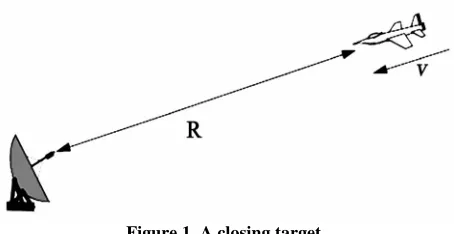
Figure 1 is abridged general view of range and
Dop-pler. Range resolution, denoted as ΔR, is a radar metric
that describes its ability to detect targets in close prox-imity to each other as distinct objects. Radar systems are normally designed to operate between a minimum range
Rmin, and maximum range Rmax. Targets seperated by at
least ΔR will be completely resolved in range. Radars use
670
Figure 1. A closing target.
targets or objects such as clutter. The Doppler phenome- non describes the shift in the center frequency of an in-cident waveform.
In general, a waveform can be tailored to achieve ei-ther good Doppler or good range resolution, but not both simultaneously. So we need to consider the problem of adaptive waveform scheduling. The basic scheme for adaptive waveform scheduling is to define a cost func-tion that describes the cost of observing a target in a par-ticular location for each individual pulse and select the waveform that optimizes this function on a pulse by pulse basis.
We make no assumptions about the number of targets that may be present. We divide the area covered by a particular radar beam into a grid in range-Doppler space,
with the cells in range indexed by t=1,…,N and those in
Doppler indexed by v=1,…,M. There may be 0 target, 1
target or NM targets. So
0 1 2 ... NM 1 NM 2NM
NM NM NM NM NM
C C C C C
(1)
The number of possible scenes or hypotheses about
the radar scene is 2NM. Let the space of hypotheses be
denoted by X. The state of our model is Xt=x where x∈X.
Let Yt be the measurement variable. Let ut be the control
variable that indicates which waveform is chosen at time
t to generate measurement Yt+1, where ut∈U. The
prob-ability of receiving a particular measurement Xt=x will
depend on both the true, underlying scene and on the choice of waveform used to generate the measurement.
We define
a
x x is state transition probability where1
( |
x x t t
a P x x x x) (2)
We define
b
x x is the measurement probability where1
( ) ( | , )
x x t t t t
b u P Y x X x u (3)
Assume the transmitted baseband signal is s(t), and the
received baseband signal is r(t). The matched filter is the
one with an impulse response h(t)=s*(–t), so an output
process of our matched filter is
( ) ( ) ( )
x t s t r d
(4)In the radar case, the return signal is expected to be Dop-pler shifted, then the matched filter to a return signal
with an expected frequency shift v0 has an impulse
re-sponse
0
2 *
( ) ( ) j t
h t s t e (5)
The output is given by
0
2 ( )
( ) ( ) j t ( )
x t s t e r d
(6)where v0 is an expected frequency shift.
The baseband received signal will be modeled as a re-turn from a Swerling target:
2
( ) ( ) j dt ( )
r t As t e I n t (7)
where ( , , ) ( ) j2 dt
d
s t s t e
2
2 A
is a delayed t and
Dop-pler-shifted vd replica of the emitted baseband complex
envelope signal s(t); I is a target indicator. A approaches
a complex Gassian random variable with zero mean and
variance . We assume n(t) is complex white
Gaus-sian noise independent of A, with zero mean and
vari-ance 2N0.
At time t the magnitude square of the output of a filter
matched to a zero delay and a zero Doppler shift is
2 2
0
( ) t ( ) ( )
x t
r s t d (8)When there is no target
( ) ( )
r t v t (9)
So
0
0 0
( ) ( ) ( 0)
x n s d
(10)The random variable x( ).0 is complex Gaussian,
with zero mean and variance given by
2
0 E x( ) ( )0 x 0 2N0
(11)
ξ is the energy of the transmitted pulse. When target is present
2
( ) ( ) j dt ( )
r t As t e I n t (12)
0 2
0 0 0
( ) ( ) j d ( ) ( )
x As e n s d
(13)This random variable is still zero mean, with variance given by
2
1 0 0 2 2 2 A 0 2 0
0
( ) ( ) 2
(1 ( , ))
E x x
A
0
(14)
A(t,v)is ambiguity function, given by
2 2 2
2
1
( , ) ( ) ( )
( )
j
A s s e d
s d
(15)Recall that the magnitude square of a complex
Gaus-sian random variable ~ (0, 2)
i
distributed, with density given by 2 2 2 2 1 ~ 2 i y i
y x e
(16)
We consequently have that the probability of false
alarm Pf is given by
2 0 2 2 0 1 2 2 0 2 x D f D
P e dx e
(17)And the probability of detection Pd by
2 2 2
0 2 0
2
0 1
2
2 (1 ( , )) 2 2 1 1 2 A D x A d D
P e dx e
0
(18)In the case when a target is present in cell ( , ) ,
as-suming its actual location in the cell has a uniform dis-tribution
2 2 2
0 2 0 0
0
2
2 (1 ( , )) ( , ) 1 A a a D A d A
P e d
A
ad a
(19)where A is the resolution cell centred on (t,v) with
vol-ume |A|.
3. Q-Learning-Based Stochastic Dynamic
Programming
A target for which measurements are to be made will fall in a resolution cell. Another target, conceptually, does not interfere with measurements on the first if it occupies another resolution cell different from the first. Thus, conceptually, as long as each target occupies a resolution cell and the cells are all disjoint, the radar can make measurements on each target free of interference from others.
Define { , ,..., }u u0 1 uT where T=1 is the maximum
number of dwells that can be used to detect and confirm
targets for a given beam. Then is a sequence of
waveforms that could be used for that decision process.
We can obtain different according to different
en-vironment in cognitive radar. Let
0
( ) [T t ( , )]
t t t t
t
V X E R X u
(20)where R(Xt,ut) is the reward earned when the scene Xt
is observed using waveform ut and γ is discount factor.
Then the aim of our problem is to find the sequence
that satisfies
0
( ) max [ T t ( , )]
t t
t
V X E R X u
t (21)However, knowledge of the actual state is not avail-able. Using the method of [10], we can obtain that the
optimal control policy that is the solution of (21) is
also the solution of
0
( (0)) max [T t ( , )] t t t
V E R
p p u (22)
where Pt is the conditional density of the state given the
measurements and the controls and P0 is the a priori
probability density of the scene. P is a sufficient statistic
for the true state Xt. So we need to solve the following
problem
0
max [T t ( , )] t t t
E R u
p (23)The refreshment formula of Pt is given by
1 ' t t t BAp p
1 LAp (24)
where B is the diagonal matrix with the vector
the non-zero elements and 1 is a column vector of ones.
A is state transition matrix.
(b ux x( ))t
If we wanted to solve this problem using classical dy-namic programming, we could have to find the value
function Vt( )pt using
1 1
( ) max( ( , ) { ( ) | }) t
t t u t t t t t t
V p R p u E V p p (25)
It can also be written in probability form
1
( ) max( ( , ) ( , ) ( )) t
t t u t t t t t t
V R u P u V
p P
p p p p p (26)
However, in radar scene, explicit knowledge of target state-transition probabilities are unknown. So directly using Bellman’s dynamic programming is very hard. The Q-leaning algorithm is a direct approximation of Bell-man’s dynamic programming, and it can solve the prob-lem that we do not know explicit knowledge of state-transition probabilities. For this reason, Q-learning is very suitable to be used in the problem of adaptive waveform selection in cognitive radar.
We define a Q-factor in our problem. For a state-ac-tion pair ( , )pt ut ,
1
( , )t t ( t, )[ (t t t, )t t ]
Q u P u R u V
p P
p p p p p (27)
According to (26), (27) we can derive
* max ( , )
t
t u
V Qpt ut (28)
The above establishes the relationship between the value function of a state and the Q-factors associated with a state. Then it should be clear that, if the Q-factors are known, one can obtain the value function of a given state from above fomula.
So Q form of Bellman equation is
1 1 1
( , )
( , )[ ( , ) max ( , )] t
t t
t t t t t u t t
Q u
P u R u Q u
p P p672
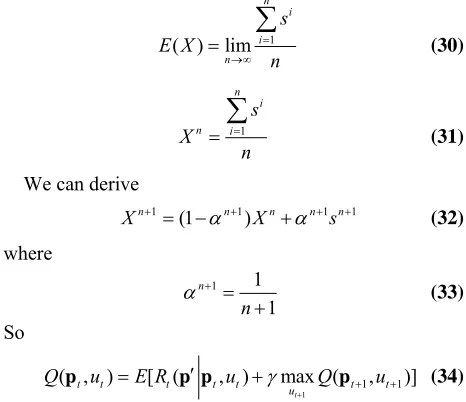
Let us denote the ith independent sample of a random
variable X by Si and the expected value by E(X). Xn is the
estimate of X in the n th iteration. So
1
( ) lim n i i n s E X n
(30)1 n i n i s X n
(31)We can derive
1 (1 1) 1
n n n n n 1
X X s
(32) where 1 1 1 n n
(33)
So
1 1 1
( , ) [ ( , ) max ( , )]
t
t t t t t u t t
Q u E R u Q u
p p p p (34)
where E is the expectation operator. We could use this
scheme in a simulator to estimate the same Q-factor. Using this algorithm, Equation (29) becomes:
1
1 1
1
1 1
( , ) (1 ) ( , )
[ ( , ) max ( , )]
t
n n n
t t t t
n n
t t t u t t
Q u Q u
R u Q u
p p
p p p (35)
Obviously, we do not have the transition probabilities in it.
Our Q-learning algorithm is as follows:
Step 1. Initialize the Q-factors to 0. Set n=1.
Step 2. For t=0,1,…T,do step 3-step 6.
Step 3. Simulation action ut. Let the curren state be Pt,
and the next state be Pt+1.
Step 4. Find the decision using the current Q-factors:
1
arg max ( , ) t
n n
t t
u
u Q pt ut (36)
Step 5. Update Q(Pt,ut) using the following equation:
1
1 1
1
1 1
( , ) (1 ) ( , )
[ ( , ) max ( , )] t
n n n
t t t t
n n
t t t u t t
Q u Q u
R u Q u
p p
p p p (37)
Step 6. Find the next state:
1 ' t t t BAp p
1 BAp (38)
Step 6. Increment n. If n<N, go to step 2.
Step 7. For each Pt∈P, select
1 1
( ) arg max ( , )
t
t t
u
d p Qp ut (39)
The policy generated by the algorithn is dˆ. Stop.
4. Simulation
In this section, we make three experiments. In order to explain the necessity of waveform selection, we make the curve of measurement probability versus SNR of three waveforms. Curve of uncertainty of state estima-tion demonstrates validity of our proposed algorithm. We also plot the figure of Q value space versus state and waveform.
We consider a simple situation. The state space is 4×
4. We consider 5 different waveforms where for each
waveform u, and each hypotheses for the target
x
, thedistribution of
x
is given in Table 1. The discountfac-tor γ=0.9. State transition matrix A is given by
0.96 0.02 0.01 0.04 0.01 0.93 0.03 0.04 0.02 0.03 0.95 0.02
0.01 0.02 0.01 0.9
A (40)
Following the approach described in [11,12], linear form of reward function will be adopted:
( , ) ' 1
Rp u p p (41)
The formula E(–R) can be considered as the
[image:4.595.55.288.122.323.2]uncer-tainty in the state estimation. In other words, it can be considered as the tracking errors.
Figure 2 is curve of measurement probability versus SNR of three waveforms. From this curve we can see that with the same SNR, different waveforms correspond to different measurement probability. Generally speaking, the waveform with wide pulse duration corresponds to high measurement probability. From this point of view, the waveform with wide pulse duration is better. How-ever, wide pulse duration means large energy of the transmitted pulse. So we should improve measurement
-10 0 10 20 30 40 50 0 0.1 0.2 0.3 0.4 0.5 0.6 0.7 0.8 0.9 1 SNR(dB) M ea s ur em ent P robabi lit y waveform1 waveform2 waveform3
[image:4.595.306.537.513.691.2]Table 1. Measurement probabilities for the example scenario.
x=1
x’=1,2,3,4 x’=1,2,3,4x=2 x’=1,2,3,4x=3 x’=1,2,3,4x=4
u=1 0.97,0.010.01,0.01 0.01,0.010.96,0.02 0.01,0.02,0.01,0.96 0.96,0.01,0.01,0.02
u=2 0.96,0.010.02,0.01 0.02,0.950.01,0.02 0.01,0.01,0.01,0.97 0.02,0.96,0.01,0.01
u=3 0.94,0.020.03,0.01 0.02,0.020.01,0.95 0.02,0.96,0.01,0.97 0.01,0.02,0.95,0.02
u=4 0.96,0.010.01,0.02 0.01,0.020.96,0.01 0.97,0.01,0.01,0.01 0.03,0.95,0.01,0.01
u=5 0.95,0.020.01,0.02 0.01,0.970.01,0.01 0.02,0.010.96,0.01 0.04,0.940.01,0.01
probability through changing waveforms according to different environment and make a balance between the width of pulse duration and the energy of the transmitted pulse. We can also derive measurement probabilities for the example scenario from this curve, as is shown in Ta-ble 1.
Figure 3 is curve of uncertainty of state estimation. From this curve we can see that for all the cases, the un-certainty of state estimation is decreasing with time, no matter how the state is changing with time. Compared to a fixed waveform, Q-learning algorithm we proposed has lower uncertainty of state estimation. That means our algorithm will reduce uncertainty in locating targets. Meanwhile our algorithm approaches the optimal wave-form selection scheme even though explicit knowledge of state-transition probabilities is unknown.
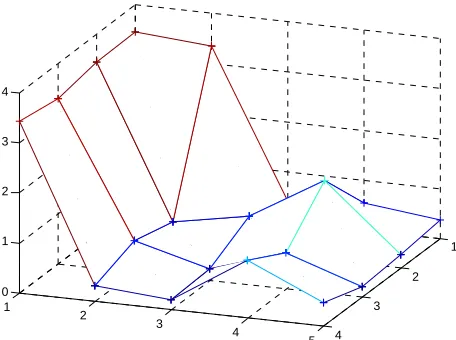
Figure 4 is the figure of Q value space versus state and waveform. Q value of different state-waveform pair can be obtained in this figure. We can see that the proposed algorithm has lower computational cost.
5. Conclusions
Adaptive waveform selection is an important problem in cognitive radar and the problem of adaptive waveform
0 10 20 30 40 50 60 70 80 90 100 0.2
0.25 0.3 0.35 0.4 0.45 0.5 0.55
time
E(
-R
)
Uncertainty of State Estimation
[image:5.595.59.286.92.215.2]Q-learning optimal scheme fixed waveform
Figure 3. Curve of uncertainty of state estimation.
1
2
3
4 1
2
3
4
5 0
1 2 3 4
Figure 4. Q value space versus state and waveform.
scheduling can be viewed as a stochastic dynamic pro-gramming problem. In this paper, Q-learning-based waveform selecting algorithm is proposed. The advan-tages of Q-learning over fixed waveform have been shown with simulations. The Q-learning algorithm can minimize the uncertainty of state estimation compared to fixed waveform and approaches the optimal waveform selection scheme. Meanwhile, Q-learning can solve the problems in which explicit knowledge of state-transition probabilities are unknown. Reasearch on alogorithms which approach the optimal waveform selection scheme and has lower computational cost is an important problem.
6. References
[1] S. Haykin, “Cognitive radar: A way of the future,” IEEE Signal Processing Magazine, Vol. 23, No. 1, pp. 30–40, 2006.
[2] C. Rago, P. Willett, and Y. Bar-Shalom, “Detecting- tracking performance with combined waveforms,” IEEE Transactions on Aerospace and Electronic Systems, Vol. 34, No. 2, pp. 612–624, 1998.
[3] D. J. Kershaw and R. J. Evans, “Waveform selective probabilistic data association,” IEEE Transactions on Aerospace and Electronic Systems, Vol. 33, No. 4, pp. 1180–1188, 1997.
[4] Y. He and E. K. P. Chong, “Sensor scheduling for target tracking in sensor networks,” 43rd IEEE Conference on Decision and Control, Paradise, Island, Bahamas, pp. 743–748, 2004.
[5] V. Krishnamurthy, “Algorithms for optimal scheduling of hidden Markov model sensors,” IEEE Trans. on Signal Processing, Vol. 50, No. 6, pp.1382–1397, 2002.
[6] C. O. Savage, and B. Moran, “Waveform selection for maneuvering targets within an IMM framework,” IEEE Transactions on Aerospace and Electronic Systems, Vol. 43, No. 3, pp. 1205–1214, 2007.
[image:5.595.60.302.524.710.2]674
“Using genetic algorithms for radar selection,” 2008 IEEE Radar Conference, Inc., Utica, NY, pp. 1–6, May 2008.
[8] B. F. La Scala and R. J. Moran Wand Evans, “Optimal adaptive waveform selection for target detection,” The International Conference on Radar, Adelaide, SA, Aus-tralia, pp. 492–496, Sept. 2003.
[9] La Scala, Rezaeian, and Moran, “Optimal adaptive wave-form selection for target tracking,” International
Confer-ence on Information Fusion, pp. 552–557, 2005. [10] D. Bertsekas, “Dynamic programming and optimal
con-trol,” Athena Scientific, Second Edition, Vol. 1, 2001. [11] V. Krishnamurthy, “Algorithms for optimal scheduling of
hidden Markov model sensors,” IEEE Transactions on Signal Processing, Vol. 50, No. 6, pp. 1382–1397, 2002. [12] W. S. Lovejoy, “Computationally feasible bounds for