Selected Papers from the PATAT'02, LNCS 2740. Also available in the Proceedings of PATAT'02, 90-103. Aug, 2002
Knowledge Discovery in a Hyper-Heuristic for Course
Timetabling Using Case-Based Reasoning
E.K. Burke1, B.L. MacCarthy2, S. Petrovic1, R. Qu1 1
School of Computer Science and Information Technology, Jubilee Campus, University of Nottingham, Nottingham, NG8 1BB, U.K.
{ekb, sxp, rxq}@cs.nott.ac.uk 2
School of Mechanical, Materials, Manufacturing Engineering and Management, University of Nottingham, University Park, Nottingham, NG7 2RD, U.K.
Abstract. This paper presents a new hyper-heuristic method using Case-Based
Reasoning (CBR) for solving course timetabling problems. The term Hyper-heuristics has recently been employed to refer to “Hyper-heuristics that choose heuris-tics” rather than heuristics that operate directly on given problems. One of the overriding motivations of hyper-heuristic methods is the attempt to develop techniques that can operate with greater generality than is currently possible. The basic idea behind this is that we maintain a case base of information about the most successful heuristics for a range of previous timetabling problems to predict the best heuristic for the new problem in hand using the previous knowledge. Knowledge discovery techniques are used to carry out the training on the CBR system to improve the system performance on the prediction. Initial results presented in this paper are good and we conclude by discussing the con-siderable promise for future work in this area.
1
Introduction
1.1 Case-Based Reasoning
the new problem employs domain knowledge of some kind. The solved new problems may be retained and the case base is thus updated. Leake [5] described CBR as fol-lows:
“In CBR, new solutions are generated not by chaining, but by retriev-ing the most relevant cases from memory and adaptretriev-ing them to fit new situations.”
A case usually consists of two major parts: the problem itself represented in a certain form to describe the conditions under which it should be retrieved; and the solution of the problem or the lessons it will teach. Throughout this paper, the term source case is used to denote the cases in the case base and the term target case is used to denote the new problem to be solved.
A similarity measure is usually defined by a formula to calculate the similarity be-tween source cases and the target case. The most similar source cases are retrieved for the target case. The development of this similarity measure for large real-world prob-lems such as those encountered in course timetabling presents one of the major re-search challenges in this area.
Case-Based Reasoning in Scheduling and Optimization Problems. Timetabling has been studied extensively over the years [1, 2, 3, 6, 7, 8, 9]. It can be thought of as a special type of scheduling problem. The potential for CBR has been discussed for different scheduling problems [10, 11]. A brief survey of CBR in scheduling was presented in [10] where three Case-Based Scheduling systems, SMARTplan [12], CBR-1 [13] and CABINS [14], were reviewed. The authors claimed that CBR is a very good approach in expert scheduling systems and emphasized potential research in dynamic scheduling. Other studies in case-based scheduling concerned a variety of scheduling problems and issues, i.e. optimization [15], nurse rostering [16] and educa-tional timetabling problems [17, 18].
1.2 Course Timetabling and Hyper-heuristics in Scheduling
Timetabling Problems. A general timetabling problem involves assigning a set of events (meetings, matches, exams, courses, etc) into a limited number of timeslots subject to a set of constraints. Constraints are usually classified into two particular types: hard constraints and soft constraints. Hard constraints should under no circum-stances be violated. Soft constraints are desirable but can be relaxed if necessary.
Over the last 40 years, there has been a considerable amount of research on time-tabling problems [1, 2, 3, 19]. In the early days of educational timetime-tabling research, graph coloring [20] and integer linear programming techniques were widely used [21]. Some of the latest approaches can be seen in [6, 7].
extensively studied. Constrained-Based techniques have also been widely employed (e.g. [26]).
Hyper-heuristics in Scheduling. Hyper-heuristics can be defined to be “heuristics that choose heuristics” or as “algorithms to pick the right algorithm for the right situa-tion” [27]. The main reason for using the term hyper-heuristics rather than the widely used tern meta-heuristics is that hyper-heuristics represent a method of from a variety of different heuristics (that may include meta-heuristics).
Some research in scheduling has investigated this approach although it does not always use the term “hyper-heuristics”. An approach was presented in [28] on open shop scheduling problems using GAs to search a space of abstractions of solutions to “evolve the heuristic choice”. GAs have been employed to construct a schedule builder that chooses the optimal combinations of heuristics [29]. Another approach in [30] used a GA to select the heuristic to order the exam in a sequential approach for exam timetabling problems. A hybrid GA investigated for vehicle routing problems has demonstrated promising results [31, 32].
Some other research on hyper-heuristics has also been carried out on a variety of scheduling problems. Guided local search was used to select from a set of heuristics and also different parameters for the traveling salesman problems [33]. In [27] a hy-per-heuristic approach was used to select from a set of lower level heuristics accord-ing to the characteristics of the current search space in a sales summit schedulaccord-ing problem.
2 Case-Based Heuristic Selection for Course Timetabling
2.1 Knowledge Discovery for Course Timetabling
The overall goal of our approach is to investigate CBR as a selector to choose (pre-dict) the best (or a reasonably good) heuristic for the problem in hand according to the knowledge obtained from solving previous similar problems. The goal is to avoid a large amount of computation time and effort on the comparison and choosing of dif-ferent heuristics. A large number of approaches and techniques in AI and OR have been studied to solve a wide range of timetabling problems successfully over the years. Comparisons have been carried out in some papers on using different ap-proaches in solving a specific range of problems. Thus the development of heuristics for timetabling is very well established and a reasonable amount of knowledge does exist on which specific heuristic works well on what specific range of timetabling problems. This provides a large number of cases that can be collected, studied and stored in the case base, providing a good starting point for solving new course time-tabling problems.
Knowl-edge discovery is the process of studying and investigating a collection of datasets to discover information such as rules, regularities, or structures in the problem domain. It was defined in [34] as a “non-trivial process of identifying valid, novel, potentially useful, and ultimately understandable patterns in data”. A key step in the knowledge discovery process is data mining that may employ a wide range of techniques from AI, machine learning, knowledge acquisition and statistics. Knowledge discovery is usu-ally carried out on databases and the application areas include medicine, finance, law and engineering [35].
In our CBR system the previous most similar cases provide information that facili-tates the prediction of the best heuristic for the target case. The retrieval in CBR is a similarity-driven process that is carried out on cases described in specific forms. Thus the key issues are the case representation (that should be in a proper form to describe the relevant context within the timetabling problem) and how it influences the similar-ity between cases which is what drives the retrieval to provide an accurate prediction on heuristic selection.
Knowledge discovery techniques are employed to extract knowledge of meaning-ful relationships within the case-based heuristic selector via iterative training proc-esses on cases of course timetabling problems. There are two iterative training stages used in the process. The first stage tries to discover the representation of cases with a proper set of features and weights. The second stage trains the case base so that it contains the proper collection of source cases. Both of the processes are carried out iteratively. The overall objective is to obtain the highest accuracy on retrievals for predictions of heuristics for target cases.
2.2 Knowledge Discovery Process on Case-Based Heuristic Selection
Getting Started. In most knowledge discovery approaches, the development starts from the data preparation. Cases in the system are represented by a list of feature-value pairs. A set of features is used to describe the relevant characteristics of the timetabling problems, and a value is given for each of these features in each case. The current CBR system examines the source cases and target case that are produced arti-ficially with specific characteristics as their problem part. These include problems with different size, different timeslots, different rooms, etc. Some heuristics will work well on some problems and less well on others. This means that the system has many types of problems that are studied and collected. Appendix A presents a description of the problem specifications. For every source case and target case, 5 heuristics (de-scribed in Appendix B) are used to solve the problem beforehand. By checking the penalties of the timetables produced, these heuristics are stored with each case in an ascending order as its solution part.
∑ − + =
=
j
i i i i
t s
ft fs w C
C S
0
2 1 ) ( *
1 )
,
( (1)
The notation is described as follows:
j is the number of features in the case representation
wi is the weight of the ith feature reflecting the relevance on the prediction
fsi, fti are the values of the ith feature in source case Cs and target case Ct respectively
The possible values of the features describing timetabling problems are all integers (see Appendix C). So the higher the value of S(Cs, Ct), the more similar the two cases are.
The performance of the system is tested on different sets of target cases. The train-ing on the system is targeted at a reasonably high accuracy on all of the (quick) trievals for the target cases. Within each retrieval, the best two heuristics of the re-trieved case are compared with the best heuristic of the target case. If the best heuristic of the target case maps onto any of the best two heuristics of the retrieved case, the retrieval is concluded as successful. Actually, in the training processes, we found that sometimes the penalties of the timetables produced by different heuristics are close or equal to each other. We choose the best 2 heuristics to be stored with each source case so that we have the best heuristic stored and still retain some randomness.
Training on the Case Representation. An initial case base is built up which contains a set of different source cases with artificially selected specific constraints and re-quirements from Appendix A. An initial list of features is first randomly selected to represent cases. Each of the features is initially assigned with the same normalized weights. There are 11 features (details of the which are given in Appendix C) in the initial case representation.
Our knowledge discovery on the case representation to train the features and their weights in the system adopts the iterative methodology presented in [36]. In every iteration, we:
a) Analyze the retrieval failures.
b) Propose new features to address retrieval failures.
c) Select a discriminating set of features for the new case representation. d) Evaluate the competence of this representation.
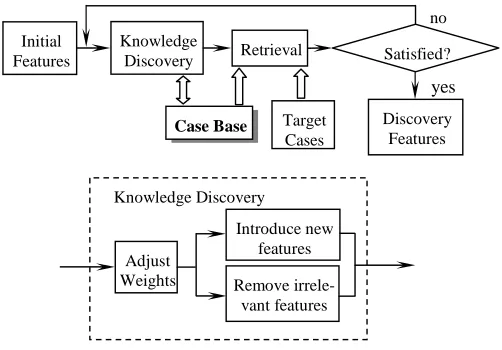
In our CBR system, the training for case representation is a recursive failure-driven process carried out to refine the initial features and their weights. A schematic dia-gram of the knowledge discovery on case representation is given in Fig. 1. The knowl-edge discovery process in the system includes the following steps:
that can contribute successful retrievals are rewarded (increased) to discriminate the source cases that should be retrieved from the others that should not be retrieved.
Removing irrelevant features. After certain rounds of iterative adjustments, the weights of some of the features may be small enough to be removed from the feature list. This means that these features are either irrelevant or less important and thus are not needed in the case representation. Retaining the irrelevant features may confuse the retrieval process, as the similarities between cases may be too close to each other, thus reducing the number of the successful retrievals and decreasing the system per-formance.
[image:6.612.177.428.319.494.2]Introducing new features. When the adjustment of feature weights does not result in a successful retrieval for a target case, new relevant features are added. New fea-tures are proposed by studying if they can distinguish the correct source case from the others, if they can give a prediction of success, or if they can express the specific characteristics in a particular case.
Fig. 1 Schematic Diagram of Knowledge Discovery on Featrues and Their Weights
Due to the complexity of the problem, at the beginning we do not know what features are relevant to the similarity-driven retrieval and which should be used to represent cases. Also we do not know their weights as we do not know how important they are to properly calculate the similarity that influences the heuristic selection. By using the recursive knowledge discovery process presented above, irrelevant and less important features are removed from the initial feature list. The feature vector that gives the highest accuracy on retrievals for all of the target cases will be employed as the basis for the second stage of knowledge discovery. The trained case representation (with 6 features left) after the first stage of training is presented in Appendix D.
no
yes
Knowledge Discovery
Introduce new features Adjust
Weights Remove
irrele-vant features Knowledge
Discovery
Case Base
Initial
Features Satisfied?
Discovery Features Retrieval
Training on the Case Base. Case selection is a particularly important issue in build-ing up a case base. Sometimes, keepbuild-ing irrelevant source cases can decrease the sys-tem performance and increase the space and time requirements of the syssys-tem. The objective of the second stage training is to select a collection of relevant cases without redundancy for the case base.
Firstly we build up two initial case bases with source cases of 9 different sizes with 10, 15, … to 50 courses in them:
a) “OneSet” – For each size, 5 source cases are produced, each has one of the 5 heuristics listed in Appendix A as its best heuristic. We name this case base “OneSet” as it contains one set of the 5 heuristics for cases with different sizes (thus in “OneSet” there are 9 * 5 = 45 source cases).
b) “TwoSet” – For each size, 10 source cases are produced, each two have one of the 5 heuristics listed in Appendix A as their best heuristic. It is named “TwoSet” and in total there are 9 * 5 * 2 = 90 source cases in “TwoSet”. The target cases are produced with the size of 10, 20, 30, … to 100 courses, for each size with 10 instances. Thus there are 10 * 10 = 100 target cases to be tested on the two initial case bases. The best heuristics for each of them is obtained beforehand to evaluate the retrieval.
A database is built up containing these two case bases and the target case set. The training process on these two initial case bases is carried out recursively using the “Leave-One-Out” strategy: Each time a source case is removed from the case base we test to see if the number of successful retrievals on the case base for all of the target cases is increased. If removing a source case decreases the number of successful re-trievals, it will be restored back to the case base as it may contribute to successful retrievals for certain types of cases. Otherwise, if the number of successful retrievals increases or does not change, it will be removed from the case base as a redundant case. The process stops when the highest number of retrievals is obtained on all the target cases.
Finally after the second stage of training, there are 14 and 15 source cases left in the original two case bases, respectively. To test the system performance, an experi-ment is carried out on both the initial and trained case bases for another set of target cases that are, of course, not the same as those of the training set. The accuracies of the system performance on these case bases are shown in Table 1.
Table 1 Accuracies of System Performance on Initial and Trained Case Bases
Case Base Retrieval Accuracy
“OneSet” (45 cases) 42%
“TwoSet” (90 cases) 60%
We can observe that the initial “TwoSet” provides better performance than that of “OneSet”. By storing more source cases, the system is equipped with more knowledge and thus is capable of providing better performance during the retrieval. We can also see that the second training process removes quite a lot of source cases that are redun-dant or that are harmful to the performance of the CBR system. With a smaller number of more relevant source cases retained in the case bases, the system performance is improved to provide higher accuracies of predictions of suitable heuristics. To obtain better system performance, a higher number of relevant source cases need to be se-lected in the case base.
3
Conclusion and Future Work
This paper presents the first step of our work in developing a hyper-heuristic method using CBR for heuristic selection on course timetabling problems. Knowledge discov-ery techniques employ relatively simple methods and just a few training processes are carried out. The results are good and indicate the possible advantages of employing knowledge discovery techniques in the course timetabling domain. We believe better results may be obtained after further training processes are carried out which employ a range of knowledge discovery techniques.
There are many more complex and elaborate techniques that can be investigated and integrated into the CBR system to improve its performance. For example, for the case representation we currently employs a simple technique that is manually carried out to choose the features and adjust their weights. This can be seen as a feature selec-tion task, which is the problem of selecting a set of features to be used as the data format in the system to achieve high accuracy of prediction. Feature selection is an important issue in machine learning [37] for which a variety of traditional techniques exist. Some recent work employing AI methods such as evolutionary algorithms [38] to optimize the feature selection also provide a wider range of possible research direc-tions. For complex timetabling problems, these more efficient algorithms can be em-ployed to carry out the searching on features more effectively when dealing with lar-ger data sets. Our future work will study and compare these different techniques to optimize the case representation to improve the system performance on a wider range of larger timetabling problems. New features are being studied and introduced into the system. For example, some refined features such as the number of rooms with a range of capacities, the number of courses with more than a certain number of constraints, etc can be introduced to give a more specific description of problems. Other issues relating to knowledge discovery in the CBR system may include how to deal with the incomplete data in case bases and how to involve domain knowledge in the system. User interaction in knowledge discovery is also important on tasks like judgment and decision-making, in which humans usually perform better than a machine.
system. Also the testing cases are artificially produced to give a systematic analysis on as many types of problem as possible. After the initial study of using CBR as a heuris-tic selector we have increased our understanding of the area. Real-world benchmark timetabling data (such as that presented in [39]) will be collected and stored in the case base for solving real-world problems. Adaptation may also need to be conducted to utilize domain knowledge on some of the heuristics retrieved for the new problem.
4
References
1. Carter, M.W., Laporte, G.: Recent developments in practical examination timetabling. In: [6]. (1995) 3 – 21
2. Carter, M.W., Laporte, G.: Recent developments in practical course timetabling. In: [9]. (1997) 3 – 19
3. Schaef, A.: A Survey of Automated Timetabling. Artificial Intelligence Review. 13 (1999)
87 – 127
4. Kolodner, J.L. Case-Based Reasoning. Morgan Kaufmann, 1993.
5. Leake, D. (ed.): Case-Based Reasoning: Experiences, Lessons and Future Directions. AAAI Press, Menlo Park, CA. 1996.
6. Burke, E.K., Erben, W. (eds.): The Practice and Theory of Automated Timetabling: Se-lected Papers from the Third International Conference. Lecture Notes in Computer Sci-ence 2079. Springer-Verlag, Berlin. 2000.
7. Burke, E., Petrovic, S.: Recent research directions in automated timetabling. European Journal of Operational Research. 140(2) (2002) 266 – 280
8. Burke, E.K., Ross, P. (eds.): The Practice and Theory of Automated Timetabling: Selected Papers from the First International Conference. Lecture Notes in Computer Science 1153. Springer-Verlag, Berlin. 1995
9. Burke, E.K., Carter, M. (eds.): The Practice and Theory of Automated Timetabling: Se-lected Papers from the Second International Conference. Lecture Notes In Computer Sci-ence 1408. Springer-Verlag, Berlin. 1997.
10. MacCarthy, B.L., Jou, P.: Case-based reasoning in scheduling. In: Khan MK, Wright CS (eds.). Proceedings of the Symposium on Advanced Manufacturing Processes, Systems and Techniques (AMPST96), (MEP Publications Ltd, 1996), (1996) 211 – 218
11. Schmidt, G.: Case-based reasoning for production scheduling. International Journal of Production Economics, 56-57 (1998) 537 – 546
12. Koton, P.: SMARTlan: A case-based resource allocation and scheduling system. Proceed-ings of Workshop on Case-Based Reasoning (DARPA). (1989) 285 – 289
13. Bezirgan, A.: A case-based approach to scheduling constraints. In: Dorn, J. and Froeschl, K.A. (eds.), Scheduling of Production Processes. Ellis Horwood Limited. (1993) 48 – 60 14. Miyashita, K., Sycara, K.: CABINS: A framework of knowledge acquisition and iterative
revision for schedule improvement and reactive repair. Artificial Intelligence, 76 (1995)
377 – 426
15. Cunningham, P., Smyth, B.: Case-based reasoning in scheduling: reusing solution compo-nents. The International Journal of Production Research. 35 (1997) 2947 – 2961.
17. Burke, E.K., MacCarthy, B. Petrovic, S., Qu, R.: Structured cases in CBR – re-using and adapting cases for timetabling problems. Journal of Knowledge-based System, 13(2-3)
(2000) 159 – 165
18. Burke, E.K., MacCarthy, B.L. Petrovic, S., Qu, R.: Case-based reasoning in course time-tabling: an attribute graph approach. In: Aha, D.W. and Watson, I. (eds.): Case-Based Reasoning Research and Development. Proceedings of 4th International Conference on Case-Based Reasoning (ICCBR2001). Lecture Notes in Artificial Intelligence 2080. Van-couver, Canada. (2000) 90 – 104
19. Burke, E.K., Jackson, K.S., Kingston, J.H., Weare, R.F.: Automated timetabling: the sate of the art. The Computer Journal, 40(9) (1997) 565 – 571
20. Werra, D.: Graphs, hypergraphs and timetabling. Methods of Operations Research (Ger-many F.R.), 49 (1985) 201 – 213
21. Carter, M.W.: A lagrangian relaxation approach to the classroom assignment problem. IFOR. 27(2) (1986) 230 – 246
22. Costa, D.: A Tabu Search Algorithm for Computing an Operational Timetable. EJOR, 76
(1994) 98 – 110
23. Abramson, D.: Constructing School Timetables using Simulated Annealing: Sequential and Parallel Algorithms. Management Science, 37(1) (1991) 98 – 113
24. Corne, D., Ross, P.: Peckish Initialisation Strategies for Evolutionary Timetabling. In: [6], (1995) 227 – 240
25. Carrasco, A.P., Pato, M.V.: A Multiobjective Genetic Algorithm for the Class/Teacher Timetabling Problem. In: [19]. (2000) 3 – 17
26. Zervoudakis, K., Stamatopoulos, P.: A Generic Object-Oriented Constraint-Based Model for University Course Timetabling. In: [19], (2000) 28 – 47
27. Burke E., Kendall, G, Newall, J. Hart, E., Ross, P and Schulenberg S: Hyper-heuristic: An Emerging Direction in Modern Search Technology. In: Glover and Kochenberg (eds.) Handbook of Meta-Heuristics. Kluwer 2003, 457 – 474
28. Fang, H.L., Ross, P., Corne, D.: A Promising Hybrid GA/Heuristic Approach for Open-Shop Scheduling Problems. The 11th European Conference on Artificial Intelligence (ECAI’94). John Wiley & Sons, Ltd, 1994.
29. Hart, E., Ross, P., Nelson, J.: Solving a Real-world Problem Using an Evolving Heuristi-cally Driven Schedule. Evolutionary Computation, 6: (1998) 61 – 80
30. Terashima-Marin, H., Ross, P., Valenzuela-Rendon, M.: Evolution of Constraint Satisfac-tion Strategies in ExaminaSatisfac-tion Timetabling. Proceedings of the Genetic and EvoluSatisfac-tionary Computation Conference 1999 (GECCO-99), Morgan Kaufmann, (1999) 635 – 642 31. Shaw, P.: Using Constraint Programming and Local Search Methods to Solve Vehicle
Routing Problems. Proceedings of CP-98. (1998) 417 – 431
32. Berger, J., Sassi, M., Salois, S.: A Hybrid Genetic Algorithm for the Vehicle Routing Problem with Windows and Itinerary Constraints. Proceedings of the Genetic and Evolu-tionary Computation Conference 1999 (GECCO-99), Morgan Kaufmann, (1999) 44 – 51 33. Voudouris, C., Tsang, E.P.K.: Guided Local Search and Its Application to the Travelling
Salesman Problem. European Journal of Operational Research, Anbar Publishing 113(2) (1999) 469 – 499
34. Fayyad, U., Piatetsky-Shapiro, G., Smyth, P.: From Data Mining to Knowledge Discovery in Databases. In: Fayyad, U., Piatetsky-Shapiro, G., Smyth, Uthurusamy, R. (eds.): Ad-vances in Knowledge Discovery and Data Mining. AAAI Press, Melo Park, CA, (1996) 1 – 34
35. Piatetsky-Shapiro, G.: Knowledge Discovery in Databases. AAAI Press, 1991.
37. Hall, M.A., Smith, L.: Practical Feature Subset Selection Machine Learning. Proceedings of the Australian Computer Science Conference. 1996.
38. Freitas, A: A Survey of Evolutionary Algorithms for Data Mining and Knowledge Discov-ery. To appear in: Ghosh, A., Tsutsui, S. (eds.): Advances in Evolutionary Computation. Springer, 2002.
39. Carter, W.M., Laporte, G.: Examination Timetabling: Algorithmic Strategies and Applica-tions, Journal of the Operational Research Society, 74 (1996) 373 – 383
40. Burke, E., Newall, J. and Weare, R.: A Simple Heuristically Guided Search for the Time-tabling Problem. Proceedings of the International ICSC Symposium on Engineering of In-telligent Systems (EIS'98), (1998) 574 – 579
Appendix A: Course Timetabling Problems Specification
Hard constraints:
1. Two courses cannot be scheduled into the same timeslot 2. A course should be carried out n times a week
3. Each course has a specific room requirement with type and capacity 4. There is a specified number of periods for each course timetabling problem Soft constraints:
1. One course should be scheduled before or after another
2. Inclusive/exclusive - a course should/should not be scheduled into a fixed timeslot
3. Consecutive - a course should/should not be scheduled into a timeslot con-secutive to that of another
Appendix B: Heuristics Used in the System
1.LD – Largest degree first.
All the courses not yet scheduled are inserted into an “unscheduled list” in descend-ing order accorddescend-ing to the number of conflicts the course has with the other courses. This heuristic tries to schedule the most difficult courses first.
2.LDT – Largest degree first with tournament selection.
This heuristic is presented in [40]. It is similar to LD except that a course employing tournament selection is selected from a subset of the “unscheduled list”. Here, a probability value of 30% is used to get a subset from the list. This heuristic tries to schedule the most difficult courses first but also give some randomness.
3.HC – Hill climbing.
An initial timetable is constructed randomly then is improved by hill climbing. 4.CD – Color degree.
Courses in the “unscheduled list” are ordered by the number of conflicts they have with those courses that are already scheduled in the timetable. Usually those courses with a large number of such conflicts are harder to schedule than courses with a smaller number of conflicts.
Courses in the “unscheduled list” are ordered by the number of periods left in the timetable for them to be scheduled validly. This heuristic gives higher priority to courses with fewer periods available.
Appendix C: Initial Features and Their Weights for Cases
f0: number of hard constraints / number of events f1: number of soft constraints / number of events f2: number of constraints / number of events f3: number of periods / number of events f4: number of rooms / number of events
f5: number of not consecutive courses / number of constraints f6: number of consecutive courses / number of constraints f7: number of hard constraints / number of constraints f8: number of soft constraints / number of constraints f9: number of hard constraints / number of periods f10: number of soft constraints / number of periods
normalized weight wi = factori * 1 / sum of weights of all the features initial factori = {1, 1, 1, 1, 1, 1, 1, 1, 1, 1, 1}
Appendix D: Trained Features and Their Weights
f0: number of exclusive courses / number of events f1: number of inclusive courses / number of events f2: number of constraints / number of events f3: number of rooms / number of events
f4: number of hard constraints / number of periods