FAULT IDENTIFICATION IN VIRTUAL MACHINES
Chris Schneider
A Thesis Submitted for the Degree of PhD at the
University of St Andrews
2015
Full metadata for this item is available in Research@StAndrews:FullText
at:
http://research-repository.st-andrews.ac.uk/
Please use this identifier to cite or link to this item: http://hdl.handle.net/10023/7327
This item is protected by original copyright
Using Unsupervised Machine Learning for
Fault Identification in Virtual Machines
Chris Schneider
This thesis is submitted in partial fulfillment for the degree of
Doctor of Philosophy
at the University of St Andrews
Abstract
Self-healing systems promise operating cost reductions in large-scale computing environments through the automated detection of, and recovery from, faults. However, at present appears to be little known empirical evidence comparing the different approaches, or demonstrations that such implementations reduce costs.
This thesis compares previous and current self-healing approaches before demon-strating a new, unsupervised approach that combines artificial neural networks with performance tests to perform fault identification in an automated fashion, i.e. the correct and accurate determination of which computer features are associated with a given performance test failure.
Several key contributions are made in the course of this research including an analysis of the different types of self-healing approaches based on their contex-tual use, a baseline for future comparisons between self-healing frameworks that use artificial neural networks, and a successful, automated fault identification in cloud infrastructure, and more specifically virtual machines. This approach uses three established machine learning techniques: Naïve Bayes, Baum-Welch, and Contrastive Divergence Learning. The latter demonstrates minimisation of human-interaction beyond previous implementations by producing a list in decreasing order of likelihood of potential root causes (i.e. fault hypotheses) which brings the state of the art one step closer toward fully self-healing systems.
This thesis also examines the impact of that different types of faults have on their respective identification. This helps to understand the validity of the data being presented, and how the field is progressing, whilst examining the differences in impact to identification between emulated thread crashes and errant user changes – a contribution believed to be unique to this research.
Acknowledgements
This research has been primarily funded by The Scottish Informatics and Computer Science Alliance (SICSA) and by the University of St Andrews, and made possible via the generous time and personal investments of other academics. Thanks go to the following people, in particular:
My supervisors Simon Dobson and Adam Barker, along with Saleem Bhatti and Graham Kirby – all of whom faculty members of The School of Computer Science at the University of St Andrews – and my colleagues Ruth Hoffman and Ildikó Pete – for their guidance, recommendations, time spent proofing, and their invaluable feedback.
Brant Moriarity, Larry Yaeger, Mehmet Dalkilic, Luis Rocha, and Marty Siegel of Indiana University for lessons both academic and social, and their personal investments in my success.
Matt and Brea Carlson, most recently of Wabash College but also of Indiana University, for their guidance, encouragement, and recommendations in getting me started with the academy, and for their continued support.
Susan Hohenberger (Waters) of The Johns Hopkins University for their investment in my education and furthering my foundational knowledge in computer science.
And, to Jeff House, who taught me to program in his own free time and asked nothing in return.
1. Candidate’s declarations:
I, Chris Schneider, hereby certify that this thesis, which is approximately 29,000 words in length, has been written by me, and that it is the record of work carried out by me and that it has not been submitted in any previous application for a higher degree.
I was admitted as a research student in Sep. 2011 and as a candidate for the degree of PhD in [month, year]; the higher study for which this is a record was carried out in the University of St Andrews between 2011 and 2015.
Date 5 Aug. 2015 signature of candidate
2. Supervisor’s declaration:
I hereby certify that the candidate has fulfilled the conditions of the Resolution and Regulations appropriate for the degree of PhD in the University of St Andrews and that the candidate is qualified to submit this thesis in application for that degree.
Date 5 Aug. 2015 signature of supervisor
3. Permission for electronic publication:(to be signed by both candidate and supervisor)
In submitting this thesis to the University of St Andrews we understand that we are giving permission for it to be made available for use in accordance with the regulations of the University Library for the time being in force, subject to any copyright vested in the work not being affected thereby. We also understand that the title and the abstract will be published, and that a copy of the work may be made and supplied to any bona fide library or research worker, that my thesis will be electronically accessible for personal or research use unless exempt by award of an embargo as requested below, and that the library has the right to migrate my thesis into new electronic forms as required to ensure continued access to the thesis. We have obtained any third-party copyright permissions that may be required in order to allow such access and migration, or have requested the appropriate embargo below.
The following is an agreed request by candidate and supervisor regarding the publication of this thesis:
PRINTED COPY
a) No embargo on print copy
b) Embargo on all or part of print copy for a period of … years (maximum five years) on the following ground(s):
Publication would be commercially damaging to the researcher, or to the supervisor, or the University
Publication would preclude future publication
Publication would be in breach of laws or ethics
c) Permanent or longer term embargo on all or part of print copy for a period of … years (the request will be referred to the Pro-Provost and permission will be granted only in exceptional circumstances).
Supporting statement for printed embargo request:
ELECTRONIC COPY
a) No embargo on electronic copy
b) Embargo on all or part of electronic copy for a period of … years (maximum five years) on the following ground(s):
Publication would be commercially damaging to the researcher, or to the supervisor, or the University
Publication would preclude future publication
Publication would be in breach of law or ethics
c) Permanent or longer term embargo on all or part of electronic copy for a period of … years (the request will be referred to the Pro-Provost and permission will be granted only in exceptional circumstances).
Supporting statement for electronic embargo request:
Date 5 Aug. 2015 signature of candidate signature of supervisor
Please note initial embargoes can be requested for a maximum of five years. An embargo on a thesis submitted to the Faculty of Science and Medicine is rarely granted for more than two years in the first instance, without good justification. The Library will not lift an embargo before confirming with the student and supervisor that they do not intend to request a continuation. In the absence of an agreed response from both student and supervisor, the Head of School will be consulted. Please note that the total period of an embargo, including a continuation, is not expected to exceed ten years.
For Emma, who always believed.
C
ONTENTS
Contents i
List of Figures iii
List of Tables vii
1 Introduction 5
1.1 Motivation . . . 6
1.2 Hypothesis & Central Tenets . . . 7
1.2.1 Hypothesis . . . 7
1.2.2 Central Claims . . . 8
1.3 Main Contributions . . . 8
1.4 Definitions. . . 9
1.5 Published Works . . . 12
1.6 Organisation . . . 14
2 Background 15 2.1 Introduction . . . 15
2.1.1 Terminology . . . 16
2.1.2 Assumptions . . . 18
2.2 The History of Autonomic Computing . . . 20
2.2.1 Self-* Systems . . . 21
2.2.2 Self-Healing Systems . . . 23
2.3 Machine Learning Techniques . . . 24
2.3.1 Artificial Neural Networks . . . 25
2.3.2 Hidden Markov Models. . . 26
2.3.3 Restricted Boltzmann Machines . . . 27
2.3.4 Stochastic Primitives . . . 29
3 A Systematic Review of Self-Healing Systems 31 3.1 Methodology . . . 31
3.1.1 Search Process . . . 32
3.1.2 Research Questions . . . 33
3.1.3 Quality Assessment . . . 34
3.1.4 Data Collection & Analysis. . . 34
3.1.5 Results . . . 35
3.2 A Comparison of Self-Healing Systems . . . 35
3.2.1 Management Styles . . . 36
3.2.2 Computing Environments . . . 44
3.2.3 Learning Methodologies . . . 49
3.3 Synthesis . . . 54
3.4 Synopsis . . . 58
4 An Automated Approach for Identifying Faults 63 4.1 Problem Description . . . 63
4.2 Approach . . . 64
4.2.1 Running Example . . . 67
4.3 Experiments . . . 68
4.3.1 Hidden Markov Models & Artificial Neural Networks . . . 70
4.3.2 Restricted Boltzmann Machines . . . 72
4.4 Limitations . . . 73
4.5 Threats to Validity. . . 75
4.5.1 Construct . . . 75
4.5.2 Internal . . . 76
4.5.3 External . . . 77
4.6 Implementation . . . 78
4.7 Comparison & Inference . . . 84
4.7.1 Baseline Establishment . . . 84
4.7.2 UBL - An External Basis for Comparison . . . 85
4.7.3 Collection . . . 88
4.7.4 Classification . . . 89
4.7.5 Learning & Analysis . . . 91
4.7.6 Comparison Constraints . . . 96
5 Results & Discussion 99 5.1 Introduction . . . 99
5.2 Overview . . . 100
5.3 Results . . . 101
5.3.1 The FDFs . . . 103
5.3.2 UBL . . . 116
5.4 Discussion . . . 119
6 Conclusion 127 6.1 Findings . . . 127
6.2 Lessons . . . 128
6.3 Future Work . . . 131
Appendix A Appendix-A 133 A.1 UBL Results . . . 133
L
IST OF
F
IGURES
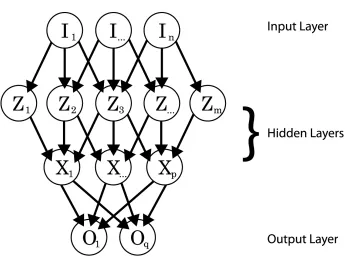
2.1 Artificial Neural Network. ANNs are a type of statistical model that operates
by updating weights along paths between hidden and visible layers to forecast or otherwise ‘learn’ a series of inputs. . . 25
2.2 Hidden Markov Model. HMMs operate by forecasting the hidden layer (Zs) using
observations from a visible set of inputs (i.e. a Markov chain, Xs). Unlike ANNs, HMMs do not use more than two independent layers to separate observed and hidden data. . . 27
2.3 Restricted Boltzmann Machine. RBMs operate similarly to ANNs and HMMs,
but adjust their weights by using an form of alternating Gibbs sampling. This allows them to update their layers in parallel – an advantage over other stochastic primitives. 29
3.1 Management Styles versus Computing Environments. Managed environments
– such as Cloud and n-Tier infrastructures – show a preference for top-down management styles, whereas ad hoc computing environments prefer bottom-up management styles. . . 43
3.2 Learning Methodologies versus Computing Environments. Most self-healing
systems prefer a supervised learning methodology, regardless of the environment it is implemented in. This is useful for ensuring correct behaviours, but also a limitation in potential for autonomy. . . 48
3.3 Learning Methodologies versus Management Styles. When self-healing system
are implemented in a top-down fashion, they tend to leverage supervised learning methodologies. Likewise, bottom-up management styles are more likely to use unsupervised and semi-supervised learning. . . 54
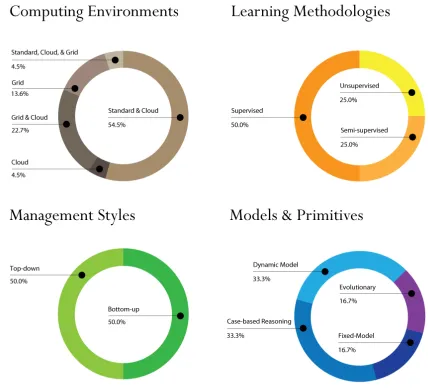
3.4 Self-Healing Systems Frameworks. Self-healing systems frameworks as
cate-gorised by learning methodology, computing environment, and expected manage-ment style by first author’s last name, year of introduction, and framework title (if appropriate). In some cases frameworks exhibit abilities to operate under multiple assumptions – these incidents are represented by additional bullets within the graph. Figure 2.8 divides this information into percentages with each entry represented once per category. . . 55
3.5 Relative Coverage of Different Self-Healing Techniques. . . . 56
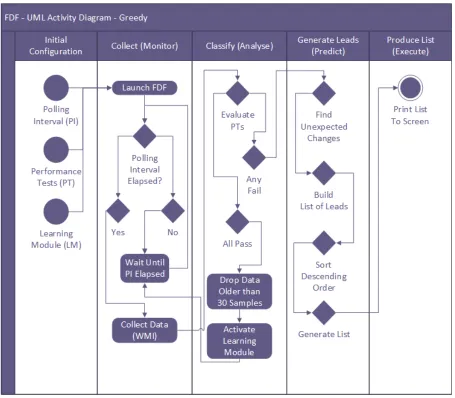
4.1 Fault Detection Framework Logic & Architecture Diagram using Greedy Ingest. The FDF leveraging ANNs and HMMs operates by updating its primitives
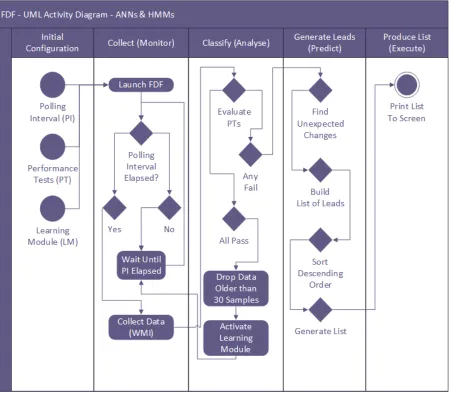
as soon as feature data is recovered from the system. . . 66
4.2 Fault Detection Framework Logic & Architecture Diagram using Lazy Ingest.
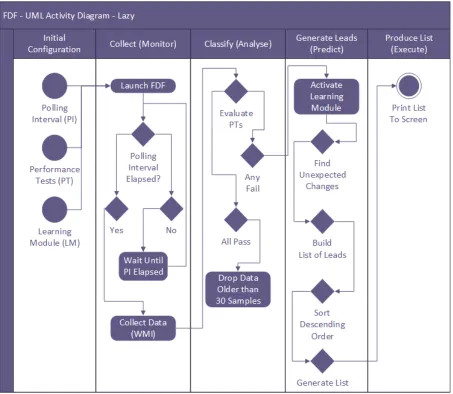
The FDF leveraging RBMs operates identically to the FDF that uses ANNs and HMMs except with a lazy ingest mechanism for feature behaviour data. Primitives using a lazy ingest are only trained upon fault detection. . . 67
4.3 Running Example – Successful Data Collection via FDFs. Cropped image showing successful data collection when running an RBM-based FDF. . . 68
4.4 Running Example – Fault Identification via FDFs. Cropped image showing a
sample of an FDF result screen. The full sized list has been truncated to save space but can contain 5 to 300 leads. . . 68
4.5 Fault Detection Framework Logic & Architecture using Hidden Markov Mod-els and Artificial Neural Networks. Fault Detection Frameworks are provided
three inputs, set to run, and then injected with faults at varying time intervals. The result is an ordered list of leads based on forecasted feature behaviours. . . 71
5.1 FDF v1.0 - Time Taken. Time-Taken represents the number of “ElapsedTicks”
converted to milliseconds (ms) between when a fault is detected and the return of an ordered list of potential root causes. The ANN took less time than the HMM to produce an ordered list of fault hypotheses. Shortened times allow for a wider range of recovery solutions making them more desirable. Both values grow linearly per the amount of data being provided. . . 105
5.2 FDF v1.0 - Confidence. Confidence conveys how likely the FDF’s suspect a given
lead is associated with the correct root cause of the detected fault. Converse to the amount of time taken, the HMM produced much higher confidence values than the ANN. This is a result that was unexpected because of the way that the Baum-Welch algorithm calculates probabilities. . . 105
5.3 FDF v1.0 - Fault Position. The average position of a correct root cause as returned
by the FDF is represented in this graph. As the lists are ordered by descending probability, lower values are better. The averages from the experiments show that the HMM outperforms the ANN in nearly every test. Additionally, fault position improvement is much slower with the ANN. . . 107
5.4 FDF v1.0 - Total Leads. FDFs generate leads when a fault is detected. This graph
represents the average total number of suspect features (i.e. ‘leads’) at 5-point sample intervals. The FDF using HMMs is able to generate more leads than the one using ANNs, however more leads is not always better. The ideal result is a list containing only the features that are associated with the cause of the fault. . . 107
5.5 FDF v1.0 - Precision. HMMs provide more precise results initially, but eventually
trade with ANNs. This is significant in that neither approach is particularly precise, but as more information is added, the HMM appears to drop in precision. This result correlates with more leads being generated, and some second ordering issues. 109
5.6 FDF v1.0 - F-Measure. The F-Measure represents the overall performance of
List of Figures V
5.7 FDF v2.0 - Time Taken. A switch from greedy to lazy data ingest caused an
expected increased time-based performance metrics. This is because all of the calculations for training the RBMs was performed once a fault was detected versus after every collection sample. . . 111
5.8 FDF v2.0 - Confidence. The gradual increase in confidence values via the CDL
appears to be more robust than previous approaches. Rather than a relative value being given or steep increases, a gradual pattern emerges as more data is fed into the FDF. . . 111
5.9 FDF v2.0 - Time Taken - RBMs - Variance. The computational time to generate
leads using RBMs remained largely predictable. The greater the number of features identified for initial investigation, the more time required to complete the calcu-lations. Variance occurred due to the number of leads needing to be investigated. Note: HMM and ANN trials are not included. See Page 105. . . 112
5.10 FDF v2.0 - Confidence - RBMs - Variance. Confidence values generally display little variance. The learning rate of CDL operated as predicted in nearly all cases with one notable exception where the number of features produced by the fault injecting were smaller than previous trials. Investigation into the cause of this yielded inconclusive results. . . 112
5.11 FDF v2.0 - Fault Position. The average fault position when using the RBM appears to be competitive and often outperform other approaches. . . 113
5.12 FDF v2.0 - Total Leads. The total avenues for investigation are much higher when a lazy data ingest is used. . . 113
5.13 FDF v2.0 - Fault Position - RBMs - Variance. This graphs shows results of an identical feature being selected between trials. Normally, the first related feature to the root cause is selected from the list by a test administrator. In this case, only the original feature is selected to help illustrate variance. This helps provide an understanding of how the RBM makes suggestions. At 20 minutes all correct features are categorised within the top 10 leads. . . 114
5.14 FDF v2.0 - Accuracy - RBMs - Variance. The accuracy of the RBM approach increases whilst variance decreases with the exception of differences between 25 and 30 minutes. The reason for this is not fully confirmed. An initial investigation showed maintenance tasks being executed by the operating system at regular inter-vals set for every 30 minutes. This may create additional features for investigation and account for differences in the 30 minute trials. . . 114
5.15 FDF v2.0 - Precision. Precision of the RBMs show a marked improvement on previous ex-periments, however some ramp up time is necessary. Averages of results show a marked improvement between the 20 and 25 minute marks and a stronger trend than prior approaches. . . 115
5.16 FDF v2.0 - Accuracy. RBMs show an improvement in accuracy over other primitives. Initial values start out low, but higher than other approaches. They continue to show steady improve-ment with the possibility of meeting the accuracy of the HMM. . . 115
5.18 FDF v2.0 - F-Measure - RBMs - Variance. A number of minor outliers occurred during the course of these experiments. Some tests provided a larger number of features to examine than were expected, and variance in fault index had an impact on results. . . 116
5.19 Prediction Accuracy Formulas: UBL 4.1: True Positive Rate 4.2: False Positive
Rate . . . 117
5.20 Precision Measurements: UBL & the FDFs. The precision of both FDF ap-proaches remains low, however the RBM approach shows a promising trend as more data is added. UBL’s precision drops the more data is added. The first three metrics show results for fault identification where all features above the correct root cause are considered false positives. The bottom two results ( -ALT) show precision for fault detection. . . 120
5.21 Average Position of Faults Based on Approach: UBL & the FDFs. UBL and the FDFs prioritise potential sources of faults. Correct recommendations are represented as an average of all tests based on primitive type. Lower values signify better recommendations. . . 122
L
IST OF
T
ABLES
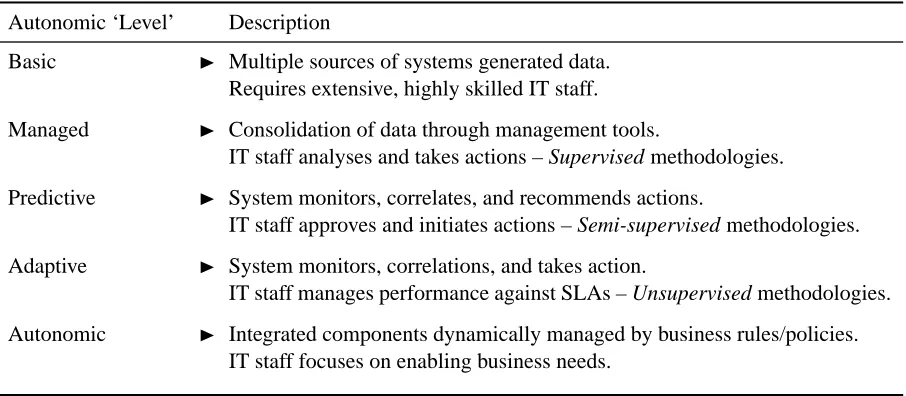
2.1 Autonomic Computing Levels, IBM, circa 2002. This table represents the initial
Autonomic Computing levels proposed by IBM, however a small addition of where Supervised, Semi-supervised, and Unsupervised learning methodologies has been appended. . . 22
4.1 WMI Classes – Names & Unique Column Identifiers. This table illustrates the
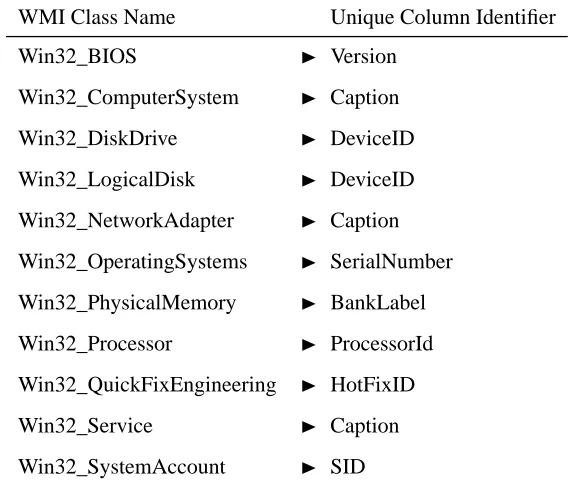
classes and the columns used to uniquely identify rows within the sampled WMI data. 79
4.2 Performance Tests – Names & Descriptions. . . . 81
4.3 UBL Testing Suites. UBL uses various testing suites on a number of application
platforms. Although some of these tests are used across all scenarios, the majority are not. For simplification, a testing matrix is included here.. . . 88
4.4 Summary of Testing: UBL. In the original work, results for UBL are presented
textually, graphically, or sometimes not at all. G = Data via Graph Only, Blank = No Data, TP = True Positives, FP = False Positives. . . 95
4.5 FDF and UBL Property Comparison. This table presents a summary of the
com-parison of operating properties in unsupervised self-healing frameworks discussed in this chapter. . . 98
5.1 Lead Times: UBL. This chart represents the number of seconds UBL identified a
failure before it reached a terminal threshold; higher values are better. Blank = No Data. . . 119
G
LOSSARY
Adverse Configuration Change (ACC) A configuration change either simulated or real made
by a human administrator that negatively impacts the performance of a computer system.
Artificial Neural Network (ANN) A family of statistical learning models used to estimate or
approximate functions. Artificial neural networks are generally presented as systems
of interconnected "neurons" which send messages to each other. The connections have
numeric weights and biases that can be tuned using a learning algorithm and observations
over time. This allows artificial neural networks to exhibit adaptive behaviours.
Application Programming Interface (API) A set of routines and protocols for interacting
with software applications.
Case-based Reasoning (CBR) The process of solving newly observed problems based on
those which are both similar and have been previously observed.
Contrastive Divergence Learning (CDL) A learning algorithm based on alternating Gibbs
Sampling commonly used to train Restricted Boltzmann Machines.
Central Processing Unit (CPU) Computer circuitry used to carry out instructions of a
com-puter program.
Direct Fault Injection (DFI) A type of fault either simulated or real that is not directly
associated with intended use of a computing program or configuration change. Examples
include unexpected thread termination, unexpected resource constraints such as out of memory exceptions, and other computing events typically outwith the intended use of
software by a human administrator.
Domain Name Service (DNS) A service that resolves human-readable fully qualified domain
names to internet addresses; e.g. www.google.com –> 173.194.45.48. DNS services underly much of the basic functionality of the internet.
Fault Detection Framework (FDF) A computing application used to detect anomalies within
a computing system.
Genetic Algorithm (GA) An heuristic, iterative search algorithm that combines stochastic
generation of new "populations" subsets with fitness tests to dynamically generate new,
stronger outputs.
Generative Stochastic Network (GSN) A type of artificial neural network being pioneered
using revisions to the backward propagation of errors learning algorithm.
Hidden Markov Model (HMM) A statistical model that attempts to forecast behaviours based
on observed information – requires the system being observed to be a Markov process
with unobserved (i.e. hidden) states – that is typically paired with the Baum-Welch
learning algorithm.
Infrastructure as a Service (IaaS) A type of internet-based (i.e. cloud) service that provides
access to hardware and basic, low-level software services. This allows for greater
customisation potential for clients, but also more overhead. See "Software as a Service",
and "Platform as a Service".
Integrated Development Environment (IDE) Any environment used for programming
soft-ware on a computer system.
Internet Information Services (IIS) Microsoft branded service used for delivering web-based
content (i.e. HTTP, HTTPS) on the internet.
Java Virtual Machine (JVM) A virtual machine used for running Java-based programming
code. It is administrated by the Java Runtime Environment.
Java Runtime Environment (JRE) An environment for instantiating and controlling Java
Virtual Machines.
κ-Nearest Neighbour (κ-NN) A supervised method for building a classification model using
feature data. These models can be used to forecast computer feature behaviours.
Principal Component Analysis (PCA) An eigenvector-based multivariate analysis procedure
that uses an orthogonal transformation to convert a set of observations of possibly
correlated variables into a set of values of linearly uncorrelated variables called principal
components. It is used primarily to reduce the dimensionality of data and determine
principal components of interest.
3
Platform as a Service (PaaS) A type of internet-based (i.e. cloud) service that provides access
to a pre-determined platform for end users to interact with typically offering moderately
developed, self-contained services. This allows for less customisation potential than IaaS
offerings but also less overhead for use. See "Service as a Service" and "Infrastructure as
a Service".
Quality of Service (QoS) A term to represent the overall performance of a computing service
including availability, reliability, and similar measures.
Restricted Boltzmann Machine (RBM) A type of artificial neural network based on a
Boltz-mann Machine. It typically consists of hidden and observed layers of "neurons"; (see
Arti-ficial Neural Networks). Unlike fully recurrent neural networks, Restricted Boltzmann
Machines do not allow direct cross communication between neurons on their respective
layers.
Receiver Operating Characteristic (ROC) A graphical plot that illustrates the performance
of a binary classifier system as its discrimination threshold is varied. The curve is created
by plotting the true positive rate against the false positive rate at various threshold settings.
Service as a Service (SaaS) A type of internet-based (i.e. cloud) service that provides access
to a service front-end and minimal infrastructure resources or platform customisation. This typically offers well developed, self-contained services with little to no
customisa-tion. (See Platform as a Service and Infrastructure as a Service).
Service Level Agreement (SLA) An agreed upon objective – usually between multiple
enti-ties – regarding computing performance.
Service Level Objective (SLO) A policy or other formal, written obligation regarding the
intended minimum performance of a computing system or service.
Self-organising Map (SOM) A type of artificial neural network (ANN) that is trained using
unsupervised learning to produce a low-dimensional representation of an input space.
Self-organizing maps are different from other artificial neural networks in that they use a
combination of neighborhood functions to preserve topological properties of the input.
Scalable Vector Graphic (SVG) A lossless image format that uses vectors to redraw scaled
images upon demand.
Unified Modelling Language (UML) A General purpose modelling language used for
Unsupervised Behavioural Learning (UBL) An approach for understanding errant
comput-ing system behaviours uscomput-ing unsupervised learncomput-ing within a self-organiscomput-ing map.
Virtual Machine (VM) A simulated computing system typically running inside a hypervisor
or larger (sometimes physical) apparatus.
Windows Management Interface (WMI) A proprietary service offered by Microsoft
1
C
HAPTER
O
NE
I
NTRODUCTION
This thesis focuses on self-healing systems, how they operate, and advances in their respective
detection strategies. It describes exigencies in this area of study and then demonstrates positive results from two separate experiments using stochastic primitives that leverage unsupervised
learning. Using a combination of unsupervised learning, stochastic primitives, and
per-formance tests, the root cause of a fault in cloud infrastructure (i.e. virtual machines)
can accurately be identified by comparing a system’s observed and predicted feature
behaviours.
The increasing complexity of modern computing environments is continuing to produce
chal-lenges in reliable and efficient systems management. Complexity has convoluted administrative requirements such that the static capabilities of human-based supervision are showing decreases
in their relative effectiveness [1, 2, 3, 4]. This is increasing the costs of systems management whilst simultaneously failing to address longstanding problems–such as issues with change
management, and simple human error [5, 6]. These issues are particularly evident in multi-tier architectures where services comprise of several sets of systems with differing responsibilities.
The advent of self-adaptive systems is an approach in addressing the rising complexity
require-ments of systems management [7, 8]. These systems address multiple problems within this space from configuration (i.e. provisioning), optimisation, protection, and
self-healing. Self-healing systems attempt to classify and analyse sensory data to automate the
detection then mitigation of faults. This in turn reduces the need for systems to interface with
human administrators, which presumably lowers operational costs and, ideally, improves upon
existing mitigation techniques.
There are varying degrees of autonomy within self-healing systems. This is largely
depen-dent upon the type of computing environment, management style, and learning algorithms
or primitives used. The latter topic can broadly be summarised as the difference between
reactive versus proactive (i.e. supervised and unsupervised) strategies, respectively. Reactive
solutions are constrained to resolving faults only after they have been previously observed,
a fortiori. In order to realise fully self-healing systems, a shift must occur from supervised
to unsupervised learning strategies. Unsupervised strategies allow for this shift by anticipating
faults in circumstances that have not been previously observed and, principally, offer the highest
potential degree of reduction in human intervention. However, the use of such techniques come with costs – including potentially higher rates of error, and a lack of scrutability for some types
of errors.
Additionally, criteria on the viability of self-healing – or self-adaptive – solutions have not been
agreed upon. The simple fact of the matter is that there is no public information on what types
of behaviours, error rates, or resource utilisations are acceptable for self-healing systems in
production environments. One of the primary goals of this thesis is to encourage adoption of
these techniques in such environments and demonstrate their potential viability.
1.1
Motivation
The realisation of self-healing systems presents a number of potential benefits in large-scale computing environments including the reduction of operational costs, faster fault mitigation
than existing methodologies, and fewer problems related to complexity – such as human error
in the consistency of systems’ configurations and change control procedures [4]. However, there is presently no public data to support these claims, nor – prior to this work – are there
any known studies that compare one type of self-healing system to another based on either
performance metrics or their intended use. For those works that do exist within this area of
research, their use depends on simulated data or they operate under artificial constraints.
Using stochastic primitives, performance tests, and unsupervised learning in conjunction allows
for the accurate identification of problem areas within an infrastructure without having to train
highly specialised members of staff – an action that is believed to be potentially cost reducing
– whilst also shifting from reactive to proactive fault mitigation. Proactive mitigation promises
faster resolutions than human counterparts, and reduction of down-time compared to reactive
approaches.
1.2. HYPOTHESIS & CENTRAL TENETS 7
However, it is anticipated that these types of studies will be more likely to occur once accuracy
and timing expectations having been clearly set – which this thesis helps to establish.
This thesis provides the first known direct comparison of self-healing systems methodologies
(i.e. frameworks) in order to establish a baseline, and it attempts to understand their respective
specialisations in terms of computing environment, preference in primitives and learning
algorithms, and their management styles. It then goes on to describe a novel approach for
identifying the root cause of faults using stochastic primitives and unsupervised learning using non-simulated data in a fully reproducible manner. Results, code, and associated assets are
provided to the public for the purposes of validation.
1.2
Hypothesis & Central Tenets
The general hypothesis and claims within this thesis are summarised here. Many of these
statements rely upon further explanation or references that are provided later in their respective
chapters.
The central hypothesis is listed here first, with central claims following:
1.2.1
Hypothesis
Using a combination of unsupervised learning, stochastic primitives, and performance
tests, the root cause of a fault within virtual machines can accurately be identified in cloud
infrastructure by comparing a system’s observed and predicted feature behaviours.
Success is determined if an accurate list sorted by descending order of potential root causes
is correctly returned upon instantiation of a fault with a known root cause in a controlled computing environment. A list will be accurate overall if it contains the correct root cause
in the top 10 recommendations. Accuracy and precision will be measured by understanding the
relative position of root causes in proximity toward the first position in the ordered list.
Failure is determined upon any result where the root cause of a fault is not immediately and
accurately evident or it is below the top 10 – this includes any failure of the software in question,
or its dependencies.
For constraint reasons at the minimum bound, the smallest dataset sample will be five minutes.
1.2.2
Central Claims
1. Automated fault detection is important and has the potential to reduce operating costs
and complexity in maintaining large-scale computing environments. This is based on the assumption that systems within such environments can detect and enact recovery strategies
faster than their human counterparts, and that some environments – particularly
auto-provisioning clouds – are becoming too complex to manage manually.
2. Using high-level performance tests is necessary to categorise observed data and it emulates
and adheres to existing research within the field of administering systems using ‘policies’
rather than individual technical corrections [4].
3. This thesis assumes that: 1.) Some faults will not be detected by the framework application
presented in this thesis, and 2.) by definition, it is unknown which faults will not be detected.
For these reasons all of the generated outputs of the services described herein are evaluated manually to ensure accuracy.
4. Some faults are not recoverable – such as hardware errors. The types of faults anticipated
in this book are limited to those that are recoverable only: adverse configuration changes (ACCs) (i.e. human error) anddirect fault injections (DFIs) (i.e. intentionally crashing a service or application by corrupting its allocated memory).
5. Finally, this thesis is limited in scope. It does not attempt to make new research claims or
changes to the state of the art regarding learning algorithms, stochastic primitives, or other,
related areas of study. Although some premises are provided for the selection and use of
the artificial intelligence techniques used in this thesis, operating theories behind learning algorithms, stochastic primitives, and other topics are not addressed in depth. Likewise,
paradigm matters – such as if the primary focus of self-healing systems should be on fault
tolerance or fault remediation – are intentionally not addressed.
This thesis only focuses on providing a novel approach for the automated determination of
the root cause of a fault under controlled conditions, and attempts to lay the foundation for
further studies in this specific area of study.
1.3
Main Contributions
1.4. DEFINITIONS 9
1. A survey of self-healing systems that contrasts computing environments, learning
algo-rithms, and management styles, (Chapters2,3)
2. A novel approach for self-healing systems that combines unsupervised learning with
stochastic primitives to analyse feature changes in order to accurately generate a descending
ordered list of fault hypotheses, (Chapter4)
3. Foundational work for comparing fault identification approaches using unlabelled data,
including the first known direct comparison of self-healing systems’ approaches, (Chapter
4, Section4.3and Chapter5) and
4. Results that show a demonstrable improvement in accuracy over existing approaches under
similar conditions (Chapter5).
1.4
Definitions
The majority of terms used within this book are primarily in reference to IBM’s initial
parlance, or those terms provided in Rodosek, et al’s, Self-Healing Systems: Foundations and
Challenges [9]. Definitions to terms based on these prior works may be occasionally updated to address current technological trends and research, with such instances being called out when appropriate. In some cases new terminology is provided to accent critical areas of research, or
to call out important information – such as the difference between human error leading to faults
(ACCs), and faults caused by unexpected program failures (DFIs). Definitions of common terms are provided here for ease of reference:
Accuracy How close the measured value is to the actual (true) value. Depending on the context
this is measured by whether or not the correct feature is in the top 10 features returned
in the ordered list of leads, or by measuring all correct cases overall all sampled cases –
(Nt p+ Nt n) / (Nt p+Nt n+N+f p+Nf n). Any features ordered higher in the list than one
identified by the test administrator are considered false positives.
Availability Whether or not a computing system is accessible – e.g. via expected services.
Churn The rate at which computing device membership changes within a computing
environ-ment [10].
Clouds Collections of either real or virtualised computing devices that are centrally managed,
be configured identically, housed in a data-centre, and operated by a large professional or
academic staff [10,11].
Confidence A representation of a learning algorithm’s perceived likelihood that a specific
feature is related to the root cause of the fault – i.e. the probability of unexpected
behaviour of a feature given some number of prior observations.
Note: Confidence value generation depends on the learning algorithm being used. For
Naïve Bayes it is a weighted proportion of the previously viewed feature changes up to
the maximum window size – i.e. 30. For Baum-Welch, an expectation-maximisation
(EM) algorithm is used to find the maximum likelihood of potential behaviours using
all of the observed set of feature inputs – this produces a proportional result with one
value always equaling 100%. WithContrastive Divergence Learning (CDL), an “energy function” is used – see Section2.3.3and associated literature [12,13,14].
Drift A specialised term used to describe the phenomenon of the potential loss of accuracy
between when a test completes as related to when feature data was last sampled from a
computing system.
ElapsedTicks A programming object used for tracking time in C# that automatically accounts
for differences incentral processing unit (CPU) frequencies. This is not to be confused with “Elapsed Ticks”, which are a similarly named programming object also used in C#
for time calculations, but do not take into account differences in CPU cycles between computing systems.
ElapsedTicks are used to ensure greater reproducibility – minute differences in machine
configurations and operating systems can impact the results gained from using traditional
timing mechanisms. These differences occur regardless of hardware specification and
can manifest even under identical configurations due to differences in timing frequency on system boot [15].
Fault Detection The process of determining when a fault is present.
Fault Identification The process of determining the root cause of a fault, if present.
Fault Position The position of the correct root cause of a fault in a list of fault hypotheses or
“leads”.
Feature(s) Any property – such as a performance metric or configuration value – in a
comput-ing system that details or describes a computcomput-ing system’s state. Examples include free
disk space, an internet protocol address on a network interface card, a working directory,
1.4. DEFINITIONS 11
Grids A voluntary collections of either physical or virtual computing systems that share
resources, and typically consist of multiple, heterogenous configurations. In these
environments churn – the rate at which membership changes – is expected to be high, and
systems are expected to be managed in an ad hoc fashion. This can translate to computing
environments that do not require professional services to operate, such as those housed in
a data-centre.
High Availability High availability is defined as having less than 5 minutes of service
down-time in a normal 365 day calendar year or ~99.999% availability; also known as “Five
Nines” in industry nomenclature.
Large-scale computing environment A distributed, possibly world-wide, collection of
com-puters that consists of many different layers of components. This term is kept intentionally
ambiguous to address a plethora of acceptable solutions and conditions and avoid over
specialisation.
Although there are numerous interpretations as to what constitutes a computing
environ-ment the majority of terms applied within this thesis are taken from a single source [11].
Performance Test An human supplied set of logical conditions capable of being discretely
evaluated which indicate whether or not a computing system is operating within expected
and acceptable boundaries (see Service Level Objective(s)). Sometimes discussed in
association with Fitness Tests when discussing Genetic Algorithms.
Precision How close the measured values are to each other.
Root-cause Analysis The act of determining the source or sources of a particular fault; in this
case the determination of which feature or set of features triggered or contributed to said
fault such that a service-level objective or performance test failed to be met.
Reliability A percentage of time that a computing system operates as expected.
Self-healing Systems Self-healing systems are defined as servers – either physical or virtual –
that detect and recover from faults without in an automated fashion without interrupting
the overall usable state of a service where possible; some faults are assumed to be
unavoidably service impacting.
Specifically, self-healing systems are virtual machines that are intended to exist within a
large-scale computing environment under the above definition. These environments are
assumed to host a service requiring high-availability.
Standard Computing Environments (i.e. Traditional computing environments) are defined
as established, non-virtualised and typically legacy computing environments that are
otherwise similar in definition to clouds.
Stochastic Primitive A special, collective term for computing primitives that leverage a
ran-dom probability distribution or statistical model to forecast and approximate outputs of
a given function. This typically includes Artificial Neural Networks, Hidden Markov
Models, and Restricted Boltzmann Machines.
Supervised Learning The use of labelled data to train a computing primitive to infer a
function. Typically, this is achieved by pairing an expected output with an input.
Time-Taken The total time required in ElapsedTicks between service-level objective (SLO)
failure and print out of an ordered list of fault hypotheses to an output screen or terminal
(see ElapsedTicks).
Total Leads The total number of fault hypotheses generated by a stochastic primitive at the
time of SLOfailure. This represents the total number of avenues to be explored by the
Fault Detection Framework (FDF).
Unsupervised Learning The use of unlabelled data to train a computing primitive to infer
a function. Data is provided to the primitive without reinforcement or an expected
output. This allows the primitive to build representations of the input for later decision
making [16].
1.5
Published Works
This thesis incorporates work that has been previously peer-reviewed, published, and presented:
1. C. Schneider. "Autonomic Techniques for Systems Management" (Poster Session). Sixth
International Workshop on Self-Organizing Systems (IWSOS) 2012. Delft University of
Technology. Delft, The Netherlands. 15-16 March 2012. [17].
This work was primarily focused on fault discovery mechanisms in self-healing systems,
and, broadly, discussed what autonomic techniques were currently in place for their
subse-quent self-management. An overview, motivation, and summary of the problem space as it
existed in 2012 were provided along with a preliminary description of the approach to be
1.5. PUBLISHED WORKS 13
2. C. Schneider, A. Barker, and S. Dobson, "A survey of self-healing systems frameworks", in
Software Practice and Experience, Wiley, 2013. [7]
The journal of Software Practice & Experience published the literature survey included in
this book (Chapter2). It provides an overview of the history of the Autonomic Computing initiative before focusing specifically on self-healing systems and a contextual examination
of their implementations.
3. C. Schneider, A. Barker, and S. Dobson, "Autonomous Fault Detection in Self-healing Sys-tems: Comparing Hidden Markov Models and Artificial Neural Networks", in Proceedings
of International Workshop on Adaptive Self-tuning Computing Systems, ADAPT ‘14, (New
York, NY, USA), pp. 24:24–24:31, ACM, 2014. [18]
This is the first publication presenting the approach described in this thesis. It incorporates
the design, development, and metrics gathering processes associated with subsequent
ex-periments, and provides a baseline for the more complex approach utilised in the following
paper.
4. C. Schneider, A. Barker, and S. Dobson, "Autonomous Fault Detection in Self-healing
Systems using Restricted Boltzmann Machines", in 11th IEEE International Conference
and Workshops on the Engineering of Autonomic Autonomous Systems, (Laurel, Maryland),
IEEE Computer Society, IEEE, 2014. [19]
This paper represents the state of the art as proposed in this thesis for generating fault
hypotheses using stochastic primitives and unsupervised learning in self-healing systems. It
compares results with the previously mentioned approach before laying the foundation for future work.
5. C. Schneider, A. Barker, and S. Dobson, “Evaluating unsupervised fault detection in
self-healing systems using stochastic primitives,” EAI Endorsed Transactions on Self-Adaptive
Systems, vol. 15, January 2015. DOI:10.4108/sas1.1.e3. [20]
This is a summary paper published in the journal EAI Endorsed Transactions on
Self-Adaptive Systems that discusses and contrasts both prior works with an external experiment
1.6
Organisation
This thesis is divided into five chapters and one appendix. Chapter 1 introduces self-healing
systems, the motivation and claims discussed herein, and provides an overview of
contribu-tions and structure within this thesis. Chapter 2 summarises prior research by contrasting
the management styles, computing environments, and learning algorithms of existing self-healing systems before concluding with exigencies in the field, an in-depth motivation, and
an hypothesis. Chapters 3 and 4 describe the approaches used to evaluate the hypothesis,
including theoretical assumptions, technical specifications, and implementation details of the
experiments, and discusses their results, respectively, in chronological order of publication
2
C
HAPTER
T
WO
B
ACKGROUND
This chapter discusses the history of self-managing systems – chiefly from the context of IBM’s
Autonomic Computing Initiative. The following chapter builds on this information to expand the motivation provided in chapter one.
2.1
Introduction
Self-healing methodologies are often realised through the use of machine learning techniques
or other aspects in artificial intelligence. They have have been described via architectural
differences [21], network behaviours [8], research areas [22], biological likenesses [23], and, most recently, by contrasting their learning algorithms, implementation, and management
styles [7]. These surveys have produced a broad spectrum of knowledge and highlighted notable advances and exigencies within the field. However, the effectiveness of these solutions and the
commonalities shared between implementations have not yet been fully explored.
This chapter discusses the background of such systems, and helps to lay the foundation for
further exploration in comparing healing systems methodologies. It uniquely divides
self-healing behaviours contextually which is based on the idea that not all approaches are created
equal, nor appropriate given the purposes of their implementations.
The type of environment or infrastructure in which healing frameworks operate, the
self-healing behaviours or problems expected to be addressed, and their manageability
require-ments or hierarchical needs are critical for understanding self-healing systems research and methodologies. These factors are categorised herein as computing environments, learning
methodologies, and management styles, respectively. Analysing self-healing frameworks
based on commonly shared use-cases (i.e. tiers) allows for a comparative understanding of
each methodology, their respective benefits, and their relative human costs. By contrasting
behavioural properties with their expected implementation and level of autonomy, this chapter
provides a greater understanding of which techniques are being leveraged, and under what
circumstances. It also examines correlations between these factors by exploring the type of
self-healing methodologies as related to their expected environment.
2.1.1
Terminology
Although some definitions have been attempted, the terminology used within self-healing
systems is not fully agreed upon [4,9]. This has caused confusion when similar or sometimes identical terms are used under different connotative assumptions. This is particularly evident in
self-healing systems where common goals are shared but approached under different
ideologies-such as self-*, self-managing, mimetic, and evolutionary computing. When this happens
definitions can have unexpected cross referencing problems – such as those between self-healing, and self-configuring.
Ambiguity in terminology is also a major issue. Self-managing systems–a term broadly
associated with systems that can monitor and adjust their own behaviours–represents a large
area of study. As such, some approaches divide self-managing systems into tenets–e.g. IBM’s
Self-* approach [2, 4]. IBM’s tenets are categorised into healing, configuring,
Self-protecting, and Self-optimizing behaviours. Self-healing systems, specifically, are defined as
“... systems [that] discover, diagnose, and react to disruptions. For a system to be self-healing, it must be able to recover from a failed component by first detecting and isolating the failed component, taking it off line, fixing or isolating the failed component, and reintroducing the fixed or replacement component into service without any apparent application disruption.” [4] [p. 8].
However, what constitutes the successful implementation of self-healing systems is much more
equivocal.
In 2003 Ganek and Corbi state “...self-healing and self-configuring is the ability to dynamically
2.1. INTRODUCTION 17
and Corbi: It does not readily address the current trends in technology, that some faults are
unpreventable and will require a system shutdown to mitigate, or that some faults may not be
predictable (but still recoverable).
Technological trends have shaped the way in which self-healing systems are being defined.
The rise of mass virtualisation post 2003 has arguably allowed for large-scale computing
environments to accept the arbitrary shutdown of one system to be replaced by a new, better
configured virtual instance without interruption to live, production services. It is this environ-ment upon which the theories in this book are largely based. However, these theories are built
with the expectation that if it works in virtual environments, it should also work in physical
environments.
Some faults will not be preventable – such as hardware failures, software corruption, or poor
decisional choices by human agents. In these circumstances a system shutdown may be
unavoidable. Such circumstances should not invalidate the legitimacy of self-healing systems
as an approach.
Some faults are not predictable but are still recoverable. In those instances the success of a
self-healing system should be defined by evaluating its enactment of a self elected course of action–
or recovery strategy. A recovery strategy should be at least equivalent to a human counterpart in
terms of mitigating the faults, and ideally implemented in a faster, and yet still accurate fashion.
Under these considerations the latter stipulation – that a system cannot be shut down to address a fault – is considered to be obsolete. Additionally, because Ganek and Corbi’s definitions do
not address current technological trends, they do not feel well enough defined to be of sufficient
use.
If a self-healing system automatically corrects a fault by changing a program’s feature
be-haviour, is that a form of self-configuration? What if that feature behaviour is adjusted
through a configuration file? The vast majority of self-healing systems experiments leverage
autonomous reconfiguration as a mechanism for addressing faults – either before or after they happen. Broadly summarised, key approaches consist of local parameter tweaking (including
evolutionary, bio-inspired, and search-based techniques) [18, 19, 24, 10, 25, 26, 27, 28, 29], behavioural correlation [30, 31, 32], contextual weighting of information (i.e. windowing) [18, 19, 33, 34, 29, 35], self-election of roles based on availability and load [36, 37, 38], and atomistic reconfiguration – the independent discovery and use of openly exposed resources [39]. Notably, a number of frameworks implement more than one approach – particularly parameter
In fact, the changing of a system’s overall state in any self-elected manner – which happens
almost continuously in most systems anyway – provides ambiguity to the term in general.
Self-healing and self-configuring in these respects are, arguably, almost synonymous in definitions
in such cases.
Self-configuration does remain a unique and valid subset of self-management – however, due to
confusion between the defined areas of focus of the aforementioned tenets [4], it behooves us to expand on and clarify the initial definition of self-healing systems. Initially, self-configuring systems were described in the following manner:
“When hardware and software systems have the ability to define themselves them-selves ‘on-the fly,’ they are self-configuring. This aspect of self-managing means that new features, software, and servers can be dynamically added to the enterprise infrastructure with no disruption of services.” [4] [p. 8].
In modern parlance, this behaviour is more akin to self-provisioning – the autonomous
instan-tiation and adoption of a configuration subset (or role) within an infrastructure. Many cloud
computing environments accomplish this behaviour through provisioning managers – but their
specifics are varied and are outside of the scope of this work.
Self-healing systems are then taken to mean any system leveraging a framework that
au-tonomously detects and then subsequently generates a recovery strategy from said fault – where possible. Caveats to this definition include the ability to detect faults that are not able to be
mitigated, and that some faults cannot (or occasionally will not) be detected before they occur.
That is to say a system need not detect every potential fault perfectly or risk not being able to
be defined as a self-healing system.
The decision to define self-healing systems in this manner is not arbitrary and is based on prior
work as described in the following Section2.1.2, and in Section1.4.
2.1.2
Assumptions
The definition of self-healing systems has been expanded to include behavioural aspects that
are commonly evaluated in modern computing infrastructures. It is no longer acceptable for a
system to simply detect and recover from faults – it must do so transparently, and within certain
performance criteria. As such, some assumptions about how self-healing computing systems
2.1. INTRODUCTION 19
The integration of behavioural aspects has helped to unify business needs with IBM’s original
vision of self-healing systems. By adopting partially self-healing systems into traditional
infrastructures, an evolution of techniques and new self-healing systems methodologies have
emerged. However, not all self-healing methodologies are compatible with existing
infrastruc-tures and the maturity of many of these techniques has not been fully realised. As self-healing
systems methodologies become more mature, less human supervision should be required.
One approach to understanding maturity in a self-healing environment is by evaluating systems state via behavioural properties [9, 40,6]. By understanding when and how long a system ex-ecutes self-healing behaviours, it becomes possible to evaluate self-healing approaches against
existing implementations. Understanding the effectiveness of self-healing computing systems
against current approaches provides a practical baseline for understanding the advancement of
self-healing systems outside of the Autonomic Maturity Model.
Although there are numerous physical components that make up large-scale computing
envi-ronments, the scope of this thesis primarily emphasises virtual servers as central points of focus. It is important to note that exigencies can exist outside of this scope, which the server is still
responsible for identifying. Examples of this include network connectivity diagnosis, and being
able to determine resource availability, such as a remote application programming interface (API).
Devices in these environments are expected to have high-availability constraints, and be
relatively static in terms of their rate of churn. Typically, large-scale computing environments
utilise multi-tiered architectures divided into front-end, middleware, and back-end sub-divisions that exist absent of virtualised components. Standard (i.e. traditional) computing environments
are intended to represent the most common configurations for small, mid, sometimes large-size
network-aware service applications.
It is assumed that self-healing behaviours in computing environments may never be fully
realised and that some problems will indefinitely require human interaction. Although this
is not in keeping with the initial proposal, at some point it is perhaps unavoidable. For example,
there are no known software solutions to mitigate non-redundant hardware failures. However, diagnosing and escalating such a situation to an administrator is still a desirable self-healing
behaviour. As such, systems that can operate to the edge of their limitations are still considered
to be successfully self-healing.
That being said, shifting from supervised to unsupervised learning is assumed to be more likely
to produce fully automated self-healing behaviours. Supervised approaches, by definition, can
costs as they still require human interaction [28].
As large-scale computing infrastructures have become more complex, existing methods for
operating and maintaining systems have become less effective [4]. Anecdotal evidence suggests that the use of skilled engineers to apply monitoring techniques that search for faults, engage in
root-cause analysis, and execute appropriate recovery strategies remains the de facto standard
of most professional organisations. Most of these monitoring techniques utilise some form of
behavioural test to indicate when a fault is present. Self-healing systems seek to automate these processes. If a service fails, rather than requiring an engineer to intervene, a self-healing system
would autonomously diagnose the fault and then execute a recovery strategy.
Lastly, recovery is assumed to be a more difficult problem than detection – as Kephart said: “The
final stage, automated re-mediation of a problem once it has been localized, is perhaps the most difficult.” [5]. However, the detection of faulty states is necessary before executing recovery strategies, a fortiori. This logic is the foundation upon which some aspects of framework
maturity are gauged – a topic discussed further in Section2.2.1.
2.2
The History of Autonomic Computing
Many of the methodologies discussed in this paper refer to existing works in Autonomic Computing. Autonomic Computing covers a wide range of topics in self-managing systems–
including self-healing, self-optimisation, self-protection, and self-configuration properties.
Al-though a familiarity with this area of research is assumed, a summary of foundational literature
is provided here for ease of reference.
This section discusses in brief the Autonomic Computing Initiative [2], and the goals and criteria of self-healing systems, as initially described by IBM and subsequent publications [4,3]. The illustration of these goals provides a way to narrow the problem space into addressable components and brings context to the methodologies presented in this survey.
The Autonomic Computing Initiative was proposed in 2001 to address growing complexity in
systems management [2]. IBM proposed building software that could autonomously manage systems using a series of closed control loops and environmental knowledge per the work of
Dave Clark, et alia [41]. Environmental knowledge is often denoted simply as K. Recursive software elements combine contextual information (i.e. K) with a series of inferential steps
2.2. THE HISTORY OF AUTONOMIC COMPUTING 21
2.2.1
Self-* Systems
In 2003, IBM published two articles that built upon their initial proposal outlining the
aforemen-tioned four primary tenets in Autonomic Computing, a general process for autonomic systems management [3], and a set of criteria that described behavioural levels and generic goals of self-managing systems [4]. The process for automating systems management tasks, often referred to as MAPE+K, outlined a recursive approach for continuously understanding and making changes
to a system’s state. By utilising knowledge (K) about a system’s environment, a designated
software agent would: Monitor, Analyse, Plan, and Execute (MAPE) instructions to meet
user-specified policies. Since its introduction, MAPE+K has proven to be a central component in
many self-managing systems implementations.
In order to understand the effectiveness of a given MAPE+K based process, behavioural
benchmarks (i.e. levels) were used to evaluate the implementations’ maturity [4]. These levels ranged from basic to fully autonomic and were evaluated based on whether they could
consolidate information, recommend an action, autonomously take an action, and finally
interpret a user-specified policy to do all of the aforementioned behaviours (Figure 2.1). Importantly, this article recommended an evolutionary approach in reaching each of these
stages. Building self-managing systems that operate at different levels permits heterogeneous
infrastructures, and allows for the gradual adoption of Autonomic Computing technology. This
includes environments where existing systems may not be compatible with all of the autonomic
computing levels.
To address the challenges proposed in these two articles, agent-based approaches for managing
systems were introduced [6]. Utilising aspects in artificial intelligence, this work was based on an earlier text discussing reflex, goal, and utility agents [42]. Simply stated, reflex agents use if-then rules to map actions to a specified state. In practice, this approach is used once some
condition is met to execute a pre-specified set of instructions. Goal and utility-based agents
attempt to exhibit rational decision making by autonomously determining what actions to take
based on expected results. The primary difference between goal and utility based agents is that the former selects behaviours to attain a given objective, whilst the latter attempts to reach
and optimise behaviours such that suitable trade-offs between these multiple objectives can be
achieved at once. This was particularly useful if two goal policies contradicted each other.
Using this approach as a foundation, IBM proposed that self-managing solutions leverage
Action, Goal, and Utility policies. These policies incorporated high-level objectives with systems tasks whilst allowing for resolution conflicts between enacted behaviours. However, the