Emotion-Color Associations in the Context of the Face
Christopher A. Thorstenson1,2
Andrew J. Elliot1
Adam D. Pazda3
David I. Perrett4
Dengke Xiao4
Department of Clinical and Social Sciences in Psychology, University of Rochester, Rochester, NY1
Munsell Color Science Laboratory, Rochester Institute of Technology, Rochester, NY2
Department of Psychology, University of South Carolina - Aiken, Aiken, SC3
School of Psychology, University of St Andrews, St Andrews, UK.4
Word count: 6677
Abstract
Facial expressions of emotion contain important information that is perceived and used by observers to understand others’ emotional state. While there has been considerable research into perceptions of facial musculature and emotion, less work has been conducted to understand perceptions of facial coloration and emotion. The current research examined emotion-color associations in the context of the face. Across four experiments, participants were asked to manipulate the color of face, or shape, stimuli along two color axes (i.e., red-green, yellow-blue) for six target emotions (i.e., anger, disgust, fear, happiness, sadness, surprise). The results yielded a pattern that is consistent with physiological and psychological models of emotion.
Outward expressions of emotion convey information about an individual’s internal physiological and psychological state. Perceptual expectations regarding emotion are generated and reinforced through continued interactions with others. Specifically, perceivable
characteristics of emotion are detected and stored as information, which is later used to effectively predict and understand others’ emotion (Jack, Garrod, & Schyns, 2013; Yuille & Kersten, 2006). These expectations therefore reflect deeply engrained emotion-perception associations. By studying these associations, we can understand how emotion information is transmitted and interpreted as social information.
An important, yet understudied property of emotion expression is facial coloration. While a substantial amount of research on emotion expression has been dedicated to investigating facial musculature (Ekman, 1993), very little empirical work has been conducted to examine the role of facial coloration changes in emotion communication. However, facial coloration reflects
physiological and psychological processes that are biologically and socially relevant. For
example, facial color has been shown to influence perceptions of health (Stephen, Coetzee, Law Smith, & Perrett, 2009; Young, Thorstenson, & Pazda, 2016), attractiveness (Jones, Little, Burt, & Perrett, 2004; Thorstenson, Pazda, Elliot, & Perrett, 2016), and personality (Stephen, Oldham, Perrett, & Barton, 2012). Further, because the expression of emotion cues is an important
Hagen, & Perrett, 2013; Re, Whitehead, Xiao, & Perrett, 2011; Tan & Stephen, 2013). This suggests that skin color plays an important role in social communication. The current research aims to investigate observers’ emotion-color associations that are presumed to represent a deep knowledge of the link between emotion expression and color in the social environment.
There is extant research that examines color associations in general, and emotion-color associations specifically (Adams & Osgood, 1973), and it is clear that color is a key perceptual feature in emotion language (Sutton & Altarriba, 2016). However, much of this workis limited in the generalizability of the findings. Specifically, much of the research relies on self-reported associations to color words or stimuli that lack context specificity. However, constraining color associations to a particular context is essential. For instance, red may carry positive connotations in affiliative contexts, but may carry negative connotations in achievement contexts (Elliot & Maier, 2014). In our experiments, we constrain the context of color associations to the domain of emotion and face perception. By doing so, we hope to elicit emotion-color associations that are specific to facial emotion expressions. Further, color association research often relies on discrete color categories (e.g., red, blue, etc.). However, color is not only categorical, but varies
continuously. We can gain a much richer understanding of emotion-color associations by conceptualizing color as continuous (e.g., how much color?), as well as categorical (e.g., which color?). Finally, much of the past research fails to ground color associations in a theoretical framework (but see Palmer & Schloss, 2010, for a theoretical framework for color preferences). Here, we offer a physiologically plausible model for emotion-relevant color expectations.
We expect that emotion-color associations on the face will reflect the actual
Contemporary models of emotion grounded in the approach-avoidance distinction (see Elliot, Eder, & Harmon-Jones, 2013) offer conceptual frameworks from which we can derive
hypotheses about the relation between emotion, physiology, and color expression. For instance, the biopsychosocial model (BPS; Blascovich & Mendes, 2000) of challenge and threat holds that particular psychological states reliably predict specific patterns of cardiovascular activity,
including peripheral vasculature. Within this model, challenge (i.e., an approach-oriented state occurring when an individual experiences sufficient resources to meet situational demands) elicits dilated arteries, facilitating blood flow to the periphery (i.e., vasodilation), which includes facial skin areas. Conversely, threat (i.e., an avoidance-oriented state occurring when an
individual experiences insufficient resources to meet situational demands) elicits constricted arteries, inhibiting blood flow to peripheral areas (i.e., vasoconstriction).
and deoxygenation of the blood cells (Changizi & Shimojo, 2011). Conversely, emotions that involve flushing the periphery with rapid circulation of oxygenated blood (i.e., vasodilation) will result in redder and yellower skin appearance.
The notion of embodiment (Niedenthal et al., 2005) suggests that physiological states interact with information processing systems to influence perception and cognition regarding emotion. Hemoglobin concentration is concretely related to the temperature of the skin; vasoconstriction (predicting bluer and greener skin appearance) will lower skin temperature, while vasodilation (predicting redder and yellower skin appearance) will raise skin temperature (Changizi & Shimojo, 2011). Colors are also abstractly associated with temperature; blue and green hues are considered ‘cold’ colors, while red and yellow hues are considered ‘warm’ colors (Kay & Regier, 2003). Therefore, it is possible that there is correspondence between how blood flow (and accordingly skin color) is modified with emotion, and perception and cognition related to emotion. We expected that emotion-color associations would follow these patterns when measured using facial stimuli.
facial color changes applied for emotion were consistent when coloring nonfaces. In Experiment 3, participants completed a task similar to that used in Experiment 1, but colored either a face or an abstract shape to match the emotion terms. Across these experiments, we tested our primary hypotheses that participants would increase redness and yellowness for approach-oriented emotions (i.e., anger, happiness, surprise), and decrease redness and yellowness for avoidance-oriented emotions (i.e., disgust, sadness, fear), relative to neutral.
For each experiment, all data exclusions, manipulations, and variables analyzed are reported, and data collection was completed prior to any analysis. All participants were unique; each individual only participated in one experiment. All analyses included only participants with color-normal vision, assessed by self-report at the end of each experiment; participants that reported a color vision deficiency were excluded from analyses a priori. Data and example materials for each experiment are available online at: osf.io/9ds8h.
Experiment 1
For this experiment, participants were asked to manipulate the color of faces along the two color axes, CIELAB a* (red-green) and b* (yellow-blue), for each of six emotion terms (afraid, angry, disgusted, happy, sad, surprised) and a neutral category. We chose these terms because they resemble exemplars of classic emotion categories (Ekman, Friesen, & Ellsworth, 1982), and reflect how people commonly understand and communicate conceptions of emotion (Shaver, Schwartz, Kirson, & O’Connor, 1987).
Method
Stimuli. Experimental stimuli were generated the same way as in Stephen, Law Smith, Stirrat, and Perrett (2009). Caucasian participants from a university in southeastern Scotland were photographed with neutral faces in a setting with standard illuminant controls. Photographs were color corrected using in-frame color standards. Eight (4 female) target faces were used as stimuli.
Color was manipulated and evaluated in CIELAB color space. CIELAB consists of three orthogonal dimensions of color; Lightness (L), a red-green opponent axis (a*), and a yellow-blue opponent axis (b*). The CIELAB color space is modeled on the human visual system and is considered to be perceptually uniform, meaning a change in one unit is approximately equivalent for each dimension (Fairchild, 2013).
Matlab was used to produce color masks that were applied to the skin areas of the faces. Each face was manipulated on CIELAB a* and b* color axes in combination, by ±32 units in 12 steps for each axis. For instance, manipulating a* alone produced a series of 13 frames, such that the first frame had skin redness reduced by 32 units of a*, increasing incrementally so that frame 7 was the baseline image, and the final frame had face redness increased by 32 units of a*. The b* color axis was manipulated in the same way, along with every combined permutation of the two axes, resulting in a total of 169 frames per face. This allowed each face to vary on both color axes simultaneously. For all transforms, lightness, hair, eyes, clothing, and background remained constant.
monitor (color calibrated using an i1 Pro Spectrophotometer). A computer program presented the facial stimuli one image at a time. Participants were able to alter the skin color along CIELAB a* and b* axes simultaneously by moving the mouse horizontally and vertically across the image. Mouse movement at an angle to the Cartesian axes produced a mixture of CIELAB a* and b* color change. The initial color transform that was presented was randomized, and the direction of color change was randomized (i.e., moving the mouse in any direction either increased or
decreased a* and b* values differently between trials). Participants were instructed to “make the face as [afraid / angry / disgusted / happy / neutral / sad / surprised] as possible”. Emotion terms were not defined for participants. Participants performed this task for each of the 8 faces, once for each emotion condition, for a total of 56 trials. The emotion conditions were grouped in blocks, so that participants completed each set of emotion trials in a single block. Block order was randomized, and face order within blocks was randomized.
Results and discussion
across different targets (p > .50). The remaining variance in color changes between participants at level 3 was significant for a* and b* (p < .001).
Due to the lack of variance at level 2, we reduced our final model to two levels with targets now modeled at level 1. Target sex (dummy coded; 1 = male, 0 = female) and emotions (dummy coded; neutral was the reference group) were included as level 1 predictor variables. Participant sex (dummy coded; 1 = male, 0 = female) was included as a level 2 predictor2. Sex variables at each level were mean-centered and emotions were uncentered.
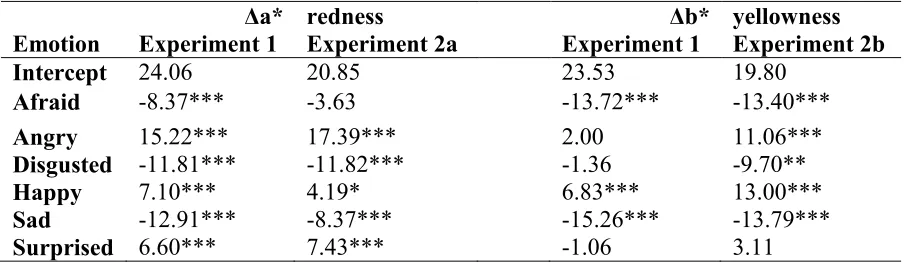
Redness. The intercept for redness was the average a* value across all participants and targets for the neutral category. No effect of target sex was observed. Main effects emerged for each of the six emotion categories (see Table 1; reported values are the unstandardized B coefficients). Specifically, participants increased redness for anger, happiness, and surprise, but decreased redness for fear, disgust, and sadness. Redness changes for anger and fear differed across participant sex (-8.77, p = .010; -8.57, p = .012, respectively). Men increased redness for anger (23.20, p < .001) and decreased redness for fear (-15.87, p < .001); the same pattern emerged for women, but to a lesser extent (anger: B = 14.42, p < .001; fear: B = -7.30, p < .001).
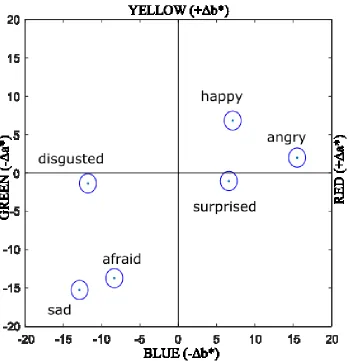
anger (11.33, p = .002), but women did not (.67, p = .62). See Figure 1 for a plot comparing color changes across emotion categories.
Table 1. Changes in a* and b* values, relative to the neutral category, across different emotion categories in Experiments 1 and 2.
Δa* redness Δb* yellowness
Emotion Experiment 1 Experiment 2a Experiment 1 Experiment 2b
Intercept 24.06 20.85 23.53 19.80
Afraid -8.37*** -3.63 -13.72*** -13.40***
Angry 15.22*** 17.39*** 2.00 11.06***
Disgusted -11.81*** -11.82*** -1.36 -9.70**
Happy 7.10*** 4.19* 6.83*** 13.00***
Sad -12.91*** -8.37*** -15.26*** -13.79***
Surprised 6.60*** 7.43*** -1.06 3.11
Note: *p < .05, **p < .01, ***p < .001.
category. In Experiment 2 (a and b), we conducted a more focused investigation of these emotion-color associations by having participants manipulate facial coloration for each dimension while constraining the values of the other.
Experiment 2a
Experiment 1 showed that participants had distinct color associations for each of the six emotion terms. Thus far, participants applied changes along the two color axes simultaneously. However, if these emotion-color associations are grounded in a physiologically-related
perceptual expectation, then we would expect the patterns to be consistent when assessed along each of the color axes independently. Therefore, in Experiments 2a and 2b, we sought to assess emotion-color associations along each of the axes separately. In Experiment 2a, participants were able to manipulate the color of faces along a* (red-green) only, for each of the six emotion terms and a neutral category. In Experiment 2b, participants performed the same task, manipulating the color of faces along b* (yellow-blue) only.
Method
Stimuli. The same eight (4 female) target faces from Experiment 1 were used as stimuli. Color masks were generated and applied in a similar way as in Experiment 1, except that each face was manipulated on the a* axis only.
Results and discussion
We built a three-level model with color changes across emotions modeled at level 1, targets modeled at level 2, and participants modeled at level 3. As in the previous experiment, there was insufficient variance at level 2 (p > .50), so we reduced our model to two levels, which were identical to those in Experiment 1.
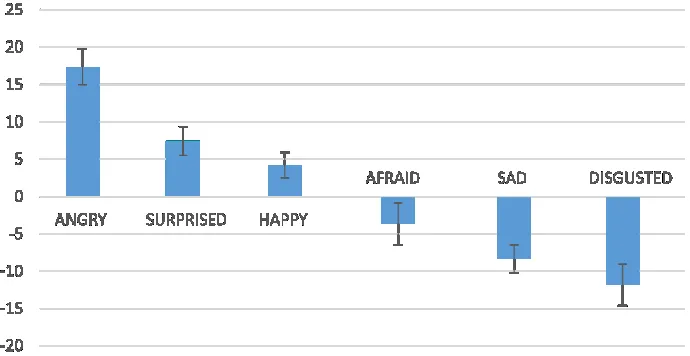
Redness. The intercept for redness was the average a* value across all participants and targets for the neutral category. No effect of target sex was observed. Main effects emerged for each emotion category except fear (see Table 1). Specifically, participants increased redness for anger, happiness, and surprise, but decreased redness for sadness and disgust. The decrease observed for fear was not significant, although it was in the same direction as in Experiment 1. There was also an interaction between participant sex and disgust (-12.11, p = .022). Men decreased redness (-18.78, p < .001); women numerically decreased redness, though this was not significantly different from zero ( = -6.67, p = .11). See Figure 2 for a graph comparing redness changes across emotion categories.
Figure 2. Mean and standard error bars for color changes, relative to the neutral category, applied in Experiment 2a. Participants changed a* (red-green) for the six emotion terms.
Experiment 2b Method
Stimuli. The same eight (4 female) target faces from Experiment 2a were used as stimuli. Color masks were generated and applied in the same way as in Experiment 2a, except that each face was manipulated on the b* axis only.
image. Participants were instructed to “make the face as [afraid / angry / disgusted / happy / neutral / sad / surprised] as possible”. Emotion terms were not defined for participants. Results and discussion
We built a three-level model with color changes across emotions modeled at level 1, targets modeled at level 2, and participants modeled at level 3. As in the previous experiments, there was insufficient variance at level 2 (p > .50), so we reduced our model to two levels, which were identical to those in the prior experiments.
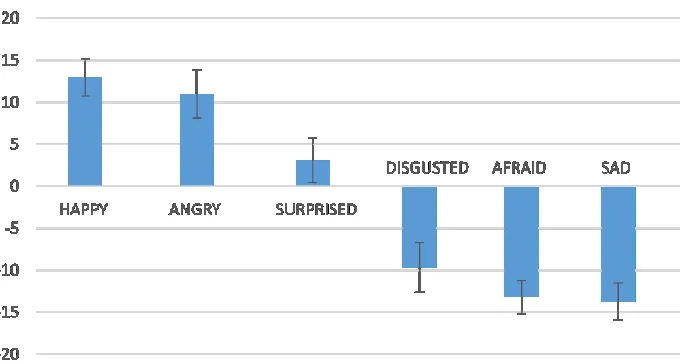
Yellowness. The intercept for yellowness was the average b* value across all participants and targets for the neutral category. No effect of target sex or participant sex was observed. Main effects emerged for each emotion except surprise (see Table 1). Participants increased
yellowness for anger and happiness, and decreased yellowness for fear, disgust, and sadness. See Figure 3 for a graph comparing yellowness changes across emotion categories.
surprise, relative to neutral, in either experiment. This may indicate that only facial redness, but not facial yellowness, conveys social information regarding surprise.
Figure 3. Mean and standard error bars for color changes, relative to the neutral category, applied in Experiment 2b. Participants changed b* (yellow-blue) for the six emotion terms.
Experiment 3
Method
Stimuli. For the faces condition, the eight (4 female) target faces from Experiments 1 and 2 were used as stimuli. Color masks for variations along a*, b*, and the combination of the two were produced and applied in the same way as in Experiments 1 and 2. For the shapes condition, we generated eight shape templates: a rectangle and an oval, each rotated at 0, 45, 90, and 135 degrees. The color of each template was manipulated along a*, b*, and the combination of the two, resulting in an equal number of steps and magnitude of change as in the faces condition. We chose to manipulate the shape color in the same way as the face color in order to keep the
conditions consistent. This provided an advantage in that the conditions would be equated as much as possible. However, it also provided a disadvantage in that it constricted the range of colors that participants could alter. In other words, the range of possible colors for faces and shapes were equal, but were limited to the range of change that could be applied to faces in the previous experiments.
Procedure. 210 (133 female, Mage = 19.85) undergraduate students without a color vision deficiency from a northeastern U.S. university participated in exchange for course credit.
Participants performed this task for each of the 8 faces (or shapes), once for each emotion
condition and a neutral condition, for a total of 56 trials. The emotion conditions were grouped in blocks, so that participants viewed each of the 8 faces (or shapes) in a single emotion block, before moving on to the next emotion block with each of the 8 faces (or shapes). Block order was randomized, and face (or shape) order within blocks was randomized.
Results and discussion
We built a three-level model with color changes across emotions modeled at level 1, targets modeled at level 2, and individual participants modeled at level 3. As in the previous experiments, we collapsed across levels 1 and 2 due to insufficient variance at the second level (p > .50). Emotions were included as level 1 predictor variables (dummy coded; neutral was the reference group). Condition (dummy coded; 1 = shapes, 0 = faces) and participant sex (dummy coded; 1 = male, 0 = female) were included as level 2 predictors. 24 participants (faces = 10, shapes = 14) were excluded from the level 2 model, because they did not provide sex data. Sex variables were mean-centered; emotion categories and experimental condition were uncentered. Given that target sex only applied to participants in the faces condition (with target shapes varying in the shapes condition), we omitted this variable from the omnibus model, but included it in subsequent models described below.
Redness. A main effect of condition emerged, such that the intercept for redness (i.e., the average a* values across all participants and targets for the neutral category) was greater for faces than for shapes (p < .001). Main effects also emerged for each of the six emotion categories (all ps < .001). However, each of the six main effects was qualified by an interaction with
Thus, we report results separately for faces and shapes below. Target sex/shape was included in these models as a mean-centered level 1 predictor. No effects were observed for target sex or participant sex.
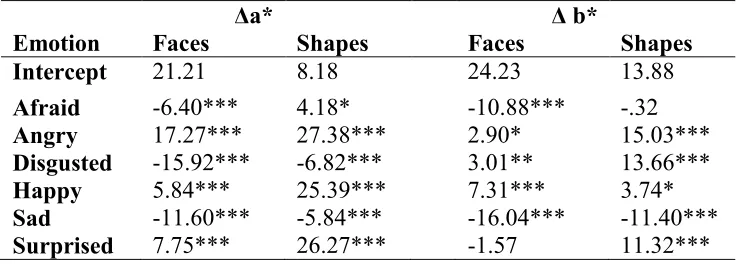
Table 2. Changes in a* and b* values, relative to the neutral category, across different emotion categories for faces vs. shapes in Experiment 3.
Δa* Δ b*
Emotion Faces Shapes Faces Shapes
Intercept 21.21 8.18 24.23 13.88
Afraid -6.40*** 4.18* -10.88*** -.32
Angry 17.27*** 27.38*** 2.90* 15.03***
Disgusted -15.92*** -6.82*** 3.01** 13.66***
Happy 5.84*** 25.39*** 7.31*** 3.74*
Sad -11.60*** -5.84*** -16.04*** -11.40***
Surprised 7.75*** 26.27*** -1.57 11.32*** Note: *p < .05, **p < .01, ***p < .001.
Faces. Participants (N = 104) increased redness for anger, happiness, and surprise. Participants decreased redness for disgust, sadness, and fear.
Shapes. Participants (N = 106) increased redness for anger, happiness, surprise, and fear.
Redness was decreased for disgust and sadness.
results separately for faces and shapes below. Target sex/shape was included in these models as a level 1 predictor. No effects were observed for target sex or participant sex.
Faces. Participants increased yellowness for anger, happiness, and disgust. Yellowness
was decreased for sadness and fear. Yellowness for surprise was not significantly different from the neutral category (p = .27).
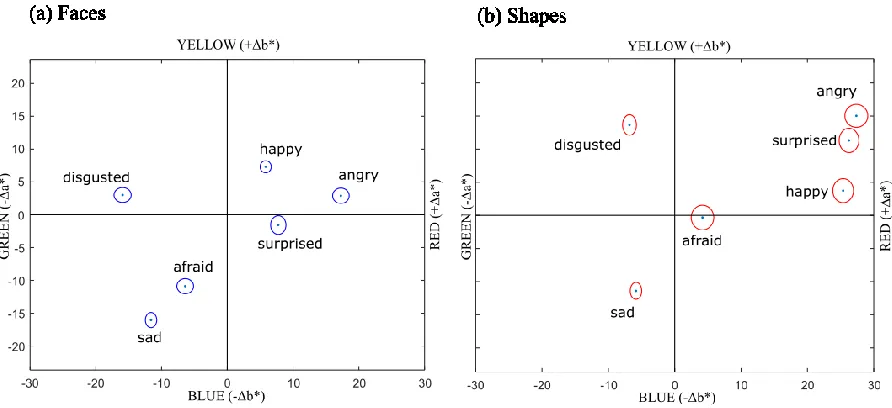
Shapes. Participants increased yellowness for anger, happiness, disgust, and surprise. Yellowness was decreased for sadness. Yellowness for fear was not significantly different from the neutral category (p = .86). See Figure 4 for plots comparing color changes across conditions.
The results observed for facial skin color changes along the redness axis were consistent with those from the previous experiments. Participants increased facial redness for approach-oriented emotions (anger, happiness, surprise), and decreased facial redness for avoidance-oriented emotions (disgust, fear, sadness). The results for facial skin color changes along the yellowness axis are mostly consistent with the previous experiments. Participants increased facial yellowness for anger and happiness, while facial yellowness for surprise was not different from the neutral category. In addition, participants decreased facial yellowness for sadness and fear, in accord with the results from the previous experiments. However, facial yellowness for disgust was not different from the neutral category in Experiment 3.
(disgust, fear, sadness), participants decreased both redness and yellowness more for faces than for shapes. This suggests that color associations for the approach-oriented emotions are more constrained when viewed in the context of the face, while color associations for the avoidance-oriented emotions are exacerbated when viewed in the context of the face. We discuss potential reasons for this patterning below.
Figure 4. Mean and standard error ellipses for color changes, relative to the neutral category, applied in Experiment 3. Participants simultaneously changed a* (red-green) and b* (yellow-blue) dimensions for the six emotion terms, on either (a) faces or (b) shapes.
General Discussion
Across four experiments, participants were asked to manipulate the color of neutral faces to best match several target emotion terms. The results revealed a pattern of emotion-color associations that maps well onto physiological and psychological correlates of emotion
increased facial yellowness for anger and happiness. Conversely, participants decreased facial yellowness for fear and sadness. Finally, participants did not consistently manipulate facial yellowness for disgust across experiments, and participants did not manipulate facial yellowness for surprise, relative to neutral, across experiments. Thus, although both redness and yellowness changes were associated with the focal emotions, the patterns were, numerically, clearest for redness. This would seem to be in accord with evidence that individuals are more sensitive to redness (relative to yellowness) changes on the face (Tan & Stephen, 2013), likely because redness on the face is a particularly strong indicator of socially-relevant information (Re et al., 2011).
Anger, happiness, and surprise can be considered approach-oriented emotions (Carver & Harmon-Jones, 2009; Fredrickson, 1998; Meyer, Niepel, Rudolph, & Schützwohl, 1991), have been shown to elicit peripheral vasodilation (Collet, Vernet-Maury, Delhomme, & Dittmar, 1997; Drummond, 1994; Drummond & Quah, 2001), and were adjusted to look redder and yellower on faces (except for surprised faces, which were not significantly altered along b*). Sadness and fear can be considered avoidance-oriented emotions (Nesse, 1990, 1991), have been shown to elicit peripheral vasoconstriction in some instances (Drummond, 1997; Kreibig,
therefore difficult to interpret. Recent research has shown that disgust can be elicited by different types of stimuli, and that these types prompt differing patterns of physiological reactivity
(Shenhav & Mendes, 2014). This might help to explain the inconsistency along the b* dimension across our experiments. It is additionally important to note that while general inferences can be made about the relation between skin blood flow and skin color, it is not currently clear how some distal measures of peripheral blood flow used in the research reviewed above are related to facial blood flow. For instance, digital PPG and skin temperature indicate change in blood flow, but are typically measured from the finger. While this could represent global changes in
peripheral cardiovasculature, it is unclear whether the face, specifically, is affected.
One unexpected, but interesting pattern in our data is that several yellowness associations were numerically weaker when assessed along the two axes simultaneously (Experiments 1 and 3), but stronger when assessed alone (Experiment 2b). The two color-opponent dimensions (red-green and yellow-blue) are orthogonal (Fairchild, 2013), have been shown to involve distinct functional and neural pathways (Dacey & Packer, 2003; Krauskopf & Gegenfurtner, 1992), and can be independently influenced on skin by hemoglobin oxygenation and concentration
(Changizi & Shimojo, 2006). However, color is naturally viewed as the combination of these dimensions, and the hemoglobin variables are likely correlated with respect to cardiovascular reactivity. That yellowness associations became stronger when assessed independently might reflect an existing expectation that gets “washed-out” in the presence of a more salient one (redness).
versus more abstract color associations (on shapes). We found that the direction of color changes applied between faces and shapes was consistent, but that the magnitude of the color changes differed. Specifically, the approach-oriented emotions (anger, happiness, surprise) were adjusted more for shapes than for faces, while the avoidance-oriented emotions (fear, disgust, sadness) were adjusted more for faces than for shapes. The findings for the approach-oriented emotions suggest that participants limited the amount of redness and yellowness that they added to the faces because they sought to make the faces look plausibly angry, happy, and surprised; the shape context provided no such constraints, and therefore participants likely relied entirely on abstract associations in their color selections. The findings for the avoidance-oriented emotions suggest that participants eliminated (i.e., “drained”) color from the faces even more so than from the shapes; plausibility seems less critical to the absence of redness and yellowness than to its presence, and participants went out of their way to minimize these colors on faces (relative to shapes) to convey these avoidance-oriented emotions.
Another, not necessarily independent, factor that may have played a role in the observed interactive patterns in Experiment 3 is that the participant-generated baseline values for the neutral category across the face and shape conditions differed from each other, with the neutral faces being redder and yellower than the neutral shapes. It is likely that participants used this neutral point as an anchor for the face judgments, and adjusted from this anchor to produce the color for each emotion. This anchoring and adjustment process is not relevant for shapes;
additional redness and yellowness needed to convey the approach-oriented emotions, and may have enhanced the amount of redness and yellowness needed to convey the avoidance-oriented emotions.
Although we are focusing primarily on the differences in the magnitude of color changes observed between the faces and shapes, it is also important to highlight that the direction of the color changes was highly similar across conditions. Participants’ color changes were presumably a function of both concrete, experiential viewing of color-emotion pairings on the face over time and more abstract stereotype- or metaphor-based knowledge of color-emotion connections. These sources of influence are unquestionably intertwined (e.g., the abstract knowledge is likely, at least in part, an extension and perhaps elaboration of the concrete experiential knowledge) and likely promote the same (directional) pattern of color changes for faces and shapes. Thus, the similarity in the direction of color changes in our data was both expected and quite
straightforward to explain; it is the disentangling of these sources of influence that is much more complex and in need of considerable more empirical attention.
Strengths of our design include descriptive specificity. Participants applied color changes to the faces continuously, rather than categorically. This is important for multiple reasons. First, it mimics the way that color varies in the natural environment and therefore allows for a more precise description of color. Second, it allowed us to access more implicit associations. Laypersons may not explicitly describe emotion expressions in terms of blood-flow
There is currently contention around how emotions are best characterized. For instance, some view emotions as basic, distinct, culturally universal, and modular states (e.g., Ekman, 1992; Izard & Ackerman, 2000; Ortony, Clore, & Collins, 1988), while others view emotions as context-dependent constructions informed by underlying dimensions (e.g., Barrett, 2006;
Cacioppo, Gardner, & Berntson, 1999; Carver & Scheier, 1998). In conducting the research herein, it is not our intention to argue that emotions are basic in nature or that they are limited to the six emotion terms included in the present work (see Ortony & Turner, 1990, for a review). Instead, we took advantage of the utility of using prototypical emotion terms, because such terms reflect the cognitive representation of emotion in memory and language (which likely varies across culture), and therefore are useful for studying networks of associations related to emotion (see Shaver et al., 1987). Nor do we argue that facial coloration is a marker of discrete emotions, but rather presume that facial coloration changes correspond to more basic psychological and physiological processes such as arousal or motivational orientation, which are expressed and perceived in context-dependent situations.
In the present research, we have documented emotion-color associations that are
of individuals during actual emotion expressions unfolding over time. Such research would be useful in documenting regional differences in color expression (e.g., forehead vs. cheeks) and the temporal course of color expression. Another limitation of our research is that the facial stimuli used in our experiments were all Caucasian. Future work should investigate whether these associations are influenced by racial differences in the stimuli, the observer, or both.
The importance of the emotion-color associations studied herein may be seen in the common use of color in culture. For example, visual-expressive communications (i.e.,
emoticons) often display happy faces in yellow, disgusted faces in green, and angry faces in red. Further, Oxford English Dictionary definitions of “blue” include the terms “fear” and
References
Adams, F. M., & Osgood, C. E. (1973). A cross-cultural study of the affective meanings of color. Journal of Cross-Cultural Psychology, 4(2), 135–156. doi: 10.1177/002202217300400201
Barchard, K. A., Grob, K. E., & Roe, M. J. (2016). Is sadness blue? The problem of using figurative language for emotions on psychological tests. Behavior Research Methods. doi: 10.3758/s13428-016-0713-5
Barrett, L. F. (2006). Solving the emotion paradox: Categorization and the experience of emotion. Personality and Social Psychology Review, 10, 20–46. doi:
10.1207/s15327957pspr1001_2
Blascovich, J., & Mendes, W. B. (2000). Challenge and threat appraisals: The role of affective cues. In J. Forgas (Ed.), Feeling and thinking: The role of affect in social cognition (pp. 59 – 82). Cambridge, England: Cambridge University Press.
Bryk, A. S, & Raudenbush, S. W. (1992). Hierarchical linear models in social and behavioral research: applications and data analysis methods (1st ed.). Newbury Park, CA: Sage. Cacioppo, J. T., Gardner, W. L., & Berntson, G. G. (1999). The affect system has parallel and
integrative processing components: Form follows function. Journal of Personality and Social Psychology, 76, 839– 855. doi: 10.1037/0022-3514.76.5.839
Carver, C. S., & Harmon-Jones, E. (2009). Anger is an approach-related affect: evidence and implications. Psychological Bulletin, 135(2), 183–204. doi: 10.1037/a0013965
Changizi, M., & Shimojo, S. (2011). Social color vision. In R. B. Adams (Ed.), The Science of Social Vision. New York, NY: Oxford University Press.
Changizi, M., Zhang, Q., & Shimojo, S. (2006). Bare skin, blood and the evolution of primate colour vision. Biology Letters, 2(2), 217–21. doi: 10.1098/rsbl.2006.0440
Collet, C., Vernet-Maury, E., Delhomme, G., & Dittmar, A. (1997). Autonomic nervous system response patterns specificity to basic emotions. Journal of the Autonomic Nervous System, 62(1–2), 45–57. doi: 10.1016/S0165-1838(96)00108-7
Dacey, D. M., & Packer, O. S. (2003). Colour coding in the primate retina: Diverse cell types and cone-specific circuitry. Current Opinion in Neurobiology, 13(4), 421–427. doi: 10.1016/S0959-4388(03)00103-X
Drummond, P. (1994). The effect of anger and pleasure on facial blood flow. Australian Journal of Psychology, 46(2), 95–99. doi: 10.1080/00049539408259479
Drummond, P. (1997). Correlates of facial flushing and pallor in anger-provoking situations. Personality and Individual Differences, 23(4), 575–582. doi:
10.1016/S0191-8869(97)00077-9
Drummond, P., & Quah, S. H. (2001). The effect of expressing anger on cardiovascular
reactivity and facial blood flow in Chinese and Caucasians. Psychophysiology, 38(2), 190– 196. doi: 10.1111/1469-8986.3820190
Ekman, P. (1992). An argument for basic emotions. Cognition & Emotion, 6, 169–200. doi: 10.1080/02699939208411068
Ekman, P. (1993). Facial expression and emotion. American Psychologist, 48(4), 384–392. doi: 10.1037/0003-066x.48.4.384
Ekman, P., Friesen, W. V., & Ellsworth, P. (1982). Emotion in the Face. New York, NY: Cambridge University Press.
Elliot, A. J., Eder, A. B., & Harmon-Jones, E. (2013). Approach-avoidance motivation and emotion: Convergence and divergence. Emotion Review, 5, 308-311.
Elliot, A. J., & Maier, M. a. (2014). Color psychology: effects of perceiving color on psychological functioning in humans. Annual Review of Psychology, 65, 95–120. doi: 10.1146/annurev-psych-010213-115035
Fairchild, M. D. (2013). Color appearance models (3rd ed.). West Sussex, UK: John Wiley &
Sons.
Fredrickson, B. L. (1998). What good are positive emotions? Review of General Psychology, 2(3), 300–319. doi: 10.1037/1089-2680.2.3.300
Gendron, M., Roberson, D., van der Vyver, J. M., & Barrett, L. F. (2014). Perceptions of emotion from facial expressions are not culturally universal: evidence from a remote culture. Emotion, 14(2), 251. doi: 10.1037/a0036052
Jones, B. C., Little, A. C., Burt, D. M., & Perrett, D. I. (2004). When facial attractiveness is only skin deep. Perception, 33(5), 569–576. doi: 10.1068/p3463
Kay, P., & Regier, T. (2003). Resolving the question of color naming universals. Proceedings of
the National Academy of Sciences, 100(15), 9085-9089. doi: 10.1073/pnas.1532837100
Keltner, D., & Haidt, J. (1999). Social functions of emotions at four levels of analysis. Cognition & Emotion, 13(5), 505-521. doi: 10.4249/scholarpedia.4567
Krauskopf, J., & Gegenfurtner, K. (1992). Color discrimination and adaptation. Vision Research, 32(11), 2165–2175. doi: 10.1016/0042-6989(92)90077-V
Kreibig, S. D., Wilhelm, F. H., Roth, W. T., & Gross, J. J. (2007). Cardiovascular, electrodermal, and respiratory response patterns to fear- and sadness-inducing films. Psychophysiology, 44, 787–806. doi: 10.1111/j.1469-8986.2007.00550.x
Lefevre, C. E., Ewbank, M. P., Calder, a J., Hagen, E. Von, & Perrett, D. I. (2013). It is all in the face : carotenoid skin coloration loses attractiveness outside the face. Biology Letters, 9 (6):20130633. doi: 10.1098/rsbl.2013.0633
Meyer, W.-U., Niepel, M., Rudolph, U., & Schützwohl, A. (1991). An experimental analysis of surprise. Cognition & Emotion, 5, 295–311. doi: 10.1080/02699939108411042
Nesse, R. (1990). Evolutionary explanations of emotions. Human Nature, 1(3), 261–89. doi: 10.1007/BF02733986
Niedenthal, P. M., Barsalou, L. W., Winkielman, P., Krauth-Gruber, S., & Ric, F. (2005). Embodiment in attitudes, social perception, and emotion. Personality and Social Psychology Review, 9(3), 184-211. doi: 10.1207/s15327957pspr0903_1
Ortony, A., Clore, G. L., & Collins, A. (1988). The cognitive structure of emotions. New York, NY: Cambridge University Press.
Ortony, A, & Turner, T. J. (1990). What’s basic about basic emotions? Psychological Review, 97(3), 315–331. doi: 10.1037/0033-295X.97.3.315
Palmer, S. E., & Schloss, K. B. (2010). An ecological valence theory of human color preference. Proceedings of the National Academy of Sciences of the United States of America, 107(19),
8877–82. doi: 10.1073/pnas.0906172107
Phelps, E. a, Ling, S., & Carrasco, M. (2006). Emotion facilitates perception and potentiates the perceptual benefits of attention. Psychological Science, 17(4), 292–9. doi: 10.1111/j.1467-9280.2006.01701.x
Re, D. E., Whitehead, R. D., Xiao, D., & Perrett, D. I. (2011). Oxygenated-blood colour change thresholds for perceived facial redness, health, and attractiveness. PloS One, 6(3), e17859. doi: 10.1371/journal.pone.0017859
Rohrmann, S., & Hopp, H. (2008). Cardiovascular indicators of disgust. International Journal of Psychophysiology, 68, 201–208. doi: 10.1016/j.ijpsycho.2008.01.011
Shenhav, A., & Mendes, W. B. (2014). Aiming for the stomach and hitting the heart: dissociable triggers and sources for disgust reactions. Emotion, 14(2), 301–309. doi: 10.1037/a0034644 Stephen, I. D., Coetzee, V., Law Smith, M., & Perrett, D. I. (2009). Skin blood perfusion and
oxygenation colour affect perceived human health. PloS One, 4(4), e5083. doi: 10.1371/journal.pone.0005083
Stephen, I. D., Law Smith, M. J., Stirrat, M. R., & Perrett, D. I. (2009). Facial skin coloration affects perceived health of human faces. International Journal of Primatology, 30(6), 845– 857. doi: 10.1007/s10764-009-9380-z
Stephen, I. D., Oldham, F. H., Perrett, D. I., & Barton, R. A. (2012). Redness Enhances Perceived Aggression, Dominance and Attractiveness in Men’s Faces. Evolutionary Psychology, 10(3), 562–572. doi: 10.1177/147470491201000312
Sutton, T. M., & Altarriba, J. (2008). Emotion words in the mental lexicon: A new look at the emotional Stroop effect. The Mental Lexicon, 3(1), 29–46. doi: 10.1075/ml.3.1.04sut Tan, K. W., & Stephen, I. D. (2013). Colour detection thresholds in faces and colour patches.
Perception, 42(7), 733–741. doi: 10.1068/p7499
Thorstenson, C. A., Pazda, A. D., Elliot, A. J., & Perrett, D. I. (2016). Facial redness increases men’s perceived healthiness and attractiveness. Perception. doi: 0301006616680124. Tybur, J. M., Lieberman, D., Kurzban, R., & DeScioli, P. (2013). Disgust: evolved function and
Välisuo, P., Kaartinen, I., Kuokkanen, H., & Alander, J. (2010). The colour of blood in skin: A comparison of Allen’s test and photonics simulations. Skin Research and Technology, 16(5), 390–396. doi: 10.1111/j.1600-0846.2010.00449.x
Young, S. G., Thorstenson, C. A., & Pazda, A. D. (2016). Facial redness, expression, and
masculinity influence perceptions of anger and health. Cognition and Emotion, 1-12. doi:
10.1080/02699931.2016.1273201
Yuille, A., & Kersten, D. (2006). Vision as Bayesian inference: analysis by synthesis? Trends in Cognitive Sciences, 10(7), 301–308. doi: 10.1016/j.tics.2006.05.002
Zonios, G., Bykowski, J., & Kollias, N. (2001). Skin melanin, hemoglobin, and light scattering properties can be quantitatively assessed in vivo using diffuse reflectance spectroscopy. Journal of Investigative Dermatology, 117, 1452–1457. doi:
Footnotes
1 In addition to the reported experiments, we also conducted a preliminary experiment. In this experiment, participants simultaneously manipulated faces along a* (red-green) and b* (yellow-blue) axes to match two target emotions: anger and fear. Participants increased facial redness and yellowness for anger, and decreased facial redness and yellowness for fear. The study details and data are available online at: osf.io/9ds8h.
2 Level 1 model
Y = 0 + 1(targetsex) + 2(afraid) + 3(angry) + 4(disgusted) + 5(happy) + 6(sad) +7 (surprised) + r
Level 2 model
0 = 00 + (sex) +
1 = 10 + (sex)
2 = 20 + (sex)
= 30 + (sex)
4 = 40 + (sex)
5 = 50 + (sex)
6 = 60 + (sex)