coCFGROUPS
COLLIN BLEAK, FRANCESCO MATUCCI, AND MAX NEUNH ¨OFFER
Abstract. Lehnert and Schweitzer show in [21] that R. Thompson’s groupV
is a co-context-free (coCF) group, thus implying that all of its finitely gener-ated subgroups are alsocoCFgroups. Also, Lehnert shows in his thesis that
V embeds inside thecoCFgroup QAut(T2,c), which is a group of particular
bijections on the vertices of an infinite binary 2-edge-colored tree, and he con-jectures that QAut(T2,c) is a universalcoCFgroup. We show that QAut(T2,c)
embeds into V, and thus obtain a new form for Lehnert’s conjecture. Fol-lowing up on these ideas, we begin work to build a representation theory into R. Thompson’s groupV. In particular we classify precisely which Baumslag-Solitar groups embed intoV.
1. Introduction
1.1. History and context. There has been a long historical interplay between classes of formal languages, and classes of groups. This connection was first made by Max Dehn, who in 1911 stressed the importance of several formal problems associated with group presentations, one of which was the word problem for groups (Given a groupG, is there an algorithm which determines, in finite time, whether or not any given finite product of generators is trivial?). Note that when one looks at the set of “words” in the generators which are equivalent to the identity in the group one has specified a formal language. The more complicated this formal language is, the more complex an algorithm would have to be in order to positively answer Dehn’s question.
Thus, as classes of languages become more complex, some “corresponding” classes of groups become wider, and thus harder to comprehend in a meaning-ful fashion. Ways to build these correspondences are through the word or co-word problems for groups, but other flavours of correspondence have also been seen (see, e.g., [2, 25, 19, 16, 17, 18]). To date, classifications of corresponding sets of groups (for classes of languages) only exist for very simple classes of languages, but the results on the group theory side are quite striking. In order to discuss this further, we need to give a definition.
Given a finitely generated group G =hXi, one can define the language of the word problem to be the set of words
W P(G) ={w∈F(X)|w≡G 1}. Similarly, thelanguage of the co-word problem is defined to be
coW P(G) ={w∈F(X)|w6≡G 1}.
2000Mathematics Subject Classification. Primary XYZ; Secondary XYZ.
Key words and phrases. Context-free groups, Quasi-automorphisms of a tree, Thompson’s
groupV, Baumslag-Solitar groups.
And now, let us state some results on the group theory side.
In 1972, Anisimov in [2] shows that for a finitely generated group G, W P(G) is a regular language if and only if Gis finite. The proof of this is not difficult, but the idea of building the correspondence in the first place represents quite a step forward. Later, in the early 1980’s, a celebrated collection of papers of Muller and Schupp (relying on Dunwoody’s accessibility theory - see [11, 24, 25]) show the following theorem.
Theorem 1(Muller, Schupp). LetGbe a finitely generated group. Then,W P(G)
is a context-free language if and only if Gis virtually free.
A groupGwithW P(G) a context free language is called acontext-free group or aCF group.
One thus sees thatCF groups provide a generalisation of finite groups from the point of view of computer science, as the context-free languages are one of the simplest generalisations of regular languages (the difference arises as the machines that are used to create context-free languages are directed labelled graphs which have a stack for memory, and can make transitions based on this changing stack, while the machines for regular languages are simply finite directed graphs with no form of memory other than their structure, see, e.g., [20] for an introduction to automata and formal language theory).
Muller and Schupp’s results are in some sense the last complete classification of a class of groups corresponding to a class of languages. Thus, focus has shifted to thecoCFgroups.
The classcoCFofco-context-free groups is defined to be finitely generated groups G such that coW P(G) is context-free. This is a generalisation as the virtually free groups actually havedeterministic context-free word problems, and thus their language of co-words is also a deterministic context-free language.
In [19] Holt, Rees, R¨over and Thomas introduce thecoCFgroups. They show that the classcoCFof all co-context-free groups is closed under taking:
• taking finite direct products,
• taking restricted standard wreath products with context-free top groups,
• passing to finitely generated subgroups
• passing to finite index overgroups.
In [19] there are also various conjectures about how other operations interact with the class coCF. Also, there is a discussion about whether certain very specific groups can becoCFgroups. Currently, it is conjectured thatZ2∗
Zand the Grig-orchuk group Γ are not in coCF, and that certain wreath products cannot be in coCF.
Now, letT2,cbe the infinite binary 2-edge-colored binary tree (left edges = red, right edges = blue), and let QAut(T2,c) be the group of all bijections on the vertices ofT2,cwhich respect the edge and color relationships, except for at possibly finitely many locations. Lehnert in [23] shows the following results, amongst others.
Theorem 2 (Lehnert). The group QAut(T2,c) is a coCFgroup, and there is an
embedding from R. Thompsons groupV intoQAut(T2,c).
We note that Lehnert and Schweitzer [21] prove that the Higman-Thompson groupsGr,s are in coCF, which also shows thatV =G2,1 is incoCF.
Conjecture 3 (Lehnert). The group QAut(T2,c) is a universalcoCFgroup. Thus, Lehnert conjectures that a groupG is incoCFif and only if it is finitely generated and it embeds in QAut(T2,c).
It is the main focus of this paper to discuss Lehnert’s conjecture.
1.2. Our results, and the ongoing discussion. Lehnert and Schweitzer in [22] ask the authors of [6] whether they thought one could embed QAut(T2,c) into R. Thompson’s groupV, as those authors had just shown thatZ2∗
Zfails to embed intoV (supporting the conjecture of Holt, R¨over, Rees and Thomas). This question eventually lead the current authors to our main result, below.
Theorem 4. There is an embeddingQAut(T2,c)V. That is, one can now re-state Lehnert’s conjecture as:
Conjecture 5 (Lehnert). R. Thompson’s groupV is a universalcoCFgroup. Thus, if Lehnert’s conjecture is true, a group will be in coCFif and only if it is finitely generated and it embeds as a subgroup ofV.
Working to understand the classcoCFbetter, we will now discuss some of what is known about the subgroups of R. Thompson’s groupV.
It is known thatV contains many embedded copies of non-abelian free groups, and indeed, many free products of its subgroups. In the paper [6], the authors give some more specific results. They find conditions under which particular restricted wreath products and free products of subgroups ofV actually can embed into V. Also, they show thatZ∗Z2 does not embed into V, supporting the conjecture of Holt, R¨over, Rees, and Thomas. In [10] Nathan Corwin adds to these results by showing thatZoZ2 does not embed intoV.
Three important questions that are often asked, pertaining to subgroup structure of a given groupG, are a) to decide if non-abelian free groups embed into G, b) to decide whether surface groups embed intoG, and c) to decide if the Baumslag-Solitar groups embed intoG.
In [26] R¨over shows that if n is a proper divisor of m, then the Baumslag-Solitar groupBS(m, n) does not embed intoV. R¨over’s proof is based on using the fact observed by Higman (the corollary to Lemma 9.3 (see [15])) that non-torsion elements in the Higman-Thompson groups fail to have infinitely many roots. Using a different method, we extend R¨over’s result as follows.
In this paper we show that certain Baumslag-Solitar groups are coCF groups. In particular, we decide exactly which Baumslag-Solitar groups embed in R. Thomp-son’s groupV (and indeed, into the Higman-Thompson groupsGs,r).
Theorem 6. Let m, n ∈Z\ {0}. Let BS(m, n) be the corresponding
Baumslag-Solitar group.
(1) If |m| 6=|n|, thenBS(m, n)fails to embed in V.
(2) If |m|=|n|, then there is an embedding ofBS(m, n)in V.
In fact, the theorem above holds for all of the Higman-Thompson groups Gr,s (not justV =G2,1) using essentially the same proof we give.
results for the Baumslag-Solitar groups, and in fact the argument is equivalent to our presented argument. We discuss this briefly in Section 5.
It is a question of Gromov as to whether the surface groups embed into all (word-)hyperbolic groups [4], and there has been much work on this question by the broader community. Amongst many results and partial results, one can highlight the general results of the Calegari school on stable commutator length, and in particular the work in [8, 9, 28] which shows amongst other things that in HNN extensions of free groups, amalgamating the base free group to an endomorphic embedded copy of itself, one can often find surface subgroups. The present authors have attempted to use these results to find surface groups (other than the torus and the Klein bottle groups) inV, but so far we have been unsuccessful. Thus, we ask the following question.
Question 7. Do the hyperbolic (closed) surface groups embed into R. Thompson’s groupV?
We note in passing that it is known that the set of subgroups inV is closed in passing to finite index over-groups (see e.g. [6, 26]), thus all that is required is to find a copy of any single hyperbolic (closed) surface subgroup inV to see that they all embed.
Even if hyperbolic (closed) surface groups do not embed into R. Thompson’s group V, it may still be the case that they are in the classcoCF, and so it is also natural to ask the following question.
Question 8. Are the hyperbolic (closed) surface groups in the classcoCF? In response to an early draft of this article Daniel Farley in [13] describes a particular list of coCFgroups arising from his constructions with Bruce Hughes, which might be used to disprove Lehnert’s conjecture, if one can show that one of these groups fails to embed intoV.
Acknowledgements. Thanks go to Lehnert and Schweitzer for asking us about the relation between V and QAut(T2,c). We wish to thank Fr´ed´eric Haglund for suggesting us to investigate whether or not surface groups embed inV, and to thank Mark Sapir for asking us to investigate whether the Baumslag-Solitar groups embed intoV. We thank Jos´e Burillo, Yves de Cornulier and Claas R¨over for helpful and interesting conversations. We are also grateful for the interest Adrien Le Boudec has shown in this work, and the interesting conversations we have had with him in response to early drafts of this article. The second author gratefully acknowledges the Fondation Math´ematique Jacques Hadamard (ANR 10 CAMP 0151 02 -FMJH - Investissement d’Avenir) for the support received during the development of this work.
2. Decomposition of elements ofQAut(T2,c)
In this section we define two ways to describe an element of QAut(T2,c). The first form associates a minimal element ofV with an element of QAut(T2,c), but is complicated by the intervention of two further bijections between finite subsets of
{0,1}∗, while the second way is simpler, and associates any element of QAut(T
in his dissertation [23]. Still, the first form enables us to build an embedding of QAut(T2,c) into V in Section 4.
To set up the notation we will be using, we define by {0,1}∗ as the set of all finite words in the alphabet {0,1} and by{0,1}ω the set of infinite words in the alphabet{0,1}. The set{0,1}ωcorresponds to the boundary of the treeT
2and to
the standard ternary Cantor setC2. If a worda∈ {0,1}∗ is aprefix of a word w,
we write a ≤w. If a1, a2 ∈ {0,1}
∗
we write a1 ⊥a2 if neither is a prefix of the
other.
2.1. Building an element in V from an element in QAut(T2,c). Let τ ∈ QAut(T2,c) be seen as a mapτ:{0,1}∗{0,1}∗. For anyw∈ {0,1}∗we examine the pair (w, wτ) to find the largest common suffix swsuch that
w=xwsw
wτ=ywsw
for suitablexw, yw∈ {0,1}∗ prefixes. We define Γτ:={(xw, yw)|w∈ {0,1}∗}.
Claim 9. Γτ is finite.
Proof. Since the mapτis a quasi-automorphism, there exists a levelkin the domain tree below which the adjacency and color relations are respected by the action ofτ. Assume thatw1 is any node below levelkand letw2:=w1a, for somea∈ {0,1}.
Sincew1 andw2 are adjacent and below levelk, we havew2τ = (w1a)τ= (w1τ)a.
This immediately extends to any word λ ∈ {0,1}∗, so that (w1λ)τ = (w1τ)λ.
Since this argument holds for any w1 below level k, this shows that there can be
only finitely many elements in Γτ since every word below levelkis a descendant of
the finite set of words at levelk.
Since the set Γτ is finite we can find a subsetMτ ⊆Γτ which is essential in the following sense: for every pair (a, b)∈Mτ there exist infinitely many wordswsuch that (xw, yw) = (a, b).
Recall that ananti-chain is a subset of a partially ordered set such that any two elements in the subset are incomparable and that an anti-chain iscomplete if it is maximal with respect to inclusion. By the definition ofMτ the sets of words
LDτ :=
a∈ {0,1}∗| ∃b∈ {0,1}∗,(a, b)∈Mτ and
LRτ :=
b∈ {0,1}∗| ∃a∈ {0,1}∗,(a, b)∈Mτ
both form finite complete anti-chains for the poset{0,1}∗ ordered by prefix inclu-sion. The setLDτ has the properties that ifa16=a2∈ LDτ ⊂ {0,1}
∗
thena1⊥a2
and for all sufficiently long wordswin {0,1}∗, there isaw∈ LDτ so that aw < w,
and similarly forLRτ. Therefore, Mτ naturally determines a prefix code map on {0,1}ωwhich is determined by two finite complete anti-chains of equal cardinality. Note that this is another way of defining element of R. Thompson’s groupV.
Furthermore, one easily sees that the construction of Mτ as above produces the bijection between the leaves of the unique minimal tree-pair representative for the particular element vτ of V which Mτ determines. As any finite rooted subtree ofT2 is determined by its leaves and vice-versa, we can identify the finite
complete anti-chainsLDτ,LRτ with finite trees Dτ, Rτ and say that (Dτ, Rτ, στ)
writevτ ∼(Dτ, Rτ, στ) in this case to emphasise that (Dτ, Rτ, στ) is the minimal tree pair representing vτ. (Note: we also writevτ ∼(D, R, σ) if (D, R, σ) is any tree pair representingvτ.)
Remark 10.There may exist a wordw∈ {0,1}∗such that there is a pair (a, b)∈M τ withaprefix ofwbut w→wτ is not determined by the pair (a, b). This will lead us to consider a finite permutation also associated with τ, which we will discuss below in Subsection 2.3.
2.2. The finite bijection between internal nodes of the tree pair invτ. By a slight abuse of notation we identify the treeDτwith the set of words corresponding to the nodes ofτstrictly above the leaves. We make a similar identification forRτ. We now define a (non-canonical) bijection bτ : Dτ → Rτ. For every word w∈Dτ∩(Rτ)τ−1, we define wbτ :=wτ. Then we complete bτ to a bijection by choosing and fixing a bijection between the setsDτ\(Rτ)τ−1 andRτ\(Dτ)τ.
2.3. Finite permutation on a subset of the nodes of the treeRτ. We observe that vτ can be seen as a tree pair diagram or a map acting on {0,1}
∗
\Dτ as a prefix replacement map. Consider the following map
e vτ =
(
bτ overDτ
vτ over{0,1}∗\Dτ.
The mapevτ is an element of QAut(T2,c) and, by construction, it differs with τ on only finitely many vertices (which are possibly spread betweenDτand{0,1}∗\Dτ). Thus the mappτ :=evτ−1τ is a permutation on finitely many vertices ofT2,c.
2.4. Minimal decomposition of elements inQAut(T2,c). We are now able to write down the decomposition for τ ∈QAut(T2,c) that we were looking for. The following result is an immediate consequence of the discussion above.
Lemma 11 (Minimal decomposition). For every τ ∈ QAut(T2,c), there exists a
permutation pτ on finitely many vertices of T2,c so that
(2.1) τ=evτpτ
whereevτ ∈QAut(T2,c)acts as an element of Thompson’s groupV beneath a suitable
level and is a bijection on the finitely many nodes above such level.
We say that the decomposition of Lemma 11 is aminimal decomposition because the tree pair for the associated element ofV is minimal.
Remark 12. As observed above, this decomposition is not unique and depends on how we choose to build the mapbτ. Nevertheless, there is always a way to create the decomposition in (2.1).
2.5. Disjoint decomposition form for elements inQAut(T2,c). It is possible to rewrite the form of Lemma 11 so thatvτ is represented by a tree pair (Dd, Rd, σd) whose domain tree Dd is the full subtree of T2 at depth k, for some k, while
bτ :X →Y is a bijection from the setX of vertices ofT2 of depth less thank, to
Lemma 13 (Disjoint decomposition). For every τ ∈ QAut(T2,c), there exists a
map dτ ∈QAut(T2,c)which acts as an element of Thompson’s group V beneath a
suitable level and is a bijection on the finitely many nodes above such level and such that
(2.2) τ =dτ.
Proof. We use the same notation of the previous subsections and apply Lemma 11 to the element τ to rewrite it as evτpτ. We then unreduce the tree pair diagram (Dτ, Rτ, σ) of vτ to a new pair (Dτ0, R0τ, σ0) where D0τ is a full subtree chosen so that the leaves of each of the treesD0τ andR0τ are strictly below the set of vertices non-trivially acted upon by both bτ and pτ. We now define a mapbτ0 :D0τ →R0τ by (t)b0τ := (t)veτ and the mapp
0
τ : R0τ → R0τ by (t)p0τ := (t)pτ. By construction and Lemma 11, it is obvious that (t)τ= (t)b0τp0τ fort∈D0τ.
We thus definesτ:D0τ →Rτ0 by (t)sτ :=b0τp0τ and finally we define
dτ= (
sτ overDτ0 e
vτ over{0,1}∗\D0τ.
It is immediate from our construction thatτ=dτand thatdτis built as an element ofV below some level and a bijection above such level.
We say that the decomposition of Lemma 13 is adisjoint decomposition because dτ is described via a bijectionsτ and an element of Thompson’s groupV, that is
e
vτ restricted to the lowest vertices in{0,1}∗\D0τ (which clearly define a tree). We sometimes refer tosτas thebijection part ofdτand to element of the Thompson’s groupV given by restrictingveτ to the lowest vertices of{0,1}
∗
\Dτ0 as theV-part of dτ.
Remark 14. Given a map τ ∈ QAut(T2,c) we can canonically define the cutoff
level ofτ as the smallest levelkof the domain tree such that the mapτ behaves as a colour and adjacency preserving automorphism on every vertex on every level
≥k. IfI(τ) is the set of vertices in the domain ofτ such that τ does not respect either the adjacency relation or the color relation, and` is the largest level of any point insideI(τ), thenk=`+ 1.
We observe that the definition of the cutoff level depends only onτ, but one can also recover it via the support ofpτ. If we denote by Supp(pτ) the support ofpτ and consider the set
Z(pτ) := Dτ\(Rτ)τ−1
∪(Rτ\(Dτ)τ)τ−1∪Supp(pτ)τ−1
and ris the largest level of any point in Z(pτ), thenk=r+ 1. Ifk is the cutoff level ofτ, we call the disjoint decomposition built via the full subtree of levelk as thecutoff disjoint decomposition of τ. We observe that this decomposition is unique since the cutoff level is uniquely defined.
Lemma 15. Any disjoint decomposition can be obtained by refining the cutoff dis-joint decomposition.
3. An embedding V ,→QAut(T2,c)
In this section we provide an embedding Θ :V ,→QAut(T2,c). Our embedding is similar in spirit to that Lehnert describes in his dissertation [23]. We provide this embedding as we were not able to directly verify the embedding Lehnert describes. Given an element of V, we will embed it in QAut(T2,c), with support over the union of the set of words which begin with ‘0’ together with the set which contains only the empty word. No word beginning with ‘1’ will be moved by our embedding. Intuitively, our map will be what one gets if one associates V as acting on the ordered set (0,1/2] by interval exchange maps which exchange intervals of the form (a, b] whereaandbare dyadic rationals in the set (0,1/2] (where here, the root of
T2,c is corresponding to the value 1/2, and our embedded copy ofV is acting only on the left half of the interval [0,1] (fixing 0). Thus, our embedding really will be in the spirit of Lehnert’s embedding, we now formalise this discussion.
Rule for the injection: Given any finite rooted binary tree T, overlay the tree on T2,c so that the root of T will be placed at the node 0 of T2,c. Refer to the embedded tree as T0. LetX0 be the set of interior nodes ofT0 as a subset of the nodes of T2,c, and setX := X0∪ {ε}, that is, X0 together with the empty node. Now associate a bijectionωT from the leaves ofT0 to the nodes inX. We associate the leaves of T0 to the nodes ofX in left-to-right order (as seen in the tree where again, 0 means “left child” and 1 means “right child”). In particular, the rightmost leaf ofT0 is associated with the node.
Now, given an element α ∈ V, let us describe the image αΘ in QAut(T2,c). Suppose α∼(D, R, σ). The we can embed bothD and R in T2,c each as in the above paragraph to find embedded imagesD0andR0, remembering the associations from the leaves of these trees to the finite words in {0,1}∗ which correspond to nodes of these trees (or the empty word) after they are embedded inT2,c. Now the permutationσinforms us how to move the maximal subtrees of the treeT2,crooted at the leaves ofD0 so they become trees rooted at the leaves of R0. Ifnis a node ofT2,c associated to a leaf of D0 viaωD−1 (so, nis either an interior node ofD0 or the root node ofT2,c), then it should be mapped to the nodenω−D1σωR which is a node ofT2,c associated to a leaf ofR0 by the mapωR.
We leave the following lemma as a technical exercise for the reader. As described below, this lemma enables one to verify that Θ is well defined (despite apparently depending on an initial choice of tree-pair for a given element ofV). It then follows that Θ is a non-trivial group homomorphism.
Lemma 16. Suppose thatα∈V hasα∼(D1, R1, σ1)andα∼(D2, R2, σ2), where
D2 is an elementary expansion of D1 (that is, D2 contains D1, and has exactly
one extra caret). Then R2 is an elementary expansion of R1 as well, and the map
Θwill send both representative tree pairs(D1, R1, σ1)and(D2, R2, σ2)to the same
element in QAut(T2,c).
The first consequence of Lemma 16 is that any two tree pairs representing the same element have the same image through Θ and so Θ is well-defined.
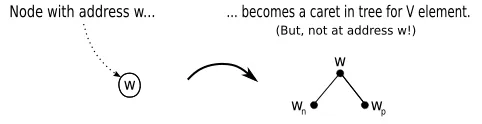
w
Node with address w... ... becomes a caret in tree for V element.
w
wn wp
[image:9.612.186.427.114.176.2](But, not at address w!)
Figure 1. The replacement rule for nodes
vertices ofT2,c given by the composition of the mapsαΘ and βΘ is precisely the bijection given by the domain tree ofαmapping to the range tree of β under the composition of the mapsσαandσβ (which is (αβ)Θ).
We can observe that this homomorphism is non-trivial since applying it to the element ofV that swaps the prefixes 0 with 1 already produces a non-trivial element of QAut(T2,c). Then simplicity ofV implies that we have an embedding.
4. An embedding QAut(T2,c),→V
In this section we show the existence of a group homomorphismϕ: QAut(T2,c)→ V and, forτ∈QAut(T2,c), we define it via the the disjoint decompositiondτ.
For everyτ ∈QAut(T2,c), we apply Lemma 13 and obtain a disjoint decompo-sition of τ as an element dτ ∈ QAut(T2,c). We let Ddτ and Rdτ be the domain
and range trees so thatdτ acts as an element ofV on the leaves ofDdτ (and below
them) and as a bijection above such leaves.
We now apply the following construction to the trees Ddτ and Rdτ. We only
explain it for the tree Ddτ, the other being analogous. Assume that a vertex
w∈Ddτ has two children edges eleft anderight and one parent edgeeparent in the
tree. We replace w with a caret whose vertices are labeled by (w, wn, wp), where wnis the left child ofwandwpis the right child ofw. We attach the former parent edgeeparent on top of wand we attach the former edges eleft anderight below the
vertex wn. The vertex wp has no children. We apply this construction to every vertexw∈Ddτ with two exceptions:
(1) the root vertex ε, for which there is no parent edge and so we only attach the two edges below the left childεn ofε.
(2) Any leaf vertexw, to which we attach the two children edges with terminal verticeswn andwp.
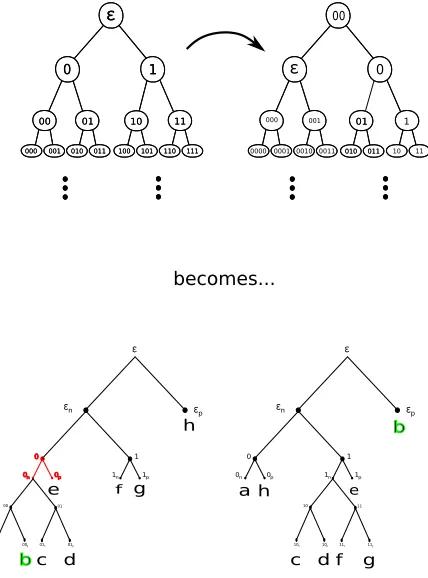
The result of this construction is shown in figure 4. We denote the two trees we have just constructed byDbdτ and Rbdτ. We say that all leaves of the form wn are
then-leavesand the leaves of the formwp are thep-leaves.
If L(T) defines the set of leaves of a finite binary treeT, we observe that the map dτ induces a a bijection σdτ : L(Dbdτ) → L(Rbdτ) which we now construct.
By definition, the map σdτ acts on a leaf wn ∈ L(Dbdτ) by sending it to the leaf
dτ(w)n ∈ L(Rbdτ) and acts on a leafwp ∈ L(Dbdτ) by sending it to a suitable leaf
tp∈ L(Rbdτ) if the mapdτ sends its parent vertexw(seen as a vertex inDdτ) to a
vertext (seen as a vertex inRdτ). This defines a permutationσdτ on then-leaves
ε
0
00 01 10 11
1
000 001 010 011 100 101 110 111
ε
0
00 01 10 11
1
000 001 010 011 100 101 110 111
1
0
0000 0001 0010 0011 10 11
ε
00
000 001 01
010 011
01
010 011
ε
εn εp
0 1
0n 0p 1n 1p
00
n 01
00 00p 01n 01p
ε
εn εp
0 1
0n 0p 1n 1p
10
n 11
10 10p 11n 11p
a b c d
e f g
h
a
c d h
f g
e
becomes...
[image:10.612.201.415.115.404.2]b
Figure 2. The replacement rule for nodes
We define ϕ(τ) := (Dbdτ,Rbdτ, σdτ) ∈ V (see figure 4). We need to verify that
such map is well defined as it relies on a choice of a disjoint decomposition.
Lemma 17. The map ϕ: QAut(T2,c)→V defined above is well-defined.
Proof. By Lemma 15, any disjoint decompositiondτ is built by starting from the cutoff disjoint decomposition and expanding the domain full subtree of theV-part coincides withDdτ. Any disjoint decomposition represents exactly the same map as
τ, but the way it is written out is slightly different, even if the final outcome is the same function. Any two disjoint decomposition can be obtained from the cutoff one using unreductions of theV-part, thus one can go from one disjoint decomposition to another via a sequence of reductions and unreductions of theV-part. Hence, it is sufficient to prove our claim in the case of two disjoint decompositionsfτ andgτ so that the tree pair defining theV-part of gτ is obtained by an unreduction of a single level, that is adding a caret to each leaf in the domain and the range tree of theV-part offτ.
in an order preserving way to the verticesfτ(w)p=gτ(w)p, gτ(w0)p, gτ(w1)p. Ob-serve that, as we added the exact same construction of figure 4 to the verticeswn and fτ(w)n while building the tree diagram of ϕ(gτ), we can immediately reduce it. We can do this for each and every of the carets we added to the V-part offτ.
Hence, it is immediate thatϕ(gτ) =ϕ(fτ).
Theorem 18. The map ϕ: QAut(T2,c)→V is an injective homomorphism.
Proof. The map ϕ is a group homomorphism. Let τ, λ ∈ QAut(T2,c) and let fτ and gλ be disjoint decompositions built so that the range tree Rfτ contains the
full subtree constituting the domain treeDgλ. We can now unreduce the domain
treeDgλ to make it become equal toRfτ and we unreduceRgλ accordingly to get
a new tree R. We call σgλ the bijection on the vertices which one obtains from
σgλ after this unreduction. We defineg 0
λ ∈ QAut(T2,c) as the map which has a V-part defined by (Rfτ, R, σgλ) and a bijection part which is given by gλ on all
vertices above the setL(Rfτ). Therefore,g 0
λ =gλ as maps and, by a slight abuse of notation, we still say thatg0λ is a “disjoint” decomposition ofλas in this proof we only need the requirement thatgλ0 is an automorphism on every vertex below
L(Dg0
λ). Therefore we have
(Dfτ, Rfτ, σfτ)(Dgλ, Rgλ, σgλ) = (Dfτ, Rfτ, σfτ)(Rfτ, R, σgλ) = (Dfτ, R, σfτσgλ)
By construction, the tree pair (Dfτ, R, σfτσgλ) has a domain tree which is a full
sub-tree and is deep enough so that the action on all levels below is given by the compo-sition of theV-parts offτand ofgλ. This implies that the tree pair (Dfτ, R, σfτσgλ)
constitutes the V-part of a disjoint decomposition for the element τ λ (which we denote bydτ λ), where the associated bijection part can be computed by composing the bijections occurring within the treesDfτ, Rfτ, R.
Now observe thatϕ(dτ λ) is obtained by expanding the treesDfτ andR and
ap-plying thedτ λto then-leaves and thep-leaves. We obtain the tree pair (Dbfτ,R, σ) =b ϕ(dτ λ).
We consider now the tree pairsϕ(fτ) andϕ(g0λ) =ϕ(gλ). Since the range tree of theV-part ofgλ0 isR, it is clear that the range tree ofϕ(gλ0) is equal toR. Therefore,b the domain tree ofϕ(dτ λ) and ofϕ(fτ)ϕ(g0λ) is equal and the corresponding range trees coincide.
We observe that the bijection on then-leaves ofϕ(dτ λ) andϕ(fτ)ϕ(gλ0) is exactly the same because the V-part of dτ λ was built by composing the tree pairs of the V-parts offτ andgλ0. As we are dealing with disjoint decompositions, the actions above L(Dfτ) andL(Dg0λ) do not affect the V-parts and so the bijections on the
p-leaves ofϕ(fτ) and ofϕ(gλ0) are exactly the bijections appearing in the bijection parts offτ andgλ0. Thus the bijection on thep-leaves ofϕ(fτ)ϕ(gλ0) is determined by the composition of the bijection parts infτandg0λwhich is equal to the bijection part ofdτ λ. Therefore the bijection on thep-leaves ofϕ(fτ)ϕ(gλ0) is equal to that of ϕ(dτ λ). By putting everything together and using Lemma 17 we deduce that ϕ(dτ λ) =ϕ(fτ)ϕ(g0λ) =ϕ(fτ)ϕ(gλ).
The map ϕ is injective. Let dτ be the cutoff decomposition form for τ ∈ kerϕ. The domain and the range tree ofϕ(dτ) must be the equal and the permutation on every leaf is the identity permutation. Therefore the V-part of dτ is the identity element and the bijection part is the identity map, that is dτ is the identity map
One observes that by composing the maps Θ andϕwe can produce large families of embeddings of the typeV →V and QAut(T2,c)→QAut(T2,c). It is commonly known that V contains many copies of itself, however it is a question whether or not the embeddings produced here by multiple compositions of Θ and ϕ are of independent interest.
5. Embedding Baumslag-Solitar groups inV
In this section, we prove that the Baumslag-Solitar groups
BS(m, n) =ha, b|b−1amb=ani
fail to embed in R. Thompson’s groupV whenever|m| 6=|n|and that they do embed otherwise. R¨over observes that the following result is a consequence of Higman’s work in [15].
Theorem 19(R¨over, [26]). Ifnis a proper divisor ofm, then the groupBS(m, n)
does not embed in Thompson’s groupV.
Recall that Farb and Franks have embedding results in groups related to Thomp-son groups. More precisely, they show the following
Theorem 20 (Farb-Franks, [12]). Let m, nbe positive integers.
(1) If m > n ≥ 1 the group BS(m, n) embeds in the group of orientation-preserving analytic diffemorphisms Diffω+(R) and also inside the groups of orientation-preserving homeomorphisms Homeo+(S1) andHomeo+(I).
(2) If m > n >1, the group BS(m, n)does not embed intoDiff2+(I). Ifndoes
not dividem, the group BS(m, n) does not embed intoHomeo+(S1).
Taking the Farb and Franks result together with the R¨over result, we have some evidence that most Baumslag-Solitar groups do not embed inT, and probably also in V. Thus, it is somewhat natural that only if |m|=|n| should one expect that BS(m, n) might embed inV (well, in R. Thompson’s groupT at the least). In this section, we show that these indications do not mislead.
The key idea behind the main result of this section is the following:
Lemma 21. Let v ∈ V be non-torsion, and r and s be integers. Then whenever
(vr)w=vs for somew∈V, we have that|r|=|s|.
The essence of the argument below will be clear to any reader who has digested the material on revealing pairs for elements ofV (for instance, as in [5], which has an expository section written to explain these objects). Note that Higman in [15] introduces the technology of normal and semi-normal forms and later in [7] Brin introduces the analogous technology of revealing pairs, which we have chosen to use here.
Proof. If two elements x, y ∈ V, we use the conjugation notation xy = y−1xy.
Assume thatv,w∈V,v is not torsion, and that there are integersrandsso that (vr)w=vs.We will now show that|r|=|s|. Note that ifr= 0 the lemma result is immediately true, asv0= 1V. Hence, we will assume below that neitherrnorsis zero.
finite orbits on the Cantor set C2. For example, a possibility for m is the least
common multiple of the set of lengths of all finite periodic orbits, as there are only finitely many such lengths. Now, the element αadmits a finite set of points I(α), which we will call theimportant points of α(following [5]), consisting of the repelling and attracting points in the Cantor set under the action ofhαi. For each point in the set I(α), it is the case that α restricted to some small interval Up containing pis an affine map which fixes exactly the point p, where the slope of this map is 2sp, for some s
p a fixed non-zero integer. Now, as (vr)w =vs we see that
(αr)w= ((vm)r)w= ((vr)w)m= (vs)m= (vm)s=αs
as well.
For any integeru∈Z\ {0}, consider the finite set of logarithms of derivatives
Su=
log2
d dtα
u
t=x | x∈I(α)
.
Observe thatSu=u· S1={uv|v∈ S1}. The equation above implies thatwsends
Sr to Ss. It is straightforward to verify that the finite set of slopes of (αr)w on I(α) is exactly equal toSr. Therefore
r· S1=Sr=Ss=s· S1
and thus, ifk= max{|v| |v∈ S1}>0, one has
|r|k= max{|rv| |v∈ S1}= max{|sv| |v∈ S1}=|s|k
By the cancellation law, we have|r|=|s|.
Remark 22. We would like to make a small historical comment. The core idea behind the proof of Lemma 21 is that the product of the set of slopes of the affine restrictions of v in a small neighbourhood of an orbit of a repelling or attracting periodic point (ofC2 associated with the action ofhvi) is an invariant of conjugacy
in V ofv. (See, e.g., [3, 14, 15, 27] for solutions of the conjugacy problem forV). One can think of the result as a total “speed” along an orbit, and it is useful in many ways. For instance, this product-of-slopes calculation for an orbit occurs in section 7 of [5] to analyse element centralisers. As described later in this section, it also appears in [5] to show that all cyclic subgroups are undistorted inV.
We are now ready to give a proof of Theorem 6.
Theorem 6. Let m, n∈Z\ {0}. Let BS(m, n)be the corresponding
Baumslag-Solitar group.
(1) If |m| 6=|n|, thenBS(m, n)fails to embed in V.
(2) If |m|=|n|, then there is an embedding ofBS(m, n)in V.
Proof. Part (1) follows immediately by Lemma 21, since the elementa∈BS(m, n) is non-torsion.
For part (2) we consider the following construction. Lete∈ {−1,1}and consider the groupBS(m, em). We now consider the diagonal embedding ofBS(m, em) into the direct product (Z∗(Z/mZ))×(Z oϕZ). The embedding ofBS(m, em) in the two coordinates is seen as follows:
• the left homomorphism is given by modding out by the common subgroup
• the right homomorphism is the homomorphism from BS(m, em) = ha, bi
toBS(1, e) =ha0, b0i ∼= (Z oϕZ), where a7→a0 andb7→b0.
It is straightforward to see that the intersection of the kernels of the two coordinates is trivial. The authors learned of the nice construction detailed above from Yves de Cornulier [1].
Now, the groupsZ andZ/mZare demonstrable groups for V, so Theorem 1.4 in [6] implies thatZ∗(Z/mZ) is a subgroup ofV. (A group isdemonstrable for V if it admits a demonstrative embedding inV. A subgroup ofV isdemonstrative if there is a basic open set in the Cantor setC2 which is moved entirely off of itself
by any non-trivial element of the acting group. See Bleak and Salazar-D´ıaz [6] for more details.)
Separately, we need to discuss the following two cases:
• the groupBS(1,1), which is isomorphic toZ2 is a well-known subgroup of
V, and
• the groupBS(1,−1) which is the Klein bottle group.
Noting that there is a double cover of the torus to the Klein bottle, the Klein bottle group is a finite extension of the group Z2≤V and therefore BS(1,−1) is also a subgroup ofV (by Corollary 1.3 of Bleak and Salazar-D´ıaz [6], the set of isomorphism classes of subgroups of V is closed under extensions by finite groups).
Therefore,BS(m, em) embeds into the group (Z∗(Z/mZ))×(Z oϕZ) which is a subgroup ofV ×V which, in turn, is a subgroup ofV.
We are grateful to Jos´e Burillo who pointed out that one can sometimes use an argument based on distortion to show certain non-embedding results. Indeed, this type of argument can be used in our context to show the main non-embedding results of Theorem 6. Here is how the argument runs.
First, recall Theorem 1.3 in [5] which says that all cyclic groups are undistorted inV. Now recall that when|m| 6=|n|, the groupBS(m, n) has distorted cyclic sub-groups. Now we observe that ifBS(m, n) were a subgroup ofV andv∈BS(m, n) were an element of infinite order, then the distortion of hvi in V would have to be at least as much as it is inBS(m, n) and that yields a contradiction, therefore implying that for suchmandn,BS(m, n) does not embed inV.
We observe that this argument is fundamentally equivalent to the one given in the proof of Lemma 21; to prove cyclic groups are undistorted inV, one measures the ‘speed’ of the elements in the cyclic subgroup, near to their attracting and repelling orbits.
References
1. http://mathoverflow.net/questions/119719/when-is-a-baumslag-solitar-group-linear. 2. A. V. An¯ıs¯ımov,Certain algorithmic questions for groups and context-free languages,
Kiber-netika (Kiev) (1972), no. 2, 4–11. MR 0312774 (47 #1329)
3. J.M. Belk and F. Matucci,Conjugacy and dynamics in Thompson’s groups, Geometriae Ded-icata,169, No. 1 (2014) 239–261,arXiv:math.GR/0708.4250.
4. Mladen Bestvina, Questions in geometric group theory, web page: (2013), http://www.math.utah.edu/ bestvina/eprints/questions-updated.pdf.
5. C. Bleak, H. Bowman, A. Gordon, G. Graham, J. Hughes, F. Matucci, and E. Sapir,
Cen-tralizers in R. Thompson’s group Vn, Groups, Geometry and Dynamics 7, No. 4 (2013),
6. Collin Bleak and Olga Salazar-D´ıaz,Free products in R. Thompson’s groupV, Trans. Amer. Math. Soc.365(2013), no. 11, 5967–5997. MR 3091272
7. Matthew G. Brin,Higher dimensional Thompson groups, Geom. Dedicata108(2004), 163– 192. MR MR2112673 (2005m:20008)
8. D. Calegari and Walker. A., Random groups contain surface subgroups, preprint, arXiv:math.GR/1304.2188.
9. ,Surface subgroups from linear programming, preprint,arXiv:math.GR/1212.2618.
10. Nathan Corwin,Embedding and non-embedding results for R. Thompson’s groupV and related
groups, Ph.D. thesis, University of Nebraska - Lincoln, 2013.
11. M. J. Dunwoody,The accessibility of finitely presented groups, Invent. Math.81(1985), no. 3, 449–457. MR 807066 (87d:20037)
12. Benson Farb and John Franks,Groups of homeomorphisms of one-manifolds, i: actions of
nonlinear groups, preprint,arXiv:math.DS/0107085.
13. D. Farley, Local similarity groups with context-free co-word problem, preprint,
arXiv:math.GR/1406.4590.
14. Victor Guba and Mark Sapir,Diagram groups, Mem. Amer. Math. Soc.130(1997), no. 620, viii+117. MR MR1396957 (98f:20013)
15. Graham Higman,Finitely presented infinite simple groups, Department of Pure Mathematics, Department of Mathematics, I.A.S. Australian National University, Canberra, 1974, Notes on Pure Mathematics, No. 8 (1974). MR MR0376874 (51 #13049)
16. D. F. Holt, M. D. Owens, and R. M. Thomas,Groups and semigroups with a one-counter
word problem, Journal of the Australian Mathematical Society85(2008), 197–209.
17. D. F. Holt, S. Rees, and C. E. R¨over,Groups with context-free conjugacy problems, Interna-tional Journal of Algebra and Computation21(2011), no. 01n02, 193–216.
18. D. F. Holt and C. E. R¨over,Groups with indexed co-word problem, International Journal of Algebra and Computation16(2006), no. 05, 985–1014.
19. Derek F. Holt, Sarah Rees, Claas E. R¨over, and Richard M. Thomas,Groups with
context-free co-word problem, J. London Math. Soc. (2) 71 (2005), no. 3, 643–657. MR 2132375
(2006a:20065)
20. John E. Hopcroft and Jeff D. Ullman,Introduction to automata theory, languages, and
com-putation, Addison-Wesley Publishing Company, 1979.
21. J. Lehnert and P. Schweitzer, The co-word problem for the Higman-Thompson group is
context-free, Bull. Lond. Math. Soc.39(2007), no. 2, 235–241. MR MR2323454 (2008f:20064)
22. , personal communication (2009).
23. J¨org Lehnert,Gruppen von quasi-automorphismen, 2008, Goethe Universit¨at, Frankfurt. 24. David E. Muller and Paul E. Schupp,Groups, the theory of ends, and context-free languages,
J. Comput. System Sci.26(1983), no. 3, 295–310. MR 710250 (84k:20016)
25. ,The theory of ends, pushdown automata, and second-order logic, Theoret. Comput.
Sci.37(1985), no. 1, 51–75. MR 796313 (87h:03014)
26. Claas R¨over,Subgroups of finitely presented simple groups, Ph.D. thesis, University of Oxford, 1999.
27. Olga Patricia Salazar-D´ıaz, Thompson’s group V from a dynamical viewpoint, Internat. J. Algebra Comput.20(2010), no. 1, 39–70. MR 2655915 (2011k:37032)
28. Alden Walker,Surface maps into free groups, Ph.D. thesis, California Institute of Technology, 2012.
School of Mathematics and Statistics, University of St Andrews, Mathematical In-stitute, North Haugh, St Andrews, KY16 9SS, Scotland, UK
E-mail address:[email protected]
D´epartement de Math´ematiques, Bˆatiment 425, bureau 21, Facult´e des Sciences d’Orsay, Universit´e Paris-Sud 11, F-91405 Orsay, France
E-mail address:[email protected]
School of Mathematics and Statistics, University of St Andrews, Mathematical In-stitute, North Haugh, St Andrews, KY16 9SS, Scotland, UK