http://www.scirp.org/journal/tel ISSN Online: 2162-2086
ISSN Print: 2162-2078
DOI: 10.4236/tel.2017.73041 April 20, 2017
Is There a Reserve Saving Effect of
International Clearing Union?
Testing for Asian Clearing Union
Vijay Singh Shekhawat
*, Vinish Kathuria
Shailesh J. Mehta School of Management, Indian Institute of Technology Bombay, Mumbai, India
Abstract
International Clearing Unions (ICU) are expected to save international re-serves for their members. This study derives a benchmark for rere-serves saving (RSE) that includes all net reserve savings net of costs for inter-temporal cre-dit that accrue from the clearing process within any ICU. As a test case, RSE of Asian Clearing Union (ACU) is computed and is found to be US $4.5 lion per year over the period 2000 to 2015. RSE ranges from zero to US $8 bil-lion. A counterfactual extension of ACU membership to Thailand and Malay-sia indicates that the RSE may not necessarily increase. The RSE can be ex-tended to any clearing system that follows the principles of inter-temporal credit, multilateral netting and uses single currency for netting and settlement. RSE of such a clearing systems will depend on the balance of credit and debit positions of members. RSE is highest when the trade is perfectly balanced and the countries follow a floating rate regime.
Keywords
International Clearing Union, Reserve Saving Effect, International Trade Settlements, Inter-Temporal Credit
1. Introduction
International Clearing Unions (ICU)1 are one of the instruments for economic
integration and are expected to create conducive environment for increase in trade, to save foreign exchange reserves (henceforth, reserves) and pave the way for higher forms of economic integration [2][3]. International trade is settled by payments in acceptable foreign currencies that are transmitted through
corre-1An ICU is a multilateral mechanism for periodic settlement of trade, on a net basis, through pay-ments by central banks without relying on any particular country to supply the gross volume of cur-rencies needed for such settlement [1].
How to cite this paper: Shekhawat, V.S. and Kathuria, V. (2017) Is There a Reserve Saving Effect of International Clearing Union? Testing for Asian Clearing Union. Theoretical Economics Letters, 7, 562-574. https://doi.org/10.4236/tel.2017.73041
Received: March 1, 2017 Accepted: April 17, 2017 Published: April 20, 2017
Copyright © 2017 by authors and Scientific Research Publishing Inc. This work is licensed under the Creative Commons Attribution International License (CC BY 4.0).
http://creativecommons.org/licenses/by/4.0/
563
spondent banks. ICU is an alternate mechanism whereby the trade payments are routed by the correspondent banks to a central bank or clearing agent. These central banks then hold the settlement receivable and payable positions for a pre-defined time period before netting them off. The netting is done on a multi-lateral basis by a central clearing agency. This mechanism is the core to func-tioning of an ICU. ICUs are expected to have a positive impact on the reserves of the countries and the magnitude of this impact is expected to depend on the balance of trade within the ICU [4]. A more balanced ICU will generate the highest possible reserve savings through a multi-lateral netting of trade receiv-ables and payreceiv-ables. These savings are expected to reduce the demand for re-serves, thereby providing stability to the exchange rates.
The economic impact of ICU is linked to this financial intermediation by an ICU, where it lends the savings of surplus countries to deficit countries during the process of multilateral netting [5]. Skidelsky [6] and Davidson [7] emphasize that ICU can shift the burden of balance of payment (BoP) adjustment on coun-tries with surplus by automatically extending credit to debtors. Piffaretti [8] also supports the idea of a multilateral international clearing house that addresses the shortcomings of the national currencies reserve-based system by allowing ad-justment through the debtors. Studies have also argued that ICUs would counter dampening effect on trade due to lack of reserves by putting the burden of ad-justment on both surplus and debtor countries (see for example [1][5][6] among others). All these arguments assume that ICU would have large and significant effect on the foreign reserves of the members.
The interesting question that emerges is whether all ICUs necessarily generate large savings of reserves for all their members? Can such savings occur in ab-sence of ICUs? Few studies have attempted to answer these question, even fewer have addressed the issue empirically and none have applied it to the oldest ICU, but still functional—the Asian Clearing Union (ACU). This paper uses a bench- mark model for assessing the reserve saving effect (RSE) of an ICU and applies it to ACU as a case study. Results, using data from 2000 to 2015, indicate that members of an ICU have differential reserve savings. Positive RSE tends to have a direct relation with the size of the country’s GDP and trade. Larger countries save more reserves while smaller countries have low or no savings of reserves. RSE can also occur without an ICU when countries have bilateral trade settle-ment arrangesettle-ments. However, such RSE will be less than or equal to what can be generated by participating in an ICU. Counterfactual extension of ICU by ex-pansion of membership indicates that inclusion of new members can enhance the RSE. The paper fills in the gap in literature by theoretical extension of a re-serve saving effect model by included a term for cost of settlement, and its ap-plication for assessment of ACU in its existing form and its counterfactual ex-tension.
564
the model for assessing the effects of ACU and presents the results and Section 5 concludes.
2. Net Settlement System of an International Clearing Union
(ICU)
Structure of an ICU is analogous to prevailing national net clearing and settle-ment system, where financial institutions settle their daily inter-institutional claims arising out of financial or trading, netted over a specific time window [8]. The main difference between ICU and a national net clearing system is that an ICU functions at two layers of netting—one at the national level where every central bank has a net receipt or payment at the end of each day that allows it to record the net debit or credit; and two at the ICU level where, at the end of the settlement cycle, each country’s debit and credits are set off and a net position is arrived at. The net debit or credit position results in outflow or inflow of foreign currency, than may affect the foreign exchange reserves. The central bank is re-quired to absorb all foreign exchange flows into its reserves either by purchasing it against issue of domestic currency or against issue of special currency like Ba-cor2 or ACU Monetary Unit. Alternately, the central bank may also sell foreign
currency against purchase of its own currency or special currency.
ICU attempts to equalize the debits and credits similar to assets and liabilities, in a closed system. If net credits equal debits in the system, no foreign currency flows exit the clearing union, then each member has full control over the ex-change rate. In a market based trade settlement, if there are n banks then we need n n
(
−1)
2 conduits to effect the settlement while in an ICU frameworkwe only need
(
n−1)
conduits. For example, if there are 10 banks each in threecountries or a total of 30 banks in the system. Under ICU we can have a maxi-mum of only 29 (i.e. 30 − 1) flows between the banks where 29 banks send and 1 bank receives the funds on a net basis. Under a market based settlement, there can be a maximum of 435 [(30 × 29)/2] flows. Such flows of foreign exchange will have an impact on the balance of trade of the countries. In order to illus-trate, we show a typical transaction flow under ICU with the net position of each country at the end of the settlement cycle (Table 1). Suppose there are four countries A, B, C and D that have bilateral trade. Country A imports from B and exports to C and D.
Assuming that countries do not participate in an ICU, then country A will re-ceive its surplus of 7000 (row 5 column 1) and pay its deficit of 5000 (row 6 column 1). Similarly, B will receive 2000 and pay 11,000 (row 5 and 6 of column 2), C will receive 7000 and pay 0 (row 5 and 6 of column 3) and D will receive 4000 and pay 6000 (row 5 and 6 of column 4). Since the receipts and payments will not match, all of them will have to arrange for funds to pay off their imports
565
Table 1. Illustration of bilateral net positions in an ICU.
Countries A B C D Net Trade*
1 2 3 4 5
1 A - −5000 +4000 +3000 +2000
2 B −5000 - +2000 −6000 −9000
3 C +4000 +2000 - +1000 +7000
4 D +3000 −6000 +1000 - −2000
5 Surplus +7000 +2000 +7000 +4000 +20,000
6 Deficits −5000 −11,000 0 −6000 −22,000
7 Net Positions +2000 −9000 +7000 −2000 −2000 Note: -ve value indicates country’s import from other countries, +ve value means export to other countries. * Net trade refers to the difference between the amount payable for imports and receivable for exports by the respective countries.
or deficits amounting to 22,000 (row 6 column 5). Hence on an aggregate the volume of international assets needed by these four countries would be 22,000 units.
On the other hand, if they decide to participate in an ICU, they need to pay only their net positions at the end of the pre-defined period, which is 9000 for country B (row 7 column 2) and 2000 for country D (row 7 column 4) i.e. a total of 11,000. In summary, while a gross system requires 22,000 units of interna-tional assets, the ICU reduces this demand to half of that. Extending the exam-ple, if we assume that the countries in net credit position (A and C) allow debt-ors to run their deficits for the next period then even the net payment of 11,000 is not needed provided the debtors are able to export to creditors an equivalent amount.
The effect of netting on the BoP position of the countries can be understood using standard Hecksher-Ohlin and Krugman models of international trade. In terms of these models, the budget constraint3 of the economy is determined by
the terms-of-trade4 as a downward-sloped line with slope equal to the ratio of
prices (P) of x to y where x is the exportable commodity and y is the im-
portable i.e. x y
P
P (Krugman and Obstfeld, 2009). If we assume that country A
imports Qx units of x commodity at price Px from country B and country B
imports commodity Qy units of y from country A at price Py. If there is
only one period within which the x and y are exchanged and payments are
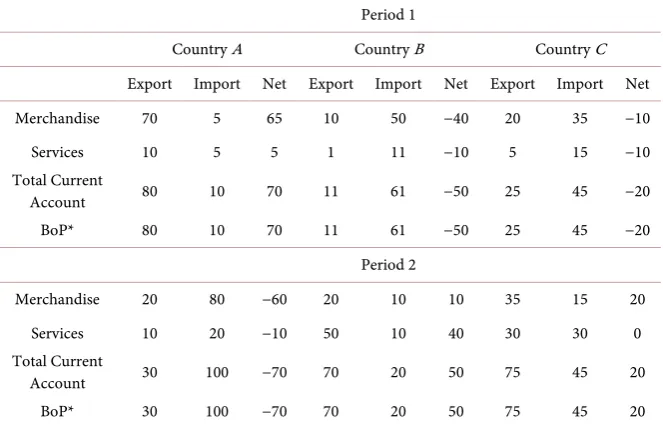
settled and there were no prior reserves, then neither country can import for the other as they possess no reserves. In other words, it is constrained by existing balance of trade. In order to enhance the trade, either country will need to allow import by the other against credit. This can be illustrated with a stylized BoP statements of three ICU countries A, B and C over two periods (Table 2).
3Under conditions of autarky, a budget constraint represents the limitation of consumption by indi-viduals in a country.
566
Table 2. Illustration of Inter-temporal BoP adjustment in presence of ICU.
Period 1
Country A Country B Country C
Export Import Net Export Import Net Export Import Net
Merchandise 70 5 65 10 50 −40 20 35 −10
Services 10 5 5 1 11 −10 5 15 −10
Total Current
Account 80 10 70 11 61 −50 25 45 −20
BoP* 80 10 70 11 61 −50 25 45 −20
Period 2
Merchandise 20 80 −60 20 10 10 35 15 20
Services 10 20 −10 50 10 40 30 30 0
Total Current
Account 30 100 −70 70 20 50 75 45 20
BoP* 30 100 −70 70 20 50 75 45 20
Note: BoP is Balance of payment; Capital Account, Reserves and Error and Omissions are assumed to be zero.
Let us assume that country A, B and C are members of ICU. In period 1, countries B and C owe a total of 70 units (55 + 15) to country A on a net basis. With the introduction of credit for one period, the constraint is relaxed as in the next period, as the countries are able to offset their positions. Countries B and C
now have a net export of 70 units that settles their dues to Country A from pe-riod 1. The only obligation that remains to be settled at the end of pepe-riod 2 is the interest r levied on the deficit countries B and C by country A. Hence, the obli-gations in one period get netted off in the second period and the net pay off of the countries is therefore lower.
In a nutshell, an ICU will reduce the volume of international assets required, pressurizes the debtors to correct their deficits, as countries with persistent debit positions will be restricted to access inter-temporal credits or they have to raise resources at higher costs [10]. All these benefits of ICU hinge on its ability to conserve reserves and create a system where the creditors with surplus extend credit to the debtors. We now formalize the above illustration into a model for estimating the reserve saving of an ICU.
3. Benchmarking the Reserve Savings of an International
Clearing Union
Reserve savings under ICU happen when members net off their multilateral re-ceipts and payments. Suppose a country i has X amount of exports and M
amount of imports from country j. At the same time, country j, also has
some exports and imports from country i. If we assume that ICU settles the
same, the country with less amount payable at time t will not be required to pay at all. In a two country model, the trade dues of each country will be given by
567
As exports of one country equals import of the other (i.e., Mi= Xj), then the
savings of an ICU is simply M. In case, if X >M, then M need not be paid for
as X sets off the dues. If M >X , then X amount need not be paid for and only M-X is payable. Hence minimum of X or M is the savings from an ICU.
,
min
∑
Xi j,∑
Mij (1)Countries with pegged exchange rate will absorb the savings into their re-serves. However, countries with a managed exchange rate can decide the extent to which the imports will be paid from reserves. Therefore, only a fraction of the imports (M) are paid using reserves (R), termed as the import cover ratio (i.e.
M
R ) [11][12]. This implies that imports are fraction of reserves and of this frac-
tion, only a small part is used for payment of imports. Of the amount payable as per Equation (1), only this fraction will contribute to reserve savings and not the entire amount. Stock (R) to flow (M) ratio gives us a unit of time t[13]. For in-stance the M of 12 months is 4 billion and R is 12 billion, then, then R M is 3
years or 36 months. If we assume that all M is paid from R, then for every R, only rd
2 3 will remain while 1 3rd goes into payments. As at any time t, the
recording of stock R includes payments for flow M made till t, then the R at time
t is
[
R+M]
. The ratio will then be RR+M. To obtain standard flow to stock
ratio, we divide both numerator and denominator with R and get a fraction of imports that affect reserves, which is given by:
1
1 M
R
α =
+
(2)
α also captures the extent to which reducing one unit value of net imports by routing through the clearing union will help the country to reduce its foreign exchange reserves. Auguste [10] using a similar derivation identifies the con-temporaneous reserve saving effect (RSE) for all countries participating in an ICU. Adjusting Equation (1) with Equation (2), we obtain the same
,
RSE=αmin
∑
Xi j,∑
Mij (3)Generalizing Equation (3) for p countries in an ICU gives us:
(
1 1)
RSE=
α
min∑
iP= Xi,∑
iP= Mi (4)In case of p countries, however there is a possibility of both bilateral and mul-tilateral netting of payments. Effects of ICUs are necessarily mulmul-tilateral, hence we have to deduct the bilateral effect for pair of each trade partner. The RSE for country j while removing bilateral effects with j will then be given by the follow-ing identity.
(
) (
1)
1 1 1
RSEj min P j, P j P min j, j
it it it it
i X i M i X M
α
−= = =
=
∑
∑
−∑
(5)568
like aids, grants, interest, capital gains etc. denoted by RV, that may increase the reserves without any contribution from the ICU. Incorporating these into Equa-tion (5), we can now calculate the RSE for a country j time t in an ICU with p
members would be:
(
1 1) (
1)
1 1 1
RSEtj
α
t min ip Xitj, ip Mitj ip min Xitj,Mitj RVtj− − −
= = =
=
∑
∑
−∑
− (6)Standard reports of any ICU publish data derived from Equation. (4) as the benefits accruing to countries (See for example ACU, 2014 for data on ACU
[14]). However, in absence of adjustments shown in Equation (6), these benefits may be overstated.
3.1. Modelling the Credit Arrangement within ICU
Multilateral credit is the key to ICUs as it allows each member continue trade by using intra-temporal trade. Cost and availability of this credit is expected to be used as a tool for correcting the BoP imbalances. As explained above, under ICU mechanism, the debtor or creditor position is maintained in the books of the ICU and at the end of settlement period (say 1 month), the net position (debits minus credits) is arrived at. It may happen that some countries would have net credit while other have a net debit position. Assuming that the country is a gross importer within ICU i.e. it imports from all other members, then its position would be in debit against each country. In such a scenario, the debtor country can be assumed to avail multilateral credit from all other members for a period of say 1 month. At the end of the period, the debtor has to repay the creditors and the cycle commences once again from zero. Let the cost (c) of this credit for 1 month (i.e. 30/365year) be charged at an annual interest rate of r%. This cost for country j for a credit over time t will then be
(
1)
1 365
p j it i
rt
c=
∑
=− M (7)For every country where gross exports exceed the gross imports from all other members, the RSE will then be given by the following identity
(
1 1) (
1)
1 1 1
RSEtj
α
t min ip Xitj, ip Mitj ip min Xitj,Mitj RVtj ctj− − −
= = =
=
∑
∑
−∑
− − (8) Addition of c to the RSE causes the model to capture all the financing costs and benefits (other than administrative costs) that can be obtained by joining an ICU. In case a country is a net importer from other countries, it will pay c as fi-nancing cost and vice versa. This model is an improvement over Auguste [10]that limited the RSE to trade settlement benefits only.
569
over the market based credit. Williamson [17] also does not find any evidence that financial intermediation leads to better allocation of resources than what the market can otherwise garner. In a recent study Philippon [18] highlighted the increase in transaction cost due to intermediation. The study shows that even though there are diverse systems for risk mitigation, commercial activities have been charged higher by intermediaries like banks without any real reduction in risk. Poghosyan [19] findings also support the view that in low income coun-tries, financial intermediation costs have not been declining primarily due to low banking competition and weak institutional frameworks. This high financial in-termediation costs are symptomatic of a number of systemic problems including diseconomies of scale due to market fragmentation, high operating costs ineffi-cient institutional environment and institutional interference in financial market activity. The presence of ICU in the foreign exchange market can also create an institutional structure that may fragment the market, have higher operating costs and market regulation that may divert trade (Pan A. Yotopoulos, 1992).
The interesting question that emerges from the example is whether such in-ter-temporal credit extends the budget constraint or is such credit adding to the costs? In order to examine this issue in depth, we take the case of Asian Clearing Union (ACU) and examine the effect of credit on easing of budget constraint using RSE as the indicator.
3.2. Asian Clearing Union (ACU)—A Case
ACU was established in 1974 under aegis of erstwhile Economic and Social Commission for Asia and Far East primarily to address the issues of trade im-balance in South Asia (Jalan, 2003). The initial signatories to the ACU agree-ment were Iran, Sri Lanka, India, Bangladesh, Nepal and Pakistan. Myanmar (Burma) joined later in 1977, Bhutan in 2000 and Maldives in 2009. The agree-ment states the four key objectives for setting up ACU with an international clearing system at its core. These objectives were to provide a multilateral net settlement facility for current international transactions; conserve foreign ex-change reserves through this settlement facility; promote monetary co-operation for expansion of trade and to provide for currency swap arrangement as a means of temporary credit facility [20][21].
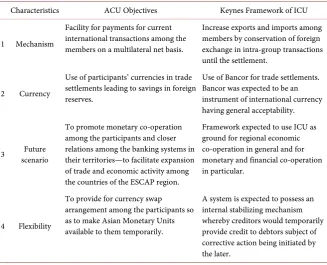
In order to use ACU as a test case for ICU, it should broadly conform to prin-ciples enunciated by Keynes [9]. One major exception is the international cur-rency (Bancor) envisaged by Keynes for ICUs, that is not a part of ACU frame-work. However, ACU uses ACU monetary unit that is pegged to US Dollar or Euro (as per the preference of the participants) allowing the trade settlements in a single currency. Table 3 compares the ACU objectives with the ICU frame-work proposed by Keynes.
570
Table 3. Comparison of objectives of ACU with those of Keynes ICU framework.
Characteristics ACU Objectives Keynes Framework of ICU
1 Mechanism
Facility for payments for current international transactions among the members on a multilateral net basis.
Increase exports and imports among members by conservation of foreign exchange in intra-group transactions until the settlement.
2 Currency
Use of participants’ currencies in trade settlements leading to savings in foreign reserves.
Use of Bancor for trade settlements. Bancor was expected to be an instrument of international currency having general acceptability.
3 scenario Future
To promote monetary co-operation among the participants and closer relations among the banking systems in their territories—to facilitate expansion of trade and economic activity among the countries of the ESCAP region.
Framework expected to use ICU as ground for regional economic co-operation in general and for monetary and financial co-operation in particular.
4 Flexibility
To provide for currency swap arrangement among the participants so as to make Asian Monetary Units available to them temporarily.
A system is expected to possess an internal stabilizing mechanism whereby creditors would temporarily provide credit to debtors subject of corrective action being initiated by the later.
Source: Authors’ compilation
ACU using benchmark model derived at Equation (8) now can be carried using data for its member countries.
3.3. Data
571
[image:10.595.58.539.587.719.2]4. Results and Discussion
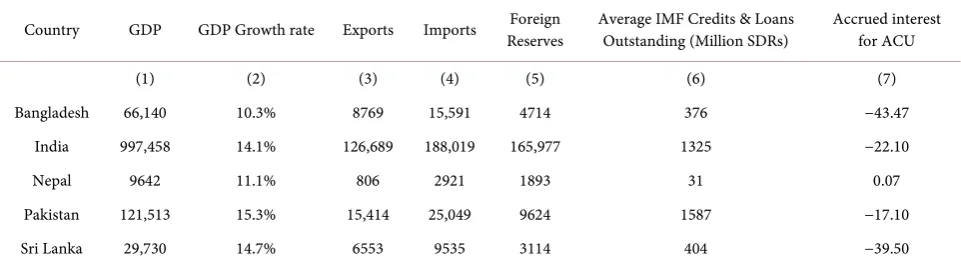
Table 4 reports the select key economic indicators of the ACU member coun-tries. The economic indicators show the diversity among ACU councoun-tries. India has a relatively large GDP, exports, imports and reserves as compared to all other members.
All countries are trade deficit as the imports exceed the imports (columns 3 and 4). India has the highest foreign exchange reserves in the group indicating its ability to be the single largest creditor (column 5). Average outstanding IMF loans and credits reflects vulnerability to external flows requiring these countries to borrow from IMF (column 6). India and Pakistan have the maximum average outstanding loans while Bhutan has not availed any such loans. The summary statistics indicate the need for all countries to conserve reserves. Perhaps that might have motivated their ACU membership too. Using the benchmark model in Equation (8), we estimate the Reserve saving effect (RSE) for the ACU mem-bers from 2000 to 2015. The interest costs c as charged to the ACU members are adjusted in calculation. Results are presented in Table 5.
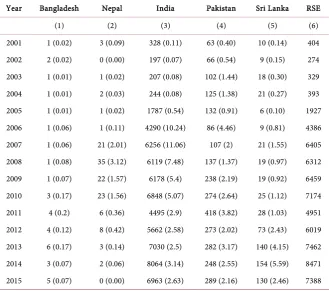
Table 5 indicates that the RSE has been positive for most countries except for Nepal in 2002 and 2015. In these two years, the interest costs for partici-pating in the ICU was equal to the gross reserve savings. The RSE rises as in-tra-ACU trade rises as it is has an axiomatic linear relation. If the ratio of re-serves to imports (Import cover ratio) rises due to disproportionate increase in reserves, then increase in intra-ACU trade leads to higher RSE. This is because with increase in R/M due to disproportionate increase in R (i.e., a country has adopted an export driven strategy), the percentage of reserves utilized for pay-ments of imports will decline and at some stage, the stock-flow relationship ceases to have interaction. The country wise results indicate that while some countries like India and Pakistan may have large RSE, there are countries with zero RSE as well. In other words, ICU membership may not ensure RSE to all the member countries.
An interesting question is whether the low RSE is due to the present set of countries or can be generalized for all ICUs? In other words, if there were other countries in ACU, would the RSE be different?
Table 4. Select economic indicators of ACU member from 2001 to 2015 (US$ Million).
Country GDP GDP Growth rate Exports Imports Reserves Foreign Average IMF Credits & Loans Outstanding (Million SDRs) Accrued interest for ACU
(1) (2) (3) (4) (5) (6) (7)
Bangladesh 66,140 10.3% 8769 15,591 4714 376 −43.47
India 997,458 14.1% 126,689 188,019 165,977 1325 −22.10
Nepal 9642 11.1% 806 2921 1893 31 0.07
Pakistan 121,513 15.3% 15,414 25,049 9624 1587 −17.10
Sri Lanka 29,730 14.7% 6553 9535 3114 404 −39.50
572
Table 5. Reserve saving effect of ACU members from 2001 to 2015 (US$ Million).
Year Bangladesh Nepal India Pakistan Sri Lanka RSE
(1) (2) (3) (4) (5) (6)
2001 1 (0.02) 3 (0.09) 328 (0.11) 63 (0.40) 10 (0.14) 404 2002 2 (0.02) 0 (0.00) 197 (0.07) 66 (0.54) 9 (0.15) 274 2003 1 (0.01) 1 (0.02) 207 (0.08) 102 (1.44) 18 (0.30) 329 2004 1 (0.01) 2 (0.03) 244 (0.08) 125 (1.38) 21 (0.27) 393 2005 1 (0.01) 1 (0.02) 1787 (0.54) 132 (0.91) 6 (0.10) 1927 2006 1 (0.06) 1 (0.11) 4290 (10.24) 86 (4.46) 9 (0.81) 4386 2007 1 (0.06) 21 (2.01) 6256 (11.06) 107 (2) 21 (1.55) 6405 2008 1 (0.08) 35 (3.12) 6119 (7.48) 137 (1.37) 19 (0.97) 6312 2009 1 (0.07) 22 (1.57) 6178 (5.4) 238 (2.19) 19 (0.92) 6459 2010 3 (0.17) 23 (1.56) 6848 (5.07) 274 (2.64) 25 (1.12) 7174 2011 4 (0.2) 6 (0.36) 4495 (2.9) 418 (3.82) 28 (1.03) 4951 2012 4 (0.12) 8 (0.42) 5662 (2.58) 273 (2.02) 73 (2.43) 6019 2013 6 (0.17) 3 (0.14) 7030 (2.5) 282 (3.17) 140 (4.15) 7462 2014 3 (0.07) 2 (0.06) 8064 (3.14) 248 (2.55) 154 (5.59) 8471 2015 5 (0.07) 0 (0.00) 6963 (2.63) 289 (2.16) 130 (2.46) 7388 Notes: * sudden increase is caused by inclusion of oil import figures. Figure in parenthesis is the percentage of reserve savings to total reserves. The average RSE of Column 6 is US$ 4.5 billion.
Counterfactual Extension of ACU
Counterfactual extension of an ICU is an interesting way of testing whether presence of more members in the ICU would have altered this position of low RSE. Similar counterfactual exercises have been used to study the hypothetical effects of ICUs by Duggan [1] and Hirai [21]. We evaluate the RSE for ACU by adding few more countries from South East Asia—Thailand and Malaysia and then compare the results. The selection of these two countries is based on their similarities with existing members, so the basic structure of flows within the ICU does not get disturbed. For instance, like existing ACU members, these two countries have formed economic associations to enhance trade, which will make it easier to integrate with a payment union. These countries follow precautionary reserve accumulation policies like most of the ACU members. The potential RSE for Thailand and Malaysia, if they become members of ACU, over the period is given in Table 6.
5. Conclusions
573
Table 6. RSE of ACU after inclusion of Malaysia and Thailand (US$ Million).
Year Thailand Malaysia RSE-ACU* RSE-Extended Increase (%)
2001 64 4 404 472 17
2002 40 1 274 315 15
2003 34 0 329 363 10
2004 10 4 393 407 4
2005 32 11 1927 1970 2
2006 43 19 4386 4448 1
2007 42 8 6405 6455 1
2008 69 16 6312 6397 1
2009 75 1 6459 6535 1
2010 106 4 7174 7284 2
2011 99 3 4951 5053 2
2012 117 3 6019 6139 2
2013 96 0 7462 7558 1
2014 62 0 8471 8533 1
2015 57 0 7388 7445 1
Notes: * RSE of select ACU countries from Table 5 (column 6); RSE-Extended is summation of RSE of se-lect ACU members, Thailand and Malaysia.
be applied to any clearing system as a benchmark as it provides the net savings effect. As a test case, the RSE benchmark model evaluates Asian Clearing Union over 15 year period from 2000 to 2015 to find that on an US$ 4.5 billion per year is the extent of reserve saving. However, there is a wide variation in the RSE and generally countries with low GDP have RSE as low as zero while countries with higher GDP save more, though as a percentage of their existing reserves, it is less than 5% for all countries. Countries with larger trade will have larger savings and thereby be able to enhance trade without being limited by international budget constraints. A counterfactual extension of ACU membership to Thailand and Malaysia indicates that the RSE may increase for the participating member but the increase is RSE is not assured.
574
References
[1] Duggan, M.C. (2013) Taking Back Globalization: A China-United States Counter-factual Using Keynes’s 1941 International Clearing Union. Review of Radical Po-litical Economics, 45, 508-516.https://doi.org/10.1177/0486613412475191
[2] Yoshimasa, K. and Tinbergen, J. (1966) International Economic Integration, Eco-nomic Review. Hitotsubashi University, 17, 187-189.
[3] Alessandrini, P. and Fratianni, M. (2009) Resurrecting Keynes to Stabilize the In-ternational Monetary System. Open Economies Review, 20, 339-358.
https://doi.org/10.1007/s11079-008-9106-4
[4] Randall, W.L. (2013) Keynes: The Return of the Master. Eastern Economic Journal, 39, 134-137.https://doi.org/10.1057/eej.2010.42
[5] Romar, C. (2012) For an International Clearing Union. Journal of Economic Stud-ies, 39, 398-409.https://doi.org/10.1108/01443581211255611
[6] Skidelsky, R. (2011) The Relevance of Keynes. Cambridge Journal of Economics, 35, 1-12.https://doi.org/10.1093/cje/beq043
[7] Davidson, P. (2009) The Keynes Solution: The Path to Global Economic Prosperity. Palgrave Macmillan, London.
[8] Piffaretti, N.F. (2009) Reshaping the International Monetary Architecture Lessons from Keynes’ Plan. World Bank Policy Research Working Paper No. 5034.
[9] Moggridge, D. (1980) John Maynard Keynes XXV Activities 1940-1944 Shaping the Post War World the Clearing Union. Macmillan Cambridge University Press, Lon-don.
[10] Auguste, B.G. (1997) The Economics of International Payments Unions and Clear-ing Houses: Theory and Measurement. Palgrave Macmillan, London.
[11] Terada-Hagiwara, A. (2005) Foreign Exchange Reserves, Exchange Rate Regimes, and Monetary Policy: Issues in Asia. Asian Development Review, 22, 1-34.
[12] Arize, A.C. and Malindretos, J. (2012) Foreign Exchange Reserves in Asia and Its Impact on Import Demand. International Journal of Economics and Finance, 4, 21-
32.https://doi.org/10.5539/ijef.v4n3p21
[13] Currie, D. (1976) Some Criticisms of the Monetary Analysis of Balance of Payments Correction. The Economic Journal, 86, 508-522.https://doi.org/10.2307/2230796 [14] ACU (2014) Annual Report. ACU Annual Report 162.
www.asianclearingunion.org/Publications/AnnualReport.aspx
[15] Scholtens, B. and Van Wensveen, D. (2000) A Critique on the Theory of Financial Intermediation. Journal of Banking & Finance, 24, 1243-1251.
[16] Levine, R. (2002) Bank-Based or Market-Based Financial Systems: Which Is Better?
Journal of Financial Intermediation, 11, 398-428.
[17] Williamson, S.D. (1986) Costly Monitoring, Financial Intermediation, and Equilib-rium Credit Rationing. Journal of Monetary Economics, 18, 159-179.
[18] Philippon, T. (2015) Has the US Finance Industry Become Less Efficient? On the Theory and Measurement of Financial Intermediation. American Economic Re-view, 105, 1408-1438.https://doi.org/10.1257/aer.20120578
[19] Poghosyan, T. (2013) Financial Intermediation Costs in Low Income Countries: The Role of Regulatory, Institutional, and Macroeconomic Factors. Economic Sys-tems, 37, 92-110.
[20] ACU (1974) Asian Clearing Union Agreement. www.asianclearingunion.com [21] Hirai, T. (2013) International Design and the British Empire: Keynes on the Relief
Submit or recommend next manuscript to SCIRP and we will provide best service for you:
Accepting pre-submission inquiries through Email, Facebook, LinkedIn, Twitter, etc. A wide selection of journals (inclusive of 9 subjects, more than 200 journals)
Providing 24-hour high-quality service User-friendly online submission system Fair and swift peer-review system
Efficient typesetting and proofreading procedure
Display of the result of downloads and visits, as well as the number of cited articles Maximum dissemination of your research work
Submit your manuscript at: http://papersubmission.scirp.org/