http://www.scirp.org/journal/jss ISSN Online: 2327-5960
ISSN Print: 2327-5952
DOI: 110.4236/jss.2017.58008 Aug. 8, 2017 101 Open Journal of Social Sciences
Comparative Study of Physicians’ Job
Satisfaction Levels in the Public and the
Private Sectors in Russia
Maria Shkolnikova
1, Michael Yugay
2, Victoria Pankevich
2*1Research Clinical Institute for Pediatrics of the Pirogov Russian National Research Medical University, Moscow, Russia 2National Research University Higher School of Economics, Moscow, Russia
Abstract
Job satisfaction is widely seen as a significant factor in an organisation’s effi-ciency. In healthcare, job satisfaction is very important because it helps to de-velop a clinic’s human resource potential, and thus to influence the quality of the medical services provided. The aim of this study is to compare physicians’ job satisfaction levels in public, private, and departmental healthcare organi-sations. Respondents were asked to evaluate their overall attitude towards their work and their levels of satisfaction with factors such as salary, working conditions, and team atmosphere. The results of the study showed that the physicians with the highest job satisfaction levels are in the private sector (67%), whereas physicians in the departmental and the public sectors have much lower job satisfaction levels (9% and 11%, respectively). In terms of sal-ary, physicians who work in public clinics have lower levels of satisfaction (11%) than physicians who work in other types of clinics. Most of the physi-cians surveyed appear to be content with the team atmosphere in their work-place, with around 70% of respondents in all organisation types indicating that they are satisfied with this aspect of their work. Logistic regression analy-sis showed that the motivating factor which most influences the satisfaction levels of healthcare workers in public clinics is their working conditions, whereas the factor that most influences the satisfaction levels of physicians in the private sector is their salary. Meanwhile, the factors that most influence the satisfaction levels of physicians in departmental organisations are both their working conditions and their salary.
Keywords
Job Satisfaction, Hospitals, Physicians, Incentives, Motivation
How to cite this paper: Shkolnikova, M., Yugay, M. and Pankevich, V. (2017) Com-parative Study of Physicians’ Job Satisfac-tion Levels in the Public and the Private Sectors in Russia. Open Journal of Social Sciences, 5, 101-113.
https://doi.org/10.4236/jss.2017.58008
Received: July 9, 2017 Accepted: August 5, 2017 Published: August 8, 2017
Copyright © 2017 by authors and Scientific Research Publishing Inc. This work is licensed under the Creative Commons Attribution International License (CC BY 4.0).
DOI: 10.4236/jss.2017.58008 102 Open Journal of Social Sciences
1. Introduction
The success of every healthcare organisation depends on various factors. The main reasons for studying these factors are to increase the efficiency of an or-ganisation and to ensure that the oror-ganisation’s employees reach their full po-tential. One of these factors is physicians’ and nurses’ job satisfaction (JS). While the importance of this factor is generally recognised, additional investigations of satisfaction levels are necessary as external conditions and societal values are constantly changing. The available data indicate that workers who are content with their job are more hardworking, efficient, disciplined, and better at manag-ing their time than workers who are not satisfied [1]-[6]. Therefore, if the em-ployees in an organisation report high levels of job satisfaction, it may be ex-pected that the organisation would have high levels of efficiency [7]-[12]. Survey results in various countries show that healthcare workers’ JS levels depend on many factors. For example, physicians working in a hospital in Orlando (Florida, USA) rated their relationships with patients and colleagues and their opportuni-ties for self-development as the most significant contributors to their JS [9]. A survey conducted in a public clinic in Serbia showed that JS grows with physi-cians’ levels of education [12]. It was also revealed that the majority of respon-dents (76%) feel overloaded with work and do not have an opportunity to influ-ence their job. Several studies of physicians’ JS have also been conducted in Rus-sia. For example, a survey conducted in two regional public hospitals in Saint Petersburg and Astrakhanskaya oblast found that more than two-thirds of phy-sicians (67.7%) are not content with their job [13]. The results further showed that a similar share of respondents believed their reimbursement is insufficient, and almost 80% feel overloaded at work. The most motivating factor cited by the physicians surveyed was the opportunity to help other people.
DOI: 10.4236/jss.2017.58008 103 Open Journal of Social Sciences requirements and expectations associated with his or her job, which in turn in-forms the employee’s overall attitude towards his or her work.
The study of workers’ JS is particularly important today because human re-sources have become the main factor that determines an organisation’s effi-ciency. There is substantial evidence that it is rather difficult to run a company in which the employees have low levels of JS. When studying physicians’ job sat-isfaction, particular attention should be paid to the conditions and the features of their work, including whether the physicians are employed by a public, a pri-vate, or a departmental organisation. The main objective in the public sector is to utilise public finances in the most efficient way possibly, whereas the main objective in the private sector is maximum profitability. Thus, we can assume that a private sector organisation has greater incentives than a public sector or-ganisation to develop and implement various instruments to increase its effi-ciency. However, a public sector organisation may be more entrenched with the traditions and associations of particular specialists, and it could adopt some practices from the private sector, especially in the area of workers’ motivation.
Therefore, the purpose of the study was to examine the features of Russian physicians’ job satisfaction depending on the type of the sector where they work and to carry out a comparative analysis.
Practical social significance of the research lies in the fact that the study was aimed at the development of the recommendations for the heads of medical or-ganizations on how to make workers more content with job. What is more, the analysis of the studies related to the topic showed that previously no articles de-scribed the difference between job satisfaction in public and private healthcare organizations in Russia. The results of the current research are based on the sta-tistical analysis of primary data and cover important gaps in scientific field, what proves its academic significance.
2. Methods
The aim of the research was to compare the levels of job satisfaction of physi-cians working in public, private, and departmental1 medical organisations in
Moscow. The data were collected in 2014-2015 in three types of healthcare or-ganisations in Moscow: public, private, and departmental. The research sample consisted of 469 physicians. The data were collected with a specially designed questionnaire. The idea was to create a questioner which would cover the major constituents of the job satisfaction and evaluate the aspects of work which could influence it. At the same time, we did not want our respondents to spend too much time answering the questions that is why the questioner consisted of nine closed-ended questions:
• How long have you been working in this medical organisation?
1In Russia departmental medical organizations are established by government institutions or public
DOI: 10.4236/jss.2017.58008 104 Open Journal of Social Sciences • To what extent are you satisfied with your job?
• To what extent are you satisfied with the level of your salary? • To what extent are you satisfied with your working conditions?
• To what extent are you satisfied with the team atmosphere in your work-place?
• What would you like to improve in your working conditions? • Do you educate yourself?
• Which sources of information do you use for self-education? • What incentives do you consider to be the most important for you?
Questionnaires were submitted to 65 clinic administrative offices and then distributed among physicians2. The study sample consisted of 229 physicians
working in public hospitalssituated in 10 (out of 12) different Moscow districts (48.8% of the sample), 195 physicians working in 2 large departmental hospitals (41.5% of the sample), and 45 physicians working in one of the Top 5 private clinics in Moscow (9.6% of the sample). Therefore, the sample can be considered as representative because it reflects in relevant to the general structure of the medical organizations in Moscow proportions the physicians of different types of the clinics. All of the answers were converted into figures and processed with SPSS statistics 22.0.
The data analysis included crosstabs, descriptive statistics, and logistic regres-sion analysis. Logistic regresregres-sion analysis was usedto evaluate how the physi-cians’ levels of satisfaction with their salary, their working conditions, and the team atmosphere in their workplace influenced the likelihood that they would report being satisfied or dissatisfied with their job. This type of analysis was chosen because it allowed us to pay particular attention to the differences be-tween two groups of respondents: those who are satisfied and those who are dis-satisfied. The dependent variable (job satisfaction) was thereforebinary. The lo-gistic regression model was:
(
0 ,1 1 2 2 3 3)
Pr=g p + p x +p x +p x
where g(z) is logic-function g(z) = 1/(1+ e−Z), р
0-constant, x1, x2, x3-resulting
ex-planatory variables “satisfaction with salary”, “satisfaction with working condi-tions”, “satisfaction with team atmosphere” respectively, p1, p2, p3-regression
co-efficients and (Pr)-physicians’ overall job satisfaction levels.
3. Results
The average level of JS reported by physicians in all types of medical organisa-tions was less than 70%. The lowest indicator was found in public medical or-ganisations (56.3%), and the indicator was only slightly higher in departmental organisations (58.2%). The highest indicator was found in private organisations (67.4%; p < 0.05).
2The survey was conducted only among the clinics that expressed their ineptest to the research and
DOI: 10.4236/jss.2017.58008 105 Open Journal of Social Sciences The findings further revealed that the longer physicians had worked in a par-ticular organisation, the more likely they were to report being satisfied with their job (Figure 1). Around half of the workers in the group with the highest job seniority reported being satisfied with their job. By contrast, only 6.3% of the physicians who had worked at the organisation for less than a year reported be-ing satisfied with their work.
[image:5.595.211.533.293.476.2] [image:5.595.211.536.507.702.2]The analysis of physicians’ levels of satisfaction with their salary showed that 71.1% of respondents in the private sector, but only 22.1% of respondents in the departmental sector and just 10.7% of respondents the private sector, reported being satisfied with their salary (Figure 2). The results further showed that 46.1% of the physicians at public hospitals reported being more satisfied than not—a figure that is 4% lower than the share found among physicians at de-partmental organisations. If we summarise these two groups of answers (satis-fied and more satis(satis-fied than not), we see that positive answers to the question
Figure 1. Physicians’ job satisfaction levels and their job seniority.
DOI: 10.4236/jss.2017.58008 106 Open Journal of Social Sciences were given by 97.8% of physicians at private hospitals, 64.2% of physicians at departmental hospitals, and 56.8% of physicians at public healthcare organisa-tions (Figure 2). The highest share of physicians who said they are not satisfied with their salary (43.2%) were in the public sector.
Physicians in different types of medical organisations differ in their levels of satisfaction with their working conditions. This indicator was almost the same among physicians in the public and the departmental sectors (37.6% - 37.4%), but was twice as high among physicians in the private sector (84.4%) (Figure 3). The aggregated indicator of physicians’ job satisfaction was 83.9% in public medical organisations, and was a full 100% in private clinics.
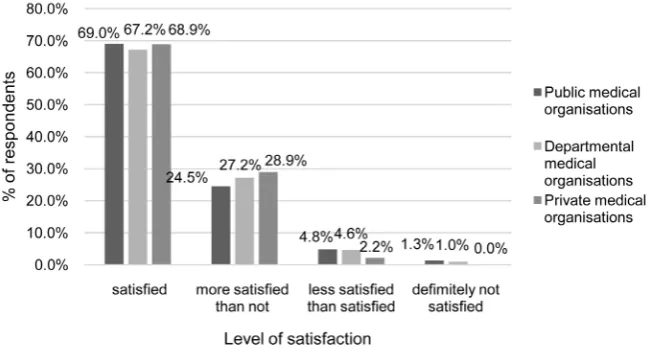
Levels of satisfaction with team atmosphere were rather high among physi-cians at all types of medical organisations, at around 70% (Figure 4). Less than 6% of respondents reported they are not satisfied with this factor.
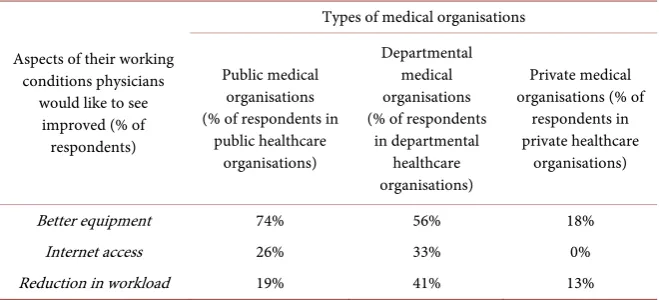
Nearly three-quarters (74%, Table 1) of the physicians working in public
[image:6.595.208.534.296.469.2]Figure 3. Physicians’ satisfaction levels with working conditions in different types of medical organisations.
[image:6.595.210.535.518.694.2]DOI: 10.4236/jss.2017.58008 107 Open Journal of Social Sciences
Table 1. Aspects of their working conditions physicians would like to see improved.
Aspects of their working conditions physicians
would like to see improved (% of
respondents)
Types of medical organisations
Public medical organisations (% of respondents in
public healthcare organisations)
Departmental medical organisations (% of respondents
in departmental healthcare organisations)
Private medical organisations (% of
respondents in private healthcare
organisations)
Better equipment 74% 56% 18%
Internet access 26% 33% 0%
Reduction in workload 19% 41% 13%
healthcare organisationssaid they would like to see improvements in their hos-pital’s equipment, compared to 56% of physicians in the departmental sector and just 18% of physicians in the private sector. In addition, none of the physi-cians in the private sector, 26% of respondents in the public sector, and 33% of respondents in the departmental sector reported that there is a need to improve internet access in their workplace. Whereas 41% of physicians at departmental clinics said they would like a decrease in their workload, surprisingly small shares of physicians at the two other types of organisations reported wanting less work.
An analysis of the survey data revealed that a salary increase is the incentive that is most valued by physicians, cited by 89% in the public sector, 93% in the departmental sector, and 84% in the private sector (Table 2). In addition, an improvement in working conditions was cited as an important incentive by around half of physicians at both public and departmental medical organisa-tions. Community recognition seems to be appreciated more by physicians in the departmental and the private sectors than in the public sector. Less than 15% of all respondents said they would like to be promoted and to a role with higher status.
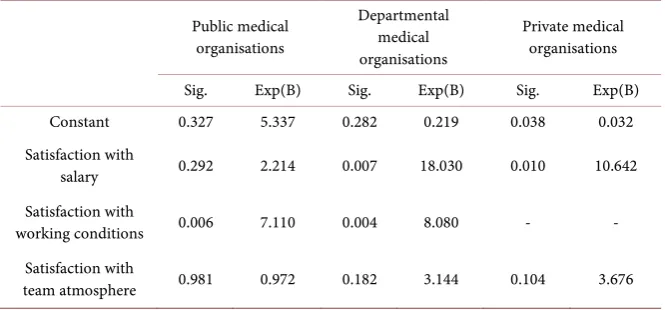
A logistic regression analysis was conducted for each type of healthcare or-ganisation in order to determine which factors were most influential in the pub-lic, the private, and the departmental sectors. Table 3 displays the coefficients for the independent variables and the types of healthcare organisations.
3.1. Public Medical Organisations
According to the results of the logistic regression, the correlations of the model are statistically significant (p < 0.05, χ2(4) = 11.724). The explained variation in
the dependent variable based on our model is 16.6% (Nagelkerke R2). The results
DOI: 10.4236/jss.2017.58008 108 Open Journal of Social Sciences
Table 2. The importance of different incentives to physicians.
Incentive (% of respondents)
Types of medical organisations
Public medical organisations
Departmental medical organisations
Private medical organisations
Salary increase 89% 93% 84%
Improvement in working
conditions 53% 56% 20%
Community recognition 21% 43% 40%
Empowerment 9% 7% 13%
Promotion 7% 9% 13%
Table 3. Logistic regressing predicting the likelihood that physicians would report being satisfied based on their salary, working conditions, and team atmosphere.
Public medical organisations
Departmental medical organisations
Private medical organisations
Sig. Exp(B) Sig. Exp(B) Sig. Exp(B) Constant 0.327 5.337 0.282 0.219 0.038 0.032 Satisfaction with
salary 0.292 2.214 0.007 18.030 0.010 10.642 Satisfaction with
working conditions 0.006 7.110 0.004 8.080 - - Satisfaction with
team atmosphere 0.981 0.972 0.182 3.144 0.104 3.676
or she will be satisfied with his or her job increases by seven. Moreover, the cor-relation coefficients between variables such as “satisfaction with salary” and “satisfaction with team atmosphere” with the overall level of JS are also statisti-cally significant (Table 4). Thus, these variables positively influence job satisfac-tion.
3.2. Departmental Medical Organisations
The set of variables of the model for departmental medical organisations shows significant correlation (p < 0.0005, χ2(4) = 40.173). The model explains 44.5% of
the dependent variable variation. In this model, two variables are statistically significant: “satisfaction with salary” (p < 0.01) and “satisfaction with work con-ditions” (p < 0.005). Moreover, workers’ levels of satisfaction with their salary influence the overall level of JS more significantly (Exp(B)) = 18.030, Table 3. The variable «satisfaction with team atmosphere» shows a positive significant correlation with JS (p < 0.005) (Table 4).
3.3. Private Medical Organisations
[image:8.595.207.540.287.442.2]DOI: 10.4236/jss.2017.58008 109 Open Journal of Social Sciences
Table 4. Correlation coefficients with the variable “job satisfaction”.
Public medical organisations
Departmental medical organisations
Private medical organisations
Pearson correlation
Satisfaction with
salary 0.186 0.347 0.587 Satisfaction with
work conditions 0.310 0.375 0.607 Satisfaction with
team atmosphere 0.106 0.347 0.456
Sig. (1-tailed)
Satisfaction with
salary 0.002 0.000 0.000 Satisfaction with
work conditions 0.000 0.000 0.000 Satisfaction with
team atmosphere 0.043 0.000 0.001
nificant correlation (p < 0.0005, χ2(4) = 22.863), and the explained variation in
the dependent variable based on the model is 55.3% (Nagelkerke R2). For
physi-cians at this type of organisation only one variable appears to be statistically sig-nificant: “satisfaction with salary” (p < 0.05). This variable also has a strong im-pact on the dependent variable (JS) ((Exp(B)) = 10.642, Table 4). Moreover, multicollinearity exists between the independent variables “satisfaction with work conditions” and “satisfaction with team atmosphere”. Thus, the first vari-able was excluded from the model.
4. Discussion
The results of the research showed that physicians working in public healthcare organisations are less satisfied with their job than physicians in private and de-partmental clinics (56%, 67%, and 58%, respectively). These differences are not as significant as we had expected. We had anticipated that this indicator would have been somewhat higher among physicians in public healthcare organisa-tions. As a result of reforms of Moscow’s healthcare system that are currently being implemented, some medical centres are being closed. Thus, it is possible that physicians at these clinics did not report being dissatisfied with their job because they were afraid of being fired. However, given the longitudinal but cross-sectional character of our research, we could not prove that this was the case. For purposes of comparison, a survey in Jordan showed that JS levels are higher among physicians working in private healthcare organisations than among physicians working in public clinics [19].
compli-DOI: 10.4236/jss.2017.58008 110 Open Journal of Social Sciences cated situations at work, and of keeping their expectations low.
In addition, we found that physicians’ levels of satisfaction with the team at-mosphere in their workplace are rather high, and do not vary based on the type of healthcare organisation. The miniscule proportion (0% - 1%) of physicians who said they are not satisfied with this aspect confirms our assumption that team atmosphere is essential to medical practise, in which collaboration and mutual assistance are key elements. A similar survey conducted in Moscow in 2010 showed that the majority (82%) of physicians are satisfied with their rela-tionships with their colleagues [20].
The factor the physicians surveyed indicated they would most like to improve is the equipment in the public sector (Table 2). This finding is hardly surprising, as most public healthcare organisations in Moscow are in need of substantial re-pairs and better equipment. When asked about incentives, around 90% of physi-cians rated a salary increase as important (Table 3). But only 10% said they highly value a career promotion.
The logistic regression analysis showed that in the public sector working con-ditions is the factor that has the greatest influence on physicians’ overall levels of job satisfaction. In this research, “working conditions” refers to both the physical conditions of the workplace and the way the work is organised. The fact that in Russia physicians at public healthcare organisations usually work fewer hours than physicians at private and departmental clinics could explain these results. In the private sector, salary has the strongest influence on physicians’ levels of JS. Physicians in this sector usually have a salary that is several times higher than is typical in the other sectors, primarily because private clinics function in a com-petitive environment, and thus have to provide better conditions for both pa-tients and workers.
In every regression logistic analysis and for every type of healthcare organisa-tion, we found a factor that is particularly significant for workers’ job satisfac-tion. We should, however, mention that all of the factors investigated in the re-search are important to some extent. This was confirmed by the statistically sig-nificant correlation coefficients we found for each of the organisation types (Table 4). This fact should be taken into consideration when developing instru-ments for improving healthcare workers’ job satisfaction levels.
5. Conclusions
DOI: 10.4236/jss.2017.58008 111 Open Journal of Social Sciences doctors who reported being absolutely satisfied is twice as the corresponding share of physicians at public hospitals, and 3.5 times lower than the correspond-ing share of physicians at private clinics. The aggregated indicator is slightly higher than that of public healthcare organisations, or 66%.
Another interesting result of the study concerns the physicians’ levels of satis-faction with team atmosphere. It was revealed that levels of satissatis-faction with this factor are quite high (around 70%) among physicians at all types of medical or-ganisations. This confirms the importance of departmental support for the medical community.
Logistic regression analysis showed that the statistically significant factors which influence the probability that a physician will be content with his or her job are as follows: satisfaction with working conditions for public medical or-ganisations, satisfaction with salary and working conditions for departmental clinics, and satisfaction with salary for private clinics. These results suggest that physicians’ levels of JS—which in turn influence their efficiency—can be raised through increases in compensation and improvements in work conditions. This can be done in a number of ways, included by providing physicians with allow-ances, bonuses, better equipment, and other non-financial incentives. It is im-portant to note, however, that these incentives and improvements could have different effects in different types of medical settings. In future research, it would be reasonable to study the influence of other factors on physicians’ job satisfac-tion levels. According to a recent study of healthcare workers’ motivasatisfac-tions, fi-nancial encouragement is only seventh on the list of priorities [21]. This finding also correlates with the results of a McKinsey study that noted that non-financial incentives—such as acknowledgement from colleagues and supervisors, social contacts, and self-improvement—could be more efficient than salary increases and cash bonuses [22]. Therefore, future motivation models should be more flexible and reflect a range of workers’ interests. Such motivation models would be particularly useful to medical organisations that have limited financial re-sources, and cannot afford to offer additional financial incentives to their work-ers. However, given that in contemporary society, financial capital is often sub-stituted for social capital, and public benefits are becoming more important than individual interests; the potential for the further development of the Russian healthcare system appears to be high.
Conflict of Interest
The authors declare that they have no conflict of interest.
References
[1] Smith, P.C., Kendall, L.M. and Hulin, C.L. (1969) Measurement of Satisfaction in Work and Retirement. Rand Mc Nally, Chicago, IL, 194.
[2] Cooper, C.L., Rout, U. and Faragher, B. (1989) Mental Health, Job Satisfaction, and Job Stress among General Practitioners. BMJ, 298, 336.
DOI: 10.4236/jss.2017.58008 112 Open Journal of Social Sciences
[3] Rose, M. (1994) Job Satisfaction, Job Skills, and Personal Skills. Penn Retal. Skill and Occupational Change, Oxford, 244-280.
[4] Judge, T.A., Locke, E.A. and Durham, C.C. (1997) The Dispositional Causes of Job Satisfaction: A Core Evaluations Approach. Research in Organizational Behavior, 19, 151-188.
[5] Nikic, D., et al. (2008) Job Satisfaction in Health Care Workers. Acta Medica Me-dianae, 4, 9-12.
[6] Lysenko, I.L., Chirkov, V.A., Breusov, A.V. and Mazitov, M.R. (2014) Kachestven-nye harakteristiki medicinskogo personala kak osnovnaya sostavlyayushchaya ehf-fektivnosti pervichnoj mediko-sanitarnoj pomoshchi. Prakticheskaya Medicina, 4, 65-68.
[7] House, R.J. and Wigdor, L.A. (1967) Herzberg’s Dualfactor Theory of Job Satisfac-tion and MotivaSatisfac-tion: A Review of the Evidence and a Criticism. Personnel Psychol-ogy, 4, 369-390. https://doi.org/10.1111/j.1744-6570.1967.tb02440.x
[8] Bodrov, V.A. (2007) Udovletvorennost’ rabotojkaksub’’ektivnyjpokazatel’ profes-sional’nojprigodnosti. Chelovecheskijfaktor: Problemypsihologii i ehrgonomiki, 3, 2-9.
[9] Medvedeva, L. (2008) Udovletvorennost’ rabotnikovtrudomkakfaktorpovyshe-niyaehffektivnostiproizvodstva. Upravlenieehkonomicheskimisistemami: Ehlek-tronnyjnauchnyjzhurnal, 13, 37-45.
[10] Peters, D.H., et al. (2010) Job Satisfaction and Motivation of Health Workers in Public and Private Sectors: Cross-Sectional Analysis from Two Indian States. Hu-man Resources for Health, 8, 27. https://doi.org/10.1186/1478-4491-8-27
[11] Jex, S.M. and Britt, T.W. (2014) Organizational Psychology: A Scientist-Practitioner Approach. John Wiley and Sons, New York, 706.
[12] Bogue, R.J., et al. (2006) Secrets of Physician Satisfaction. Physician Executive, 32, 30-39.
[13] Yur’ev, V. and Tarhanov, V. (2014) Samoocenkavrachejrazlichnyhspecial Nostejih-social Nogostatusa i Professional Nojdeyatel Nosti. Modern Problem Science and Education, 2, 310. http://www.science-education.ru/ru/article/view?id=12498 [14] Herzberg, F., Mausner, B. and Snyderman, B.B. (2011) The Motivation to Work.
Transaction Publishers, Piscataway, 157.
[15] Hackman, J.R. and Oldham, G.R. (1976) Motivation through the Design of Work: Test of a Theory. Organizational Behavior and Human Performance, 2, 250-279.
https://doi.org/10.1016/0030-5073(76)90016-7
[16] Adams, J.S. (1965) Inequity in Social Exchange. Advances in Experimental Social Psychology, 2, 267-299. https://doi.org/10.1016/S0065-2601(08)60108-2
[17] Locke, E.A. (1976) The Nature and Causes of Job Satisfaction. Handbook of Indus-trial and Organizational Psychology, 1, 1297-1343.
[18] Spector, P.E. (1997) Job Satisfaction: Application, Assessment, Causes, and Conse-quences. SAGE Publications, Thousand Oaks.
[19] Bodur, S. (2002) Job Satisfaction of Health Care Staff Employed at Health Centres.
Turkey Occupational Medicine, 6, 353-355.
https://doi.org/10.1093/occmed/52.6.353
[20] Bussing, A. (2002) Motivaciya i Udovletvorennost. Upravleniechelovecheskimire-sursami.
Vliyanieprioritetnyhfaktorovtrudovojmotivaciinavybor-DOI: 10.4236/jss.2017.58008 113 Open Journal of Social Sciences
professional Nojdeyatel Nostimedicinskihrabotnikov.
[22] Dewhurst, M., Guthridge, M. and Mohr, E. (2009) Motivating People: Getting beyond Money.
http://www.mckinsey.com/business-functions/organization/our-insights/motivatin g-people-getting-beyond-money
Submit or recommend next manuscript to SCIRP and we will provide best service for you:
Accepting pre-submission inquiries through Email, Facebook, LinkedIn, Twitter, etc. A wide selection of journals (inclusive of 9 subjects, more than 200 journals)
Providing 24-hour high-quality service User-friendly online submission system Fair and swift peer-review system
Efficient typesetting and proofreading procedure
Display of the result of downloads and visits, as well as the number of cited articles Maximum dissemination of your research work
Submit your manuscript at: http://papersubmission.scirp.org/